Phylum : Basidiomycota
About 30% of the total fungi belongs to Basidiomycota.
It includes about 550 genera and 15000 species. Fungi such as rust, smut, jelly fungi,
mushroome, Bracket fungi and puff balls belong to this group. Most of these are
Saprophytic causing decay of woods, litters or dungs. Rust and smut are plant pathogens
Characters:
1. Septate Mycelium usually with Dolipore septum and clamp connections
2. The extensive dikaryophase
3. Production of basidiospores
Somatic structures:
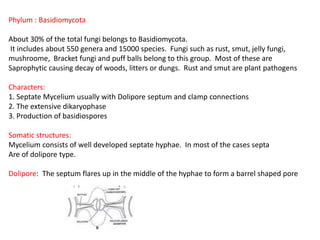
Mycelium consists of well developed septate hyphae. In most of the cases septa
Are of dolipore type.
Dolipore: The septum flares up in the middle of the hyphae to form a barrel shaped pore
Mycelium generally passes through three distinct phases viz., Primary, secondary and
Tertiary mycelium.
Primary mycelium: Primary mycelium results from the germination of basidiospores
Secondary mycelium: Secondary mycelium develops by dikaryotisation of Primary mycelium
Teritiary mycelium: Dikaryotic and is represented by organized and specialized tissues.
when condition are suitable for reproduction the secondary mycelium undergoes complex
Morphological changes and produces fruiting structure ( Basidiocarp).
,
Teliospores
Primary mycelium
Secondary dikaryotic mycelium
Clamp connection: Terminal binucleate cell formation of clamp starts
as a bulging from the hyphal wall between the two nuclei . Both nuclei undergo
Mitotic divisions simultaneously and such nuclear division.
Hyphal types:
1. Generative hyphae: These are basic types of hyphae
2. Skeletal hyphae: Unbranched relatively wide with thickened wall. Hyphal
Lumen is much narrow and always lack clamp connections. Septa is not observed
Skeletal hyphae
Generative hyphae
Binding hyphae
Hyphal systems:
1. Monomitic- Only generatie hypha is associated
2. Dimitic and Trimitic- Generative hypha is associated with either Skeleton or binding hypha
3. Trimitic system: Includes all the three types
Asexual Reproduction: FraGMENTATIONS, condia, budding and oidia ( sporidia)
Sexual Reproduction:
Distinguishable sex organs are not formed in Basidiomycota except in Puccinia,
Where the spermatia and the receptive hyphae represent the male and female sex organs
Sexual reproduction is a long drawn process
The dikaryophase starts with the coming together of two compatible nuclei
During plasmogamy, extends through the greater part of the life cycle and
Is perpetuated by the urediniospores in rusts. It ends with the occurrence of
Karyogamy and meiosis in the basidium, which is usually the terminal cell,
Subtended by a clamp connection. The resulting four recombinant haploid
nuclei are incorporated in the four basidiospores. The resulting four basidiospores.
In rusts and smut s, karyogamy and meiosis occur in specialized, thick walled
Spores called teliospores. These germinate after a resting period and give
Rise to a short hypha, which bears the basidiospores.
Plasmogamy ( Dikaryotization0 occurs in different ways;
1. Somatogamy between cells of monokaryotic hyphae
2. Fusion between an oidium and a monokaryotic hypha
3. Spermatization of receptive hypae
Dikaryons may be formed directly after meiosis, by inclusion of two haploid
nuclei of opposite mating types in the basidiospores. Dikaryotic basidiospores
Directly give rise to dikaryotic mycelium
Basidiocarp ( Basidioma) Basidiomata are highly attractive and beautiful, hence
Are called fungus flowers ( ustomycetes and teliomycetes do not form basidioma)
Basidiocarp is formed by the dikaryotic tertiary mycelium. After a certain period
Of maturity secondary mycelium is stimulated to produce a compact type of
Pseudoparenchymatous tissue, which ultimately results in the production of
Fruit bodies with various sizes, shapes and colours. Basidiocarp may be
Gelatinous, cartilaginous, papery, flashy, spongy, corky or woody.
Hymenium: is the row of basidia and the sterile companions, the basidioles,
Cystidia, hyphoides , setae etc.,
Types of basidia:
Basidia: Bear the Basidiospores,
Basidioles: These are young, aborted or sterile basidia
Earlier, the basidioles were called as paraphyses.
Cystidia: These are vesiculate to clavate, projecting beyond the level of
the basidia. It serving as air traps, provide mechanical strength to the Hymenium
Types of cystidia
I Origion- Hymenial, tramal
II Location- Pleurocystidia, ceilocystidia,, Pileocystidia, cautocystidia
Dermatocystidia, Endocystidia
III shape: leptocystidia, Lamprocystidia
IV. Contents: 1. Gloeocystidia: Versiform cells, containing mucilage or oily substance
2. Chrysocystidia: Like Leptocystidia but with hightly staining contents.
Hyphidia: These are hyphal end cells which function as air traps around the
Developing basidia.
Setae: These are dark brown, stiff, thick walled smooth, pointed and fusiform to
Ventricose structure: Setare are found in the Hymenium
Discharge of Basidiospores: The active and passive discharge of basidiospores
Basidiospores are violently discharged are called Ballistospores
Passively discharged basidiospores are called Statismospores
Ballistospores are discharged by Buller’s phenomena
First noted by Buller 1931 in coprinus. Basidiospores discharge forcibly,
such a basidiospore borne obliquely at the tip of sterigmata, a lateral bubble is
Formed just near the hilum ( point of attachement of basidiospore with sterigma)
Types of basidia
1.Holo basidia: Non septate, single celled basidium. Cylindrical, clavate with
Sterigmata from the apex
2. Phragmobasidium: Phragmobasidium is divided by primary septa into a number of
Cells (Usually four)
a. Stichobasidium: Basidium transversely septate
b. Chiastobasidium: Basidium longitudinally septae
Chemical reactions: useful in identification of families and genera
Amyloidity Hyphal or spore walls furn blue in Mlzer’s reagent – Amyloid reaction
Dextrinodity: Walls turn brown in Melzer’s reagent - dextrinoid reaction
Cyanophily: The walls take intense blue colour in lactic acid containing cotton blue
Or Methylene blue
Xanthochroic reaction (KOH) brown hyphae become darker to black-
Reaction is termed positive
Classification : Kirk et al., 2008
Phylum: Basidiomycota:
Sub Phylum:
1. Agaricomycotina class: Hymenomycetes- Dolipore septum,
Septal pore cap, Glucoe/Mannose/Xylose
Order: Agaricales, Aphyllophorales, Auriculariales, Ceratobasidiales,
Sub Phylum: 2: Pucciniomycotina : Simple pores, no septal pore cap, Mannose/glucose/fructose
Order: Uredinales, Septobasidiales, Sporidiales, Eocronartium
Sub Phylum: 3. Ustilaginomycotina: Septal pore margin, flared or not, no septal pore cap
Glucose/Mannose/Galactose
Order: Ustilaginales , Exobasidiales
Order: Agaricales 17 families Mushrooms and toad stools
1.Boletaceae_ Basidiocarp resemble that of mushroom, pileus is undersides possess
vertically arranged tubes. Basidiospores forcibly discharged Boletus illudens
2. Hygrophoraceae- White, thin walled basidiospores G: Hygrophorus
3. Tricholomataceae: White spored species G: Termitomyces, Flammulina
Marasmius, clitocybe, Tricholoma, Armillaria, Panellus, Laccaria, Omphalotus
4. Amanitaceae: White spores, free gills and the presence of an annules and a volva
G. Amanita caesarea
5. Agaricaceae: Basidiocarp with a white to brown or gray-brown cap, free gills, an
Annule but no volva. Agaricus brunnescens
6. Strophoriaceae- Attached gills and produce dark spores (Purple brown)
G. Stropharia, Conocybe, Gymnopilus, Psilocybe
7. Coprinaceae- Black to purple-brown or purple, black spores G. Coprinus.
8. Pluteaceae- Produce pink colour basidiospores
G. Pluteus, volvariella
9. Cortinariaceae- Produce brown spores
G. Inocybe, Galerina, Pholiota
F: Agaricaceae:
1. Black or brown colour of the basidiospores
2. Presence of annulus
3. Easily separate stipe from Pileus
4. Free Lamellae
5. G: Agaricus campestris- The basidioma is umbrella shaped, consisting of a stem (stipe)
6. And a pileus, Tertiary mycelium
7. Edible Mushroom: Agaricus,
Life cycle:
Agaricus campestris
F: Amanitaceae: 5 genera
1. The lamellate are free from stipe and have bilateral trama
2. Spores and gills are white
3. The stipe is separated from the pileus
4. Both volva and annulus are present in mature basidiomata
5. G: Amanita- 200 species, Highly Poisonous nature
6. A. Phalloides- death chair or death cap
7. A. verna- destroying angel
8. A. Pantherima- Panther cap
9. A. Muscaria- killing flies – fly agaric
10. A. Phalloides
11. A. citrina- false death cap harmless but unpleascent
Stipe
F: Coprinaceae_ Black spored agaricus
Discovered by A.H.R.Buller
Basidiomata are typically fragile and bears shreds of ruptured cuties
11 genera 722 species- grown on dung of herbivore animals and humus rich soil.
G: Coprinus: ( Ink caps)Grow on humus rich soil, compost heap, herbivore dung
C.comatus-best edible fungi
Coprine is used in the treatment of chronic alcoholism
The stalk is 1.5 cm , thickness, white, smooth and distinct annulus.
The gills are white when young, turn pink with age and finally black
F: Plutaceae
G: Volvariella- Paddy straw mushrooms)
V. Volvaceae and V. diplasia- straw or paddy mushroom.
Fast growing mushrooms with a slender, fleshy stipe, 3-8 cm in length and a
dark- gray cap, 6-12 cm in diameter.
Dark gray cap
F: Strophariaceae: Epicutis: thin layer covering the pileus or stipe is called cutis
Epicutis of the pileus is composed of appressed, narrow, tubular, often gelatinous
Hypae. The basidiospores are brown and possess an apical germ pore.
The stipe and pileus are conflent ( flesh are not separated)
G: Psilocybe ( scared fungi) – contain chemicals Psilocybin and Psilocin ( Heim 1959)
Long stipe
Liberty cap
Liberty cap
F: Tricholomataceae- 147 genera and 2347 species
Tricholoma, Armillaria
1. Stipe is confluent with the pileus
2. Colour of the spores is variable ( white, yellowish, buff, pink or brown)
3. Lamellae attached with stipe, rarely free
4. Hyphae lack clamp connection
5. G. Armillaria mellea- 40 species ( Honey fungus) Shoe string fungus
6. 1. White basidiospores
7. 2. Adnate or slightly decurrent gills
8. Presence of annuls
9. Parasitic causing root rot diseases on forest trees
Shoe string
O; Boletales: Pore mushroom or boletes)
1. Tubular hymenosphore- Tube open on the lower surfaces of the pileus ( Polypores)
2. No gills
3. Tube layer is easily detachable
4. The pileus decays readily and infested by worms
5. F: Boletaceae G: Boletus 130 spp B. edulis
6. Most popular edible species.
7. Brown , rounded pileus resembles a bun
8. -- The stem is white or pale , 5-10cm long,
9. Tube and fleshare also white
10. B. satanas- poisonousB. Parasiticus- grow parasitically on scleroderma
Bun shaped
O: Cantharellales: Basidiomata are either funnel shaped, tubular or stalked and
Pileate 12 familis 52 genera
F1. Cantharellaceae- Pileate basidiomata
G: Cantharellus- Basidioma is funnel shaped with a short, black stem, the
Hymenophores comprises thick folds, resembling mushroom gills
F: Clavariaceae( club or coral fungi)
G: Clavaria: Thind 1961- 7 species
Thin walled hyphae, without clamp connection
Found in grass fields, growing in clusters on the ground
C. vermicularius: Basidiomata are brittle, pure white cylindrical with pointed tips,
Looking like white wax tapers.
Basidiospores are white, tips of the branches are blunt, some times flattened and
Toothed
F: Craterellaceae G: Craterellus Horn of plenty
Fleshy funnel shaped basidiomata with a short black stem
Edible mushroom
C. cornucopioides
O: Ceratobasidiales: Epibasidia, through stout, sub-cylindrical
Or fusoid, more or less, digitate
G: Ceratobasidium: Inflated, subglobose to obpytiform, aseptate.
Long four epibasidium, saprobic orparasiti
C. cornigerum.
Collapsed basidium
Hypobasidium
Epibasidi
O: Ganodermatales
Dorsiventrally pileatand bear tubular hymenophore.
The context is trimitic.
Cystidia ansetae are absent
Basidiospores are coloured, 2 layered G: Ganoderma 50 species
G. lucidum- destructive root parasie on Dalbergia, Albizia, Acacia an some
Angiosperm
Forms annual, bracket shaped, stalked basidiomata
Basidiospores are coloured, 2 layered and apically truncate
O: Poriates- polypores or pore fungi
Numberous fine pores on the under surface of their basidiomata
F: corialaceae
Coriolus versicolor: white rot of wood, grows on logs, old stumps and
Branches of trees, forming semicircular or kidney shaped basidiomata,
Arranged in tiers.
F: Lentinaceae 9 genera 145 species- Stipitate basidioma
Pleurotus: stipe ilateral, large andfleshy and grow on tree trunks or stumps
P. Osteatus ( Oyster mushroom Edible mushorrom
Young cap is deep bluish gray or black, but soon turns pale and brownish.
O: Sclerodermatales
F: Sclerodermataceae
G: Scleroderma
Basidioma showing sporemass, spore spiny or reticulate
O: Nidulariales ( Birds nest fungi)
G. Cyathus 44 species grown on rotting wood,
Initially globose but later becomes funnel or vas- shaped
Sub Phylum: Pucciniomycotina- Rust and related fungi- 190 genera 8016 species
Characters:
1. Obligate parasites- Parasites on crop plants , scale insects
2. Karyogamy through spermatia
3. Obsence of basidioma
4. Explosive dischage of basidiospores ( Ballistospores)
5. Absence of clamp connection
6. Formation of Teliospores
Mycelium: Intercellular with haustoria
Sexual reproduction: ( Karyogamy and meiosis) occurs during germination of teiospores
Classification: 8 classes
Class: Pucciniomycetes
Order: 1. Pucciniales-Rust
2. Septobasidiales F: septobasidiaceae G. Septobasidium- scale insects
O: Puccinales:
8F: 1. Coleosporiaceae
2. Melampsoraceae
3. Mikronegeriaceae
4. Phakopsoraceae
5. Phragmidiaceae
6. Pileolariaceae
7. Pucciniaeae
8. Raveneliaceae
Hemileia- Incertea sedis ( Not assigned any family)
Compplex life cycle: in the kingdom fungi
- Five spore type 0 to IV
- - Three type of lifecycles- Macro, demi and Microcyclic
- Rust fungus may be Autoecious or heteroecious
- Fruiting strucutes of rust pathogen
- I Pycnium: o stage: Pycnia are haploid structures flask shaped. The pycniospores
- Are haploid, uninucleate which function as spermatia when transferred to
- Another pycnium. Pycnium bearing pycniospores
PAUTB
Aecium: Stage I- Aecium bearing aeciospores, diploid (2n) , aecia are frequently open,
cupulate sori chich bear dikaryotic aeciospores in chains. The aeciospores are first
Dikaryotic spores
Aeciospores- non repeating vegetative spores produced after dikaryotisation
which germinate to intiate dikaryotic mycelium.
n+n- intial stage
2n- Mature Aeciospores
III Uredium- Stage II- Uredium bearing urediospores,
The uredium is usually a sorus and the urediospores are dikaryotic. This stage is
Repetitive as a Urediospores may germinate, forming dikaryotic mycelium which
again gives rise to uredia.
Telium- Stag III- Telium containing teliospores, a telium is usually a sorus
The teliospores function as probasidia and are the site of karyogamy and meiosis.
They also known as resting spores
Teliospores- basidia producing spores
Binucleate- young n+n Mature 2n
Basidum ; Stage IV- Bearing basidiospores, the haploid, basidiospores produced from
The teliospores are capable of reinfecting the host and inititing the life cycle again
Basidiospores (n) monokaryotis spores produced on basidia usually after meiosis
Life cycle pattern in rust
1. Eutype ( macrocyclic) life cycle 0 I II III spore forms- Karyogamy in Teliospores Pgt
2. Brachy type ( Microcyclic) 0 - II III spore forms Aecia omitted P. helianthi
3. Opsis type ( Demicyclie) 0 I - III Uredia omitted Gymnosporangium
4. Lepto type 0 - - III Aecia and Uredia omitted P. arenariae
Teliospores are not resting spores
5. Microtype 0 - - III Aecia and Uredia omitted P. malvacearum
Teliospores are resting spores
6. Endotype 0 I -- Karyogamy in aeciospores Endophyllum euphorbiae
7. Hemi type 0 I - - Incomplete life cycle
8. Repeating aecia - I II - Telial omitted – Phragmidium discifloreum
Heterociourust: pathogen complete the life cycle on two different host
( Hetero= different Ion= home
Autocious rust: pathogen complete life cycle on one kind host
Auto= me ion=home
I Macrocycylic Heterociou rust: It produce all kind of spores for completion of life cycle
On two different kind of host. It is also long cyclic rust
Alternate host on O and I Main host on II and III
1. Cronortium ribicola: 0 and I stage on white pine II and III stage on Goose Berry
2. Uredinopsis osnundae 0 and I on Abies II and III on Cinnamonfir
3. Uromyces dianthi 0 and I Tiltymalus sp II and III on carnation
4. G. Juniperi virginianae 0 and I on apple II nd III on red cedar ( Juniperus virginiana)
5. Puccinia coronata cron rust of oats 0 and I on Rhamnus II and III on oats
6. Puccinia rubigo-vera tritici 0 and I Thalictrum II and III wheat
7. Puccinia sorghi 0 and I Oxalis stricta II and III stage on maize
8.Puccinia graminis tritici: Black stem rust of wheat
0 and I- B vulgaries, B.tinctoria, B.lycicum, B.coriaria, B.aristata Mahonia II and III wheat
9. Puccinia purpurea 0 and I Oxalis sp II and III on sorghum
10. Puccinia pennisity 0 and I Solanum melangena II and III on bajra
Macrocyclic autoecious rust- pathogen complete the LC on single host
1. Uromyces phaceoli 0 I II III stage on beans
2. Melampsora lini 0 I II III on flecks
3. Phragmidium sp 0 I II III on rose
4. Puccinia asparagi 0 I II and III on asparagus
5. Microcyclie/Hemi cyclid/demicyclic rust- no alternate host only uredial and telial stages
6. Demicyclic: Gynocona peckiana- Lack of uredial stage
7. Microcyclic P. striiformis- P. arachidis, H. vastatrix, Phakopsora vitis, P. helianthi
Somatic structure: Mycelium is well developed and septate ramifying
between the intercellular spaces of the host tissues. Hypha produces
spherical haustoria which penetrate inside the host tissues and absorb nutrition
Reproduction stages; Heterothallic
It is a long cycled rust and thus produces all five distinct spore stages in the life.
The gametic stage is represented by pycnia ( spermaonia) and aecia
Represented in the stage In which plasmogamy ( diploidisation) occurs.
The uredia represents the conidia or repeating asexual stage and telia and basidia
Represent the stages in which karyogamy and meiosis respectively occurs.
Physiological or biological specialization: It is occurrence of entities within
morphological species that differ from each other in one or more physiological
Characters including pathogeniciy, biochemical properties, cultural variabilities
Spore germination and ecological relationship
Species, varieties, races, biotypes.
Classification
P. Basidiomycota sub Phylum: Pucciniomycotina O : Pucciniales – rust fungi
F. 1. Pucciniaceae: Erumpent telia, pedicillate, bicelled/ single celled teliospores
Flat or discoid, sub epidermal pycnia and catenulate aeciospores
17 genera Puccinia, Gymnosporangium, uromyces
Puccinia- 4938 species, parasitizing on angiosperms
P. g. agrostidies-agrostis; P. allii- onion; P. asparagi-asparagus: P.carthami-safflower
P. g.t- wheat; P. helianthi : sunflowe; P. sorghi- maize; P.recondita- orange or brown rust
Of wheat; P. purpurea- sorghum; P. malvacearum-holyhock ; P.g.airae-Deschampsia
P.avenae-oats; P.g.secalis-rye; P.g. poae- Poa
Genus: Gymnosporangium- 57 species
-Teliospores are bicelled
-Pedicels which gelatinize with moist
-Restricted to temperate region
-Telia stage occurs on gymnosperms
-aecia on dictyledons G.juniperi virginianae- rust of apple
Genus Uromyces – 800 species
-unicellular teliospores thickened at the apex, pedicels
Uromyces appendiculatus, U.phaseioli –bean rust
U.cicertis- gram rust
U. pisi, U.fabae-pea rust’ U.dianthi- carnation rust
F: Melampsoraceae G: Melampsora- 90 species
-Teliospores are single celled
-sessile and formed in a palisade layer
-Telia are erumpent, covered by the host epidermis
M.lini- flax rust, Melampsorella cerastii on pinaceae Melampsoridium betulinum on betulaceae
F: Phragmidiaceae- 14 genera G. Phragmidium 110 species
-Pedicels
-Transversely septate
-Many celled teliospores, each cell has 2-3 germpores
P.mucronatum, P.tuberculatum-rose P. rubidaei- rasp berries
4. Raveneliacea – 26 genera G. Ravenelia- 200 species
- Prasitise on legumes
- -Teliospore heads formed by fusion of several teliospores
- Each teliospore separate stalk
- -Telial heads smooth/ornamented with several small projections
- R. emblicae- found on fruits of Phylanthus emblica
- R.gooddingii- rust on Acacia
- R. morongiae- on Morongia
- 5. Phakopsoraceae: Phakopsora vitis- grape rust
- P. desmium- cotton rust
- - sessile Teliospores
- -Teliospores arranged in depth
G: Nyssospora- autoecious genus
Teliospores flattened laterally, triquetrously 3 celled walls deeply coloured, spinose
N. Echinata on Umbelliferae
N. Clavellosa on Arallaceae family Pongamea rust
Yellow
G: Hemileia- Pycnia and aecia are not known
Uredia formed in sub –stomatal chambers
Urediniospores- reniform or hump shaped
Teliospores- Unicellular, thin walled pale termeric shape
Termeric shape
8. Masseeelea_ Telial hairs, single celled , sessile teliospores Host
Host: Euphorbiacea
Pgt
Life cycle of Gymnosporangium
Hemileia vastatrix life cycle
Sub Phylum: Ustilaginomycotina Class: ustilaginomycetes, Entorrhizomycetes
Exobasidiomycetes
Charactersl
-Lack of parenthesomes
- Formation of yeast phase culture
- -Presence of zones of host-parasite interaction with fungal deposites
- Resulting from special fungal vesicles
- Dominance of glucose and absence of xylose in the cell wall
- 80 genera, 1500 species – parasitic on angiospersm
- Poaceae ( 571) and Cyperaceae (12%)
Class: Entorrhizomycetes: O: Entorrhizaleso- small groups of unusual teleosporic
Root parasites of Juncaceae and cyperaceae. Lack of membrane bands or caps’
At the pores and presence of local interaction zones without interaction apparatus
G. Entorrhiza, Talbotiomyces
Class: Ustilaginomycetes- presence of enlarged interaction zones
O: Urocystidales ( Holobasidia), Ustilaginales (Phragmobasidia)
Class: Exobasidiomycetes- pre dominatly holobasidia and consists of teleosporic
And non teleosporic genera, The presence of pore caps
Basidia and sori are important in the differentiation of families
Class: Ustilaginmycetes
- Highly host specifie
- -Hyphae are ususlly intercellular and form haustoria
- Teliospores are formed in sori
- Spores may be free, pairs or aggregate in more or less persistent spore balls
- -The spore balls may be composed entirely of fertile spores or a
- Combination of fertile spores or sterile cells
- Teliospores are formed from intercalary as well as terminal cells of the
- Dikaryotic secondary mycelium
- Teliospore germination:
- Teliospore forms a septate epibasidium ( Promycelium) also called
- Phragmobasidium bearing 4 basidiospores Terminally or laterally
Infection types: seedling infection, ( Loose smut of wheat)
Embryo infection ( U.tritici), Shoot infection ( U. maydis. Local infection( U. maydis)
Somatic structure: Primary mycelium is formed by the germination of basidiospores.
Hyphae are septate, monokaryotic and do not bear clamp connection.
Primary mycelium is very short lived and dikaryotisatim takes place
Immediately after germination of basidiospores
Haploid primary mycelium is incapable to attack the host and infection occurs only’
Secondary mycelium
Asexual reproduction:
1. conidia- both primary and secondary mycelium produce conidia/ sporidia
2. Budding- U. maydis, U.violacea- budding of conidia
3. Sexual reproduction: Heterothallic and Plasmogamy occurs between to compatibe
4. Strains
1.Conjugation between two basidospores U. avenae
2. Fusion between two germ tube – U. hordei
3. Hyphal fusion U. maydis
Dispersal of Teleutospores
Ovaries and grains- U. hordei, U. nuda
Grain galls- U.maydis
Anthers-U. anthearum
Wind- U.tritici
Seed- U.tritici
Germination teleutospores and formation of basidiospores
-Karyogamy occurs in teleutospores
-Teleutospore germinateds by producing promycelium ( epibasidium0
-The diploid nucleus migrates to form promycelium and under goes
Meiosis which results into four haploid nucleis.
Soon promycelium develops three transverse septa and four cells are formed,
Each cell containing single haploid nucleus
Basidospores after landing on suitable hosts germinate to form haploid
primary mycelium or it may copulate with another basidiospores or
germbube to produce dikaryotic hyphae.
Genera 1. Teiospores characters- free or aggregated into hard spore balls
2. Ornamentation of the teliospores- smooth, reticulate, echinulate,
Verrucose or Tuberculat
3. Type and site of sorus development
-dusty or compact of the sorus
-presence or absence of a peridium
-presence of columella ( Host origin)
Erumpent ( galls) or non erumpent nature
Order: 1. Urocystidales 41 families F. Urocystidaceae 7 genera
G. Urocystis ( 170) : spore balls consists of 1-4 dark fertile central cells surrounded b
Peripheral layer or hyaline sterile cells
U. cepulae-onion smut
U.occulta, U.agropyri- Flag smut of wheat
Order 2 Ustilaginales: 8 families 49 genera
F: 1. Ustilaginaceae- G. Ustilago
2. Anthracoideacea- GL Tolyposporium penicillariae – Bajara smut
G: Ustilago: The teliosorus is without a peridium, the black dusty teliospores
Are covered by amembrane of host origion
U. tritici- Loose smut of wheat
U.segetum var. tritici
U.maydi-smut of maize
U.nuda-Loose smut of barely
U.scitaminea-Whip smut of sugarcane
U. occidentalis-smut of cyanadon
G: Sphacelotheca : Sori developed in a peridium of fungus cells, forming around
A central columella of host tissue
S. sorghi- grain smut of sorghum
S. cruenta=-Loose smut of sorghum
S.reiliana- Head smut of sorghum
G: Melanopsichium: sori forming in hard, gall like
Masses mostly in the inflorescence ( agglutinated in to nodules) M. Eleusini – smut of ragi
G: Sorosporium: spore balls evanescent or tening to fragment ito single spores
F: Anthracoideacea
G: Tolyposporium : grow on cyperacea and Juncaceae
Spores in the balls held together by Inter connected thickening of the exospore walls
T. Penillaria- smut of bajra
T.ehrenbergii- smut of sorghum
Class: Exobasidiomycetes
O: Tilletiales
F: Tilletiaceae
G; Telletia- H shaped secondary sporidia
T. laevis, T. caries- bunt of wheat, T.foetida- Hill/stinking smut of wheat
G. Neovossia- H shaped secondary sporidia absent, needle shaped sporidia
N. indica- karnal bunt of wheat
N. horrida- bunt of rice
O : Exobasidiales: galls on leaves
F: 1. Ericaceae- formation of basidia in a larger uncovered on the leaf surface
2. Commelinaceae
3. Brachybasidiaceae
4. Cryptobasidiaceae
5.Exobasidiaceae
6.Graphiolaceae
F; Exobasidiaceae: The basidiospores are Ballistospores
G: Exobasidium vexans – blister blight of tea
O: Malasseziales G. Malassezia.
M.furfur, M.globosa. M.restricta cause skin infection dendruff
P Basidiomycota.pptx

P Basidiomycota.pptx

  • 1.
    Phylum : Basidiomycota About30% of the total fungi belongs to Basidiomycota. It includes about 550 genera and 15000 species. Fungi such as rust, smut, jelly fungi, mushroome, Bracket fungi and puff balls belong to this group. Most of these are Saprophytic causing decay of woods, litters or dungs. Rust and smut are plant pathogens Characters: 1. Septate Mycelium usually with Dolipore septum and clamp connections 2. The extensive dikaryophase 3. Production of basidiospores Somatic structures: Mycelium consists of well developed septate hyphae. In most of the cases septa Are of dolipore type. Dolipore: The septum flares up in the middle of the hyphae to form a barrel shaped pore
  • 2.
    Mycelium generally passesthrough three distinct phases viz., Primary, secondary and Tertiary mycelium. Primary mycelium: Primary mycelium results from the germination of basidiospores Secondary mycelium: Secondary mycelium develops by dikaryotisation of Primary mycelium Teritiary mycelium: Dikaryotic and is represented by organized and specialized tissues. when condition are suitable for reproduction the secondary mycelium undergoes complex Morphological changes and produces fruiting structure ( Basidiocarp). , Teliospores Primary mycelium Secondary dikaryotic mycelium
  • 3.
    Clamp connection: Terminalbinucleate cell formation of clamp starts as a bulging from the hyphal wall between the two nuclei . Both nuclei undergo Mitotic divisions simultaneously and such nuclear division. Hyphal types: 1. Generative hyphae: These are basic types of hyphae 2. Skeletal hyphae: Unbranched relatively wide with thickened wall. Hyphal Lumen is much narrow and always lack clamp connections. Septa is not observed Skeletal hyphae Generative hyphae Binding hyphae
  • 4.
    Hyphal systems: 1. Monomitic-Only generatie hypha is associated 2. Dimitic and Trimitic- Generative hypha is associated with either Skeleton or binding hypha 3. Trimitic system: Includes all the three types Asexual Reproduction: FraGMENTATIONS, condia, budding and oidia ( sporidia) Sexual Reproduction: Distinguishable sex organs are not formed in Basidiomycota except in Puccinia, Where the spermatia and the receptive hyphae represent the male and female sex organs
  • 5.
    Sexual reproduction isa long drawn process The dikaryophase starts with the coming together of two compatible nuclei During plasmogamy, extends through the greater part of the life cycle and Is perpetuated by the urediniospores in rusts. It ends with the occurrence of Karyogamy and meiosis in the basidium, which is usually the terminal cell, Subtended by a clamp connection. The resulting four recombinant haploid nuclei are incorporated in the four basidiospores. The resulting four basidiospores. In rusts and smut s, karyogamy and meiosis occur in specialized, thick walled Spores called teliospores. These germinate after a resting period and give Rise to a short hypha, which bears the basidiospores. Plasmogamy ( Dikaryotization0 occurs in different ways; 1. Somatogamy between cells of monokaryotic hyphae 2. Fusion between an oidium and a monokaryotic hypha 3. Spermatization of receptive hypae
  • 6.
    Dikaryons may beformed directly after meiosis, by inclusion of two haploid nuclei of opposite mating types in the basidiospores. Dikaryotic basidiospores Directly give rise to dikaryotic mycelium Basidiocarp ( Basidioma) Basidiomata are highly attractive and beautiful, hence Are called fungus flowers ( ustomycetes and teliomycetes do not form basidioma) Basidiocarp is formed by the dikaryotic tertiary mycelium. After a certain period Of maturity secondary mycelium is stimulated to produce a compact type of Pseudoparenchymatous tissue, which ultimately results in the production of Fruit bodies with various sizes, shapes and colours. Basidiocarp may be Gelatinous, cartilaginous, papery, flashy, spongy, corky or woody. Hymenium: is the row of basidia and the sterile companions, the basidioles, Cystidia, hyphoides , setae etc.,
  • 7.
    Types of basidia: Basidia:Bear the Basidiospores, Basidioles: These are young, aborted or sterile basidia Earlier, the basidioles were called as paraphyses. Cystidia: These are vesiculate to clavate, projecting beyond the level of the basidia. It serving as air traps, provide mechanical strength to the Hymenium Types of cystidia I Origion- Hymenial, tramal II Location- Pleurocystidia, ceilocystidia,, Pileocystidia, cautocystidia Dermatocystidia, Endocystidia III shape: leptocystidia, Lamprocystidia IV. Contents: 1. Gloeocystidia: Versiform cells, containing mucilage or oily substance 2. Chrysocystidia: Like Leptocystidia but with hightly staining contents. Hyphidia: These are hyphal end cells which function as air traps around the Developing basidia. Setae: These are dark brown, stiff, thick walled smooth, pointed and fusiform to Ventricose structure: Setare are found in the Hymenium
  • 8.
    Discharge of Basidiospores:The active and passive discharge of basidiospores Basidiospores are violently discharged are called Ballistospores Passively discharged basidiospores are called Statismospores Ballistospores are discharged by Buller’s phenomena First noted by Buller 1931 in coprinus. Basidiospores discharge forcibly, such a basidiospore borne obliquely at the tip of sterigmata, a lateral bubble is Formed just near the hilum ( point of attachement of basidiospore with sterigma)
  • 9.
    Types of basidia 1.Holobasidia: Non septate, single celled basidium. Cylindrical, clavate with Sterigmata from the apex 2. Phragmobasidium: Phragmobasidium is divided by primary septa into a number of Cells (Usually four) a. Stichobasidium: Basidium transversely septate b. Chiastobasidium: Basidium longitudinally septae
  • 10.
    Chemical reactions: usefulin identification of families and genera Amyloidity Hyphal or spore walls furn blue in Mlzer’s reagent – Amyloid reaction Dextrinodity: Walls turn brown in Melzer’s reagent - dextrinoid reaction Cyanophily: The walls take intense blue colour in lactic acid containing cotton blue Or Methylene blue Xanthochroic reaction (KOH) brown hyphae become darker to black- Reaction is termed positive
  • 11.
    Classification : Kirket al., 2008 Phylum: Basidiomycota: Sub Phylum: 1. Agaricomycotina class: Hymenomycetes- Dolipore septum, Septal pore cap, Glucoe/Mannose/Xylose Order: Agaricales, Aphyllophorales, Auriculariales, Ceratobasidiales, Sub Phylum: 2: Pucciniomycotina : Simple pores, no septal pore cap, Mannose/glucose/fructose Order: Uredinales, Septobasidiales, Sporidiales, Eocronartium Sub Phylum: 3. Ustilaginomycotina: Septal pore margin, flared or not, no septal pore cap Glucose/Mannose/Galactose Order: Ustilaginales , Exobasidiales
  • 12.
    Order: Agaricales 17families Mushrooms and toad stools 1.Boletaceae_ Basidiocarp resemble that of mushroom, pileus is undersides possess vertically arranged tubes. Basidiospores forcibly discharged Boletus illudens 2. Hygrophoraceae- White, thin walled basidiospores G: Hygrophorus 3. Tricholomataceae: White spored species G: Termitomyces, Flammulina Marasmius, clitocybe, Tricholoma, Armillaria, Panellus, Laccaria, Omphalotus 4. Amanitaceae: White spores, free gills and the presence of an annules and a volva G. Amanita caesarea 5. Agaricaceae: Basidiocarp with a white to brown or gray-brown cap, free gills, an Annule but no volva. Agaricus brunnescens 6. Strophoriaceae- Attached gills and produce dark spores (Purple brown) G. Stropharia, Conocybe, Gymnopilus, Psilocybe 7. Coprinaceae- Black to purple-brown or purple, black spores G. Coprinus. 8. Pluteaceae- Produce pink colour basidiospores G. Pluteus, volvariella 9. Cortinariaceae- Produce brown spores G. Inocybe, Galerina, Pholiota
  • 13.
    F: Agaricaceae: 1. Blackor brown colour of the basidiospores 2. Presence of annulus 3. Easily separate stipe from Pileus 4. Free Lamellae 5. G: Agaricus campestris- The basidioma is umbrella shaped, consisting of a stem (stipe) 6. And a pileus, Tertiary mycelium 7. Edible Mushroom: Agaricus,
  • 14.
  • 15.
    F: Amanitaceae: 5genera 1. The lamellate are free from stipe and have bilateral trama 2. Spores and gills are white 3. The stipe is separated from the pileus 4. Both volva and annulus are present in mature basidiomata 5. G: Amanita- 200 species, Highly Poisonous nature 6. A. Phalloides- death chair or death cap 7. A. verna- destroying angel 8. A. Pantherima- Panther cap 9. A. Muscaria- killing flies – fly agaric 10. A. Phalloides 11. A. citrina- false death cap harmless but unpleascent Stipe
  • 17.
    F: Coprinaceae_ Blackspored agaricus Discovered by A.H.R.Buller Basidiomata are typically fragile and bears shreds of ruptured cuties 11 genera 722 species- grown on dung of herbivore animals and humus rich soil. G: Coprinus: ( Ink caps)Grow on humus rich soil, compost heap, herbivore dung C.comatus-best edible fungi Coprine is used in the treatment of chronic alcoholism The stalk is 1.5 cm , thickness, white, smooth and distinct annulus. The gills are white when young, turn pink with age and finally black
  • 19.
    F: Plutaceae G: Volvariella-Paddy straw mushrooms) V. Volvaceae and V. diplasia- straw or paddy mushroom. Fast growing mushrooms with a slender, fleshy stipe, 3-8 cm in length and a dark- gray cap, 6-12 cm in diameter. Dark gray cap
  • 20.
    F: Strophariaceae: Epicutis:thin layer covering the pileus or stipe is called cutis Epicutis of the pileus is composed of appressed, narrow, tubular, often gelatinous Hypae. The basidiospores are brown and possess an apical germ pore. The stipe and pileus are conflent ( flesh are not separated) G: Psilocybe ( scared fungi) – contain chemicals Psilocybin and Psilocin ( Heim 1959) Long stipe Liberty cap
  • 21.
  • 22.
    F: Tricholomataceae- 147genera and 2347 species Tricholoma, Armillaria 1. Stipe is confluent with the pileus 2. Colour of the spores is variable ( white, yellowish, buff, pink or brown) 3. Lamellae attached with stipe, rarely free 4. Hyphae lack clamp connection 5. G. Armillaria mellea- 40 species ( Honey fungus) Shoe string fungus 6. 1. White basidiospores 7. 2. Adnate or slightly decurrent gills 8. Presence of annuls 9. Parasitic causing root rot diseases on forest trees
  • 23.
  • 24.
    O; Boletales: Poremushroom or boletes) 1. Tubular hymenosphore- Tube open on the lower surfaces of the pileus ( Polypores) 2. No gills 3. Tube layer is easily detachable 4. The pileus decays readily and infested by worms 5. F: Boletaceae G: Boletus 130 spp B. edulis 6. Most popular edible species. 7. Brown , rounded pileus resembles a bun 8. -- The stem is white or pale , 5-10cm long, 9. Tube and fleshare also white 10. B. satanas- poisonousB. Parasiticus- grow parasitically on scleroderma Bun shaped
  • 25.
    O: Cantharellales: Basidiomataare either funnel shaped, tubular or stalked and Pileate 12 familis 52 genera F1. Cantharellaceae- Pileate basidiomata G: Cantharellus- Basidioma is funnel shaped with a short, black stem, the Hymenophores comprises thick folds, resembling mushroom gills
  • 26.
    F: Clavariaceae( clubor coral fungi) G: Clavaria: Thind 1961- 7 species Thin walled hyphae, without clamp connection Found in grass fields, growing in clusters on the ground C. vermicularius: Basidiomata are brittle, pure white cylindrical with pointed tips, Looking like white wax tapers. Basidiospores are white, tips of the branches are blunt, some times flattened and Toothed
  • 27.
    F: Craterellaceae G:Craterellus Horn of plenty Fleshy funnel shaped basidiomata with a short black stem Edible mushroom C. cornucopioides
  • 28.
    O: Ceratobasidiales: Epibasidia,through stout, sub-cylindrical Or fusoid, more or less, digitate G: Ceratobasidium: Inflated, subglobose to obpytiform, aseptate. Long four epibasidium, saprobic orparasiti C. cornigerum. Collapsed basidium Hypobasidium Epibasidi
  • 29.
    O: Ganodermatales Dorsiventrally pileatandbear tubular hymenophore. The context is trimitic. Cystidia ansetae are absent Basidiospores are coloured, 2 layered G: Ganoderma 50 species G. lucidum- destructive root parasie on Dalbergia, Albizia, Acacia an some Angiosperm Forms annual, bracket shaped, stalked basidiomata Basidiospores are coloured, 2 layered and apically truncate
  • 30.
    O: Poriates- polyporesor pore fungi Numberous fine pores on the under surface of their basidiomata F: corialaceae Coriolus versicolor: white rot of wood, grows on logs, old stumps and Branches of trees, forming semicircular or kidney shaped basidiomata, Arranged in tiers.
  • 31.
    F: Lentinaceae 9genera 145 species- Stipitate basidioma Pleurotus: stipe ilateral, large andfleshy and grow on tree trunks or stumps P. Osteatus ( Oyster mushroom Edible mushorrom Young cap is deep bluish gray or black, but soon turns pale and brownish.
  • 32.
    O: Sclerodermatales F: Sclerodermataceae G:Scleroderma Basidioma showing sporemass, spore spiny or reticulate O: Nidulariales ( Birds nest fungi) G. Cyathus 44 species grown on rotting wood, Initially globose but later becomes funnel or vas- shaped
  • 33.
    Sub Phylum: Pucciniomycotina-Rust and related fungi- 190 genera 8016 species Characters: 1. Obligate parasites- Parasites on crop plants , scale insects 2. Karyogamy through spermatia 3. Obsence of basidioma 4. Explosive dischage of basidiospores ( Ballistospores) 5. Absence of clamp connection 6. Formation of Teliospores Mycelium: Intercellular with haustoria Sexual reproduction: ( Karyogamy and meiosis) occurs during germination of teiospores
  • 34.
    Classification: 8 classes Class:Pucciniomycetes Order: 1. Pucciniales-Rust 2. Septobasidiales F: septobasidiaceae G. Septobasidium- scale insects O: Puccinales: 8F: 1. Coleosporiaceae 2. Melampsoraceae 3. Mikronegeriaceae 4. Phakopsoraceae 5. Phragmidiaceae 6. Pileolariaceae 7. Pucciniaeae 8. Raveneliaceae Hemileia- Incertea sedis ( Not assigned any family)
  • 35.
    Compplex life cycle:in the kingdom fungi - Five spore type 0 to IV - - Three type of lifecycles- Macro, demi and Microcyclic - Rust fungus may be Autoecious or heteroecious - Fruiting strucutes of rust pathogen - I Pycnium: o stage: Pycnia are haploid structures flask shaped. The pycniospores - Are haploid, uninucleate which function as spermatia when transferred to - Another pycnium. Pycnium bearing pycniospores PAUTB
  • 36.
    Aecium: Stage I-Aecium bearing aeciospores, diploid (2n) , aecia are frequently open, cupulate sori chich bear dikaryotic aeciospores in chains. The aeciospores are first Dikaryotic spores Aeciospores- non repeating vegetative spores produced after dikaryotisation which germinate to intiate dikaryotic mycelium. n+n- intial stage 2n- Mature Aeciospores
  • 37.
    III Uredium- StageII- Uredium bearing urediospores, The uredium is usually a sorus and the urediospores are dikaryotic. This stage is Repetitive as a Urediospores may germinate, forming dikaryotic mycelium which again gives rise to uredia.
  • 38.
    Telium- Stag III-Telium containing teliospores, a telium is usually a sorus The teliospores function as probasidia and are the site of karyogamy and meiosis. They also known as resting spores Teliospores- basidia producing spores Binucleate- young n+n Mature 2n
  • 39.
    Basidum ; StageIV- Bearing basidiospores, the haploid, basidiospores produced from The teliospores are capable of reinfecting the host and inititing the life cycle again Basidiospores (n) monokaryotis spores produced on basidia usually after meiosis
  • 40.
    Life cycle patternin rust 1. Eutype ( macrocyclic) life cycle 0 I II III spore forms- Karyogamy in Teliospores Pgt 2. Brachy type ( Microcyclic) 0 - II III spore forms Aecia omitted P. helianthi 3. Opsis type ( Demicyclie) 0 I - III Uredia omitted Gymnosporangium 4. Lepto type 0 - - III Aecia and Uredia omitted P. arenariae Teliospores are not resting spores 5. Microtype 0 - - III Aecia and Uredia omitted P. malvacearum Teliospores are resting spores 6. Endotype 0 I -- Karyogamy in aeciospores Endophyllum euphorbiae 7. Hemi type 0 I - - Incomplete life cycle 8. Repeating aecia - I II - Telial omitted – Phragmidium discifloreum
  • 41.
    Heterociourust: pathogen completethe life cycle on two different host ( Hetero= different Ion= home Autocious rust: pathogen complete life cycle on one kind host Auto= me ion=home I Macrocycylic Heterociou rust: It produce all kind of spores for completion of life cycle On two different kind of host. It is also long cyclic rust Alternate host on O and I Main host on II and III 1. Cronortium ribicola: 0 and I stage on white pine II and III stage on Goose Berry 2. Uredinopsis osnundae 0 and I on Abies II and III on Cinnamonfir 3. Uromyces dianthi 0 and I Tiltymalus sp II and III on carnation 4. G. Juniperi virginianae 0 and I on apple II nd III on red cedar ( Juniperus virginiana) 5. Puccinia coronata cron rust of oats 0 and I on Rhamnus II and III on oats 6. Puccinia rubigo-vera tritici 0 and I Thalictrum II and III wheat 7. Puccinia sorghi 0 and I Oxalis stricta II and III stage on maize
  • 42.
    8.Puccinia graminis tritici:Black stem rust of wheat 0 and I- B vulgaries, B.tinctoria, B.lycicum, B.coriaria, B.aristata Mahonia II and III wheat 9. Puccinia purpurea 0 and I Oxalis sp II and III on sorghum 10. Puccinia pennisity 0 and I Solanum melangena II and III on bajra Macrocyclic autoecious rust- pathogen complete the LC on single host 1. Uromyces phaceoli 0 I II III stage on beans 2. Melampsora lini 0 I II III on flecks 3. Phragmidium sp 0 I II III on rose 4. Puccinia asparagi 0 I II and III on asparagus 5. Microcyclie/Hemi cyclid/demicyclic rust- no alternate host only uredial and telial stages 6. Demicyclic: Gynocona peckiana- Lack of uredial stage 7. Microcyclic P. striiformis- P. arachidis, H. vastatrix, Phakopsora vitis, P. helianthi
  • 43.
    Somatic structure: Myceliumis well developed and septate ramifying between the intercellular spaces of the host tissues. Hypha produces spherical haustoria which penetrate inside the host tissues and absorb nutrition Reproduction stages; Heterothallic It is a long cycled rust and thus produces all five distinct spore stages in the life. The gametic stage is represented by pycnia ( spermaonia) and aecia Represented in the stage In which plasmogamy ( diploidisation) occurs. The uredia represents the conidia or repeating asexual stage and telia and basidia Represent the stages in which karyogamy and meiosis respectively occurs. Physiological or biological specialization: It is occurrence of entities within morphological species that differ from each other in one or more physiological Characters including pathogeniciy, biochemical properties, cultural variabilities Spore germination and ecological relationship Species, varieties, races, biotypes.
  • 44.
    Classification P. Basidiomycota subPhylum: Pucciniomycotina O : Pucciniales – rust fungi F. 1. Pucciniaceae: Erumpent telia, pedicillate, bicelled/ single celled teliospores Flat or discoid, sub epidermal pycnia and catenulate aeciospores 17 genera Puccinia, Gymnosporangium, uromyces Puccinia- 4938 species, parasitizing on angiosperms P. g. agrostidies-agrostis; P. allii- onion; P. asparagi-asparagus: P.carthami-safflower P. g.t- wheat; P. helianthi : sunflowe; P. sorghi- maize; P.recondita- orange or brown rust Of wheat; P. purpurea- sorghum; P. malvacearum-holyhock ; P.g.airae-Deschampsia P.avenae-oats; P.g.secalis-rye; P.g. poae- Poa
  • 45.
    Genus: Gymnosporangium- 57species -Teliospores are bicelled -Pedicels which gelatinize with moist -Restricted to temperate region -Telia stage occurs on gymnosperms -aecia on dictyledons G.juniperi virginianae- rust of apple Genus Uromyces – 800 species -unicellular teliospores thickened at the apex, pedicels Uromyces appendiculatus, U.phaseioli –bean rust U.cicertis- gram rust U. pisi, U.fabae-pea rust’ U.dianthi- carnation rust
  • 46.
    F: Melampsoraceae G:Melampsora- 90 species -Teliospores are single celled -sessile and formed in a palisade layer -Telia are erumpent, covered by the host epidermis M.lini- flax rust, Melampsorella cerastii on pinaceae Melampsoridium betulinum on betulaceae F: Phragmidiaceae- 14 genera G. Phragmidium 110 species -Pedicels -Transversely septate -Many celled teliospores, each cell has 2-3 germpores P.mucronatum, P.tuberculatum-rose P. rubidaei- rasp berries
  • 47.
    4. Raveneliacea –26 genera G. Ravenelia- 200 species - Prasitise on legumes - -Teliospore heads formed by fusion of several teliospores - Each teliospore separate stalk - -Telial heads smooth/ornamented with several small projections - R. emblicae- found on fruits of Phylanthus emblica - R.gooddingii- rust on Acacia - R. morongiae- on Morongia - 5. Phakopsoraceae: Phakopsora vitis- grape rust - P. desmium- cotton rust - - sessile Teliospores - -Teliospores arranged in depth
  • 48.
    G: Nyssospora- autoeciousgenus Teliospores flattened laterally, triquetrously 3 celled walls deeply coloured, spinose N. Echinata on Umbelliferae N. Clavellosa on Arallaceae family Pongamea rust Yellow
  • 49.
    G: Hemileia- Pycniaand aecia are not known Uredia formed in sub –stomatal chambers Urediniospores- reniform or hump shaped Teliospores- Unicellular, thin walled pale termeric shape Termeric shape
  • 50.
    8. Masseeelea_ Telialhairs, single celled , sessile teliospores Host Host: Euphorbiacea
  • 51.
  • 52.
    Life cycle ofGymnosporangium
  • 53.
  • 54.
    Sub Phylum: UstilaginomycotinaClass: ustilaginomycetes, Entorrhizomycetes Exobasidiomycetes Charactersl -Lack of parenthesomes - Formation of yeast phase culture - -Presence of zones of host-parasite interaction with fungal deposites - Resulting from special fungal vesicles - Dominance of glucose and absence of xylose in the cell wall - 80 genera, 1500 species – parasitic on angiospersm - Poaceae ( 571) and Cyperaceae (12%)
  • 55.
    Class: Entorrhizomycetes: O:Entorrhizaleso- small groups of unusual teleosporic Root parasites of Juncaceae and cyperaceae. Lack of membrane bands or caps’ At the pores and presence of local interaction zones without interaction apparatus G. Entorrhiza, Talbotiomyces Class: Ustilaginomycetes- presence of enlarged interaction zones O: Urocystidales ( Holobasidia), Ustilaginales (Phragmobasidia) Class: Exobasidiomycetes- pre dominatly holobasidia and consists of teleosporic And non teleosporic genera, The presence of pore caps Basidia and sori are important in the differentiation of families
  • 56.
    Class: Ustilaginmycetes - Highlyhost specifie - -Hyphae are ususlly intercellular and form haustoria - Teliospores are formed in sori - Spores may be free, pairs or aggregate in more or less persistent spore balls - -The spore balls may be composed entirely of fertile spores or a - Combination of fertile spores or sterile cells - Teliospores are formed from intercalary as well as terminal cells of the - Dikaryotic secondary mycelium - Teliospore germination: - Teliospore forms a septate epibasidium ( Promycelium) also called - Phragmobasidium bearing 4 basidiospores Terminally or laterally
  • 57.
    Infection types: seedlinginfection, ( Loose smut of wheat) Embryo infection ( U.tritici), Shoot infection ( U. maydis. Local infection( U. maydis) Somatic structure: Primary mycelium is formed by the germination of basidiospores. Hyphae are septate, monokaryotic and do not bear clamp connection. Primary mycelium is very short lived and dikaryotisatim takes place Immediately after germination of basidiospores Haploid primary mycelium is incapable to attack the host and infection occurs only’ Secondary mycelium Asexual reproduction: 1. conidia- both primary and secondary mycelium produce conidia/ sporidia 2. Budding- U. maydis, U.violacea- budding of conidia 3. Sexual reproduction: Heterothallic and Plasmogamy occurs between to compatibe 4. Strains 1.Conjugation between two basidospores U. avenae 2. Fusion between two germ tube – U. hordei 3. Hyphal fusion U. maydis
  • 58.
    Dispersal of Teleutospores Ovariesand grains- U. hordei, U. nuda Grain galls- U.maydis Anthers-U. anthearum Wind- U.tritici Seed- U.tritici Germination teleutospores and formation of basidiospores -Karyogamy occurs in teleutospores -Teleutospore germinateds by producing promycelium ( epibasidium0 -The diploid nucleus migrates to form promycelium and under goes Meiosis which results into four haploid nucleis. Soon promycelium develops three transverse septa and four cells are formed, Each cell containing single haploid nucleus
  • 59.
    Basidospores after landingon suitable hosts germinate to form haploid primary mycelium or it may copulate with another basidiospores or germbube to produce dikaryotic hyphae. Genera 1. Teiospores characters- free or aggregated into hard spore balls 2. Ornamentation of the teliospores- smooth, reticulate, echinulate, Verrucose or Tuberculat 3. Type and site of sorus development -dusty or compact of the sorus -presence or absence of a peridium -presence of columella ( Host origin) Erumpent ( galls) or non erumpent nature
  • 60.
    Order: 1. Urocystidales41 families F. Urocystidaceae 7 genera G. Urocystis ( 170) : spore balls consists of 1-4 dark fertile central cells surrounded b Peripheral layer or hyaline sterile cells U. cepulae-onion smut U.occulta, U.agropyri- Flag smut of wheat Order 2 Ustilaginales: 8 families 49 genera F: 1. Ustilaginaceae- G. Ustilago 2. Anthracoideacea- GL Tolyposporium penicillariae – Bajara smut G: Ustilago: The teliosorus is without a peridium, the black dusty teliospores Are covered by amembrane of host origion U. tritici- Loose smut of wheat U.segetum var. tritici U.maydi-smut of maize U.nuda-Loose smut of barely U.scitaminea-Whip smut of sugarcane U. occidentalis-smut of cyanadon
  • 61.
    G: Sphacelotheca :Sori developed in a peridium of fungus cells, forming around A central columella of host tissue S. sorghi- grain smut of sorghum S. cruenta=-Loose smut of sorghum S.reiliana- Head smut of sorghum G: Melanopsichium: sori forming in hard, gall like Masses mostly in the inflorescence ( agglutinated in to nodules) M. Eleusini – smut of ragi G: Sorosporium: spore balls evanescent or tening to fragment ito single spores
  • 62.
    F: Anthracoideacea G: Tolyposporium: grow on cyperacea and Juncaceae Spores in the balls held together by Inter connected thickening of the exospore walls T. Penillaria- smut of bajra T.ehrenbergii- smut of sorghum Class: Exobasidiomycetes O: Tilletiales F: Tilletiaceae G; Telletia- H shaped secondary sporidia T. laevis, T. caries- bunt of wheat, T.foetida- Hill/stinking smut of wheat G. Neovossia- H shaped secondary sporidia absent, needle shaped sporidia N. indica- karnal bunt of wheat N. horrida- bunt of rice
  • 63.
    O : Exobasidiales:galls on leaves F: 1. Ericaceae- formation of basidia in a larger uncovered on the leaf surface 2. Commelinaceae 3. Brachybasidiaceae 4. Cryptobasidiaceae 5.Exobasidiaceae 6.Graphiolaceae F; Exobasidiaceae: The basidiospores are Ballistospores G: Exobasidium vexans – blister blight of tea O: Malasseziales G. Malassezia. M.furfur, M.globosa. M.restricta cause skin infection dendruff