• Islam, like Judaism and Christianism, is a
monotheistic religion that believes in one god.
• The Prophet Muhammad (Mahoma) preached
this religion during the 7th century in Arabia.
• After the Prophet’s death, his followers began to
spread Islam across Asia, North Africa and parts
of Europe.
• Islam appeared in the Arabian Peninsule.
• The Arabs, who lived there, worked in
agriculture (close to oasis areas) and livestock
farming, and traded with camel caravans.
• There were two important cities in the
Arabian Peninsule at that time: Mecca (La
Meca) and Medina.
• In Mecca there was a sacred stone, the Kaaba.
• Muhammad was born in
Mecca around 570. He
was a very religious man.
• Legend says that the
archangel Gabriel
appeared to him and
revealed him a new
religion. He would be the
new prophet of the only
god, Allah.
• Muhammad began preaching a new religion: Islam.
• The people from Mecca didn’t believe
Muhammad and he was persecuted.
• He had to escape from Mecca and went to
Medina in the year 622. This is known as Hijra
(Hégira in Spanish). It marks the beginning of
the Muslim era and the Islamic calendar.
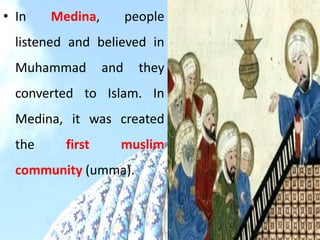
• In Medina, people
listened and believed in
Muhammad and they
converted to Islam. In
Medina, it was created
the first muslim
community (umma).
• When Muhammad died in 632, the majority of the
Arabs had become Muslims (followers of Islam).
• The Koran is the sacred book of Islam. It
contains the ideas that Allah revealed to
Muhammad.
• Islam is a monotheistic
religion. Muslim believe that
Allah is the only god and he
is all-powerful.
• They believe Muhammad is
the Prophet of Islam.
• In Islam, there are preachers
(imams) and other officials
(ulemas) who interpret the
Koran.
THE FIVE PILLARS
• Islam has 5 pillars that all the Muslims have to
fulfill:
They believe in a single god.
They have to pray five times a day.
They have to fast during the Ramadan.
They have to give money to the needy.
They have to make a pilgrimage to Mecca at least
once in a lifetime.
OTHER RULES IN ISLAM
• They cannot drink alcohol.
• They cannot eat pork.
• They cannot gamble or bet money.
• They (above all, women) have to dress
modestly.
THE ISLAMIC CODE OF CONDUCT
• Caliphs were Muhammad’s successors, they
represented Allah on Earth. They controlled
politics and religion.
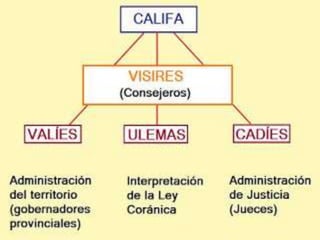
• Judges, or qadis (cadíes in Spanish), should
apply justice as it is described in the Koran.
THE ISLAMIC CHARGES
• Caliphs were Muhammad’s successors, they
represented Allah on Earth. They controlled
politics and religion.
• Viziers are ministers who help caliphs to
govern.
• Emirs are the governors in provinces.
• Judges, or qadis (cadíes in Spanish), should
apply justice as it is described in the Koran.
• They cannot represent Allah or Muhammed
in images.
• Muslim have to spread their religion, even
with jihad (guerra santa).
• Muslim have to help beggars and poor people
and they cannot lend money with interest.
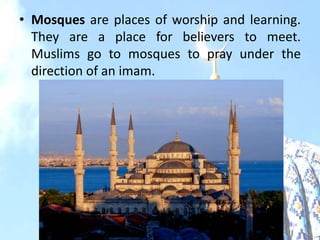
• Mosques are places of worship and learning.
They are a place for believers to meet.
Muslims go to mosques to pray under the
direction of an imam.
THE ORTHODOX CALIPHATE (632-661)
• Muhammad’s successors were chosen
between his relatives and friends. They lived
in Medina, and adopted the title of CALIPH,
they had all the power (politics and religious).
• The first four caliphs were: Abu Bakr, Omar,
Otman and Alí.
• At this time, Arabs conquered Syria,
Palestine, Egypt and Mesopotamia.
THE UMAYYAD CALIPHATE OF
DAMASCUS (661-750)
• The Umayyad family ruled
the Islam territories from
the year 661.
• They chose a new capital:
Damascus.
• They conquered new
territories: Irán,
Afghanistan, Central Asia,
Pakistan, Northern Africa
and the Iberian Peninsula.
• During the Umayyad Caliphate, they reached
the river Indo and the Turkestan.
• And westwards, they conquered almost all the
Iberian Peninsule and tried to reach France,
but they were stopped in the year 732, battle
of Poitiers, by the Franks.
THE ABBASID CALIPHATE
• In the year 750, the Abbasids took control
from the Umayyads of Damascus. The
Umayyad family was killed, except one prince.
• The new capital is Baghdad.
• From then on, Islam was spread by mariners
and traders who travelled the world.
• Little by little, the Abbasids lost control of
parts of their territory, for example, Al-
Ándalus, the last Umayyad prince fled to Al-
Ándalus and they founded an independent
emirate (later a caliphate).
• The Ottoman Turks became very powerful
during the next centuries. The great eastern
fortress of Christianity, Constantinople, fell to
Islamic Ottomans in 1453.
• People conquered by the Muslims could
continue practising their own religion, but
they have to pay a special tax.
• Being Muslim had social and economic
advantages. As a result, most inhabitants of
the territory converted to Islam.
• Agriculture was the main economic activity.
• Muslims introduced new products: cane, rice,
cotton, oranges, lemons, saffron, silk
(moreras), eggplants (berenjenas).
• They began to use irrigation systems, such as
the wheel or irrigation canals (acequias).
• Cities like Damascus, Baghdad or Córdoba had
a great development.
Damascus
• Apart from the agriculture, other important
economic activities were:
Artcraft (artesanía). They made cotton, silk
and linen tissues, carpets, tapestries, leather,
parfums, paper.
Trade. They traded luxury products, such as
silk, especies, salt, slaves. They traded with
camel caravans (land) or in boats. Their routes
joined the Mediterranean and Indian Ocean
with África, Far East and Northern Europe.
Their currencies were the dinar (gold) or the
dirham (silver).
ZOCO / SOUK
MUSLIMS NON-MUSLIMS (dimmies)
Arabic people Christians
Berebers Jews
People who have converted to Islam
(mawali)
• They used the Arabic as their language.
• They created their own culture founding
classical and oriental elements.
• They served as a bridge between Orient and
Occident. They took to Occident from Orient
inventions such as the compass, the
clepsidras, the astrolab, the arabic numbers.
• They created schools to learn about Koran,
called madrasas, and universities.
• Arabic culture was very advanced in
Astronomy, Mathematics and Medicine.
• We can outstand:
Avicena (doctor and philosopher)
Averroes (doctor and philosopher)
Islam 2º ESO

Islam 2º ESO

  • 2.
    • Islam, likeJudaism and Christianism, is a monotheistic religion that believes in one god. • The Prophet Muhammad (Mahoma) preached this religion during the 7th century in Arabia. • After the Prophet’s death, his followers began to spread Islam across Asia, North Africa and parts of Europe.
  • 4.
    • Islam appearedin the Arabian Peninsule. • The Arabs, who lived there, worked in agriculture (close to oasis areas) and livestock farming, and traded with camel caravans. • There were two important cities in the Arabian Peninsule at that time: Mecca (La Meca) and Medina. • In Mecca there was a sacred stone, the Kaaba.
  • 6.
    • Muhammad wasborn in Mecca around 570. He was a very religious man. • Legend says that the archangel Gabriel appeared to him and revealed him a new religion. He would be the new prophet of the only god, Allah. • Muhammad began preaching a new religion: Islam.
  • 8.
    • The peoplefrom Mecca didn’t believe Muhammad and he was persecuted. • He had to escape from Mecca and went to Medina in the year 622. This is known as Hijra (Hégira in Spanish). It marks the beginning of the Muslim era and the Islamic calendar.
  • 10.
    • In Medina,people listened and believed in Muhammad and they converted to Islam. In Medina, it was created the first muslim community (umma).
  • 11.
    • When Muhammaddied in 632, the majority of the Arabs had become Muslims (followers of Islam).
  • 13.
    • The Koranis the sacred book of Islam. It contains the ideas that Allah revealed to Muhammad. • Islam is a monotheistic religion. Muslim believe that Allah is the only god and he is all-powerful. • They believe Muhammad is the Prophet of Islam. • In Islam, there are preachers (imams) and other officials (ulemas) who interpret the Koran.
  • 14.
    THE FIVE PILLARS •Islam has 5 pillars that all the Muslims have to fulfill: They believe in a single god. They have to pray five times a day. They have to fast during the Ramadan. They have to give money to the needy. They have to make a pilgrimage to Mecca at least once in a lifetime.
  • 16.
    OTHER RULES INISLAM • They cannot drink alcohol. • They cannot eat pork. • They cannot gamble or bet money. • They (above all, women) have to dress modestly.
  • 17.
    THE ISLAMIC CODEOF CONDUCT • Caliphs were Muhammad’s successors, they represented Allah on Earth. They controlled politics and religion. • Judges, or qadis (cadíes in Spanish), should apply justice as it is described in the Koran.
  • 18.
    THE ISLAMIC CHARGES •Caliphs were Muhammad’s successors, they represented Allah on Earth. They controlled politics and religion. • Viziers are ministers who help caliphs to govern. • Emirs are the governors in provinces. • Judges, or qadis (cadíes in Spanish), should apply justice as it is described in the Koran.
  • 20.
    • They cannotrepresent Allah or Muhammed in images. • Muslim have to spread their religion, even with jihad (guerra santa). • Muslim have to help beggars and poor people and they cannot lend money with interest.
  • 22.
    • Mosques areplaces of worship and learning. They are a place for believers to meet. Muslims go to mosques to pray under the direction of an imam.
  • 26.
    THE ORTHODOX CALIPHATE(632-661) • Muhammad’s successors were chosen between his relatives and friends. They lived in Medina, and adopted the title of CALIPH, they had all the power (politics and religious). • The first four caliphs were: Abu Bakr, Omar, Otman and Alí. • At this time, Arabs conquered Syria, Palestine, Egypt and Mesopotamia.
  • 29.
    THE UMAYYAD CALIPHATEOF DAMASCUS (661-750) • The Umayyad family ruled the Islam territories from the year 661. • They chose a new capital: Damascus. • They conquered new territories: Irán, Afghanistan, Central Asia, Pakistan, Northern Africa and the Iberian Peninsula.
  • 30.
    • During theUmayyad Caliphate, they reached the river Indo and the Turkestan. • And westwards, they conquered almost all the Iberian Peninsule and tried to reach France, but they were stopped in the year 732, battle of Poitiers, by the Franks.
  • 31.
    THE ABBASID CALIPHATE •In the year 750, the Abbasids took control from the Umayyads of Damascus. The Umayyad family was killed, except one prince. • The new capital is Baghdad. • From then on, Islam was spread by mariners and traders who travelled the world.
  • 32.
    • Little bylittle, the Abbasids lost control of parts of their territory, for example, Al- Ándalus, the last Umayyad prince fled to Al- Ándalus and they founded an independent emirate (later a caliphate).
  • 33.
    • The OttomanTurks became very powerful during the next centuries. The great eastern fortress of Christianity, Constantinople, fell to Islamic Ottomans in 1453.
  • 34.
    • People conqueredby the Muslims could continue practising their own religion, but they have to pay a special tax. • Being Muslim had social and economic advantages. As a result, most inhabitants of the territory converted to Islam.
  • 36.
    • Agriculture wasthe main economic activity. • Muslims introduced new products: cane, rice, cotton, oranges, lemons, saffron, silk (moreras), eggplants (berenjenas).
  • 37.
    • They beganto use irrigation systems, such as the wheel or irrigation canals (acequias).
  • 38.
    • Cities likeDamascus, Baghdad or Córdoba had a great development. Damascus
  • 39.
    • Apart fromthe agriculture, other important economic activities were: Artcraft (artesanía). They made cotton, silk and linen tissues, carpets, tapestries, leather, parfums, paper. Trade. They traded luxury products, such as silk, especies, salt, slaves. They traded with camel caravans (land) or in boats. Their routes joined the Mediterranean and Indian Ocean with África, Far East and Northern Europe. Their currencies were the dinar (gold) or the dirham (silver).
  • 42.
  • 44.
    MUSLIMS NON-MUSLIMS (dimmies) Arabicpeople Christians Berebers Jews People who have converted to Islam (mawali)
  • 46.
    • They usedthe Arabic as their language. • They created their own culture founding classical and oriental elements. • They served as a bridge between Orient and Occident. They took to Occident from Orient inventions such as the compass, the clepsidras, the astrolab, the arabic numbers.
  • 47.
    • They createdschools to learn about Koran, called madrasas, and universities. • Arabic culture was very advanced in Astronomy, Mathematics and Medicine. • We can outstand: Avicena (doctor and philosopher) Averroes (doctor and philosopher)