PREPARED FOR : DR ABDULLAHI AYOADE AHMAD
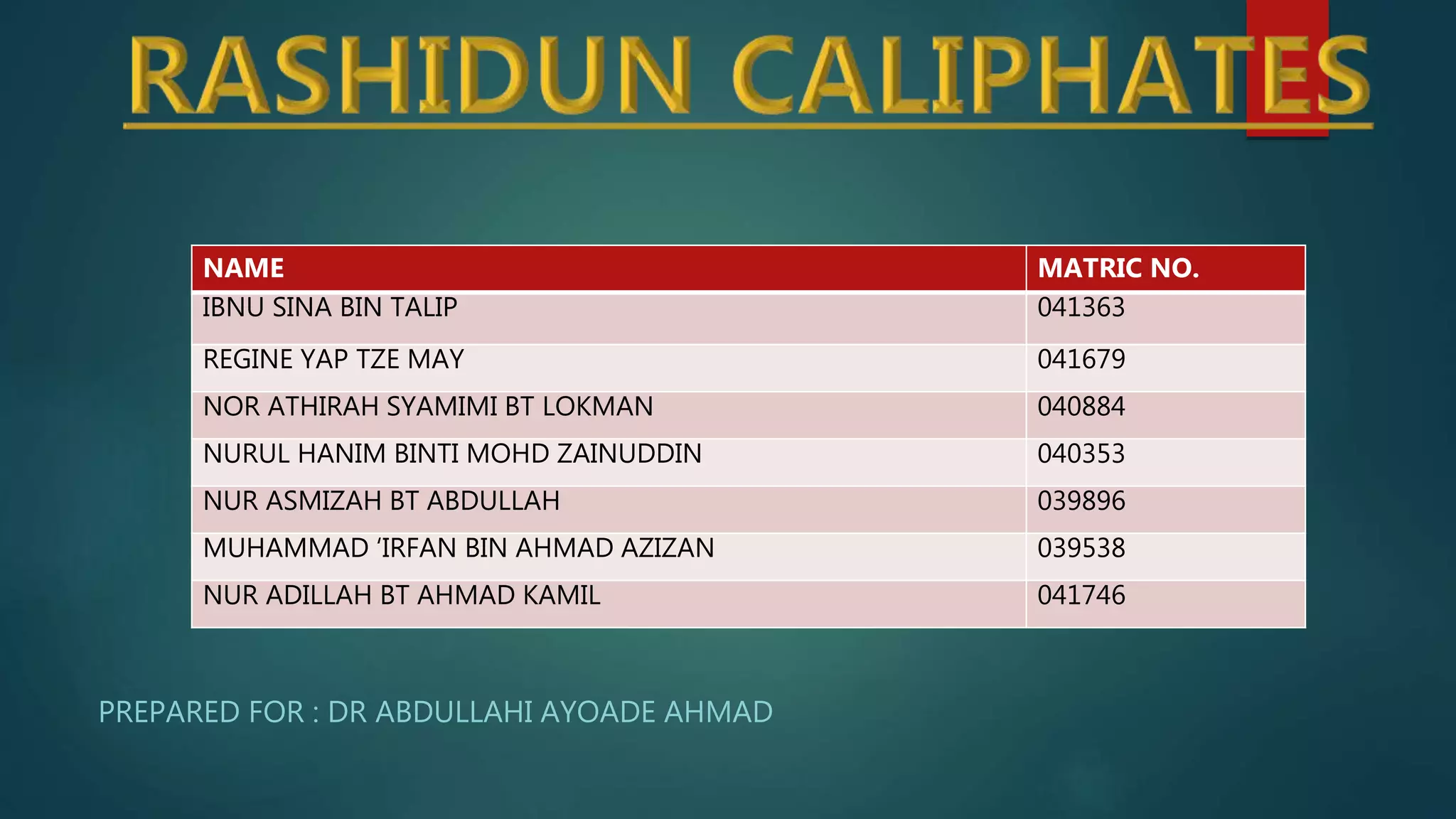
NAME MATRIC NO.
IBNU SINA BIN TALIP 041363
REGINE YAP TZE MAY 041679
NOR ATHIRAH SYAMIMI BT LOKMAN 040884
NURUL HANIM BINTI MOHD ZAINUDDIN 040353
NUR ASMIZAH BT ABDULLAH 039896
MUHAMMAD ‘IRFAN BIN AHMAD AZIZAN 039538
NUR ADILLAH BT AHMAD KAMIL 041746
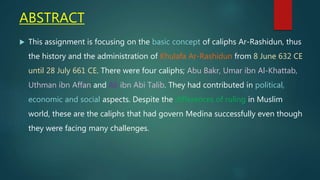
ABSTRACT
 This assignment is focusing on the basic concept of caliphs Ar-Rashidun, thus
the history and the administration of Khulafa Ar-Rashidun from 8 June 632 CE
until 28 July 661 CE. There were four caliphs; Abu Bakr, Umar ibn Al-Khattab,
Uthman ibn Affan and Ali ibn Abi Talib. They had contributed in political,
economic and social aspects. Despite the differences of ruling in Muslim
world, these are the caliphs that had govern Medina successfully even though
they were facing many challenges.
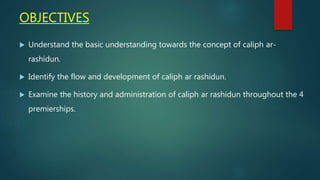
OBJECTIVES
 Understand the basic understanding towards the concept of caliph ar-
rashidun.
 Identify the flow and development of caliph ar rashidun.
 Examine the history and administration of caliph ar rashidun throughout the 4
premierships.
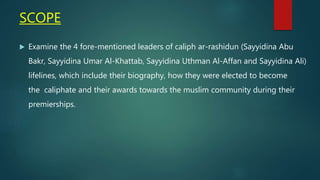
SCOPE
 Examine the 4 fore-mentioned leaders of caliph ar-rashidun (Sayyidina Abu
Bakr, Sayyidina Umar Al-Khattab, Sayyidina Uthman Al-Affan and Sayyidina Ali)
lifelines, which include their biography, how they were elected to become
the caliphate and their awards towards the muslim community during their
premierships.
INTRODUCTION
 The word ‘Rashidun’ in Arabic means ‘Rightly Guided’ or ‘Perfect’.
 ‘Caliph’ or in Arabic form ‘Khalifa’ means the leader Muslim civil and
religious ruler, and were the successor of messenger of God.
 Those who truly followed the footsteps of the Prophet Muhammad and are
the earliest and closest companions to prophet.
 The first four caliphs of Islamic community namely Abu Bakr, Umar,
Uthman and Ali.
INTRODUCTION
 Abu Bakr Abdullah bin Abi Quhafah (632 to 634 CE) -The Truthful/As-
Siddiq.
 Umar ibn Al-Khattab (23 Aug 642- 3 Nov 644 CE) -Al-Faruq.
 Uthman ibn Affan (6 Nov 644-17 Jun 656)
-Al-Ghani
 Ali ibn Abi Talib (656 until 661 CE) – Abu Turab.
 After the death of Ali ibn Abi Talib, Mu’awiyah became the fifth caliph
and establishing the Umayyad Dynasty.
Rashidun
Caliphate:
Abu Bakr As-
Siddiq
the suppression of the
apostasy
the unification
of Arabia
conquests of
greater parts of
Iraq and Syria
helped to
spread Islam
who made sure that the
sayings of the Prophet
were written down
= Holy Quran
CALIPHATE UMAR AL-KHATTAB
 FULL NAME : ABU HAFSH, UMAR AL FARUQ IBN KHATTAB IBN NUFAIL IBN ABDIL UZZA IBN ADI
IBN KA’AB IBN LUAY IBN GHALIB AL QURASY.
 SECOND CALIPHS OF RASHIDUN CALIPHATE
 A TOUGH AND BRAVE MAN, WHITE SKINNED, TALL AND STOUT, STURDY, AND STRONG
 IN 622 CE, THE PROPHET’S FOLLOWERS MIGRATE TO MADINAH
 UMAR MIGRATED IN DAYLIGHT – DARES EVERYONE WHO TRIES TO STOP HIM.
 ACCOMPANIED BY AMR B SURAQAH; ABDULLAH B SURAQAH; WAQID B ABDULLAH TAMIMI;
KHAULA B ABI KHAULA; MALIK B ABI KHALLLA; AYAS B BUKAIR; AQIL B BUKAIR; AMIR B BUKAIR
AND KHALID B BUKAIR.
 AL- FAROOQ (THE ONE WHO DISTINGUISHES BETWEEN RIGHT AND WRONG AND THE FIRST
MAN TO SHOW HIS ISLAMIC STATE IN MECCA )
 A really good fighter - masters all fighting skills and he also knows how to ride and
handle horses
 he became the next Rashidun Caliphate because of the trustworthy of Abu Bakr towards
him.
 Umar was the first Muslim ruler to organise the army as a State Department.
 This reform was introduced in 637 A.D. A beginning was made with the Quraish and the
Ansars and the system was gradually extended to the whole of Arabia
 On the 1st of November 644 A.D, at the time of the morning prayer, a Persian named
Firoz struck Umar six consecutive blows with his dagger, and Umar fell on the floor
profusely bleeding.
 He was brought up to a bed and he died on 3rd November 644 A.D.
 His reign was then being passed to Saidina Uthman
UTHMAN AL AFFAN
 Third Caliph of the Rashidun Caliphate
 Chosen by a committee
 Reigned from 6 November 644 to 17 June 656
Military
 Some of the largest Islamic territorial expansion
 - North Africa, Caucuses, Cyprus
 Left authority to Abdallah ibn Sa‘ad ibn Abi as-Saraḥ and Muʿawiyah ibn ʾAbi Ṣufyan
 - Build up naval fleet, mark the first Muslim navy in history
 - Control of Cyprus, Anatolia
 - End of Byzantine control in Mediterranean
Economy
 Land expansion – Booty and land tax
- Conquered land belonged to original owner, not divided by army, dissatisfied
- Raise salary to participant of conquest (25%)
 Remove restriction to purchase agricultural land in conquered countries.
 Introduce new coinage
- Arabic words addition on dirhams
Contribution to Islam
 Official version of Quran
- Medina written style
- Suggested by Hudhayfah ibn al-Yaman
 Noticed different recitations of Quran in different dialects and scripts
- Elected committee that lead by Zayd ibn Thabit to compile to make perfect copies
- Sent copies to Muslim provinces – ordered other Quran materials to be burned
- Qari sent to provinces to teach orally
ALI BIN ABI TALIB
BACKGROUND
 He was the Forth Caliph of Muslim
 He was the cousin and son-in-Law of Prophet Muhammad (S.A.W)
 He was born in 600 A.D., on the 13th of Rajab
 His mother is Fatima binti Asad
 His father is Hazrat Abu Talib (an uncle of Prophet)
 He was being the caliph between 656 and 651 CE
ELECTION OF ALI AS A CALIPH
 After the assassination of the 3rd Caliph (Uthman Ibn Affan) rebels had to elect a new Caliph.
 Some Companions of Muhammad tried to persuade him to accept the office, but he refused
to accept caliphate by the fact that the people who pressed him hardest were the rebels,
and he therefore declined the offer.
 When the notable companions of Muhammad as well as people who live in Medina urged
him, he finally agreed.
 This shows that Ali was willing to sacrifice himself to become as a Caliph, although at that
time the country was in chaos due to the death of Caliph Uthman and no heirs bequeathed
as his successor.
CONTRIBUTION OF ALI
 Ali was the victor of the battle of Badr  In that battle, he was alone killed half the
number of all the Makkans.
 In the battle of Uhud, most of the Muslims fled from the battlefield. However, he was
alone who did not flee because he had saved the life of his master, Prophet Muhammad
on that day.
 At the siege of Medina, Ali killed Amr bin Abd Wudd, and thereby saved Medina from
being overrun, and its people from being massacred.
 He also was the secretary who indicted the Treaty of Hudaybiyya.
 He and Prophet purified the House of God for all time by removing all vestiges of
idolatry and polytheism from it.
ADMINISTRATION OF ALI
He divided his entire state services into departments and sub-departments:
i. finance department
ii. Army
iii. central secretariat
iv. Judiciary
v. provincial offices
For the ministerial positions, it were distributed on the basis of:
i. merit (not distributed on the basis of wealth, relationship, tribalism or influence in
society)
ii. od-fearing and men of principles where there was no scope for the double faced
hypocrites to be placed at the helm of governmental responsibilities
iii. classed as wise and learned men with no sinful or criminal mentality  when they had
been accepted as advisors, they would speak the bitter truth unreservedly and without
fear of the status of government officials
Commercial activities:
 profiteering, hoarding and black marketing were prohibited
 army was the important organ of the State as the role of the army was defined and
qualification of those entitled to join and those not entitled to join were specified
 rights of rulers over the ruled and rights of ruled over the rulers were also pronounced
 The largest contribution of Caliph Ali to Islamic government is he was willing to accept the post
of Supreme Leader of the Islamic government and also fighting tooth and nail in order to
maintain stability and harmony in the country
CONCLUSION
• RASHIDUN CALIPHATES HAD THEIR OWN WAY AND CAPABILITY IN RUNNING THE
GOVERNMENT.
• PEOPLE NOWADAYS LIVE WITH QURAN AND SUNNAH AFTER RASHIDUN CALIPHATES EMPIRE
ENDED .
• PEOPLE LOST THEIR UNIFIER .
• ALTHOUGH THE CALIPHS TRIED THEIR BEST, UMMAH WERE DIVIDED DUE TO OLD TRIBAL
RIVALRIES AND PRESSURES OF A GROWING TERRITORIAL EMPIRE.
• EXISTENCE OF SHIA AND SUNNI UNTIL NOW .

rashidun caliphates

  • 1.
    PREPARED FOR :DR ABDULLAHI AYOADE AHMAD NAME MATRIC NO. IBNU SINA BIN TALIP 041363 REGINE YAP TZE MAY 041679 NOR ATHIRAH SYAMIMI BT LOKMAN 040884 NURUL HANIM BINTI MOHD ZAINUDDIN 040353 NUR ASMIZAH BT ABDULLAH 039896 MUHAMMAD ‘IRFAN BIN AHMAD AZIZAN 039538 NUR ADILLAH BT AHMAD KAMIL 041746
  • 2.
    ABSTRACT  This assignmentis focusing on the basic concept of caliphs Ar-Rashidun, thus the history and the administration of Khulafa Ar-Rashidun from 8 June 632 CE until 28 July 661 CE. There were four caliphs; Abu Bakr, Umar ibn Al-Khattab, Uthman ibn Affan and Ali ibn Abi Talib. They had contributed in political, economic and social aspects. Despite the differences of ruling in Muslim world, these are the caliphs that had govern Medina successfully even though they were facing many challenges.
  • 3.
    OBJECTIVES  Understand thebasic understanding towards the concept of caliph ar- rashidun.  Identify the flow and development of caliph ar rashidun.  Examine the history and administration of caliph ar rashidun throughout the 4 premierships.
  • 4.
    SCOPE  Examine the4 fore-mentioned leaders of caliph ar-rashidun (Sayyidina Abu Bakr, Sayyidina Umar Al-Khattab, Sayyidina Uthman Al-Affan and Sayyidina Ali) lifelines, which include their biography, how they were elected to become the caliphate and their awards towards the muslim community during their premierships.
  • 5.
    INTRODUCTION  The word‘Rashidun’ in Arabic means ‘Rightly Guided’ or ‘Perfect’.  ‘Caliph’ or in Arabic form ‘Khalifa’ means the leader Muslim civil and religious ruler, and were the successor of messenger of God.  Those who truly followed the footsteps of the Prophet Muhammad and are the earliest and closest companions to prophet.  The first four caliphs of Islamic community namely Abu Bakr, Umar, Uthman and Ali.
  • 6.
    INTRODUCTION  Abu BakrAbdullah bin Abi Quhafah (632 to 634 CE) -The Truthful/As- Siddiq.  Umar ibn Al-Khattab (23 Aug 642- 3 Nov 644 CE) -Al-Faruq.  Uthman ibn Affan (6 Nov 644-17 Jun 656) -Al-Ghani  Ali ibn Abi Talib (656 until 661 CE) – Abu Turab.  After the death of Ali ibn Abi Talib, Mu’awiyah became the fifth caliph and establishing the Umayyad Dynasty.
  • 7.
    Rashidun Caliphate: Abu Bakr As- Siddiq thesuppression of the apostasy the unification of Arabia conquests of greater parts of Iraq and Syria helped to spread Islam who made sure that the sayings of the Prophet were written down = Holy Quran
  • 8.
    CALIPHATE UMAR AL-KHATTAB FULL NAME : ABU HAFSH, UMAR AL FARUQ IBN KHATTAB IBN NUFAIL IBN ABDIL UZZA IBN ADI IBN KA’AB IBN LUAY IBN GHALIB AL QURASY.  SECOND CALIPHS OF RASHIDUN CALIPHATE  A TOUGH AND BRAVE MAN, WHITE SKINNED, TALL AND STOUT, STURDY, AND STRONG  IN 622 CE, THE PROPHET’S FOLLOWERS MIGRATE TO MADINAH  UMAR MIGRATED IN DAYLIGHT – DARES EVERYONE WHO TRIES TO STOP HIM.  ACCOMPANIED BY AMR B SURAQAH; ABDULLAH B SURAQAH; WAQID B ABDULLAH TAMIMI; KHAULA B ABI KHAULA; MALIK B ABI KHALLLA; AYAS B BUKAIR; AQIL B BUKAIR; AMIR B BUKAIR AND KHALID B BUKAIR.  AL- FAROOQ (THE ONE WHO DISTINGUISHES BETWEEN RIGHT AND WRONG AND THE FIRST MAN TO SHOW HIS ISLAMIC STATE IN MECCA )
  • 9.
     A reallygood fighter - masters all fighting skills and he also knows how to ride and handle horses  he became the next Rashidun Caliphate because of the trustworthy of Abu Bakr towards him.  Umar was the first Muslim ruler to organise the army as a State Department.  This reform was introduced in 637 A.D. A beginning was made with the Quraish and the Ansars and the system was gradually extended to the whole of Arabia  On the 1st of November 644 A.D, at the time of the morning prayer, a Persian named Firoz struck Umar six consecutive blows with his dagger, and Umar fell on the floor profusely bleeding.  He was brought up to a bed and he died on 3rd November 644 A.D.  His reign was then being passed to Saidina Uthman
  • 10.
    UTHMAN AL AFFAN Third Caliph of the Rashidun Caliphate  Chosen by a committee  Reigned from 6 November 644 to 17 June 656 Military  Some of the largest Islamic territorial expansion  - North Africa, Caucuses, Cyprus  Left authority to Abdallah ibn Sa‘ad ibn Abi as-Saraḥ and Muʿawiyah ibn ʾAbi Ṣufyan  - Build up naval fleet, mark the first Muslim navy in history  - Control of Cyprus, Anatolia  - End of Byzantine control in Mediterranean
  • 11.
    Economy  Land expansion– Booty and land tax - Conquered land belonged to original owner, not divided by army, dissatisfied - Raise salary to participant of conquest (25%)  Remove restriction to purchase agricultural land in conquered countries.  Introduce new coinage - Arabic words addition on dirhams Contribution to Islam  Official version of Quran - Medina written style - Suggested by Hudhayfah ibn al-Yaman  Noticed different recitations of Quran in different dialects and scripts - Elected committee that lead by Zayd ibn Thabit to compile to make perfect copies - Sent copies to Muslim provinces – ordered other Quran materials to be burned - Qari sent to provinces to teach orally
  • 12.
    ALI BIN ABITALIB BACKGROUND  He was the Forth Caliph of Muslim  He was the cousin and son-in-Law of Prophet Muhammad (S.A.W)  He was born in 600 A.D., on the 13th of Rajab  His mother is Fatima binti Asad  His father is Hazrat Abu Talib (an uncle of Prophet)  He was being the caliph between 656 and 651 CE
  • 13.
    ELECTION OF ALIAS A CALIPH  After the assassination of the 3rd Caliph (Uthman Ibn Affan) rebels had to elect a new Caliph.  Some Companions of Muhammad tried to persuade him to accept the office, but he refused to accept caliphate by the fact that the people who pressed him hardest were the rebels, and he therefore declined the offer.  When the notable companions of Muhammad as well as people who live in Medina urged him, he finally agreed.  This shows that Ali was willing to sacrifice himself to become as a Caliph, although at that time the country was in chaos due to the death of Caliph Uthman and no heirs bequeathed as his successor.
  • 14.
    CONTRIBUTION OF ALI Ali was the victor of the battle of Badr  In that battle, he was alone killed half the number of all the Makkans.  In the battle of Uhud, most of the Muslims fled from the battlefield. However, he was alone who did not flee because he had saved the life of his master, Prophet Muhammad on that day.  At the siege of Medina, Ali killed Amr bin Abd Wudd, and thereby saved Medina from being overrun, and its people from being massacred.  He also was the secretary who indicted the Treaty of Hudaybiyya.  He and Prophet purified the House of God for all time by removing all vestiges of idolatry and polytheism from it.
  • 15.
    ADMINISTRATION OF ALI Hedivided his entire state services into departments and sub-departments: i. finance department ii. Army iii. central secretariat iv. Judiciary v. provincial offices
  • 16.
    For the ministerialpositions, it were distributed on the basis of: i. merit (not distributed on the basis of wealth, relationship, tribalism or influence in society) ii. od-fearing and men of principles where there was no scope for the double faced hypocrites to be placed at the helm of governmental responsibilities iii. classed as wise and learned men with no sinful or criminal mentality  when they had been accepted as advisors, they would speak the bitter truth unreservedly and without fear of the status of government officials
  • 17.
    Commercial activities:  profiteering,hoarding and black marketing were prohibited  army was the important organ of the State as the role of the army was defined and qualification of those entitled to join and those not entitled to join were specified  rights of rulers over the ruled and rights of ruled over the rulers were also pronounced  The largest contribution of Caliph Ali to Islamic government is he was willing to accept the post of Supreme Leader of the Islamic government and also fighting tooth and nail in order to maintain stability and harmony in the country
  • 18.
    CONCLUSION • RASHIDUN CALIPHATESHAD THEIR OWN WAY AND CAPABILITY IN RUNNING THE GOVERNMENT. • PEOPLE NOWADAYS LIVE WITH QURAN AND SUNNAH AFTER RASHIDUN CALIPHATES EMPIRE ENDED . • PEOPLE LOST THEIR UNIFIER . • ALTHOUGH THE CALIPHS TRIED THEIR BEST, UMMAH WERE DIVIDED DUE TO OLD TRIBAL RIVALRIES AND PRESSURES OF A GROWING TERRITORIAL EMPIRE. • EXISTENCE OF SHIA AND SUNNI UNTIL NOW .