Early Muslim Dynasties Expansion & Conflict
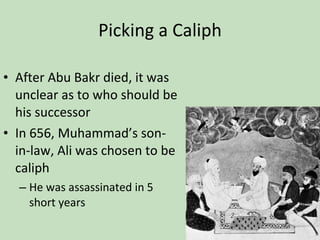
Picking a Caliph After Abu Bakr died, it was unclear as to who should be his successor In 656, Muhammad’s son-in-law, Ali was chosen to be caliph He was assassinated in 5 short years
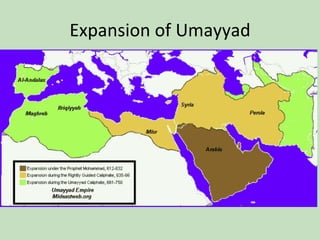
Umayyad Dynasty In 661, general  Mu’awiyah  became caliph He made the office of caliph hereditary to solve the problems of succession This created the  Umayyad Dynasty The Umayyad continued conquering and spreading Islam until all of North Africa and Spain  had become Muslim Expansion into Europe ended in 732 at the Battle of Tours
Expansion of Umayyad
Umayyads and the split of Islam Discrimination in the Umayyad dynasty led to revolts Hussein , the second son of Ali, led one revolt. This revolt split Islam into two groups Shiite Muslims only accept Ali’ descendants as true caliphs The Sunni Muslims only accept descendants of the Umayyads as caliphs
Abbasid Dynasty In 750,  Abu al-abbas  overthrew the Umayyad dynasty and set up the  Abbasid dynasty Harun al-Rashid  is the best known caliph of the Abbasids and the time during his rule is called the Golden Age He moved the capital to Baghdad for its prosperous location near trade routes
Abbasid Expansion When Harun al-Rashid died, his two sons fought over the caliphate Eventually, ruler of the Abbasid Empire in North Africa and Spain  began to form their own dynasties The Spanish even established its own caliphate
Conflicts The Egyptian Fatamid dynasty were overthrown by the Seljuk Turks, soldiers hired to fight for them. In 1055, a Turkish leader captured Baghdad and held the title sultan, or “holder of power” The Byzantine emperor, Alexius I asked Christians for help against the Turks This began a series of crusades, or conflicts and battles of Christians against Muslims
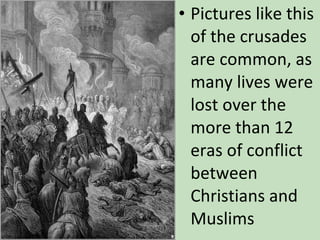
Pictures like this of the crusades are common, as many lives were lost over the more than 12 eras of conflict between Christians and Muslims

Unit 5 lesson 2 muslim dynasties

  • 1.
    Early Muslim DynastiesExpansion & Conflict
  • 2.
    Picking a CaliphAfter Abu Bakr died, it was unclear as to who should be his successor In 656, Muhammad’s son-in-law, Ali was chosen to be caliph He was assassinated in 5 short years
  • 3.
    Umayyad Dynasty In661, general Mu’awiyah became caliph He made the office of caliph hereditary to solve the problems of succession This created the Umayyad Dynasty The Umayyad continued conquering and spreading Islam until all of North Africa and Spain had become Muslim Expansion into Europe ended in 732 at the Battle of Tours
  • 4.
  • 5.
    Umayyads and thesplit of Islam Discrimination in the Umayyad dynasty led to revolts Hussein , the second son of Ali, led one revolt. This revolt split Islam into two groups Shiite Muslims only accept Ali’ descendants as true caliphs The Sunni Muslims only accept descendants of the Umayyads as caliphs
  • 6.
    Abbasid Dynasty In750, Abu al-abbas overthrew the Umayyad dynasty and set up the Abbasid dynasty Harun al-Rashid is the best known caliph of the Abbasids and the time during his rule is called the Golden Age He moved the capital to Baghdad for its prosperous location near trade routes
  • 7.
    Abbasid Expansion WhenHarun al-Rashid died, his two sons fought over the caliphate Eventually, ruler of the Abbasid Empire in North Africa and Spain began to form their own dynasties The Spanish even established its own caliphate
  • 8.
    Conflicts The EgyptianFatamid dynasty were overthrown by the Seljuk Turks, soldiers hired to fight for them. In 1055, a Turkish leader captured Baghdad and held the title sultan, or “holder of power” The Byzantine emperor, Alexius I asked Christians for help against the Turks This began a series of crusades, or conflicts and battles of Christians against Muslims
  • 9.
    Pictures like thisof the crusades are common, as many lives were lost over the more than 12 eras of conflict between Christians and Muslims