African
Civilizations
Chapter 8:1-3
African
Civilizations
Chapter 8:1-3
1500 BC- 500 AD
In Your Notes:
• Check to make sure you have all main ideas
that are underlined in your notes. If you do
not, add them. If you do, mark/circle them to
find them more easily.
Section 1: Diverse Societies in Africa
• Main Idea= African peoples developed diverse
societies as they adapted to varied
environments
• Why it matters now? Differences among
modern societies are also based on people’s
interactions with their environments
• THEMES: how geography affects societies
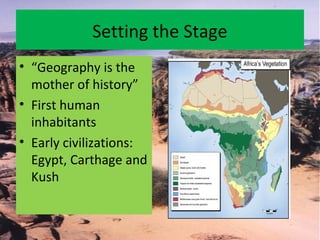
Setting the Stage
• “Geography is the
mother of history”
• First human
inhabitants
• Early civilizations:
Egypt, Carthage and
Kush
Geography
• Second largest continent in the
world
• Occupies 1/5 of the earth’s land
surfaces
• Coastline has few harbors and
ports
• Africa lies on the equator (tropics)
• From plains to snowy mountains
• From drought to rainfall
• From rocky to rain forests
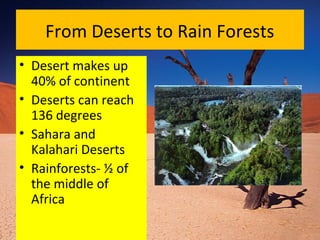
From Deserts to Rain Forests
• Desert makes up
40% of continent
• Deserts can reach
136 degrees
• Sahara and
Kalahari Deserts
• Rainforests- ½ of
the middle of
Africa
From Fertile Farmlands to Grassy
Plains
• Fertile land on the
northern and southern
tips
• Largest amount of
people live on the
savannas (grassy plains)
• Savannas cover 40% of
continent
• Desertification= a
transformation from
fertile land into desert
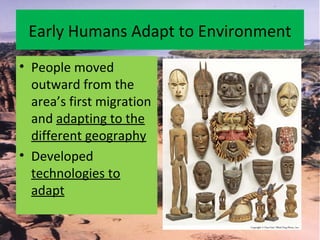
Early Humans Adapt to Environment
• People moved
outward from the
area’s first migration
and adapting to the
different geography
• Developed
technologies to
adapt
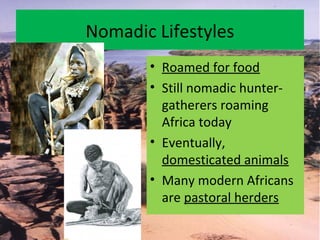
Nomadic Lifestyles
• Roamed for food
• Still nomadic hunter-
gatherers roaming
Africa today
• Eventually,
domesticated animals
• Many modern Africans
are pastoral herders
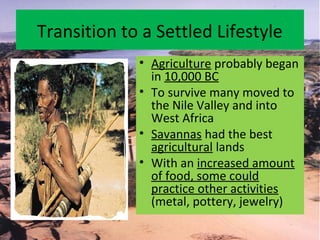
Transition to a Settled Lifestyle
• Agriculture probably began
in 10,000 BC
• To survive many moved to
the Nile Valley and into
West Africa
• Savannas had the best
agricultural lands
• With an increased amount
of food, some could
practice other activities
(metal, pottery, jewelry)
Crash Course:
Agricultural Revolution
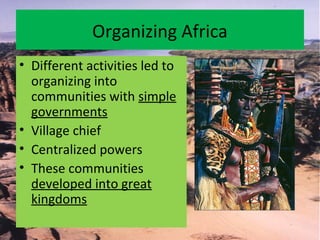
Organizing Africa
• Different activities led to
organizing into
communities with simple
governments
• Village chief
• Centralized powers
• These communities
developed into great
kingdoms
*African Common Characteristics
• 1. Importance of basic social unit,
the family
– Extended family
– Clan= a group that shared common
ancestors
• 2. Belief in one creator, or god
– Animism= religion in which spirits
played an important role in
regulating life
– Spirits sent to animals, plants and
natural forces
• 3. Oral stories kept history alive
– Griots= storytellers
Early Societies in West Africa
• How we know about Africa?
– *oral history
– Recent archaeology findings
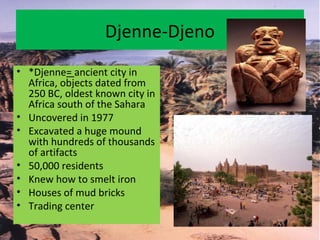
Djenne-Djeno
• *Djenne= ancient city in
Africa, objects dated from
250 BC, oldest known city in
Africa south of the Sahara
• Uncovered in 1977
• Excavated a huge mound
with hundreds of thousands
of artifacts
• 50,000 residents
• Knew how to smelt iron
• Houses of mud bricks
• Trading center
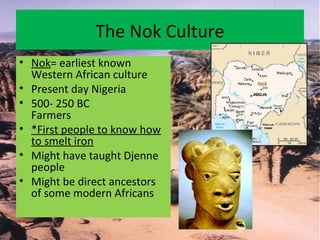
The Nok Culture
• Nok= earliest known
Western African culture
• Present day Nigeria
• 500- 250 BC
Farmers
• *First people to know how
to smelt iron
• Might have taught Djenne
people
• Might be direct ancestors
of some modern Africans
Section 2: The Kingdom of Aksum &
East African Trade
• Main Idea: The kingdom of Aksum became an
international trading power and adopted
Christianity
• Why it matters now? Ancient Aksum, which is
now Ethiopia, is still a center of Eastern
Christianity
• THEMES: religion spread through trade
Setting the Stage
• Before Nok, Kush in the
east was powerful
enough to conquer
Egypt
• Assyrians came in and
drove Kushites south
• Kush remained powerful
until it was conquered
by another more
powerful kingdom
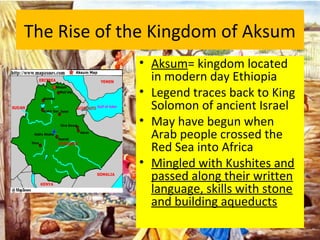
The Rise of the Kingdom of Aksum
• Aksum= kingdom located
in modern day Ethiopia
• Legend traces back to King
Solomon of ancient Israel
• May have begun when
Arab people crossed the
Red Sea into Africa
• Mingled with Kushites and
passed along their written
language, skills with stone
and building aqueducts
Aksum Controls International
Trade
• Location made it an important trading
center
• Red Sea coastline gave it influence
over sea trade on the Med. Sea &
Indian Ocean
• Along caravan route to Egypt and
Meroe
• Adulis= Aksum’s chief seaport
• *International trading power
• Traded: salt, rhino horns, tortoise
shells, ivory, emeralds, gold
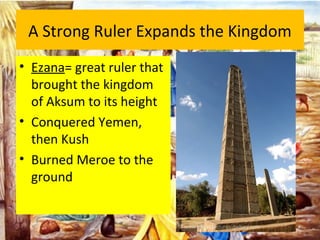
A Strong Ruler Expands the Kingdom
• Ezana= great ruler that
brought the kingdom
of Aksum to its height
• Conquered Yemen,
then Kush
• Burned Meroe to the
ground
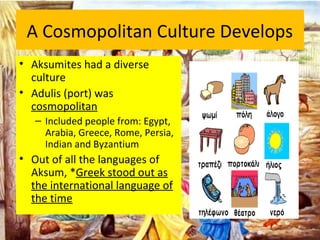
A Cosmopolitan Culture Develops
• Aksumites had a diverse
culture
• Adulis (port) was
cosmopolitan
– Included people from: Egypt,
Arabia, Greece, Rome, Persia,
Indian and Byzantium
• Out of all the languages of
Aksum, *Greek stood out as
the international language of
the time
Spread of Christianity
• One god= Mahrem
• Believed their king was
directly descended from him
• Animists, honored nature
and dead ancestors
• Offered sacrifices to those
spirits, Mahrem and the
Greek god of war, Ares
• Christianity spread from
trade
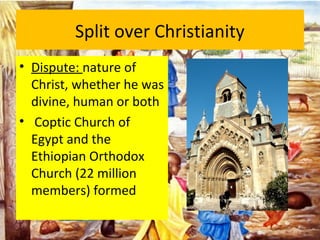
Split over Christianity
• Dispute: nature of
Christ, whether he was
divine, human or both
• Coptic Church of
Egypt and the
Ethiopian Orthodox
Church (22 million
members) formed
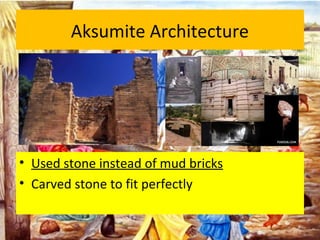
Aksumite Architecture
• Used stone instead of mud bricks
• Carved stone to fit perfectly
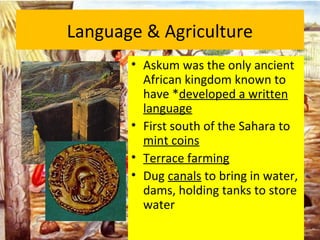
Language & Agriculture
• Askum was the only ancient
African kingdom known to
have *developed a written
language
• First south of the Sahara to
mint coins
• Terrace farming
• Dug canals to bring in water,
dams, holding tanks to store
water
The Fall of Aksum
• Lasted 800 years
• Declined under invaders
who practiced Islam
• Muslims conquered and
spread religion along as
they went
• Ports were cut off, and the
kingdom declined in
international power
Section 3: Bantu Speaking Peoples
• Main Idea: Throughout history, people have
been driven to uproot themselves and explore
their world
• Why it matters now? Migration continues to
shape the modern world
• Theme: Migration
*Causes for Migrations
• Environmental changes
• Economic pressure
• Political and religious
persecution
• Technological development
• Best way to study patterns
of movement is to study the
movement of languages
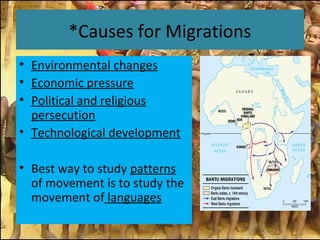
Massive Migrations
• *900 languages in the
Niger-Congo all stemmed
from the parent
language, Proto-Bantu
• Bantu-speaking peoples
• Bantu= “people”
• Bantu went south
spreading their language
Bantu Language
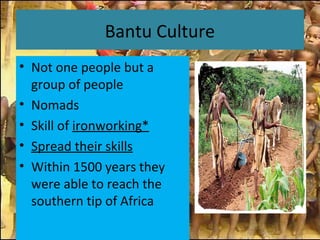
Bantu Culture
• Not one people but a
group of people
• Nomads
• Skill of ironworking*
• Spread their skills
• Within 1500 years they
were able to reach the
southern tip of Africa
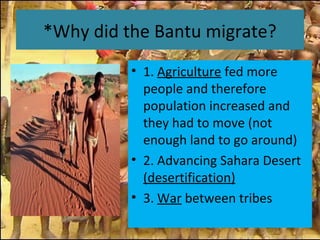
*Why did the Bantu migrate?
• 1. Agriculture fed more
people and therefore
population increased and
they had to move (not
enough land to go around)
• 2. Advancing Sahara Desert
(desertification)
• 3. War between tribes
*Effects of the Bantu Migration
• Spread of culture
• Intermingling and
intermarrying
• Were a unifying
influence throughout
Africa
“Guns, Germs & Steel: Bantu &
Ancient Africa”

African Civilizations (8:1-3)

  • 1.
  • 2.
    In Your Notes: •Check to make sure you have all main ideas that are underlined in your notes. If you do not, add them. If you do, mark/circle them to find them more easily.
  • 3.
    Section 1: DiverseSocieties in Africa • Main Idea= African peoples developed diverse societies as they adapted to varied environments • Why it matters now? Differences among modern societies are also based on people’s interactions with their environments • THEMES: how geography affects societies
  • 4.
    Setting the Stage •“Geography is the mother of history” • First human inhabitants • Early civilizations: Egypt, Carthage and Kush
  • 5.
    Geography • Second largestcontinent in the world • Occupies 1/5 of the earth’s land surfaces • Coastline has few harbors and ports • Africa lies on the equator (tropics) • From plains to snowy mountains • From drought to rainfall • From rocky to rain forests
  • 6.
    From Deserts toRain Forests • Desert makes up 40% of continent • Deserts can reach 136 degrees • Sahara and Kalahari Deserts • Rainforests- ½ of the middle of Africa
  • 7.
    From Fertile Farmlandsto Grassy Plains • Fertile land on the northern and southern tips • Largest amount of people live on the savannas (grassy plains) • Savannas cover 40% of continent • Desertification= a transformation from fertile land into desert
  • 8.
    Early Humans Adaptto Environment • People moved outward from the area’s first migration and adapting to the different geography • Developed technologies to adapt
  • 9.
    Nomadic Lifestyles • Roamedfor food • Still nomadic hunter- gatherers roaming Africa today • Eventually, domesticated animals • Many modern Africans are pastoral herders
  • 10.
    Transition to aSettled Lifestyle • Agriculture probably began in 10,000 BC • To survive many moved to the Nile Valley and into West Africa • Savannas had the best agricultural lands • With an increased amount of food, some could practice other activities (metal, pottery, jewelry)
  • 11.
  • 12.
    Organizing Africa • Differentactivities led to organizing into communities with simple governments • Village chief • Centralized powers • These communities developed into great kingdoms
  • 13.
    *African Common Characteristics •1. Importance of basic social unit, the family – Extended family – Clan= a group that shared common ancestors • 2. Belief in one creator, or god – Animism= religion in which spirits played an important role in regulating life – Spirits sent to animals, plants and natural forces • 3. Oral stories kept history alive – Griots= storytellers
  • 14.
    Early Societies inWest Africa • How we know about Africa? – *oral history – Recent archaeology findings
  • 15.
    Djenne-Djeno • *Djenne= ancientcity in Africa, objects dated from 250 BC, oldest known city in Africa south of the Sahara • Uncovered in 1977 • Excavated a huge mound with hundreds of thousands of artifacts • 50,000 residents • Knew how to smelt iron • Houses of mud bricks • Trading center
  • 16.
    The Nok Culture •Nok= earliest known Western African culture • Present day Nigeria • 500- 250 BC Farmers • *First people to know how to smelt iron • Might have taught Djenne people • Might be direct ancestors of some modern Africans
  • 17.
    Section 2: TheKingdom of Aksum & East African Trade • Main Idea: The kingdom of Aksum became an international trading power and adopted Christianity • Why it matters now? Ancient Aksum, which is now Ethiopia, is still a center of Eastern Christianity • THEMES: religion spread through trade
  • 18.
    Setting the Stage •Before Nok, Kush in the east was powerful enough to conquer Egypt • Assyrians came in and drove Kushites south • Kush remained powerful until it was conquered by another more powerful kingdom
  • 19.
    The Rise ofthe Kingdom of Aksum • Aksum= kingdom located in modern day Ethiopia • Legend traces back to King Solomon of ancient Israel • May have begun when Arab people crossed the Red Sea into Africa • Mingled with Kushites and passed along their written language, skills with stone and building aqueducts
  • 20.
    Aksum Controls International Trade •Location made it an important trading center • Red Sea coastline gave it influence over sea trade on the Med. Sea & Indian Ocean • Along caravan route to Egypt and Meroe • Adulis= Aksum’s chief seaport • *International trading power • Traded: salt, rhino horns, tortoise shells, ivory, emeralds, gold
  • 21.
    A Strong RulerExpands the Kingdom • Ezana= great ruler that brought the kingdom of Aksum to its height • Conquered Yemen, then Kush • Burned Meroe to the ground
  • 22.
    A Cosmopolitan CultureDevelops • Aksumites had a diverse culture • Adulis (port) was cosmopolitan – Included people from: Egypt, Arabia, Greece, Rome, Persia, Indian and Byzantium • Out of all the languages of Aksum, *Greek stood out as the international language of the time
  • 23.
    Spread of Christianity •One god= Mahrem • Believed their king was directly descended from him • Animists, honored nature and dead ancestors • Offered sacrifices to those spirits, Mahrem and the Greek god of war, Ares • Christianity spread from trade
  • 24.
    Split over Christianity •Dispute: nature of Christ, whether he was divine, human or both • Coptic Church of Egypt and the Ethiopian Orthodox Church (22 million members) formed
  • 25.
    Aksumite Architecture • Usedstone instead of mud bricks • Carved stone to fit perfectly
  • 26.
    Language & Agriculture •Askum was the only ancient African kingdom known to have *developed a written language • First south of the Sahara to mint coins • Terrace farming • Dug canals to bring in water, dams, holding tanks to store water
  • 27.
    The Fall ofAksum • Lasted 800 years • Declined under invaders who practiced Islam • Muslims conquered and spread religion along as they went • Ports were cut off, and the kingdom declined in international power
  • 28.
    Section 3: BantuSpeaking Peoples • Main Idea: Throughout history, people have been driven to uproot themselves and explore their world • Why it matters now? Migration continues to shape the modern world • Theme: Migration
  • 29.
    *Causes for Migrations •Environmental changes • Economic pressure • Political and religious persecution • Technological development • Best way to study patterns of movement is to study the movement of languages
  • 30.
    Massive Migrations • *900languages in the Niger-Congo all stemmed from the parent language, Proto-Bantu • Bantu-speaking peoples • Bantu= “people” • Bantu went south spreading their language
  • 31.
  • 32.
    Bantu Culture • Notone people but a group of people • Nomads • Skill of ironworking* • Spread their skills • Within 1500 years they were able to reach the southern tip of Africa
  • 33.
    *Why did theBantu migrate? • 1. Agriculture fed more people and therefore population increased and they had to move (not enough land to go around) • 2. Advancing Sahara Desert (desertification) • 3. War between tribes
  • 34.
    *Effects of theBantu Migration • Spread of culture • Intermingling and intermarrying • Were a unifying influence throughout Africa
  • 35.
    “Guns, Germs &Steel: Bantu & Ancient Africa”