AL-ANDALUS
THE CONQUEST
How was the political situation in the Iberian Peninsula
at the beginning of the VIII century?
There was a civil war in the Visigothic kingdom
between the king Rodrigo and the family of Witiza,
who had been the king before
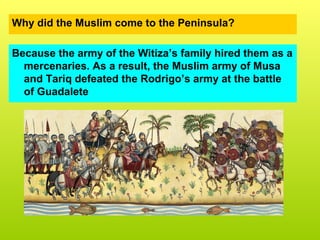
Why did the Muslim come to the Peninsula?
Because the army of the Witiza’s family hired them as a
mercenaries. As a result, the Muslim army of Musa
and Tariq defeated the Rodrigo’s army at the battle
of Guadalete
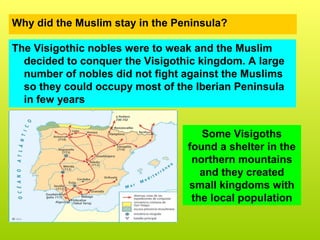
Why did the Muslim stay in the Peninsula?
The Visigothic nobles were to weak and the Muslim
decided to conquer the Visigothic kingdom. A large
number of nobles did not fight against the Muslims
so they could occupy most of the Iberian Peninsula
in few years
Some Visigoths
found a shelter in the
northern mountains
and they created
small kingdoms with
the local population
The dependent Emirate of Cordoba
• Al-Alandalus was an Emirate of the Caliphate of
Damascus. It was like a province in the Caliphate.
• Its capital was in Córdoba and the main authority was
the Emir who was a governor
The independent Emirate of
Cordoba
• In 750, Abd-al-Rahman could escape from Damascus
when his family was assassinated by the Abbasid family
which took the power of Islam and set the capital of the
Caliphate in Baghdad.
• In 756, Abd-al-Rahman set an independent emirate in
Al-Andalus. That meant that they obeyed the Caliph of
Baghdad from a religious point of view but they were
independent from a political point of view
The Caliphate of Córdoba
• The Emir Abd-al-Rahman III was very successful
defeating the Christians and keeping the peace in Al-
Andalus
• In 926, when there was a crisis in Baghdad, he decided to
be a Caliph. Thus, he was not only the main political
authority in Al-Andalus but also the religious leader.
• In 976, the new Caliph Hisham II was only 11 years old.
As a result, the general Al-Mansur ruled Al-Andalus.
When the Caliph became an adult, he was not interested
in politics and he left the power to Al-Mansur, who set a
military dictatorship.
• The attacks against the Christians were very common
under Al-Mansur. He only wanted treasure and money
from the Christians in order to reduce taxes in Al-Andalus
The Taifas
• When Al-Mansur died, there were internal fights in Al-
Andalus and Caliphate declined.
• In 1031, Al-Andalus was divided into small kingdoms
called Taifas. They fought in order to expand their lands
against other taifas.
• They also suffered attacks from the Christians and they
became weaker. As a result, some taifas paid taxes to the
Christians in order to have them as mercenaries or avoid
their attacks
• However, Christian Kingdoms were stronger and they
started to conquer some taifas and expand their lands to
the River Tajo
Almoravids and Almohads
• The small and weak taifas asked for help to the
Almoravids, who were warriors from the North of Africa.
• Almoravids did not only stop the Christians but they also
unified Al-Andalus
• However, other power from the North of Africa –the
Almohads-fought against Almoravids and defeated them
taking the power in Al-Andalus
• In 1212, the Christians decided to fight together against
the Almohads and they defeated them in the battle of Las
Navas de Tolosa
• Christians only left the Kingdom of Granada for the
Muslims
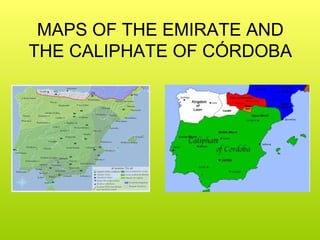
MAPS OF THE EMIRATE AND
THE CALIPHATE OF CÓRDOBA
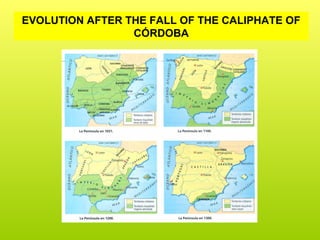
EVOLUTION AFTER THE FALL OF THE CALIPHATE OF
CÓRDOBA
The Nasrid Kingdom of Granada
• The Kingdom of Granada was the last
Muslim territory in the Iberian Peninsula
• It was in the south-east of Andalucía and
its capital was Granada
• It could survive for more than two
centuries because they paid taxes to the
kings of Castile.
• However, the Catholic Monarchs decided
to conquer the Kingdom of Granada in
1492 because they wanted to have good
relations with the Pope and give the
Muslim lands to their nobles

Al andalus

  • 1.
  • 2.
    THE CONQUEST How wasthe political situation in the Iberian Peninsula at the beginning of the VIII century? There was a civil war in the Visigothic kingdom between the king Rodrigo and the family of Witiza, who had been the king before
  • 3.
    Why did theMuslim come to the Peninsula? Because the army of the Witiza’s family hired them as a mercenaries. As a result, the Muslim army of Musa and Tariq defeated the Rodrigo’s army at the battle of Guadalete
  • 4.
    Why did theMuslim stay in the Peninsula? The Visigothic nobles were to weak and the Muslim decided to conquer the Visigothic kingdom. A large number of nobles did not fight against the Muslims so they could occupy most of the Iberian Peninsula in few years Some Visigoths found a shelter in the northern mountains and they created small kingdoms with the local population
  • 5.
    The dependent Emirateof Cordoba • Al-Alandalus was an Emirate of the Caliphate of Damascus. It was like a province in the Caliphate. • Its capital was in Córdoba and the main authority was the Emir who was a governor
  • 6.
    The independent Emirateof Cordoba • In 750, Abd-al-Rahman could escape from Damascus when his family was assassinated by the Abbasid family which took the power of Islam and set the capital of the Caliphate in Baghdad. • In 756, Abd-al-Rahman set an independent emirate in Al-Andalus. That meant that they obeyed the Caliph of Baghdad from a religious point of view but they were independent from a political point of view
  • 7.
    The Caliphate ofCórdoba • The Emir Abd-al-Rahman III was very successful defeating the Christians and keeping the peace in Al- Andalus • In 926, when there was a crisis in Baghdad, he decided to be a Caliph. Thus, he was not only the main political authority in Al-Andalus but also the religious leader. • In 976, the new Caliph Hisham II was only 11 years old. As a result, the general Al-Mansur ruled Al-Andalus. When the Caliph became an adult, he was not interested in politics and he left the power to Al-Mansur, who set a military dictatorship. • The attacks against the Christians were very common under Al-Mansur. He only wanted treasure and money from the Christians in order to reduce taxes in Al-Andalus
  • 8.
    The Taifas • WhenAl-Mansur died, there were internal fights in Al- Andalus and Caliphate declined. • In 1031, Al-Andalus was divided into small kingdoms called Taifas. They fought in order to expand their lands against other taifas. • They also suffered attacks from the Christians and they became weaker. As a result, some taifas paid taxes to the Christians in order to have them as mercenaries or avoid their attacks • However, Christian Kingdoms were stronger and they started to conquer some taifas and expand their lands to the River Tajo
  • 9.
    Almoravids and Almohads •The small and weak taifas asked for help to the Almoravids, who were warriors from the North of Africa. • Almoravids did not only stop the Christians but they also unified Al-Andalus • However, other power from the North of Africa –the Almohads-fought against Almoravids and defeated them taking the power in Al-Andalus • In 1212, the Christians decided to fight together against the Almohads and they defeated them in the battle of Las Navas de Tolosa • Christians only left the Kingdom of Granada for the Muslims
  • 10.
    MAPS OF THEEMIRATE AND THE CALIPHATE OF CÓRDOBA
  • 11.
    EVOLUTION AFTER THEFALL OF THE CALIPHATE OF CÓRDOBA
  • 12.
  • 13.
    • The Kingdomof Granada was the last Muslim territory in the Iberian Peninsula • It was in the south-east of Andalucía and its capital was Granada • It could survive for more than two centuries because they paid taxes to the kings of Castile. • However, the Catholic Monarchs decided to conquer the Kingdom of Granada in 1492 because they wanted to have good relations with the Pope and give the Muslim lands to their nobles