G P Jamnagar
Welding
CO
Identify joining methods for fabrications, and fabricate simple job using
joining method.
Welding
Welding is metallurgical fusion process,where part to be joined by the application of heat and
pressure.
•It is used to join the two different parts.
•It is commonly used in the industries.
•Advantages.
•It is used for repair work.
•Strength of joint is good.
•They have high corrosion resistance.
•Welding is used for fluid tight joints.
•Different types of joints can be done.
•Welding is economical and cost efficient.
Two Categories of Welding Processes
 Fusion welding - coalescence is accomplished by
melting the two parts to be joined, in some cases
adding filler metal to the joint
 Examples: arc welding, resistance spot welding,
oxyfuel gas welding
 Solid state welding - heat and/or pressure are used
to achieve coalescence, but no melting of base
metals occurs and no filler metal is added
 Examples: forge welding, diffusion welding,
friction welding
Welding
Disadvantages.
•It produce harmful radiations.
•It produce internal stresses distortion and change in micro structure in welding region.
•Previous badge preparation requires.
•Require skilled operator.
•Applications.
•Automobile parts.
•Aircraft and ship construction.
•Machine frames.
•Pipelines.
•Tanks and vessels.
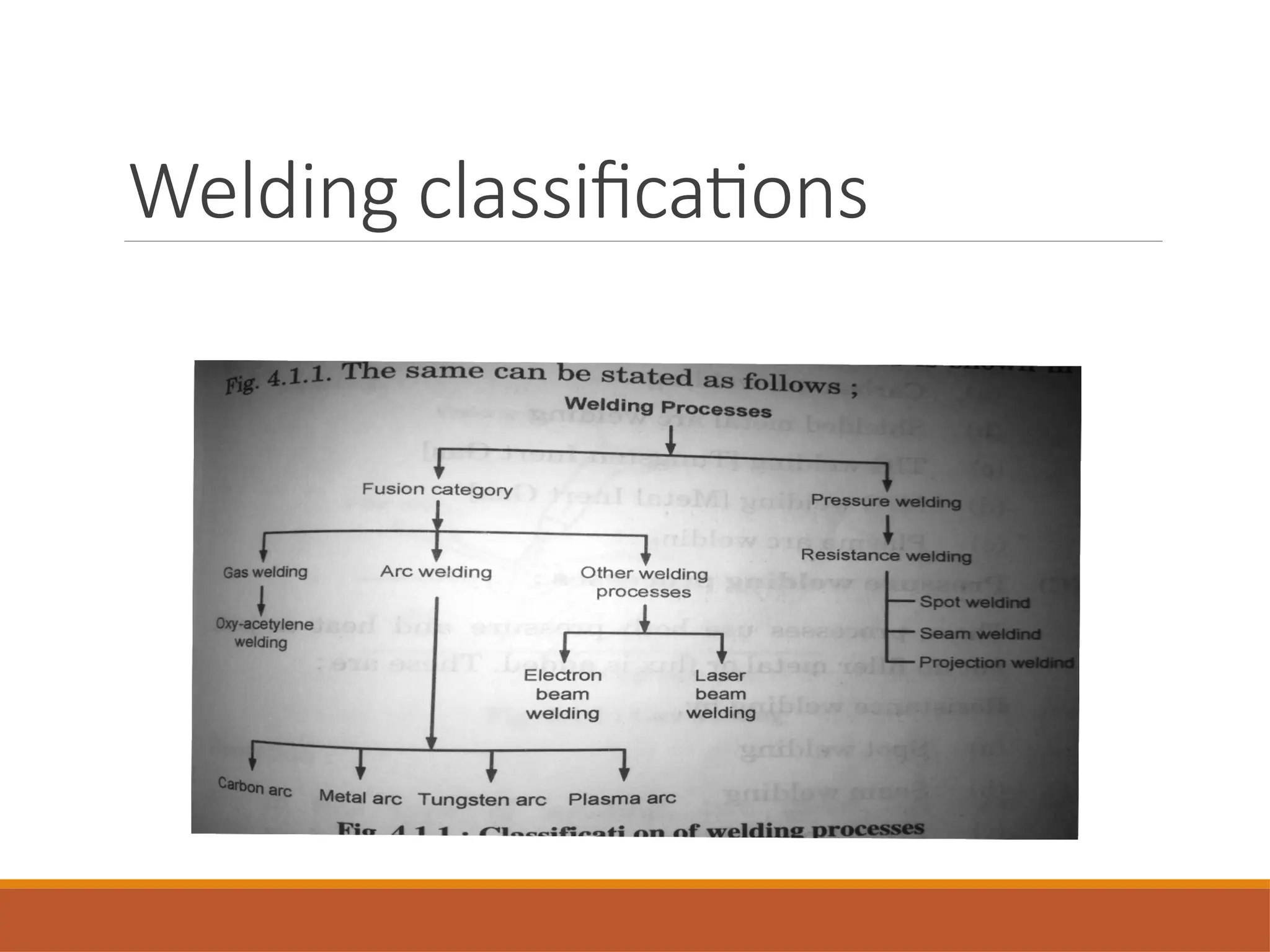
Welding classifications
Welding Processes
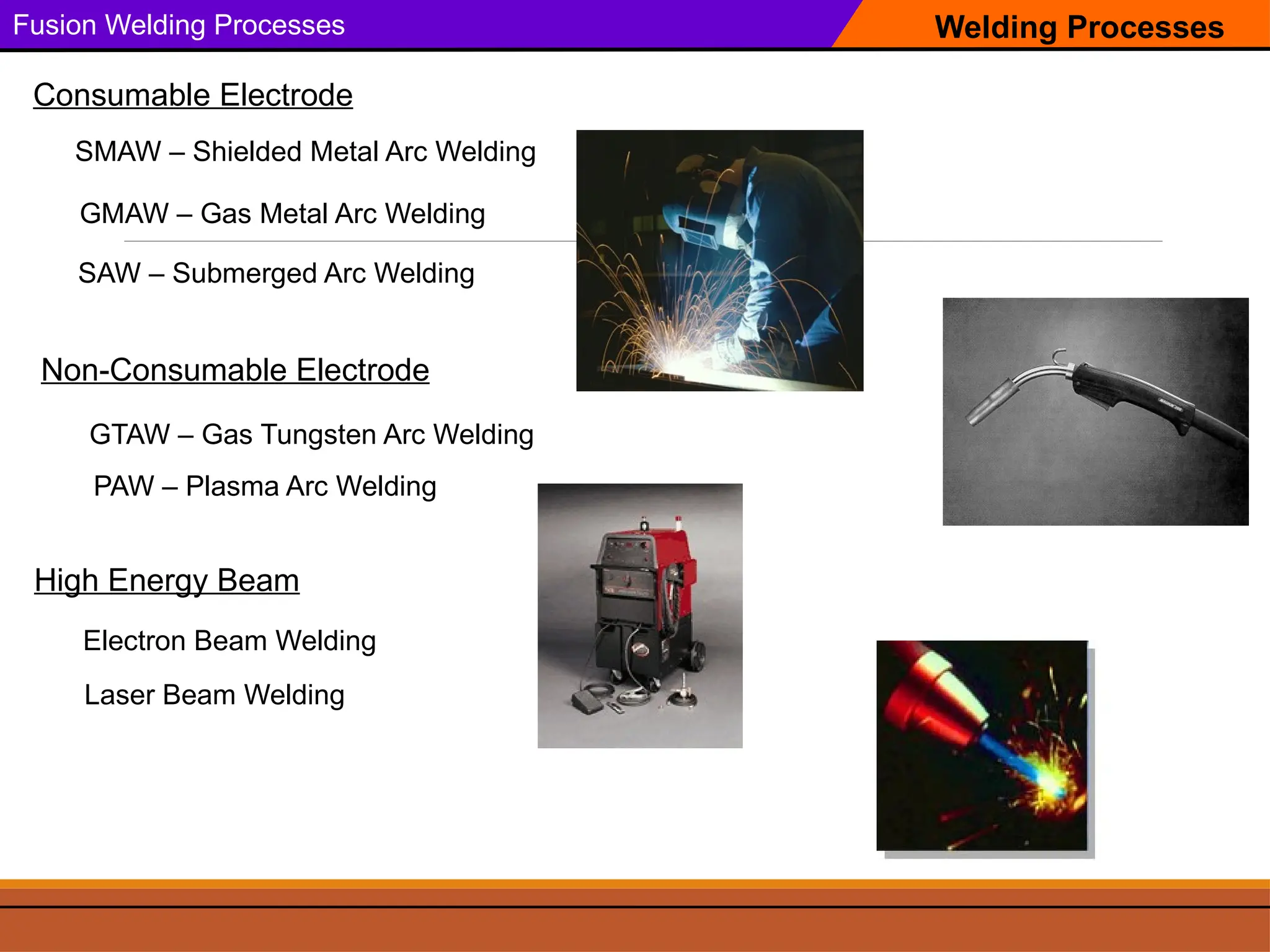
Fusion Welding Processes
GMAW – Gas Metal Arc Welding
SMAW – Shielded Metal Arc Welding
Non-Consumable Electrode
GTAW – Gas Tungsten Arc Welding
Electron Beam Welding
SAW – Submerged Arc Welding
Consumable Electrode
PAW – Plasma Arc Welding
High Energy Beam
Laser Beam Welding
Welding Processes
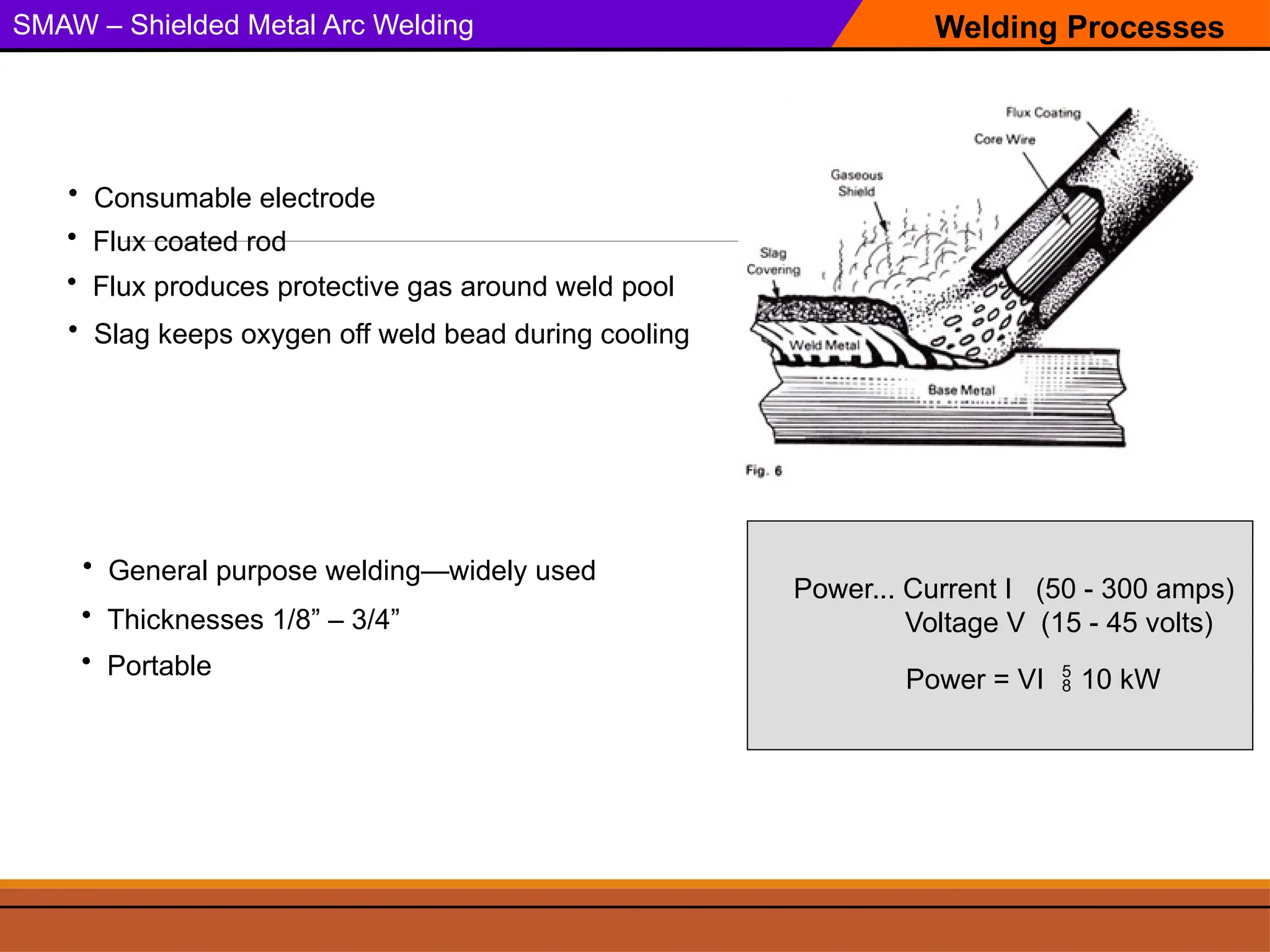
SMAW – Shielded Metal Arc Welding
• Slag keeps oxygen off weld bead during cooling
• Consumable electrode
• Flux produces protective gas around weld pool
• Flux coated rod
Power = VI  10 kW
Power... Current I (50 - 300 amps)
Voltage V (15 - 45 volts)
• General purpose welding—widely used
• Thicknesses 1/8” – 3/4”
• Portable
Welding Processes
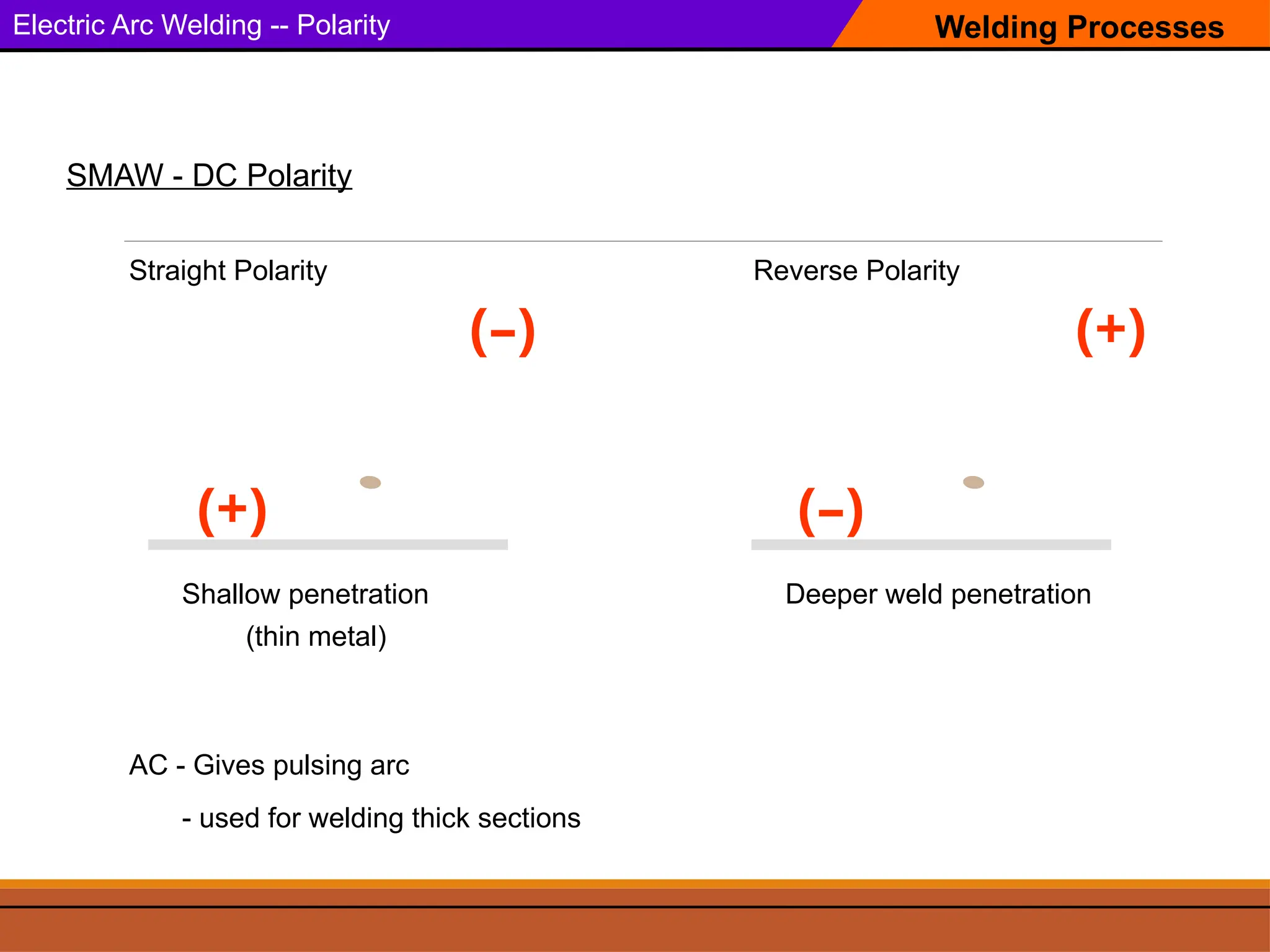
Electric Arc Welding -- Polarity
SMAW - DC Polarity
Straight Polarity
Shallow penetration Deeper weld penetration
(thin metal)
Reverse Polarity
(+)
(–)
(–)
(+)
AC - Gives pulsing arc
- used for welding thick sections
Welding Processes
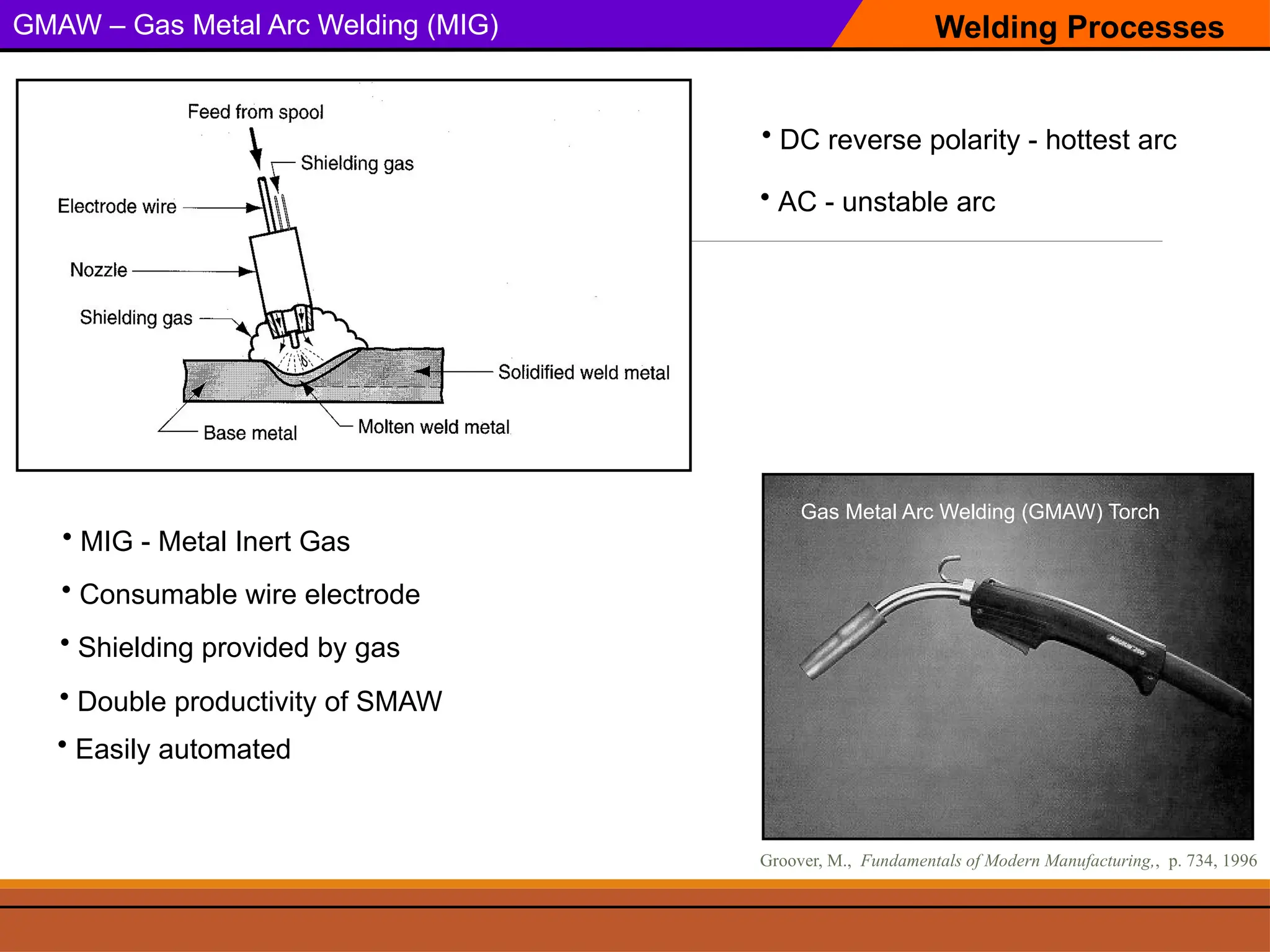
GMAW – Gas Metal Arc Welding (MIG)
• DC reverse polarity - hottest arc
• MIG - Metal Inert Gas
• Consumable wire electrode
• AC - unstable arc
Groover, M., Fundamentals of Modern Manufacturing,, p. 734, 1996
Gas Metal Arc Welding (GMAW) Torch
• Shielding provided by gas
• Double productivity of SMAW
• Easily automated
Welding Processes
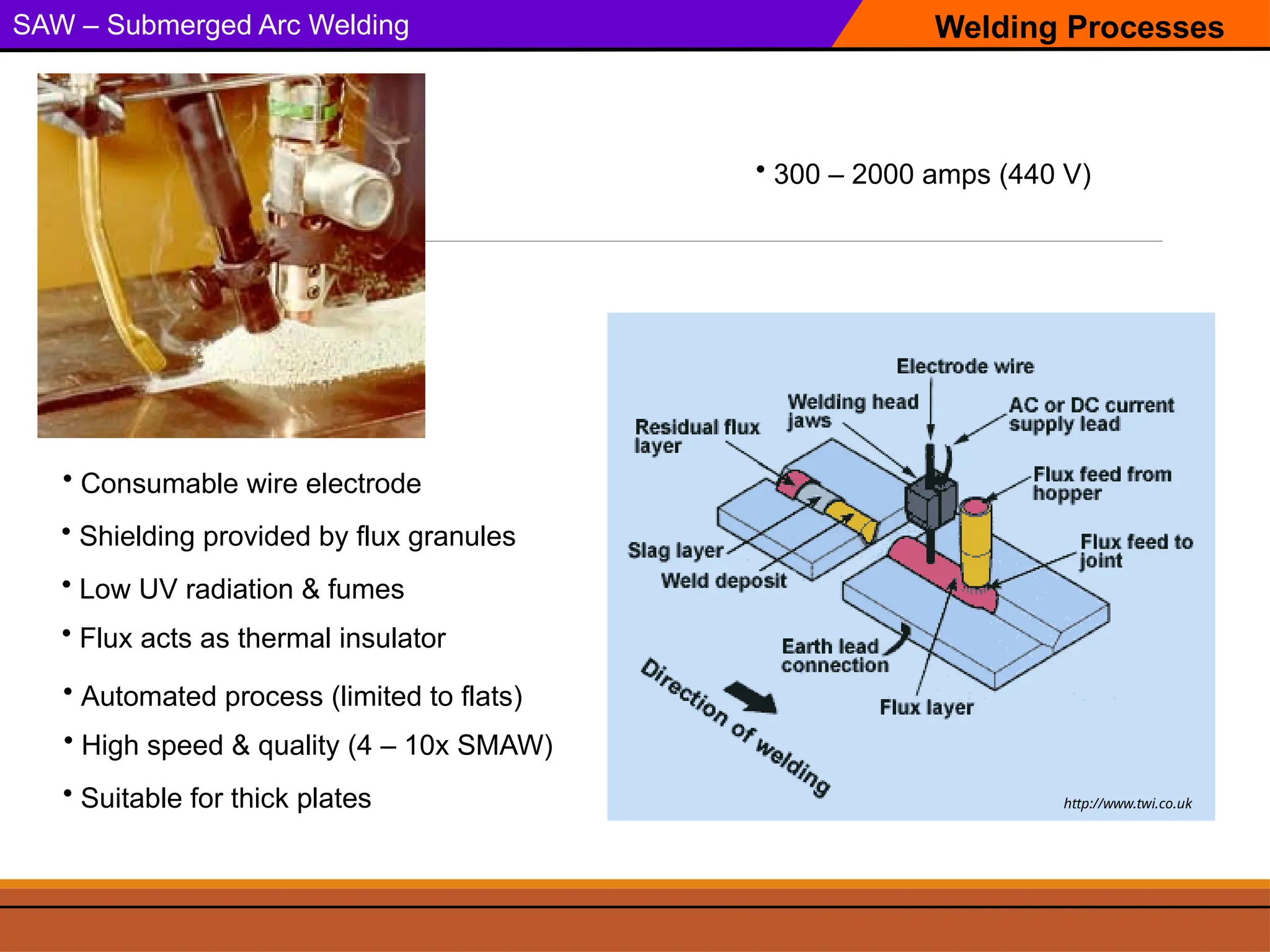
SAW – Submerged Arc Welding
• 300 – 2000 amps (440 V)
• Consumable wire electrode
Gas Metal Arc Welding (GMAW) Torch
• Shielding provided by flux granules
• Automated process (limited to flats)
• Low UV radiation & fumes
• Flux acts as thermal insulator
• High speed & quality (4 – 10x SMAW)
• Suitable for thick plates http://www.twi.co.uk
Welding Processes
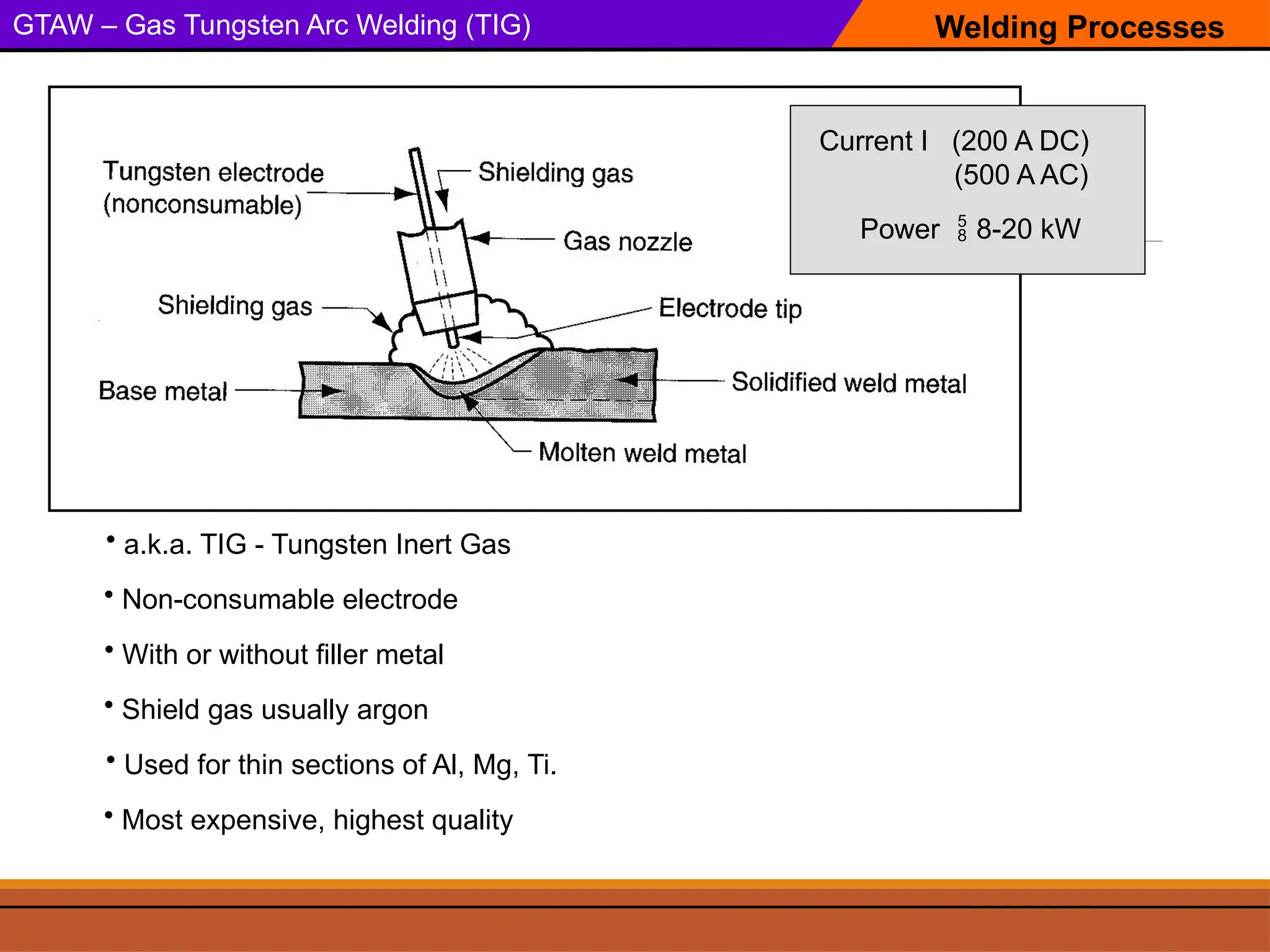
GTAW – Gas Tungsten Arc Welding (TIG)
• Non-consumable electrode
• a.k.a. TIG - Tungsten Inert Gas
• Shield gas usually argon
• Used for thin sections of Al, Mg, Ti.
• With or without filler metal
Power  8-20 kW
Current I (200 A DC)
(500 A AC)
• Most expensive, highest quality
Welding Processes
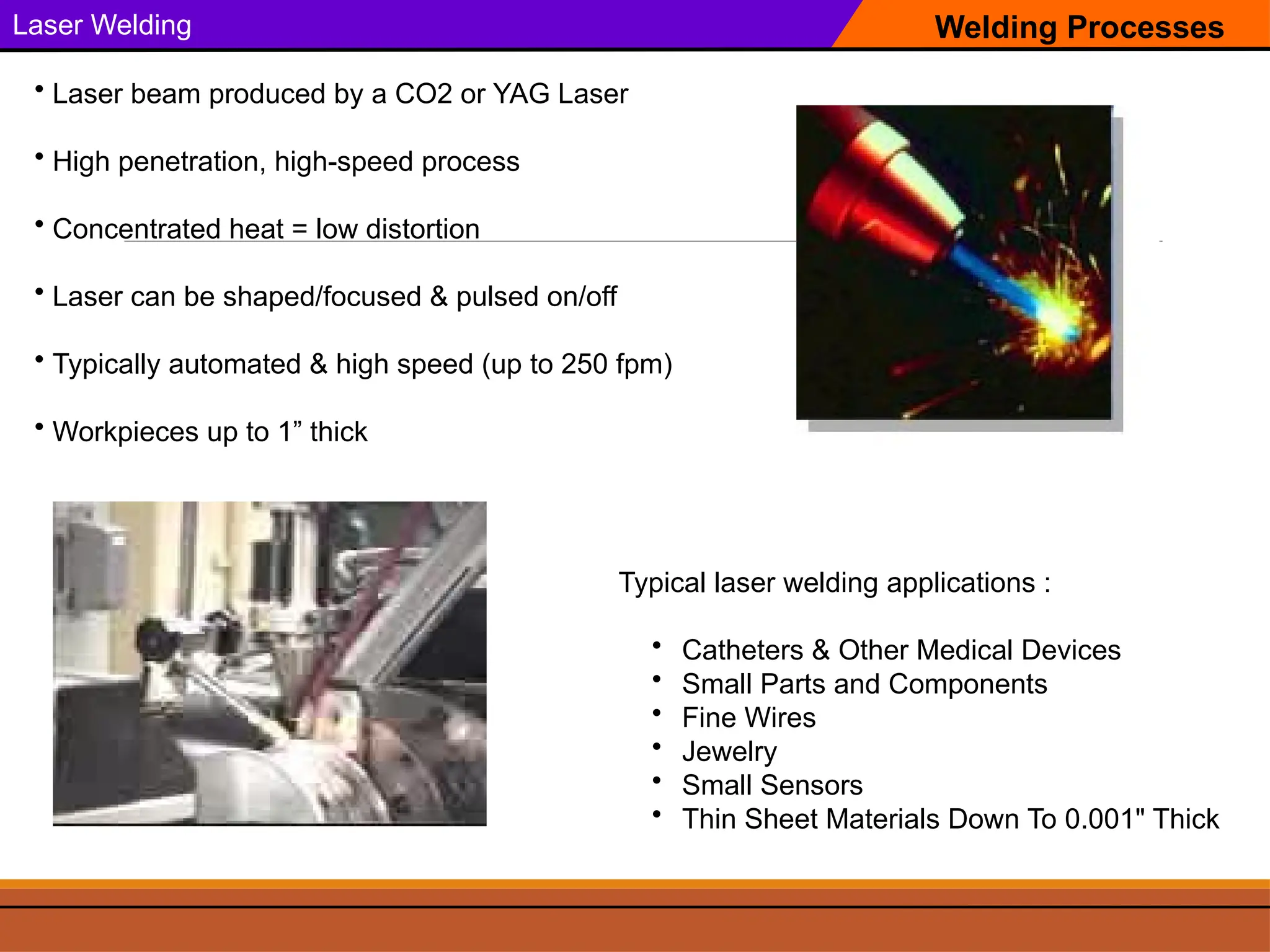
Laser Welding
Typical laser welding applications :
• Catheters & Other Medical Devices
• Small Parts and Components
• Fine Wires
• Jewelry
• Small Sensors
• Thin Sheet Materials Down To 0.001" Thick
• Laser beam produced by a CO2 or YAG Laser
• High penetration, high-speed process
• Concentrated heat = low distortion
• Laser can be shaped/focused & pulsed on/off
• Typically automated & high speed (up to 250 fpm)
• Workpieces up to 1” thick
Welding Processes
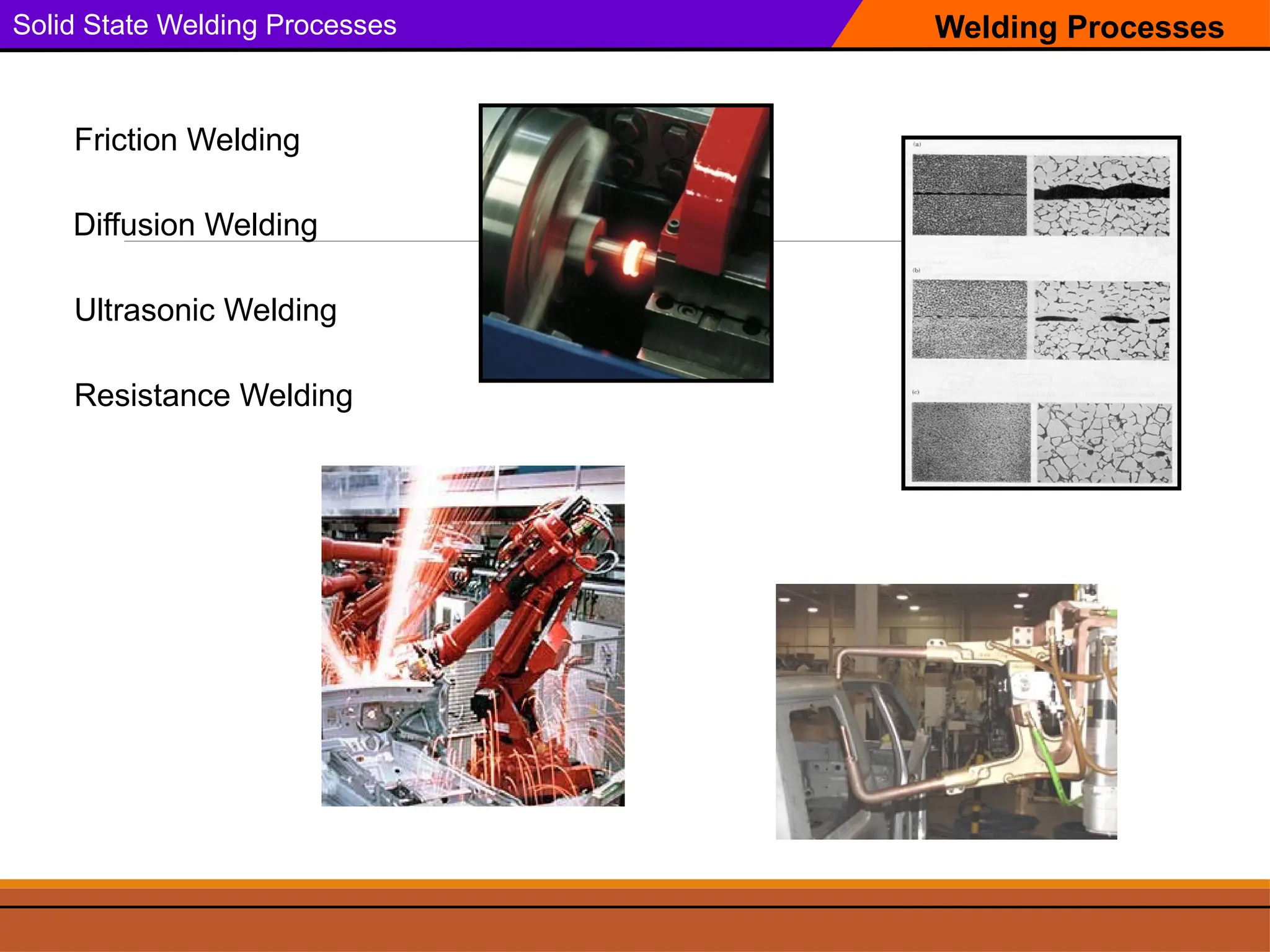
Solid State Welding Processes
Friction Welding
Ultrasonic Welding
Resistance Welding
Diffusion Welding
Welding Processes
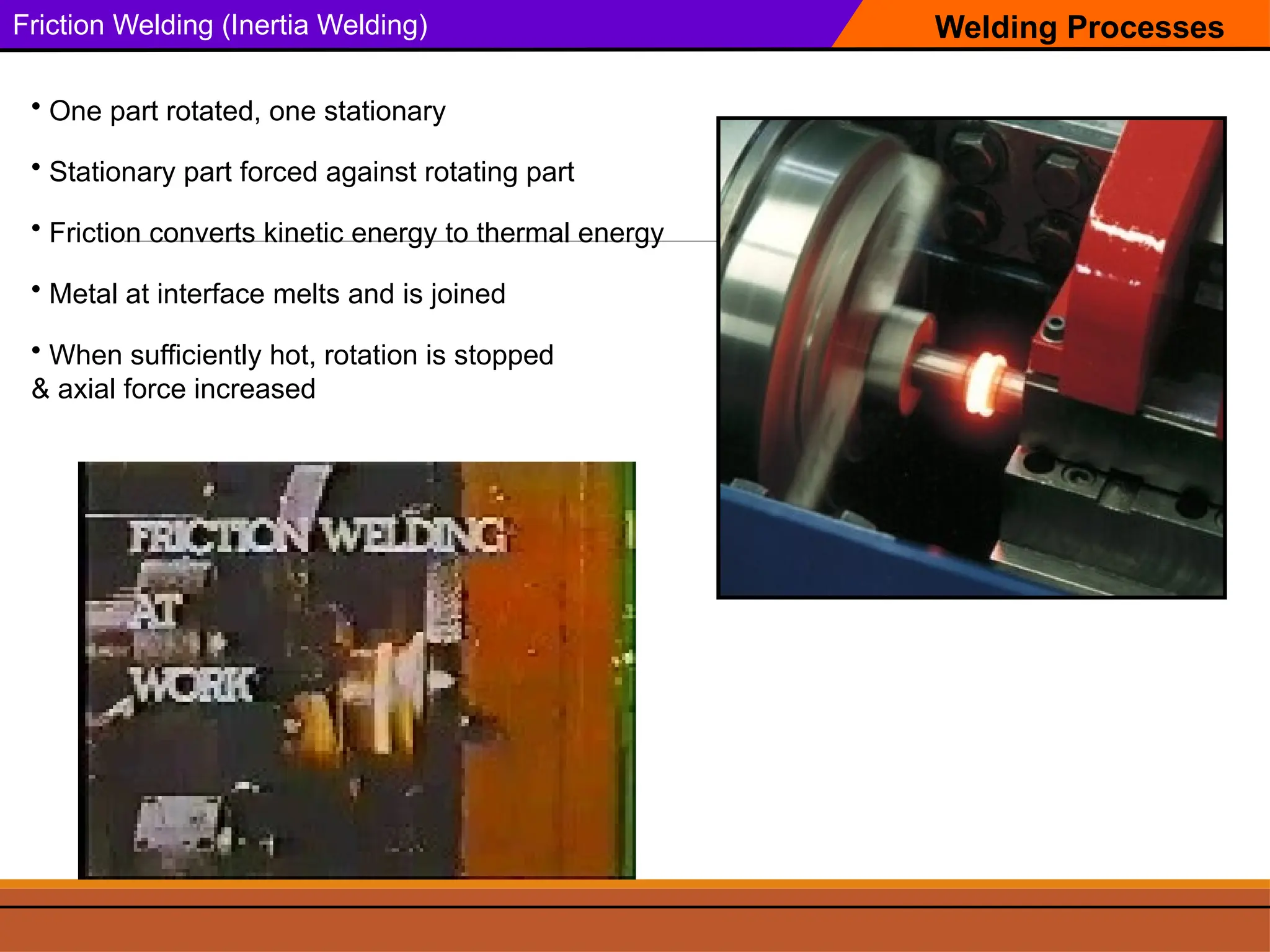
Friction Welding (Inertia Welding)
• One part rotated, one stationary
• Stationary part forced against rotating part
• Friction converts kinetic energy to thermal energy
• Metal at interface melts and is joined
• When sufficiently hot, rotation is stopped
& axial force increased
Welding Processes
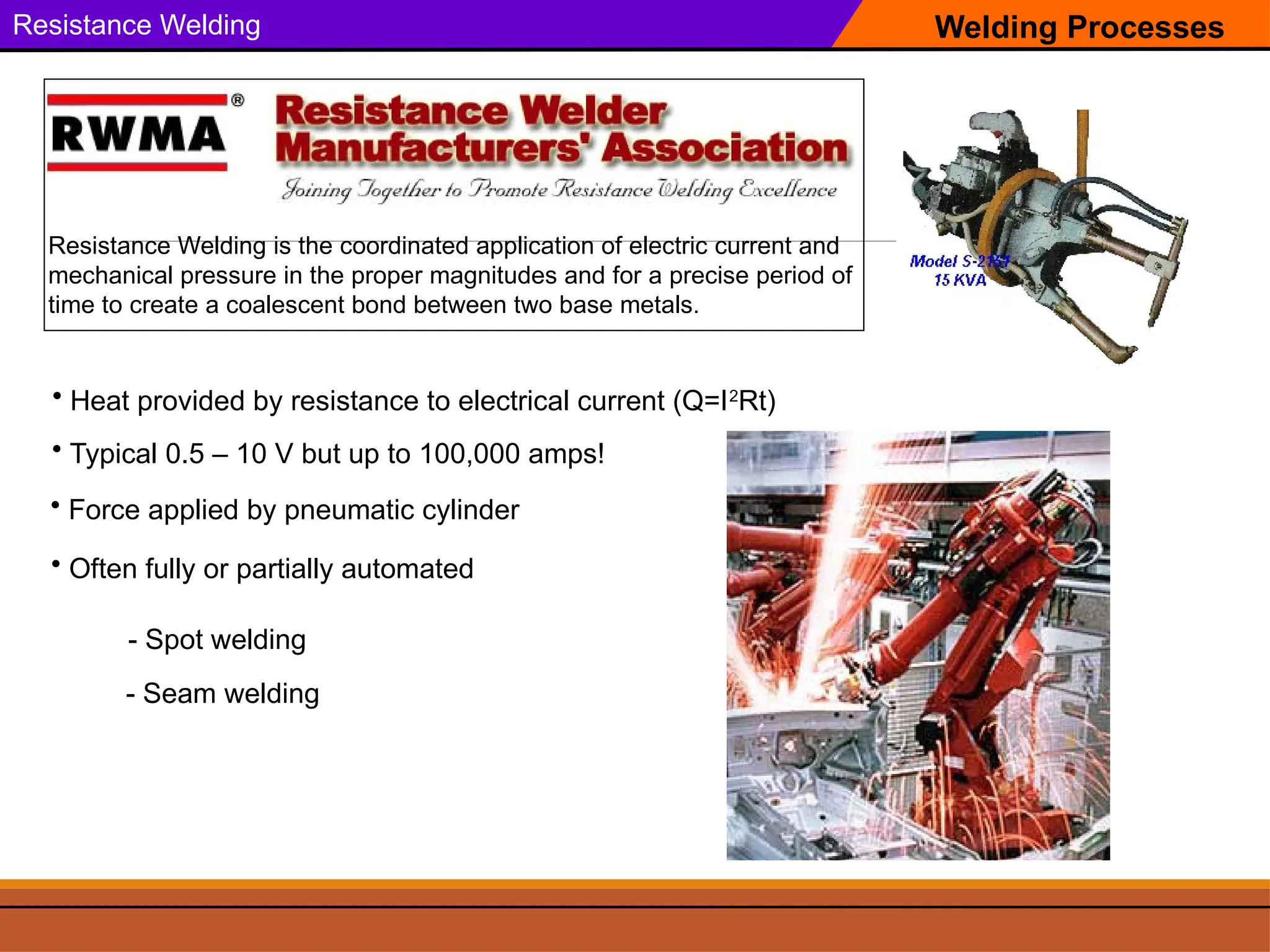
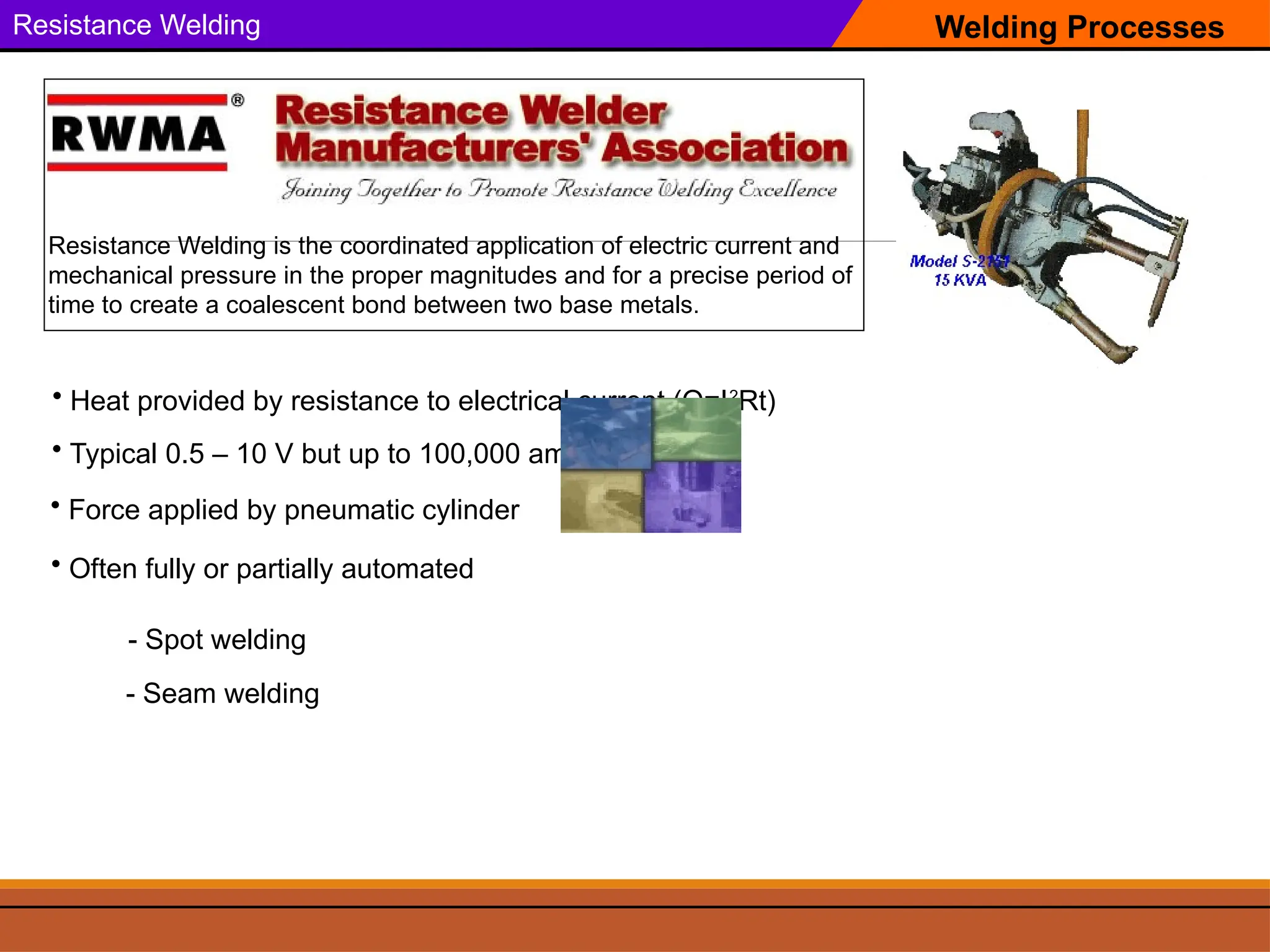
Resistance Welding
Resistance Welding is the coordinated application of electric current and
mechanical pressure in the proper magnitudes and for a precise period of
time to create a coalescent bond between two base metals.
• Heat provided by resistance to electrical current (Q=I2
Rt)
• Force applied by pneumatic cylinder
• Typical 0.5 – 10 V but up to 100,000 amps!
• Often fully or partially automated
- Spot welding
- Seam welding
Welding Processes
Resistance Welding
Resistance Welding is the coordinated application of electric current and
mechanical pressure in the proper magnitudes and for a precise period of
time to create a coalescent bond between two base metals.
• Heat provided by resistance to electrical current (Q=I2
Rt)
• Force applied by pneumatic cylinder
• Typical 0.5 – 10 V but up to 100,000 amps!
• Often fully or partially automated
- Spot welding
- Seam welding
Welding Processes
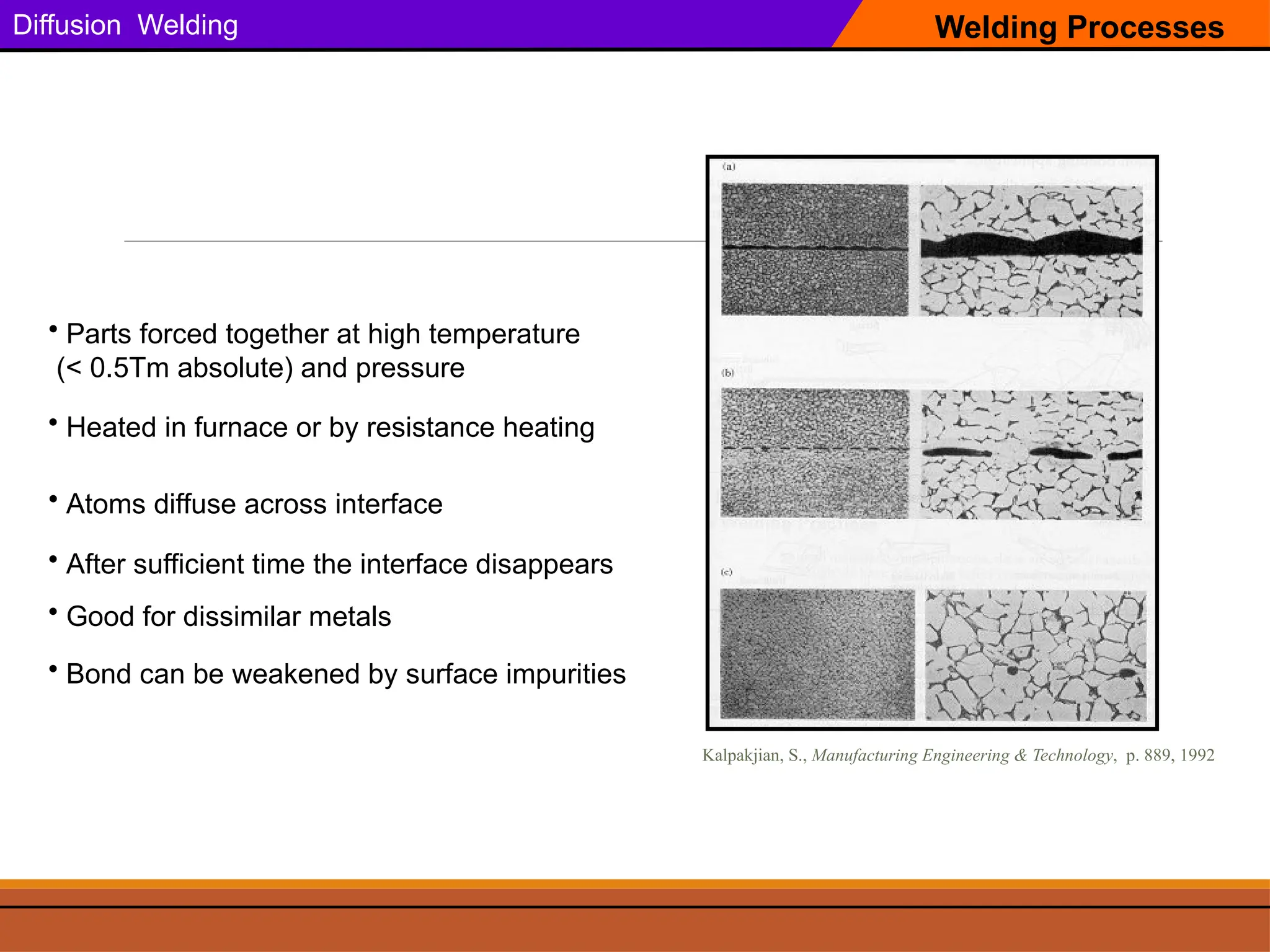
Diffusion Welding
• Parts forced together at high temperature
(< 0.5Tm absolute) and pressure
Kalpakjian, S., Manufacturing Engineering & Technology, p. 889, 1992
• Atoms diffuse across interface
• After sufficient time the interface disappears
• Good for dissimilar metals
• Heated in furnace or by resistance heating
• Bond can be weakened by surface impurities
Welding Classification
•Gas arc welding.
1. Air acetylene welding.
2. Oxyacetylene welding.
3. Pressure gas welding.
•Arc welding.
1. Carbon arc welding.
2. Shielded metal arc welding.
3. TIG welding.
4. MIG welding.
5. Plasma arc welding
Welding classification
•Pressure welding process
•Process requires both heat and pressure for joining. It does not require filler metal.
1. Spot welding.
2. Seam welding.
3. Projection welding.
•Other fusion process.
1. Electron beam welding.
2. Laser beam welding.
Acetylene gas welding
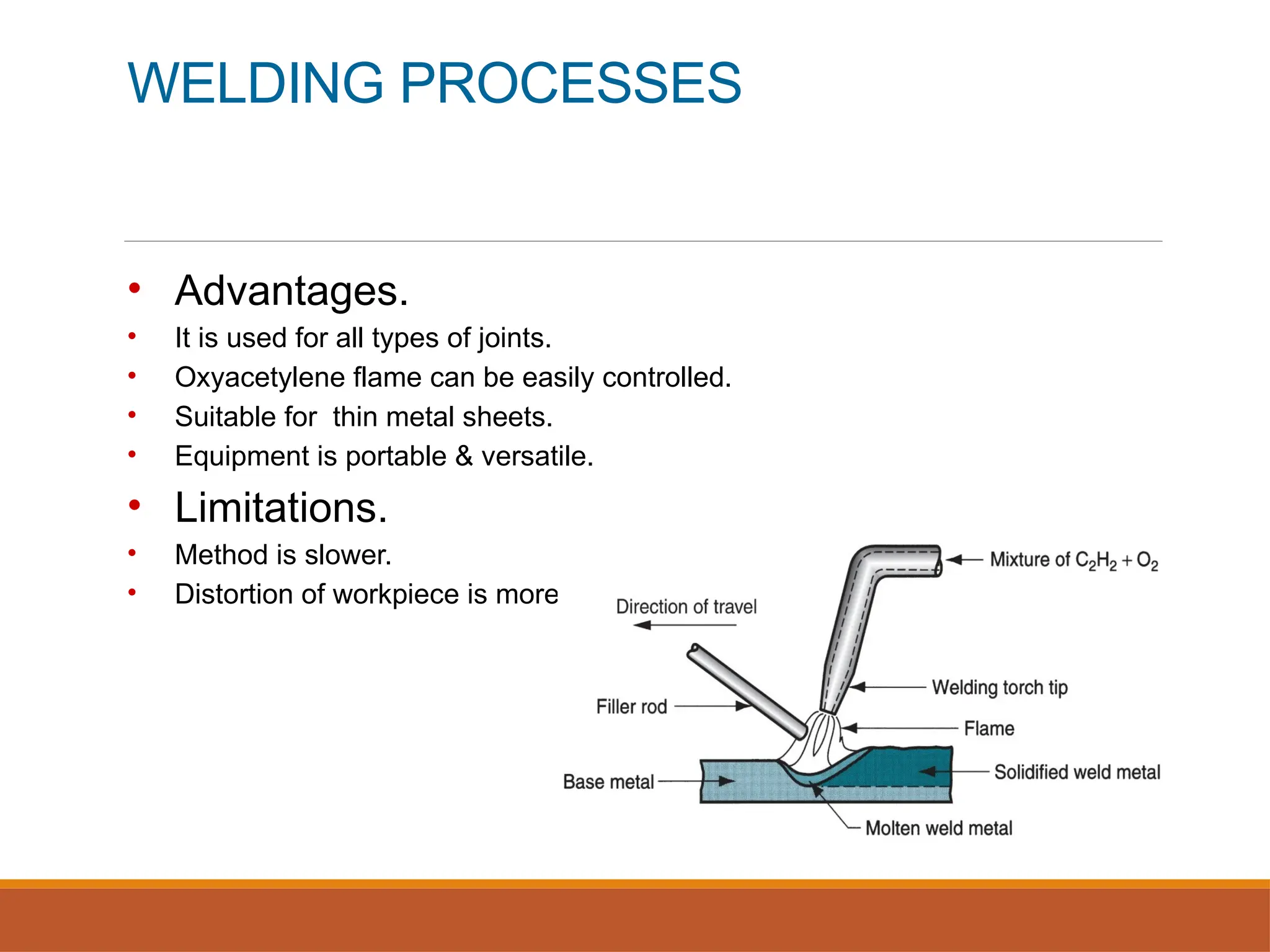
In this process oxygen and acetylene gas is used for welding process.
It rises the temperature of metal above melting point.
Filler material is used for joining.
Operation
In this process oxygen and acetylene is used for the welding.
Oxygen supports the combustion and acetylene gas generate high temp.
Operation starts with placing the part togather which is to be join.
Oxiacetylene flame heat the metal temp produced is about 3200°c.
Filler metal is added to the join which join the parts by melting it self.
filler material is copper coated steel, carbon steel.
chemical reaction at tip is as followed.
2C²H²+5O²→4CO²+2H²O
WELDING PROCESSES
• Advantages.
• It is used for all types of joints.
• Oxyacetylene flame can be easily controlled.
• Suitable for thin metal sheets.
• Equipment is portable & versatile.
• Limitations.
• Method is slower.
• Distortion of workpiece is more.
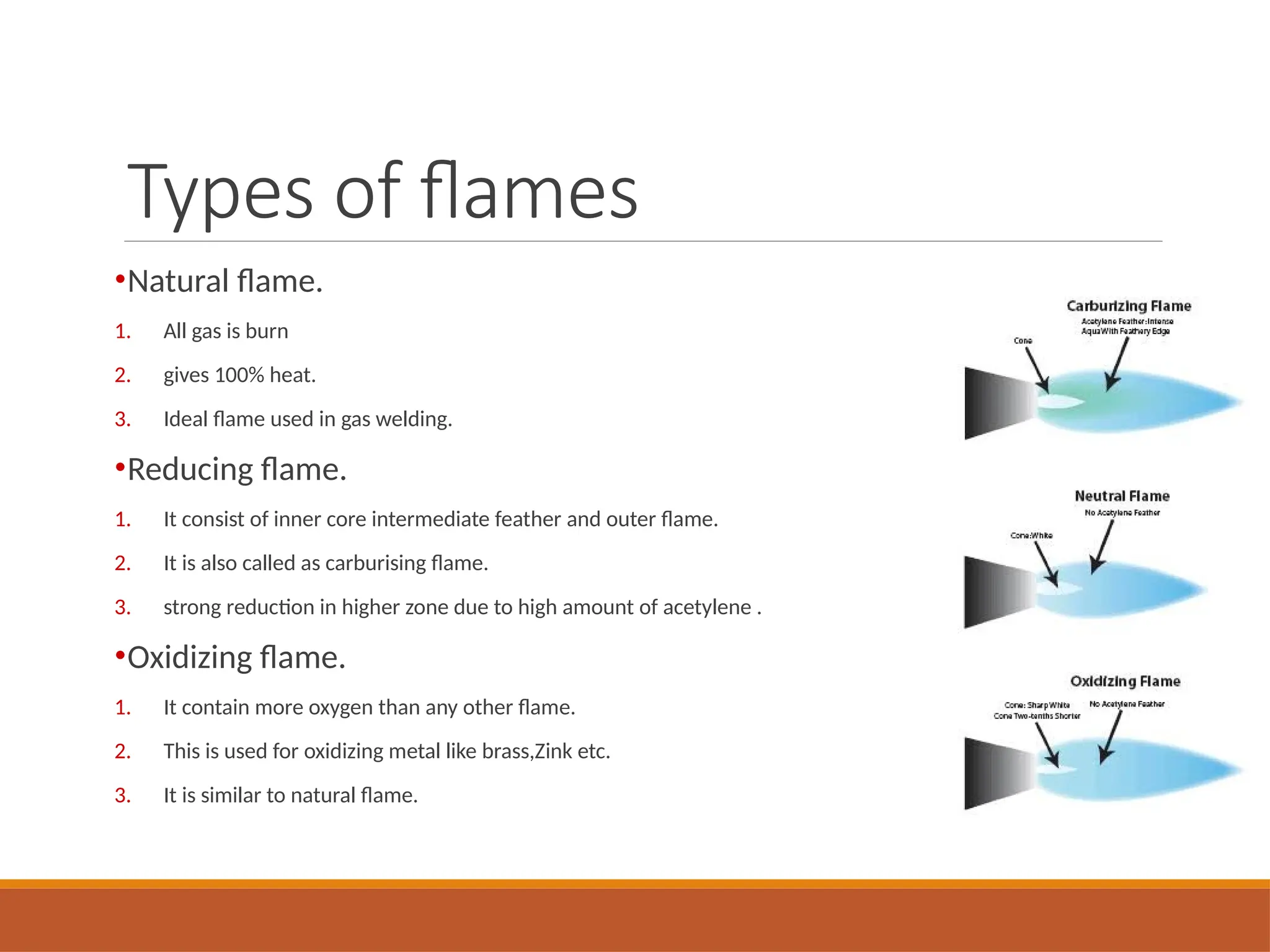
Types of flames
•Natural flame.
1. All gas is burn
2. gives 100% heat.
3. Ideal flame used in gas welding.
•Reducing flame.
1. It consist of inner core intermediate feather and outer flame.
2. It is also called as carburising flame.
3. strong reduction in higher zone due to high amount of acetylene .
•Oxidizing flame.
1. It contain more oxygen than any other flame.
2. This is used for oxidizing metal like brass,Zink etc.
3. It is similar to natural flame.
Arc welding
In this process heat generation takes place by an electric arc.
Both work piece and electrod is connected to different terminals of AC or DC supply.
small gap bet work piece and electrod arc is generated.
It produces temp about 3600°c.
It having following types.
1. Carbon Arc welding.
2. Shielded metal arc welding.
3. Gas shielded arc welding.
4. Plasma arc welding.
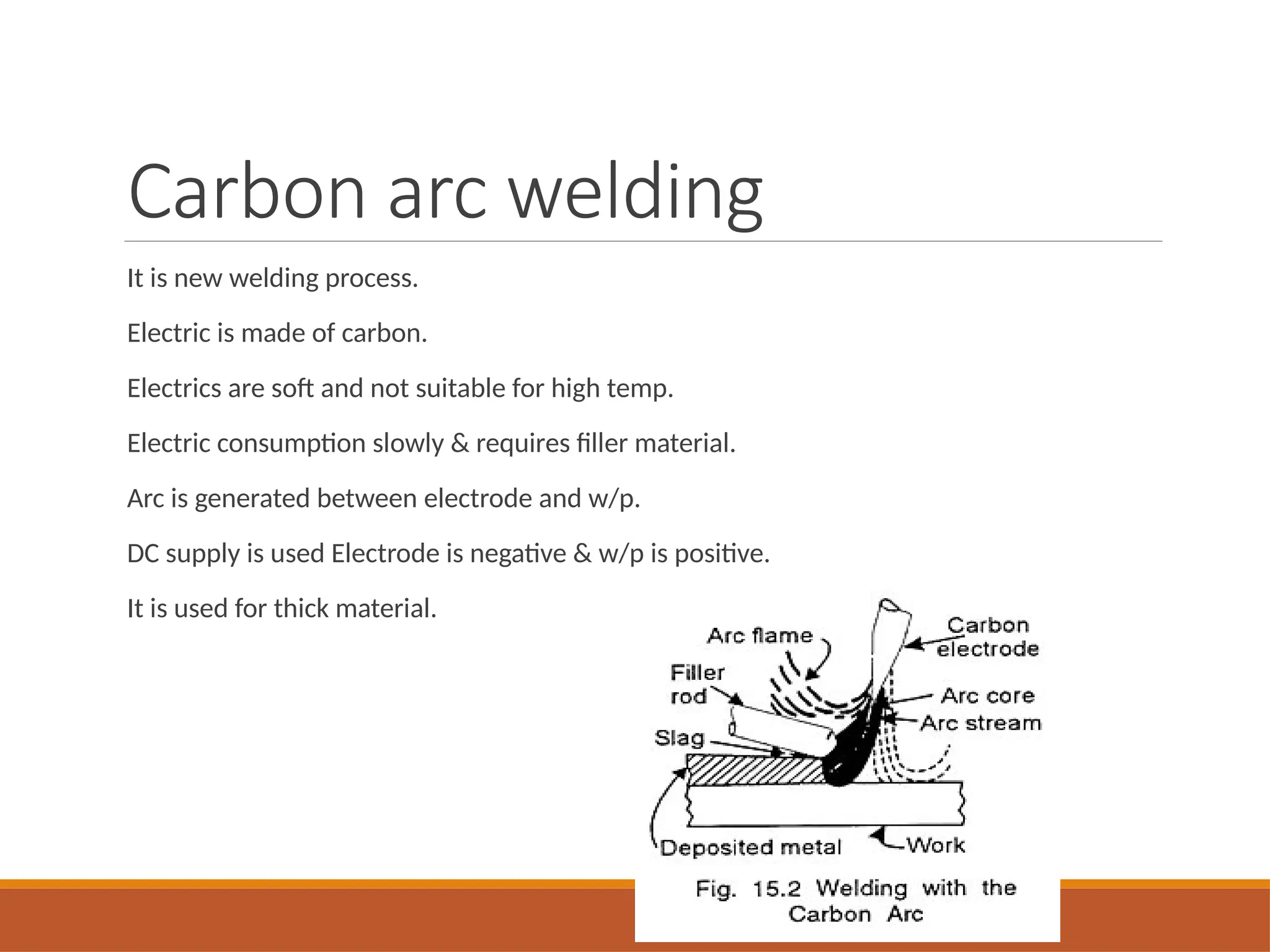
Carbon arc welding
It is new welding process.
Electric is made of carbon.
Electrics are soft and not suitable for high temp.
Electric consumption slowly & requires filler material.
Arc is generated between electrode and w/p.
DC supply is used Electrode is negative & w/p is positive.
It is used for thick material.
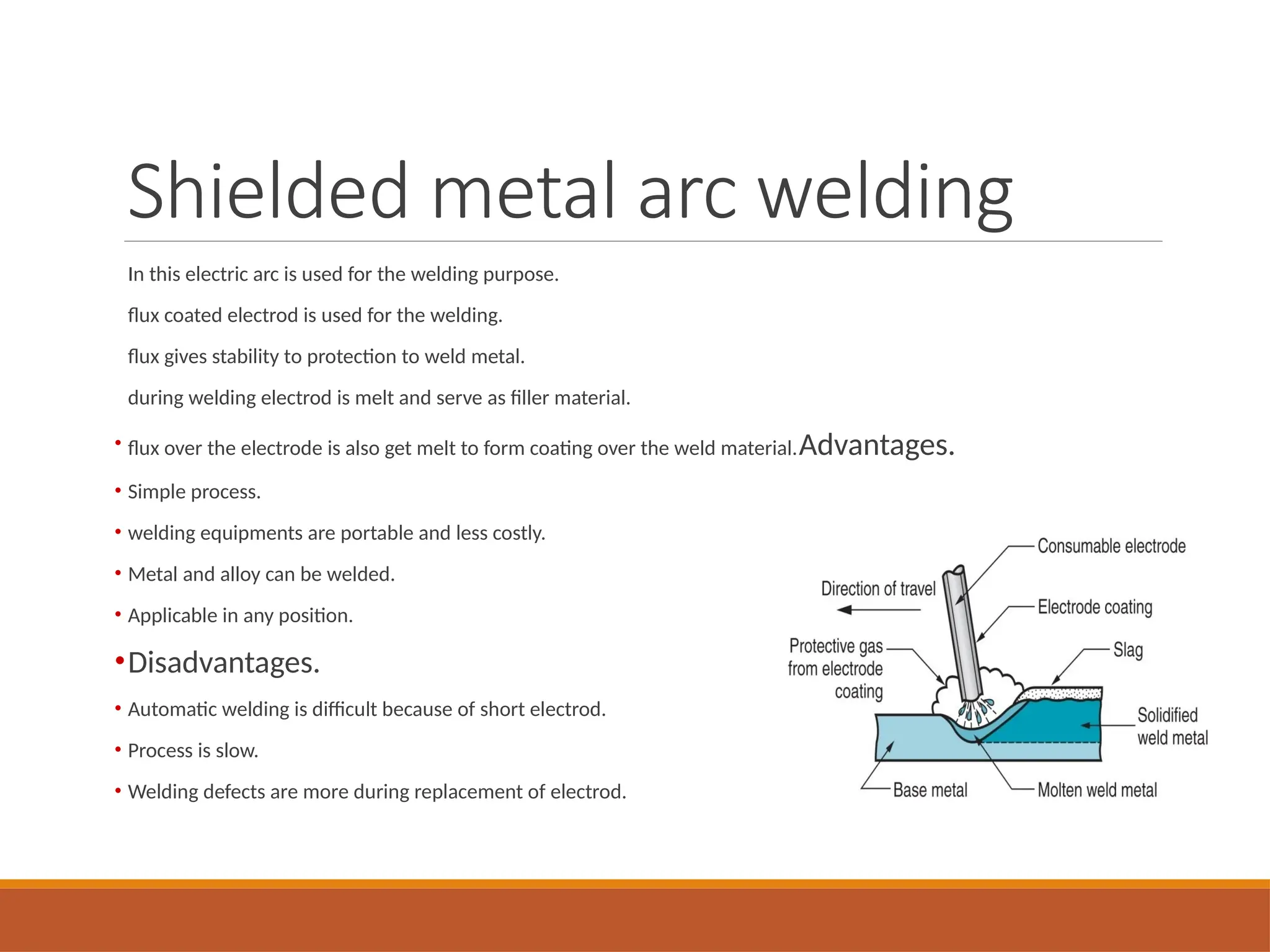
Shielded metal arc welding
In this electric arc is used for the welding purpose.
flux coated electrod is used for the welding.
flux gives stability to protection to weld metal.
during welding electrod is melt and serve as filler material.
• flux over the electrode is also get melt to form coating over the weld material.Advantages.
• Simple process.
• welding equipments are portable and less costly.
• Metal and alloy can be welded.
• Applicable in any position.
•Disadvantages.
• Automatic welding is difficult because of short electrod.
• Process is slow.
• Welding defects are more during replacement of electrod.
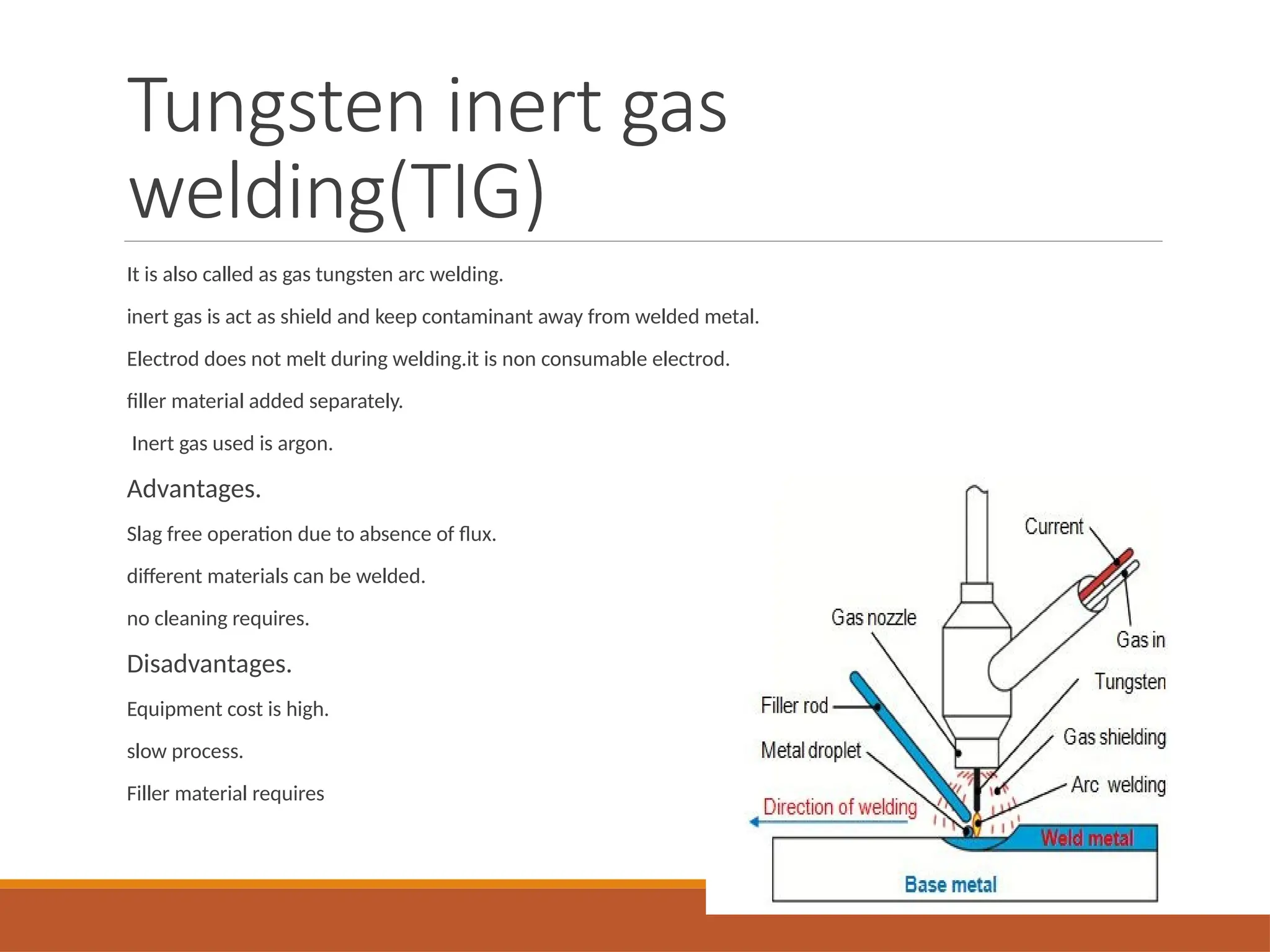
Tungsten inert gas
welding(TIG)
It is also called as gas tungsten arc welding.
inert gas is act as shield and keep contaminant away from welded metal.
Electrod does not melt during welding.it is non consumable electrod.
filler material added separately.
Inert gas used is argon.
Advantages.
Slag free operation due to absence of flux.
different materials can be welded.
no cleaning requires.
Disadvantages.
Equipment cost is high.
slow process.
Filler material requires
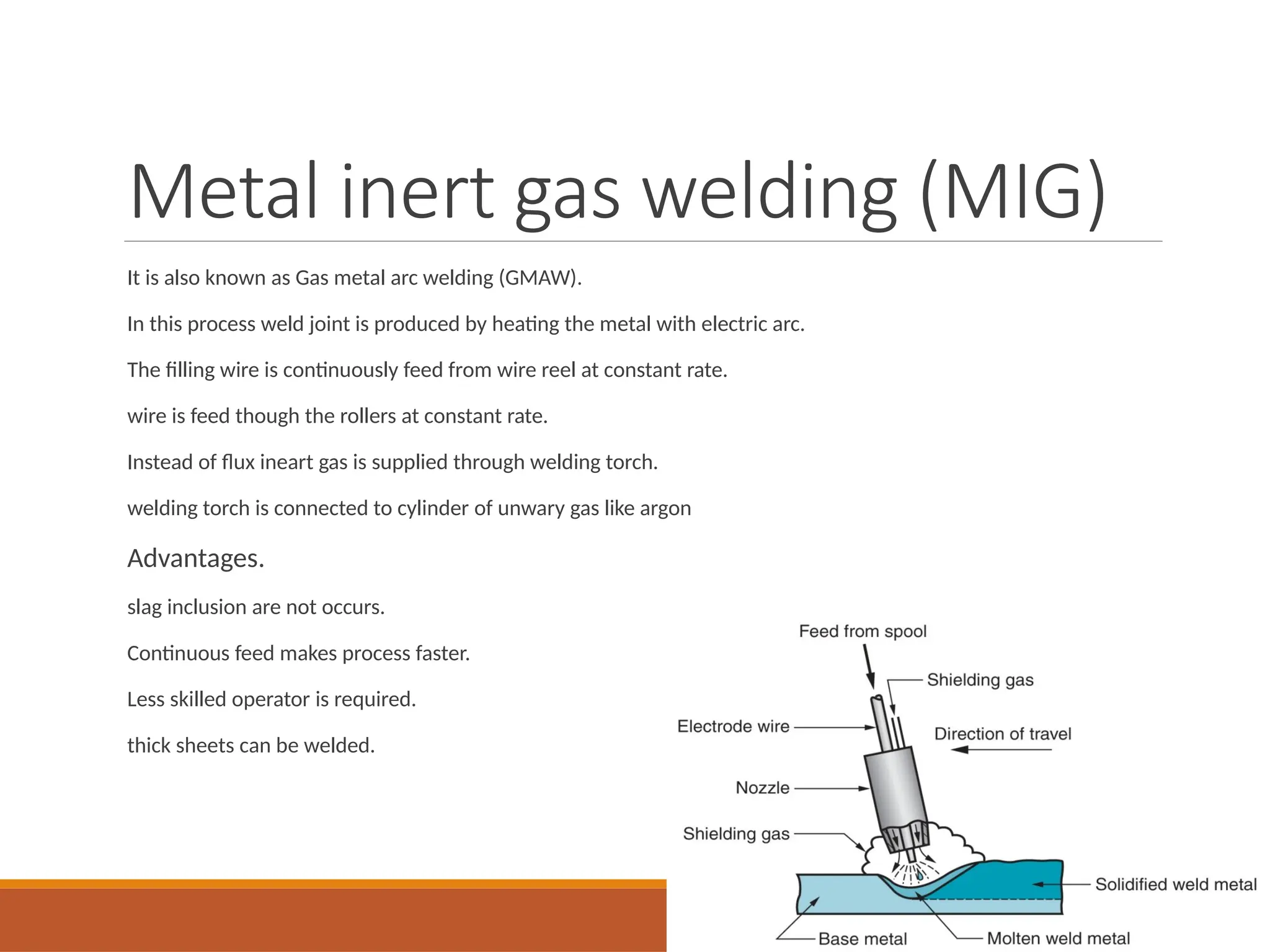
Metal inert gas welding (MIG)
It is also known as Gas metal arc welding (GMAW).
In this process weld joint is produced by heating the metal with electric arc.
The filling wire is continuously feed from wire reel at constant rate.
wire is feed though the rollers at constant rate.
Instead of flux ineart gas is supplied through welding torch.
welding torch is connected to cylinder of unwary gas like argon
Advantages.
slag inclusion are not occurs.
Continuous feed makes process faster.
Less skilled operator is required.
thick sheets can be welded.
Disadvantages.
Process is complicated.
setup is complicated.
Initial cost is high..
Applications.
For welding of commercial
metals like Nickel,killed steel.
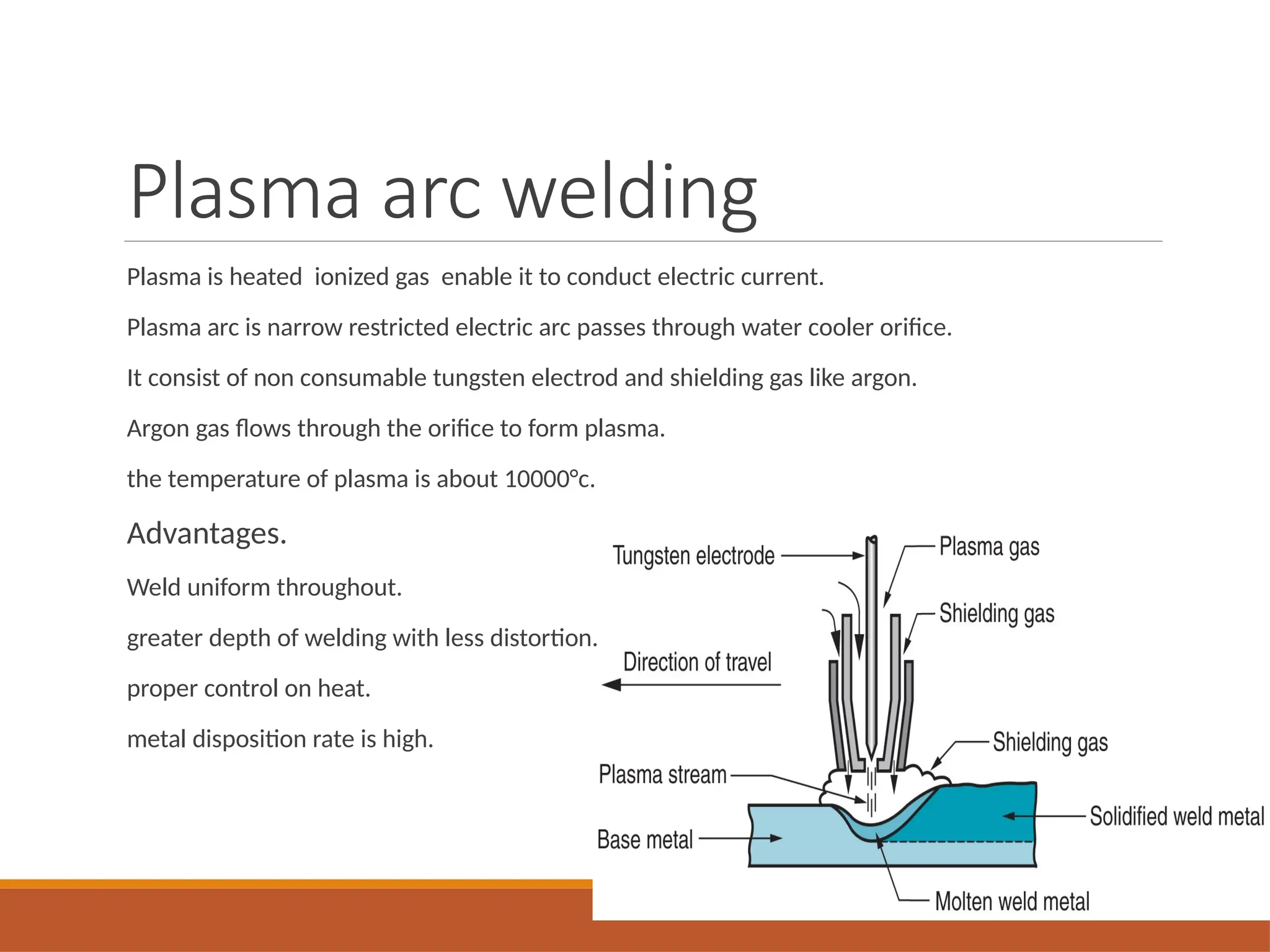
Plasma arc welding
Plasma is heated ionized gas enable it to conduct electric current.
Plasma arc is narrow restricted electric arc passes through water cooler orifice.
It consist of non consumable tungsten electrod and shielding gas like argon.
Argon gas flows through the orifice to form plasma.
the temperature of plasma is about 10000°c.
Advantages.
Weld uniform throughout.
greater depth of welding with less distortion.
proper control on heat.
metal disposition rate is high.
Plasma arc welding
Limitations.
Welding equipments are expensive.
frequent replacement of nozzle.
Applications
Stainless steel welding.
Nickel alloy in aero plane.
Aluminium or graphite nozzles for rocket
Resistance welding
In these process heat and pressure is applied on joint.
No additional filler or flux material required.
joint is obtained by means of electrical resisitance.
During process heavy current about 15000A is passed over joint with limited
area for short time.
Heavy current heat joint up to plastic state.
due to high pressure metal get fused and forms joint.
Heat generated is given as bellow H= CI2Rt
It is classified as
1.Spot Welding
2.Seam Welding
3.Projection welding
4.Upset Welding
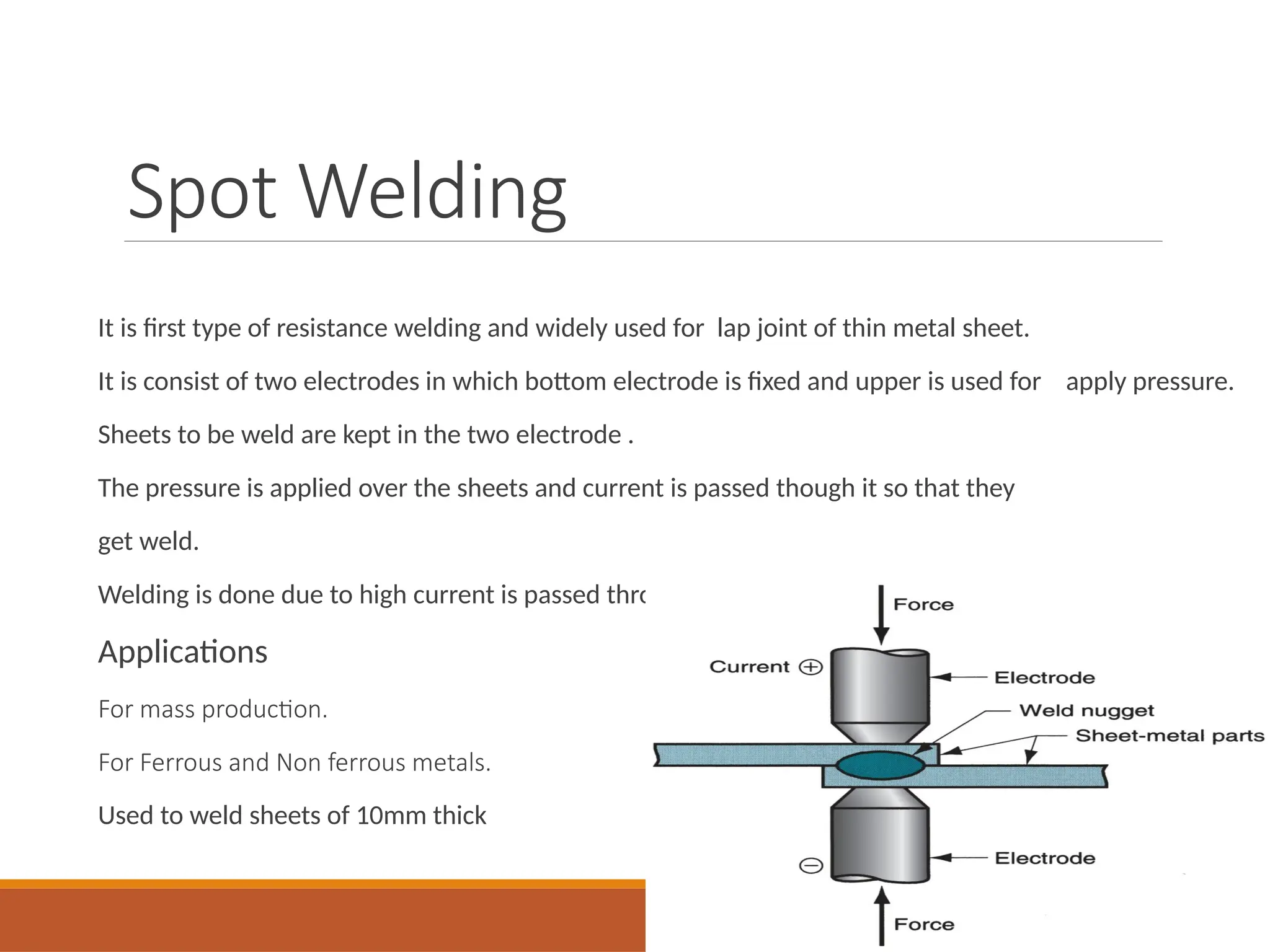
Spot Welding
It is first type of resistance welding and widely used for lap joint of thin metal sheet.
It is consist of two electrodes in which bottom electrode is fixed and upper is used for apply pressure.
Sheets to be weld are kept in the two electrode .
The pressure is applied over the sheets and current is passed though it so that they
get weld.
Welding is done due to high current is passed through the metal plates which produce heat.
Applications
For mass production.
For Ferrous and Non ferrous metals.
Used to weld sheets of 10mm thick
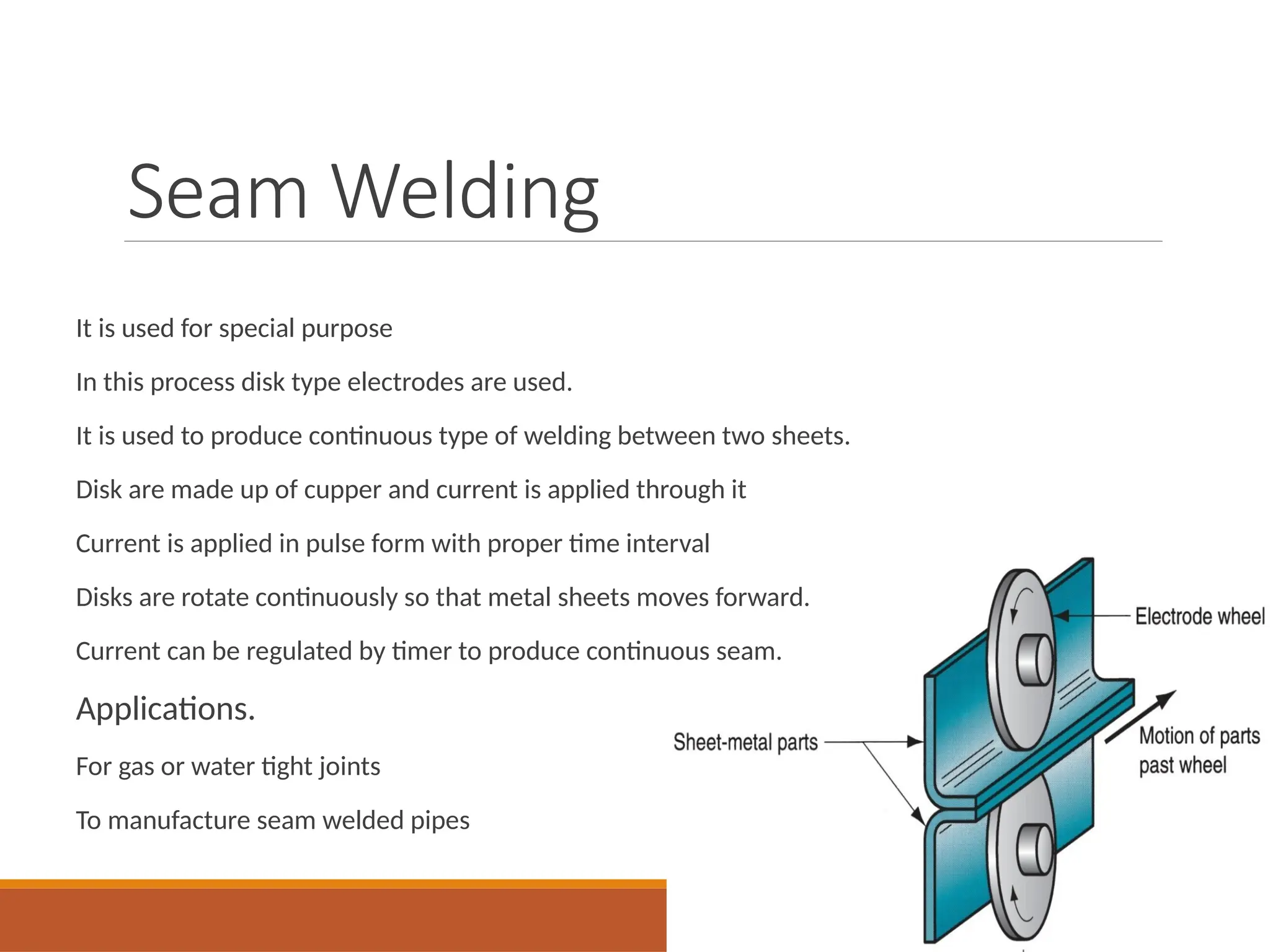
Seam Welding
It is used for special purpose
In this process disk type electrodes are used.
It is used to produce continuous type of welding between two sheets.
Disk are made up of cupper and current is applied through it
Current is applied in pulse form with proper time interval
Disks are rotate continuously so that metal sheets moves forward.
Current can be regulated by timer to produce continuous seam.
Applications.
For gas or water tight joints
To manufacture seam welded pipes
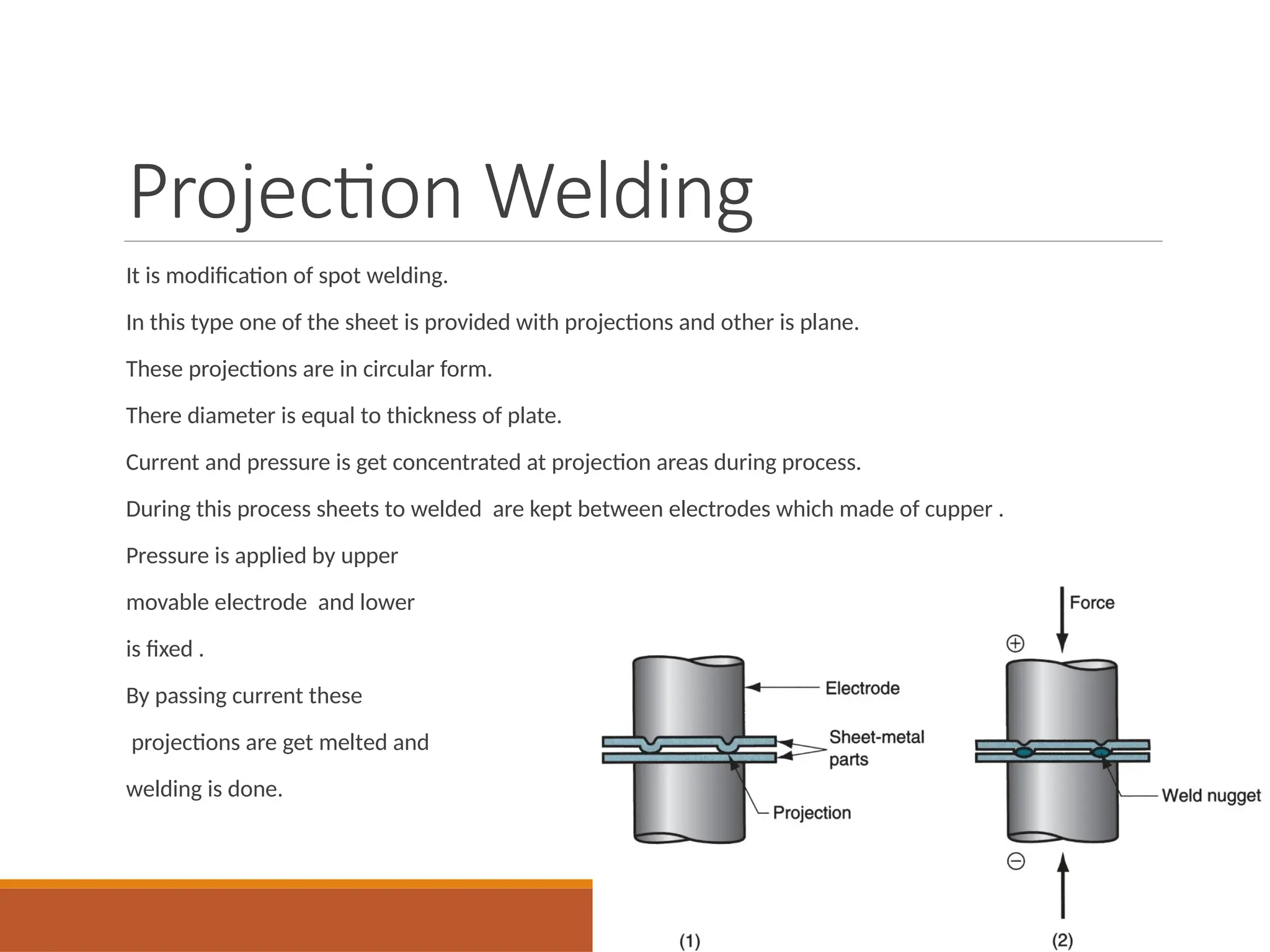
Projection Welding
It is modification of spot welding.
In this type one of the sheet is provided with projections and other is plane.
These projections are in circular form.
There diameter is equal to thickness of plate.
Current and pressure is get concentrated at projection areas during process.
During this process sheets to welded are kept between electrodes which made of cupper .
Pressure is applied by upper
movable electrode and lower
is fixed .
By passing current these
projections are get melted and
welding is done.
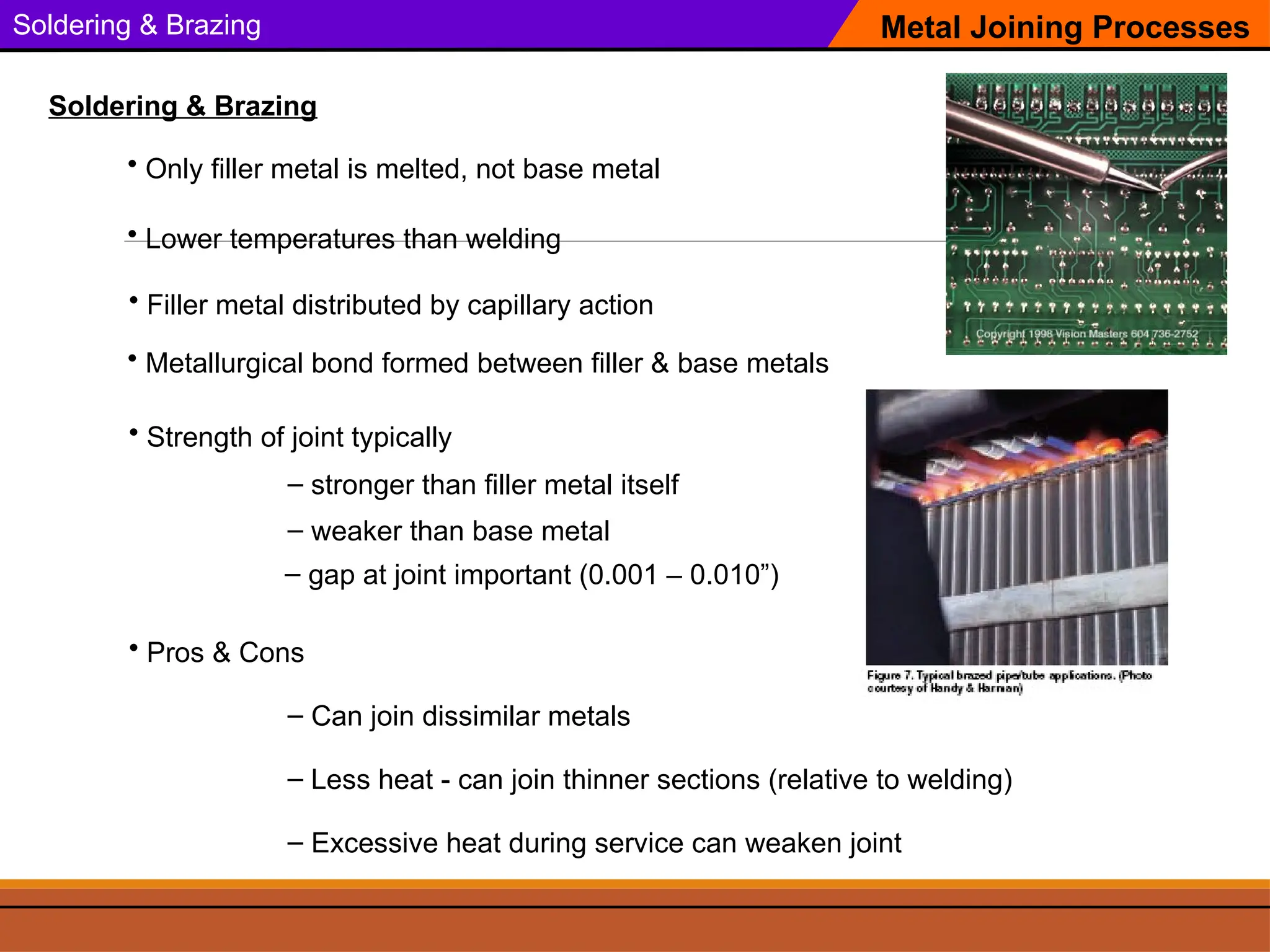
Soldering & Brazing Metal Joining Processes
Soldering & Brazing
• Filler metal distributed by capillary action
• Only filler metal is melted, not base metal
• Strength of joint typically
– Can join dissimilar metals
– Less heat - can join thinner sections (relative to welding)
– stronger than filler metal itself
– weaker than base metal
– Excessive heat during service can weaken joint
• Pros & Cons
• Lower temperatures than welding
– gap at joint important (0.001 – 0.010”)
• Metallurgical bond formed between filler & base metals
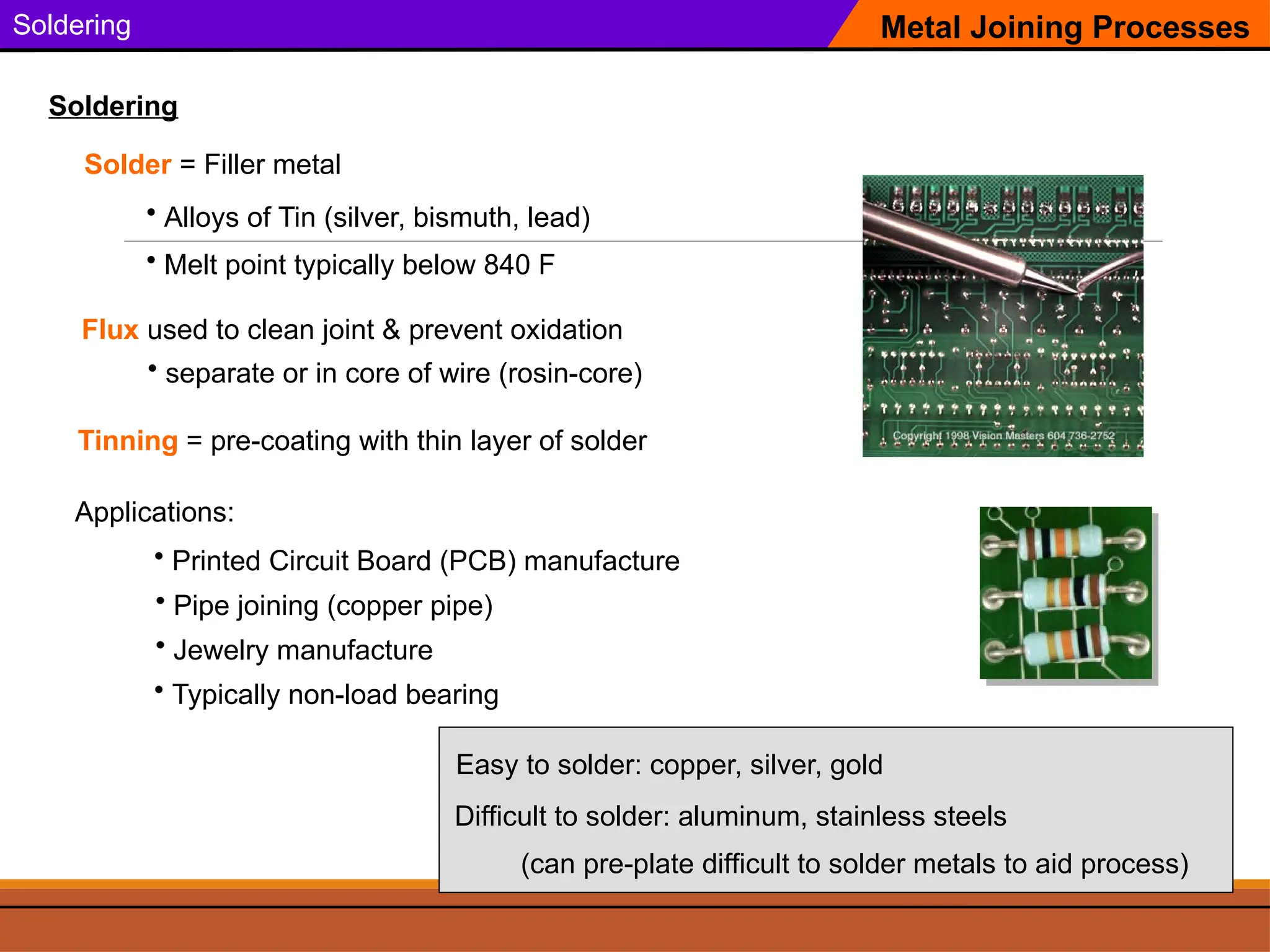
Soldering
Solder = Filler metal
Metal Joining Processes
Soldering
Applications:
• Printed Circuit Board (PCB) manufacture
• Pipe joining (copper pipe)
• Jewelry manufacture
Easy to solder: copper, silver, gold
Difficult to solder: aluminum, stainless steels
(can pre-plate difficult to solder metals to aid process)
• Alloys of Tin (silver, bismuth, lead)
• Melt point typically below 840 F
Flux used to clean joint & prevent oxidation
• Typically non-load bearing
Tinning = pre-coating with thin layer of solder
• separate or in core of wire (rosin-core)
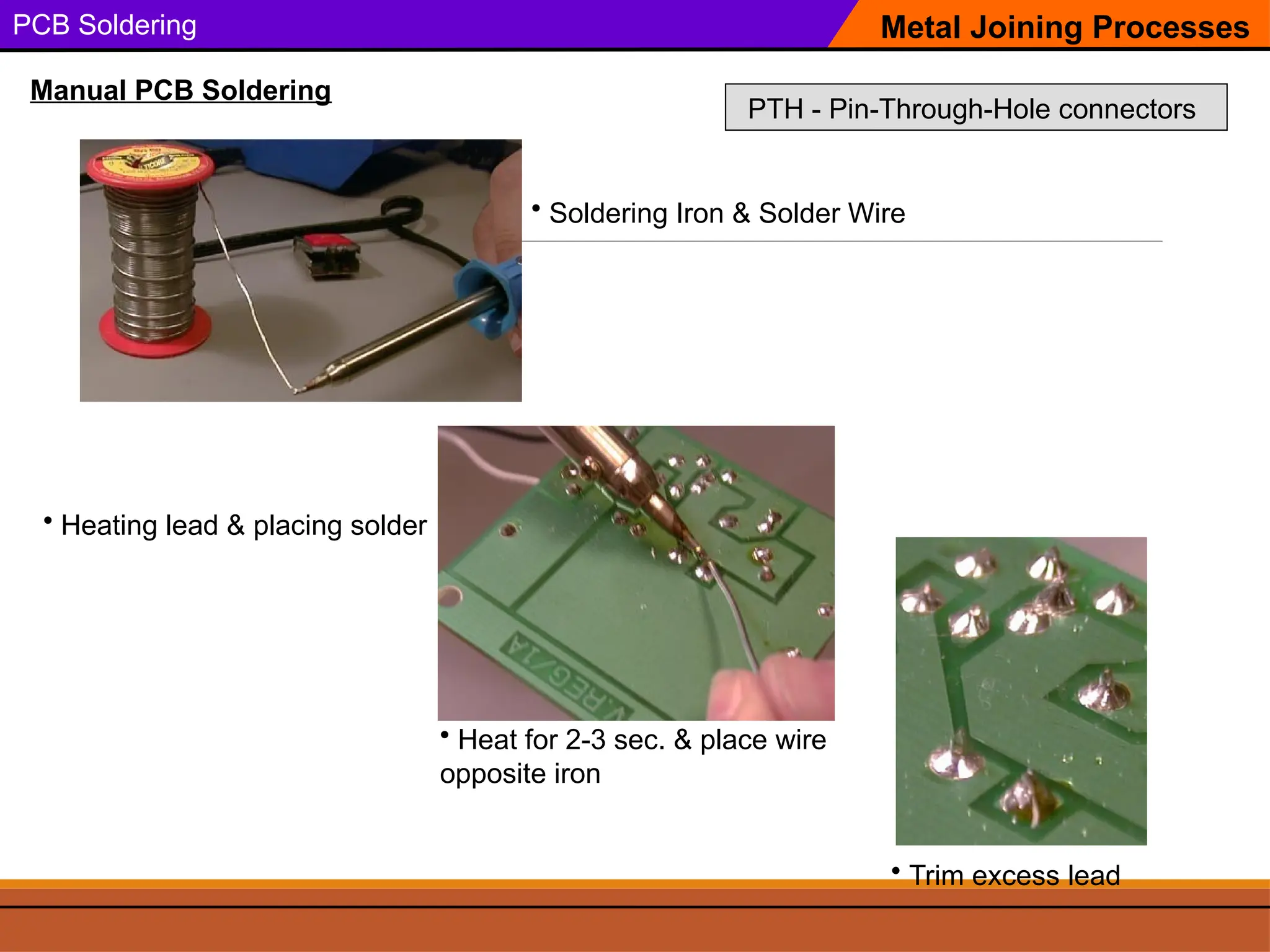
PCB Soldering
• Soldering Iron & Solder Wire
Metal Joining Processes
Manual PCB Soldering
• Heating lead & placing solder
• Trim excess lead
• Heat for 2-3 sec. & place wire
opposite iron
PTH - Pin-Through-Hole connectors
PCB Reflow Soldering Metal Joining Processes
Automated Reflow Soldering
SMT = Surface Mount Technology
Printed solder paste on a printed circuit board (PCB)
• Solder Paste serves the following functions:
– supply solder material to the soldering spot,
– hold the components in place prior to soldering,
– clean the solder lands and component leads
– prevent further oxidation of the solder lands.
• Solder/Flux paste mixture applied to PCB using screen print or similar
transfer method
• PCB assembly then heated in “Reflow” oven to melt solder and secure connection
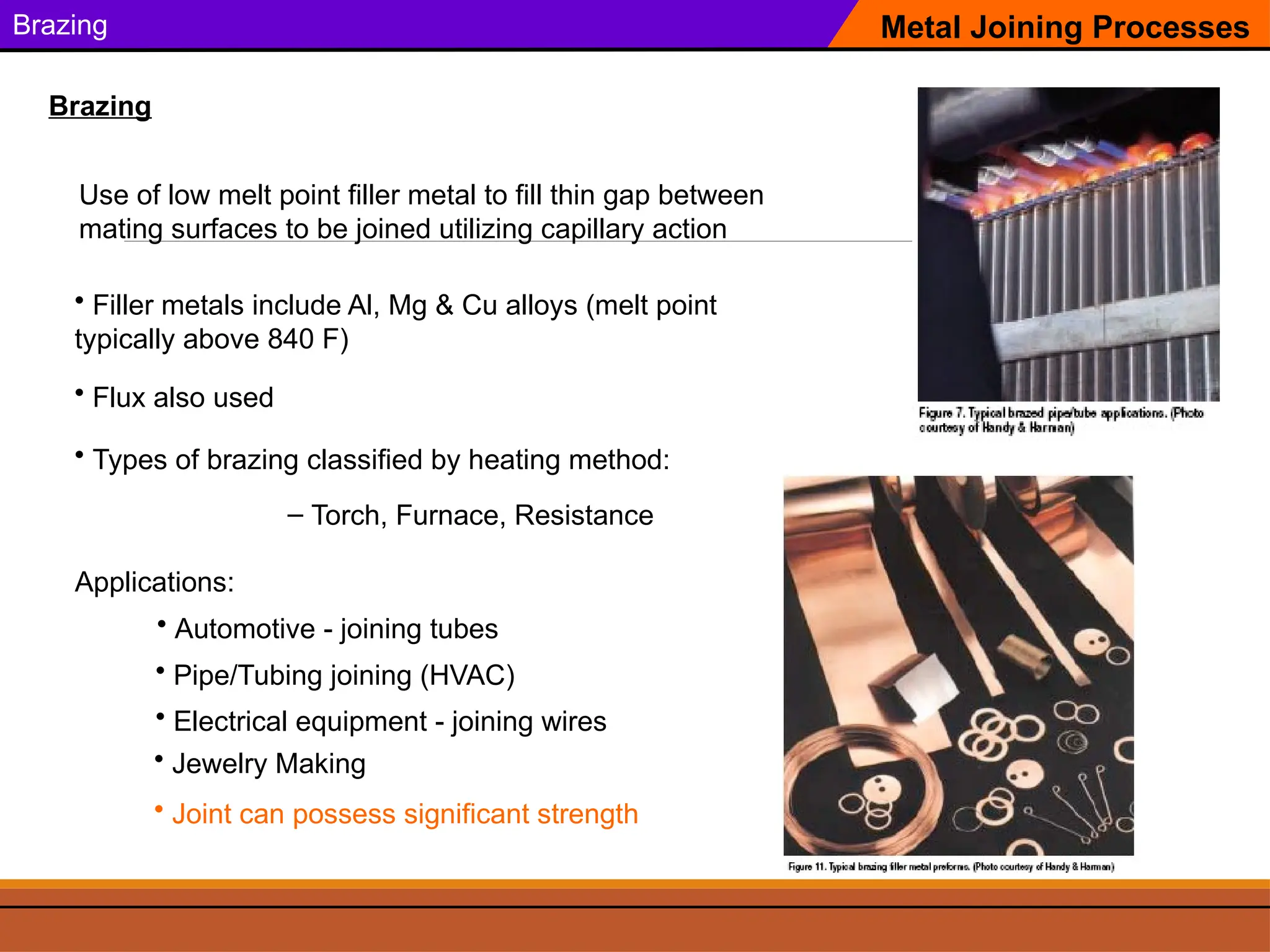
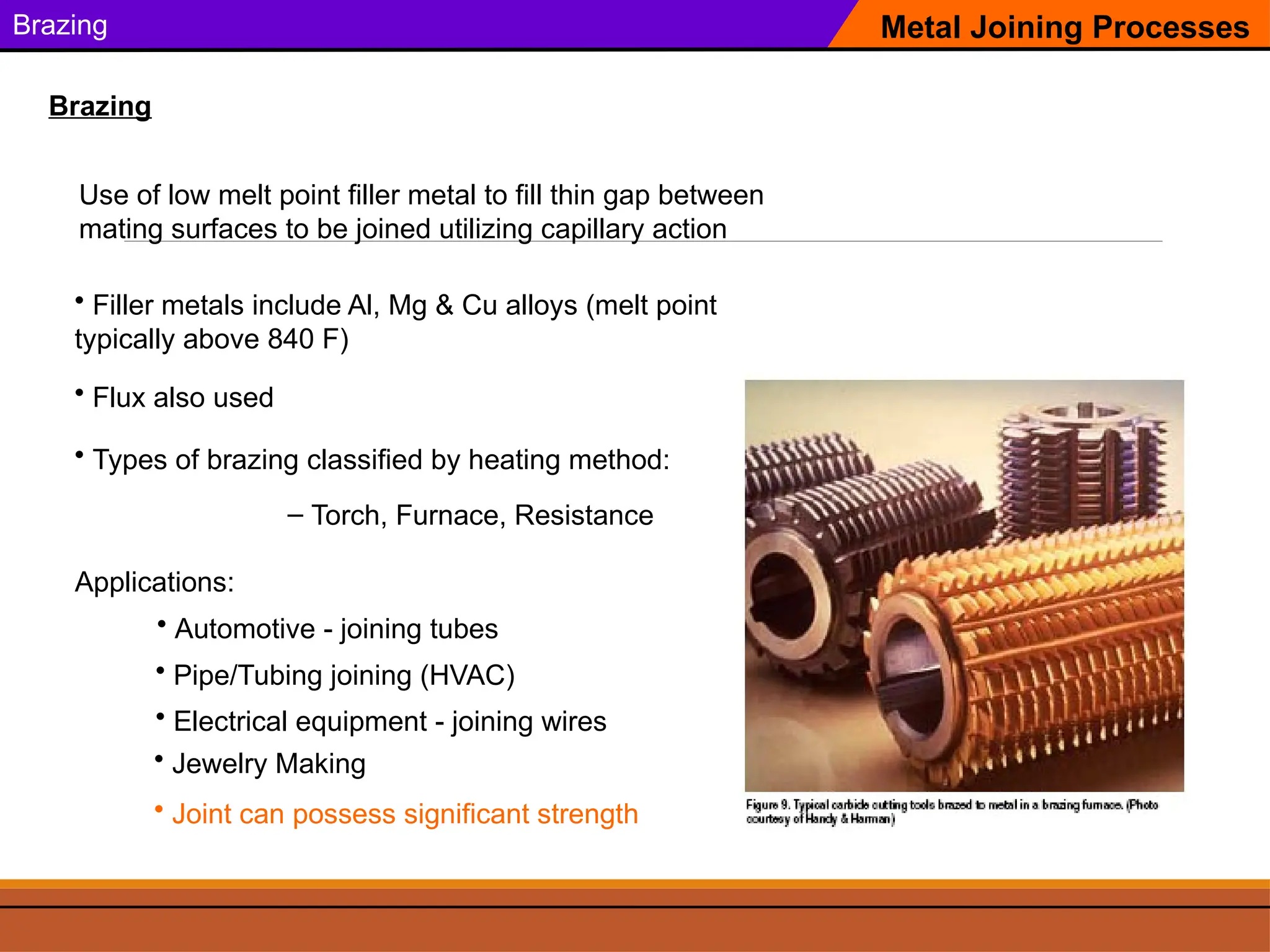
Brazing
Use of low melt point filler metal to fill thin gap between
mating surfaces to be joined utilizing capillary action
Metal Joining Processes
Brazing
Applications:
• Pipe/Tubing joining (HVAC)
• Filler metals include Al, Mg & Cu alloys (melt point
typically above 840 F)
• Automotive - joining tubes
• Electrical equipment - joining wires
• Jewelry Making
• Flux also used
• Types of brazing classified by heating method:
– Torch, Furnace, Resistance
• Joint can possess significant strength
Brazing
Use of low melt point filler metal to fill thin gap between
mating surfaces to be joined utilizing capillary action
Metal Joining Processes
Brazing
Applications:
• Pipe/Tubing joining (HVAC)
• Filler metals include Al, Mg & Cu alloys (melt point
typically above 840 F)
• Automotive - joining tubes
• Electrical equipment - joining wires
• Jewelry Making
• Flux also used
• Types of brazing classified by heating method:
– Torch, Furnace, Resistance
• Joint can possess significant strength
Brazing Metal Joining Processes
Brazing
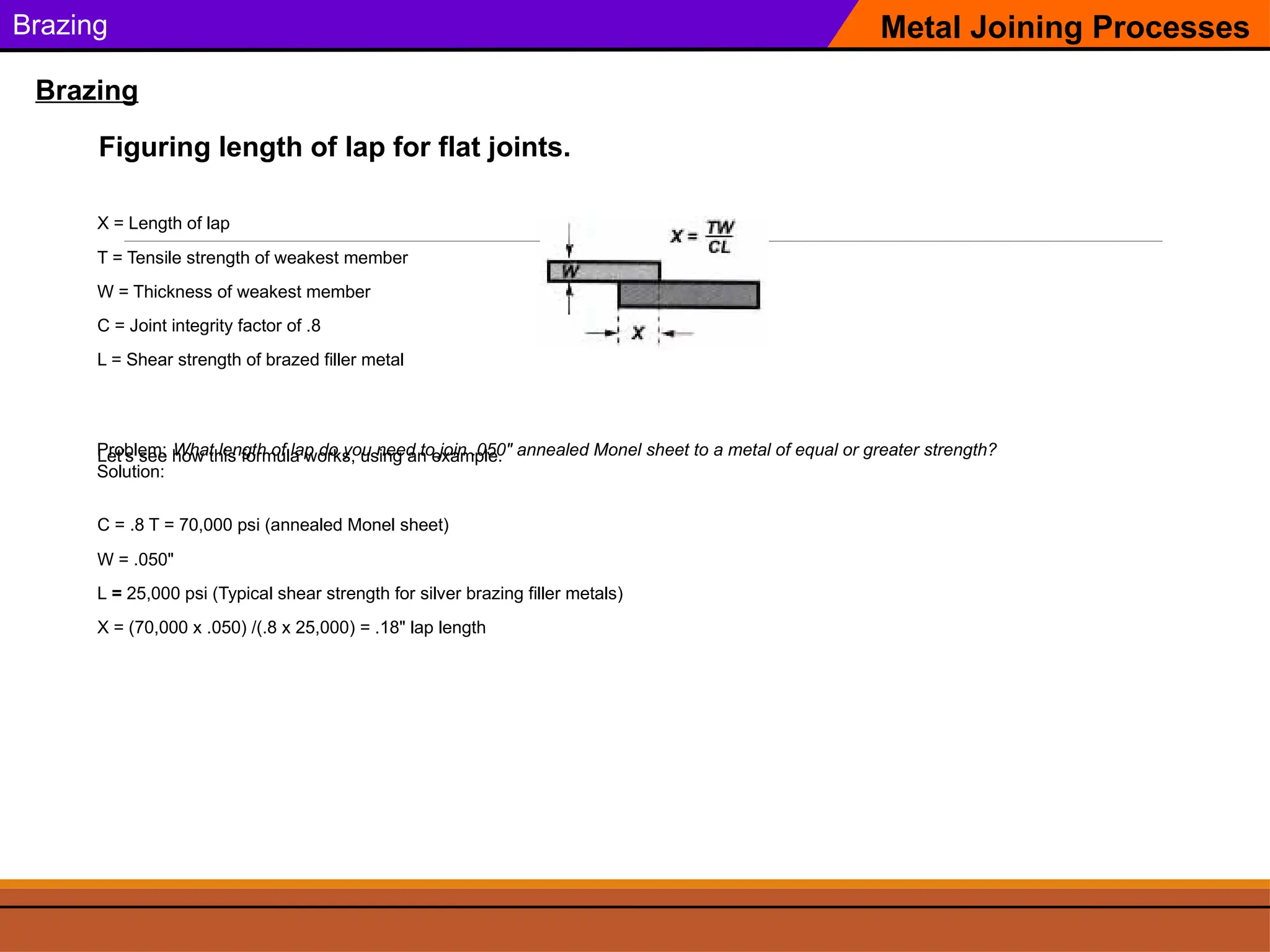
Figuring length of lap for flat joints.
X = Length of lap
T = Tensile strength of weakest member
W = Thickness of weakest member
C = Joint integrity factor of .8
L = Shear strength of brazed filler metal
Let’s see how this formula works, using an example.
Problem: What length of lap do you need to join .050" annealed Monel sheet to a metal of equal or greater strength?
Solution:
C = .8 T = 70,000 psi (annealed Monel sheet)
W = .050"
L = 25,000 psi (Typical shear strength for silver brazing filler metals)
X = (70,000 x .050) /(.8 x 25,000) = .18" lap length

welding.pptx for diploma engineering branch mechanical

  • 1.
  • 2.
    CO Identify joining methodsfor fabrications, and fabricate simple job using joining method.
  • 3.
    Welding Welding is metallurgicalfusion process,where part to be joined by the application of heat and pressure. •It is used to join the two different parts. •It is commonly used in the industries. •Advantages. •It is used for repair work. •Strength of joint is good. •They have high corrosion resistance. •Welding is used for fluid tight joints. •Different types of joints can be done. •Welding is economical and cost efficient.
  • 4.
    Two Categories ofWelding Processes  Fusion welding - coalescence is accomplished by melting the two parts to be joined, in some cases adding filler metal to the joint  Examples: arc welding, resistance spot welding, oxyfuel gas welding  Solid state welding - heat and/or pressure are used to achieve coalescence, but no melting of base metals occurs and no filler metal is added  Examples: forge welding, diffusion welding, friction welding
  • 5.
    Welding Disadvantages. •It produce harmfulradiations. •It produce internal stresses distortion and change in micro structure in welding region. •Previous badge preparation requires. •Require skilled operator. •Applications. •Automobile parts. •Aircraft and ship construction. •Machine frames. •Pipelines. •Tanks and vessels.
  • 6.
  • 7.
    Welding Processes Fusion WeldingProcesses GMAW – Gas Metal Arc Welding SMAW – Shielded Metal Arc Welding Non-Consumable Electrode GTAW – Gas Tungsten Arc Welding Electron Beam Welding SAW – Submerged Arc Welding Consumable Electrode PAW – Plasma Arc Welding High Energy Beam Laser Beam Welding
  • 8.
    Welding Processes SMAW –Shielded Metal Arc Welding • Slag keeps oxygen off weld bead during cooling • Consumable electrode • Flux produces protective gas around weld pool • Flux coated rod Power = VI  10 kW Power... Current I (50 - 300 amps) Voltage V (15 - 45 volts) • General purpose welding—widely used • Thicknesses 1/8” – 3/4” • Portable
  • 9.
    Welding Processes Electric ArcWelding -- Polarity SMAW - DC Polarity Straight Polarity Shallow penetration Deeper weld penetration (thin metal) Reverse Polarity (+) (–) (–) (+) AC - Gives pulsing arc - used for welding thick sections
  • 10.
    Welding Processes GMAW –Gas Metal Arc Welding (MIG) • DC reverse polarity - hottest arc • MIG - Metal Inert Gas • Consumable wire electrode • AC - unstable arc Groover, M., Fundamentals of Modern Manufacturing,, p. 734, 1996 Gas Metal Arc Welding (GMAW) Torch • Shielding provided by gas • Double productivity of SMAW • Easily automated
  • 11.
    Welding Processes SAW –Submerged Arc Welding • 300 – 2000 amps (440 V) • Consumable wire electrode Gas Metal Arc Welding (GMAW) Torch • Shielding provided by flux granules • Automated process (limited to flats) • Low UV radiation & fumes • Flux acts as thermal insulator • High speed & quality (4 – 10x SMAW) • Suitable for thick plates http://www.twi.co.uk
  • 12.
    Welding Processes GTAW –Gas Tungsten Arc Welding (TIG) • Non-consumable electrode • a.k.a. TIG - Tungsten Inert Gas • Shield gas usually argon • Used for thin sections of Al, Mg, Ti. • With or without filler metal Power  8-20 kW Current I (200 A DC) (500 A AC) • Most expensive, highest quality
  • 13.
    Welding Processes Laser Welding Typicallaser welding applications : • Catheters & Other Medical Devices • Small Parts and Components • Fine Wires • Jewelry • Small Sensors • Thin Sheet Materials Down To 0.001" Thick • Laser beam produced by a CO2 or YAG Laser • High penetration, high-speed process • Concentrated heat = low distortion • Laser can be shaped/focused & pulsed on/off • Typically automated & high speed (up to 250 fpm) • Workpieces up to 1” thick
  • 14.
    Welding Processes Solid StateWelding Processes Friction Welding Ultrasonic Welding Resistance Welding Diffusion Welding
  • 15.
    Welding Processes Friction Welding(Inertia Welding) • One part rotated, one stationary • Stationary part forced against rotating part • Friction converts kinetic energy to thermal energy • Metal at interface melts and is joined • When sufficiently hot, rotation is stopped & axial force increased
  • 16.
    Welding Processes Resistance Welding ResistanceWelding is the coordinated application of electric current and mechanical pressure in the proper magnitudes and for a precise period of time to create a coalescent bond between two base metals. • Heat provided by resistance to electrical current (Q=I2 Rt) • Force applied by pneumatic cylinder • Typical 0.5 – 10 V but up to 100,000 amps! • Often fully or partially automated - Spot welding - Seam welding
  • 17.
    Welding Processes Resistance Welding ResistanceWelding is the coordinated application of electric current and mechanical pressure in the proper magnitudes and for a precise period of time to create a coalescent bond between two base metals. • Heat provided by resistance to electrical current (Q=I2 Rt) • Force applied by pneumatic cylinder • Typical 0.5 – 10 V but up to 100,000 amps! • Often fully or partially automated - Spot welding - Seam welding
  • 18.
    Welding Processes Diffusion Welding •Parts forced together at high temperature (< 0.5Tm absolute) and pressure Kalpakjian, S., Manufacturing Engineering & Technology, p. 889, 1992 • Atoms diffuse across interface • After sufficient time the interface disappears • Good for dissimilar metals • Heated in furnace or by resistance heating • Bond can be weakened by surface impurities
  • 19.
    Welding Classification •Gas arcwelding. 1. Air acetylene welding. 2. Oxyacetylene welding. 3. Pressure gas welding. •Arc welding. 1. Carbon arc welding. 2. Shielded metal arc welding. 3. TIG welding. 4. MIG welding. 5. Plasma arc welding
  • 20.
    Welding classification •Pressure weldingprocess •Process requires both heat and pressure for joining. It does not require filler metal. 1. Spot welding. 2. Seam welding. 3. Projection welding. •Other fusion process. 1. Electron beam welding. 2. Laser beam welding.
  • 21.
    Acetylene gas welding Inthis process oxygen and acetylene gas is used for welding process. It rises the temperature of metal above melting point. Filler material is used for joining. Operation In this process oxygen and acetylene is used for the welding. Oxygen supports the combustion and acetylene gas generate high temp. Operation starts with placing the part togather which is to be join. Oxiacetylene flame heat the metal temp produced is about 3200°c. Filler metal is added to the join which join the parts by melting it self. filler material is copper coated steel, carbon steel. chemical reaction at tip is as followed. 2C²H²+5O²→4CO²+2H²O
  • 22.
    WELDING PROCESSES • Advantages. •It is used for all types of joints. • Oxyacetylene flame can be easily controlled. • Suitable for thin metal sheets. • Equipment is portable & versatile. • Limitations. • Method is slower. • Distortion of workpiece is more.
  • 23.
    Types of flames •Naturalflame. 1. All gas is burn 2. gives 100% heat. 3. Ideal flame used in gas welding. •Reducing flame. 1. It consist of inner core intermediate feather and outer flame. 2. It is also called as carburising flame. 3. strong reduction in higher zone due to high amount of acetylene . •Oxidizing flame. 1. It contain more oxygen than any other flame. 2. This is used for oxidizing metal like brass,Zink etc. 3. It is similar to natural flame.
  • 24.
    Arc welding In thisprocess heat generation takes place by an electric arc. Both work piece and electrod is connected to different terminals of AC or DC supply. small gap bet work piece and electrod arc is generated. It produces temp about 3600°c. It having following types. 1. Carbon Arc welding. 2. Shielded metal arc welding. 3. Gas shielded arc welding. 4. Plasma arc welding.
  • 25.
    Carbon arc welding Itis new welding process. Electric is made of carbon. Electrics are soft and not suitable for high temp. Electric consumption slowly & requires filler material. Arc is generated between electrode and w/p. DC supply is used Electrode is negative & w/p is positive. It is used for thick material.
  • 26.
    Shielded metal arcwelding In this electric arc is used for the welding purpose. flux coated electrod is used for the welding. flux gives stability to protection to weld metal. during welding electrod is melt and serve as filler material. • flux over the electrode is also get melt to form coating over the weld material.Advantages. • Simple process. • welding equipments are portable and less costly. • Metal and alloy can be welded. • Applicable in any position. •Disadvantages. • Automatic welding is difficult because of short electrod. • Process is slow. • Welding defects are more during replacement of electrod.
  • 27.
    Tungsten inert gas welding(TIG) Itis also called as gas tungsten arc welding. inert gas is act as shield and keep contaminant away from welded metal. Electrod does not melt during welding.it is non consumable electrod. filler material added separately. Inert gas used is argon. Advantages. Slag free operation due to absence of flux. different materials can be welded. no cleaning requires. Disadvantages. Equipment cost is high. slow process. Filler material requires
  • 28.
    Metal inert gaswelding (MIG) It is also known as Gas metal arc welding (GMAW). In this process weld joint is produced by heating the metal with electric arc. The filling wire is continuously feed from wire reel at constant rate. wire is feed though the rollers at constant rate. Instead of flux ineart gas is supplied through welding torch. welding torch is connected to cylinder of unwary gas like argon Advantages. slag inclusion are not occurs. Continuous feed makes process faster. Less skilled operator is required. thick sheets can be welded.
  • 29.
    Disadvantages. Process is complicated. setupis complicated. Initial cost is high.. Applications. For welding of commercial metals like Nickel,killed steel.
  • 30.
    Plasma arc welding Plasmais heated ionized gas enable it to conduct electric current. Plasma arc is narrow restricted electric arc passes through water cooler orifice. It consist of non consumable tungsten electrod and shielding gas like argon. Argon gas flows through the orifice to form plasma. the temperature of plasma is about 10000°c. Advantages. Weld uniform throughout. greater depth of welding with less distortion. proper control on heat. metal disposition rate is high.
  • 31.
    Plasma arc welding Limitations. Weldingequipments are expensive. frequent replacement of nozzle. Applications Stainless steel welding. Nickel alloy in aero plane. Aluminium or graphite nozzles for rocket
  • 32.
    Resistance welding In theseprocess heat and pressure is applied on joint. No additional filler or flux material required. joint is obtained by means of electrical resisitance. During process heavy current about 15000A is passed over joint with limited area for short time. Heavy current heat joint up to plastic state. due to high pressure metal get fused and forms joint. Heat generated is given as bellow H= CI2Rt It is classified as 1.Spot Welding 2.Seam Welding 3.Projection welding 4.Upset Welding
  • 33.
    Spot Welding It isfirst type of resistance welding and widely used for lap joint of thin metal sheet. It is consist of two electrodes in which bottom electrode is fixed and upper is used for apply pressure. Sheets to be weld are kept in the two electrode . The pressure is applied over the sheets and current is passed though it so that they get weld. Welding is done due to high current is passed through the metal plates which produce heat. Applications For mass production. For Ferrous and Non ferrous metals. Used to weld sheets of 10mm thick
  • 34.
    Seam Welding It isused for special purpose In this process disk type electrodes are used. It is used to produce continuous type of welding between two sheets. Disk are made up of cupper and current is applied through it Current is applied in pulse form with proper time interval Disks are rotate continuously so that metal sheets moves forward. Current can be regulated by timer to produce continuous seam. Applications. For gas or water tight joints To manufacture seam welded pipes
  • 35.
    Projection Welding It ismodification of spot welding. In this type one of the sheet is provided with projections and other is plane. These projections are in circular form. There diameter is equal to thickness of plate. Current and pressure is get concentrated at projection areas during process. During this process sheets to welded are kept between electrodes which made of cupper . Pressure is applied by upper movable electrode and lower is fixed . By passing current these projections are get melted and welding is done.
  • 36.
    Soldering & BrazingMetal Joining Processes Soldering & Brazing • Filler metal distributed by capillary action • Only filler metal is melted, not base metal • Strength of joint typically – Can join dissimilar metals – Less heat - can join thinner sections (relative to welding) – stronger than filler metal itself – weaker than base metal – Excessive heat during service can weaken joint • Pros & Cons • Lower temperatures than welding – gap at joint important (0.001 – 0.010”) • Metallurgical bond formed between filler & base metals
  • 37.
    Soldering Solder = Fillermetal Metal Joining Processes Soldering Applications: • Printed Circuit Board (PCB) manufacture • Pipe joining (copper pipe) • Jewelry manufacture Easy to solder: copper, silver, gold Difficult to solder: aluminum, stainless steels (can pre-plate difficult to solder metals to aid process) • Alloys of Tin (silver, bismuth, lead) • Melt point typically below 840 F Flux used to clean joint & prevent oxidation • Typically non-load bearing Tinning = pre-coating with thin layer of solder • separate or in core of wire (rosin-core)
  • 38.
    PCB Soldering • SolderingIron & Solder Wire Metal Joining Processes Manual PCB Soldering • Heating lead & placing solder • Trim excess lead • Heat for 2-3 sec. & place wire opposite iron PTH - Pin-Through-Hole connectors
  • 39.
    PCB Reflow SolderingMetal Joining Processes Automated Reflow Soldering SMT = Surface Mount Technology Printed solder paste on a printed circuit board (PCB) • Solder Paste serves the following functions: – supply solder material to the soldering spot, – hold the components in place prior to soldering, – clean the solder lands and component leads – prevent further oxidation of the solder lands. • Solder/Flux paste mixture applied to PCB using screen print or similar transfer method • PCB assembly then heated in “Reflow” oven to melt solder and secure connection
  • 40.
    Brazing Use of lowmelt point filler metal to fill thin gap between mating surfaces to be joined utilizing capillary action Metal Joining Processes Brazing Applications: • Pipe/Tubing joining (HVAC) • Filler metals include Al, Mg & Cu alloys (melt point typically above 840 F) • Automotive - joining tubes • Electrical equipment - joining wires • Jewelry Making • Flux also used • Types of brazing classified by heating method: – Torch, Furnace, Resistance • Joint can possess significant strength
  • 41.
    Brazing Use of lowmelt point filler metal to fill thin gap between mating surfaces to be joined utilizing capillary action Metal Joining Processes Brazing Applications: • Pipe/Tubing joining (HVAC) • Filler metals include Al, Mg & Cu alloys (melt point typically above 840 F) • Automotive - joining tubes • Electrical equipment - joining wires • Jewelry Making • Flux also used • Types of brazing classified by heating method: – Torch, Furnace, Resistance • Joint can possess significant strength
  • 42.
    Brazing Metal JoiningProcesses Brazing Figuring length of lap for flat joints. X = Length of lap T = Tensile strength of weakest member W = Thickness of weakest member C = Joint integrity factor of .8 L = Shear strength of brazed filler metal Let’s see how this formula works, using an example. Problem: What length of lap do you need to join .050" annealed Monel sheet to a metal of equal or greater strength? Solution: C = .8 T = 70,000 psi (annealed Monel sheet) W = .050" L = 25,000 psi (Typical shear strength for silver brazing filler metals) X = (70,000 x .050) /(.8 x 25,000) = .18" lap length

Editor's Notes