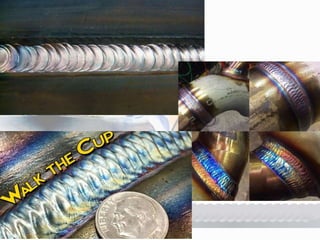
TIG Welding
(GTAW)
Terms
• TIG stands for Tungsten Inert Gas
• Technically called Gas Tungsten Arc Welding or
GTAW
Arc Welding
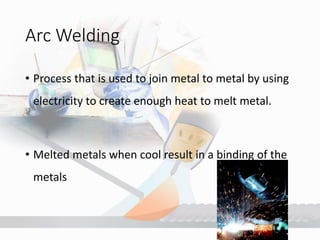
• Process that is used to join metal to metal by using
electricity to create enough heat to melt metal.
• Melted metals when cool result in a binding of the
metals
Flux And Shielding Gas
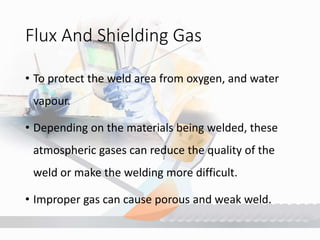
• To protect the weld area from oxygen, and water
vapour.
• Depending on the materials being welded, these
atmospheric gases can reduce the quality of the
weld or make the welding more difficult.
• Improper gas can cause porous and weak weld.
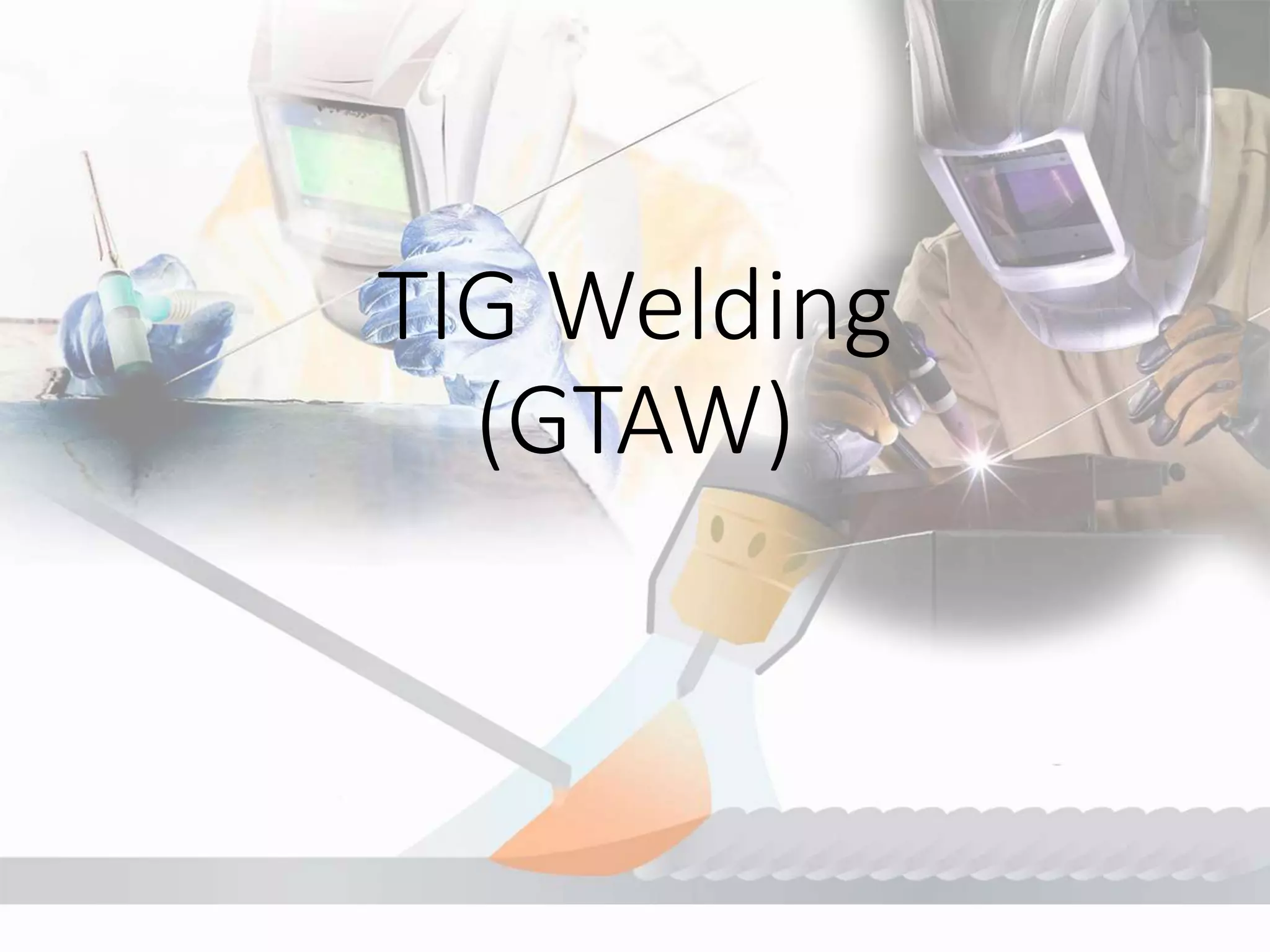
TIG Welding
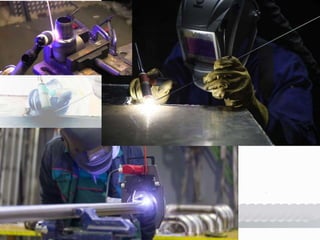
• Arc welding Process that uses a non-consumable
tungsten electrode to produce the weld.
• Weld area is protected from atmospheric
contamination by an inert shielding gas.
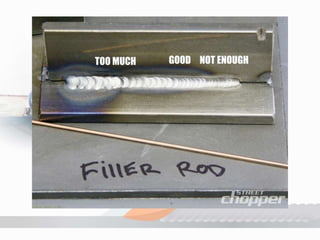
• A filler metal is normally used.
TIG Welding Requirements
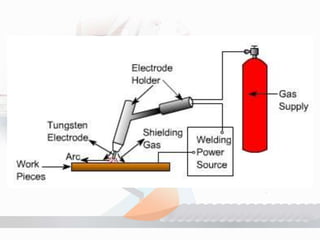
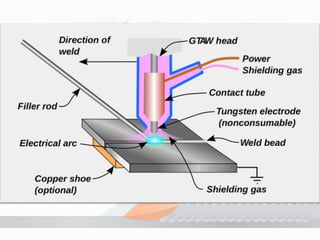
• Requires 3 things, Heat, Shielding, and Filler metal.
• Heat is produced by electricity passing through the
tungsten electrode by creating an arc to the metal.
• The shielding comes from a compressed bottle of gas.
• The filler metal is just a wire that is dipped by hand into
the arc and melted
Process
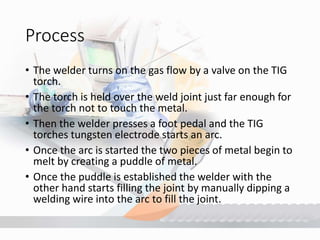
• The welder turns on the gas flow by a valve on the TIG
torch.
• The torch is held over the weld joint just far enough for
the torch not to touch the metal.
• Then the welder presses a foot pedal and the TIG
torches tungsten electrode starts an arc.
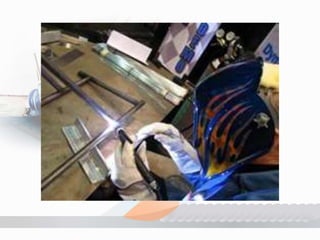
• Once the arc is started the two pieces of metal begin to
melt by creating a puddle of metal.
• Once the puddle is established the welder with the
other hand starts filling the joint by manually dipping a
welding wire into the arc to fill the joint.
Components Of TIG Welder
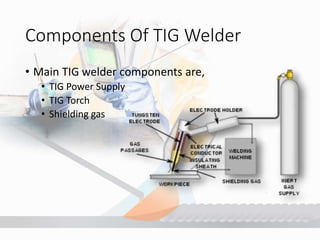
• Main TIG welder components are,
• TIG Power Supply
• TIG Torch
• Shielding gas
TIG Power Supply
• Usually welding power supplies which supplies
constant current.
• “High frequency start” eliminates the need to
physically strike an arc like SMAW by creating a
brief moment of high voltage.
• Pre-flow and post-flow feature confirms the
protection of the weld by supplying shielding gas
before and after the weld is performed.
• Frequency settings help the characteristics of the
welding arc.
TIG Welding Voltage Type and
Welding Polarities
• Both AC and DC currents are used.
• D/C electrode (-) negative concentrates about 2/3
of the heat onto the metal welded.
• This produces a deep penetration weld.
• D/C electrode (+) positive concentrates about 2/3
of the heat onto the electrode.
• This produces a shallow weld.
TIG Torch
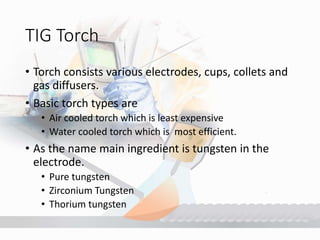
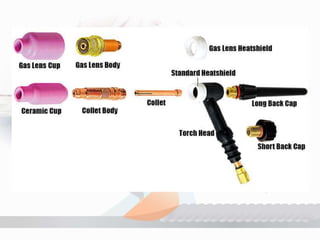
• Torch consists various electrodes, cups, collets and
gas diffusers.
• Basic torch types are
• Air cooled torch which is least expensive
• Water cooled torch which is most efficient.
• As the name main ingredient is tungsten in the
electrode.
• Pure tungsten
• Zirconium Tungsten
• Thorium tungsten
Tungsten Electrode
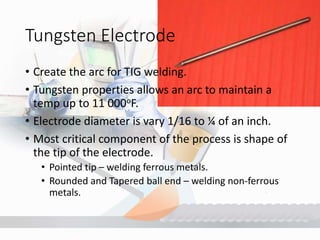
• Create the arc for TIG welding.
• Tungsten properties allows an arc to maintain a
temp up to 11 000oF.
• Electrode diameter is vary 1/16 to ¼ of an inch.
• Most critical component of the process is shape of
the tip of the electrode.
• Pointed tip – welding ferrous metals.
• Rounded and Tapered ball end – welding non-ferrous
metals.
Shielding Gas
• Necessary to protect welding area from
atmospheric gases which can cause fusion defects,
porosity and weld metal embrittlement.
• Also transfers heat from the tungsten electrode and
helps start and maintain a stable arc.
• Most of cases pure Argon is used.
• Argon-Hydrogen, Argon-Nitrogen, Argon-Helium
mixtures are also used.
• Ar-He typically used on thicker metals to get deep
penetration.
USES
• Most commonly used to weld thin sections of
stainless steel, steel and non-ferrous metals such as
Aluminum, Copper Nickel alloys, Magnesium,
Titanium.
• Combinations of dissimilar metals also TIG welded
such as Copper to Everdur, Copper to Stainless
Steel, Nickel to steel and Stainless Steel to Cast
iron.
Advantages
• Works on almost all types of metals with higher
melting points. Specially for reactive metals like
titanium and zirconium, which dissolve oxygen and
nitrogen and become embrittled.
• Accuracy and control. The process provides more
precise control of the weld than any other arc
welding process, because the arc heat and filler
metal are independently controlled.
• Good looking weld beads
• Very good for joining thin base metals because of
excellent control of heat input.
• Creates strong joints. It produces top quality welds
in almost all metals and alloys used by industry.
• Clean process with minimal amount of of fumes,
sparks, spatter and smoke i.e. minimal finishing
required.
• Works in any position.
• Because the electrode is non-consumable, the
process can be used to weld by fusion alone
without the addition of filler metal.
Disadvantages
• Brighter UV rays when compared to other welding
processes
• Slower process than consumable electrode arc
welding processes.
• Takes practice (Difficult Process)
• More expensive process overall. Expensive welding
supplies (tungsten Electrodes and Shielding gases)
• Not easily portable.
• Transfer of molten tungsten from the electrode to
the weld causes contamination. The resulting
tungsten inclusion is hard and brittle.
• Exposure of the hot filler rod to air using improper
welding techniques causes weld metal
contamination.
Tig welding
Tig welding

Tig welding

  • 1.
  • 2.
    Terms • TIG standsfor Tungsten Inert Gas • Technically called Gas Tungsten Arc Welding or GTAW
  • 3.
    Arc Welding • Processthat is used to join metal to metal by using electricity to create enough heat to melt metal. • Melted metals when cool result in a binding of the metals
  • 4.
    Flux And ShieldingGas • To protect the weld area from oxygen, and water vapour. • Depending on the materials being welded, these atmospheric gases can reduce the quality of the weld or make the welding more difficult. • Improper gas can cause porous and weak weld.
  • 5.
    TIG Welding • Arcwelding Process that uses a non-consumable tungsten electrode to produce the weld. • Weld area is protected from atmospheric contamination by an inert shielding gas. • A filler metal is normally used.
  • 7.
    TIG Welding Requirements •Requires 3 things, Heat, Shielding, and Filler metal. • Heat is produced by electricity passing through the tungsten electrode by creating an arc to the metal. • The shielding comes from a compressed bottle of gas. • The filler metal is just a wire that is dipped by hand into the arc and melted
  • 9.
    Process • The welderturns on the gas flow by a valve on the TIG torch. • The torch is held over the weld joint just far enough for the torch not to touch the metal. • Then the welder presses a foot pedal and the TIG torches tungsten electrode starts an arc. • Once the arc is started the two pieces of metal begin to melt by creating a puddle of metal. • Once the puddle is established the welder with the other hand starts filling the joint by manually dipping a welding wire into the arc to fill the joint.
  • 12.
    Components Of TIGWelder • Main TIG welder components are, • TIG Power Supply • TIG Torch • Shielding gas
  • 13.
    TIG Power Supply •Usually welding power supplies which supplies constant current. • “High frequency start” eliminates the need to physically strike an arc like SMAW by creating a brief moment of high voltage. • Pre-flow and post-flow feature confirms the protection of the weld by supplying shielding gas before and after the weld is performed. • Frequency settings help the characteristics of the welding arc.
  • 14.
    TIG Welding VoltageType and Welding Polarities • Both AC and DC currents are used. • D/C electrode (-) negative concentrates about 2/3 of the heat onto the metal welded. • This produces a deep penetration weld. • D/C electrode (+) positive concentrates about 2/3 of the heat onto the electrode. • This produces a shallow weld.
  • 15.
    TIG Torch • Torchconsists various electrodes, cups, collets and gas diffusers. • Basic torch types are • Air cooled torch which is least expensive • Water cooled torch which is most efficient. • As the name main ingredient is tungsten in the electrode. • Pure tungsten • Zirconium Tungsten • Thorium tungsten
  • 17.
    Tungsten Electrode • Createthe arc for TIG welding. • Tungsten properties allows an arc to maintain a temp up to 11 000oF. • Electrode diameter is vary 1/16 to ¼ of an inch. • Most critical component of the process is shape of the tip of the electrode. • Pointed tip – welding ferrous metals. • Rounded and Tapered ball end – welding non-ferrous metals.
  • 18.
    Shielding Gas • Necessaryto protect welding area from atmospheric gases which can cause fusion defects, porosity and weld metal embrittlement. • Also transfers heat from the tungsten electrode and helps start and maintain a stable arc. • Most of cases pure Argon is used. • Argon-Hydrogen, Argon-Nitrogen, Argon-Helium mixtures are also used. • Ar-He typically used on thicker metals to get deep penetration.
  • 20.
    USES • Most commonlyused to weld thin sections of stainless steel, steel and non-ferrous metals such as Aluminum, Copper Nickel alloys, Magnesium, Titanium. • Combinations of dissimilar metals also TIG welded such as Copper to Everdur, Copper to Stainless Steel, Nickel to steel and Stainless Steel to Cast iron.
  • 21.
    Advantages • Works onalmost all types of metals with higher melting points. Specially for reactive metals like titanium and zirconium, which dissolve oxygen and nitrogen and become embrittled. • Accuracy and control. The process provides more precise control of the weld than any other arc welding process, because the arc heat and filler metal are independently controlled. • Good looking weld beads • Very good for joining thin base metals because of excellent control of heat input.
  • 22.
    • Creates strongjoints. It produces top quality welds in almost all metals and alloys used by industry. • Clean process with minimal amount of of fumes, sparks, spatter and smoke i.e. minimal finishing required. • Works in any position. • Because the electrode is non-consumable, the process can be used to weld by fusion alone without the addition of filler metal.
  • 23.
    Disadvantages • Brighter UVrays when compared to other welding processes • Slower process than consumable electrode arc welding processes. • Takes practice (Difficult Process) • More expensive process overall. Expensive welding supplies (tungsten Electrodes and Shielding gases)
  • 24.
    • Not easilyportable. • Transfer of molten tungsten from the electrode to the weld causes contamination. The resulting tungsten inclusion is hard and brittle. • Exposure of the hot filler rod to air using improper welding techniques causes weld metal contamination.