Introduction to Nondestructive Testing http://Power.Smsm.ir
Outline Introduction to NDT Overview of Six Most  Common NDT Methods Selected Applications http://Power.Smsm.ir
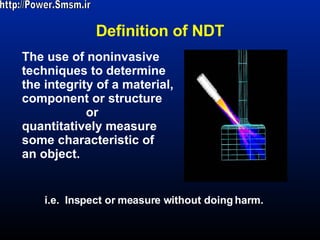
Definition of NDT The use of noninvasive  techniques to determine  the integrity of a material,  component or structure  or  quantitatively measure some characteristic of an object.   i.e.  Inspect or measure without doing harm. http://Power.Smsm.ir
Methods of NDT Visual Liquid Penetrant Magnetic Particle Eddy Current Ultrasonic X-ray  Microwave Acoustic Emission Thermography Laser Interferometry Replication Flux Leakage Acoustic Microscopy Magnetic Measurements Tap Testing http://Power.Smsm.ir
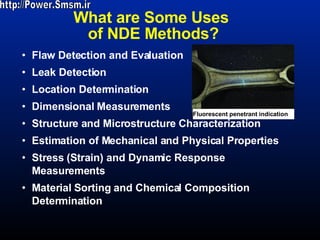
What are Some Uses  of NDE Methods? Flaw Detection and Evaluation Leak Detection  Location Determination Dimensional Measurements  Structure and Microstructure Characterization  Estimation of Mechanical and Physical Properties  Stress (Strain) and Dynamic Response Measurements  Material Sorting and Chemical Composition Determination  Fluorescent penetrant indication http://Power.Smsm.ir
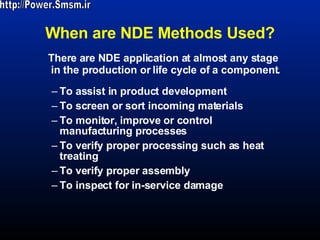
When are NDE Methods Used? To assist in product development  To screen or sort incoming materials To monitor, improve or control manufacturing processes To verify proper processing such as heat treating To verify proper assembly To inspect for in-service damage There are NDE application at almost any stage in the production or life cycle of a component. http://Power.Smsm.ir
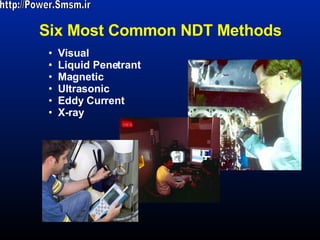
Six Most Common NDT Methods Visual Liquid Penetrant  Magnetic  Ultrasonic Eddy Current X-ray http://Power.Smsm.ir
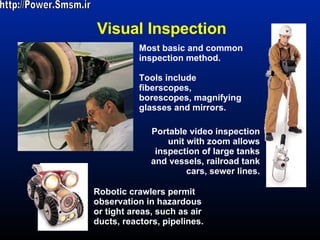
Visual Inspection http://Power.Smsm.ir Most basic and common inspection method. Tools include fiberscopes, borescopes, magnifying glasses and mirrors. Robotic crawlers permit observation in hazardous or tight areas, such as air ducts, reactors, pipelines. Portable video inspection unit with zoom allows inspection of large tanks and vessels, railroad tank cars, sewer lines.
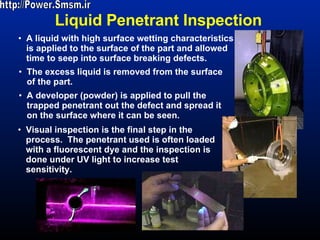
Liquid Penetrant Inspection The excess liquid is removed from the surface of the part.  http://Power.Smsm.ir A liquid with high surface wetting characteristics is applied to the surface of the part and allowed time to seep into surface breaking defects. A developer (powder) is applied to pull the trapped penetrant out the defect and spread it on the surface where it can be seen.  Visual inspection is the final step in the process.  The penetrant used is often loaded with a fluorescent dye and the inspection is done under UV light to increase test sensitivity.
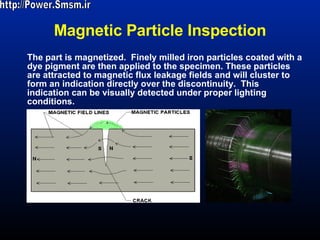
Magnetic Particle Inspection The part is magnetized.  Finely milled iron particles coated with a dye pigment are then applied to the specimen. These particles are attracted to magnetic flux leakage fields and will cluster to form an indication directly over the discontinuity.  This indication can be visually detected under proper lighting conditions.   http://Power.Smsm.ir
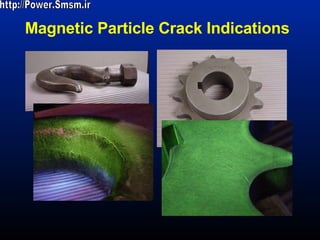
Magnetic Particle Crack Indications   http://Power.Smsm.ir
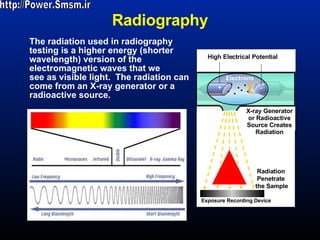
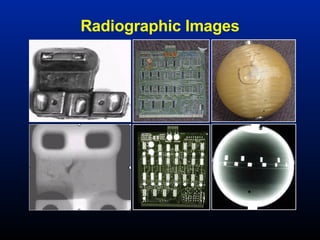
Radiography The radiation used in radiography testing is a higher energy (shorter wavelength) version of the electromagnetic waves that we  see as visible light.  The radiation can come from an X-ray generator or a radioactive source.  http://Power.Smsm.ir High Electrical Potential Electrons - + X-ray Generator or Radioactive Source Creates Radiation Exposure Recording Device Radiation  Penetrate  the Sample
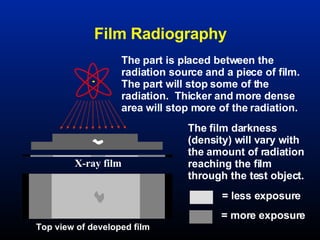
Film Radiography Top view of developed film   X-ray film The film darkness (density) will vary with the amount of radiation reaching the film through the test object. The part is placed between the radiation source and a piece of film.  The part will stop some of the radiation.  Thicker and more dense area will stop more of the radiation.  = more exposure = less exposure
Radiographic Images
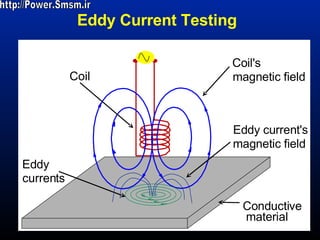
Eddy Current Testing Conductive material Coil http://Power.Smsm.ir Coil's  magnetic field Eddy  currents Eddy current's  magnetic field
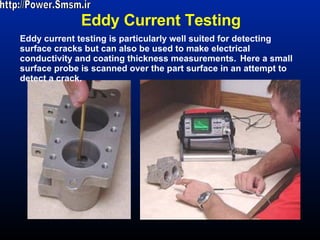
Eddy Current Testing Eddy current testing is particularly well suited for detecting surface cracks but can also be used to make electrical conductivity and coating thickness measurements.   Here a small surface probe is scanned over the part surface in an attempt to detect a crack. http://Power.Smsm.ir
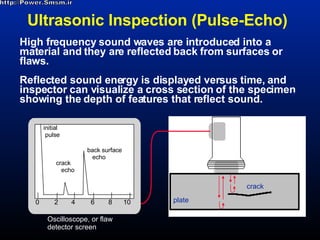
Ultrasonic Inspection (Pulse-Echo)  High frequency sound waves are introduced into a material and they are reflected back from surfaces or flaws. Reflected sound energy is displayed versus time, and inspector can visualize a cross section of the specimen showing the depth of features that reflect sound.  f plate crack initial  pulse crack echo back surface echo Oscilloscope, or flaw detector screen http://Power.Smsm.ir 0 2 4 6 8 10
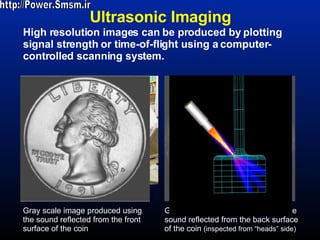
Ultrasonic Imaging Gray scale image produced using the sound reflected from the front surface of the coin Gray scale image produced using the sound reflected from the back surface of the coin  (inspected from “heads” side) High resolution images can be produced by plotting signal strength or time-of-flight using a computer-controlled scanning system. http://Power.Smsm.ir
Common Application of NDT Inspection of Raw Products Inspection Following Secondary Processing In-Services Damage Inspection http://Power.Smsm.ir
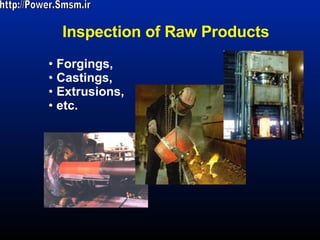
Inspection of Raw Products Forgings, Castings, Extrusions, etc. http://Power.Smsm.ir
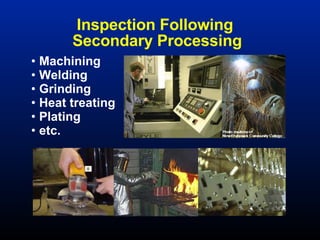
Machining Welding Grinding Heat treating Plating etc. Inspection Following  Secondary Processing
Cracking Corrosion Erosion/Wear Heat Damage etc. Inspection For  In-Service Damage
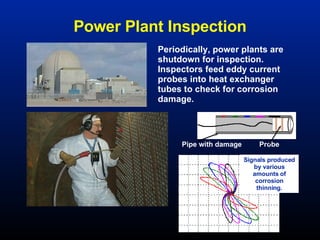
Power Plant Inspection Periodically, power plants are shutdown for inspection.  Inspectors feed eddy current probes into heat exchanger tubes to check for corrosion damage. Probe Signals produced by various amounts of corrosion thinning. Pipe with damage
Wire Rope Inspection Electromagnetic devices and visual inspections are used to find broken wires and other damage to the wire rope that is used in chairlifts, cranes and other lifting devices.  http://Power.Smsm.ir
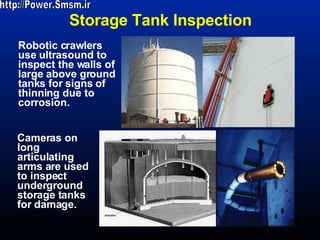
Storage Tank Inspection Robotic crawlers use ultrasound to inspect the walls of large above ground tanks for signs of thinning due to corrosion. Cameras on long articulating arms are used to inspect underground storage tanks for damage.  http://Power.Smsm.ir
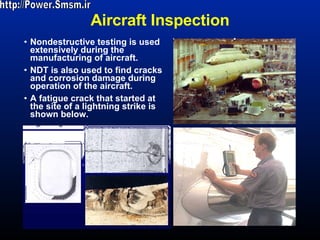
Aircraft Inspection Nondestructive testing is used extensively during the manufacturing of aircraft.  NDT is also used to find cracks and corrosion damage during operation of the aircraft. A fatigue crack that started at the site of a lightning strike is shown below.  http://Power.Smsm.ir
Jet Engine Inspection Aircraft engines are overhauled after being in service for a period of time.  They are completely disassembled, cleaned, inspected and then reassembled.  Fluorescent penetrant inspection is used to check many of the parts for cracking.  http://Power.Smsm.ir
Crash of United Flight 232 Sioux City, Iowa ,  July 19, 1989 A defect that went undetected in an engine disk was responsible for the crash of United Flight 232.  http://Power.Smsm.ir
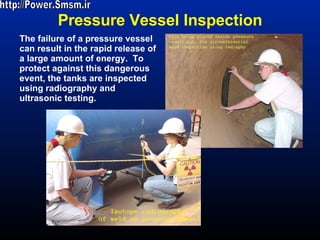
Pressure Vessel Inspection The failure of a pressure vessel can result in the rapid release of a large amount of energy.  To protect against this dangerous event, the tanks are inspected using radiography and ultrasonic testing. http://Power.Smsm.ir
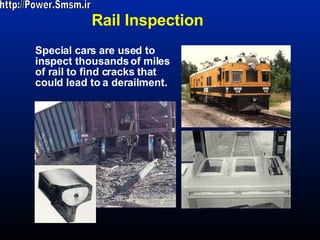
Rail Inspection Special cars are used to inspect thousands of miles of rail to find cracks that could lead to a derailment.  http://Power.Smsm.ir
Bridge Inspection The US has 578,000 highway bridges. Corrosion, cracking and other damage can all affect a bridge’s performance. The collapse of the Silver Bridge in 1967 resulted in loss of 47 lives. Bridges get a visual inspection about every 2 years. Some bridges are fitted with acoustic emission sensors that “listen” for sounds of cracks growing.  http://Power.Smsm.ir
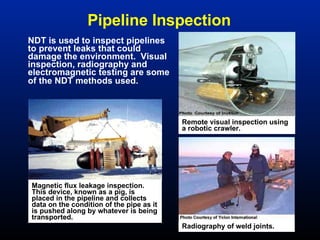
Pipeline Inspection NDT is used to inspect pipelines to prevent leaks that could damage the environment.  Visual inspection, radiography and electromagnetic testing are some of the NDT methods used.   Remote visual inspection using a robotic crawler.   Radiography of weld joints.   Magnetic flux leakage inspection.  This device, known as a pig, is placed in the pipeline and collects data on the condition of the pipe as it is pushed along by whatever is being transported.
Special Measurements Boeing employees in Philadelphia were given the privilege of evaluating the Liberty Bell for damage using NDT techniques.  Eddy current methods were used to measure the electrical conductivity of the Bell's bronze casing at various points to evaluate its uniformity.
For More Information on NDT The Collaboration for NDT Education   www.ndt-ed.org The American Society for Nondestructive Testing  www.asnt.org

Introduction_to_NDT

  • 1.
    Introduction to NondestructiveTesting http://Power.Smsm.ir
  • 2.
    Outline Introduction toNDT Overview of Six Most Common NDT Methods Selected Applications http://Power.Smsm.ir
  • 3.
    Definition of NDTThe use of noninvasive techniques to determine the integrity of a material, component or structure or quantitatively measure some characteristic of an object. i.e. Inspect or measure without doing harm. http://Power.Smsm.ir
  • 4.
    Methods of NDTVisual Liquid Penetrant Magnetic Particle Eddy Current Ultrasonic X-ray Microwave Acoustic Emission Thermography Laser Interferometry Replication Flux Leakage Acoustic Microscopy Magnetic Measurements Tap Testing http://Power.Smsm.ir
  • 5.
    What are SomeUses of NDE Methods? Flaw Detection and Evaluation Leak Detection Location Determination Dimensional Measurements Structure and Microstructure Characterization Estimation of Mechanical and Physical Properties Stress (Strain) and Dynamic Response Measurements Material Sorting and Chemical Composition Determination Fluorescent penetrant indication http://Power.Smsm.ir
  • 6.
    When are NDEMethods Used? To assist in product development To screen or sort incoming materials To monitor, improve or control manufacturing processes To verify proper processing such as heat treating To verify proper assembly To inspect for in-service damage There are NDE application at almost any stage in the production or life cycle of a component. http://Power.Smsm.ir
  • 7.
    Six Most CommonNDT Methods Visual Liquid Penetrant Magnetic Ultrasonic Eddy Current X-ray http://Power.Smsm.ir
  • 8.
    Visual Inspection http://Power.Smsm.irMost basic and common inspection method. Tools include fiberscopes, borescopes, magnifying glasses and mirrors. Robotic crawlers permit observation in hazardous or tight areas, such as air ducts, reactors, pipelines. Portable video inspection unit with zoom allows inspection of large tanks and vessels, railroad tank cars, sewer lines.
  • 9.
    Liquid Penetrant InspectionThe excess liquid is removed from the surface of the part. http://Power.Smsm.ir A liquid with high surface wetting characteristics is applied to the surface of the part and allowed time to seep into surface breaking defects. A developer (powder) is applied to pull the trapped penetrant out the defect and spread it on the surface where it can be seen. Visual inspection is the final step in the process. The penetrant used is often loaded with a fluorescent dye and the inspection is done under UV light to increase test sensitivity.
  • 10.
    Magnetic Particle InspectionThe part is magnetized. Finely milled iron particles coated with a dye pigment are then applied to the specimen. These particles are attracted to magnetic flux leakage fields and will cluster to form an indication directly over the discontinuity. This indication can be visually detected under proper lighting conditions. http://Power.Smsm.ir
  • 11.
    Magnetic Particle CrackIndications http://Power.Smsm.ir
  • 12.
    Radiography The radiationused in radiography testing is a higher energy (shorter wavelength) version of the electromagnetic waves that we see as visible light. The radiation can come from an X-ray generator or a radioactive source. http://Power.Smsm.ir High Electrical Potential Electrons - + X-ray Generator or Radioactive Source Creates Radiation Exposure Recording Device Radiation Penetrate the Sample
  • 13.
    Film Radiography Topview of developed film X-ray film The film darkness (density) will vary with the amount of radiation reaching the film through the test object. The part is placed between the radiation source and a piece of film. The part will stop some of the radiation. Thicker and more dense area will stop more of the radiation. = more exposure = less exposure
  • 14.
  • 15.
    Eddy Current TestingConductive material Coil http://Power.Smsm.ir Coil's magnetic field Eddy currents Eddy current's magnetic field
  • 16.
    Eddy Current TestingEddy current testing is particularly well suited for detecting surface cracks but can also be used to make electrical conductivity and coating thickness measurements. Here a small surface probe is scanned over the part surface in an attempt to detect a crack. http://Power.Smsm.ir
  • 17.
    Ultrasonic Inspection (Pulse-Echo) High frequency sound waves are introduced into a material and they are reflected back from surfaces or flaws. Reflected sound energy is displayed versus time, and inspector can visualize a cross section of the specimen showing the depth of features that reflect sound. f plate crack initial pulse crack echo back surface echo Oscilloscope, or flaw detector screen http://Power.Smsm.ir 0 2 4 6 8 10
  • 18.
    Ultrasonic Imaging Grayscale image produced using the sound reflected from the front surface of the coin Gray scale image produced using the sound reflected from the back surface of the coin (inspected from “heads” side) High resolution images can be produced by plotting signal strength or time-of-flight using a computer-controlled scanning system. http://Power.Smsm.ir
  • 19.
    Common Application ofNDT Inspection of Raw Products Inspection Following Secondary Processing In-Services Damage Inspection http://Power.Smsm.ir
  • 20.
    Inspection of RawProducts Forgings, Castings, Extrusions, etc. http://Power.Smsm.ir
  • 21.
    Machining Welding GrindingHeat treating Plating etc. Inspection Following Secondary Processing
  • 22.
    Cracking Corrosion Erosion/WearHeat Damage etc. Inspection For In-Service Damage
  • 23.
    Power Plant InspectionPeriodically, power plants are shutdown for inspection. Inspectors feed eddy current probes into heat exchanger tubes to check for corrosion damage. Probe Signals produced by various amounts of corrosion thinning. Pipe with damage
  • 24.
    Wire Rope InspectionElectromagnetic devices and visual inspections are used to find broken wires and other damage to the wire rope that is used in chairlifts, cranes and other lifting devices. http://Power.Smsm.ir
  • 25.
    Storage Tank InspectionRobotic crawlers use ultrasound to inspect the walls of large above ground tanks for signs of thinning due to corrosion. Cameras on long articulating arms are used to inspect underground storage tanks for damage. http://Power.Smsm.ir
  • 26.
    Aircraft Inspection Nondestructivetesting is used extensively during the manufacturing of aircraft. NDT is also used to find cracks and corrosion damage during operation of the aircraft. A fatigue crack that started at the site of a lightning strike is shown below. http://Power.Smsm.ir
  • 27.
    Jet Engine InspectionAircraft engines are overhauled after being in service for a period of time. They are completely disassembled, cleaned, inspected and then reassembled. Fluorescent penetrant inspection is used to check many of the parts for cracking. http://Power.Smsm.ir
  • 28.
    Crash of UnitedFlight 232 Sioux City, Iowa , July 19, 1989 A defect that went undetected in an engine disk was responsible for the crash of United Flight 232. http://Power.Smsm.ir
  • 29.
    Pressure Vessel InspectionThe failure of a pressure vessel can result in the rapid release of a large amount of energy. To protect against this dangerous event, the tanks are inspected using radiography and ultrasonic testing. http://Power.Smsm.ir
  • 30.
    Rail Inspection Specialcars are used to inspect thousands of miles of rail to find cracks that could lead to a derailment. http://Power.Smsm.ir
  • 31.
    Bridge Inspection TheUS has 578,000 highway bridges. Corrosion, cracking and other damage can all affect a bridge’s performance. The collapse of the Silver Bridge in 1967 resulted in loss of 47 lives. Bridges get a visual inspection about every 2 years. Some bridges are fitted with acoustic emission sensors that “listen” for sounds of cracks growing. http://Power.Smsm.ir
  • 32.
    Pipeline Inspection NDTis used to inspect pipelines to prevent leaks that could damage the environment. Visual inspection, radiography and electromagnetic testing are some of the NDT methods used. Remote visual inspection using a robotic crawler. Radiography of weld joints. Magnetic flux leakage inspection. This device, known as a pig, is placed in the pipeline and collects data on the condition of the pipe as it is pushed along by whatever is being transported.
  • 33.
    Special Measurements Boeingemployees in Philadelphia were given the privilege of evaluating the Liberty Bell for damage using NDT techniques. Eddy current methods were used to measure the electrical conductivity of the Bell's bronze casing at various points to evaluate its uniformity.
  • 34.
    For More Informationon NDT The Collaboration for NDT Education www.ndt-ed.org The American Society for Nondestructive Testing www.asnt.org

Editor's Notes

  • #2 This presentation was developed by the Collaboration for NDT Education to provide students and other audiences with a general introduction to nondestructive testing. The material by itself is not intended to train individuals to perform NDT functions, but rather to acquaint individuals with some of the common NDT methods and their uses. All rights are reserved by the authors but the material may be freely used by individuals and organizations for educational purposes. The materials may not be sold commercially, or used in commercial products or services. This presentation is one of nine developed by the Collaboration for NDT Education. The topics covered by the other presentations are: Visual Inspection Penetrant Testing Magnetic Particle Testing Eddy Current Testing Ultrasonic Testing Radiographic Testing Welder Certification Weld inspection with UT Public educators can request a free copy of the presentations by contacting the Collaboration at NDT-ed@cnde.iastate.edu. Comments are welcome at NDT-ed@cnde.iastate.edu.