   Welding is a materials joining process which produces
    coalescence of materials by heating them to suitable
    temperatures with or without the application of
    pressure or by the application of pressure alone, and
    with or without the use of filler material.

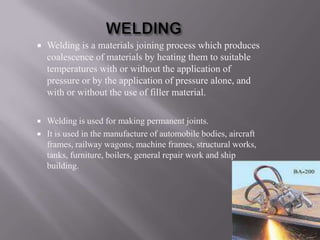
   Welding is used for making permanent joints.
   It is used in the manufacture of automobile bodies, aircraft
    frames, railway wagons, machine frames, structural works,
    tanks, furniture, boilers, general repair work and ship
    building.
   Plastic Welding or Pressure Welding
      The piece of metal to be joined are heated to a
      plastic state and forced together by external
      pressure
      (Ex) Resistance welding
   Fusion Welding or Non-Pressure Welding
      The material at the joint is heated to a molten state and allowed
      to solidify
      (Ex) Gas welding, Arc welding
(i). Arc welding
      Carbon arc           (iv)Thermit Welding
      Metal arc            (v)Solid State Welding
      Metal inert gas              Friction
      Tungsten inert gas           Ultrasonic
      Plasma arc                   Diffusion
      Submerged arc                Explosive
      Electro-slag         (vi)Newer Welding
(ii). Gas Welding                    Electron-beam
     Oxy-acetylene                  Laser
     Air-acetylene         (vii)Related Process
     Oxy-hydrogen                   Oxy-acetylene cutting
(iii). Resistance Welding            Arc cutting
       Butt                         Hard facing
                                     Brazing
       Spot
                                     Soldering
       Seam
       Projection
       Percussion
What is fusion welding..?

             A process in which parts are melted and
  fused or joint together is called fusion welding.
                   or
 Fusion welding is a group of processes that bond metal
  together by heating a portion of each piece above the
  melting point and causing them to join together.
Types of fusion welding include:
 Arc welding.

 Oxy-fuel welding.

 Metal Inert Gas (MIG).

 Tungsten Inert Gas (TIG).
 Heat is supplied by various means
  o Oxyacetylene gas
  o Electric Arc
  o Plasma Arc
  o Laser
 Filler metal may be added
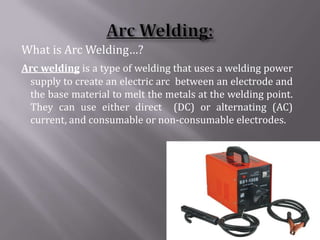
What is Arc Welding…?
Arc welding is a type of welding that uses a welding power
 supply to create an electric arc between an electrode and
 the base material to melt the metals at the welding point.
 They can use either direct (DC) or alternating (AC)
 current, and consumable or non-consumable electrodes.
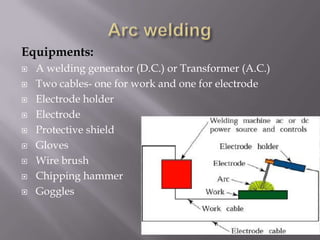
Equipments:
   A welding generator (D.C.) or Transformer (A.C.)
   Two cables- one for work and one for electrode
   Electrode holder
   Electrode
   Protective shield
   Gloves
   Wire brush
   Chipping hammer
   Goggles
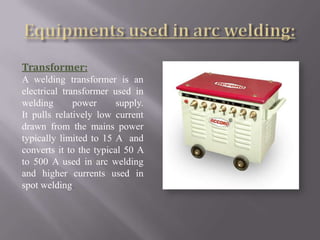
Transformer:
A welding transformer is an
electrical transformer used in
welding       power      supply.
It pulls relatively low current
drawn from the mains power
typically limited to 15 A and
converts it to the typical 50 A
to 500 A used in arc welding
and higher currents used in
spot welding.
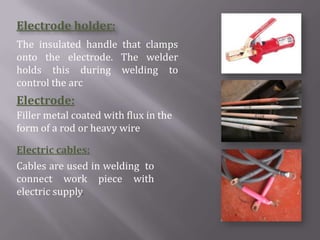
Electrode holder:
The insulated handle that clamps
onto the electrode. The welder
holds this during welding to
control the arc
Electrode:
Filler metal coated with flux in the
form of a rod or heavy wire

Electric cables:
Cables are used in welding to
connect work piece with
electric supply.
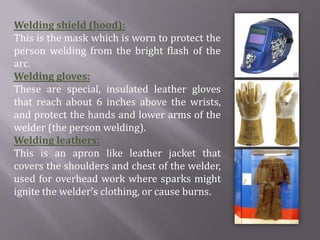
Welding shield (hood):
This is the mask which is worn to protect the
person welding from the bright flash of the
arc.
Welding gloves:
These are special, insulated leather gloves
that reach about 6 inches above the wrists,
and protect the hands and lower arms of the
welder (the person welding).
Welding leathers:
This is an apron like leather jacket that
covers the shoulders and chest of the welder,
used for overhead work where sparks might
ignite the welder's clothing, or cause burns.
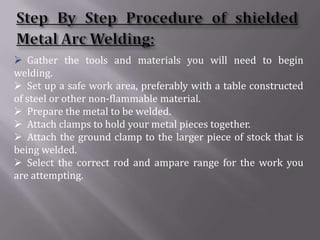
 Gather the tools and materials you will need to begin
welding.
 Set up a safe work area, preferably with a table constructed
of steel or other non-flammable material.
 Prepare the metal to be welded.
 Attach clamps to hold your metal pieces together.
 Attach the ground clamp to the larger piece of stock that is
being welded.
 Select the correct rod and ampare range for the work you
are attempting.
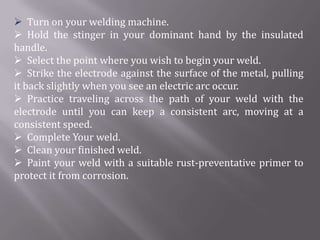
 Turn on your welding machine.
 Hold the stinger in your dominant hand by the insulated
handle.
 Select the point where you wish to begin your weld.
 Strike the electrode against the surface of the metal, pulling
it back slightly when you see an electric arc occur.
 Practice traveling across the path of your weld with the
electrode until you can keep a consistent arc, moving at a
consistent speed.
 Complete Your weld.
 Clean your finished weld.
 Paint your weld with a suitable rust-preventative primer to
protect it from corrosion.
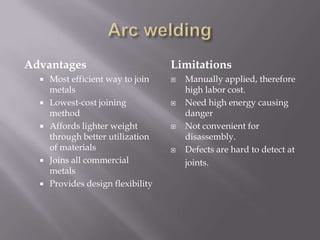
Advantages                          Limitations
     Most efficient way to join       Manually applied, therefore
      metals                            high labor cost.
     Lowest-cost joining              Need high energy causing
      method                            danger
     Affords lighter weight           Not convenient for
      through better utilization        disassembly.
      of materials                     Defects are hard to detect at
     Joins all commercial              joints.
      metals
     Provides design flexibility
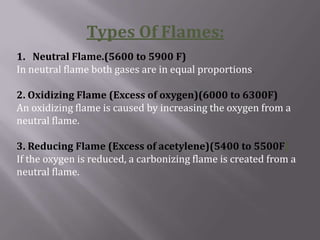
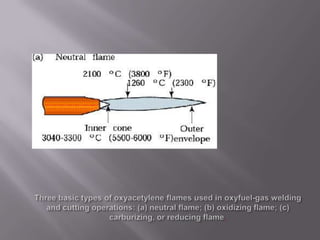
Types Of Flames:
1. Neutral Flame.(5600 to 5900 F)
In neutral flame both gases are in equal proportions.

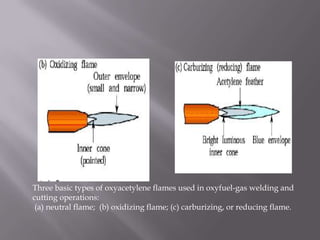
2. Oxidizing Flame (Excess of oxygen)(6000 to 6300F)
An oxidizing flame is caused by increasing the oxygen from a
neutral flame.

3. Reducing Flame (Excess of acetylene)(5400 to 5500F)
If the oxygen is reduced, a carbonizing flame is created from a
neutral flame.
Three basic types of oxyacetylene flames used in oxyfuel-gas welding and
cutting operations:
 (a) neutral flame; (b) oxidizing flame; (c) carburizing, or reducing flame.

7th lec welding

  • 2.
    Welding is a materials joining process which produces coalescence of materials by heating them to suitable temperatures with or without the application of pressure or by the application of pressure alone, and with or without the use of filler material.  Welding is used for making permanent joints.  It is used in the manufacture of automobile bodies, aircraft frames, railway wagons, machine frames, structural works, tanks, furniture, boilers, general repair work and ship building.
  • 3.
    Plastic Welding or Pressure Welding The piece of metal to be joined are heated to a plastic state and forced together by external pressure (Ex) Resistance welding  Fusion Welding or Non-Pressure Welding The material at the joint is heated to a molten state and allowed to solidify (Ex) Gas welding, Arc welding
  • 4.
    (i). Arc welding  Carbon arc (iv)Thermit Welding  Metal arc (v)Solid State Welding  Metal inert gas Friction  Tungsten inert gas Ultrasonic  Plasma arc Diffusion  Submerged arc Explosive  Electro-slag (vi)Newer Welding (ii). Gas Welding Electron-beam  Oxy-acetylene Laser  Air-acetylene (vii)Related Process  Oxy-hydrogen Oxy-acetylene cutting (iii). Resistance Welding Arc cutting  Butt Hard facing Brazing  Spot Soldering  Seam  Projection  Percussion
  • 5.
    What is fusionwelding..? A process in which parts are melted and fused or joint together is called fusion welding. or Fusion welding is a group of processes that bond metal together by heating a portion of each piece above the melting point and causing them to join together.
  • 6.
    Types of fusionwelding include:  Arc welding.  Oxy-fuel welding.  Metal Inert Gas (MIG).  Tungsten Inert Gas (TIG).
  • 7.
     Heat issupplied by various means o Oxyacetylene gas o Electric Arc o Plasma Arc o Laser  Filler metal may be added
  • 8.
    What is ArcWelding…? Arc welding is a type of welding that uses a welding power supply to create an electric arc between an electrode and the base material to melt the metals at the welding point. They can use either direct (DC) or alternating (AC) current, and consumable or non-consumable electrodes.
  • 9.
    Equipments:  A welding generator (D.C.) or Transformer (A.C.)  Two cables- one for work and one for electrode  Electrode holder  Electrode  Protective shield  Gloves  Wire brush  Chipping hammer  Goggles
  • 10.
    Transformer: A welding transformeris an electrical transformer used in welding power supply. It pulls relatively low current drawn from the mains power typically limited to 15 A and converts it to the typical 50 A to 500 A used in arc welding and higher currents used in spot welding.
  • 11.
    Electrode holder: The insulatedhandle that clamps onto the electrode. The welder holds this during welding to control the arc Electrode: Filler metal coated with flux in the form of a rod or heavy wire Electric cables: Cables are used in welding to connect work piece with electric supply.
  • 12.
    Welding shield (hood): Thisis the mask which is worn to protect the person welding from the bright flash of the arc. Welding gloves: These are special, insulated leather gloves that reach about 6 inches above the wrists, and protect the hands and lower arms of the welder (the person welding). Welding leathers: This is an apron like leather jacket that covers the shoulders and chest of the welder, used for overhead work where sparks might ignite the welder's clothing, or cause burns.
  • 13.
     Gather thetools and materials you will need to begin welding.  Set up a safe work area, preferably with a table constructed of steel or other non-flammable material.  Prepare the metal to be welded.  Attach clamps to hold your metal pieces together.  Attach the ground clamp to the larger piece of stock that is being welded.  Select the correct rod and ampare range for the work you are attempting.
  • 14.
     Turn onyour welding machine.  Hold the stinger in your dominant hand by the insulated handle.  Select the point where you wish to begin your weld.  Strike the electrode against the surface of the metal, pulling it back slightly when you see an electric arc occur.  Practice traveling across the path of your weld with the electrode until you can keep a consistent arc, moving at a consistent speed.  Complete Your weld.  Clean your finished weld.  Paint your weld with a suitable rust-preventative primer to protect it from corrosion.
  • 15.
    Advantages Limitations  Most efficient way to join  Manually applied, therefore metals high labor cost.  Lowest-cost joining  Need high energy causing method danger  Affords lighter weight  Not convenient for through better utilization disassembly. of materials  Defects are hard to detect at  Joins all commercial joints. metals  Provides design flexibility
  • 16.
    Types Of Flames: 1.Neutral Flame.(5600 to 5900 F) In neutral flame both gases are in equal proportions. 2. Oxidizing Flame (Excess of oxygen)(6000 to 6300F) An oxidizing flame is caused by increasing the oxygen from a neutral flame. 3. Reducing Flame (Excess of acetylene)(5400 to 5500F) If the oxygen is reduced, a carbonizing flame is created from a neutral flame.
  • 18.
    Three basic typesof oxyacetylene flames used in oxyfuel-gas welding and cutting operations: (a) neutral flame; (b) oxidizing flame; (c) carburizing, or reducing flame.