This document provides an overview of underwater welding, including a brief history, the two main types (wet and dry welding), advantages and disadvantages of each, applications, risks involved, safety rules, and future developments. It discusses how underwater welding was pioneered in the 1930s in Russia and how the techniques have evolved. Wet welding is done directly in water while dry welding uses an enclosed chamber. Underwater welding is used to repair ships, offshore platforms, and pipelines and allows construction in underwater environments. Safety is important due to risks like electric shock and gas explosions. The future of underwater welding may include increased automation and new techniques like friction welding.


![INTRODUCTION
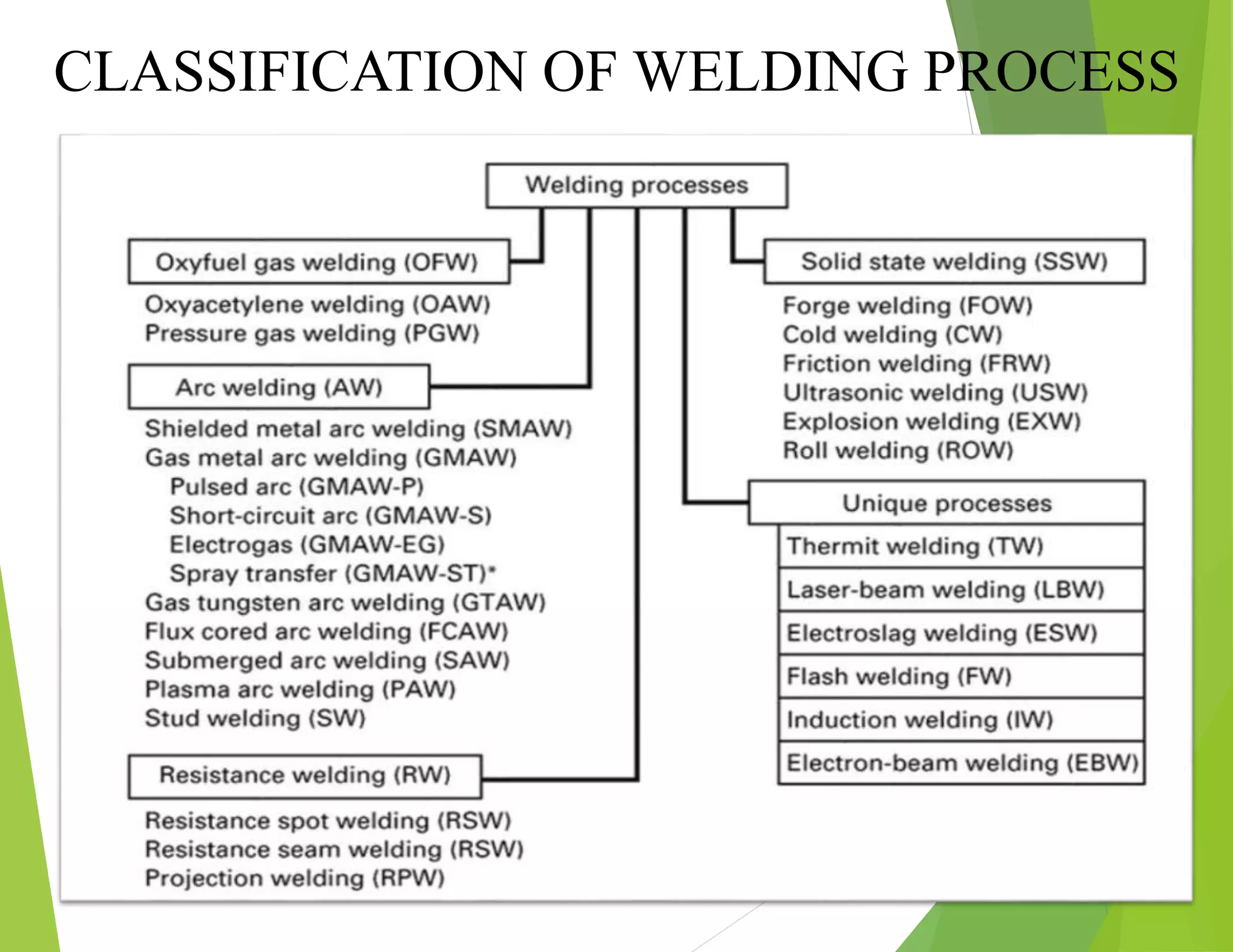
Welding can be defined as the process of joining two similar or dissimilar
metallic components with the application of heat, with or without the
application of pressure and with or without the use of filler metal.
Heat may be obtained by chemical reaction, electric arc, electrical resistance,
frictional heat, sound and light energy.[1]
Figure.1 Arc welding process [1]](https://image.slidesharecdn.com/akashpt-190425015714/75/UNDER-WATER-WELDING-3-2048.jpg)
![WELDING ELECTRODES
An electrode is used to conduct current through a workpiece to fuse two pieces
together.
Depending upon the process, the electrode is either consumable, in the case of gas
metal arc welding or shielded metal arc welding , or non-consumable, such as
in gas tungsten arc welding . [10]
Figure.2 Designation system for arc welding electrodes [1]
I.S.
CODING OF
ELECTRODES](https://image.slidesharecdn.com/akashpt-190425015714/75/UNDER-WATER-WELDING-5-2048.jpg)


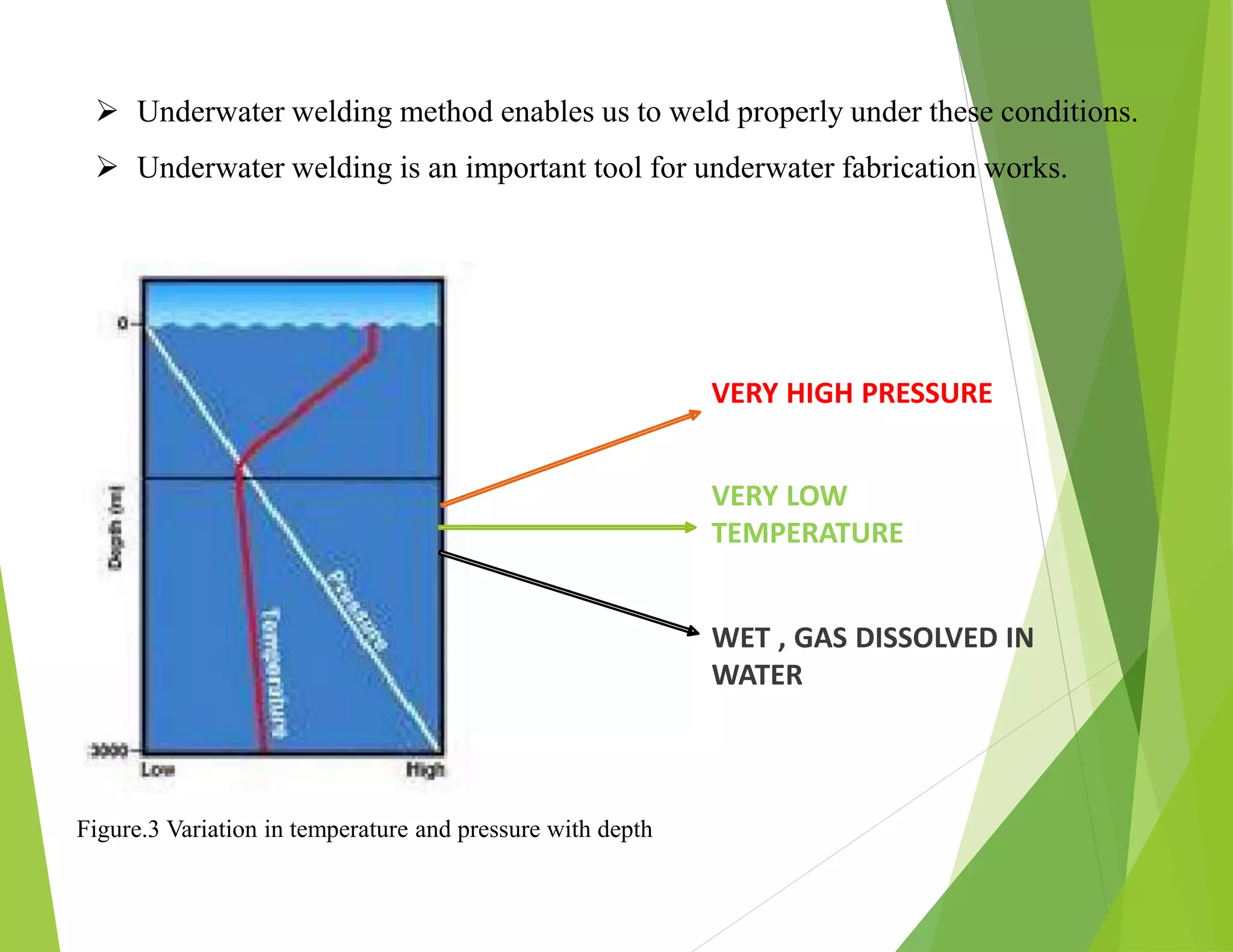
![Underwater welding is the process of welding at elevated pressures, normally
underwater.
Underwater welding can either take place wet in the water itself or dry inside a
specially constructed positive pressure enclosure and hence a dry environment.
It is predominantly referred to as "hyperbaric welding" when used in a dry
environment, and "underwater welding" when in a wetenvironment.
The applications of underwater welding are diverse—it is often used to repair
ships, offshore oil platforms, and pipelines. Steel is the most common material
welded.
Underwater welding is most commonly used for welding steel structures
including stainless steel. However it is being used for welding copper and
aluminium components also.[2]
UNDERWATER WELDING](https://image.slidesharecdn.com/akashpt-190425015714/75/UNDER-WATER-WELDING-9-2048.jpg)
![FIGURE SHOWING SCHEMATIC
DIAGRAM FOR UNDERWATER
WELDING
Figure.4 Arrangements of underwater welding [2]](https://image.slidesharecdn.com/akashpt-190425015714/75/UNDER-WATER-WELDING-11-2048.jpg)
![BRIEF HISTORY
1930s: Russian metallurgist Konstantin Khrenov made the first underwater weld in
lab test.
In 1932 after successful experimentation in the labs, Khrenov traveled
with engineers to the Black Sea for further testing and After a successful
testing, underwater welding was born.
The first ever underwater welding was carried out by British Admiralty –
Dockyard for sealing leaking ship rivets below the water line.
In 1946, special waterproof electrodes were developed in Holland by Van der
Willingen.
1970s: Whitey Grubbs and Dale Anderson of Chicago Bridge & Iron (CB&I)
qualified an underwater wet welding procedure to American Welding Society
(AWS) standards.[5]](https://image.slidesharecdn.com/akashpt-190425015714/75/UNDER-WATER-WELDING-12-2048.jpg)
![CLASSIFICATION
WET WELDING DRY WELDING
In wet welding, the welding is
performed underwater, directly
exposed to the wet environment
In dry welding, a dry chamber is
created near the area to be
welded and the welder does the job
by staying inside the chamber
Figure.6 Dry welding [6]Figure.5 Wet welding [6]](https://image.slidesharecdn.com/akashpt-190425015714/75/UNDER-WATER-WELDING-13-2048.jpg)
![WET WELDING
As the name implies, underwater wet welding is done in an environment where the base
metal and the arc are surrounded entirely by water. In wet welding MMA (manual metal
arc welding) is used.
Increased freedom of movement makes wet welding the most effective, efficient and
economical method.
Welding power supply is located on the surface with connection to the diver/welder via
cables and hoses.[6]
Figure.7 Wet welding under water[6]](https://image.slidesharecdn.com/akashpt-190425015714/75/UNDER-WATER-WELDING-14-2048.jpg)
![PRINCIPLE OF OPERATION OF WET WELDING
DC Power Supply is used with negative polarity.
The welding circuit includes the knife switch which is operated on the surface by the
assistant upon the signal of welder/diver.
The main reason for the use of the knife switch is that it cuts off the welding current.
For gripping the electrode, electrode holder with the twisted head is utilized.[5]
Figure.8 Working process of a wet welding [5]](https://image.slidesharecdn.com/akashpt-190425015714/75/UNDER-WATER-WELDING-15-2048.jpg)
![ADVANTAGES OF WET WELDING
The versatility and low cost of wet welding makes this method highly desirable.
Other benefits include the speed with which the operation is carried out.
It is less costly compared to dry welding.
The welder can reach portions of offshore structures that could not be welded using
other methods.
No enclosures are needed and no time is lost building. Readily available standard
welding machine and equipments are used. The equipment needed for mobilization
of a wet welded job is minimal.[5]](https://image.slidesharecdn.com/akashpt-190425015714/75/UNDER-WATER-WELDING-16-2048.jpg)
![DISADVANTAGES OF WET WELDING
There is rapid quenching of the weld metal by the surrounding water. Although
quenching increases the tensile strength of the weld, it decreases the ductility and impact
strength of the weldment and increases porosity and hardness.
Hydrogen Embrittlement – Large amount of hydrogen is present in the weld region,
resulting from the dissociation of the water vapour in the arc region.
The 𝐻2 dissolves in the Heat Affected Zone (HAZ) and the weld metal, which causes
Embrittlement, cracks and microscopic fissures. Cracks can grow and may result in
catastrophic failure of the structure.
Another disadvantage is poor visibility. The welder some times is not able to weld
properly.[5]](https://image.slidesharecdn.com/akashpt-190425015714/75/UNDER-WATER-WELDING-17-2048.jpg)
![DRY WELDING
Inside a specially constructed positive pressure enclosure and hence a dry
environment.
Use for high quality welds as more control over conditions.
Involves the weld being performed at the prevailing pressure in a chamber filled
with a gas mixture sealed around the structure being welded.
Figure.9 Dry welding in water[6]](https://image.slidesharecdn.com/akashpt-190425015714/75/UNDER-WATER-WELDING-18-2048.jpg)
![PRINCIPLE OF OPERATION OF DRY WELDING
Underwater welding in a dry environment is made possible by encompassing the
area to be welded with a physical barrier (weld chamber) that excludes water.
The weld chamber is designed and custom built to accommodate braces and other
structural members
Water is displaced from within the chamber by air or a suitable gas mixture,
depending upon water depth and pressure at the work site. [6]
Figure.10 Hyperbaric welding chamber [2]](https://image.slidesharecdn.com/akashpt-190425015714/75/UNDER-WATER-WELDING-19-2048.jpg)


![APPLICATION OF UNDERWATER WELDING
The important applications of underwater welding are:
Offshore construction for tapping sea resources,
Temporary repair work caused by ships collisions or unexpected accidents.
Salvaging vessels sunk in the sea
Repair and maintenance of ships
Construction of large ships beyond the capacity of existing docks.
Repair and maintenance of underwater pipelines.[1]](https://image.slidesharecdn.com/akashpt-190425015714/75/UNDER-WATER-WELDING-22-2048.jpg)
![There are some risks which are involved during the underwater welding
which are mentioned below:-
Electric Shock: There is a possibility of electric shock when the equipment is
not properly insulated, or when the power supply is not shut off immediately
when the welder terminates the arc during welding.
Explosion: Arc welding produces the hydrogen and oxygen. Pockets of gases
can build up and are potentially explosive.
Nitrogen Narcosis: A health hazard normally experienced by divers during the
diving activity when the safety stops at certain level is not adhered to.
Curiously, the risk of drowning is not listed with the hazards of underwater
welding.[15]
RISKS INVOLVED](https://image.slidesharecdn.com/akashpt-190425015714/75/UNDER-WATER-WELDING-23-2048.jpg)
![SAFETY RULES
Some necessary precautions should be carried out such as:
Follow employer’s safety practices.
Fumes and gases can be hazardous to your health.
Arc rays can injure eyes and skin.
Use adequate ventilation while welding.
Wear suitable eye protection and protective clothing.
Do not touch live electrical parts.
Wear rubber gloves.
Only change the electrode, when it is cold.[15]](https://image.slidesharecdn.com/akashpt-190425015714/75/UNDER-WATER-WELDING-24-2048.jpg)
![FUTURE DEVELOPMENTS
The major efforts on research and development should be focused on the
following topics:
Automation of the underwater joining and inspection of the welded structures.
Mechanized underwater welding for actual usage of very large floating
structures.
Investigation of the potential of using a robot manipulator for underwater
ultrasonic testing of welds in joints of complex geometry.
Application of advanced welding technique, like friction, laser welding and
understand the behaviour of materials after the welding and process
optimization.
Invention of new welding techniques and explore the possibility of its
application in underwater welding.
Wet MMA is still being used for underwater repairs, but the quality of wet welds
is poor and prone to hydrogen cracking. [3]](https://image.slidesharecdn.com/akashpt-190425015714/75/UNDER-WATER-WELDING-25-2048.jpg)

![REFERENCES
[1] De Garmo's Materials and Process 11th by J. Temple Black; Ernest Paul DeGarmo;
Ronald A. Kohser
[2] Underwater Welding-Recent Trends and Future Scope(2012): Ketan Verma and Harish
K. Garg ISSN No. (Online) : 2249-3255
[3] UNDERWATER WELDING – PRESENT STATUS AND FUTURE SCOPE (2006):
Jyotsna Dutta Majumdar
[4] UNDERWATER WELDING (2014): AKHIL CHHANIYARA ISSN(P): 2249-6890;
ISSN(E): 2249-8001 Vol. 4, Issue 1, Feb 2014, 81-90
[5] Fundamental Difficulties Associated With Underwater Wet Welding (2014): Joshua E.
Omajene, Jukka Martikainen, Paul Kah, Markku Pirinen ISSN : 2248-9622, Vol. 4, Issue
6( Version 4), June 2014, pp.26-31
[6] D.J Keats, Manual on wet welding. ISBN 1-899293-99-X
[7] W. Lucas, International Conference on computer technology in welding.
[8] Dr. R.P. Arora- Manufacturing process-II – Techmax publications, pune.
[9] J. Labanowski, "Development of underwater welding techniques," Welding International,
vol. 25, no. 12, pp. 933 - 937, 2011.](https://image.slidesharecdn.com/akashpt-190425015714/75/UNDER-WATER-WELDING-27-2048.jpg)
![[10] AWS, "Underwater welding code," AWS, USA, 2010.
[11] P. J. Keenan, "Thermal insulation of wet shielded metal arc welds," MIT, USA, 1993
[12] ASM Metals Hand Book, 9th edn, Vol 9, Welding, Brazing, And Soldering, ASM, Metals
Park, (1983)
[13] Stepath M. D, Underwater welding and cutting yields slowly to research, Welding
Engineer, April 1973
[14] Huang Her - Yueh,(2009)” Effects of shielding gas composition and activating flux on
GTAW weldments”, Materials and Design 30,(2404–2409)
[15] Underwater Welding Amit Mukund Joshi (Mechanical Engineer) ,Junior Research Fellow
Mechanical Engineering Department ,Indian Institute of Technology ,I.I.T – Bombay](https://image.slidesharecdn.com/akashpt-190425015714/75/UNDER-WATER-WELDING-28-2048.jpg)


![Underwater welding 1[1]](https://cdn.slidesharecdn.com/ss_thumbnails/underwaterwelding11-180325142223-thumbnail.jpg?width=640&height=640&fit=bounds)


