Presentation on
Diffusion welding
PRESENTED BY: LIMON SAHA
Contents
 Definition
 Schematic Figure
 Working principles
 Applications
 Titanium Diffusion Welding
 Nickel Diffusion Welding
 Advantages
 Limitations
Definition of Diffusion Welding
 A solid-state welding process that produces coalescence
of the faying surfaces by the application of pressure at
elevated temperature.
 The process does not involve macroscopic deformation,
or relative motion of the workpieces.
 A solid filler metal may or may not be inserted between
the faying surfaces.
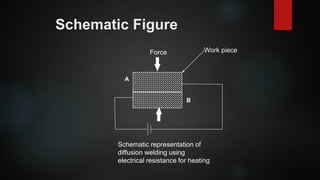
Schematic Figure
Schematic representation of
diffusion welding using
electrical resistance for heating
A
B
Force Work piece
Diffusion Welding Working
Principles
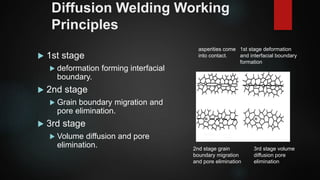
 1st stage
 deformation forming interfacial
boundary.
 2nd stage
 Grain boundary migration and
pore elimination.
 3rd stage
 Volume diffusion and pore
elimination. 2nd stage grain
boundary migration
and pore elimination
3rd stage volume
diffusion pore
elimination
asperities come
into contact.
1st stage deformation
and interfacial boundary
formation
Applications of Diffusion Welding
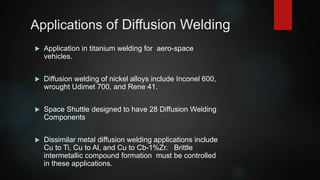
 Application in titanium welding for aero-space
vehicles.
 Diffusion welding of nickel alloys include Inconel 600,
wrought Udimet 700, and Rene 41.
 Space Shuttle designed to have 28 Diffusion Welding
Components
 Dissimilar metal diffusion welding applications include
Cu to Ti, Cu to Al, and Cu to Cb-1%Zr. Brittle
intermetallic compound formation must be controlled
in these applications.
Titanium Diffusion Welding
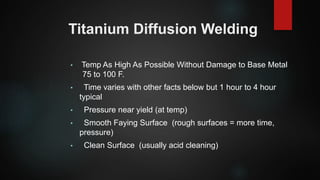
• Temp As High As Possible Without Damage to Base Metal
75 to 100 F.
• Time varies with other facts below but 1 hour to 4 hour
typical
• Pressure near yield (at temp)
• Smooth Faying Surface (rough surfaces = more time,
pressure)
• Clean Surface (usually acid cleaning)
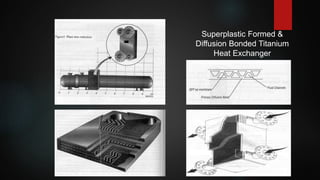
Superplastic Formed &
Diffusion Bonded Titanium
Heat Exchanger
Nickel Diffusion Welding
 Temp close to MP
 High Pressure (because High hot strength)
 Clean Surfaces - Ambient Atmosphere Control
 (Surface Oxides Do Not Dissolve)
 Nickel Filler often used (especially for rough surface)
Advantages
 This solid state process avoids pitfalls of fusion welding
 Dissimilar materials welds are possible
 Properties and microstructures remain similar to those of base
metals
 Multiple welds can be made in one setup at the same time
 Produces a product finished to size and causes minimal
deformation
 Presents less shrinkage and stresses compared to other
welding processes
 Highly automated process does not need skillful workforce
Limitations
 Costly equipment especially for large weldments
 Costly preparation with smooth surface finish and exceptional
cleanliness
 Protective atmosphere or vacuum required
 Long time to completion
 Not suited to high production rates
 Difference in thermal expansion of members may need
special attention
 Limited nondestructive inspection methods available
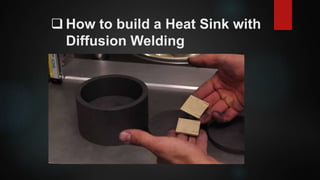
 How to build a Heat Sink with
Diffusion Welding
Diffusion welding by Limon Saha

Diffusion welding by Limon Saha

  • 1.
  • 2.
    Contents  Definition  SchematicFigure  Working principles  Applications  Titanium Diffusion Welding  Nickel Diffusion Welding  Advantages  Limitations
  • 3.
    Definition of DiffusionWelding  A solid-state welding process that produces coalescence of the faying surfaces by the application of pressure at elevated temperature.  The process does not involve macroscopic deformation, or relative motion of the workpieces.  A solid filler metal may or may not be inserted between the faying surfaces.
  • 4.
    Schematic Figure Schematic representationof diffusion welding using electrical resistance for heating A B Force Work piece
  • 5.
    Diffusion Welding Working Principles 1st stage  deformation forming interfacial boundary.  2nd stage  Grain boundary migration and pore elimination.  3rd stage  Volume diffusion and pore elimination. 2nd stage grain boundary migration and pore elimination 3rd stage volume diffusion pore elimination asperities come into contact. 1st stage deformation and interfacial boundary formation
  • 6.
    Applications of DiffusionWelding  Application in titanium welding for aero-space vehicles.  Diffusion welding of nickel alloys include Inconel 600, wrought Udimet 700, and Rene 41.  Space Shuttle designed to have 28 Diffusion Welding Components  Dissimilar metal diffusion welding applications include Cu to Ti, Cu to Al, and Cu to Cb-1%Zr. Brittle intermetallic compound formation must be controlled in these applications.
  • 7.
    Titanium Diffusion Welding •Temp As High As Possible Without Damage to Base Metal 75 to 100 F. • Time varies with other facts below but 1 hour to 4 hour typical • Pressure near yield (at temp) • Smooth Faying Surface (rough surfaces = more time, pressure) • Clean Surface (usually acid cleaning)
  • 8.
    Superplastic Formed & DiffusionBonded Titanium Heat Exchanger
  • 9.
    Nickel Diffusion Welding Temp close to MP  High Pressure (because High hot strength)  Clean Surfaces - Ambient Atmosphere Control  (Surface Oxides Do Not Dissolve)  Nickel Filler often used (especially for rough surface)
  • 10.
    Advantages  This solidstate process avoids pitfalls of fusion welding  Dissimilar materials welds are possible  Properties and microstructures remain similar to those of base metals  Multiple welds can be made in one setup at the same time  Produces a product finished to size and causes minimal deformation  Presents less shrinkage and stresses compared to other welding processes  Highly automated process does not need skillful workforce
  • 11.
    Limitations  Costly equipmentespecially for large weldments  Costly preparation with smooth surface finish and exceptional cleanliness  Protective atmosphere or vacuum required  Long time to completion  Not suited to high production rates  Difference in thermal expansion of members may need special attention  Limited nondestructive inspection methods available
  • 12.
     How tobuild a Heat Sink with Diffusion Welding