WELDING TECHNIQUES
Welding
American welding Society defines
“welding is a process of making weld; wherein
WELD is a localized coalescence of metals or
non-metals produced either by heating the
materials to suitable temperatures , with or
without the application of pressure or by the
application of pressure alone and with or
without the use of filler material”.
Coalescence : grown together in one body.
PRACTICALLY DIFFICULT TO JOIN TWO SOLIDS.
 Surfaces are not smooth on atomic level.
 Surfaces have oxides.
 Surfaces have moisture on it.
 Surfaces have dust on it.
There are two ways to overcome these problems.
1. By using very high force ( Solid state Welding )
 All oxide, dirt, adsorbed moisture etc. are removed out from
the mating surfaces.
 Atoms are brought very near so that inter-atomic forces
come into play and bonding is achieved.
2. By Melting and Solidification ( Fusion Welding)
Volatile material from the surfaces are vaporized
Oxides , dirt etc float out over the melted surface
Both the metal surfaces solidify together
 Two parts of the same chemical composition may be
welded together using no added metal to accomplish the
joint, it is called autogenous welding.
 A metal which is of same composition as of parts being
joined may be added, it is called homogenous welding
 An alloy of quite different composition, can be added in the
joint, this process is called heterogeneous welding
Welding processes
Fusion welding Solid state Brazing Braze welding
Arc Gas EBW LASER
Metal arc Carbon arc TIG Plasma
SMAW SAW MIG MAG
Diffusion
Explosive
Friction
Ultrasonic
Electric res.
Spot
Seam
Projection
Inputs during Fusion welding
Basic inputs to weld, other than the parent
materials to be joined are:
1. Heat,
2. Filler Metal and
3. Weld Pool Shielding Material
Welding Metallurgy
How these inputs and their interaction with
parent metal and among them affect the
welds and how to get quality weld by
controlling these inputs.
Almost every imaginable high energy density heat
source has been used at one time or another in
welding
Welding heat source Power density ( W/cm2
)
Gas Flame 102
-103
Argon Arc 5 X10²
-104
Plasma Arc 103
-106
Electron Beam 104
-107
Laser Beam 103
-107
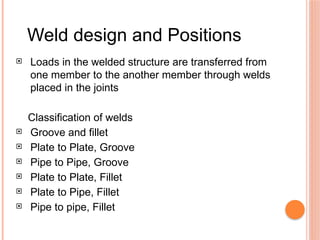
Weld design and Positions
 Loads in the welded structure are transferred from
one member to the another member through welds
placed in the joints
Classification of welds
 Groove and fillet
 Plate to Plate, Groove
 Pipe to Pipe, Groove
 Plate to Plate, Fillet
 Plate to Pipe, Fillet
 Pipe to pipe, Fillet
WELD DESIGN AND POSITIONS
 Joint design should be selected primarily on the basis
of load requirement
 Generally the joint design that requires the least
amount of weld metal
 Where possible use square groove
 Use the smaller root opening and groove angle to
minimize the filler material
 On thick plate use double instead of single V or U
groove to reduce amount of weld metal and to control
 Design the assembly and joint for accessibility for
welding
TYPE OF WELDING JOINT
 Butt joints.
 Lap joints
 Tee joints
 Corner joints
 Edge joints
ARC CHARACTERISTICS
 An arc is an electrical current flowing between two
electrodes through an ionized column of gas called a
plasma.
 The welding arc is characterized as a high current
low voltage arc that require a high concentration of
electron are emitted from the cathode and flow
along the negative ions of plasma to positive anode
 Positive ion flow in the reverse direction
 Heat is generated in cathode area by positive ion
striking the cathode, vice versa
Shielded Metal Arc Welding
(SMAW)
 Electrode acts as filler wire
 Shielding is provided by
burning of coating on electrode
which produces gases and slag
 Electrode sizes:1.6-8mm
diameter
 AWS: E6010
 Power source: AC or DC
(Choice of polarity)
 Current 30-400A
TYPE OF COVERED ELECTRODES
Carbon steel: The 60 XX series and 70 XX
series. Example AWS E6010 and E7018 etc
Low alloy steel: E70 XX to E120XX
Stainless Steel: E308,E308L,E309 and E316
Nickel and Nickel based alloys:ENiCrFe-1
Copper and copper alloy: CuSi,CuNi,CuAl
Aluminum & Al alloy E1100,E3003,E4043
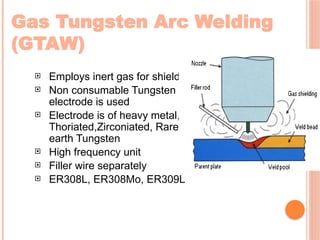
Gas Tungsten Arc Welding
(GTAW)
 Employs inert gas for shielding
 Non consumable Tungsten
electrode is used
 Electrode is of heavy metal,
Thoriated,Zirconiated, Rare
earth Tungsten
 High frequency unit
 Filler wire separately
 ER308L, ER308Mo, ER309L
24
TIG welding
external filler metal
may or may not be
added
POLARITIES
 Three different polarities used in arc welding:
 Direct Current Straight Polarity—occurs when
electrode is made negative and base plates are made
positive.
 Direct Current Reverse Polarity—occurs when
electrode is made positive and base plates are made
negative.
 Alternating Current Polarity—if power source
provides AC current then above two cases will occur one
after another in every cycle.
EFFECT OF POLARITY
ADVANTAGES OF GTAW
1. No flux (No entrapment)
2. Clear visibility – better control.
3. All positions with high quality.
4. Thin materials (0.125 mm).
5. SS, Non ferrous and number of alloys can be
welded precisely.
DISADVANTAGES OF
GTAW
 Costlier process.
 High heat input and slow process.
 Improper shielding results to
contamination.
 Improper current results to tungsten
inclusion.
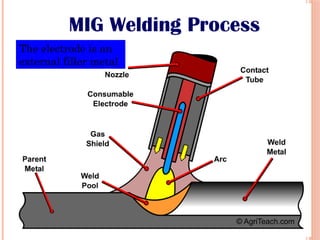
Gas Metal Arc Welding
(MIG)
 MIG/MAG welding
 Continuous consumable wire acts
as electrode.
 A shielding gas flows through the
torch and forms a blanket over the
weld puddle.
 Power source, 60-500A, DC,16-
40V arc voltage
 The wire is fed at constant speed
to give the desired weld current.
 Voltage control arc length
30
The electrode is an
external filler metal
ADVANTAGES OF MIG WELDING
 Good visibility of weld during welding.
 Continuous welding with coiled filler wire
 No slag removable difficulties
 High metal deposition rate.
 No welding fumes.
 High quality of weld
 High welding speed
 Less distortion
 Welding in all position
DISADVANTAGES
 Equipment for GMAW is sophisticated and therefore is
costly
 Because of the higher spatter ,deposition efficiency is less
compared to TIG welding
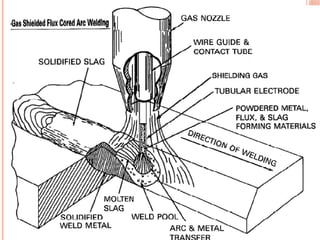
Flux Cored Arc Welding
(FCAW)
 Similar to MIG/MAG welding, except that the
consumable is a tubular wire with flux or
metal powder filled inside.
 DC only
 Long length of continuous weld possible
 Additional gas can be used.
Submerged Arc Welding
(SAW)
 The arc is fully submerged inside
the flux covering the weld joint
area.
 Filler wire is fed separately by wire
feeder.
 The weld pool and weld metal is
protected by molten thick slag by
melting the flux supplied by a
hopper.
Plasma Arc welding
A gas shielded arc welding process.
Arc created between a tungsten
electrode and a work piece.
Arc is constricted to form a highly
collimated column.
Plasma is formed through the ionisation
of the gas.
Plasma Arc welding
PAW
 High power density
 Deep penetration
 Fast process
 High velocity
 No inclusions
 Also suitable for cutting and
thin section welding
TIG plasma
 Diffused over large area
 Less power density
 Less penetration
 Less deposition
ADVANTAGES OF
PAW
1. Less welding time
2. Less labour cost.
DISADVANTAGES OF
PAW
Greater capital cost.
Reduced tolerance of the
process to joint gaps and
misalignment
Resistance welding
 The heat of welding to fuse the
two pieces is generated by the
resistance of the portion of the
pieces being joined
 After bringing the point to
melting stage squeeze is applied
and thus welding is completed
 Used for thin sheets
 Process variables, Welding
current, Welding time, Electrode
force,
 Major processes
 Spot, Projection, Seam
Oxy fuel gas welding
(OFW)
 Heat produced for welding is
obtained from chemical
reaction between oxygen and
fuel gas, generally acetylene
 Gases are mixed in proportion
to get correct flame of neutral,
oxidising or reducing nature
 Limited to thin section welding
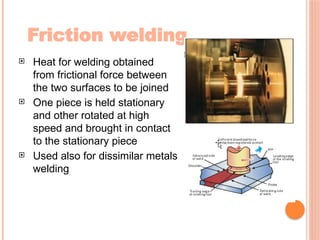
Friction welding
 Heat for welding obtained
from frictional force between
the two surfaces to be joined
 One piece is held stationary
and other rotated at high
speed and brought in contact
to the stationary piece
 Used also for dissimilar metals
welding
Electron beam welding
(EBW)
 Heat for welding obtained
from high velocity
concentrated beam of
electrons
 Electrons are produced by
heating heavy metal
cathode
 Electrons are accelerated
by anode and focused by
magnetic coils
 Vacuum is required for deep
penetration
ADVANTAGES OF EBW
Deep / narrow welds (High depth to
width ratio)
Lower heat input results narrow HAZ.
Minimum distortion (shrinkage).
Increased productivity.
LIMITATIONS OF EBW
Equipment costs are higher.
Work piece size is limited to the size of
the chamber.
Electron beam is deflected by
magnetic fields.
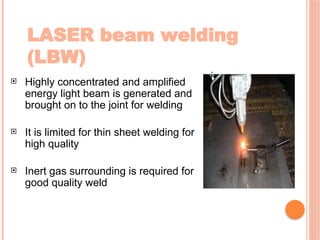
LASER beam welding
(LBW)
 Highly concentrated and amplified
energy light beam is generated and
brought on to the joint for welding
 It is limited for thin sheet welding for
high quality
 Inert gas surrounding is required for
good quality weld
Brazing, braze welding & Soldering
Brazing
• Similar or dissimilar metals can be joined by
maintaining narrow gap between parts, heating
them and feeding filler metal having melting
temperature below that of base metal, metal flow
by capillary action in gap
• If heating is above 450 deg. C, it is known as
brazing
• If heating is below 450 deg. C, it is known as
soldering
•The filler metal completely wets the butting
surfaces and form metallurgical joint
• Joint strength better than parent metals and
filler metal
•Braze welding refers to joining metals by
heating the joint up to melting temperature of
filler metal
Types of welding
discontinuities
Four categories of welding discontinuities
 Planar discontinuities- cracks, lack of fusion or
penetration, undercut and root concavity
 Volumetric discontinuities- solid inclusions, cavities,
porosities
 Geometrical discontinuities
 Metallurgical inhomogeneties
Planar flaws are considered more severe than
volumetric flaws because of high stress
concentration
Lack of Penetration
 Failure of weld metal to come down
the root surface.
 This is caused from too much speed
during the welding process
 Low welding current,
 Too short root gap
 It is found in the root of the weld
Lack of Fusion
 It can be that the weld and base metal
did not fuse or it might be that the
weld passes themselves failed to fuse.
 It occurs with high welding speed
 Low welding current.
 Presence of refractory slag.
 High thermal conductivity of material
Offset or mismatch
 Two pieces to be welded, the
edge may not match.
 Happens due to ovality in pipe or
thickness variation in plate.
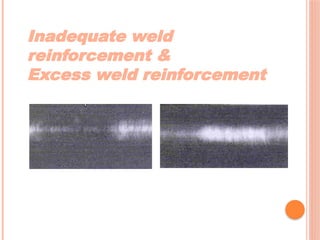
Inadequate weld
reinforcement &
Excess weld reinforcement
Crater / Weld Cracks
 Crater solidify from all sides
towards the centre, it appears like
star (*), longitudinal or transverse.
 When the welder starts the weld
and takes up his torch or arc to
complete the welds, he must take
care to fuse the discontinuity
together.
Stress crack
 Stress cracks in welds are the
result of stresses created during
the cooling of a restrained (rigid)
structure.
 Stress cracks might occur
anywhere along the weld bead,
or into the heat affected zone
(HAZ) of the base metal.
Cold cracks
 Appear in HAZ after the weld metal has cooled to
ambient temperature.
 It may appear even after the lapse of hrs after
welding is completed. Delayed crack.
 Presence of diffusible Hydrogen in weld metal
(HIC).
 These hydrogen diffuse to high
tensile stress area in weld metal
and HAZ and causes metal rupture.
 This may be longitudinal or
transverse and open to surface or
sub surface.
 Cold cracks are also formed when
the joint is too much restrained.
Hot cracks
 Appear in metals having impurities like Sulphur,
Phosphorus which has low melting points, and
solidify last.
 Solidified weld metal imposes shrinkage stresses on
this solidifying elements and cause hot cracks
 It appears immediately after solidification.
Slag inclusion
 Slag is produced by melting of
fluxes in the welding process.
 Before subsequent passes, the
slag produced must be cleaned
properly, before next pass.
 If not cleaned properly, slag
inclusion will occur
Porosity
 During welding gases are generated by
burning of fluxes or are supplied separately
for shielding.
 If the shielding gas contains moisture, it
decomposes into hydrogen and oxygen.
 Porosity may be open to the surface or sub
surface, depending on whether the gas was
trapped by the solidifying metal.
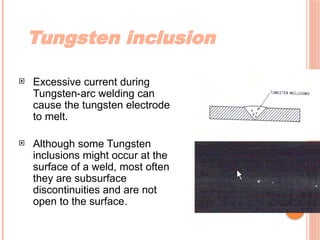
Tungsten inclusion
 Excessive current during
Tungsten-arc welding can
cause the tungsten electrode
to melt.
 Although some Tungsten
inclusions might occur at the
surface of a weld, most often
they are subsurface
discontinuities and are not
open to the surface.
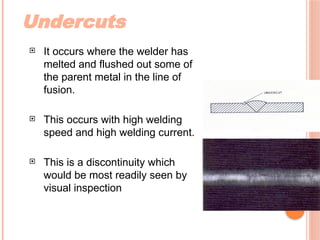
Undercuts
 It occurs where the welder has
melted and flushed out some of
the parent metal in the line of
fusion.
 This occurs with high welding
speed and high welding current.
 This is a discontinuity which
would be most readily seen by
visual inspection
Burn through
 Too thin wall joint
 Too small root face
 Excessive weld current
Suckback / Root concavity
 Concave shape of root
weld metal,
 For high purging pressure.
Metallurgical
inhomogeneities
 Altered microstructure in HAZ resulting in
Sensitizing in SS giving rise to IGC and IGSCC
 Recrystallization and grain growth in strain
hardened material resulting in loss of strength
Thank you all

Welding guidelines, rules & techniques.pptx

  • 1.
  • 2.
    Welding American welding Societydefines “welding is a process of making weld; wherein WELD is a localized coalescence of metals or non-metals produced either by heating the materials to suitable temperatures , with or without the application of pressure or by the application of pressure alone and with or without the use of filler material”. Coalescence : grown together in one body.
  • 3.
    PRACTICALLY DIFFICULT TOJOIN TWO SOLIDS.  Surfaces are not smooth on atomic level.  Surfaces have oxides.  Surfaces have moisture on it.  Surfaces have dust on it.
  • 4.
    There are twoways to overcome these problems. 1. By using very high force ( Solid state Welding )  All oxide, dirt, adsorbed moisture etc. are removed out from the mating surfaces.  Atoms are brought very near so that inter-atomic forces come into play and bonding is achieved.
  • 5.
    2. By Meltingand Solidification ( Fusion Welding) Volatile material from the surfaces are vaporized Oxides , dirt etc float out over the melted surface Both the metal surfaces solidify together
  • 6.
     Two partsof the same chemical composition may be welded together using no added metal to accomplish the joint, it is called autogenous welding.  A metal which is of same composition as of parts being joined may be added, it is called homogenous welding  An alloy of quite different composition, can be added in the joint, this process is called heterogeneous welding
  • 7.
    Welding processes Fusion weldingSolid state Brazing Braze welding Arc Gas EBW LASER Metal arc Carbon arc TIG Plasma SMAW SAW MIG MAG Diffusion Explosive Friction Ultrasonic Electric res. Spot Seam Projection
  • 8.
    Inputs during Fusionwelding Basic inputs to weld, other than the parent materials to be joined are: 1. Heat, 2. Filler Metal and 3. Weld Pool Shielding Material Welding Metallurgy How these inputs and their interaction with parent metal and among them affect the welds and how to get quality weld by controlling these inputs.
  • 9.
    Almost every imaginablehigh energy density heat source has been used at one time or another in welding Welding heat source Power density ( W/cm2 ) Gas Flame 102 -103 Argon Arc 5 X10² -104 Plasma Arc 103 -106 Electron Beam 104 -107 Laser Beam 103 -107
  • 10.
    Weld design andPositions  Loads in the welded structure are transferred from one member to the another member through welds placed in the joints Classification of welds  Groove and fillet  Plate to Plate, Groove  Pipe to Pipe, Groove  Plate to Plate, Fillet  Plate to Pipe, Fillet  Pipe to pipe, Fillet
  • 11.
    WELD DESIGN ANDPOSITIONS  Joint design should be selected primarily on the basis of load requirement  Generally the joint design that requires the least amount of weld metal  Where possible use square groove  Use the smaller root opening and groove angle to minimize the filler material  On thick plate use double instead of single V or U groove to reduce amount of weld metal and to control  Design the assembly and joint for accessibility for welding
  • 12.
    TYPE OF WELDINGJOINT  Butt joints.  Lap joints  Tee joints  Corner joints  Edge joints
  • 18.
    ARC CHARACTERISTICS  Anarc is an electrical current flowing between two electrodes through an ionized column of gas called a plasma.  The welding arc is characterized as a high current low voltage arc that require a high concentration of electron are emitted from the cathode and flow along the negative ions of plasma to positive anode  Positive ion flow in the reverse direction  Heat is generated in cathode area by positive ion striking the cathode, vice versa
  • 19.
    Shielded Metal ArcWelding (SMAW)  Electrode acts as filler wire  Shielding is provided by burning of coating on electrode which produces gases and slag  Electrode sizes:1.6-8mm diameter  AWS: E6010  Power source: AC or DC (Choice of polarity)  Current 30-400A
  • 21.
    TYPE OF COVEREDELECTRODES Carbon steel: The 60 XX series and 70 XX series. Example AWS E6010 and E7018 etc Low alloy steel: E70 XX to E120XX Stainless Steel: E308,E308L,E309 and E316 Nickel and Nickel based alloys:ENiCrFe-1 Copper and copper alloy: CuSi,CuNi,CuAl Aluminum & Al alloy E1100,E3003,E4043
  • 23.
    Gas Tungsten ArcWelding (GTAW)  Employs inert gas for shielding  Non consumable Tungsten electrode is used  Electrode is of heavy metal, Thoriated,Zirconiated, Rare earth Tungsten  High frequency unit  Filler wire separately  ER308L, ER308Mo, ER309L
  • 24.
    24 TIG welding external fillermetal may or may not be added
  • 25.
    POLARITIES  Three differentpolarities used in arc welding:  Direct Current Straight Polarity—occurs when electrode is made negative and base plates are made positive.  Direct Current Reverse Polarity—occurs when electrode is made positive and base plates are made negative.  Alternating Current Polarity—if power source provides AC current then above two cases will occur one after another in every cycle.
  • 26.
  • 27.
    ADVANTAGES OF GTAW 1.No flux (No entrapment) 2. Clear visibility – better control. 3. All positions with high quality. 4. Thin materials (0.125 mm). 5. SS, Non ferrous and number of alloys can be welded precisely.
  • 28.
    DISADVANTAGES OF GTAW  Costlierprocess.  High heat input and slow process.  Improper shielding results to contamination.  Improper current results to tungsten inclusion.
  • 29.
    Gas Metal ArcWelding (MIG)  MIG/MAG welding  Continuous consumable wire acts as electrode.  A shielding gas flows through the torch and forms a blanket over the weld puddle.  Power source, 60-500A, DC,16- 40V arc voltage  The wire is fed at constant speed to give the desired weld current.  Voltage control arc length
  • 30.
    30 The electrode isan external filler metal
  • 31.
    ADVANTAGES OF MIGWELDING  Good visibility of weld during welding.  Continuous welding with coiled filler wire  No slag removable difficulties  High metal deposition rate.  No welding fumes.  High quality of weld  High welding speed  Less distortion  Welding in all position
  • 32.
    DISADVANTAGES  Equipment forGMAW is sophisticated and therefore is costly  Because of the higher spatter ,deposition efficiency is less compared to TIG welding
  • 33.
    Flux Cored ArcWelding (FCAW)  Similar to MIG/MAG welding, except that the consumable is a tubular wire with flux or metal powder filled inside.  DC only  Long length of continuous weld possible  Additional gas can be used.
  • 35.
    Submerged Arc Welding (SAW) The arc is fully submerged inside the flux covering the weld joint area.  Filler wire is fed separately by wire feeder.  The weld pool and weld metal is protected by molten thick slag by melting the flux supplied by a hopper.
  • 36.
    Plasma Arc welding Agas shielded arc welding process. Arc created between a tungsten electrode and a work piece. Arc is constricted to form a highly collimated column. Plasma is formed through the ionisation of the gas.
  • 38.
    Plasma Arc welding PAW High power density  Deep penetration  Fast process  High velocity  No inclusions  Also suitable for cutting and thin section welding TIG plasma  Diffused over large area  Less power density  Less penetration  Less deposition
  • 39.
    ADVANTAGES OF PAW 1. Lesswelding time 2. Less labour cost.
  • 40.
    DISADVANTAGES OF PAW Greater capitalcost. Reduced tolerance of the process to joint gaps and misalignment
  • 41.
    Resistance welding  Theheat of welding to fuse the two pieces is generated by the resistance of the portion of the pieces being joined  After bringing the point to melting stage squeeze is applied and thus welding is completed  Used for thin sheets  Process variables, Welding current, Welding time, Electrode force,  Major processes  Spot, Projection, Seam
  • 42.
    Oxy fuel gaswelding (OFW)  Heat produced for welding is obtained from chemical reaction between oxygen and fuel gas, generally acetylene  Gases are mixed in proportion to get correct flame of neutral, oxidising or reducing nature  Limited to thin section welding
  • 43.
    Friction welding  Heatfor welding obtained from frictional force between the two surfaces to be joined  One piece is held stationary and other rotated at high speed and brought in contact to the stationary piece  Used also for dissimilar metals welding
  • 44.
    Electron beam welding (EBW) Heat for welding obtained from high velocity concentrated beam of electrons  Electrons are produced by heating heavy metal cathode  Electrons are accelerated by anode and focused by magnetic coils  Vacuum is required for deep penetration
  • 48.
    ADVANTAGES OF EBW Deep/ narrow welds (High depth to width ratio) Lower heat input results narrow HAZ. Minimum distortion (shrinkage). Increased productivity.
  • 49.
    LIMITATIONS OF EBW Equipmentcosts are higher. Work piece size is limited to the size of the chamber. Electron beam is deflected by magnetic fields.
  • 50.
    LASER beam welding (LBW) Highly concentrated and amplified energy light beam is generated and brought on to the joint for welding  It is limited for thin sheet welding for high quality  Inert gas surrounding is required for good quality weld
  • 51.
    Brazing, braze welding& Soldering Brazing • Similar or dissimilar metals can be joined by maintaining narrow gap between parts, heating them and feeding filler metal having melting temperature below that of base metal, metal flow by capillary action in gap • If heating is above 450 deg. C, it is known as brazing • If heating is below 450 deg. C, it is known as soldering
  • 52.
    •The filler metalcompletely wets the butting surfaces and form metallurgical joint • Joint strength better than parent metals and filler metal •Braze welding refers to joining metals by heating the joint up to melting temperature of filler metal
  • 53.
    Types of welding discontinuities Fourcategories of welding discontinuities  Planar discontinuities- cracks, lack of fusion or penetration, undercut and root concavity  Volumetric discontinuities- solid inclusions, cavities, porosities  Geometrical discontinuities  Metallurgical inhomogeneties Planar flaws are considered more severe than volumetric flaws because of high stress concentration
  • 54.
    Lack of Penetration Failure of weld metal to come down the root surface.  This is caused from too much speed during the welding process  Low welding current,  Too short root gap  It is found in the root of the weld
  • 55.
    Lack of Fusion It can be that the weld and base metal did not fuse or it might be that the weld passes themselves failed to fuse.  It occurs with high welding speed  Low welding current.  Presence of refractory slag.  High thermal conductivity of material
  • 56.
    Offset or mismatch Two pieces to be welded, the edge may not match.  Happens due to ovality in pipe or thickness variation in plate.
  • 57.
  • 58.
    Crater / WeldCracks  Crater solidify from all sides towards the centre, it appears like star (*), longitudinal or transverse.  When the welder starts the weld and takes up his torch or arc to complete the welds, he must take care to fuse the discontinuity together.
  • 59.
    Stress crack  Stresscracks in welds are the result of stresses created during the cooling of a restrained (rigid) structure.  Stress cracks might occur anywhere along the weld bead, or into the heat affected zone (HAZ) of the base metal.
  • 60.
    Cold cracks  Appearin HAZ after the weld metal has cooled to ambient temperature.  It may appear even after the lapse of hrs after welding is completed. Delayed crack.  Presence of diffusible Hydrogen in weld metal (HIC).
  • 61.
     These hydrogendiffuse to high tensile stress area in weld metal and HAZ and causes metal rupture.  This may be longitudinal or transverse and open to surface or sub surface.  Cold cracks are also formed when the joint is too much restrained.
  • 62.
    Hot cracks  Appearin metals having impurities like Sulphur, Phosphorus which has low melting points, and solidify last.  Solidified weld metal imposes shrinkage stresses on this solidifying elements and cause hot cracks  It appears immediately after solidification.
  • 63.
    Slag inclusion  Slagis produced by melting of fluxes in the welding process.  Before subsequent passes, the slag produced must be cleaned properly, before next pass.  If not cleaned properly, slag inclusion will occur
  • 64.
    Porosity  During weldinggases are generated by burning of fluxes or are supplied separately for shielding.  If the shielding gas contains moisture, it decomposes into hydrogen and oxygen.  Porosity may be open to the surface or sub surface, depending on whether the gas was trapped by the solidifying metal.
  • 65.
    Tungsten inclusion  Excessivecurrent during Tungsten-arc welding can cause the tungsten electrode to melt.  Although some Tungsten inclusions might occur at the surface of a weld, most often they are subsurface discontinuities and are not open to the surface.
  • 66.
    Undercuts  It occurswhere the welder has melted and flushed out some of the parent metal in the line of fusion.  This occurs with high welding speed and high welding current.  This is a discontinuity which would be most readily seen by visual inspection
  • 67.
    Burn through  Toothin wall joint  Too small root face  Excessive weld current
  • 68.
    Suckback / Rootconcavity  Concave shape of root weld metal,  For high purging pressure.
  • 69.
    Metallurgical inhomogeneities  Altered microstructurein HAZ resulting in Sensitizing in SS giving rise to IGC and IGSCC  Recrystallization and grain growth in strain hardened material resulting in loss of strength
  • 70.