Ultrasonic
welding
Made by :
Mohamed hamdy mandoh
Mohamed nasr aboelhamayel
Nader salama ebrahim
Presented to:
Dr . Hassan abd elhafez
CONTENTS
INTRODUCTION
WHY TO USE US WELDING
ULTRASONIC WELDING PROCESS
ULTRASONIC WELDING MECHANISM
PRINCIPLE OF ULTRASONIC MACHINING
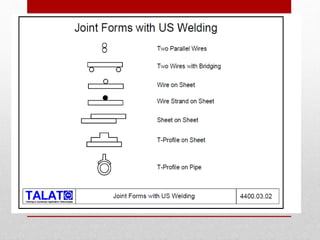
JOINT FORMS WITH ULTRASONIC MACHINING
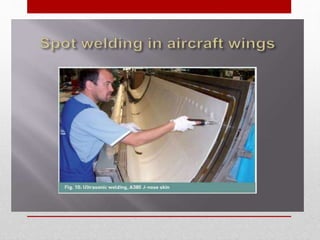
SPOT WELDING IN AIRCRAFT WINGS
ADVANTAGES
DIS ADVANTAGES
APPLICATION
INTRODUCTION
• Ultrasonic welding is an industrial technique whereby
high-frequency ultrasonic acoustic vibrations are locally
applied to work pieces being held together under pressure
to create a solid-state weld.
Solid
State
Welding
Electrical
Chemical
Mechanical
Friction
Pressure
Ultrosonic
Weld
Flow chart of solid state welding
MAIN PARTS
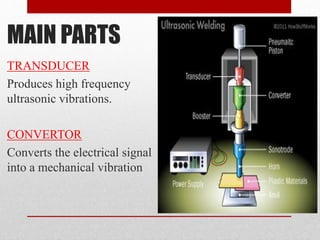
TRANSDUCER
Produces high frequency
ultrasonic vibrations.
CONVERTOR
Converts the electrical signal
into a mechanical vibration
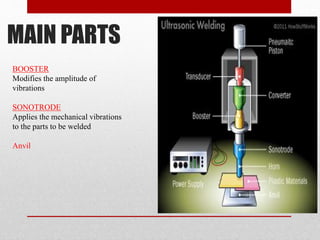
BOOSTER
Modifies the amplitude of
vibrations
SONOTRODE
Applies the mechanical vibrations
to the parts to be welded
Anvil
MAIN PARTS
Ultrasonic Welding
Mechanism
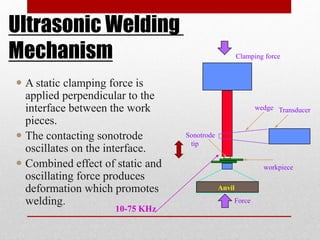
 A static clamping force is
applied perpendicular to the
interface between the work
pieces.
 The contacting sonotrode
oscillates on the interface.
 Combined effect of static and
oscillating force produces
deformation which promotes
welding.
Anvil
Sonotrode
tip
Clamping force
wedge Transducer
Force
workpiece
10-75 KHz
Principle of Ultrasonic
Welding
Anvil
Mass
Sonotrode
tip
Clamping
force
wedge Transducer
Force
WeldmentVibration
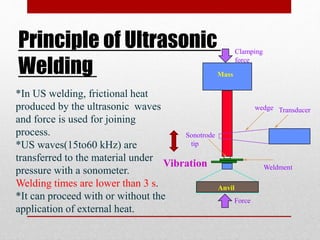
*In US welding, frictional heat
produced by the ultrasonic waves
and force is used for joining
process.
*US waves(15to60 kHz) are
transferred to the material under
pressure with a sonometer.
Welding times are lower than 3 s.
*It can proceed with or without the
application of external heat.
Ultrasonic Welding Power
Generation
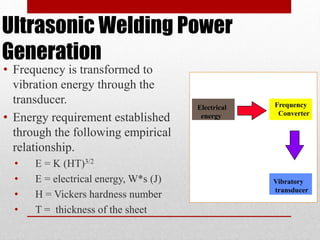
• Frequency is transformed to
vibration energy through the
transducer.
• Energy requirement established
through the following empirical
relationship.
• E = K (HT)3/2
• E = electrical energy, W*s (J)
• H = Vickers hardness number
• T = thickness of the sheet
Electrical
energy
Frequency
Converter
Vibratory
transducer
Interfacial Interaction
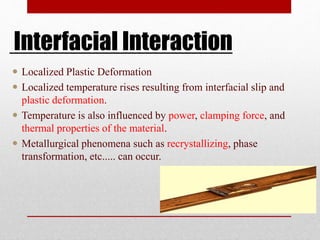
 Localized Plastic Deformation
 Localized temperature rises resulting from interfacial slip and
plastic deformation.
 Temperature is also influenced by power, clamping force, and
thermal properties of the material.
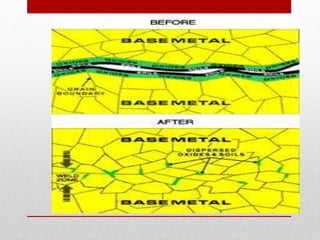
 Metallurgical phenomena such as recrystallizing, phase
transformation, etc..... can occur.
Why to use US welding?
• First - Ultrasonic assembly uses ultrasonic vibratory energy
which is transmitted through the parts to melt and bond
thermoplastic materials And joining thin sheet gauge metals
and other lightweight materials
• Second - This technique is fast, efficient, non-contaminating .
• Third - In ultrasonic welding, there are no connective bolts,
nails, soldering materials, or adhesives necessary to bind the
materials together.
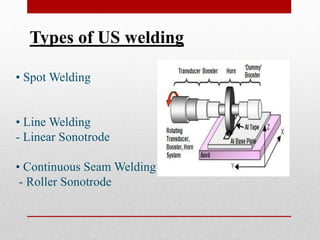
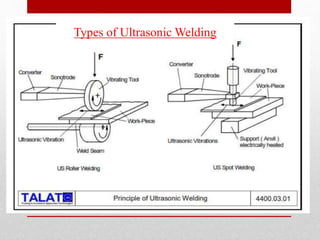
Types of US welding
• Spot Welding
• Line Welding
- Linear Sonotrode
• Continuous Seam Welding
- Roller Sonotrode
•.
Types of Ultrasonic Welding
Sonotrode Tip and Anvil Material
High Speed Tool Steels used to weld
• Soft Materials
• Aluminum
• Copper
• Iron
• Low Carbon Steel
Hardenable Nickel-Base Alloys used to weld
• Hard, High Strength Metals and Alloys
Advantages of Ultrasonic
Welding
• No heat is applied and no melting occurs
• Permits welding of thin to thick sections
• Welding can be made through some surface coatings
• Dissimilar metals having vastly different melting points can
be joined
• Pressures used are lower, welding times are shorter, and the
thickness of deformed regions are thinner than for cold
welding
Limitations of Ultrasonic
Welding
• Competitively not economical
• Process is limited to lap joints.
• Butt welds can not be made because there is no means of
supporting the work pieces and applying clamping force.
• Due to fatigue loading the life of equipment is short.
• This process is limited to small welds of thin, malleable metals
Eg: Aluminium, Copper, Nickel
Applications of Ultrasonic
Welding
 Computer and electrical industries delicate
circuits, Junctions of wire harnesses , flash drives and
computer disks, Semiconductor devices
• Aerospace and automotive industries instrument panels,
door panels, lamps, air ducts, steering wheels, and engine
components
• Medical industry
Applications
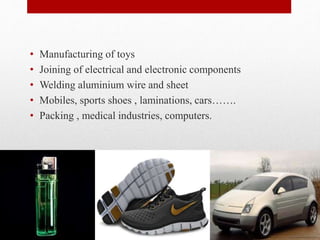
• Manufacturing of toys
• Joining of electrical and electronic components
• Welding aluminium wire and sheet
• Mobiles, sports shoes , laminations, cars…….
• Packing , medical industries, computers.
6/8/2014SUBHASIS.....MIT BBSR
21
Thank you

ultrasonic welding

  • 1.
    Ultrasonic welding Made by : Mohamedhamdy mandoh Mohamed nasr aboelhamayel Nader salama ebrahim Presented to: Dr . Hassan abd elhafez
  • 2.
    CONTENTS INTRODUCTION WHY TO USEUS WELDING ULTRASONIC WELDING PROCESS ULTRASONIC WELDING MECHANISM PRINCIPLE OF ULTRASONIC MACHINING JOINT FORMS WITH ULTRASONIC MACHINING SPOT WELDING IN AIRCRAFT WINGS ADVANTAGES DIS ADVANTAGES APPLICATION
  • 3.
    INTRODUCTION • Ultrasonic weldingis an industrial technique whereby high-frequency ultrasonic acoustic vibrations are locally applied to work pieces being held together under pressure to create a solid-state weld.
  • 4.
  • 5.
    MAIN PARTS TRANSDUCER Produces highfrequency ultrasonic vibrations. CONVERTOR Converts the electrical signal into a mechanical vibration
  • 6.
    BOOSTER Modifies the amplitudeof vibrations SONOTRODE Applies the mechanical vibrations to the parts to be welded Anvil MAIN PARTS
  • 7.
    Ultrasonic Welding Mechanism  Astatic clamping force is applied perpendicular to the interface between the work pieces.  The contacting sonotrode oscillates on the interface.  Combined effect of static and oscillating force produces deformation which promotes welding. Anvil Sonotrode tip Clamping force wedge Transducer Force workpiece 10-75 KHz
  • 8.
    Principle of Ultrasonic Welding Anvil Mass Sonotrode tip Clamping force wedgeTransducer Force WeldmentVibration *In US welding, frictional heat produced by the ultrasonic waves and force is used for joining process. *US waves(15to60 kHz) are transferred to the material under pressure with a sonometer. Welding times are lower than 3 s. *It can proceed with or without the application of external heat.
  • 9.
    Ultrasonic Welding Power Generation •Frequency is transformed to vibration energy through the transducer. • Energy requirement established through the following empirical relationship. • E = K (HT)3/2 • E = electrical energy, W*s (J) • H = Vickers hardness number • T = thickness of the sheet Electrical energy Frequency Converter Vibratory transducer
  • 10.
    Interfacial Interaction  LocalizedPlastic Deformation  Localized temperature rises resulting from interfacial slip and plastic deformation.  Temperature is also influenced by power, clamping force, and thermal properties of the material.  Metallurgical phenomena such as recrystallizing, phase transformation, etc..... can occur.
  • 12.
    Why to useUS welding? • First - Ultrasonic assembly uses ultrasonic vibratory energy which is transmitted through the parts to melt and bond thermoplastic materials And joining thin sheet gauge metals and other lightweight materials • Second - This technique is fast, efficient, non-contaminating . • Third - In ultrasonic welding, there are no connective bolts, nails, soldering materials, or adhesives necessary to bind the materials together.
  • 13.
    Types of USwelding • Spot Welding • Line Welding - Linear Sonotrode • Continuous Seam Welding - Roller Sonotrode
  • 14.
  • 15.
    Sonotrode Tip andAnvil Material High Speed Tool Steels used to weld • Soft Materials • Aluminum • Copper • Iron • Low Carbon Steel Hardenable Nickel-Base Alloys used to weld • Hard, High Strength Metals and Alloys
  • 18.
    Advantages of Ultrasonic Welding •No heat is applied and no melting occurs • Permits welding of thin to thick sections • Welding can be made through some surface coatings • Dissimilar metals having vastly different melting points can be joined • Pressures used are lower, welding times are shorter, and the thickness of deformed regions are thinner than for cold welding
  • 19.
    Limitations of Ultrasonic Welding •Competitively not economical • Process is limited to lap joints. • Butt welds can not be made because there is no means of supporting the work pieces and applying clamping force. • Due to fatigue loading the life of equipment is short. • This process is limited to small welds of thin, malleable metals Eg: Aluminium, Copper, Nickel
  • 20.
    Applications of Ultrasonic Welding Computer and electrical industries delicate circuits, Junctions of wire harnesses , flash drives and computer disks, Semiconductor devices • Aerospace and automotive industries instrument panels, door panels, lamps, air ducts, steering wheels, and engine components • Medical industry
  • 21.
    Applications • Manufacturing oftoys • Joining of electrical and electronic components • Welding aluminium wire and sheet • Mobiles, sports shoes , laminations, cars……. • Packing , medical industries, computers. 6/8/2014SUBHASIS.....MIT BBSR 21
  • 22.

Editor's Notes

  • #9 Typical components of an ultrasonic welding system are illustrated in the above figure. Linear ultrasonic vibrations are generated in the transducer and transferred to a sonotrode. The anvil holds the components in a fixed position and supports the clamping force.
  • #10 The energy required to make an ultrasonic weld can be related to the hardness of the workpieces and the thickness of the part in contact with the sonotrode tip. Analysis of data covering a wide range of materials and thickness has led to the above empirical relationship. The constant “k” is a complex function that appears to involve primarily the electro-mechanical conversion efficiency of the transducer, the impedance match into the weld, and other characteristics of the welding system. Different types of transducer systems should have substantially different k values.