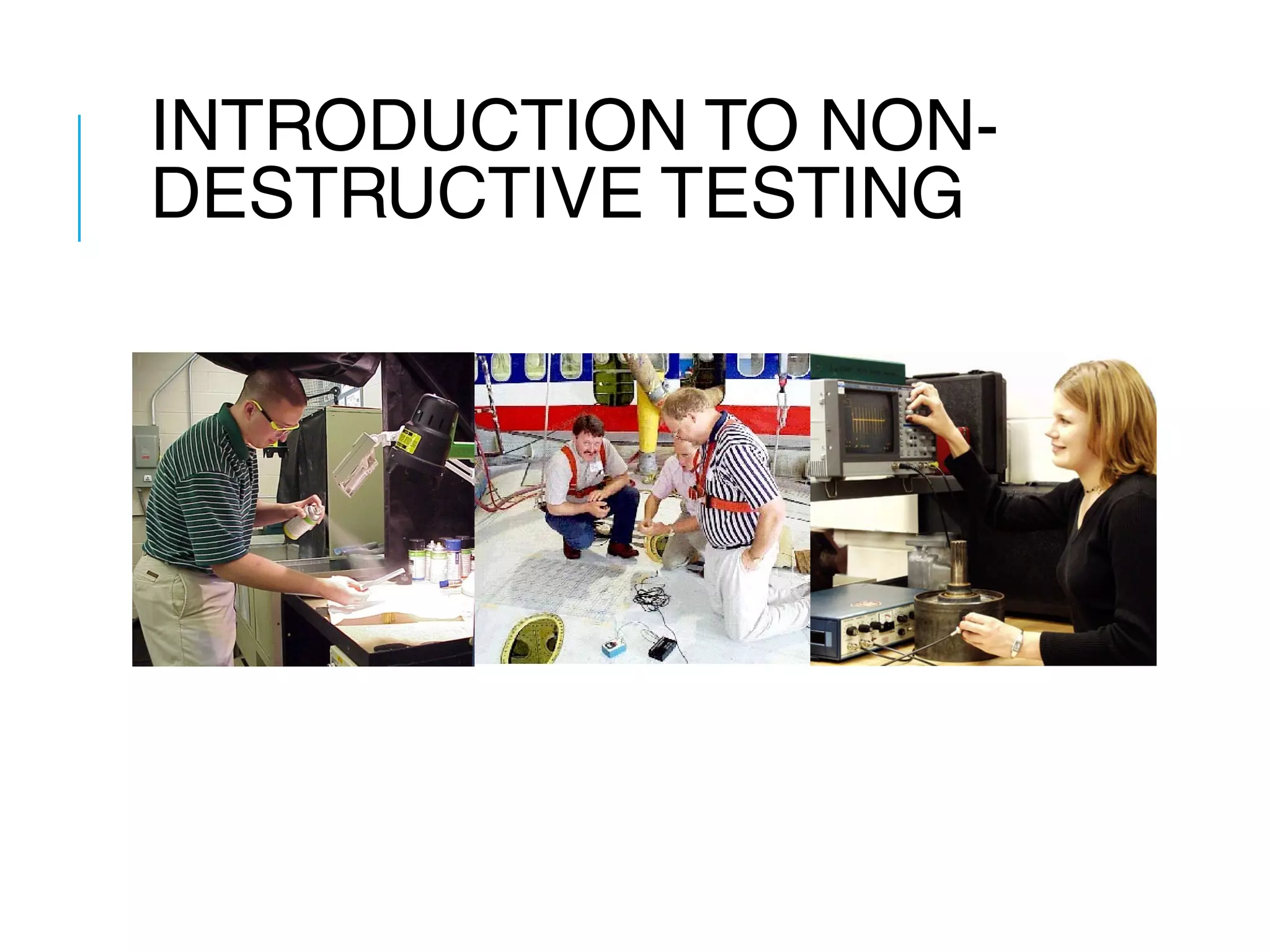
INTRODUCTION TO NONDESTRUCTIVE TESTING
OUTLINE
Introduction to NDT
Overview of Six Most
Common NDT Methods
Selected Applications
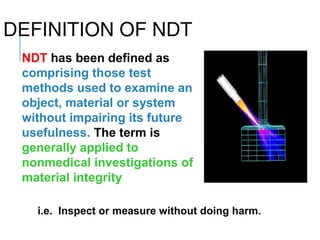
DEFINITION OF NDT
NDT has been defined as
comprising those test
methods used to examine an
object, material or system
without impairing its future
usefulness. The term is
generally applied to
nonmedical investigations of
material integrity
i.e. Inspect or measure without doing harm.
THREE TYPES OF
DEFECTS
Inherent defects :- exist in parent materials
Processing defects:- developed during processing
Service defects :- developed during service are
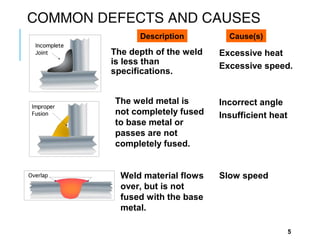
COMMON DEFECTS AND CAUSES
Description

The depth of the weld
is less than
specifications.
The weld metal is
not completely fused
to base metal or
passes are not
completely fused.
Weld material flows
over, but is not
fused with the base
metal.

Cause(s)

Excessive heat
Excessive speed.

Incorrect angle
Insufficient heat

Slow speed

5
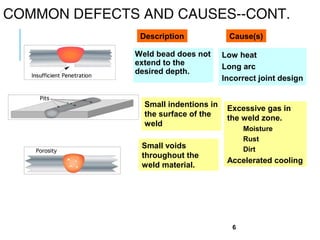
COMMON DEFECTS AND CAUSES--CONT.
Description
Weld bead does not
extend to the
desired depth.

Small indentions in
the surface of the
weld
Small voids
throughout the
weld material.

Cause(s)
Low heat
Long arc
Incorrect joint design

Excessive gas in
the weld zone.
Moisture
Rust
Dirt

Accelerated cooling

6
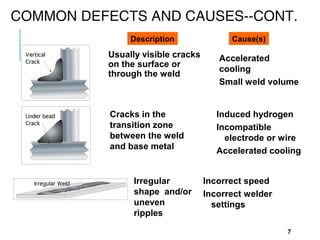
COMMON DEFECTS AND CAUSES--CONT.
Description

Cause(s)

Usually visible cracks
on the surface or
through the weld

Accelerated
cooling
Small weld volume

Cracks in the
transition zone
between the weld
and base metal

Induced hydrogen
Incompatible
electrode or wire
Accelerated cooling

Irregular
shape and/or
uneven
ripples

Incorrect speed
Incorrect welder
settings
7
WHAT ARE SOME USES
OF NDT METHODS?
Flaw Detection and Evaluation
Leak Detection
Location Determination
Dimensional Measurements

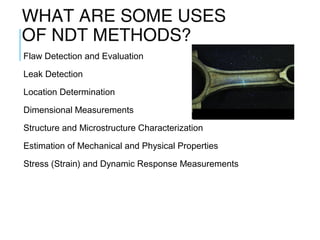
Fluorescent penetrant indication

Structure and Microstructure Characterization
Estimation of Mechanical and Physical Properties
Stress (Strain) and Dynamic Response Measurements
SIX MOST COMMON NDT
METHODS
•
•
•
•
•
•

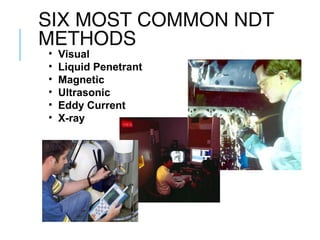
Visual
Liquid Penetrant
Magnetic
Ultrasonic
Eddy Current
X-ray
VISUAL TESTING

experienced inspector knows where are likely cracks ,
orientation of cracks relative to various zones in the weld,
surface porosity, weld penetration, potential weakness such as
sharp notches or misalignment
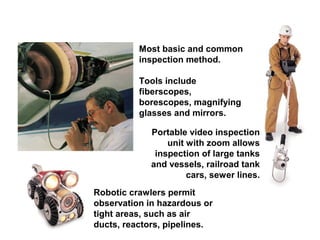
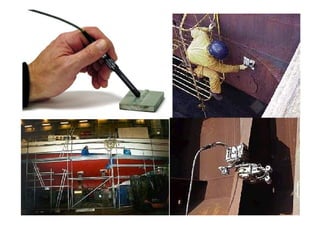
Most basic and common
inspection method.
Tools include
fiberscopes,
borescopes, magnifying
glasses and mirrors.
Portable video inspection
unit with zoom allows
inspection of large tanks
and vessels, railroad tank
cars, sewer lines.
Robotic crawlers permit
observation in hazardous or
tight areas, such as air
ducts, reactors, pipelines.
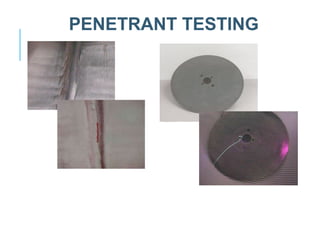
PENETRANT TESTING
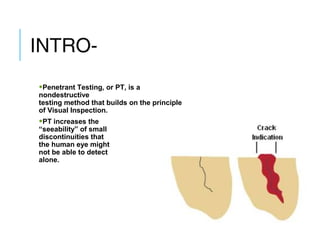
INTRO•Penetrant Testing, or PT, is a

nondestructive
testing method that builds on the principle
of Visual Inspection.

•PT increases the

“seeability” of small
discontinuities that
the human eye might
not be able to detect
alone.
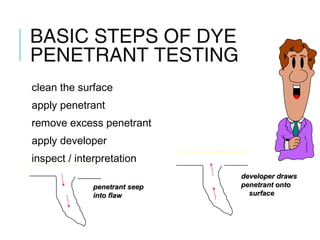
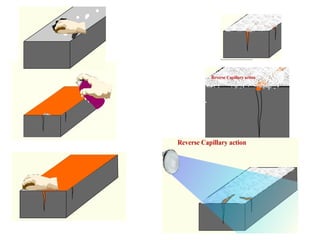
BASIC STEPS OF DYE
PENETRANT TESTING
clean the surface
apply penetrant
remove excess penetrant
apply developer
inspect / interpretation
penetrant seep
into flaw

developer draws
penetrant onto
surface
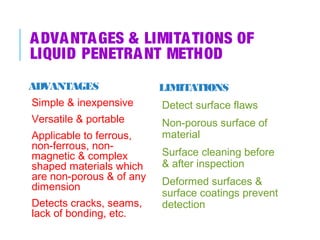
A DVA NTA GES & LIMITA TIONS OF
LIQUID PENETRA NT METHOD
ADVANTAGES

LIMITATIONS

Simple & inexpensive

Detect surface flaws

Versatile & portable
Applicable to ferrous,
non-ferrous, nonmagnetic & complex
shaped materials which
are non-porous & of any
dimension
Detects cracks, seams,
lack of bonding, etc.

Non-porous surface of
material
Surface cleaning before
& after inspection
Deformed surfaces &
surface coatings prevent
detection
MAGNETIC PARTICLE
INSPECTION
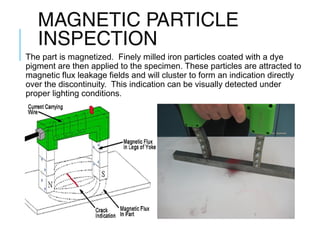
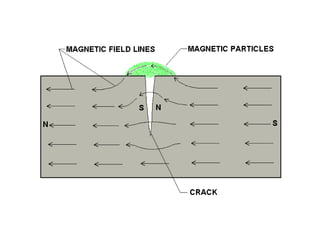
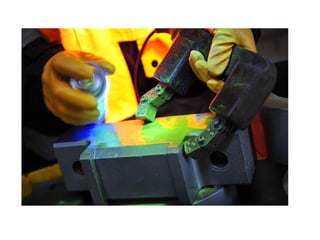
The part is magnetized. Finely milled iron particles coated with a dye
pigment are then applied to the specimen. These particles are attracted to
magnetic flux leakage fields and will cluster to form an indication directly
over the discontinuity. This indication can be visually detected under
proper lighting conditions.
RADIOGRAPHY
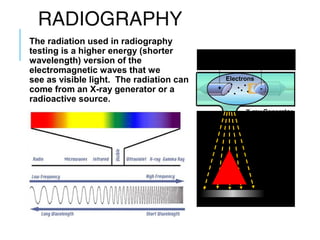
The radiation used in radiography
testing is a higher energy (shorter
wavelength) version of the
electromagnetic waves that we
see as visible light. The radiation can
come from an X-ray generator or a
radioactive source.

High Electrical Potential
Electrons
+

-

X-ray Generator
or Radioactive
Source Creates
Radiation

Radiation
Penetrate
the Sample
Exposure Recording Device
FILM
RADIOGRAPHY
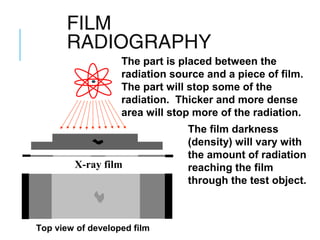
The part is placed between the
radiation source and a piece of film.
The part will stop some of the
radiation. Thicker and more dense
area will stop more of the radiation.

X-ray film

Top view of developed film

The film darkness
(density) will vary with
the amount of radiation
reaching the film
through the test object.
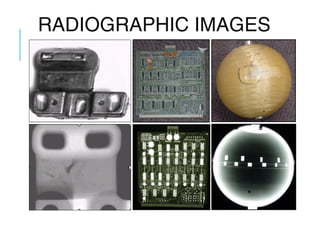
RADIOGRAPHIC IMAGES
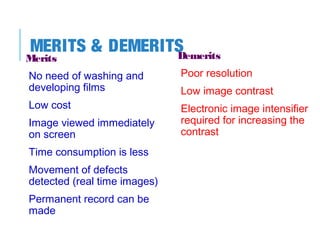
MERITS & DEMERITS
Demerits

Merits

No need of washing and
developing films

Poor resolution

Low cost

Electronic image intensifier
required for increasing the
contrast

Image viewed immediately
on screen
Time consumption is less
Movement of defects
detected (real time images)
Permanent record can be
made

Low image contrast
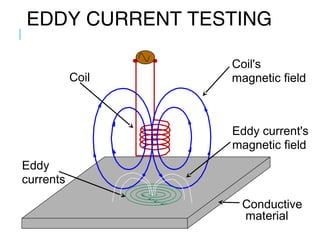
EDDY CURRENT TESTING
Coil

Coil's
magnetic field

Eddy current's
magnetic field
Eddy
currents
Conductive
material
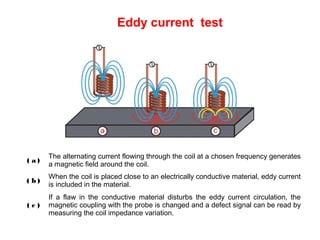
Eddy current test

( a)

The alternating current flowing through the coil at a chosen frequency generates
a magnetic field around the coil.

( b)

When the coil is placed close to an electrically conductive material, eddy current
is included in the material.

(c)

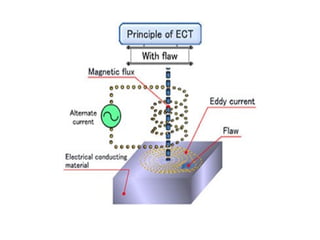
If a flaw in the conductive material disturbs the eddy current circulation, the
magnetic coupling with the probe is changed and a defect signal can be read by
measuring the coil impedance variation.
ULTRASONIC INSPECTION
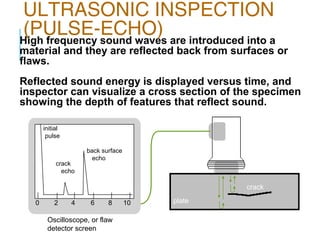
(PULSE-ECHO) are introduced into a
High frequency sound waves

material and they are reflected back from surfaces or
flaws.
Reflected sound energy is displayed versus time, and
inspector can visualize a cross section of the specimen
f
showing the depth of features that reflect sound.
initial
pulse

crack
echo

back surface
echo

crack
0

2

4

6

8

Oscilloscope, or flaw
detector screen

10

plate
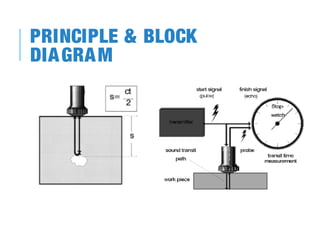
PRINCIPLE & BLOCK
DIA GRA M
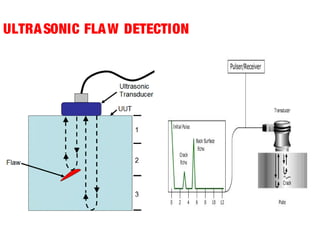
ULTRA SONIC FLA W DETECTION
COMMON APPLICATION
OF NDT
Inspection of Raw Products
Inspection Following Secondary
Processing
In-Services Damage Inspection
INSPECTION OF RAW
PRODUCTS
Forgings,
Castings,
Extrusions,
etc.
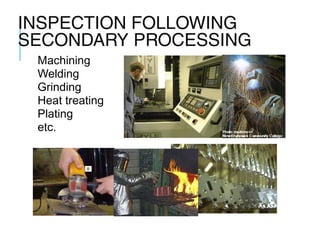
INSPECTION FOLLOWING
SECONDARY PROCESSING
Machining
Welding
Grinding
Heat treating
Plating
etc.
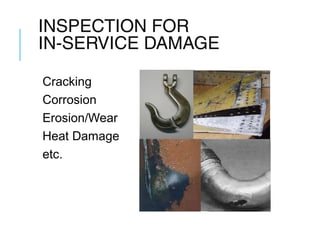
INSPECTION FOR
IN-SERVICE DAMAGE
Cracking
Corrosion
Erosion/Wear
Heat Damage
etc.
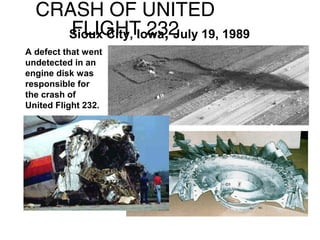
CRASH OF UNITED
FLIGHT 232
Sioux City, Iowa, July 19, 1989
A defect that went
undetected in an
engine disk was
responsible for
the crash of
United Flight 232.
RAIL
INSPECTION
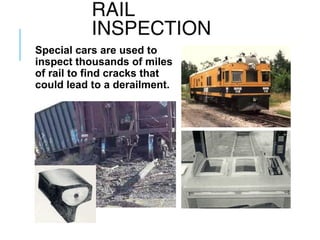
Special cars are used to
inspect thousands of miles
of rail to find cracks that
could lead to a derailment.
BRIDGE INSPECTION
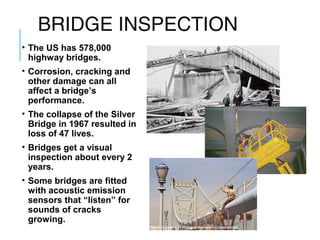
• The US has 578,000
highway bridges.
• Corrosion, cracking and
other damage can all
affect a bridge’s
performance.
• The collapse of the Silver
Bridge in 1967 resulted in
loss of 47 lives.
• Bridges get a visual
inspection about every 2
years.
• Some bridges are fitted
with acoustic emission
sensors that “listen” for
sounds of cracks
growing.
non destructive testing

non destructive testing

  • 1.
  • 2.
    OUTLINE Introduction to NDT Overviewof Six Most Common NDT Methods Selected Applications
  • 3.
    DEFINITION OF NDT NDThas been defined as comprising those test methods used to examine an object, material or system without impairing its future usefulness. The term is generally applied to nonmedical investigations of material integrity i.e. Inspect or measure without doing harm.
  • 4.
    THREE TYPES OF DEFECTS Inherentdefects :- exist in parent materials Processing defects:- developed during processing Service defects :- developed during service are
  • 5.
    COMMON DEFECTS ANDCAUSES Description The depth of the weld is less than specifications. The weld metal is not completely fused to base metal or passes are not completely fused. Weld material flows over, but is not fused with the base metal. Cause(s) Excessive heat Excessive speed. Incorrect angle Insufficient heat Slow speed 5
  • 6.
    COMMON DEFECTS ANDCAUSES--CONT. Description Weld bead does not extend to the desired depth. Small indentions in the surface of the weld Small voids throughout the weld material. Cause(s) Low heat Long arc Incorrect joint design Excessive gas in the weld zone. Moisture Rust Dirt Accelerated cooling 6
  • 7.
    COMMON DEFECTS ANDCAUSES--CONT. Description Cause(s) Usually visible cracks on the surface or through the weld Accelerated cooling Small weld volume Cracks in the transition zone between the weld and base metal Induced hydrogen Incompatible electrode or wire Accelerated cooling Irregular shape and/or uneven ripples Incorrect speed Incorrect welder settings 7
  • 8.
    WHAT ARE SOMEUSES OF NDT METHODS? Flaw Detection and Evaluation Leak Detection Location Determination Dimensional Measurements Fluorescent penetrant indication Structure and Microstructure Characterization Estimation of Mechanical and Physical Properties Stress (Strain) and Dynamic Response Measurements
  • 9.
    SIX MOST COMMONNDT METHODS • • • • • • Visual Liquid Penetrant Magnetic Ultrasonic Eddy Current X-ray
  • 10.
    VISUAL TESTING experienced inspectorknows where are likely cracks , orientation of cracks relative to various zones in the weld, surface porosity, weld penetration, potential weakness such as sharp notches or misalignment
  • 11.
    Most basic andcommon inspection method. Tools include fiberscopes, borescopes, magnifying glasses and mirrors. Portable video inspection unit with zoom allows inspection of large tanks and vessels, railroad tank cars, sewer lines. Robotic crawlers permit observation in hazardous or tight areas, such as air ducts, reactors, pipelines.
  • 12.
  • 13.
    INTRO•Penetrant Testing, orPT, is a nondestructive testing method that builds on the principle of Visual Inspection. •PT increases the “seeability” of small discontinuities that the human eye might not be able to detect alone.
  • 14.
    BASIC STEPS OFDYE PENETRANT TESTING clean the surface apply penetrant remove excess penetrant apply developer inspect / interpretation penetrant seep into flaw developer draws penetrant onto surface
  • 16.
    A DVA NTAGES & LIMITA TIONS OF LIQUID PENETRA NT METHOD ADVANTAGES LIMITATIONS Simple & inexpensive Detect surface flaws Versatile & portable Applicable to ferrous, non-ferrous, nonmagnetic & complex shaped materials which are non-porous & of any dimension Detects cracks, seams, lack of bonding, etc. Non-porous surface of material Surface cleaning before & after inspection Deformed surfaces & surface coatings prevent detection
  • 17.
    MAGNETIC PARTICLE INSPECTION The partis magnetized. Finely milled iron particles coated with a dye pigment are then applied to the specimen. These particles are attracted to magnetic flux leakage fields and will cluster to form an indication directly over the discontinuity. This indication can be visually detected under proper lighting conditions.
  • 20.
    RADIOGRAPHY The radiation usedin radiography testing is a higher energy (shorter wavelength) version of the electromagnetic waves that we see as visible light. The radiation can come from an X-ray generator or a radioactive source. High Electrical Potential Electrons + - X-ray Generator or Radioactive Source Creates Radiation Radiation Penetrate the Sample Exposure Recording Device
  • 21.
    FILM RADIOGRAPHY The part isplaced between the radiation source and a piece of film. The part will stop some of the radiation. Thicker and more dense area will stop more of the radiation. X-ray film Top view of developed film The film darkness (density) will vary with the amount of radiation reaching the film through the test object.
  • 22.
  • 23.
    MERITS & DEMERITS Demerits Merits Noneed of washing and developing films Poor resolution Low cost Electronic image intensifier required for increasing the contrast Image viewed immediately on screen Time consumption is less Movement of defects detected (real time images) Permanent record can be made Low image contrast
  • 24.
    EDDY CURRENT TESTING Coil Coil's magneticfield Eddy current's magnetic field Eddy currents Conductive material
  • 26.
    Eddy current test (a) The alternating current flowing through the coil at a chosen frequency generates a magnetic field around the coil. ( b) When the coil is placed close to an electrically conductive material, eddy current is included in the material. (c) If a flaw in the conductive material disturbs the eddy current circulation, the magnetic coupling with the probe is changed and a defect signal can be read by measuring the coil impedance variation.
  • 28.
    ULTRASONIC INSPECTION (PULSE-ECHO) areintroduced into a High frequency sound waves material and they are reflected back from surfaces or flaws. Reflected sound energy is displayed versus time, and inspector can visualize a cross section of the specimen f showing the depth of features that reflect sound. initial pulse crack echo back surface echo crack 0 2 4 6 8 Oscilloscope, or flaw detector screen 10 plate
  • 29.
  • 30.
    ULTRA SONIC FLAW DETECTION
  • 32.
    COMMON APPLICATION OF NDT Inspectionof Raw Products Inspection Following Secondary Processing In-Services Damage Inspection
  • 33.
  • 34.
  • 35.
  • 36.
    CRASH OF UNITED FLIGHT232 Sioux City, Iowa, July 19, 1989 A defect that went undetected in an engine disk was responsible for the crash of United Flight 232.
  • 37.
    RAIL INSPECTION Special cars areused to inspect thousands of miles of rail to find cracks that could lead to a derailment.
  • 38.
    BRIDGE INSPECTION • TheUS has 578,000 highway bridges. • Corrosion, cracking and other damage can all affect a bridge’s performance. • The collapse of the Silver Bridge in 1967 resulted in loss of 47 lives. • Bridges get a visual inspection about every 2 years. • Some bridges are fitted with acoustic emission sensors that “listen” for sounds of cracks growing.

Editor's Notes

  • #25 Eddy currents (also called Foucault currents are electric currents induced within conductors by a changing magnetic field in the conductor. These circulating eddies of current have inductance and thus induce magnetic fields. These fields can cause repulsion, attraction,[2] propulsion, drag, and heating effects.
  • #34 Metal forging is a metal forming process that involves applying compressive forces to a work piece to deform it, and create a desired geometric change to the material Extrusion is a process used to create objects of a fixed cross-sectional profile. A material is pushed or drawn through a die of the desired cross-section.
  • #38 The heavy loads that trains place on the railroad tracks can result in the formation of cracks in the rail. If these cracks are not detected, they can lead to a derailment. Special rail cars equipped with NDT equipment are used to detect rail defects before they are big enough to cause serious problems.