Presented By,
Joydwip Karmakar
Roll No : 213116008
OUTLOOK OF THE PRESENTATION
 History
 What is Eddy Current ??
 Principles of Eddy Current Testing
 Equipment used for Eddy Current Testing
 Reference Samples
 Calibration Method
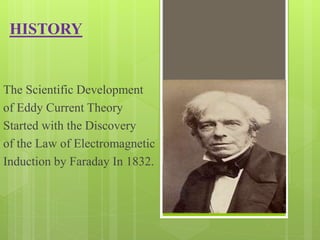
HISTORY
The Scientific Development
of Eddy Current Theory
Started with the Discovery
of the Law of Electromagnetic
Induction by Faraday In 1832.
FOUCAULT CURRENT
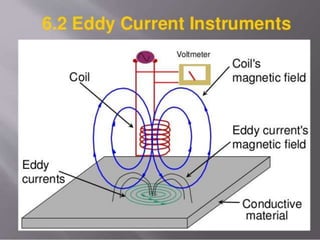
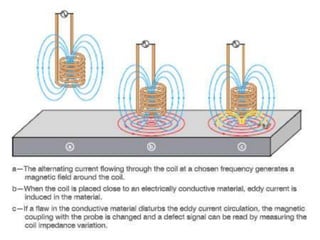
Eddy Currents are Defined as Oscillating Electrical
Currents Induced in a Conductive Material by an
Alternating Magnetic Field , due to Electromagnetic
Induction.
EQUIPMENT FOR EDDY CURRENT
TESTING
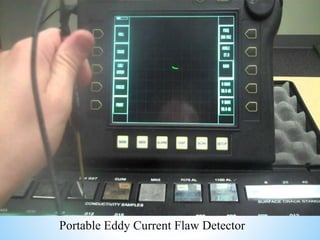
Portable Eddy Current Flaw Detector
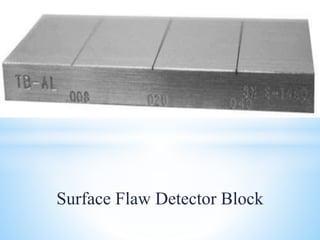
Surface Flaw Detector Block
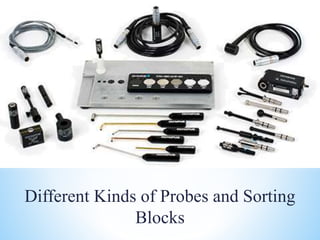
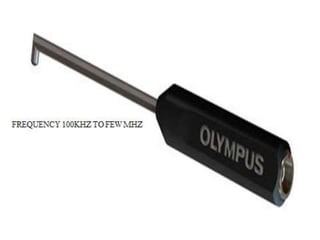
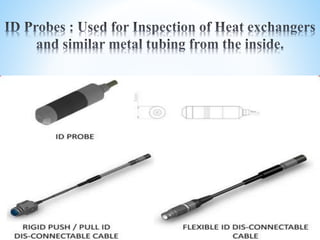
Different Kinds of Probes and Sorting
Blocks
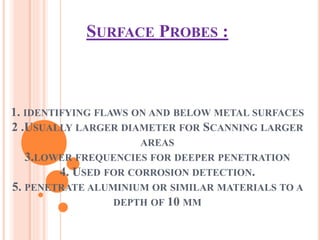
SURFACE PROBES :
1. IDENTIFYING FLAWS ON AND BELOW METAL SURFACES
2 .USUALLY LARGER DIAMETER FOR SCANNING LARGER
AREAS
3.LOWER FREQUENCIES FOR DEEPER PENETRATION
4. USED FOR CORROSION DETECTION.
5. PENETRATE ALUMINIUM OR SIMILAR MATERIALS TO A
DEPTH OF 10 MM
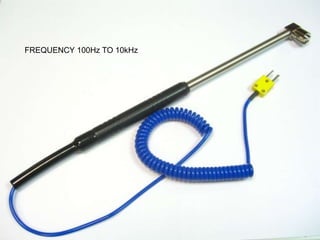
FREQUENCY 100Hz TO 10kHz
REFERENCE SAMPLES
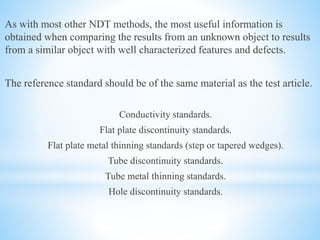
As with most other NDT methods, the most useful information is
obtained when comparing the results from an unknown object to results
from a similar object with well characterized features and defects.
The reference standard should be of the same material as the test article.
Conductivity standards.
Flat plate discontinuity standards.
Flat plate metal thinning standards (step or tapered wedges).
Tube discontinuity standards.
Tube metal thinning standards.
Hole discontinuity standards.
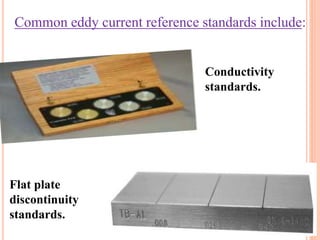
Common eddy current reference standards include:
Conductivity
standards.
Flat plate
discontinuity
standards.
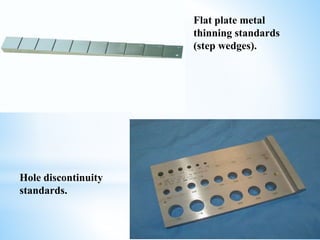
Flat plate metal
thinning standards
(step wedges).
Hole discontinuity
standards.
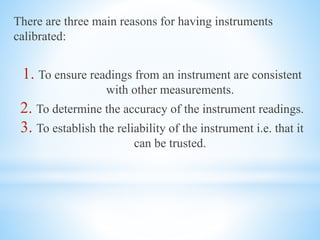
There are three main reasons for having instruments
calibrated:
1. To ensure readings from an instrument are consistent
with other measurements.
2. To determine the accuracy of the instrument readings.
3. To establish the reliability of the instrument i.e. that it
can be trusted.
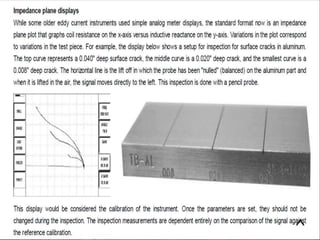
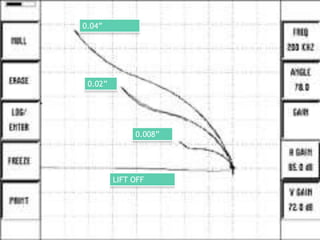
0.04”
0.02”
0.008”
LIFT OFF
EDDY CURRENT TESTING

EDDY CURRENT TESTING

  • 1.
  • 2.
    OUTLOOK OF THEPRESENTATION  History  What is Eddy Current ??  Principles of Eddy Current Testing  Equipment used for Eddy Current Testing  Reference Samples  Calibration Method
  • 3.
    HISTORY The Scientific Development ofEddy Current Theory Started with the Discovery of the Law of Electromagnetic Induction by Faraday In 1832.
  • 4.
    FOUCAULT CURRENT Eddy Currentsare Defined as Oscillating Electrical Currents Induced in a Conductive Material by an Alternating Magnetic Field , due to Electromagnetic Induction.
  • 8.
    EQUIPMENT FOR EDDYCURRENT TESTING
  • 9.
    Portable Eddy CurrentFlaw Detector
  • 10.
  • 11.
    Different Kinds ofProbes and Sorting Blocks
  • 14.
    SURFACE PROBES : 1.IDENTIFYING FLAWS ON AND BELOW METAL SURFACES 2 .USUALLY LARGER DIAMETER FOR SCANNING LARGER AREAS 3.LOWER FREQUENCIES FOR DEEPER PENETRATION 4. USED FOR CORROSION DETECTION. 5. PENETRATE ALUMINIUM OR SIMILAR MATERIALS TO A DEPTH OF 10 MM
  • 15.
  • 17.
  • 18.
    As with mostother NDT methods, the most useful information is obtained when comparing the results from an unknown object to results from a similar object with well characterized features and defects. The reference standard should be of the same material as the test article. Conductivity standards. Flat plate discontinuity standards. Flat plate metal thinning standards (step or tapered wedges). Tube discontinuity standards. Tube metal thinning standards. Hole discontinuity standards.
  • 19.
    Common eddy currentreference standards include: Conductivity standards. Flat plate discontinuity standards.
  • 20.
    Flat plate metal thinningstandards (step wedges). Hole discontinuity standards.
  • 22.
    There are threemain reasons for having instruments calibrated: 1. To ensure readings from an instrument are consistent with other measurements. 2. To determine the accuracy of the instrument readings. 3. To establish the reliability of the instrument i.e. that it can be trusted.
  • 24.