NON DESTRUCTIVE TESTING
1
15CH32
15CH156
NON DESTRUCTIVE
TESTING
INTRODUCTION:
It is a Non (physical, deep) Penetrating testing
techniques of the material used in the science of
maintenance engineering to determine the composition,
characteristics, properties and internal faults of the
material or working device’s components without
interfering into material or working device and their on
going work.
NON DESTRUCTIVE TESTING
 MOST COMMON METHODS OF “NDT” :
 visual testing:
 It is the most common technique which used to
see crack inside or surface ofthe material. In
classical time human eye is used as a driving
force . But now a days technologically is
growing faster so that’s why there are several
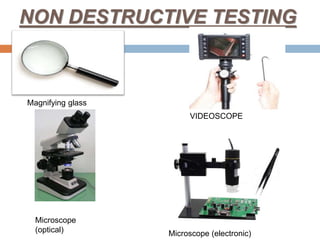
equipments used for this testing i-e.
 1.magnifying glass 2.Microscope (optical &
electronic) 3. videoscope
NON DESTRUCTIVE TESTING
Magnifying glass
VIDEOSCOPE
Microscope
(optical) Microscope (electronic)
NON DESTRUCTIVE TESTING
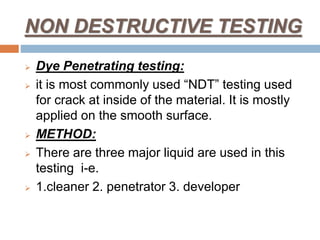
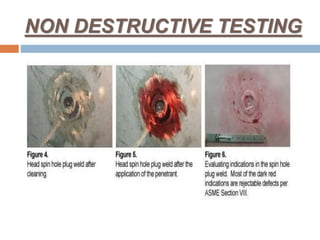
 Dye Penetrating testing:
 it is most commonly used “NDT” testing used
for crack at inside of the material. It is mostly
applied on the smooth surface.
 METHOD:
 There are three major liquid are used in this
testing i-e.
 1.cleaner 2. penetrator 3. developer
NON DESTRUCTIVE TESTING
1.cleaner: used for cleaning the extra material from the
required place to do test
2. penetrator: it should adhesive in nature to penetrate inside
the cracks
3. developer: it absorb the penetrator from surface but not
from pitting and erosive place just only from surface
NON DESTRUCTIVE TESTING
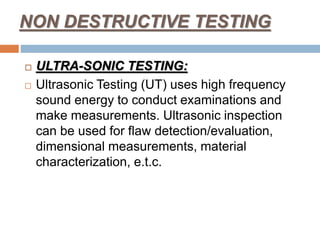
 ULTRA-SONIC TESTING:
 Ultrasonic Testing (UT) uses high frequency
sound energy to conduct examinations and
make measurements. Ultrasonic inspection
can be used for flaw detection/evaluation,
dimensional measurements, material
characterization, e.t.c.
NON DESTRUCTIVE TESTING
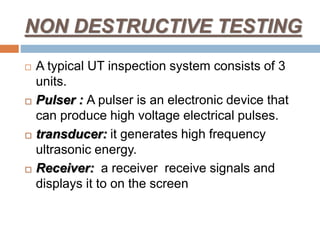
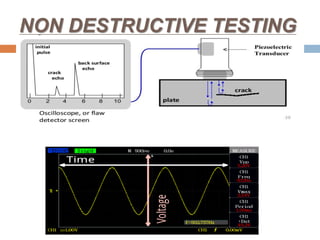
 A typical UT inspection system consists of 3
units.
 Pulser : A pulser is an electronic device that
can produce high voltage electrical pulses.
 transducer: it generates high frequency
ultrasonic energy.
 Receiver: a receiver receive signals and
displays it to on the screen
NON DESTRUCTIVE TESTING
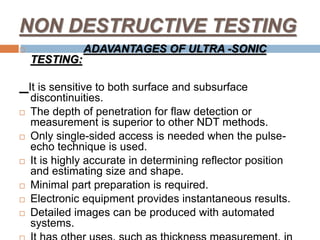
 ADAVANTAGES OF ULTRA -SONIC
TESTING:
It is sensitive to both surface and subsurface
discontinuities.
 The depth of penetration for flaw detection or
measurement is superior to other NDT methods.
 Only single-sided access is needed when the pulse-
echo technique is used.
 It is highly accurate in determining reflector position
and estimating size and shape.
 Minimal part preparation is required.
 Electronic equipment provides instantaneous results.
 Detailed images can be produced with automated
systems.
NON DESTRUCTIVE TESTING
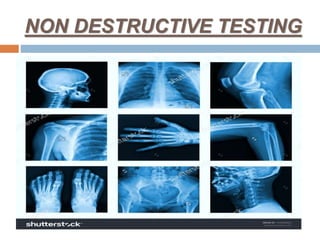
 RADIOGRAPHY TESTING:
 It is a method for testing hidden flaw by using
the ability of the short wave length
 (electromagnetic wave) or Photons energy
NON DESTRUCTIVE TESTING
NON-DESTRUCTIVE TESTING

NON-DESTRUCTIVE TESTING

  • 1.
  • 2.
    NON DESTRUCTIVE TESTING INTRODUCTION: It isa Non (physical, deep) Penetrating testing techniques of the material used in the science of maintenance engineering to determine the composition, characteristics, properties and internal faults of the material or working device’s components without interfering into material or working device and their on going work.
  • 3.
    NON DESTRUCTIVE TESTING MOST COMMON METHODS OF “NDT” :  visual testing:  It is the most common technique which used to see crack inside or surface ofthe material. In classical time human eye is used as a driving force . But now a days technologically is growing faster so that’s why there are several equipments used for this testing i-e.  1.magnifying glass 2.Microscope (optical & electronic) 3. videoscope
  • 4.
    NON DESTRUCTIVE TESTING Magnifyingglass VIDEOSCOPE Microscope (optical) Microscope (electronic)
  • 5.
    NON DESTRUCTIVE TESTING Dye Penetrating testing:  it is most commonly used “NDT” testing used for crack at inside of the material. It is mostly applied on the smooth surface.  METHOD:  There are three major liquid are used in this testing i-e.  1.cleaner 2. penetrator 3. developer
  • 6.
    NON DESTRUCTIVE TESTING 1.cleaner:used for cleaning the extra material from the required place to do test 2. penetrator: it should adhesive in nature to penetrate inside the cracks 3. developer: it absorb the penetrator from surface but not from pitting and erosive place just only from surface
  • 7.
  • 8.
  • 9.
  • 10.
  • 11.
    NON DESTRUCTIVE TESTING ULTRA-SONIC TESTING:  Ultrasonic Testing (UT) uses high frequency sound energy to conduct examinations and make measurements. Ultrasonic inspection can be used for flaw detection/evaluation, dimensional measurements, material characterization, e.t.c.
  • 12.
    NON DESTRUCTIVE TESTING A typical UT inspection system consists of 3 units.  Pulser : A pulser is an electronic device that can produce high voltage electrical pulses.  transducer: it generates high frequency ultrasonic energy.  Receiver: a receiver receive signals and displays it to on the screen
  • 13.
  • 14.
    NON DESTRUCTIVE TESTING ADAVANTAGES OF ULTRA -SONIC TESTING: It is sensitive to both surface and subsurface discontinuities.  The depth of penetration for flaw detection or measurement is superior to other NDT methods.  Only single-sided access is needed when the pulse- echo technique is used.  It is highly accurate in determining reflector position and estimating size and shape.  Minimal part preparation is required.  Electronic equipment provides instantaneous results.  Detailed images can be produced with automated systems.
  • 15.
    NON DESTRUCTIVE TESTING RADIOGRAPHY TESTING:  It is a method for testing hidden flaw by using the ability of the short wave length  (electromagnetic wave) or Photons energy
  • 16.
  • 17.
  • 18.
  • 19.
  • 20.