Architectural Drawing
and Graphics I
ADG I| 1201505
Building Components and Materials:
Annotations and Conventions
Unit 2: Graphic language and
its Components
Architectural annotations and conventions
for representation of various;
Building Materials and
Building Components
Structure of the Presentation..
 Definition: Annotations & Conventions
 Aim/Goal of the Presentation
 Building Types: As per Uses and type of
Construction
 Components of a common Building: Detailed
description of each component
 Material Conventions for depiction
 Plan, Elevation, Section in a drawing.
Language/Communication
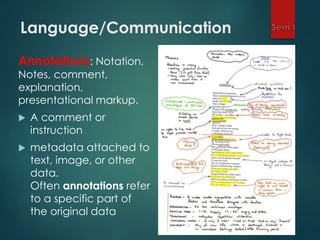
Annotations: Notation,
Notes, comment,
explanation,
presentational markup.
 A comment or
instruction
 metadata attached to
text, image, or other
data.
Often annotations refer
to a specific part of
the original data
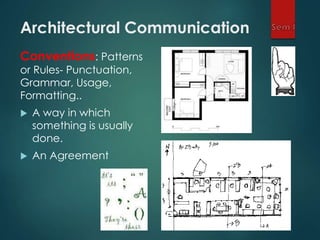
Conventions: Patterns
or Rules- Punctuation,
Grammar, Usage,
Formatting..
 A way in which
something is usually
done.
 An Agreement
Architectural Communication
AIM /Goal
To realize the Architectural Standards for
denoting a perfect and complete drawing..
Types of Architectural Drawings:
 Illustration of an Idea
 Presentation Drawing
 Working Drawing
 Corporation Drawing (for Sanctioning)
Building Types/Uses
As per National Building Code,
major building uses;
 Residential Building
 Educational Building
 Assembly Building
 Institutional Building
 Industrial Building
 Commercial Building
 Storage Building
 Infrastructure
As per Construction type /
materials, major building types;
 Solid or ‘traditional’
construction
 Structural steel frame
construction
 Reinforced concrete
construction
 Modular system construction
 Portal frame construction
 Composite construction
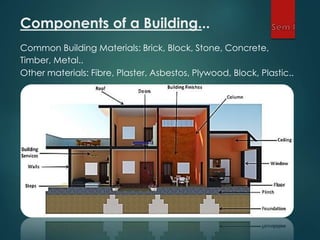
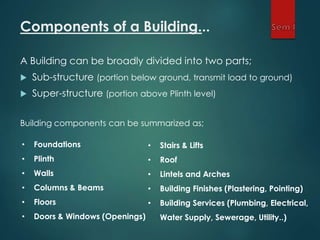
Components of a Building...
Common Building Materials: Brick, Block, Stone, Concrete,
Timber, Metal..
Other materials: Fibre, Plaster, Asbestos, Plywood, Block, Plastic..
Components of a Building...
A Building can be broadly divided into two parts;
 Sub-structure (portion below ground, transmit load to ground)
 Super-structure (portion above Plinth level)
Building components can be summarized as;
• Foundations
• Plinth
• Walls
• Columns & Beams
• Floors
• Doors & Windows (Openings)
• Stairs & Lifts
• Roof
• Lintels and Arches
• Building Finishes (Plastering, Pointing)
• Building Services (Plumbing, Electrical,
Water Supply, Sewerage, Utility..)
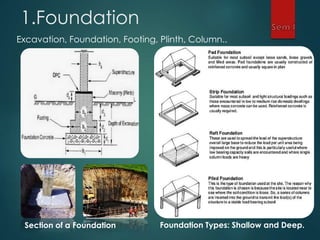
1.Foundation
Excavation, Foundation, Footing, Plinth, Column..
Foundation Types: Shallow and Deep.Section of a Foundation
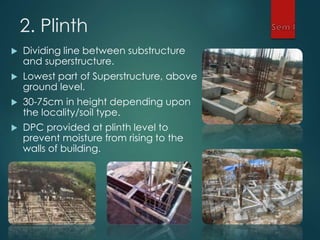
2. Plinth
 Dividing line between substructure
and superstructure.
 Lowest part of Superstructure, above
ground level.
 30-75cm in height depending upon
the locality/soil type.
 DPC provided at plinth level to
prevent moisture from rising to the
walls of building.
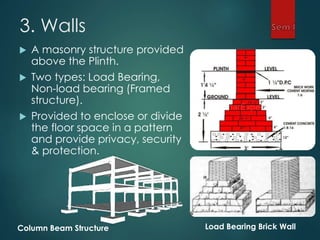
3. Walls
 A masonry structure provided
above the Plinth.
 Two types: Load Bearing,
Non-load bearing (Framed
structure).
 Provided to enclose or divide
the floor space in a pattern
and provide privacy, security
& protection.
Load Bearing Brick WallColumn Beam Structure
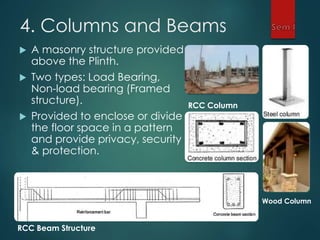
4. Columns and Beams
 A masonry structure provided
above the Plinth.
 Two types: Load Bearing,
Non-load bearing (Framed
structure).
 Provided to enclose or divide
the floor space in a pattern
and provide privacy, security
& protection.
RCC Beam Structure
RCC Column
Wood Column
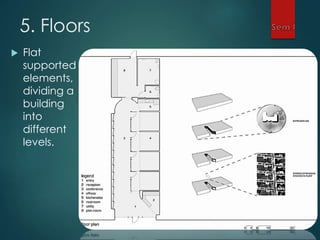
5. Floors
 Flat
supported
elements,
dividing a
building
into
different
levels.
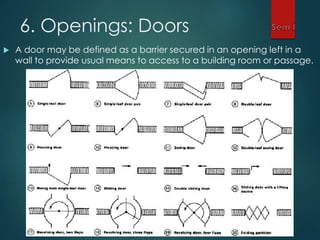
6. Openings: Doors
 A door may be defined as a barrier secured in an opening left in a
wall to provide usual means to access to a building room or passage.
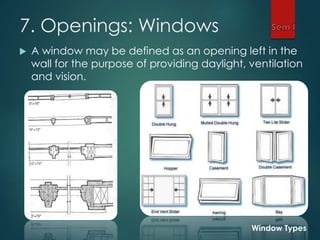
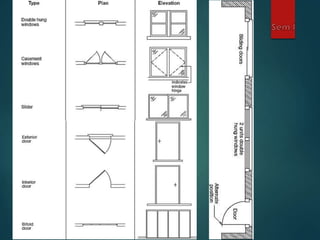
7. Openings: Windows
 A window may be defined as an opening left in the
wall for the purpose of providing daylight, ventilation
and vision.
Window Types
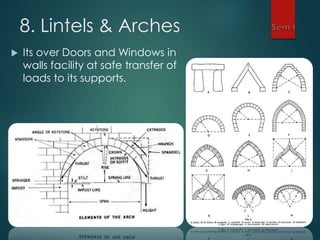
8. Lintels & Arches
 Its over Doors and Windows in
walls facility at safe transfer of
loads to its supports.
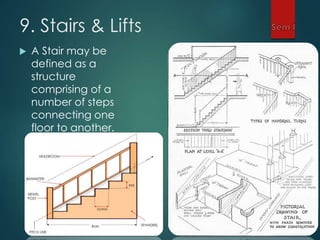
9. Stairs & Lifts
 A Stair may be
defined as a
structure
comprising of a
number of steps
connecting one
floor to another.
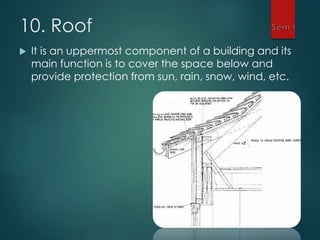
10. Roof
 It is an uppermost component of a building and its
main function is to cover the space below and
provide protection from sun, rain, snow, wind, etc.
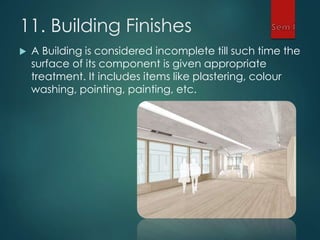
11. Building Finishes
 A Building is considered incomplete till such time the
surface of its component is given appropriate
treatment. It includes items like plastering, colour
washing, pointing, painting, etc.
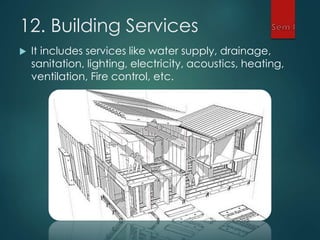
12. Building Services
 It includes services like water supply, drainage,
sanitation, lighting, electricity, acoustics, heating,
ventilation, Fire control, etc.
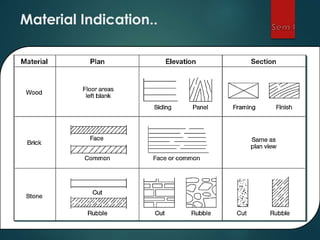
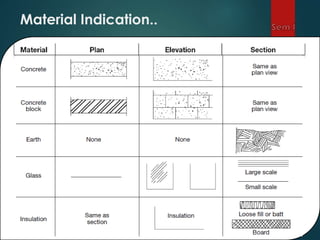
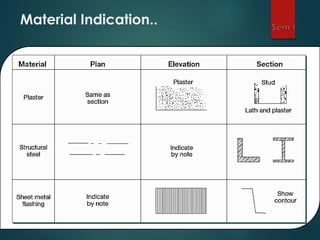
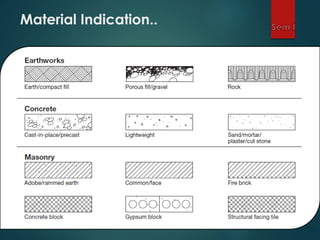
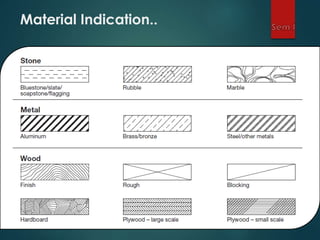
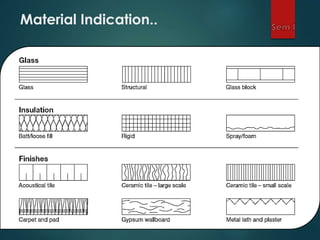
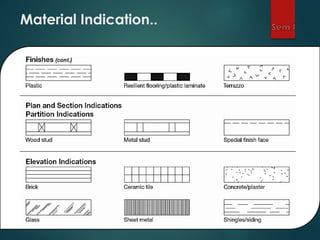
Material Indication..
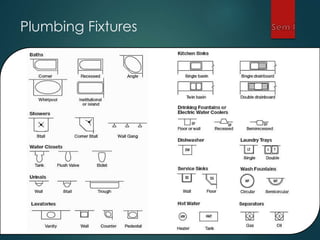
Plumbing Fixtures
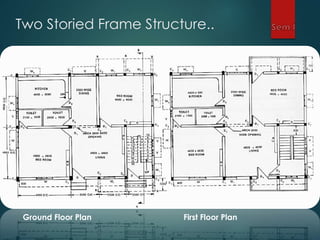
Two Storied Frame Structure..
Ground Floor Plan First Floor Plan
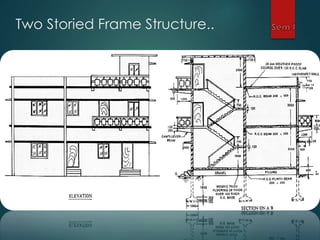
Two Storied Frame Structure..
Questions? Thank you for Listening…

002 ADG I: Building Components and Materials

  • 1.
    Architectural Drawing and GraphicsI ADG I| 1201505 Building Components and Materials: Annotations and Conventions
  • 2.
    Unit 2: Graphiclanguage and its Components Architectural annotations and conventions for representation of various; Building Materials and Building Components
  • 3.
    Structure of thePresentation..  Definition: Annotations & Conventions  Aim/Goal of the Presentation  Building Types: As per Uses and type of Construction  Components of a common Building: Detailed description of each component  Material Conventions for depiction  Plan, Elevation, Section in a drawing.
  • 4.
    Language/Communication Annotations: Notation, Notes, comment, explanation, presentationalmarkup.  A comment or instruction  metadata attached to text, image, or other data. Often annotations refer to a specific part of the original data
  • 5.
    Conventions: Patterns or Rules-Punctuation, Grammar, Usage, Formatting..  A way in which something is usually done.  An Agreement Architectural Communication
  • 6.
    AIM /Goal To realizethe Architectural Standards for denoting a perfect and complete drawing.. Types of Architectural Drawings:  Illustration of an Idea  Presentation Drawing  Working Drawing  Corporation Drawing (for Sanctioning)
  • 7.
    Building Types/Uses As perNational Building Code, major building uses;  Residential Building  Educational Building  Assembly Building  Institutional Building  Industrial Building  Commercial Building  Storage Building  Infrastructure As per Construction type / materials, major building types;  Solid or ‘traditional’ construction  Structural steel frame construction  Reinforced concrete construction  Modular system construction  Portal frame construction  Composite construction
  • 8.
    Components of aBuilding... Common Building Materials: Brick, Block, Stone, Concrete, Timber, Metal.. Other materials: Fibre, Plaster, Asbestos, Plywood, Block, Plastic..
  • 9.
    Components of aBuilding... A Building can be broadly divided into two parts;  Sub-structure (portion below ground, transmit load to ground)  Super-structure (portion above Plinth level) Building components can be summarized as; • Foundations • Plinth • Walls • Columns & Beams • Floors • Doors & Windows (Openings) • Stairs & Lifts • Roof • Lintels and Arches • Building Finishes (Plastering, Pointing) • Building Services (Plumbing, Electrical, Water Supply, Sewerage, Utility..)
  • 10.
    1.Foundation Excavation, Foundation, Footing,Plinth, Column.. Foundation Types: Shallow and Deep.Section of a Foundation
  • 11.
    2. Plinth  Dividingline between substructure and superstructure.  Lowest part of Superstructure, above ground level.  30-75cm in height depending upon the locality/soil type.  DPC provided at plinth level to prevent moisture from rising to the walls of building.
  • 12.
    3. Walls  Amasonry structure provided above the Plinth.  Two types: Load Bearing, Non-load bearing (Framed structure).  Provided to enclose or divide the floor space in a pattern and provide privacy, security & protection. Load Bearing Brick WallColumn Beam Structure
  • 13.
    4. Columns andBeams  A masonry structure provided above the Plinth.  Two types: Load Bearing, Non-load bearing (Framed structure).  Provided to enclose or divide the floor space in a pattern and provide privacy, security & protection. RCC Beam Structure RCC Column Wood Column
  • 14.
    5. Floors  Flat supported elements, dividinga building into different levels.
  • 15.
    6. Openings: Doors A door may be defined as a barrier secured in an opening left in a wall to provide usual means to access to a building room or passage.
  • 16.
    7. Openings: Windows A window may be defined as an opening left in the wall for the purpose of providing daylight, ventilation and vision. Window Types
  • 18.
    8. Lintels &Arches  Its over Doors and Windows in walls facility at safe transfer of loads to its supports.
  • 19.
    9. Stairs &Lifts  A Stair may be defined as a structure comprising of a number of steps connecting one floor to another.
  • 20.
    10. Roof  Itis an uppermost component of a building and its main function is to cover the space below and provide protection from sun, rain, snow, wind, etc.
  • 21.
    11. Building Finishes A Building is considered incomplete till such time the surface of its component is given appropriate treatment. It includes items like plastering, colour washing, pointing, painting, etc.
  • 22.
    12. Building Services It includes services like water supply, drainage, sanitation, lighting, electricity, acoustics, heating, ventilation, Fire control, etc.
  • 23.
  • 24.
  • 25.
  • 26.
  • 27.
  • 28.
  • 29.
  • 30.
  • 31.
    Two Storied FrameStructure.. Ground Floor Plan First Floor Plan
  • 32.
    Two Storied FrameStructure..
  • 33.
    Questions? Thank youfor Listening…