presentation on
BRICK MASONRY
Content:
• Introduction to Brick masonry . . . . . . . . . . . . . . . . . . . . . . . . . . . . . . . . . . . . . . . . . . . . .
• Types of Bricks used in masonry work . . . . . . . . . . . . . . . . . . . . . . . . . . . . . . . . . . . . . . . . .
• Classification of brick . . . . . . . . . . . . . . . . . . . . . . . . . . . . . . . . . . . . . . . . . . . . . . . . . .
• Terminology of Brick . . . . . . . . . . . . . . . . . . . . . . . . . . . . . . . . . . . . . . . . . . . . . . . . . .
• General Principles To Be Observed In Brick Masonry Construction . . . . . . . . . . . . . . . . . . . . . . . . .
• What is Brick Bonds . . . . . . . . . . . . . . . . . . . . . . . . . . . . . . . . . . . . . . . . . . . . . . . . . . .
• Different types of Brick Bonds . . . . . . . . . . . . . . . . . . . . . . . . . . . . . . . . . . . . . . . . . . . . .
• TEE-JUNCTION . . . . . . . . . . . . . . . . . . . . . . . . . . . . . . . . . . . . . . . . . . . . . . . . . . . . . .
• Pier . . . . . . . . . . . . . . . . . . . . . . . . . . . . . . . . . . . . . . . . . . . . . . . . . . . . . . . . . . . .
• Bonds and Shapes of Piers . . . . . . . . . . . . . . . . . . . . . . . . . . . . . . . . . . . . . . . . . . . . . . .
• Piers of various thickness in English bond . . . . . . . . . . . . . . . . . . . . . . . . . . . . . . . . . . . . . . .
• Piers of various thickness in double Flemish bond . . . . . . . . . . . . . . . . . . . . . . . . . . . . . . . . . .
• Piers Attached to Main Walls . . . . . . . . . . . . . . . . . . . . . . . . . . . . . . . . . . . . . . . . . . . . . .
• Squint Junction . . . . . . . . . . . . . . . . . . . . . . . . . . . . . . . . . . . . . . . . . . . . . . . . . . . . . .
• Squint Quoins . . . . . . . . . . . . . . . . . . . . . . . . . . . . . . . . . . . . . . . . . . . . . . . . . . . . . .
• Tools of brick layer . . . . . . . . . . . . . . . . . . . . . . . . . . . . . . . . . . . . . . . . . . . . . . . . . . . .
• Retaining wall . . . . . . . . . . . . . . . . . . . . . . . . . . . . . . . . . . . . . . . . . . . . . . . . . . . . . .
• Design of retaining wall . . . . . . . . . . . . . . . . . . . . . . . . . . . . . . . . . . . . . . . . . . . . . . . .
• Different types of retaining wall . . . . . . . . . . . . . . . . . . . . . . . . . . . . . . . . . . . . . . . . . . .
• Conditions Of Stability Of Retaining Walls . . . . . . . . . . . . . . . . . . . . . . . . . . . . . . . . . . . . . . .
• Reinforced Brick Work . . . . . . . . . . . . . . . . . . . . . . . . . . . . . . . . . . . . . . . . . . . . . . . . .
• Defects In Brick Masonry . . . . . . . . . . . . . . . . . . . . . . . . . . . . . . . . . . . . . . . . . . . . . . . .
• Conclusion . . . . . . . . . . . . . . . . . . . . . . . . . . . . . . . . . . . . . . . . . . . . . . . . . . . . . . . .
1
2
2
3
4-5
6
7
8-15
16
17
17
18
19
20
21
21
22
23
24
24-25
26
27
28
29
Brick masonry:
+ =
Mortar:
Types of Bricks used in masonry work:
Traditional
Modular
Bangladesh standard size:
Bangladesh: 9.5×4.5×2.74 inch
With mortar:10×5×3 Inch
Brick masonry work
strength depend on
1.Slenderness ratio
2.Wind lateral pressure
3.Degree of soundness of
construction
Quality of
mortar
Method
of
bonding
Quality of
brick
Mud+Water
Surki+Lime+water
Lime+sand+Water
Cement+Sand+Water
Cement+lime+sand+water
Construction of brick unit bonded together with mortar is termed as brick masonry.
Brick is the common materials of the masonry construction. It is a very durable form of
construction. Types of mortar & brick is the element of brick masonry. Brick is made of
clay or shale formed, dried and fired into manufacturing process.
2
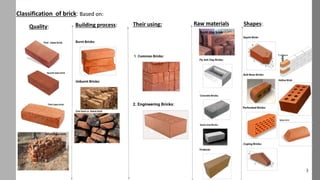
Classification of brick: Based on:
Building process: Their using: Raw materials Shapes:
Quality:
3
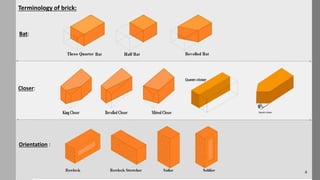
Terminology of brick:
Bat:
Closer:
Orientation :
4
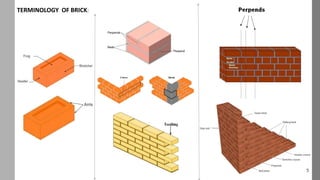
TERMINOLOGY OF BRICK:
5
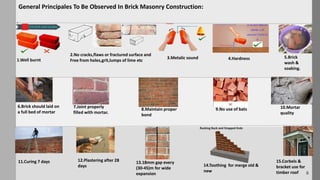
General Principales To Be Observed In Brick Masonry Construction:
3.Metalic sound 4.Hardness 5.Brick
wash &
soaking.
6.Brick should laid on
a full bed of mortar
7.Joint properly
filled with mortar.
8.Maintain proper
bond
10.Mortar
quality
11.Curing 7 days 12.Plastering after 28
days
13.18mm gap every
(30-45)m for wide
expansion
15.Corbels &
bracket use for
timber roof
14.Toothing for merge old &
new
9.No use of bats
2.No cracks,flaws or fractured surface and
Free from holes,grit,lumps of lime etc
1.Well burnt
6
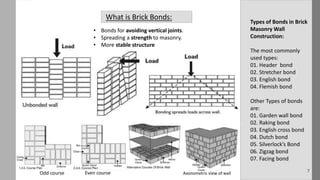
What is Brick Bonds:
Types of Bonds in Brick
Masonry Wall
Construction:
The most commonly
used types:
01. Header bond
02. Stretcher bond
03. English bond
04. Flemish bond
Other Types of bonds
are:
01. Garden wall bond
02. Raking bond
03. English cross bond
04. Dutch bond
05. Silverlock’s Bond
06. Zigzag bond
07. Facing bond
• Bonds for avoiding vertical joints.
• Spreading a strength to masonry.
• More stable structure
Odd course Even course Axonometric view of wall 7
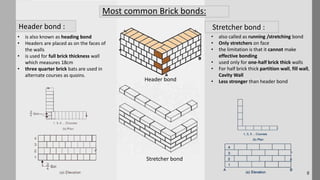
• is also known as heading bond
• Headers are placed as on the faces of
the walls
• is used for full brick thickness wall
which measures 18cm
• three quarter brick bats are used in
alternate courses as quoins.
• also called as running /stretching bond
• Only stretchers on face
• the limitation is that it cannot make
effective bonding
• used only for one-half brick thick walls
• For half brick thick partition wall, fill wall,
Cavity Wall
• Less stronger than header bond
Header bond
Stretcher bond
Most common Brick bonds:
Header bond : Stretcher bond :
8
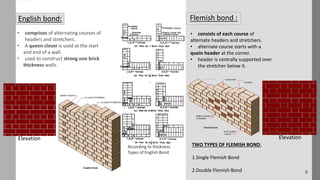
• consists of each course of
alternate headers and stretchers.
• alternate course starts with a
quoin header at the corner.
• header is centrally supported over
the stretcher below it.
TWO TYPES OF FLEMISH BOND:
1.Single Flemish Bond
2.Double Flemish Bond
Elevation
• comprises of alternating courses of
headers and stretchers.
• A queen closer is used at the start
and end of a wall.
• used to construct strong one brick
thickness walls.
According to thickness
Types of English Bond
Elevation
English bond: Flemish bond :
9
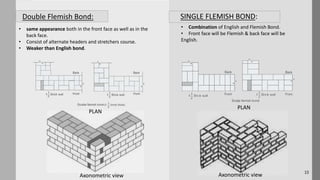
• same appearance both in the front face as well as in the
back face.
• Consist of alternate headers and stretchers course.
• Weaker than English bond.
• Combination of English and Flemish Bond.
• Front face will be Flemish & back face will be
English.
PLAN
PLAN
Double Flemish Bond: SINGLE FLEMISH BOND:
Axonometric view Axonometric view 10
• A different but common brick bond.
• bricks are stacked on top of one another.
• used in non-load bearing situations
as alternative of stretcher bond
• for only decorative purpose as partition wall
Elevation
• variant of Flemish bond
• involves a header between two strechers in each course.
• headers is limited and therefore the price is lower.
Elevation
Monk Bond: Stack Bond:
Axonometric view
Axonometric view
11
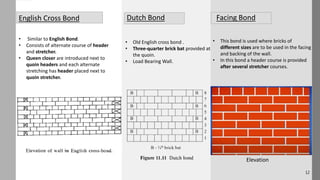
English Cross Bond Dutch Bond Facing Bond
Elevation
• Similar to English Bond.
• Consists of alternate course of header
and stretcher.
• Queen closer are introduced next to
quoin headers and each alternate
stretching has header placed next to
quoin stretcher.
• Old English cross bond .
• Three-quarter brick bat provided at
the quoin.
• Load Bearing Wall.
• This bond is used where bricks of
different sizes are to be used in the facing
and backing of the wall.
• In this bond a header course is provided
after several stretcher courses.
12
English Garden Wall Bond
Garden Wall Bond
Flemish Garden Wall Bond
• This arrangement consists of one course of
headers to three courses of stretchers.
• A queen closer is placed next to the quoin
header of the heading course to give the
necessary lap.
• Header placed to three or sometimes even five stretchers
in series throughout the length of the courses.
• A three quarter bat placed next to the quoin header and a
header is laid over the middle of each central stretcher.
13
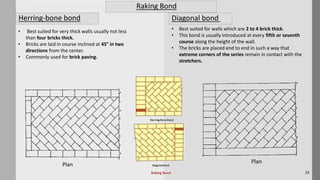
Herring-bone bond
Raking Bond
Diagonal bond
Plan
Plan
• Best suited for very thick walls usually not less
than four bricks thick.
• Bricks are laid in course inclined at 45° in two
directions from the center.
• Commonly used for brick paving.
• Best suited for walls which are 2 to 4 brick thick.
• This bond is usually introduced at every fifth or seventh
course along the height of the wall.
• The bricks are placed end to end in such a way that
extreme corners of the series remain in contact with the
stretchers.
14
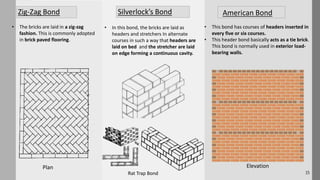
Rat Trap Bond
Zig-Zag Bond Silverlock’s Bond American Bond
Plan Elevation
• The bricks are laid in a zig-zag
fashion. This is commonly adopted
in brick paved flooring.
• In this bond, the bricks are laid as
headers and stretchers In alternate
courses in such a way that headers are
laid on bed and the stretcher are laid
on edge forming a continuous cavity.
• This bond has courses of headers inserted in
every five or six courses.
• This header bond basically acts as a tie brick.
This bond is normally used in exterior load-
bearing walls.
15
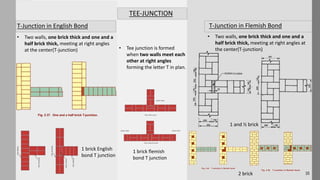
2 brick
1 and ½ brick
1 brick English
bond T junction
1 brick flemish
bond T junction
T-Junction in English Bond
TEE-JUNCTION
T-Junction in Flemish Bond
• Two walls, one brick thick and one and a
half brick thick, meeting at right angles
at the center(T-junction) • Tee junction is formed
when two walls meet each
other at right angles
forming the letter T in plan.
• Two walls, one brick thick and one and a
half brick thick, meeting at right angles at
the center(T-junction)
16
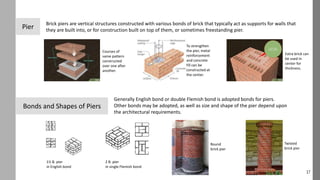
Brick piers are vertical structures constructed with various bonds of brick that typically act as supports for walls that
they are built into, or for construction built on top of them, or sometimes freestanding pier.
Pier
Courses of
same pattern
constructed
over one after
another.
To strengthen
the pier, metal
reinforcement
and concrete
fill can be
constructed at
the center.
Extra brick can
be used in
center for
thickness.
Generally English bond or double Flemish bond is adopted bonds for piers.
Other bonds may be adopted, as well as size and shape of the pier depend upon
the architectural requirements.
Bonds and Shapes of Piers
Twisted
brick pier
Round
brick pier
1½ B. pier
in English bond
2 B. pier
in single Flemish bond
17
Piers of various thickness in English bond
18
Piers of various thickness in double Flemish bond
19
Piers of various shapes and sizes are
attached to walls to support
the long walls, and to bear load
of the roofs.
Pier
• 1,3,5,… course of brick wall is attached
with a projected part of 1,3,5,… course
of brick pier. Again, 2,4,6,… course of
brick wall is supported by 2,4,6,… course
of brick pier.
• Projected part of the pier creates a
lock between wall and pier.
• Thickness and shape of pier may vary
according to the thickness of attached
wall.
Piers Attached to Main Walls
20
Squint Junction When two walls meet each other at an angle other than a right angle, create a squint junction.
• Formed when an internal wall meets an external
continuous wall at an angle other than 90°.
• Usually, the angle is kept at 45°.
• Is like Tee-junction with an oblique wall.
• English bond or Flemish bond.
• Not very common in brick masonry.
1,3,5,… 1,3,5,…
2,4,6,… 2,4,6,…
Squint junction
in English bond
Squint junction
in Flemish bond
Squint Quoins
A quoin at the corner of a building not forming a right angle
is called a squint quoin.
• Divided into two categories:
i. Obtuse squint quoins
ii. Acute squint quoins
• One wall is longer than the other,
thus produce an acute-angled squint at the back street
and an obtuse-angled squint at the opposite angle.
21
1. Hammer 2. Line and pins 3. Brick axe 4. Spirit level
5. Plumb rule 6. Mason’s square 7. Trowel 8. Two foot four fold rule
TOOLS OF BRICK-LAYER
22
 Retaining wall is a structure that are designed to withstand lateral
pressure of soil ,liquid , earth filling , sand or other granular
materials.
 Requires : hill road construction , masonry dam , wings wall of
bridge
 Resisting force : Bearing ,Sliding ,Overturning
 Type : Dry stone masonry ,stone masonry ,brick
masonry ,Plain cement concrete and reinforce cement
concrete.
Masonry dam Earth fill
Wings wall
Retaining wall
23
The thrust from the backing which tends to overturn the
wall or cause it to slide ,is the deciding factor in the
selection of the section and type of the wall.
Conditions :
>cohesion of soli
>dryness of the backing material
>the manner in which the materials is filled against the
wall
FACTORS:
# the wall is so designed that the selfweight is sufficient.
#the resultant force must lies within the middle third of
base.
# no tension at wall base
# calculate the earth pressure.
Design of retaining wall: Different types of retaining wall
24
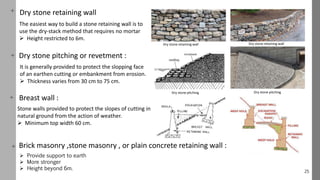
The easiest way to build a stone retaining wall is to
use the dry-stack method that requires no mortar
 Height restricted to 6m.
Dry stone pitching or revetment :
It is generally provided to protect the slopping face
of an earthen cutting or embankment from erosion.
 Thickness varies from 30 cm to 75 cm.
Breast wall :
Stone walls provided to protect the slopes of cutting in
natural ground from the action of weather.
 Minimum top width 60 cm.
Dry stone retaining wall
Brick masonry ,stone masonry , or plain concrete retaining wall :
 Provide support to earth
 More stronger
 Height beyond 6m.
Dry stone retaining wall
Dry stone pitching Dry stone pitching
Dry stone retaining wall
25
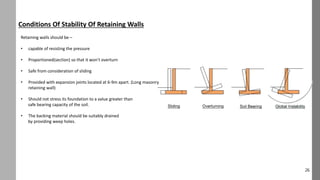
Conditions Of Stability Of Retaining Walls
Retaining walls should be –
• capable of resisting the pressure
• Proportioned(section) so that it won’t overturn
• Safe from consideration of sliding
• Provided with expansion joints located at 6-9m apart. (Long masonry
retaining wall)
• Should not stress its foundation to a value greater than
safe bearing capacity of the soil.
• The backing material should be suitably drained
by providing weep holes.
26
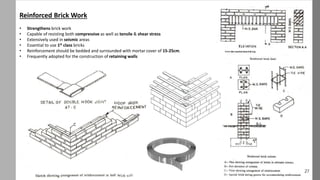
Reinforced Brick Work
• Strengthens brick work
• Capable of resisting both compressive as well as tensile & shear stress
• Extensively used in seismic areas
• Essential to use 1st class bricks
• Reinforcement should be bedded and surrounded with mortar cover of 15-25cm.
• Frequently adopted for the construction of retaining walls
27
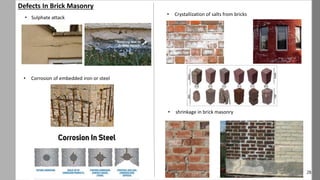
Defects In Brick Masonry
• Sulphate attack
• Crystallization of salts from bricks
• Corrosion of embedded iron or steel
• shrinkage in brick masonry
28
Conclusion:
As bricks have very low tensile strength. Brick masonry cannot be used in a high seismic zone.
Since bricks absorb water easily, it causes effluorescence when not exposed to air. A rough surface of bricks can
cause mold to grow if not cleaned properly.
Brick masonry is very cheaper. Brick masonry increases the thermal mass of a building and
thereby resists fire. Brick blocks do not require any dressing and light in weight . The bonding strength is
very good and the brickwork is more durable. No complicated lifting equipment is required for brickwork,
no problem with its availability. masonry tends to be heavy and must be built upon a strong foundation,
such as reinforced concrete , to avoid setting and cracking.
That’s why ,brick masonry is the most prominent masonry among all other masonries in construction.
29
30
THANK YOU

Brick Masonry

  • 1.
  • 2.
    Content: • Introduction toBrick masonry . . . . . . . . . . . . . . . . . . . . . . . . . . . . . . . . . . . . . . . . . . . . . • Types of Bricks used in masonry work . . . . . . . . . . . . . . . . . . . . . . . . . . . . . . . . . . . . . . . . . • Classification of brick . . . . . . . . . . . . . . . . . . . . . . . . . . . . . . . . . . . . . . . . . . . . . . . . . . • Terminology of Brick . . . . . . . . . . . . . . . . . . . . . . . . . . . . . . . . . . . . . . . . . . . . . . . . . . • General Principles To Be Observed In Brick Masonry Construction . . . . . . . . . . . . . . . . . . . . . . . . . • What is Brick Bonds . . . . . . . . . . . . . . . . . . . . . . . . . . . . . . . . . . . . . . . . . . . . . . . . . . . • Different types of Brick Bonds . . . . . . . . . . . . . . . . . . . . . . . . . . . . . . . . . . . . . . . . . . . . . • TEE-JUNCTION . . . . . . . . . . . . . . . . . . . . . . . . . . . . . . . . . . . . . . . . . . . . . . . . . . . . . . • Pier . . . . . . . . . . . . . . . . . . . . . . . . . . . . . . . . . . . . . . . . . . . . . . . . . . . . . . . . . . . . • Bonds and Shapes of Piers . . . . . . . . . . . . . . . . . . . . . . . . . . . . . . . . . . . . . . . . . . . . . . . • Piers of various thickness in English bond . . . . . . . . . . . . . . . . . . . . . . . . . . . . . . . . . . . . . . . • Piers of various thickness in double Flemish bond . . . . . . . . . . . . . . . . . . . . . . . . . . . . . . . . . . • Piers Attached to Main Walls . . . . . . . . . . . . . . . . . . . . . . . . . . . . . . . . . . . . . . . . . . . . . . • Squint Junction . . . . . . . . . . . . . . . . . . . . . . . . . . . . . . . . . . . . . . . . . . . . . . . . . . . . . . • Squint Quoins . . . . . . . . . . . . . . . . . . . . . . . . . . . . . . . . . . . . . . . . . . . . . . . . . . . . . . • Tools of brick layer . . . . . . . . . . . . . . . . . . . . . . . . . . . . . . . . . . . . . . . . . . . . . . . . . . . . • Retaining wall . . . . . . . . . . . . . . . . . . . . . . . . . . . . . . . . . . . . . . . . . . . . . . . . . . . . . . • Design of retaining wall . . . . . . . . . . . . . . . . . . . . . . . . . . . . . . . . . . . . . . . . . . . . . . . . • Different types of retaining wall . . . . . . . . . . . . . . . . . . . . . . . . . . . . . . . . . . . . . . . . . . . • Conditions Of Stability Of Retaining Walls . . . . . . . . . . . . . . . . . . . . . . . . . . . . . . . . . . . . . . . • Reinforced Brick Work . . . . . . . . . . . . . . . . . . . . . . . . . . . . . . . . . . . . . . . . . . . . . . . . . • Defects In Brick Masonry . . . . . . . . . . . . . . . . . . . . . . . . . . . . . . . . . . . . . . . . . . . . . . . . • Conclusion . . . . . . . . . . . . . . . . . . . . . . . . . . . . . . . . . . . . . . . . . . . . . . . . . . . . . . . . 1 2 2 3 4-5 6 7 8-15 16 17 17 18 19 20 21 21 22 23 24 24-25 26 27 28 29
  • 3.
    Brick masonry: + = Mortar: Typesof Bricks used in masonry work: Traditional Modular Bangladesh standard size: Bangladesh: 9.5×4.5×2.74 inch With mortar:10×5×3 Inch Brick masonry work strength depend on 1.Slenderness ratio 2.Wind lateral pressure 3.Degree of soundness of construction Quality of mortar Method of bonding Quality of brick Mud+Water Surki+Lime+water Lime+sand+Water Cement+Sand+Water Cement+lime+sand+water Construction of brick unit bonded together with mortar is termed as brick masonry. Brick is the common materials of the masonry construction. It is a very durable form of construction. Types of mortar & brick is the element of brick masonry. Brick is made of clay or shale formed, dried and fired into manufacturing process. 2
  • 4.
    Classification of brick:Based on: Building process: Their using: Raw materials Shapes: Quality: 3
  • 5.
  • 6.
  • 7.
    General Principales ToBe Observed In Brick Masonry Construction: 3.Metalic sound 4.Hardness 5.Brick wash & soaking. 6.Brick should laid on a full bed of mortar 7.Joint properly filled with mortar. 8.Maintain proper bond 10.Mortar quality 11.Curing 7 days 12.Plastering after 28 days 13.18mm gap every (30-45)m for wide expansion 15.Corbels & bracket use for timber roof 14.Toothing for merge old & new 9.No use of bats 2.No cracks,flaws or fractured surface and Free from holes,grit,lumps of lime etc 1.Well burnt 6
  • 8.
    What is BrickBonds: Types of Bonds in Brick Masonry Wall Construction: The most commonly used types: 01. Header bond 02. Stretcher bond 03. English bond 04. Flemish bond Other Types of bonds are: 01. Garden wall bond 02. Raking bond 03. English cross bond 04. Dutch bond 05. Silverlock’s Bond 06. Zigzag bond 07. Facing bond • Bonds for avoiding vertical joints. • Spreading a strength to masonry. • More stable structure Odd course Even course Axonometric view of wall 7
  • 9.
    • is alsoknown as heading bond • Headers are placed as on the faces of the walls • is used for full brick thickness wall which measures 18cm • three quarter brick bats are used in alternate courses as quoins. • also called as running /stretching bond • Only stretchers on face • the limitation is that it cannot make effective bonding • used only for one-half brick thick walls • For half brick thick partition wall, fill wall, Cavity Wall • Less stronger than header bond Header bond Stretcher bond Most common Brick bonds: Header bond : Stretcher bond : 8
  • 10.
    • consists ofeach course of alternate headers and stretchers. • alternate course starts with a quoin header at the corner. • header is centrally supported over the stretcher below it. TWO TYPES OF FLEMISH BOND: 1.Single Flemish Bond 2.Double Flemish Bond Elevation • comprises of alternating courses of headers and stretchers. • A queen closer is used at the start and end of a wall. • used to construct strong one brick thickness walls. According to thickness Types of English Bond Elevation English bond: Flemish bond : 9
  • 11.
    • same appearanceboth in the front face as well as in the back face. • Consist of alternate headers and stretchers course. • Weaker than English bond. • Combination of English and Flemish Bond. • Front face will be Flemish & back face will be English. PLAN PLAN Double Flemish Bond: SINGLE FLEMISH BOND: Axonometric view Axonometric view 10
  • 12.
    • A differentbut common brick bond. • bricks are stacked on top of one another. • used in non-load bearing situations as alternative of stretcher bond • for only decorative purpose as partition wall Elevation • variant of Flemish bond • involves a header between two strechers in each course. • headers is limited and therefore the price is lower. Elevation Monk Bond: Stack Bond: Axonometric view Axonometric view 11
  • 13.
    English Cross BondDutch Bond Facing Bond Elevation • Similar to English Bond. • Consists of alternate course of header and stretcher. • Queen closer are introduced next to quoin headers and each alternate stretching has header placed next to quoin stretcher. • Old English cross bond . • Three-quarter brick bat provided at the quoin. • Load Bearing Wall. • This bond is used where bricks of different sizes are to be used in the facing and backing of the wall. • In this bond a header course is provided after several stretcher courses. 12
  • 14.
    English Garden WallBond Garden Wall Bond Flemish Garden Wall Bond • This arrangement consists of one course of headers to three courses of stretchers. • A queen closer is placed next to the quoin header of the heading course to give the necessary lap. • Header placed to three or sometimes even five stretchers in series throughout the length of the courses. • A three quarter bat placed next to the quoin header and a header is laid over the middle of each central stretcher. 13
  • 15.
    Herring-bone bond Raking Bond Diagonalbond Plan Plan • Best suited for very thick walls usually not less than four bricks thick. • Bricks are laid in course inclined at 45° in two directions from the center. • Commonly used for brick paving. • Best suited for walls which are 2 to 4 brick thick. • This bond is usually introduced at every fifth or seventh course along the height of the wall. • The bricks are placed end to end in such a way that extreme corners of the series remain in contact with the stretchers. 14
  • 16.
    Rat Trap Bond Zig-ZagBond Silverlock’s Bond American Bond Plan Elevation • The bricks are laid in a zig-zag fashion. This is commonly adopted in brick paved flooring. • In this bond, the bricks are laid as headers and stretchers In alternate courses in such a way that headers are laid on bed and the stretcher are laid on edge forming a continuous cavity. • This bond has courses of headers inserted in every five or six courses. • This header bond basically acts as a tie brick. This bond is normally used in exterior load- bearing walls. 15
  • 17.
    2 brick 1 and½ brick 1 brick English bond T junction 1 brick flemish bond T junction T-Junction in English Bond TEE-JUNCTION T-Junction in Flemish Bond • Two walls, one brick thick and one and a half brick thick, meeting at right angles at the center(T-junction) • Tee junction is formed when two walls meet each other at right angles forming the letter T in plan. • Two walls, one brick thick and one and a half brick thick, meeting at right angles at the center(T-junction) 16
  • 18.
    Brick piers arevertical structures constructed with various bonds of brick that typically act as supports for walls that they are built into, or for construction built on top of them, or sometimes freestanding pier. Pier Courses of same pattern constructed over one after another. To strengthen the pier, metal reinforcement and concrete fill can be constructed at the center. Extra brick can be used in center for thickness. Generally English bond or double Flemish bond is adopted bonds for piers. Other bonds may be adopted, as well as size and shape of the pier depend upon the architectural requirements. Bonds and Shapes of Piers Twisted brick pier Round brick pier 1½ B. pier in English bond 2 B. pier in single Flemish bond 17
  • 19.
    Piers of variousthickness in English bond 18
  • 20.
    Piers of variousthickness in double Flemish bond 19
  • 21.
    Piers of variousshapes and sizes are attached to walls to support the long walls, and to bear load of the roofs. Pier • 1,3,5,… course of brick wall is attached with a projected part of 1,3,5,… course of brick pier. Again, 2,4,6,… course of brick wall is supported by 2,4,6,… course of brick pier. • Projected part of the pier creates a lock between wall and pier. • Thickness and shape of pier may vary according to the thickness of attached wall. Piers Attached to Main Walls 20
  • 22.
    Squint Junction Whentwo walls meet each other at an angle other than a right angle, create a squint junction. • Formed when an internal wall meets an external continuous wall at an angle other than 90°. • Usually, the angle is kept at 45°. • Is like Tee-junction with an oblique wall. • English bond or Flemish bond. • Not very common in brick masonry. 1,3,5,… 1,3,5,… 2,4,6,… 2,4,6,… Squint junction in English bond Squint junction in Flemish bond Squint Quoins A quoin at the corner of a building not forming a right angle is called a squint quoin. • Divided into two categories: i. Obtuse squint quoins ii. Acute squint quoins • One wall is longer than the other, thus produce an acute-angled squint at the back street and an obtuse-angled squint at the opposite angle. 21
  • 23.
    1. Hammer 2.Line and pins 3. Brick axe 4. Spirit level 5. Plumb rule 6. Mason’s square 7. Trowel 8. Two foot four fold rule TOOLS OF BRICK-LAYER 22
  • 24.
     Retaining wallis a structure that are designed to withstand lateral pressure of soil ,liquid , earth filling , sand or other granular materials.  Requires : hill road construction , masonry dam , wings wall of bridge  Resisting force : Bearing ,Sliding ,Overturning  Type : Dry stone masonry ,stone masonry ,brick masonry ,Plain cement concrete and reinforce cement concrete. Masonry dam Earth fill Wings wall Retaining wall 23
  • 25.
    The thrust fromthe backing which tends to overturn the wall or cause it to slide ,is the deciding factor in the selection of the section and type of the wall. Conditions : >cohesion of soli >dryness of the backing material >the manner in which the materials is filled against the wall FACTORS: # the wall is so designed that the selfweight is sufficient. #the resultant force must lies within the middle third of base. # no tension at wall base # calculate the earth pressure. Design of retaining wall: Different types of retaining wall 24
  • 26.
    The easiest wayto build a stone retaining wall is to use the dry-stack method that requires no mortar  Height restricted to 6m. Dry stone pitching or revetment : It is generally provided to protect the slopping face of an earthen cutting or embankment from erosion.  Thickness varies from 30 cm to 75 cm. Breast wall : Stone walls provided to protect the slopes of cutting in natural ground from the action of weather.  Minimum top width 60 cm. Dry stone retaining wall Brick masonry ,stone masonry , or plain concrete retaining wall :  Provide support to earth  More stronger  Height beyond 6m. Dry stone retaining wall Dry stone pitching Dry stone pitching Dry stone retaining wall 25
  • 27.
    Conditions Of StabilityOf Retaining Walls Retaining walls should be – • capable of resisting the pressure • Proportioned(section) so that it won’t overturn • Safe from consideration of sliding • Provided with expansion joints located at 6-9m apart. (Long masonry retaining wall) • Should not stress its foundation to a value greater than safe bearing capacity of the soil. • The backing material should be suitably drained by providing weep holes. 26
  • 28.
    Reinforced Brick Work •Strengthens brick work • Capable of resisting both compressive as well as tensile & shear stress • Extensively used in seismic areas • Essential to use 1st class bricks • Reinforcement should be bedded and surrounded with mortar cover of 15-25cm. • Frequently adopted for the construction of retaining walls 27
  • 29.
    Defects In BrickMasonry • Sulphate attack • Crystallization of salts from bricks • Corrosion of embedded iron or steel • shrinkage in brick masonry 28
  • 30.
    Conclusion: As bricks havevery low tensile strength. Brick masonry cannot be used in a high seismic zone. Since bricks absorb water easily, it causes effluorescence when not exposed to air. A rough surface of bricks can cause mold to grow if not cleaned properly. Brick masonry is very cheaper. Brick masonry increases the thermal mass of a building and thereby resists fire. Brick blocks do not require any dressing and light in weight . The bonding strength is very good and the brickwork is more durable. No complicated lifting equipment is required for brickwork, no problem with its availability. masonry tends to be heavy and must be built upon a strong foundation, such as reinforced concrete , to avoid setting and cracking. That’s why ,brick masonry is the most prominent masonry among all other masonries in construction. 29
  • 31.