BRICKS
Prepared
By
Er. Sanjeev singh
snjv432@gmail.com
CONTENTS
 Bricks
 Qualities of brick earth
 Composition of good brick earth
 Classification of bricks
 Uses of bricks
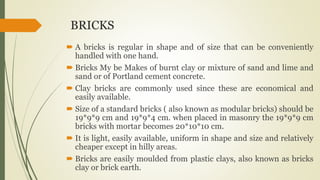
BRICKS
 A bricks is regular in shape and of size that can be conveniently
handled with one hand.
 Bricks My be Makes of burnt clay or mixture of sand and lime and
sand or of Portland cement concrete.
 Clay bricks are commonly used since these are economical and
easily available.
 Size of a standard bricks ( also known as modular bricks) should be
19*9*9 cm and 19*9*4 cm. when placed in masonry the 19*9*9 cm
bricks with mortar becomes 20*10*10 cm.
 It is light, easily available, uniform in shape and size and relatively
cheaper except in hilly areas.
 Bricks are easily moulded from plastic clays, also known as bricks
clay or brick earth.
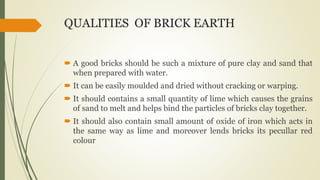
QUALITIES OF BRICK EARTH
 A good bricks should be such a mixture of pure clay and sand that
when prepared with water.
 It can be easily moulded and dried without cracking or warping.
 It should contains a small quantity of lime which causes the grains
of sand to melt and helps bind the particles of bricks clay together.
 It should also contain small amount of oxide of iron which acts in
the same way as lime and moreover lends bricks its pecullar red
colour
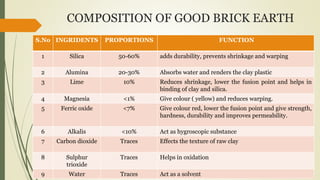
COMPOSITION OF GOOD BRICK EARTH
S.No INGRIDENTS PROPORTIONS FUNCTION
1 Silica 50-60% adds durability, prevents shrinkage and warping
2 Alumina 20-30% Absorbs water and renders the clay plastic
3 Lime 10% Reduces shrinkage, lower the fusion point and helps in
binding of clay and silica.
4 Magnesia <1% Give colour ( yellow) and reduces warping.
5 Ferric oxide <7% Give colour red, lower the fusion point and give strength,
hardness, durability and improves permeability.
6 Alkalis <10% Act as hygroscopic substance
7 Carbon dioxide Traces Effects the texture of raw clay
8 Sulphur
trioxide
Traces Helps in oxidation
9 Water Traces Act as a solvent
CLASSIFICATION OF BRICKS
 first class bricks:- these bricks of standard shape and they are burnt
in kilns.
1. The surface and edges of the bricks are sharp, square, smooth and
straight.
2. They are free from flaws, crack and stones.
3. These should have uniform texture.
4. No impression should be left on the bricks when a scratch is made
by a finger nail.
5. A metallic or ringing sound should come when two bricks are struck
against each other.
6. The crushing strength of the bricks should not be less than 10
N/mm
2
2.
7. These bricks are used for superior works of permanent nature.
CLASSIFICATION OF BRICKS
 Second class bricks:- are supposed to have the sane requirement as
the first class one except that.
1. Small cracks and their edges may not be sharp and uniform.
2. A little higher water absorption of about 16-20% of its dry weight is
allowed.
3. The surface of these bricks is somewhat rough and shape is also
slightly irregular.
4. These bricks are commonly used at place where brickwork is to be
provided with a coat of plaster.
CLASSIFICATION OF BRICKS
 Third class bricks
1. These bricks are not hard and they have rough surface with
irregular and distorted edges.
2. These bricks give dull sound when struck together.
3. They are used unimportant and temporary structure and at place
where rainfall in not heavy.
CLASSIFICATION OF BRICKS
 Fourth class bricks
1. These are overburnt bricks with irregular shape and dark colour.
2. These bricks are used as aggregates for concrete in foundation,
floors, roads etc.
USES OF BRICKS
 The first class and second class bricks are widely used for all sorts of
sound work especially of permanent nature. These structure include
building, dams, roads, sewers, bridge piers, tunnels etc.
 The third class and sun dried bricks are used for construction work of
temporary nature. These bricks are not used in damp situation or at
place subjected to heavy rains.
 The fourth class bricks are used as road metal and as aggregates in
the foundation concrete.
 Bricks

Bricks

  • 1.
  • 2.
    CONTENTS  Bricks  Qualitiesof brick earth  Composition of good brick earth  Classification of bricks  Uses of bricks
  • 3.
    BRICKS  A bricksis regular in shape and of size that can be conveniently handled with one hand.  Bricks My be Makes of burnt clay or mixture of sand and lime and sand or of Portland cement concrete.  Clay bricks are commonly used since these are economical and easily available.  Size of a standard bricks ( also known as modular bricks) should be 19*9*9 cm and 19*9*4 cm. when placed in masonry the 19*9*9 cm bricks with mortar becomes 20*10*10 cm.  It is light, easily available, uniform in shape and size and relatively cheaper except in hilly areas.  Bricks are easily moulded from plastic clays, also known as bricks clay or brick earth.
  • 4.
    QUALITIES OF BRICKEARTH  A good bricks should be such a mixture of pure clay and sand that when prepared with water.  It can be easily moulded and dried without cracking or warping.  It should contains a small quantity of lime which causes the grains of sand to melt and helps bind the particles of bricks clay together.  It should also contain small amount of oxide of iron which acts in the same way as lime and moreover lends bricks its pecullar red colour
  • 5.
    COMPOSITION OF GOODBRICK EARTH S.No INGRIDENTS PROPORTIONS FUNCTION 1 Silica 50-60% adds durability, prevents shrinkage and warping 2 Alumina 20-30% Absorbs water and renders the clay plastic 3 Lime 10% Reduces shrinkage, lower the fusion point and helps in binding of clay and silica. 4 Magnesia <1% Give colour ( yellow) and reduces warping. 5 Ferric oxide <7% Give colour red, lower the fusion point and give strength, hardness, durability and improves permeability. 6 Alkalis <10% Act as hygroscopic substance 7 Carbon dioxide Traces Effects the texture of raw clay 8 Sulphur trioxide Traces Helps in oxidation 9 Water Traces Act as a solvent
  • 6.
    CLASSIFICATION OF BRICKS first class bricks:- these bricks of standard shape and they are burnt in kilns. 1. The surface and edges of the bricks are sharp, square, smooth and straight. 2. They are free from flaws, crack and stones. 3. These should have uniform texture. 4. No impression should be left on the bricks when a scratch is made by a finger nail. 5. A metallic or ringing sound should come when two bricks are struck against each other. 6. The crushing strength of the bricks should not be less than 10 N/mm 2 2. 7. These bricks are used for superior works of permanent nature.
  • 7.
    CLASSIFICATION OF BRICKS Second class bricks:- are supposed to have the sane requirement as the first class one except that. 1. Small cracks and their edges may not be sharp and uniform. 2. A little higher water absorption of about 16-20% of its dry weight is allowed. 3. The surface of these bricks is somewhat rough and shape is also slightly irregular. 4. These bricks are commonly used at place where brickwork is to be provided with a coat of plaster.
  • 8.
    CLASSIFICATION OF BRICKS Third class bricks 1. These bricks are not hard and they have rough surface with irregular and distorted edges. 2. These bricks give dull sound when struck together. 3. They are used unimportant and temporary structure and at place where rainfall in not heavy.
  • 9.
    CLASSIFICATION OF BRICKS Fourth class bricks 1. These are overburnt bricks with irregular shape and dark colour. 2. These bricks are used as aggregates for concrete in foundation, floors, roads etc.
  • 10.
    USES OF BRICKS The first class and second class bricks are widely used for all sorts of sound work especially of permanent nature. These structure include building, dams, roads, sewers, bridge piers, tunnels etc.  The third class and sun dried bricks are used for construction work of temporary nature. These bricks are not used in damp situation or at place subjected to heavy rains.  The fourth class bricks are used as road metal and as aggregates in the foundation concrete.