Contents:
* Building structure.
* Non building structure.
* classification of buildings;
-> Based on occupancy.
-> Based on type of
construction.
Building structure:
A building structure is a man-made structure with a
roof and walls standing more or less permanently
in one place, such as a house or factory.
Buildings are classified into two categories.
1) Based on the occupancy.
2) Based on the type of construction.
Buildings classified, based on the occupancy:
Every building or portion of land shall be classified according to
its use or the character of its occupancy as a building of
Occupancy. They are categorized into the following types.
1) Agricultural buildings
2) Commercial buildings
3) Residential buildings
4) Educational buildings
5) Government buildings
6) Industrial buildings
7) Military buildings
8) Religious buildings
9) Transport buildings
10) Power plants
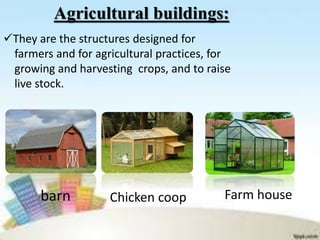
Agricultural buildings:
They are the structures designed for
farmers and for agricultural practices, for
growing and harvesting crops, and to raise
live stock.
Chicken coopbarn Farm house
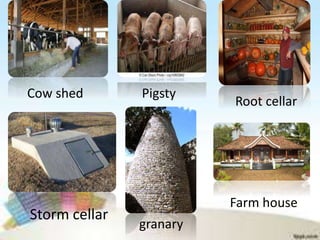
Cow shed Pigsty
Root cellar
Storm cellar
granary
Farm house
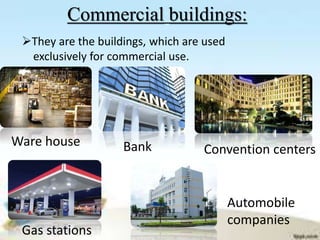
Commercial buildings:
They are the buildings, which are used
exclusively for commercial use.
Automobile
companies
Ware house Bank Convention centers
Gas stations
Super markets Sky scrapers
Market house Commercial shops
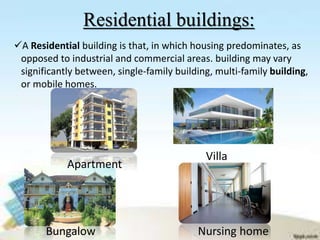
Residential buildings:
A Residential building is that, in which housing predominates, as
opposed to industrial and commercial areas. building may vary
significantly between, single-family building, multi-family building,
or mobile homes.
Apartment
Villa
Bungalow Nursing home
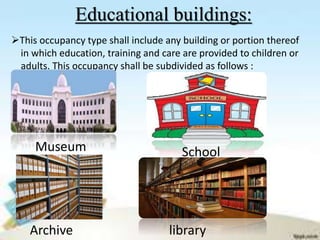
Educational buildings:
This occupancy type shall include any building or portion thereof
in which education, training and care are provided to children or
adults. This occupancy shall be subdivided as follows :
Museum School
Archive library
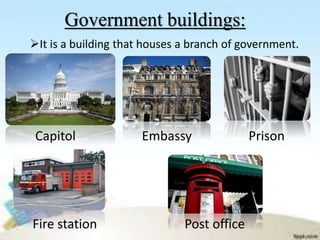
Government buildings:
It is a building that houses a branch of government.
Capitol Embassy Prison
Fire station Post office
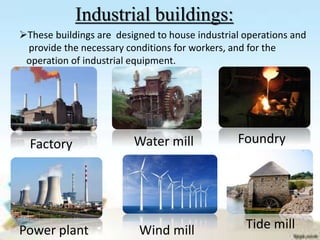
Industrial buildings:
These buildings are designed to house industrial operations and
provide the necessary conditions for workers, and for the
operation of industrial equipment.
Factory Water mill Foundry
Power plant Wind mill Tide mill
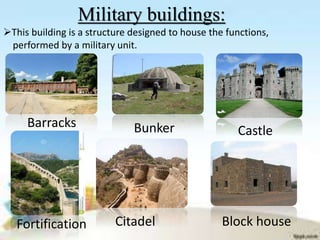
Military buildings:
This building is a structure designed to house the functions,
performed by a military unit.
Barracks Bunker
Citadel
Castle
Fortification Block house
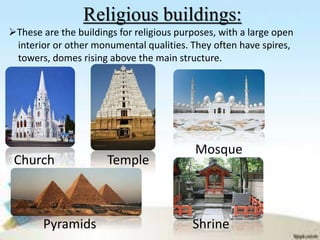
Religious buildings:
These are the buildings for religious purposes, with a large open
interior or other monumental qualities. They often have spires,
towers, domes rising above the main structure.
Church Temple
Mosque
Pyramids Shrine
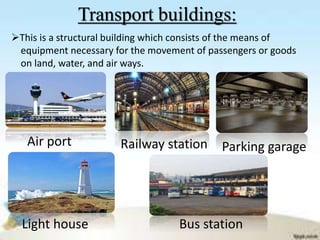
Transport buildings:
This is a structural building which consists of the means of
equipment necessary for the movement of passengers or goods
on land, water, and air ways.
Air port Railway station Parking garage
Light house Bus station
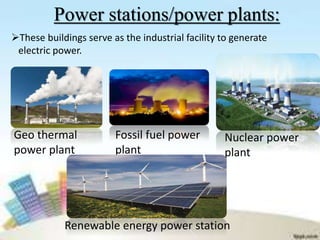
Power stations/power plants:
These buildings serve as the industrial facility to generate
electric power.
Geo thermal
power plant
Fossil fuel power
plant
Nuclear power
plant
Renewable energy power station
Based on the type of construction,
buildings are classified into 5 categories.
1) Fire resistive Buildings (Type 1A , 1B)
2)Non–Combustible Buildings (Type 2A, 2B)
3)Ordinary Buildings (Type 3A, 3B)
4)Heavy timber Buildings (Type 4)
5)Wood framed Buildings (Type 5A, 5B)
Fire resistive buildings: (Type 1A, 1B)
These type of buildings are generally high raised, and
the stoutest of all, which are usually of more than 75
feet tall.
They are constructed of concrete and protected steel,
(coated with fire resistant material) which are
designed to hold fire.
This type of buildings are generally residential and
industrial buildings.
The fire resistance is valid only for a specific
time, depending up on the type of construction.
Let us have a look at the resistive time for
Industrial and Residential buildings.
Industrial buildings:
*3 Hr- Exterior Walls.
*3 Hr- Structural Frame.
*2 Hr-Floor/Ceiling
assembly.
*1 ½ Hr-Roof Protection.
Residential buildings:
*2 Hr- Exterior Walls.
*2 Hr-Structural frame.
*2 Hr-Ceiling/Floor
Separation.
*1 Hr-Ceiling/Roof
assembly.
It means that according to the time given above, the
building is resistant towards fire, and after the specified
time it must be super viewed by the fire control authorities.
Non- combustible buildings:( Type 2A,2B)
These buildings are generally the new buildings and
remodels of commercial structures.
The walls and roofs are constructed of non- combustible
materials.(i.e. walls are rein forced masonry and the
roofs have metal structural members) .
The top of the roofs are covered with light weight
concrete etc.
Protected Non-combustible.(common in school
buildings)
*1 Hr-Exterior Walls
*1 Hr-Structural Frame
*1 Hr-Floor/Ceiling/Roof Protection
Unprotected Non-combustible.(common in
commercial buildings):
These Buildings are constructed of non-
combustible materials but these materials have
no fire resistance.
Ordinary buildings:(Type 3A,3B)
These buildings may be of old or newer constructions.
They have non-combustible walls and wooden roof.
Older constructions may have un rein-forced masonry
and have conventionally framed roof, while newer
houses have light weight roof systems, supported by
R.C.C masonry or tilt slab.
The walls and the roofs are 1 hour fire protected.
Ordinary buildings are of the other type also, which is
unprotected combustible. walls are of a wooden roof
and the floor assembly is not protected against fire.
These buildings are frequently found in "warehouse“,
districts of older cities.
*2 Hr. Exterior Walls
*No fire resistance for structural frame,
floors, ceilings, or roofs.
Specifications:
Heavy Timber:(Type 4)
These buildings were most commonly built before
1960, when bolts and metal plates were used as
connectors.
It utilizes large dimensional lumber for structural
members and interior elements. These buildings hold
up well under fire conditions.
It is critical that, as these buildings are often poorly
maintained, or have termites, the weathering issues
contributes an earlier-than-expected collapse.
*2 Hr. Exterior Walls
*1 Hr. Structural Frame or Heavy Timber
(Heavy Timber Floor/Ceiling/Roof Assemblies)
To qualify the structure, all wooden members must
have a minimum nominal dimension of 8 inches.
Specifications:
Wood framed buildings: (Type 5A,5B)
This type of construction is found in many modern
homes. The walls and roofs are made of combustible
materials—most commonly wood.
It has a few negative characteristics:
It is not highly fireproof, as it is made of wood.
It is not strong enough to resist major wind events such
as tornadoes and hurricanes.
Every timber frame home structure is made of a few
basic components:
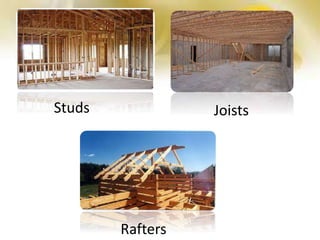
 Studs are vertical wooden members within the walls.
 Joists are the horizontal wooden beams that support
the floors.
 Rafters are the sloping wooden beams that support
the roof.
It also has protected wooden frame and unprotected
wooden frame.
Protected Wood Frame:
It is Commonly used in the construction of newer
apartment buildings; there is no exposed wood visible.
1 Hr. Exterior Walls
1 Hr. Structural Frame
1 Hr. Floor/Ceiling/Roof
Unprotected Wood Frame:
It is used commonly at single family homes and garages.
They often have exposed wood so there is no fire resistance.
Studs Joists
Rafters
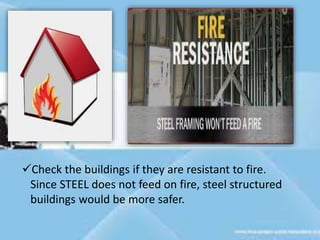
Check the buildings if they are resistant to fire.
Since STEEL does not feed on fire, steel structured
buildings would be more safer.
Hence, to construct any structure, first attain
knowledge about the type you are going to construct,
and also its safety measures.
Classification of buildings

Classification of buildings

  • 2.
    Contents: * Building structure. *Non building structure. * classification of buildings; -> Based on occupancy. -> Based on type of construction.
  • 3.
    Building structure: A buildingstructure is a man-made structure with a roof and walls standing more or less permanently in one place, such as a house or factory. Buildings are classified into two categories. 1) Based on the occupancy. 2) Based on the type of construction.
  • 4.
    Buildings classified, basedon the occupancy: Every building or portion of land shall be classified according to its use or the character of its occupancy as a building of Occupancy. They are categorized into the following types. 1) Agricultural buildings 2) Commercial buildings 3) Residential buildings 4) Educational buildings 5) Government buildings 6) Industrial buildings 7) Military buildings 8) Religious buildings 9) Transport buildings 10) Power plants
  • 5.
    Agricultural buildings: They arethe structures designed for farmers and for agricultural practices, for growing and harvesting crops, and to raise live stock. Chicken coopbarn Farm house
  • 6.
    Cow shed Pigsty Rootcellar Storm cellar granary Farm house
  • 7.
    Commercial buildings: They arethe buildings, which are used exclusively for commercial use. Automobile companies Ware house Bank Convention centers Gas stations
  • 8.
    Super markets Skyscrapers Market house Commercial shops
  • 9.
    Residential buildings: A Residentialbuilding is that, in which housing predominates, as opposed to industrial and commercial areas. building may vary significantly between, single-family building, multi-family building, or mobile homes. Apartment Villa Bungalow Nursing home
  • 10.
    Educational buildings: This occupancytype shall include any building or portion thereof in which education, training and care are provided to children or adults. This occupancy shall be subdivided as follows : Museum School Archive library
  • 11.
    Government buildings: It isa building that houses a branch of government. Capitol Embassy Prison Fire station Post office
  • 12.
    Industrial buildings: These buildingsare designed to house industrial operations and provide the necessary conditions for workers, and for the operation of industrial equipment. Factory Water mill Foundry Power plant Wind mill Tide mill
  • 13.
    Military buildings: This buildingis a structure designed to house the functions, performed by a military unit. Barracks Bunker Citadel Castle Fortification Block house
  • 14.
    Religious buildings: These arethe buildings for religious purposes, with a large open interior or other monumental qualities. They often have spires, towers, domes rising above the main structure. Church Temple Mosque Pyramids Shrine
  • 15.
    Transport buildings: This isa structural building which consists of the means of equipment necessary for the movement of passengers or goods on land, water, and air ways. Air port Railway station Parking garage Light house Bus station
  • 16.
    Power stations/power plants: Thesebuildings serve as the industrial facility to generate electric power. Geo thermal power plant Fossil fuel power plant Nuclear power plant Renewable energy power station
  • 18.
    Based on thetype of construction, buildings are classified into 5 categories. 1) Fire resistive Buildings (Type 1A , 1B) 2)Non–Combustible Buildings (Type 2A, 2B) 3)Ordinary Buildings (Type 3A, 3B) 4)Heavy timber Buildings (Type 4) 5)Wood framed Buildings (Type 5A, 5B)
  • 19.
    Fire resistive buildings:(Type 1A, 1B) These type of buildings are generally high raised, and the stoutest of all, which are usually of more than 75 feet tall. They are constructed of concrete and protected steel, (coated with fire resistant material) which are designed to hold fire. This type of buildings are generally residential and industrial buildings.
  • 20.
    The fire resistanceis valid only for a specific time, depending up on the type of construction. Let us have a look at the resistive time for Industrial and Residential buildings. Industrial buildings: *3 Hr- Exterior Walls. *3 Hr- Structural Frame. *2 Hr-Floor/Ceiling assembly. *1 ½ Hr-Roof Protection.
  • 21.
    Residential buildings: *2 Hr-Exterior Walls. *2 Hr-Structural frame. *2 Hr-Ceiling/Floor Separation. *1 Hr-Ceiling/Roof assembly. It means that according to the time given above, the building is resistant towards fire, and after the specified time it must be super viewed by the fire control authorities.
  • 22.
    Non- combustible buildings:(Type 2A,2B) These buildings are generally the new buildings and remodels of commercial structures. The walls and roofs are constructed of non- combustible materials.(i.e. walls are rein forced masonry and the roofs have metal structural members) . The top of the roofs are covered with light weight concrete etc.
  • 23.
    Protected Non-combustible.(common inschool buildings) *1 Hr-Exterior Walls *1 Hr-Structural Frame *1 Hr-Floor/Ceiling/Roof Protection Unprotected Non-combustible.(common in commercial buildings): These Buildings are constructed of non- combustible materials but these materials have no fire resistance.
  • 24.
    Ordinary buildings:(Type 3A,3B) Thesebuildings may be of old or newer constructions. They have non-combustible walls and wooden roof. Older constructions may have un rein-forced masonry and have conventionally framed roof, while newer houses have light weight roof systems, supported by R.C.C masonry or tilt slab. The walls and the roofs are 1 hour fire protected.
  • 25.
    Ordinary buildings areof the other type also, which is unprotected combustible. walls are of a wooden roof and the floor assembly is not protected against fire. These buildings are frequently found in "warehouse“, districts of older cities. *2 Hr. Exterior Walls *No fire resistance for structural frame, floors, ceilings, or roofs. Specifications:
  • 26.
    Heavy Timber:(Type 4) Thesebuildings were most commonly built before 1960, when bolts and metal plates were used as connectors. It utilizes large dimensional lumber for structural members and interior elements. These buildings hold up well under fire conditions. It is critical that, as these buildings are often poorly maintained, or have termites, the weathering issues contributes an earlier-than-expected collapse.
  • 27.
    *2 Hr. ExteriorWalls *1 Hr. Structural Frame or Heavy Timber (Heavy Timber Floor/Ceiling/Roof Assemblies) To qualify the structure, all wooden members must have a minimum nominal dimension of 8 inches. Specifications:
  • 28.
    Wood framed buildings:(Type 5A,5B) This type of construction is found in many modern homes. The walls and roofs are made of combustible materials—most commonly wood. It has a few negative characteristics: It is not highly fireproof, as it is made of wood. It is not strong enough to resist major wind events such as tornadoes and hurricanes.
  • 29.
    Every timber framehome structure is made of a few basic components:  Studs are vertical wooden members within the walls.  Joists are the horizontal wooden beams that support the floors.  Rafters are the sloping wooden beams that support the roof. It also has protected wooden frame and unprotected wooden frame.
  • 30.
    Protected Wood Frame: Itis Commonly used in the construction of newer apartment buildings; there is no exposed wood visible. 1 Hr. Exterior Walls 1 Hr. Structural Frame 1 Hr. Floor/Ceiling/Roof Unprotected Wood Frame: It is used commonly at single family homes and garages. They often have exposed wood so there is no fire resistance.
  • 31.
  • 32.
    Check the buildingsif they are resistant to fire. Since STEEL does not feed on fire, steel structured buildings would be more safer.
  • 33.
    Hence, to constructany structure, first attain knowledge about the type you are going to construct, and also its safety measures.