ARCHITECTURAL DRAWINGS
DEPARTMENT OF ARCHITECTURE,
NIT PATNA
Somnath Bhui (1105036) Guided by: Ar. Ashutosh Kumar
TYPES OF DRAWINGS
A BRIEF DISCUSSION. . . .
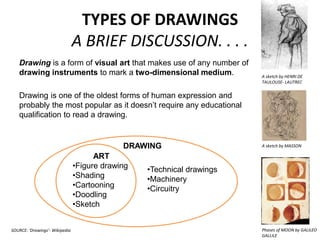
Drawing is a form of visual art that makes use of any number of
drawing instruments to mark a two-dimensional medium.
Drawing is one of the oldest forms of human expression and
probably the most popular as it doesn’t require any educational
qualification to read a drawing.
ART
•Figure drawing
•Shading
•Cartooning
•Doodling
•Sketch
•Technical drawings
•Machinery
•Circuitry
DRAWING
A sketch by HENRI DE
TAULOUSE- LAUTREC
A sketch by MASSON
Phases of MOON by GALILEO
GALLILE
SOURCE: ‘Drawings’- Wikipedia
ARCHITECTURAL DRAWINGS
• Technical drawings are graphic representations such as lines and symbols
that follow specific conventions of scale and projection.
• Architectural drawing is simply the technical drawing of a house, a
building or any kind of structure.
• A sketch, diagram, plan, or schematic used to design, construct, and
document buildings and other structures.
• The drawings may be used to indicate the overall appearance, inside or
outside the structure, or they may be used to indicate precise
measurements and other details for construction.
• Drawings, especially those for construction purposes, may be issued as a
set, with different sheets indicating different types of construction
(electrical, mechanical, plumbing).
http://www.architecturecourses.org/architectural-drawings#sthash.HVqdv5JH.dpuf
• Following is the purpose of Architectural Drawings:
 to develop a design idea into a coherent proposal
 to communicate ideas and concepts
 to convince clients of the merits of a design.
 to enable a building contractor to construct it
 as a record of the completed work,
 to make a record of a building that already exists.
• Certain set of conventions are followed while making
Architectural drawings for maintaining the uniformity of
drawings in terms of – Scale, line weight, size of sheet, line
weight, line type, symbols .
• IS 962:1989 – CODE OF PRACTICE FOR
ARCHITECTURAL AND BUILDING DRAWINGS lays down
the standards for drafting.
• Local By-laws also has certain standards that must be
followed in order to get the sanction for the project.
COMPONENTS OF ARCHITECTURAL DRAWING
• Site Plan
• Diagram (Shows the inter relationship of spaces)
• Floor Plans (Horizontal section of building at certain height)
• Elevations (View on a vertical plane situated at infinity )
• Sections (A view of the parts contained in an intersecting surface, usually
a plane surface)
• Component details (Drawings used to show the manufacture/ installation
of components)
• Isometric and Axonometric projections.
• Perspective views.
Source: IS:7973-1976, Wikipedia-
"Architectural Drawing"
TYPES OF ARCHITECTURAL DRAWINGS:
• Preliminary Drawing (Concept Sketch)
• Survey Drawings.
• Presentation Drawings.
• Municipal Drawings.
• Working Drawings.
• Detailed Project Report.
• Record Drawings.
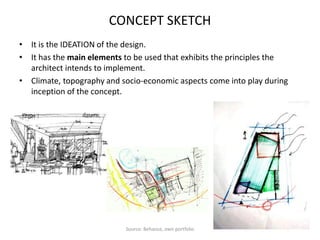
CONCEPT SKETCH
• It is the IDEATION of the design.
• It has the main elements to be used that exhibits the principles the
architect intends to implement.
• Climate, topography and socio-economic aspects come into play during
inception of the concept.
Source: Behance, own portfolio
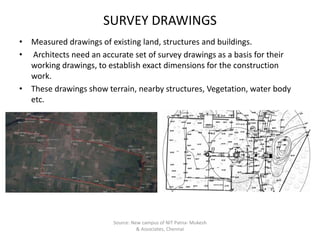
SURVEY DRAWINGS
• Measured drawings of existing land, structures and buildings.
• Architects need an accurate set of survey drawings as a basis for their
working drawings, to establish exact dimensions for the construction
work.
• These drawings show terrain, nearby structures, Vegetation, water body
etc.
Source: New campus of NIT Patna- Mukesh
& Associates, Chennai
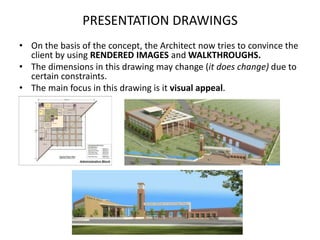
PRESENTATION DRAWINGS
• On the basis of the concept, the Architect now tries to convince the
client by using RENDERED IMAGES and WALKTHROUGHS.
• The dimensions in this drawing may change (it does change) due to
certain constraints.
• The main focus in this drawing is it visual appeal.
MUNICIPAL DRAWINGS/ SANCTION DRAWINGS
• These are the drawings prepared for obtaining sanction for the project.
• The sanctioning authorities have their own checklist of drawings to be
submitted.
• Sanction is granted for the construction of the building only after
scrutinized and found to be conforming with all the mandatory by-laws.
• Some of the required drawings are:
All floor plans
Location
Site Plan
All Elevations
Sections- Minimum one through staircase and one through toilet.
Septic Tank details (sewerage ).
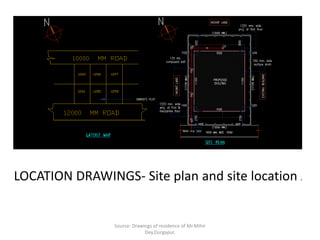
LOCATION DRAWINGS- Site plan and site location .
Source: Drawings of residence of Mr.Mihir
Dey,Durgapur.
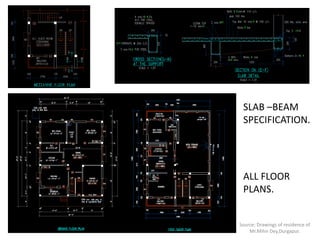
ALL FLOOR
PLANS.
SLAB –BEAM
SPECIFICATION.
Source: Drawings of residence of
Mr.Mihir Dey,Durgapur.
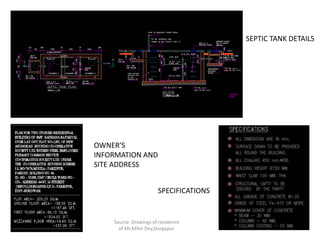
SEPTIC TANK DETAILS
SPECIFICATIONS
OWNER’S
INFORMATION AND
SITE ADDRESS
Source: Drawings of residence
of Mr.Mihir Dey,Durgapur.
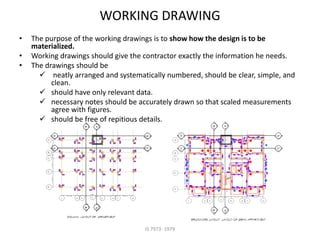
WORKING DRAWING
• The purpose of the working drawings is to show how the design is to be
materialized.
• Working drawings should give the contractor exactly the information he needs.
• The drawings should be
 neatly arranged and systematically numbered, should be clear, simple, and
clean.
 should have only relevant data.
 necessary notes should be accurately drawn so that scaled measurements
agree with figures.
 should be free of repitious details.
IS 7973- 1979
VARIOUS COMPONENTS OF
WORKING DRAWING
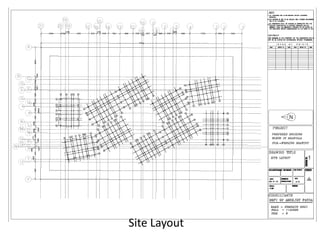
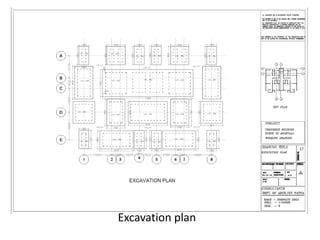
• Site Layout
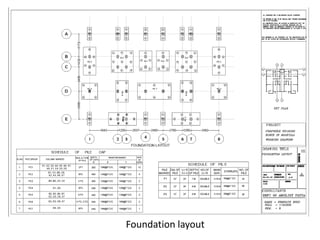
• Foundation layout
• Excavation plan
• Column layout
• Beam- column layout
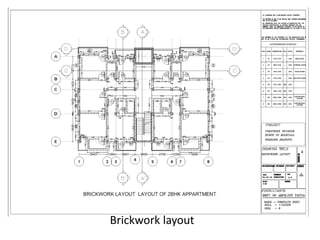
• Brickwork layout
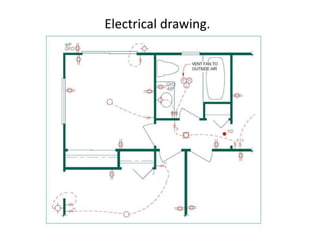
• Electrical drawing.
• PHE drawing
• HVAC drawing
• Generic details
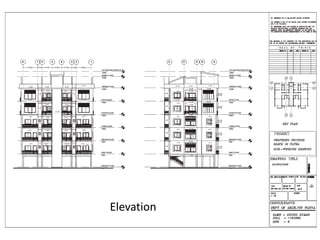
• Elevations
• Sections
Site Layout
Foundation layout
Excavation plan
Brickwork layout
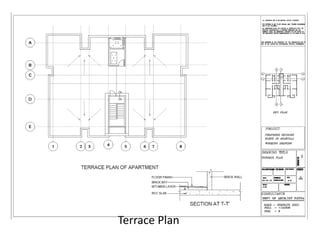
Terrace Plan
Elevation
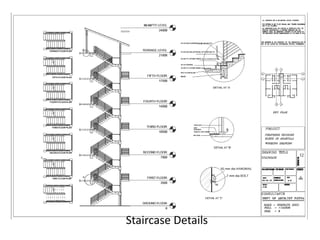
Staircase Details
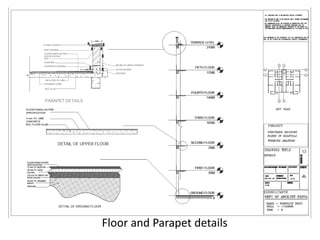
Floor and Parapet details
Electrical drawing.
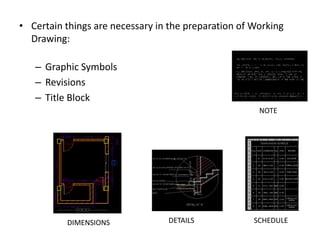
• Certain things are necessary in the preparation of Working
Drawing:
– Graphic Symbols
– Revisions
– Title Block
SCHEDULE
NOTE
DETAILSDIMENSIONS
RECORD DRAWINGS
• These are revised set of drawing
made upon completion of a project or a particular job.
• They reflect all changes made in
the specifications and working drawings during
the construction process, and show the
exact dimensions, geometry, and location of
all elements of the work completed under
the contract.
• Also called as-built drawings or just as-builts.
SOURCE: www.businessdictionary.com
BIBLIOGRAPHY
• IS: 962- 1989
• IS: 7973- 1976
• ARCHITECTURAL DRAWINGS- Wikipedia
• DRAWINGS- Wikipedia
• Mukesh & Associates, Chennai - Presentation
for new NIT Patna Campus.
• CAD CAMPUS, DURGAPUR.
THANK YOU . . .

Architectural drawings

  • 1.
    ARCHITECTURAL DRAWINGS DEPARTMENT OFARCHITECTURE, NIT PATNA Somnath Bhui (1105036) Guided by: Ar. Ashutosh Kumar
  • 2.
    TYPES OF DRAWINGS ABRIEF DISCUSSION. . . . Drawing is a form of visual art that makes use of any number of drawing instruments to mark a two-dimensional medium. Drawing is one of the oldest forms of human expression and probably the most popular as it doesn’t require any educational qualification to read a drawing. ART •Figure drawing •Shading •Cartooning •Doodling •Sketch •Technical drawings •Machinery •Circuitry DRAWING A sketch by HENRI DE TAULOUSE- LAUTREC A sketch by MASSON Phases of MOON by GALILEO GALLILE SOURCE: ‘Drawings’- Wikipedia
  • 3.
    ARCHITECTURAL DRAWINGS • Technicaldrawings are graphic representations such as lines and symbols that follow specific conventions of scale and projection. • Architectural drawing is simply the technical drawing of a house, a building or any kind of structure. • A sketch, diagram, plan, or schematic used to design, construct, and document buildings and other structures. • The drawings may be used to indicate the overall appearance, inside or outside the structure, or they may be used to indicate precise measurements and other details for construction. • Drawings, especially those for construction purposes, may be issued as a set, with different sheets indicating different types of construction (electrical, mechanical, plumbing). http://www.architecturecourses.org/architectural-drawings#sthash.HVqdv5JH.dpuf
  • 4.
    • Following isthe purpose of Architectural Drawings:  to develop a design idea into a coherent proposal  to communicate ideas and concepts  to convince clients of the merits of a design.  to enable a building contractor to construct it  as a record of the completed work,  to make a record of a building that already exists. • Certain set of conventions are followed while making Architectural drawings for maintaining the uniformity of drawings in terms of – Scale, line weight, size of sheet, line weight, line type, symbols . • IS 962:1989 – CODE OF PRACTICE FOR ARCHITECTURAL AND BUILDING DRAWINGS lays down the standards for drafting. • Local By-laws also has certain standards that must be followed in order to get the sanction for the project.
  • 5.
    COMPONENTS OF ARCHITECTURALDRAWING • Site Plan • Diagram (Shows the inter relationship of spaces) • Floor Plans (Horizontal section of building at certain height) • Elevations (View on a vertical plane situated at infinity ) • Sections (A view of the parts contained in an intersecting surface, usually a plane surface) • Component details (Drawings used to show the manufacture/ installation of components) • Isometric and Axonometric projections. • Perspective views. Source: IS:7973-1976, Wikipedia- "Architectural Drawing"
  • 6.
    TYPES OF ARCHITECTURALDRAWINGS: • Preliminary Drawing (Concept Sketch) • Survey Drawings. • Presentation Drawings. • Municipal Drawings. • Working Drawings. • Detailed Project Report. • Record Drawings.
  • 7.
    CONCEPT SKETCH • Itis the IDEATION of the design. • It has the main elements to be used that exhibits the principles the architect intends to implement. • Climate, topography and socio-economic aspects come into play during inception of the concept. Source: Behance, own portfolio
  • 8.
    SURVEY DRAWINGS • Measureddrawings of existing land, structures and buildings. • Architects need an accurate set of survey drawings as a basis for their working drawings, to establish exact dimensions for the construction work. • These drawings show terrain, nearby structures, Vegetation, water body etc. Source: New campus of NIT Patna- Mukesh & Associates, Chennai
  • 9.
    PRESENTATION DRAWINGS • Onthe basis of the concept, the Architect now tries to convince the client by using RENDERED IMAGES and WALKTHROUGHS. • The dimensions in this drawing may change (it does change) due to certain constraints. • The main focus in this drawing is it visual appeal.
  • 10.
    MUNICIPAL DRAWINGS/ SANCTIONDRAWINGS • These are the drawings prepared for obtaining sanction for the project. • The sanctioning authorities have their own checklist of drawings to be submitted. • Sanction is granted for the construction of the building only after scrutinized and found to be conforming with all the mandatory by-laws. • Some of the required drawings are: All floor plans Location Site Plan All Elevations Sections- Minimum one through staircase and one through toilet. Septic Tank details (sewerage ).
  • 11.
    LOCATION DRAWINGS- Siteplan and site location . Source: Drawings of residence of Mr.Mihir Dey,Durgapur.
  • 12.
    ALL FLOOR PLANS. SLAB –BEAM SPECIFICATION. Source:Drawings of residence of Mr.Mihir Dey,Durgapur.
  • 13.
    SEPTIC TANK DETAILS SPECIFICATIONS OWNER’S INFORMATIONAND SITE ADDRESS Source: Drawings of residence of Mr.Mihir Dey,Durgapur.
  • 14.
    WORKING DRAWING • Thepurpose of the working drawings is to show how the design is to be materialized. • Working drawings should give the contractor exactly the information he needs. • The drawings should be  neatly arranged and systematically numbered, should be clear, simple, and clean.  should have only relevant data.  necessary notes should be accurately drawn so that scaled measurements agree with figures.  should be free of repitious details. IS 7973- 1979
  • 15.
    VARIOUS COMPONENTS OF WORKINGDRAWING • Site Layout • Foundation layout • Excavation plan • Column layout • Beam- column layout • Brickwork layout • Electrical drawing. • PHE drawing • HVAC drawing • Generic details • Elevations • Sections
  • 16.
  • 17.
  • 18.
  • 19.
  • 20.
  • 21.
  • 22.
  • 23.
  • 24.
  • 25.
    • Certain thingsare necessary in the preparation of Working Drawing: – Graphic Symbols – Revisions – Title Block SCHEDULE NOTE DETAILSDIMENSIONS
  • 26.
    RECORD DRAWINGS • Theseare revised set of drawing made upon completion of a project or a particular job. • They reflect all changes made in the specifications and working drawings during the construction process, and show the exact dimensions, geometry, and location of all elements of the work completed under the contract. • Also called as-built drawings or just as-builts. SOURCE: www.businessdictionary.com
  • 27.
    BIBLIOGRAPHY • IS: 962-1989 • IS: 7973- 1976 • ARCHITECTURAL DRAWINGS- Wikipedia • DRAWINGS- Wikipedia • Mukesh & Associates, Chennai - Presentation for new NIT Patna Campus. • CAD CAMPUS, DURGAPUR.
  • 28.