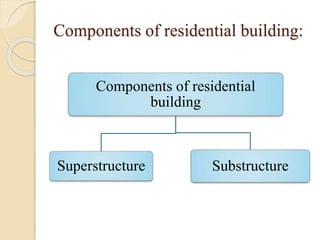
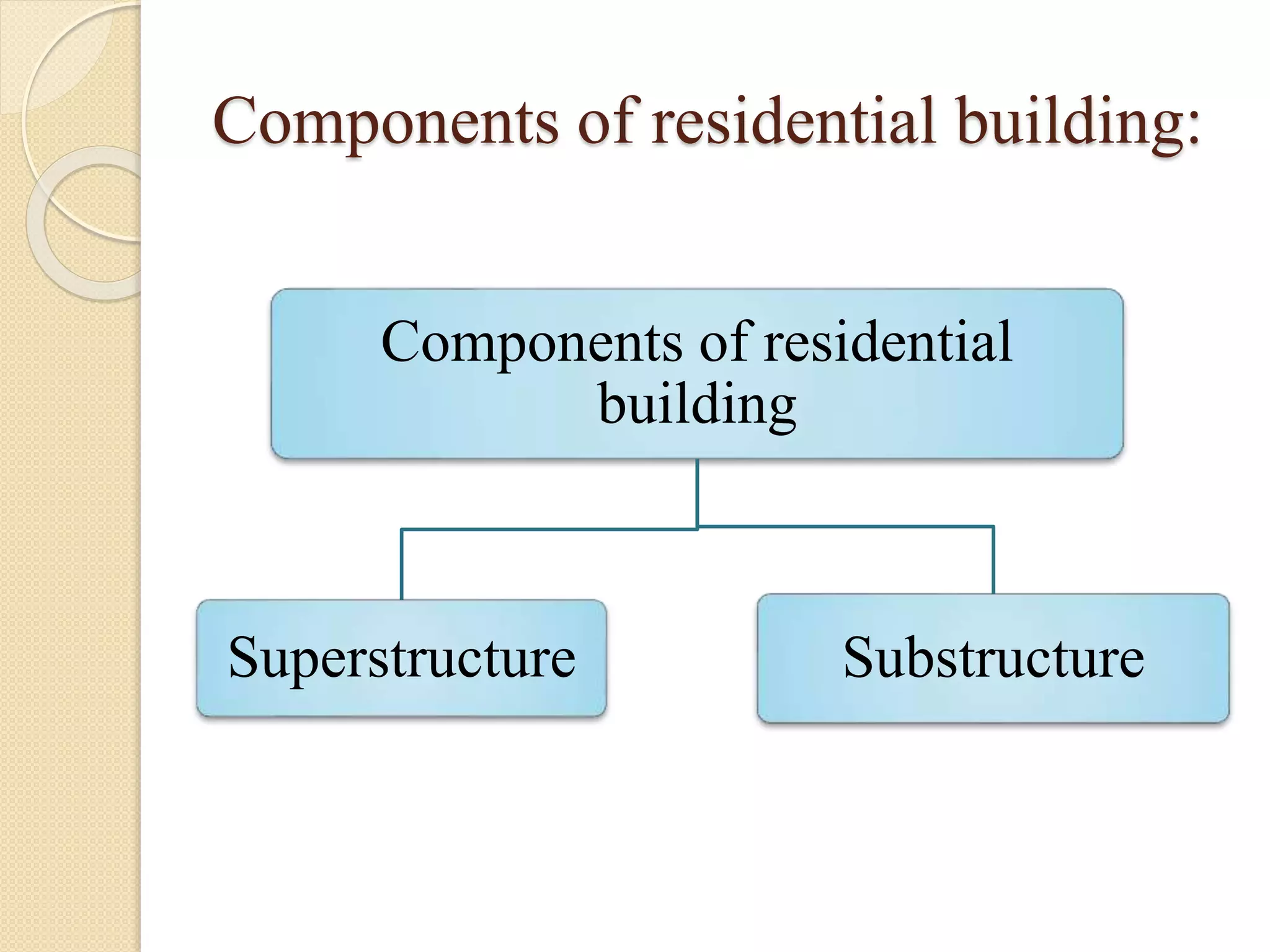
Components of residential building:
Components of residential
building
Superstructure Substructure
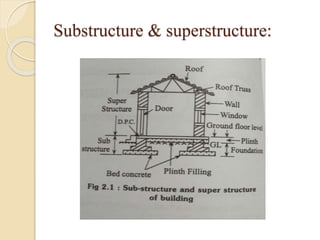
Substructure & superstructure:
Sub Structure Of Building-
It is that part of the structure which is below the ground
level i.e. foundation.
It also includes the portion below the ground level since
the height between the ground floor level and the ground
level is negligibly small as compared to the height of the
building.
Sub structural Components of building-
1.Foundation
2.plinth
3.DPC (Damp Proof Course)
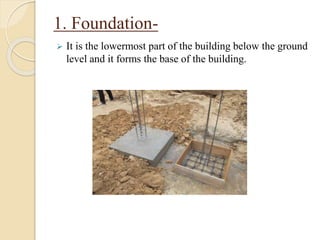
1. Foundation-
 It is the lowermost part of the building below the ground
level and it forms the base of the building.
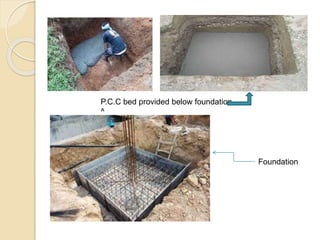
P.C.C bed provided below foundation
^
Foundation
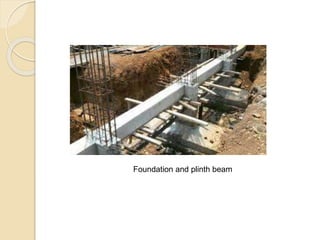
Foundation and plinth beam
 Functions of foundation:
(a) To transfer the load of the super structure to soil.
(b) To sustain the load of the building without yielding.
(c) To provide a level surface for concreting and masonry
work.
(d) To provide stability and strength to the building.
 Materials:
 Plain concrete, Reinforced Cement Concrete (R.C.C.),
Stones are used.
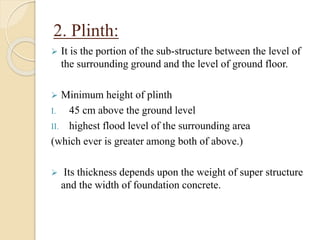
2. Plinth:
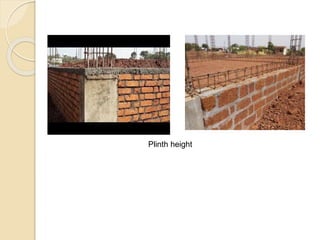
 It is the portion of the sub-structure between the level of
the surrounding ground and the level of ground floor.
 Minimum height of plinth
I. 45 cm above the ground level
II. highest flood level of the surrounding area
(which ever is greater among both of above.)
 Its thickness depends upon the weight of super structure
and the width of foundation concrete.
Plinth height
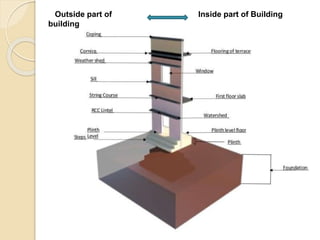
Outside part of
building
Inside part of Building
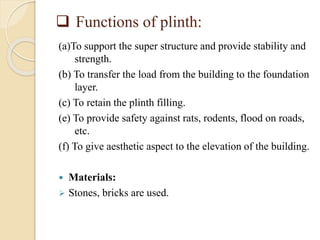
 Functions of plinth:
(a)To support the super structure and provide stability and
strength.
(b) To transfer the load from the building to the foundation
layer.
(c) To retain the plinth filling.
(e) To provide safety against rats, rodents, flood on roads,
etc.
(f) To give aesthetic aspect to the elevation of the building.
 Materials:
 Stones, bricks are used.
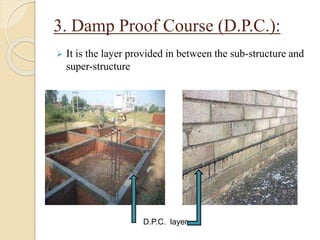
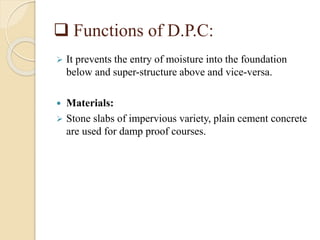
3. Damp Proof Course (D.P.C.):
 It is the layer provided in between the sub-structure and
super-structure
D.P.C. layer
 Functions of D.P.C:
 It prevents the entry of moisture into the foundation
below and super-structure above and vice-versa.
 Materials:
 Stone slabs of impervious variety, plain cement concrete
are used for damp proof courses.
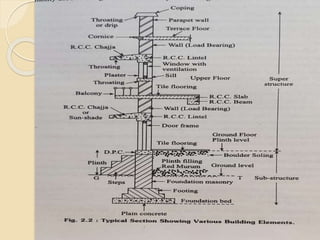
Superstructure of building:
 It is that part of the structure which is above the
ground level or ground floor level.
 The principal parts of the super-structure which
carry the structural loads are (i) Masonry walls, (ii)
Pillars or columns, (iii) Beams, (iv) Lintels, (v)
Arches, (vi) Floor slabs and (vii) Roofs etc.
 The other parts of the super-structure which do not
carry any structural loads are (i) Curtain or partition
walls, (ii) Doors, (iii) Windows and (iv) Parapet
wall etc.
Components of superstructure-
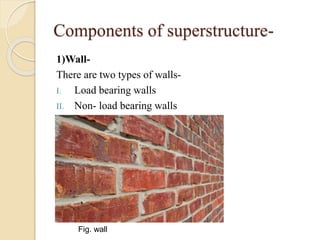
1)Wall-
There are two types of walls-
I. Load bearing walls
II. Non- load bearing walls
Fig. wall
I. Load bearing walls-
 These are built in brick and stone masonry which carry
the structural loads and transfer them from floor to
foundation.
 These are commonly used for single or double storeyed
buildings.
 Functions:
(i)To enclose or divide the space to make it functional
and useful.
(ii) To transfer the load of floors to foundation.
(iii) To provide privacy, security and protection against
weathering conditions.
Requirements:
 These walls should be strong enough to bear the self-
load, superimposed loads etc.
 They should be stable against wind, sliding and over-
turning, vibrations etc.
 They should be fire-proof and weather resistant.
 They should be plumb.
 They should not bulge under the load and should not
crack.
 They should have good appearance
II. Non-load Bearing Walls:
 These are the thin curtain and partition walls built in
various materials like, wood, plywood, glass, metals,
bricks, hollow concrete blocks etc.
 These walls do not carry any structural load and hence,
they are known as non-load bearing walls.
 They carry their self weight and rest on the floors or
beams.
 Two types of non load bearing walls depending on
their functions are-
i. Curtain wall
ii. Partition wall
i. Curtain walls -
 act as external non-load bearing walls.
 They should only be sufficiently thick to withstand
weather conditions and have required heat and sound
insulation.
 These are also known as filler, screen, panel, or cladding
walls.
ii. Partition walls -
 act as internal non-load bearing walls.
 They should be only sufficiently thick to have heat and
sound insulation.
 These are also known as division walls since they divide
the floor area into different rooms.
 They may be taken either upto full floor height like the
curtain walls or upto 2.5 m.
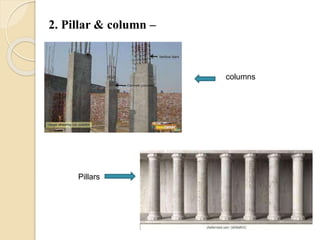
2. Pillar & column –
columns
Pillars
2. Pillar & column-
 These are the structural vertical members of a building.
 Functions-
 These are constructed at suitable intervals to provide
lateral stability to the wall.
 Pillars and columns are constructed to provide support to
the beams, slabs and transfer the loads to the foundation.
 Materials-
 These are constructed in bricks, stones, steel and
reinforced cement concrete.
 These are constructed in various sizes and shapes such as
square, rectangular, circular, etc.
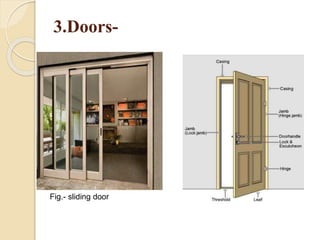
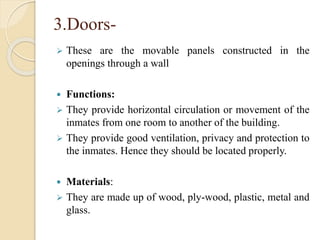
3.Doors-
Fig.- sliding door
3.Doors-
 These are the movable panels constructed in the
openings through a wall
 Functions:
 They provide horizontal circulation or movement of the
inmates from one room to another of the building.
 They provide good ventilation, privacy and protection to
the inmates. Hence they should be located properly.
 Materials:
 They are made up of wood, ply-wood, plastic, metal and
glass.
Doors-
 Requirements:
 They should be strong enough to provide protection and
security.
 They should be of good quality. Minimum size should
be 90 cm. wide and 200 cm. high.
 Types :
According to the type of shutters, these are termed as
Panelled doors, Flush doors and Glazed doors. There are
also rolling shutters, collapsible doors, swinging doors,
revolving doors and folding doors
Types of Doors -
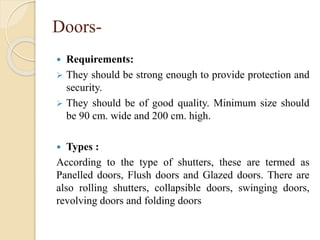
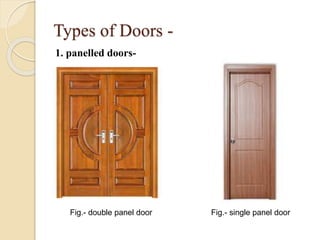
1. panelled doors-
Fig.- double panel door Fig.- single panel door
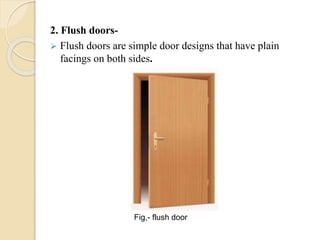
2. Flush doors-
 Flush doors are simple door designs that have plain
facings on both sides.
Fig,- flush door
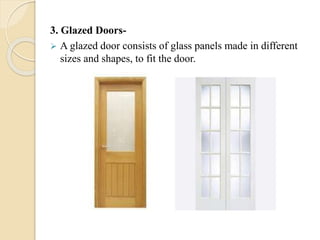
3. Glazed Doors-
 A glazed door consists of glass panels made in different
sizes and shapes, to fit the door.
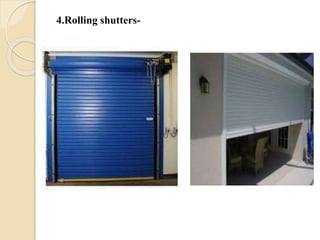
4.Rolling shutters-
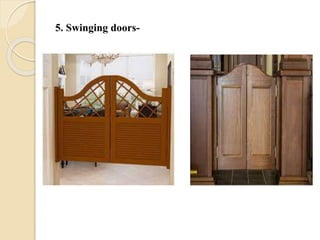
5. Swinging doors-
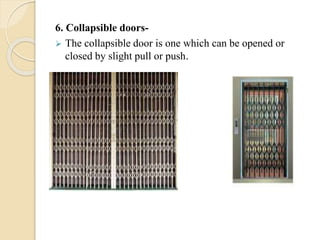
6. Collapsible doors-
 The collapsible door is one which can be opened or
closed by slight pull or push.
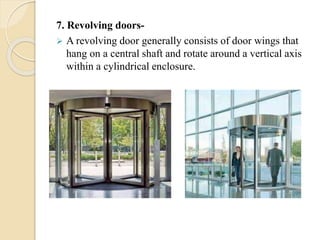
7. Revolving doors-
 A revolving door generally consists of door wings that
hang on a central shaft and rotate around a vertical axis
within a cylindrical enclosure.
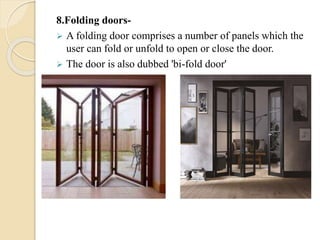
8.Folding doors-
 A folding door comprises a number of panels which the
user can fold or unfold to open or close the door.
 The door is also dubbed 'bi-fold door'
4. windows-
 These are the openings built in the walls.
 Functions:
 They provide light, air, cross ventilation etc.
 They also provide privacy and security.
 They should be built considering the direction of wind,
exterior view i.e. aspect, prospect etc.
 Materials:
 They are made up of wood, ply-wood, plastic, steel and
glass.
 Requirements:
 They should be of good quality and provide privacy
and security.
 Steel grill work can be provided to the windows to
protect the house from theft etc.
 Their size, shape and number depend upon the size of
room, out side view and weathering conditions.
 From point of view of light, ventilation, the
minimum area of the windows should not be less than
one-seventh of the floor area.
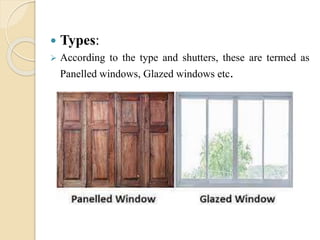
 Types:
 According to the type and shutters, these are termed as
Panelled windows, Glazed windows etc.
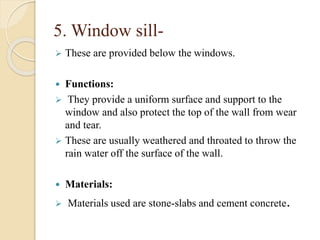
5. Window sill-
 These are provided below the windows.
 Functions:
 They provide a uniform surface and support to the
window and also protect the top of the wall from wear
and tear.
 These are usually weathered and throated to throw the
rain water off the surface of the wall.
 Materials:
 Materials used are stone-slabs and cement concrete.
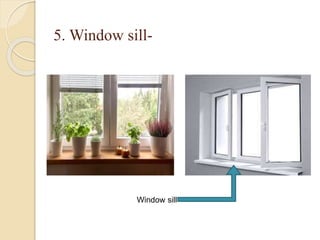
5. Window sill-
Window sill
6. Lintels and Arches-
 These are provided over the openings of doors and
windows.
 Functions:
 Lintels support the load of the wall above the opening
since the frame of the door or window is not strong to
bear it.
 The load of the wall is distributed to the area coming in
the zone of 45° or 60°.
 Arches can also be provided which take load by arch
action, unlike the lintels or beams.
 Materials:
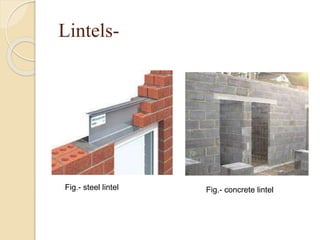
 Lintels are constructed with sound timber and R. C. C.
 The R.C.C. lintels are preferred because they are
structurally stable and simple to construct.
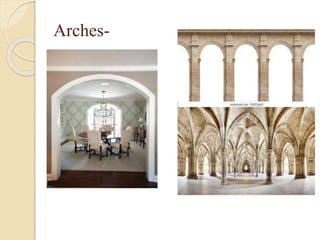
 Arches are constructed with bricks and wedged shaped
stones, the joints being filled with mortar.
 They are also constructed in reinforced cement concrete.
Lintels-
Fig.- concrete lintel
Fig.- steel lintel
Arches-
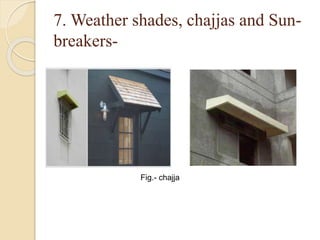
7. Weather shades, chajjas and Sun-
breakers-
Fig.- chajja
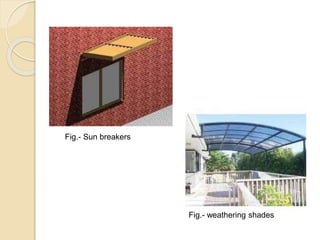
Fig.- Sun breakers
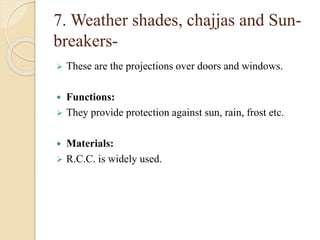
Fig.- weathering shades
7. Weather shades, chajjas and Sun-
breakers-
 These are the projections over doors and windows.
 Functions:
 They provide protection against sun, rain, frost etc.
 Materials:
 R.C.C. is widely used.
8. Floors-
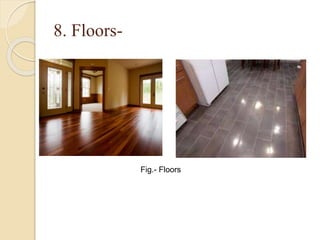
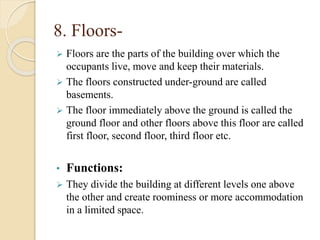
Fig.- Floors
8. Floors-
 Floors are the parts of the building over which the
occupants live, move and keep their materials.
 The floors constructed under-ground are called
basements.
 The floor immediately above the ground is called the
ground floor and other floors above this floor are called
first floor, second floor, third floor etc.
• Functions:
 They divide the building at different levels one above
the other and create roominess or more accommodation
in a limited space.
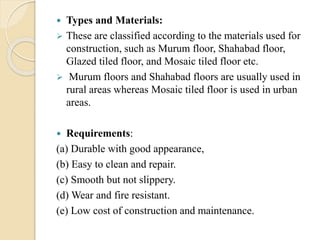
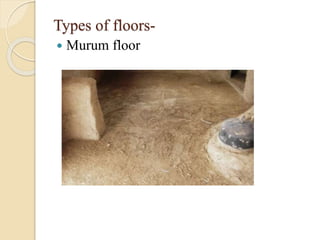
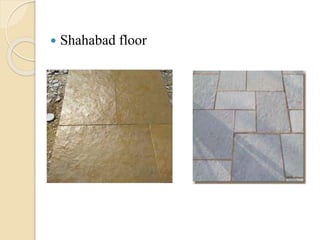
 Types and Materials:
 These are classified according to the materials used for
construction, such as Murum floor, Shahabad floor,
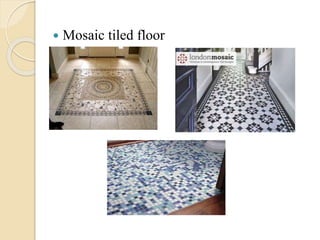
Glazed tiled floor, and Mosaic tiled floor etc.
 Murum floors and Shahabad floors are usually used in
rural areas whereas Mosaic tiled floor is used in urban
areas.
 Requirements:
(a) Durable with good appearance,
(b) Easy to clean and repair.
(c) Smooth but not slippery.
(d) Wear and fire resistant.
(e) Low cost of construction and maintenance.
Types of floors-
 Murum floor
 Shahabad floor
 Glazed tiled floor-
 Mosaic tiled floor
9. Ceiling-
 It is the lower part of upper floors.
 Functions:
 They are used as insulators against sound and vibrations
of upper floors.
 They are provided to look more pleasing and beautiful.
 Type:
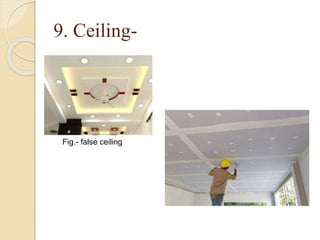
 False ceiling made of plaster of Paris, plastics etc.
9. Ceiling-
Fig.- false ceiling
10. Beams-
 Beams are structural horizontal members of a building.
 Functions:
 These are constructed to support the floors and transfer their
loads to the columns.
 They give lateral rigidity to framed structures.
 Materials:
 Materials used are timber, steel and R.C.C.
 Types:
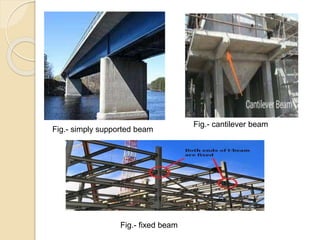
 Beams may be simply supported, fixed or cantilever type.
Fig.- simply supported beam
Fig.- cantilever beam
Fig.- fixed beam
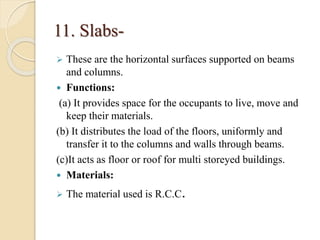
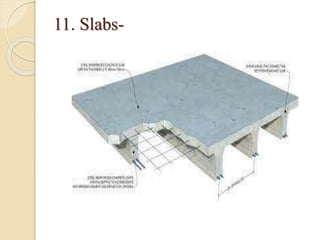
11. Slabs-
 These are the horizontal surfaces supported on beams
and columns.
 Functions:
(a) It provides space for the occupants to live, move and
keep their materials.
(b) It distributes the load of the floors, uniformly and
transfer it to the columns and walls through beams.
(c)It acts as floor or roof for multi storeyed buildings.
 Materials:
 The material used is R.C.C.
11. Slabs-
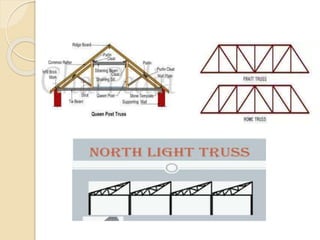
12. Truss-
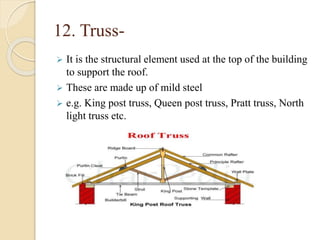
 It is the structural element used at the top of the building
to support the roof.
 These are made up of mild steel
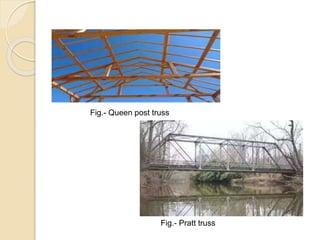
 e.g. King post truss, Queen post truss, Pratt truss, North
light truss etc.
Fig.- Queen post truss
Fig.- Pratt truss
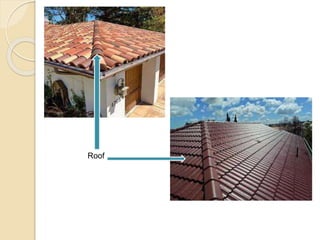
13. Roof-
 This is the top most part of the building.
 Functions:
 It protects against sun, wind, rain, snow, thefts etc.
 Materials:
 It is covered with a suitable material such as country
tiles, Mangalore tiles, Allahabad tiles, Asbestos sheets,
Galvanised iron sheets or reinforced cement concrete.
Roof
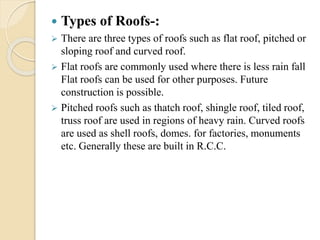
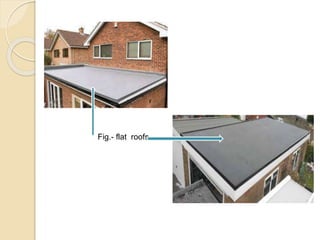
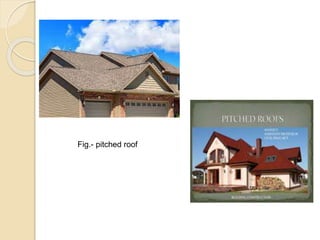
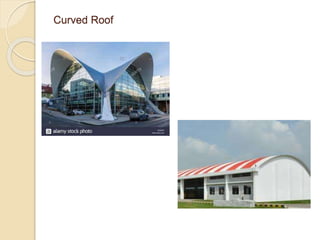
 Types of Roofs-:
 There are three types of roofs such as flat roof, pitched or
sloping roof and curved roof.
 Flat roofs are commonly used where there is less rain fall
Flat roofs can be used for other purposes. Future
construction is possible.
 Pitched roofs such as thatch roof, shingle roof, tiled roof,
truss roof are used in regions of heavy rain. Curved roofs
are used as shell roofs, domes. for factories, monuments
etc. Generally these are built in R.C.C.
Fig.- flat roofs
Fig.- pitched roof
Curved Roof
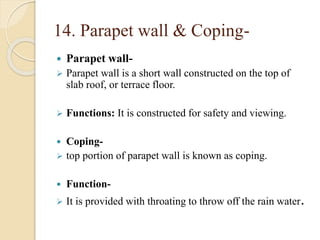
14. Parapet wall & Coping-
 Parapet wall-
 Parapet wall is a short wall constructed on the top of
slab roof, or terrace floor.
 Functions: It is constructed for safety and viewing.
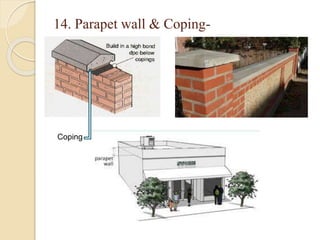
 Coping-
 top portion of parapet wall is known as coping.
 Function-
 It is provided with throating to throw off the rain water.
14. Parapet wall & Coping-
Coping
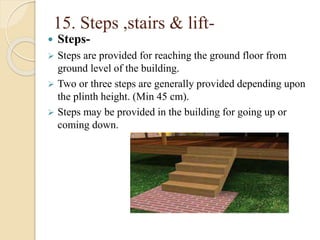
15. Steps ,stairs & lift-
 Steps-
 Steps are provided for reaching the ground floor from
ground level of the building.
 Two or three steps are generally provided depending upon
the plinth height. (Min 45 cm).
 Steps may be provided in the building for going up or
coming down.
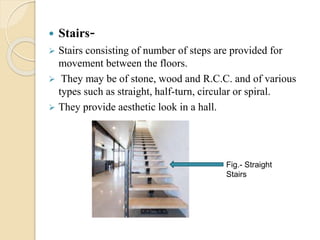
 Stairs-
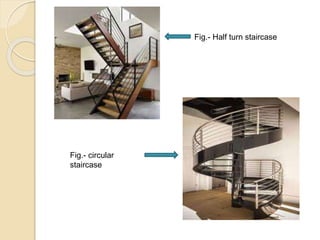
 Stairs consisting of number of steps are provided for
movement between the floors.
 They may be of stone, wood and R.C.C. and of various
types such as straight, half-turn, circular or spiral.
 They provide aesthetic look in a hall.
Fig.- Straight
Stairs
Fig.- Half turn staircase
Fig.- circular
staircase
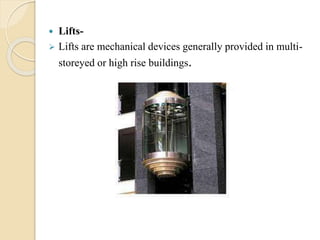
 Lifts-
 Lifts are mechanical devices generally provided in multi-
storeyed or high rise buildings.
16. Finish for walls-
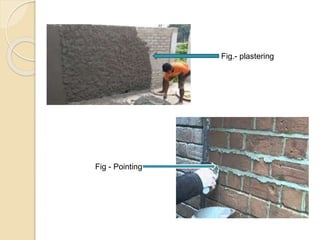
 It is done by plastering, pointing with cement mortar or
even painting.
 Functions:
 They protect the exposed surface, conceal the bad
workman ship and give a pleasant look.
 Requirements:
(a) They should be smooth
(b) They should be non-absorbent.
Fig.- plastering
Fig - Pointing

components of building.pptx

  • 1.
    Components of residentialbuilding: Components of residential building Superstructure Substructure
  • 2.
  • 3.
    Sub Structure OfBuilding- It is that part of the structure which is below the ground level i.e. foundation. It also includes the portion below the ground level since the height between the ground floor level and the ground level is negligibly small as compared to the height of the building. Sub structural Components of building- 1.Foundation 2.plinth 3.DPC (Damp Proof Course)
  • 4.
    1. Foundation-  Itis the lowermost part of the building below the ground level and it forms the base of the building.
  • 5.
    P.C.C bed providedbelow foundation ^ Foundation
  • 6.
  • 7.
     Functions offoundation: (a) To transfer the load of the super structure to soil. (b) To sustain the load of the building without yielding. (c) To provide a level surface for concreting and masonry work. (d) To provide stability and strength to the building.  Materials:  Plain concrete, Reinforced Cement Concrete (R.C.C.), Stones are used.
  • 8.
    2. Plinth:  Itis the portion of the sub-structure between the level of the surrounding ground and the level of ground floor.  Minimum height of plinth I. 45 cm above the ground level II. highest flood level of the surrounding area (which ever is greater among both of above.)  Its thickness depends upon the weight of super structure and the width of foundation concrete.
  • 9.
  • 10.
  • 11.
     Functions ofplinth: (a)To support the super structure and provide stability and strength. (b) To transfer the load from the building to the foundation layer. (c) To retain the plinth filling. (e) To provide safety against rats, rodents, flood on roads, etc. (f) To give aesthetic aspect to the elevation of the building.  Materials:  Stones, bricks are used.
  • 12.
    3. Damp ProofCourse (D.P.C.):  It is the layer provided in between the sub-structure and super-structure D.P.C. layer
  • 13.
     Functions ofD.P.C:  It prevents the entry of moisture into the foundation below and super-structure above and vice-versa.  Materials:  Stone slabs of impervious variety, plain cement concrete are used for damp proof courses.
  • 14.
    Superstructure of building: It is that part of the structure which is above the ground level or ground floor level.  The principal parts of the super-structure which carry the structural loads are (i) Masonry walls, (ii) Pillars or columns, (iii) Beams, (iv) Lintels, (v) Arches, (vi) Floor slabs and (vii) Roofs etc.  The other parts of the super-structure which do not carry any structural loads are (i) Curtain or partition walls, (ii) Doors, (iii) Windows and (iv) Parapet wall etc.
  • 16.
    Components of superstructure- 1)Wall- Thereare two types of walls- I. Load bearing walls II. Non- load bearing walls Fig. wall
  • 17.
    I. Load bearingwalls-  These are built in brick and stone masonry which carry the structural loads and transfer them from floor to foundation.  These are commonly used for single or double storeyed buildings.  Functions: (i)To enclose or divide the space to make it functional and useful. (ii) To transfer the load of floors to foundation. (iii) To provide privacy, security and protection against weathering conditions.
  • 18.
    Requirements:  These wallsshould be strong enough to bear the self- load, superimposed loads etc.  They should be stable against wind, sliding and over- turning, vibrations etc.  They should be fire-proof and weather resistant.  They should be plumb.  They should not bulge under the load and should not crack.  They should have good appearance
  • 19.
    II. Non-load BearingWalls:  These are the thin curtain and partition walls built in various materials like, wood, plywood, glass, metals, bricks, hollow concrete blocks etc.  These walls do not carry any structural load and hence, they are known as non-load bearing walls.  They carry their self weight and rest on the floors or beams.  Two types of non load bearing walls depending on their functions are- i. Curtain wall ii. Partition wall
  • 20.
    i. Curtain walls-  act as external non-load bearing walls.  They should only be sufficiently thick to withstand weather conditions and have required heat and sound insulation.  These are also known as filler, screen, panel, or cladding walls. ii. Partition walls -  act as internal non-load bearing walls.  They should be only sufficiently thick to have heat and sound insulation.  These are also known as division walls since they divide the floor area into different rooms.  They may be taken either upto full floor height like the curtain walls or upto 2.5 m.
  • 21.
    2. Pillar &column – columns Pillars
  • 22.
    2. Pillar &column-  These are the structural vertical members of a building.  Functions-  These are constructed at suitable intervals to provide lateral stability to the wall.  Pillars and columns are constructed to provide support to the beams, slabs and transfer the loads to the foundation.  Materials-  These are constructed in bricks, stones, steel and reinforced cement concrete.  These are constructed in various sizes and shapes such as square, rectangular, circular, etc.
  • 23.
  • 24.
    3.Doors-  These arethe movable panels constructed in the openings through a wall  Functions:  They provide horizontal circulation or movement of the inmates from one room to another of the building.  They provide good ventilation, privacy and protection to the inmates. Hence they should be located properly.  Materials:  They are made up of wood, ply-wood, plastic, metal and glass.
  • 25.
    Doors-  Requirements:  Theyshould be strong enough to provide protection and security.  They should be of good quality. Minimum size should be 90 cm. wide and 200 cm. high.  Types : According to the type of shutters, these are termed as Panelled doors, Flush doors and Glazed doors. There are also rolling shutters, collapsible doors, swinging doors, revolving doors and folding doors
  • 26.
    Types of Doors- 1. panelled doors- Fig.- double panel door Fig.- single panel door
  • 27.
    2. Flush doors- Flush doors are simple door designs that have plain facings on both sides. Fig,- flush door
  • 28.
    3. Glazed Doors- A glazed door consists of glass panels made in different sizes and shapes, to fit the door.
  • 29.
  • 30.
  • 31.
    6. Collapsible doors- The collapsible door is one which can be opened or closed by slight pull or push.
  • 32.
    7. Revolving doors- A revolving door generally consists of door wings that hang on a central shaft and rotate around a vertical axis within a cylindrical enclosure.
  • 33.
    8.Folding doors-  Afolding door comprises a number of panels which the user can fold or unfold to open or close the door.  The door is also dubbed 'bi-fold door'
  • 34.
    4. windows-  Theseare the openings built in the walls.  Functions:  They provide light, air, cross ventilation etc.  They also provide privacy and security.  They should be built considering the direction of wind, exterior view i.e. aspect, prospect etc.  Materials:  They are made up of wood, ply-wood, plastic, steel and glass.
  • 35.
     Requirements:  Theyshould be of good quality and provide privacy and security.  Steel grill work can be provided to the windows to protect the house from theft etc.  Their size, shape and number depend upon the size of room, out side view and weathering conditions.  From point of view of light, ventilation, the minimum area of the windows should not be less than one-seventh of the floor area.
  • 36.
     Types:  Accordingto the type and shutters, these are termed as Panelled windows, Glazed windows etc.
  • 37.
    5. Window sill- These are provided below the windows.  Functions:  They provide a uniform surface and support to the window and also protect the top of the wall from wear and tear.  These are usually weathered and throated to throw the rain water off the surface of the wall.  Materials:  Materials used are stone-slabs and cement concrete.
  • 38.
  • 39.
    6. Lintels andArches-  These are provided over the openings of doors and windows.  Functions:  Lintels support the load of the wall above the opening since the frame of the door or window is not strong to bear it.  The load of the wall is distributed to the area coming in the zone of 45° or 60°.  Arches can also be provided which take load by arch action, unlike the lintels or beams.
  • 40.
     Materials:  Lintelsare constructed with sound timber and R. C. C.  The R.C.C. lintels are preferred because they are structurally stable and simple to construct.  Arches are constructed with bricks and wedged shaped stones, the joints being filled with mortar.  They are also constructed in reinforced cement concrete.
  • 41.
  • 42.
  • 43.
    7. Weather shades,chajjas and Sun- breakers- Fig.- chajja
  • 44.
    Fig.- Sun breakers Fig.-weathering shades
  • 45.
    7. Weather shades,chajjas and Sun- breakers-  These are the projections over doors and windows.  Functions:  They provide protection against sun, rain, frost etc.  Materials:  R.C.C. is widely used.
  • 46.
  • 47.
    8. Floors-  Floorsare the parts of the building over which the occupants live, move and keep their materials.  The floors constructed under-ground are called basements.  The floor immediately above the ground is called the ground floor and other floors above this floor are called first floor, second floor, third floor etc. • Functions:  They divide the building at different levels one above the other and create roominess or more accommodation in a limited space.
  • 48.
     Types andMaterials:  These are classified according to the materials used for construction, such as Murum floor, Shahabad floor, Glazed tiled floor, and Mosaic tiled floor etc.  Murum floors and Shahabad floors are usually used in rural areas whereas Mosaic tiled floor is used in urban areas.  Requirements: (a) Durable with good appearance, (b) Easy to clean and repair. (c) Smooth but not slippery. (d) Wear and fire resistant. (e) Low cost of construction and maintenance.
  • 49.
  • 50.
  • 51.
  • 52.
  • 53.
    9. Ceiling-  Itis the lower part of upper floors.  Functions:  They are used as insulators against sound and vibrations of upper floors.  They are provided to look more pleasing and beautiful.  Type:  False ceiling made of plaster of Paris, plastics etc.
  • 54.
  • 55.
    10. Beams-  Beamsare structural horizontal members of a building.  Functions:  These are constructed to support the floors and transfer their loads to the columns.  They give lateral rigidity to framed structures.  Materials:  Materials used are timber, steel and R.C.C.  Types:  Beams may be simply supported, fixed or cantilever type.
  • 56.
    Fig.- simply supportedbeam Fig.- cantilever beam Fig.- fixed beam
  • 57.
    11. Slabs-  Theseare the horizontal surfaces supported on beams and columns.  Functions: (a) It provides space for the occupants to live, move and keep their materials. (b) It distributes the load of the floors, uniformly and transfer it to the columns and walls through beams. (c)It acts as floor or roof for multi storeyed buildings.  Materials:  The material used is R.C.C.
  • 58.
  • 59.
    12. Truss-  Itis the structural element used at the top of the building to support the roof.  These are made up of mild steel  e.g. King post truss, Queen post truss, Pratt truss, North light truss etc.
  • 61.
    Fig.- Queen posttruss Fig.- Pratt truss
  • 62.
    13. Roof-  Thisis the top most part of the building.  Functions:  It protects against sun, wind, rain, snow, thefts etc.  Materials:  It is covered with a suitable material such as country tiles, Mangalore tiles, Allahabad tiles, Asbestos sheets, Galvanised iron sheets or reinforced cement concrete.
  • 63.
  • 64.
     Types ofRoofs-:  There are three types of roofs such as flat roof, pitched or sloping roof and curved roof.  Flat roofs are commonly used where there is less rain fall Flat roofs can be used for other purposes. Future construction is possible.  Pitched roofs such as thatch roof, shingle roof, tiled roof, truss roof are used in regions of heavy rain. Curved roofs are used as shell roofs, domes. for factories, monuments etc. Generally these are built in R.C.C.
  • 65.
  • 66.
  • 67.
  • 68.
    14. Parapet wall& Coping-  Parapet wall-  Parapet wall is a short wall constructed on the top of slab roof, or terrace floor.  Functions: It is constructed for safety and viewing.  Coping-  top portion of parapet wall is known as coping.  Function-  It is provided with throating to throw off the rain water.
  • 69.
    14. Parapet wall& Coping- Coping
  • 70.
    15. Steps ,stairs& lift-  Steps-  Steps are provided for reaching the ground floor from ground level of the building.  Two or three steps are generally provided depending upon the plinth height. (Min 45 cm).  Steps may be provided in the building for going up or coming down.
  • 71.
     Stairs-  Stairsconsisting of number of steps are provided for movement between the floors.  They may be of stone, wood and R.C.C. and of various types such as straight, half-turn, circular or spiral.  They provide aesthetic look in a hall. Fig.- Straight Stairs
  • 72.
    Fig.- Half turnstaircase Fig.- circular staircase
  • 73.
     Lifts-  Liftsare mechanical devices generally provided in multi- storeyed or high rise buildings.
  • 74.
    16. Finish forwalls-  It is done by plastering, pointing with cement mortar or even painting.  Functions:  They protect the exposed surface, conceal the bad workman ship and give a pleasant look.  Requirements: (a) They should be smooth (b) They should be non-absorbent.
  • 75.