Bloom’s Taxonomy     Im age  Source:  http://redie.uabc.mx/contenido/vol6no2/art-104-spa/bloom.png   A Training Session Presented By:  Douglas Fears Peter Larson Elizabeth Parker
What Is Bloom’s Taxonomy? Bloom's Taxonomy is a hierarchial or  multi-tiered model of classifying thinking according to six cognitive levels of  complexity.
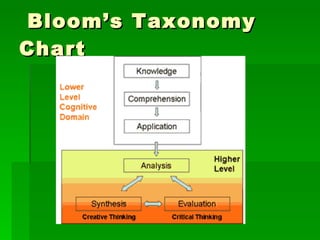
Bloom’s Taxonomy Chart
Taxonomy Descriptions KNOWLEDGE : The recall of data or information. COMPREHENSION : Understanding information; interpreting and translating knowledge. APPLICATION : Using a concept in a new situation; Applying prior knowledge to real life situations ANALYSIS : Separating concepts into components to understand organizational structural. SYNTHESIS : Puts parts together to form a whole. EVALUATION : Making judgments about value, ideas, or materials.
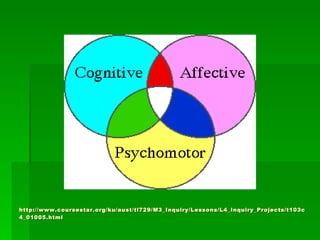
Background History During the 1950s Benjamin Bloom along with  other college researchers developed the  following levels of educational domains: Cognitive Affective  Psychomotor
http://www.coursestar.org/ku/aust/tl729/M3_Inquiry/Lessons/L4_Inquiry_Projects/t103c4_01005.html
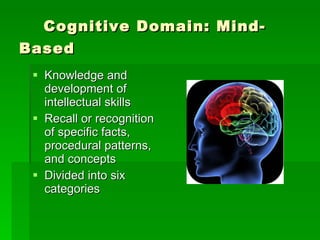
Cognitive Domain: Mind-Based Knowledge and development of intellectual skills Recall or recognition of specific facts, procedural patterns, and concepts Divided into six categories
Affective Domain: Belief-Based Receiving: attending to new information Responding: interacting with new information Valuing: seeking worth in new information Organization: filtering new information into schema Characterization: Integrating new information into schema
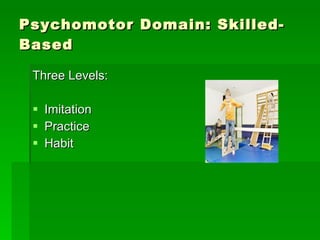
Psychomotor Domain: Skilled-Based Three Levels: Imitation Practice  Habit
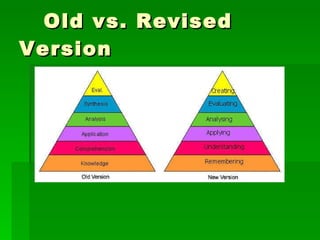
Revision of Bloom’s Taxonomy During the 1990s, a former student of Bloom, revisited his taxonomy. As a result, changes were made. Nouns were changed to verb forms to illustrate that thinking is an  active  process. The knowledge level was renamed, comprehension became understanding, and synthesis was renamed creating.
Old vs. Revised Version
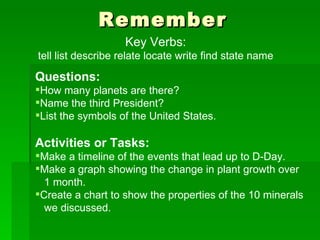
Remember Key Verbs: tell list describe relate locate write find state name Questions: How many planets are there? Name the third President? List the symbols of the United States. Activities or Tasks: Make a timeline of the events that lead up to D-Day. Make a graph showing the change in plant growth over  1 month. Create a chart to show the properties of the 10 minerals  we discussed.
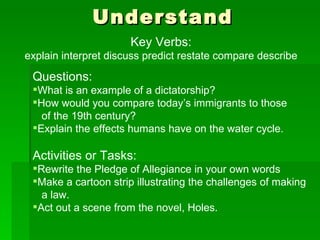
Understand Key Verbs: explain interpret discuss predict restate compare describe Questions: What is an example of a dictatorship? How would you compare today’s immigrants to those  of the 19th century? Explain the effects humans have on the water cycle. Activities or Tasks: Rewrite the Pledge of Allegiance in your own words Make a cartoon strip illustrating the challenges of making  a law. Act out a scene from the novel, Holes.
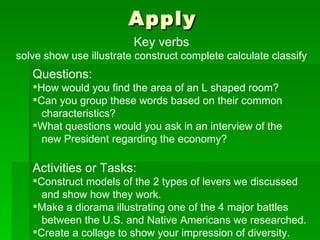
Apply Key verbs solve show use illustrate construct complete calculate classify Questions: How would you find the area of an L shaped room? Can you group these words based on their common  characteristics? What questions would you ask in an interview of the  new President regarding the economy? Activities or Tasks: Construct models of the 2 types of levers we discussed  and show how they work. Make a diorama illustrating one of the 4 major battles between the U.S. and Native Americans we researched. Create a collage to show your impression of diversity.
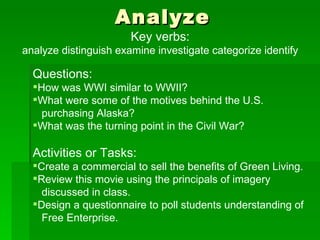
Analyze Key verbs: analyze distinguish examine investigate categorize identify Questions: How was WWI similar to WWII? What were some of the motives behind the U.S.  purchasing Alaska? What was the turning point in the Civil War? Activities or Tasks: Create a commercial to sell the benefits of Green Living. Review this movie using the principals of imagery  discussed in class. Design a questionnaire to poll students understanding of  Free Enterprise.
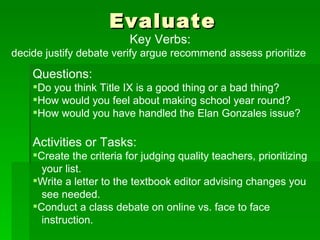
Evaluate Key Verbs: decide justify debate verify argue recommend assess prioritize  Questions: Do you think Title IX is a good thing or a bad thing? How would you feel about making school year round? How would you have handled the Elan Gonzales issue? Activities or Tasks: Create the criteria for judging quality teachers, prioritizing  your list. Write a letter to the textbook editor advising changes you  see needed. Conduct a class debate on online vs. face to face  instruction.
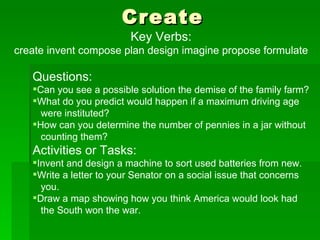
Create Key Verbs: create invent compose plan design imagine propose formulate Questions: Can you see a possible solution the demise of the family farm? What do you predict would happen if a maximum driving age  were instituted? How can you determine the number of pennies in a jar without  counting them? Activities or Tasks: Invent and design a machine to sort used batteries from new. Write a letter to your Senator on a social issue that concerns  you. Draw a map showing how you think America would look had  the South won the war.
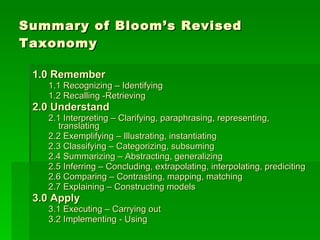
Summary of Bloom’s Revised Taxonomy 1.0 Remember 1.1 Recognizing – Identifying 1.2 Recalling -Retrieving 2.0 Understand 2.1 Interpreting – Clarifying, paraphrasing, representing, translating 2.2 Exemplifying – Illustrating, instantiating 2.3 Classifying – Categorizing, subsuming 2.4 Summarizing – Abstracting, generalizing 2.5 Inferring – Concluding, extrapolating, interpolating, prediciting 2.6 Comparing – Contrasting, mapping, matching 2.7 Explaining – Constructing models  3.0 Apply 3.1 Executing – Carrying out 3.2 Implementing - Using
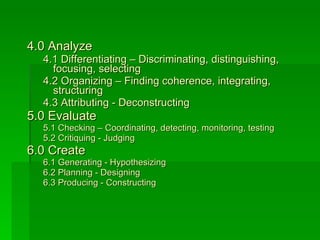
4.0 Analyze 4.1 Differentiating – Discriminating, distinguishing, focusing, selecting 4.2 Organizing – Finding coherence, integrating, structuring 4.3 Attributing - Deconstructing 5.0 Evaluate 5.1 Checking – Coordinating, detecting, monitoring, testing 5.2 Critiquing - Judging 6.0 Create 6.1 Generating - Hypothesizing 6.2 Planning - Designing 6.3 Producing - Constructing
References http:// www.teachers.ash.org.au/researchskills/dalton.htm   http://www.odu.edu/educ/llschult/blooms_taxonomy.htm   http://projects.coe.uga.edu/epltt/index.php?title=Bloom%27s_Taxonomy http:// officeport.com/edu/blooms.htm   http:// www.nwlink.com/~donclark/hrd/bloom.html   http://www.nwlink.com/~donclark/hrd/bloom.html http://www.coun.uvic.ca/learning/exams/blooms-taxonomy.html

Bloom's Taxonomy

  • 1.
    Bloom’s Taxonomy Im age Source: http://redie.uabc.mx/contenido/vol6no2/art-104-spa/bloom.png A Training Session Presented By: Douglas Fears Peter Larson Elizabeth Parker
  • 2.
    What Is Bloom’sTaxonomy? Bloom's Taxonomy is a hierarchial or multi-tiered model of classifying thinking according to six cognitive levels of complexity.
  • 3.
  • 4.
    Taxonomy Descriptions KNOWLEDGE: The recall of data or information. COMPREHENSION : Understanding information; interpreting and translating knowledge. APPLICATION : Using a concept in a new situation; Applying prior knowledge to real life situations ANALYSIS : Separating concepts into components to understand organizational structural. SYNTHESIS : Puts parts together to form a whole. EVALUATION : Making judgments about value, ideas, or materials.
  • 5.
    Background History Duringthe 1950s Benjamin Bloom along with other college researchers developed the following levels of educational domains: Cognitive Affective Psychomotor
  • 6.
  • 7.
    Cognitive Domain: Mind-BasedKnowledge and development of intellectual skills Recall or recognition of specific facts, procedural patterns, and concepts Divided into six categories
  • 8.
    Affective Domain: Belief-BasedReceiving: attending to new information Responding: interacting with new information Valuing: seeking worth in new information Organization: filtering new information into schema Characterization: Integrating new information into schema
  • 9.
    Psychomotor Domain: Skilled-BasedThree Levels: Imitation Practice Habit
  • 10.
    Revision of Bloom’sTaxonomy During the 1990s, a former student of Bloom, revisited his taxonomy. As a result, changes were made. Nouns were changed to verb forms to illustrate that thinking is an active process. The knowledge level was renamed, comprehension became understanding, and synthesis was renamed creating.
  • 11.
  • 12.
    Remember Key Verbs:tell list describe relate locate write find state name Questions: How many planets are there? Name the third President? List the symbols of the United States. Activities or Tasks: Make a timeline of the events that lead up to D-Day. Make a graph showing the change in plant growth over 1 month. Create a chart to show the properties of the 10 minerals we discussed.
  • 13.
    Understand Key Verbs:explain interpret discuss predict restate compare describe Questions: What is an example of a dictatorship? How would you compare today’s immigrants to those of the 19th century? Explain the effects humans have on the water cycle. Activities or Tasks: Rewrite the Pledge of Allegiance in your own words Make a cartoon strip illustrating the challenges of making a law. Act out a scene from the novel, Holes.
  • 14.
    Apply Key verbssolve show use illustrate construct complete calculate classify Questions: How would you find the area of an L shaped room? Can you group these words based on their common characteristics? What questions would you ask in an interview of the new President regarding the economy? Activities or Tasks: Construct models of the 2 types of levers we discussed and show how they work. Make a diorama illustrating one of the 4 major battles between the U.S. and Native Americans we researched. Create a collage to show your impression of diversity.
  • 15.
    Analyze Key verbs:analyze distinguish examine investigate categorize identify Questions: How was WWI similar to WWII? What were some of the motives behind the U.S. purchasing Alaska? What was the turning point in the Civil War? Activities or Tasks: Create a commercial to sell the benefits of Green Living. Review this movie using the principals of imagery discussed in class. Design a questionnaire to poll students understanding of Free Enterprise.
  • 16.
    Evaluate Key Verbs:decide justify debate verify argue recommend assess prioritize Questions: Do you think Title IX is a good thing or a bad thing? How would you feel about making school year round? How would you have handled the Elan Gonzales issue? Activities or Tasks: Create the criteria for judging quality teachers, prioritizing your list. Write a letter to the textbook editor advising changes you see needed. Conduct a class debate on online vs. face to face instruction.
  • 17.
    Create Key Verbs:create invent compose plan design imagine propose formulate Questions: Can you see a possible solution the demise of the family farm? What do you predict would happen if a maximum driving age were instituted? How can you determine the number of pennies in a jar without counting them? Activities or Tasks: Invent and design a machine to sort used batteries from new. Write a letter to your Senator on a social issue that concerns you. Draw a map showing how you think America would look had the South won the war.
  • 18.
    Summary of Bloom’sRevised Taxonomy 1.0 Remember 1.1 Recognizing – Identifying 1.2 Recalling -Retrieving 2.0 Understand 2.1 Interpreting – Clarifying, paraphrasing, representing, translating 2.2 Exemplifying – Illustrating, instantiating 2.3 Classifying – Categorizing, subsuming 2.4 Summarizing – Abstracting, generalizing 2.5 Inferring – Concluding, extrapolating, interpolating, prediciting 2.6 Comparing – Contrasting, mapping, matching 2.7 Explaining – Constructing models 3.0 Apply 3.1 Executing – Carrying out 3.2 Implementing - Using
  • 19.
    4.0 Analyze 4.1Differentiating – Discriminating, distinguishing, focusing, selecting 4.2 Organizing – Finding coherence, integrating, structuring 4.3 Attributing - Deconstructing 5.0 Evaluate 5.1 Checking – Coordinating, detecting, monitoring, testing 5.2 Critiquing - Judging 6.0 Create 6.1 Generating - Hypothesizing 6.2 Planning - Designing 6.3 Producing - Constructing
  • 20.
    References http:// www.teachers.ash.org.au/researchskills/dalton.htm http://www.odu.edu/educ/llschult/blooms_taxonomy.htm http://projects.coe.uga.edu/epltt/index.php?title=Bloom%27s_Taxonomy http:// officeport.com/edu/blooms.htm http:// www.nwlink.com/~donclark/hrd/bloom.html http://www.nwlink.com/~donclark/hrd/bloom.html http://www.coun.uvic.ca/learning/exams/blooms-taxonomy.html