Web QuestWeb Quest
A Web Quest
• A WebQuest is an inquiry-oriented
activity in which some or all of the
information that learners interact
with comes from resources on the
internet, optionally supplemented
with videoconferencing.
Short Term WebQuests
• The instructional goal of a short term
WebQuest is knowledge acquisition and
integration, described as Dimension 2 in
Marzano's (1992) Dimensions of Thinking
model. At the end of a short term
WebQuest, a learner will have grappled
with a significant amount of new
information and made sense of it. A
short-term WebQuest is designed to be
completed in one to three class periods.
Longer Term WebQuest
• The instructional goal of a longer term
WebQuest is to extend and refine knowledge.
• After completing a longer term WebQuest, a
learner would have analyzed a body of
knowledge deeply, transformed it in some way,
and demonstrated an understanding of the
material by creating something that others can
respond to, on-line or off-line.
• A longer term WebQuest will typically take
between one week and a month in a classroom
setting.
Critical Attributes
• WebQuests of either short or long
duration are deliberately designed to
make the best use of a learner's
time. There is questionable
educational benefit in having learners
surfing the net without a clear task
in mind, and most schools must ration
student connection time.
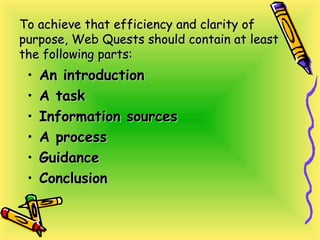
To achieve that efficiency and clarity ofTo achieve that efficiency and clarity of
purpose, Web Quests should contain at leastpurpose, Web Quests should contain at least
the following parts:the following parts:
• An introductionAn introduction
• A taskA task
• Information sourcesInformation sources
• A processA process
• GuidanceGuidance
• ConclusionConclusion
Parts of a WebQuest
An introduction that sets the stage
and provides some background
information.
– A task that is doable and interesting.
Parts of a WebQuest cont…
• A set of information sources
needed to complete the task.
Many (though not necessarily all)
of the resources are embedded in
the WebQuest document itself as
anchors pointing to information
on the World Wide Web.
Parts of a WebQuest cont…
• Information sources might include
web documents, experts available via
e-mail or realtime conferencing,
searchable databases on the net, and
books and other documents physically
available in the learner's setting.
Parts of a WebQuest cont…
• Because pointers to resources are
included, the learner is not left to
wander through webspace completely
adrift.
Parts of a WebQuest cont…
• A description of the process the
learners should go through in
accomplishing the task. The process
should be broken out into clearly
described steps.
Parts of a WebQuest cont…
• Some guidance on how to organize the
information acquired. This can take the
form of guiding questions, or directions
to complete organizational frameworks
such as timelines, concept maps, or
cause-and-effect diagrams as described
by Marzano (1988, 1992) and Clarke
(1990).
Parts of a WebQuest cont…
• A conclusion that brings closure to
the quest, reminds the learners
about what they've learned, and
perhaps encourages them to extend
the experience into other domains.
Non-critical attributes
• WebQuests are most likely to be
group activities, although one could
imagine solo quests that might be
applicable in distance education or
library settings.
Non-critical attributes
• WebQuests might be enhanced by
wrapping motivational elements
around the basic structure by
giving the learners a role to play
(e.g., scientist, detective,
reporter), simulated personae to
interact with via e-mail, and a
scenario to work within (e.g.,
you've been asked by the
Secretary General of the UN to
brief him on what's happening in
sub-Saharan Africa this week.)
Non-critical attributes
• WebQuests can be designed within a
single discipline or they can be
interdisciplinary.
Non-critical attributes
• Given that designing effective
interdisciplinary instruction is more
of a challenge than designing for a
single content area, if you are
creating a WebQuest you should
probably start with the single
discipline approach until you are
comfortable with the multidiscipline.
Some links:
• http://www.lausd.k12.ca.us/lausd/resources/webquest/index.htm
• http://studenthome.nku.edu/%7Ewebquest/gabbard/
• http://www.lausd.k12.ca.us/lausd/resources/webquest/index.htm
• http://edweb.sdsu.edu/webquest/taskonomy.html
• http://www.holliston.k12.ma.us/holliston/adams/china/inventions3.
htm#Enrichment_Activities
• http://www.holliston.k12.ma.us/holliston/adams/whatisawebquest.
htm

Web quest

  • 1.
  • 2.
    A Web Quest •A WebQuest is an inquiry-oriented activity in which some or all of the information that learners interact with comes from resources on the internet, optionally supplemented with videoconferencing.
  • 3.
    Short Term WebQuests •The instructional goal of a short term WebQuest is knowledge acquisition and integration, described as Dimension 2 in Marzano's (1992) Dimensions of Thinking model. At the end of a short term WebQuest, a learner will have grappled with a significant amount of new information and made sense of it. A short-term WebQuest is designed to be completed in one to three class periods.
  • 4.
    Longer Term WebQuest •The instructional goal of a longer term WebQuest is to extend and refine knowledge. • After completing a longer term WebQuest, a learner would have analyzed a body of knowledge deeply, transformed it in some way, and demonstrated an understanding of the material by creating something that others can respond to, on-line or off-line. • A longer term WebQuest will typically take between one week and a month in a classroom setting.
  • 5.
    Critical Attributes • WebQuestsof either short or long duration are deliberately designed to make the best use of a learner's time. There is questionable educational benefit in having learners surfing the net without a clear task in mind, and most schools must ration student connection time.
  • 6.
    To achieve thatefficiency and clarity ofTo achieve that efficiency and clarity of purpose, Web Quests should contain at leastpurpose, Web Quests should contain at least the following parts:the following parts: • An introductionAn introduction • A taskA task • Information sourcesInformation sources • A processA process • GuidanceGuidance • ConclusionConclusion
  • 7.
    Parts of aWebQuest An introduction that sets the stage and provides some background information. – A task that is doable and interesting.
  • 8.
    Parts of aWebQuest cont… • A set of information sources needed to complete the task. Many (though not necessarily all) of the resources are embedded in the WebQuest document itself as anchors pointing to information on the World Wide Web.
  • 9.
    Parts of aWebQuest cont… • Information sources might include web documents, experts available via e-mail or realtime conferencing, searchable databases on the net, and books and other documents physically available in the learner's setting.
  • 10.
    Parts of aWebQuest cont… • Because pointers to resources are included, the learner is not left to wander through webspace completely adrift.
  • 11.
    Parts of aWebQuest cont… • A description of the process the learners should go through in accomplishing the task. The process should be broken out into clearly described steps.
  • 12.
    Parts of aWebQuest cont… • Some guidance on how to organize the information acquired. This can take the form of guiding questions, or directions to complete organizational frameworks such as timelines, concept maps, or cause-and-effect diagrams as described by Marzano (1988, 1992) and Clarke (1990).
  • 13.
    Parts of aWebQuest cont… • A conclusion that brings closure to the quest, reminds the learners about what they've learned, and perhaps encourages them to extend the experience into other domains.
  • 14.
    Non-critical attributes • WebQuestsare most likely to be group activities, although one could imagine solo quests that might be applicable in distance education or library settings.
  • 15.
    Non-critical attributes • WebQuestsmight be enhanced by wrapping motivational elements around the basic structure by giving the learners a role to play (e.g., scientist, detective, reporter), simulated personae to interact with via e-mail, and a scenario to work within (e.g., you've been asked by the Secretary General of the UN to brief him on what's happening in sub-Saharan Africa this week.)
  • 16.
    Non-critical attributes • WebQuestscan be designed within a single discipline or they can be interdisciplinary.
  • 17.
    Non-critical attributes • Giventhat designing effective interdisciplinary instruction is more of a challenge than designing for a single content area, if you are creating a WebQuest you should probably start with the single discipline approach until you are comfortable with the multidiscipline.
  • 18.
    Some links: • http://www.lausd.k12.ca.us/lausd/resources/webquest/index.htm •http://studenthome.nku.edu/%7Ewebquest/gabbard/ • http://www.lausd.k12.ca.us/lausd/resources/webquest/index.htm • http://edweb.sdsu.edu/webquest/taskonomy.html • http://www.holliston.k12.ma.us/holliston/adams/china/inventions3. htm#Enrichment_Activities • http://www.holliston.k12.ma.us/holliston/adams/whatisawebquest. htm