What is Instructional
Design?
A Science
The science of creating detailed specifications for the
development, implementation, evaluation, and maintenance
of situations that facilitate the learning of both large and small
units of subject matter at all levels of complexity.
A Discipline:
The branch of knowledge concerned with research and
theory about instructional strategies and the process for
developing and implementing those strategies.
A Process:
The systematic development of instructional specifications
using learning and instructional theory to ensure the quality of
instruction…the entire process of analysis of learning needs
and goals and the development of a delivery system to meet
those needs. It includes development of instructional 2
What is Instructional
Design?
Instructional Design allows you to
analyze the learning needs of an
end-user and develop a course
that will allow you to meet its
objectives. These needs can be for
varied audiences, and at each
point you need to ensure that you
are meeting these requirements.
3
Instructional Systems
Design
After the Second World
War, the U.S. military
was looking for a
systematic way of
creating training
programs quickly and
efficiently. These
efforts resulted in the
development of some
basic Instructional
Systems Design (ISD)
models, which were
taught at the Florida
State University.
4
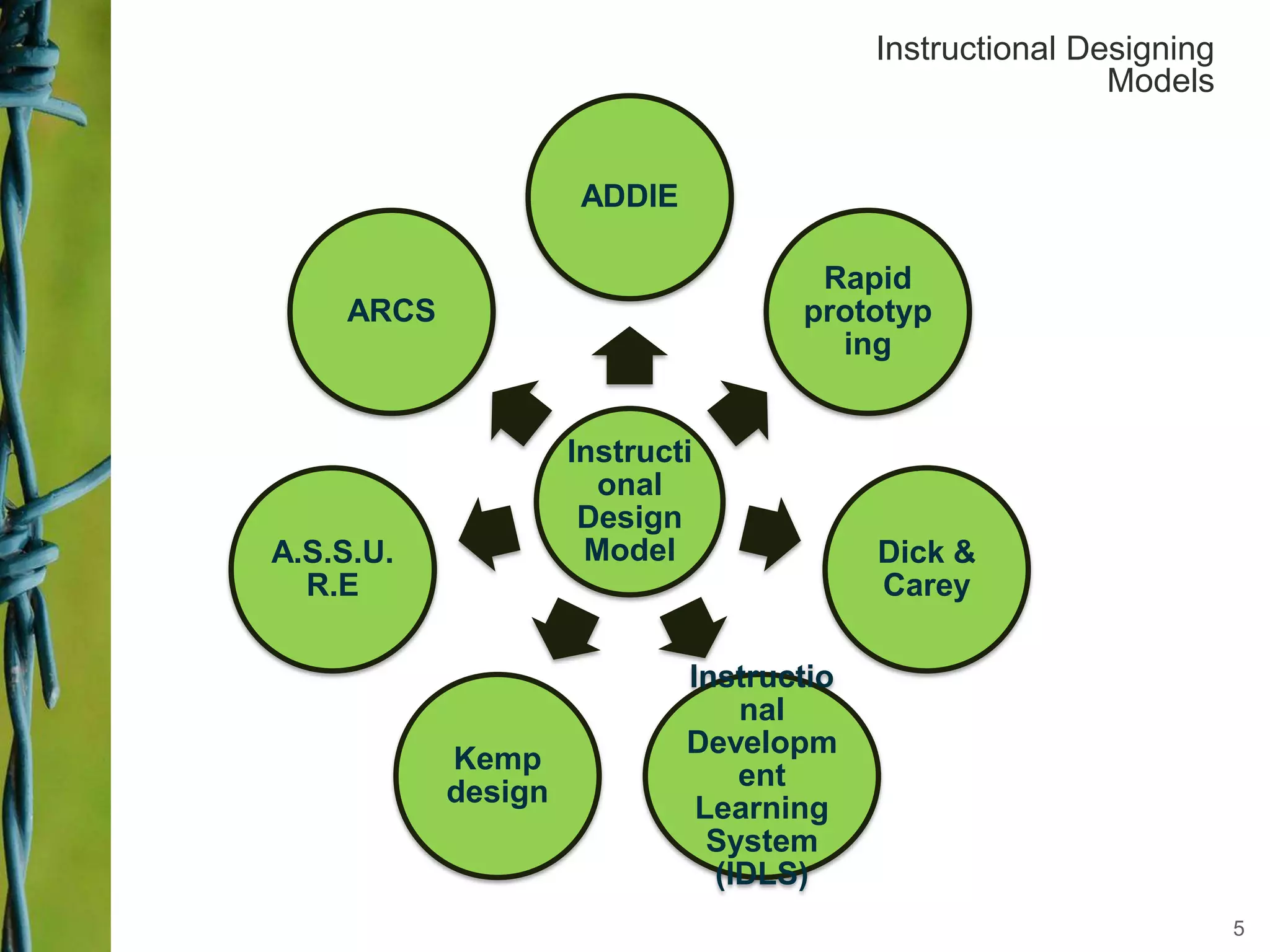
Instructi
onal
Design
Model
ADDIE
Rapid
prototyp
ing
Dick &
Carey
Instructio
nal
Developm
ent
Learning
System
(IDLS)
Kemp
design
A.S.S.U.
R.E
ARCS
5
Instructional Designing
Models
6
DAY 1
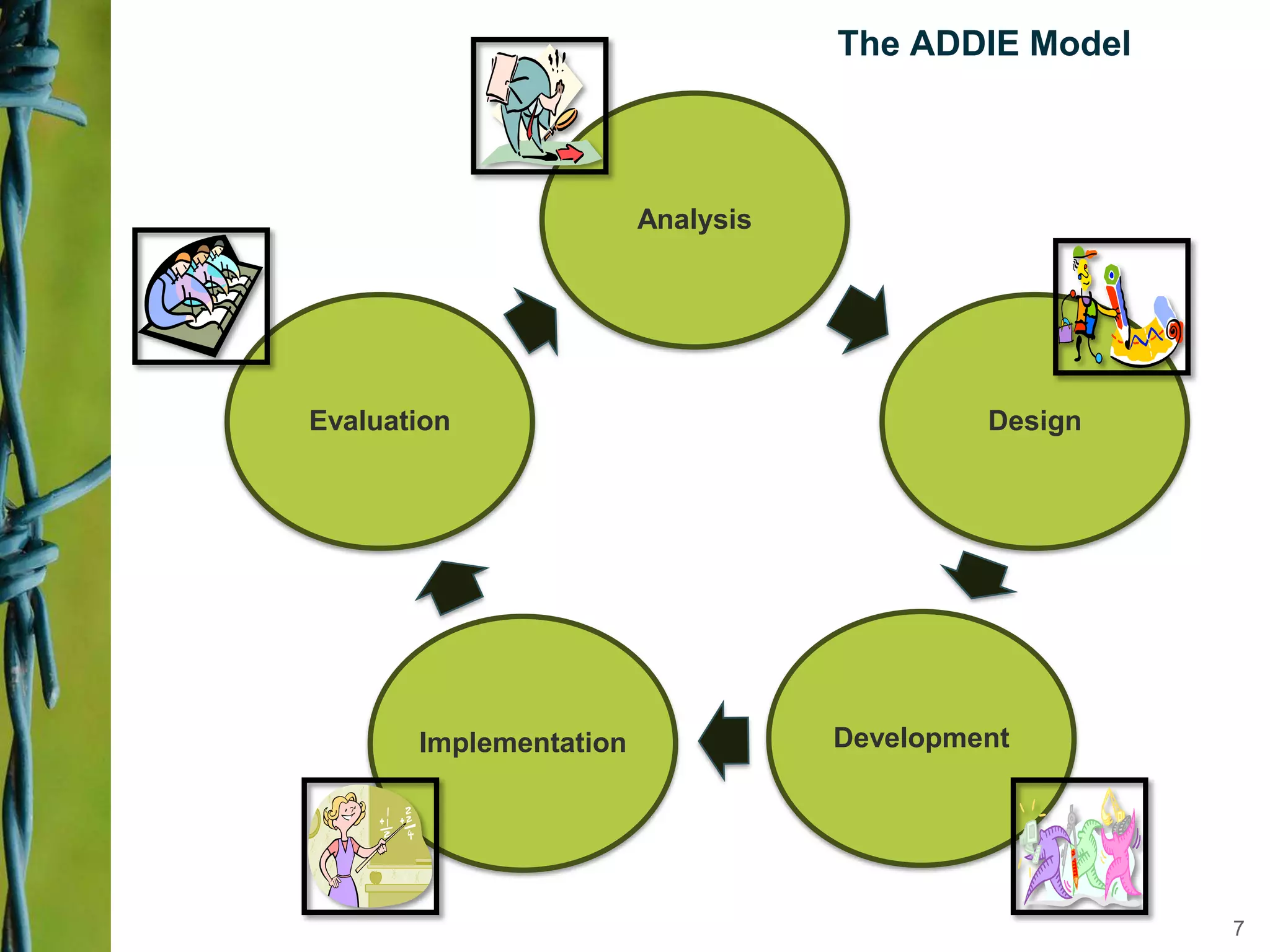
The ADDIE Model
Analysis
Design
DevelopmentImplementation
Evaluation
7
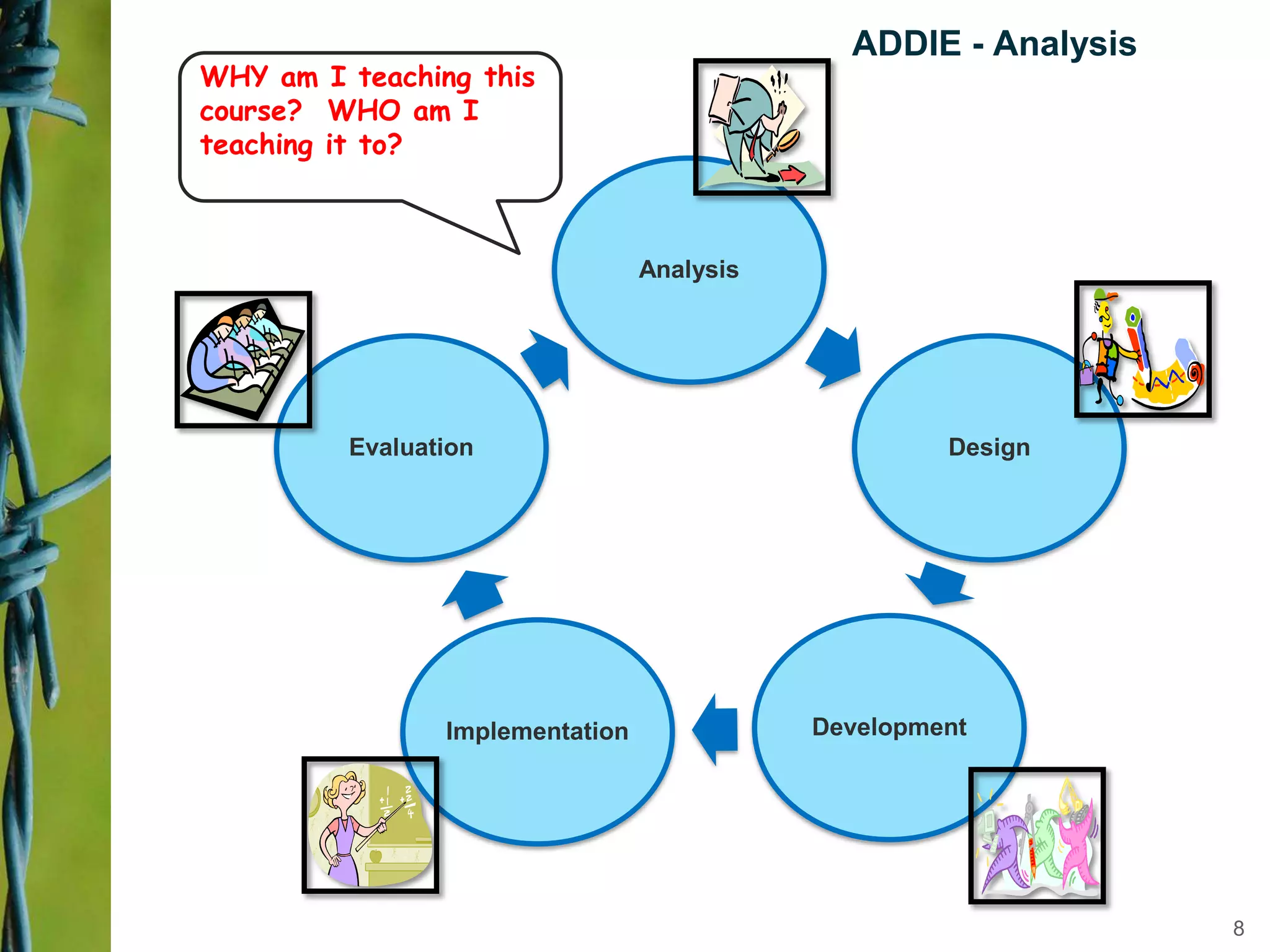
ADDIE - Analysis
WHY am I teaching this
course? WHO am I
teaching it to?
Analysis
Design
DevelopmentImplementation
Evaluation
8
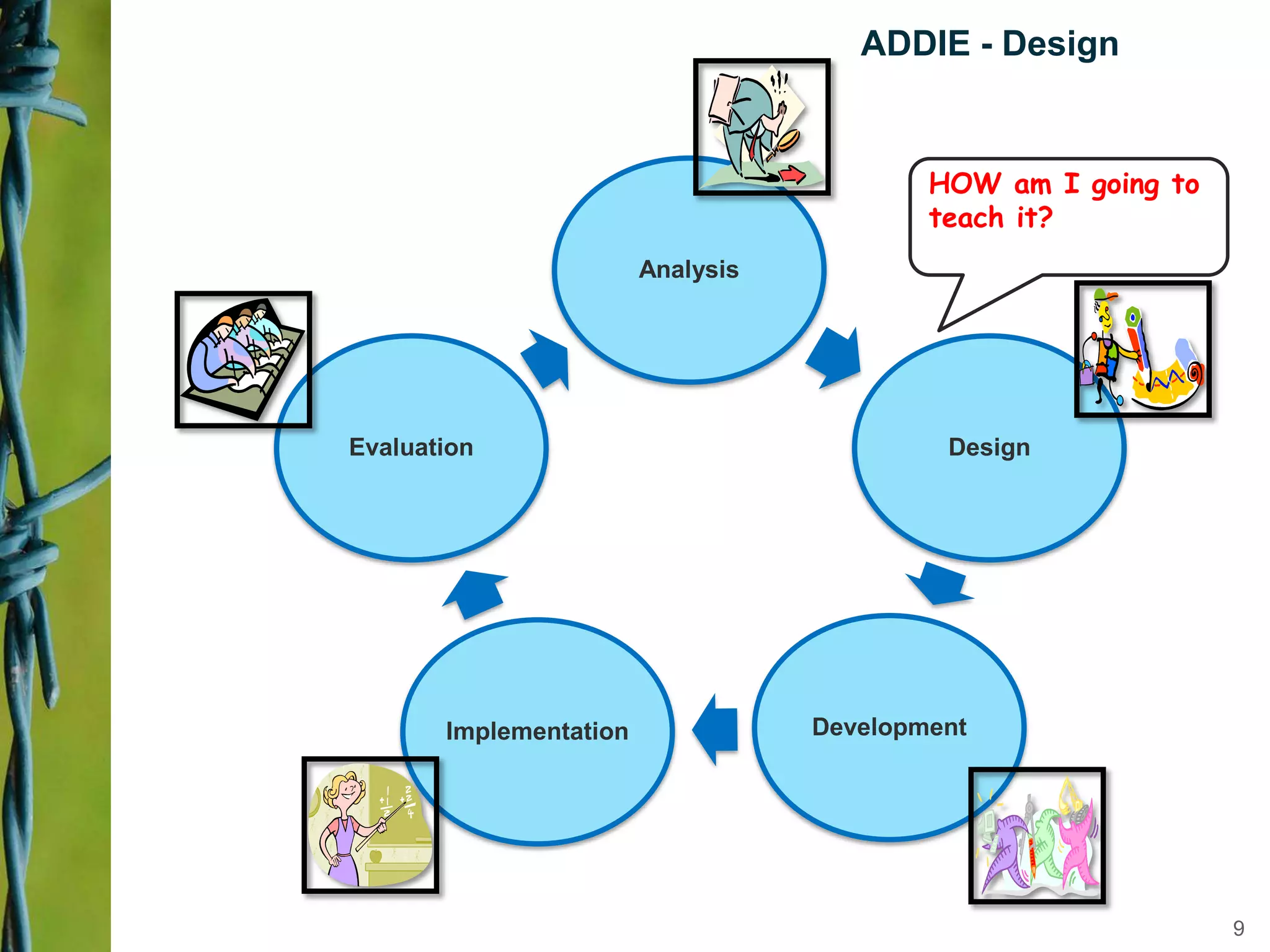
HOW am I going to
teach it?
ADDIE - Design
9
Analysis
Design
DevelopmentImplementation
Evaluation
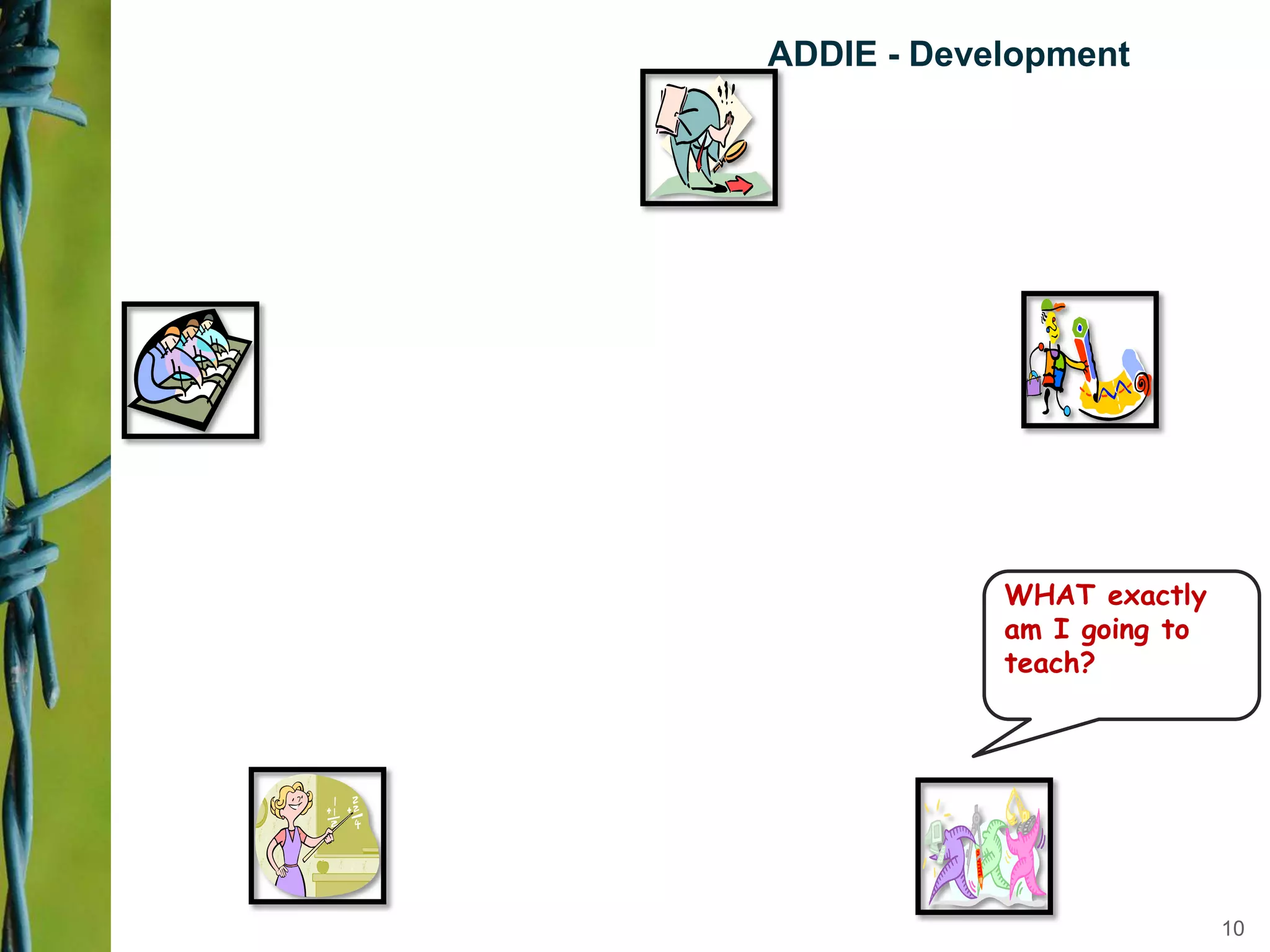
WHAT exactly
am I going to
teach?
ADDIE - Development
10
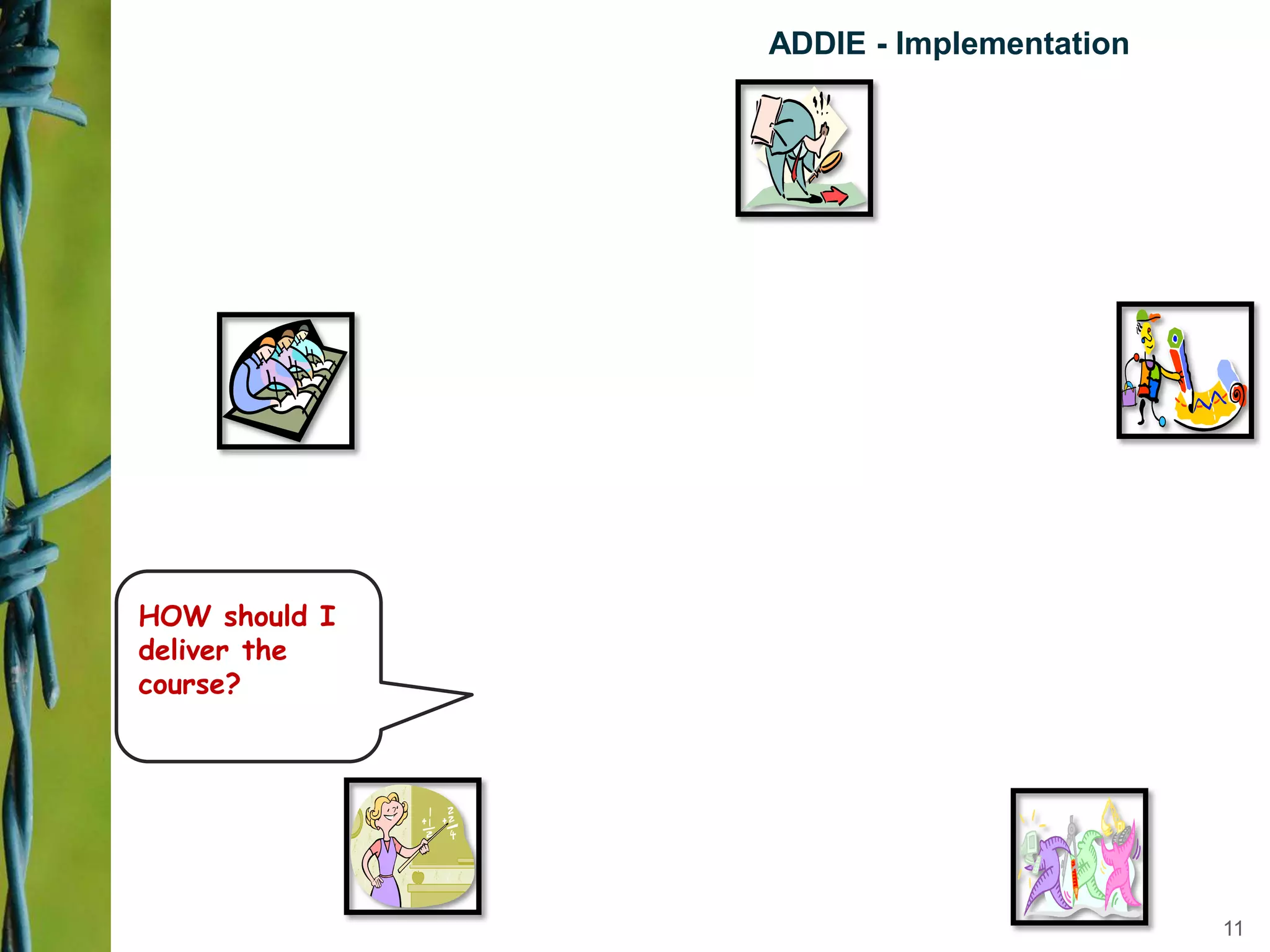
HOW should I
deliver the
course?
ADDIE - Implementation
11
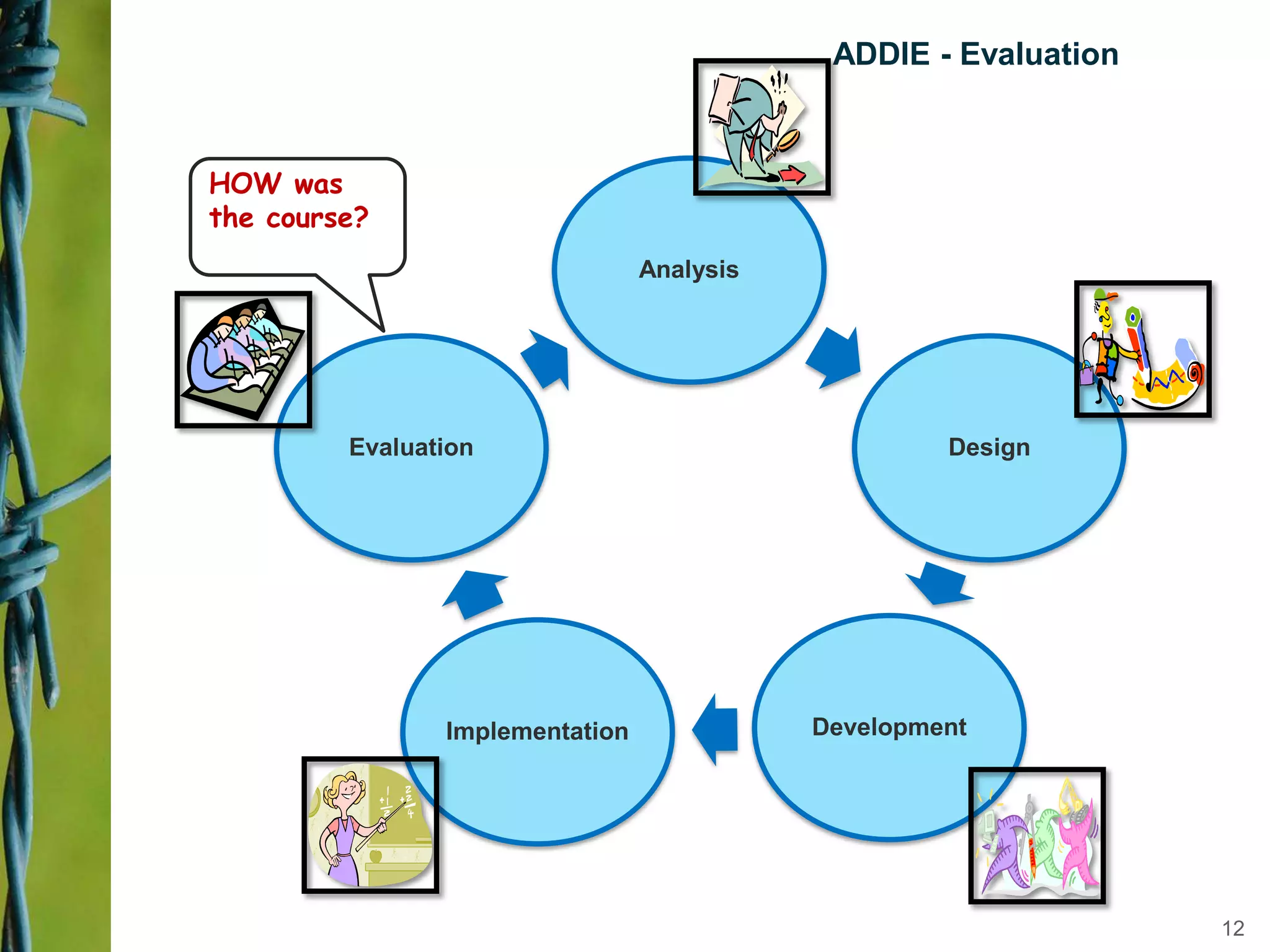
HOW was
the course?
ADDIE - Evaluation
12
Analysis
Design
DevelopmentImplementation
Evaluation
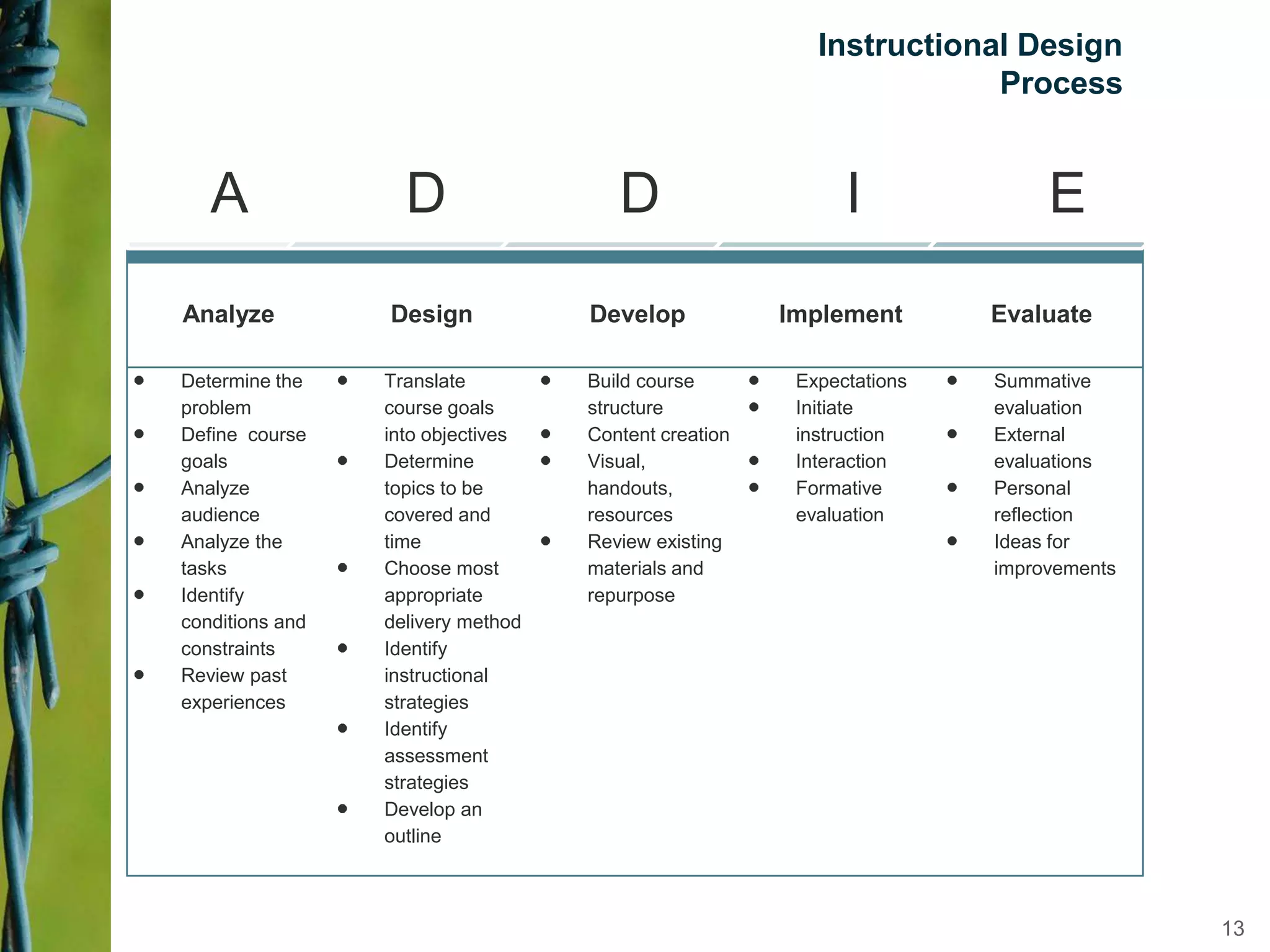
Instructional Design
Process
Analyze Design Develop Implement Evaluate
Determine the
problem
Define course
goals
Analyze
audience
Analyze the
tasks
Identify
conditions and
constraints
Review past
experiences
Translate
course goals
into objectives
Determine
topics to be
covered and
time
Choose most
appropriate
delivery method
Identify
instructional
strategies
Identify
assessment
strategies
Develop an
outline
Build course
structure
Content creation
Visual,
handouts,
resources
Review existing
materials and
repurpose
Expectations
Initiate
instruction
Interaction
Formative
evaluation
Summative
evaluation
External
evaluations
Personal
reflection
Ideas for
improvements
A D D I E
13
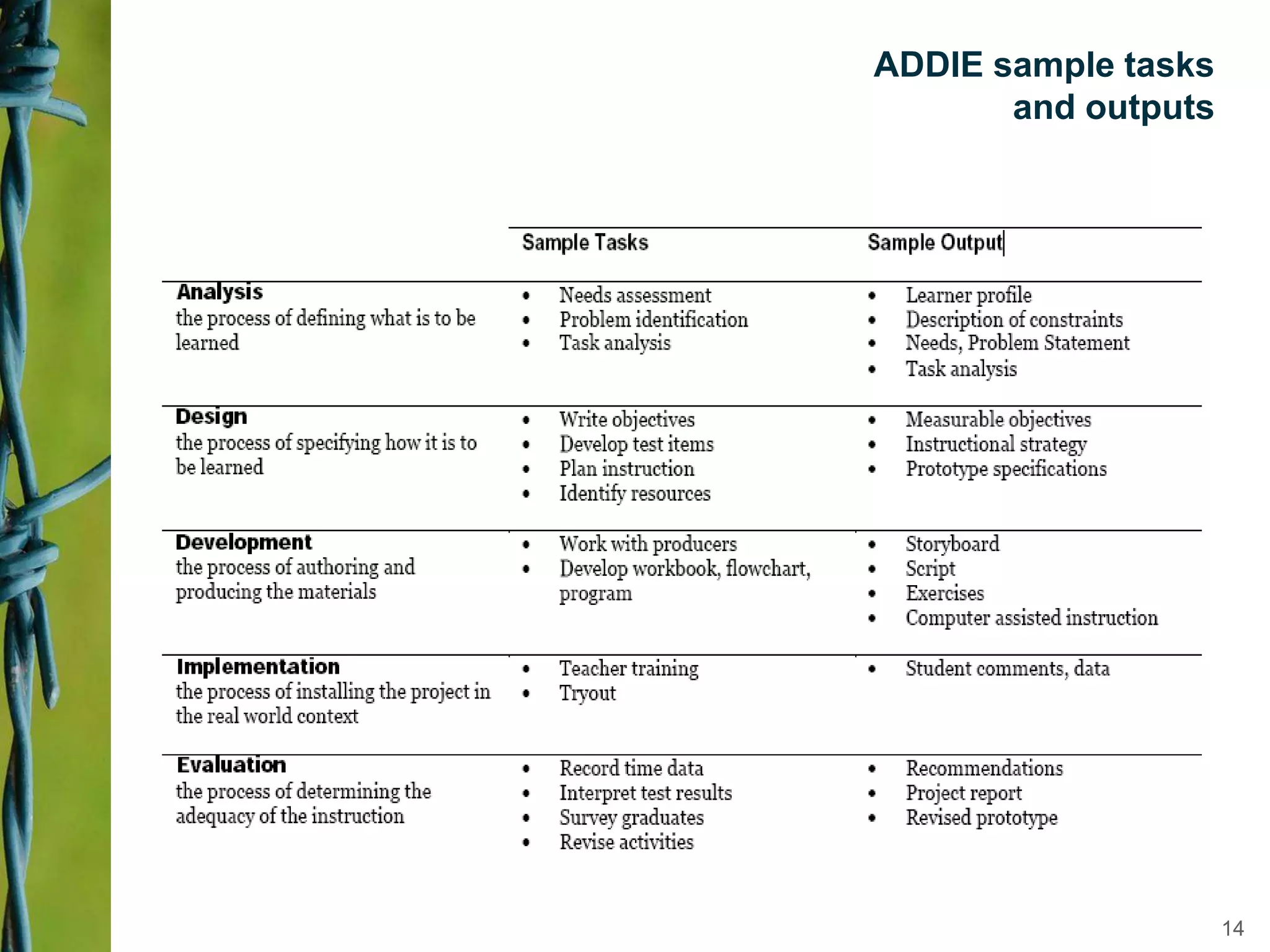
ADDIE sample tasks
and outputs
14
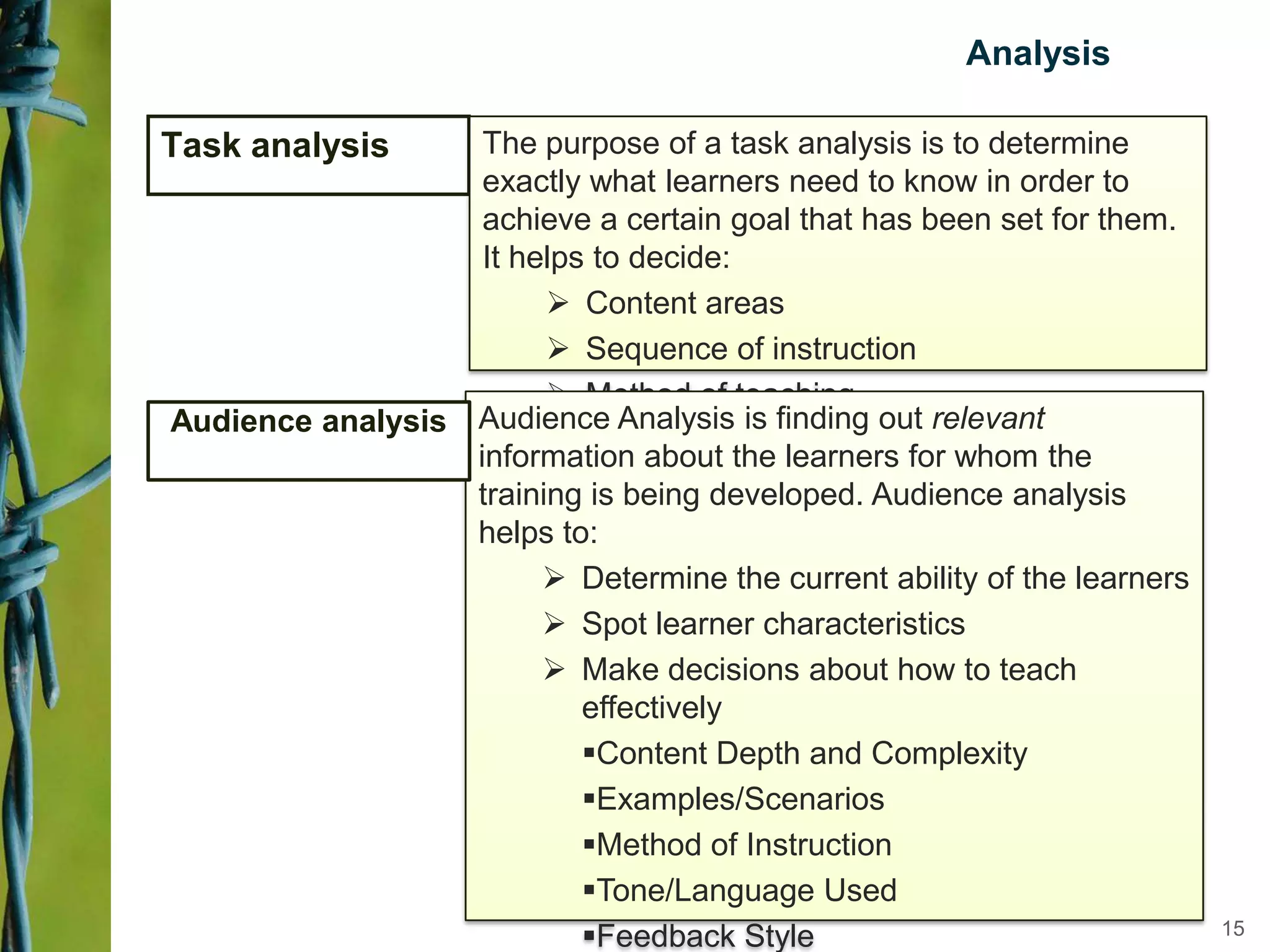
Analysis
Task analysis The purpose of a task analysis is to determine
exactly what learners need to know in order to
achieve a certain goal that has been set for them.
It helps to decide:
 Content areas
 Sequence of instruction
 Method of teaching
Audience Analysis is finding out relevant
information about the learners for whom the
training is being developed. Audience analysis
helps to:
 Determine the current ability of the learners
 Spot learner characteristics
 Make decisions about how to teach
effectively
Content Depth and Complexity
Examples/Scenarios
Method of Instruction
Tone/Language Used
Feedback Style
Audience analysis
15
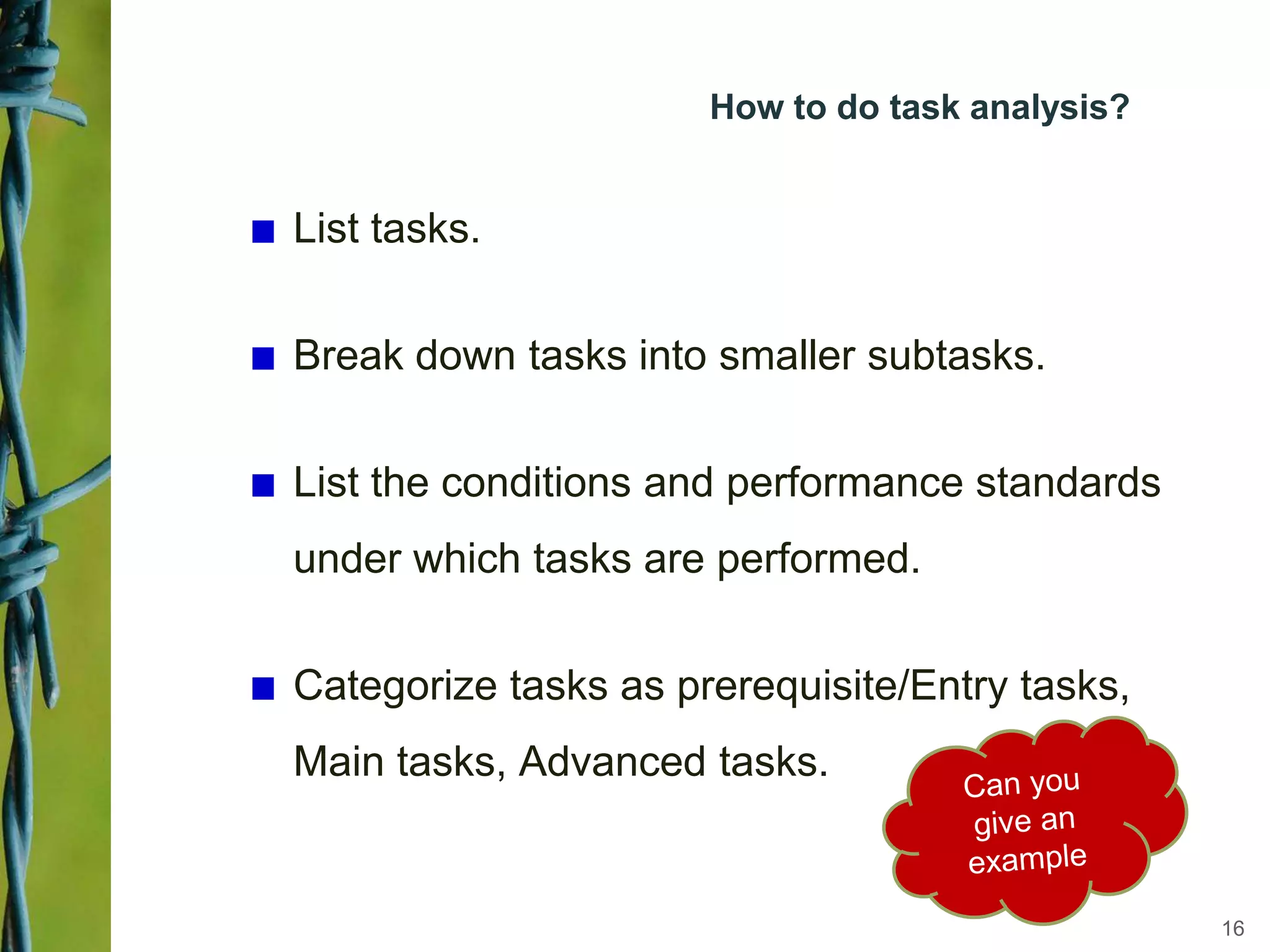
How to do task analysis?
List tasks.
Break down tasks into smaller subtasks.
List the conditions and performance standards
under which tasks are performed.
Categorize tasks as prerequisite/Entry tasks,
Main tasks, Advanced tasks.
16
How to do audience analysis?
Who is my audience – teachers/ students ?
Why would they need/read this content?
Is it really going to be useful when compared
with the books or what edge does it provide to
the learner?
Do you know of the prior knowledge of the
learner?
Have you thought how computer savvy they
are? 17
Other Analysis
Needs Assessment: The purpose of a needs
assessment is to answer the following questions:
• What is the problem?
• What is the need/learning gap?
• Is an instructional solution required?
Context Analysis: The purpose of a context
analysis is to examine the conditions in which the
learner works, such as the technology used in the
workplace, physical location, tools, or job aids.
18
19
o Select a chapter from your
subject
o Plan broadly the tasks to be
done under each stage of
ADDIE
20
Exercise

Instructional design

  • 2.
    What is Instructional Design? AScience The science of creating detailed specifications for the development, implementation, evaluation, and maintenance of situations that facilitate the learning of both large and small units of subject matter at all levels of complexity. A Discipline: The branch of knowledge concerned with research and theory about instructional strategies and the process for developing and implementing those strategies. A Process: The systematic development of instructional specifications using learning and instructional theory to ensure the quality of instruction…the entire process of analysis of learning needs and goals and the development of a delivery system to meet those needs. It includes development of instructional 2
  • 3.
    What is Instructional Design? InstructionalDesign allows you to analyze the learning needs of an end-user and develop a course that will allow you to meet its objectives. These needs can be for varied audiences, and at each point you need to ensure that you are meeting these requirements. 3
  • 4.
    Instructional Systems Design After theSecond World War, the U.S. military was looking for a systematic way of creating training programs quickly and efficiently. These efforts resulted in the development of some basic Instructional Systems Design (ISD) models, which were taught at the Florida State University. 4
  • 5.
  • 6.
  • 7.
  • 8.
    ADDIE - Analysis WHYam I teaching this course? WHO am I teaching it to? Analysis Design DevelopmentImplementation Evaluation 8
  • 9.
    HOW am Igoing to teach it? ADDIE - Design 9 Analysis Design DevelopmentImplementation Evaluation
  • 10.
    WHAT exactly am Igoing to teach? ADDIE - Development 10
  • 11.
    HOW should I deliverthe course? ADDIE - Implementation 11
  • 12.
    HOW was the course? ADDIE- Evaluation 12 Analysis Design DevelopmentImplementation Evaluation
  • 13.
    Instructional Design Process Analyze DesignDevelop Implement Evaluate Determine the problem Define course goals Analyze audience Analyze the tasks Identify conditions and constraints Review past experiences Translate course goals into objectives Determine topics to be covered and time Choose most appropriate delivery method Identify instructional strategies Identify assessment strategies Develop an outline Build course structure Content creation Visual, handouts, resources Review existing materials and repurpose Expectations Initiate instruction Interaction Formative evaluation Summative evaluation External evaluations Personal reflection Ideas for improvements A D D I E 13
  • 14.
  • 15.
    Analysis Task analysis Thepurpose of a task analysis is to determine exactly what learners need to know in order to achieve a certain goal that has been set for them. It helps to decide:  Content areas  Sequence of instruction  Method of teaching Audience Analysis is finding out relevant information about the learners for whom the training is being developed. Audience analysis helps to:  Determine the current ability of the learners  Spot learner characteristics  Make decisions about how to teach effectively Content Depth and Complexity Examples/Scenarios Method of Instruction Tone/Language Used Feedback Style Audience analysis 15
  • 16.
    How to dotask analysis? List tasks. Break down tasks into smaller subtasks. List the conditions and performance standards under which tasks are performed. Categorize tasks as prerequisite/Entry tasks, Main tasks, Advanced tasks. 16
  • 17.
    How to doaudience analysis? Who is my audience – teachers/ students ? Why would they need/read this content? Is it really going to be useful when compared with the books or what edge does it provide to the learner? Do you know of the prior knowledge of the learner? Have you thought how computer savvy they are? 17
  • 18.
    Other Analysis Needs Assessment:The purpose of a needs assessment is to answer the following questions: • What is the problem? • What is the need/learning gap? • Is an instructional solution required? Context Analysis: The purpose of a context analysis is to examine the conditions in which the learner works, such as the technology used in the workplace, physical location, tools, or job aids. 18
  • 19.
  • 20.
    o Select achapter from your subject o Plan broadly the tasks to be done under each stage of ADDIE 20 Exercise

Editor's Notes

  • #3 Robert Glaser, an eminent scholar, first used the term instructional design in 1962. The phrase systematic development implies that instructional design is a series of tasks or steps. Instructional design provides a valuable framework for effective instruction that understands the needs of the student, creates instruction specifications, and evaluates whether the instruction is effective.The second key phrase, learning and instructional theory, is about how people learn and the appropriate instructional strategies for different people. Research in these areas has lead to a rich reservoir of theories and knowledge that supports instructional design.
  • #5 Instructional Systems Design (ISD) is the methodology used for the systematic development of courses, which might be ILTs, or CBTs, or WBTs.
  • #6 ISD Models are guidelines or sets of strategies on which the approaches to teaching by instructors are based. Effective instructional models are based on learning theories. Learning Theories describe the ways that theorists believe people learn new ideas and concepts. Often, they explain the relationship between information we already know and the new information we are trying to learn. Instructional theories also play an important role in the design of instructional materials. Theories such as behaviorism, constructivism, social learning and cognitivism helps in shaping and defining the outcomes of instructional materials.While there are several dozens of ISD models, they are all based on the widely accepted ADDIE model.
  • #8 The ADDIE model is the generic process traditionally used by instructional designers and training developers. It is an Instructional Systems Design (ISD) model used predominantly. Most of the current instructional design models are spin-offs or variations of the ADDIE model. Other models include the ARCS (Attention, Relevance, Confidence, and Satisfaction), rapid prototyping, Dick & Carey and Kemp ISD models. In the ADDIE model, each step has an outcome that feeds into the subsequent step.Analysis > Design > Development > Implementation > Evaluation
  • #9 The process of defining WHAT is to be learned and by WHOMQuestions to be considered at this stage:Who are the learners? What are their ages, cultural backgrounds, past experiences, interests, educational goals, etc.?What are the needs of the learners?What are the skills, knowledge, attitudes and/or behaviours that need to be learned?What are the current instructional strategies being employed? What needs to be improved upon, added, clarified, etc.?What are the instructional goals of the project?What are the delivery options? What will the learning environment be like? Will it be face-to-face or online or blended? If online, what might be the differences between web-based and classroom-based learning?What constraints might limit the scope of your project (e.g. timeframe, human resources, financial support, technical skills, technical resources, technical support, etc.)?
  • #10 The process of specifying HOW it is to be learnedQuestions to be considered at this stage:What types of media do you want to use (e.g. graphics / video / audio)? Will you create these materials yourself or will you have them done by someone else?What resources do you have at your disposal to complete the project?What type of activities will you create: individual, interactive, collaborative, etc.?What pedagogical approach will you use in designing your project (e.g. behaviourist, constructivist, etc.)?How will you sequence the various activities of your project? Will you set up the project as one task or several tasks staggered over time? Will you divide the learning activities into units, lessons, modules, etc.? Will the content progress from simple to complex?What cognitive skills are required of the students to meet the learning goals of the project? How will you determine which methods / media / environment will best allow students to develop these cognitive skills?What skills do you expect the learners to have acquired after completing each activity? What method will you use to determine whether students have acquired the desired competencies?What does the project look like on paper? Would creating a concept map help you see how the learning activities match up with the learning objectives of the project?In the case of an online project, what type of user-interface do you want? What will be the “look and feel” of the site?How will learners determine whether or not they understand the material? What mechanism will you design to provide feedback to learners?How will you ensure that your project’s activities appeal to students with different interests and learning styles? Will you use a variety of delivery options or types of media?What exactly is the “content” of the project?
  • #11 The process of developing the learning materialsQuestions to be considered at this stage:Are you on schedule with respect to the creation of materials?Are the team members working together in an effective manner?Is each member fulfilling his/her responsibilities in terms of the production of materials?Do the newly produced materials function as expected?
  • #12 The process of delivering the project to “ real ” studentsQuestions to be considered at this stage:What information might you want to record as you observe students engaging with the learning materials for the first time?When you first introduce the materials to instructors, do they appear interested? Enthusiastic? Resistant? Critical?During the training session for instructors, do instructors catch on quickly or do they encounter unforeseen problems?How will you react to “bugs” (i.e. when you present activities to students and they do not go as planned)?Do you have a “back up” in case of technical or other problems?Will you start with a small-scale or large-scale implementation?When you first introduce the materials to a group of students, do they require constant guidance or can they work independently ?
  • #13 The process of determining the effectiveness and efficiency of the instruction. Formative evaluation takes place at each stage of the project, while summative evaluation occurs upon full implementation of the project. Note that formative evaluation takes place at each stage of the project, while summative evaluation occurs upon full implementation of the projectQuestions to be considered at this stage:What factors / criteria will you use to determine the effectiveness of the project (e.g. development of higher-order problem-solving skills, increased motivation, improved learning, etc.)?How and when will you collect data relating to the overall effectiveness of the project?How will you analyze the feedback collected from students?How will you decide whether or not you need to revise any aspects of the project before full implementation?How will you measure the content validity and reliability of the project?How will you assess whether the instructions are clear?How will you assess the reaction of learners to the instructional materials?To whom will you submit a report outlining the results of the evaluation?
  • #17 The purpose of a task analysis is to determine exactly what learners need to know in order to achieve a certain goal that has been set for them. It helps you decide:Content areasSequence of instruction Method of teaching
  • #21 Motivate the participants to present their plan and discuss on the pros and cons of the plan