By: DanielleCONSTRUCTIVISM
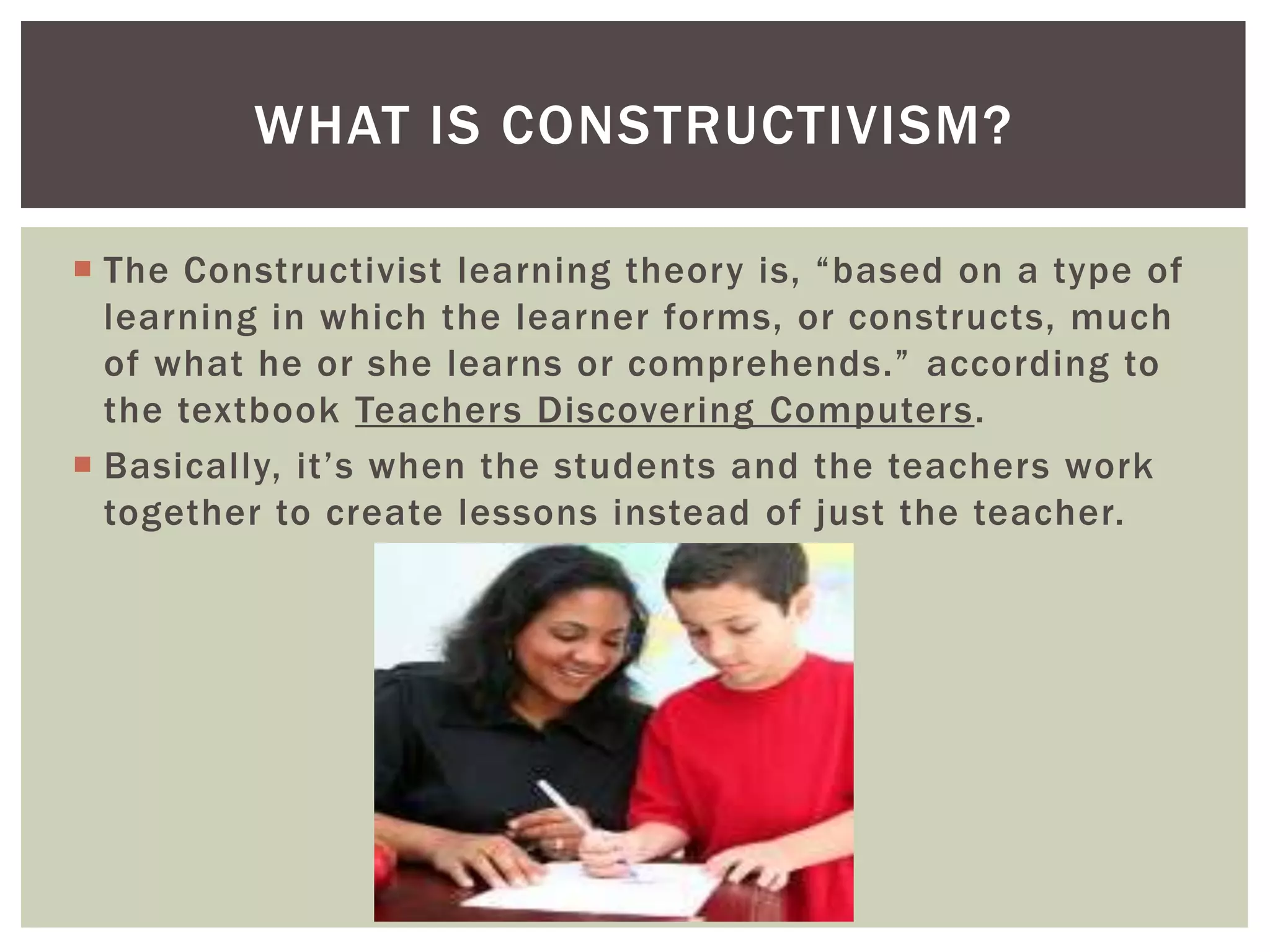
 The Constructivist learning theory is, “based on a type of
learning in which the learner forms, or constructs, much
of what he or she learns or comprehends.” according to
the textbook Teachers Discovering Computers.
 Basically, it’s when the students and the teachers work
together to create lessons instead of just the teacher.
WHAT IS CONSTRUCTIVISM?
 Jean Piaget: He saw and defined the 4 cognitive
stages in children.
 Jerome Bruner: A psychologist and an educator who
believed that even very young children could learn
anything as long as the instruction was clear and
organized.
 John Dewey: Known for being a part of the
progressive education movement and “argued that
curriculum should be relevant to students' lives”.
 Lev Vygotsky: Developed social cognition and the
Zone of Proximal Development.
IMPORTANT CONSTRUCTIVISTS
 The 4 cognitive stages are sensorimotor (0-2 years old),
preoperational (2-7), concrete operational (7-12), and
formal operational (12-adulthood).
 “Learning is an active process in which the learner uses
sensory input and constructs meaning out of it.” -Prof.
George E. Hein
 The Zone of Proximal Development (ZPD) is important
because according to Vygotsky, “cognitive development
stems from social interactions from guided learning
within the zone of proximal development as children and
their partners co-construct knowledge.”
KEY POINTS OF CONSTRUCTIVISM
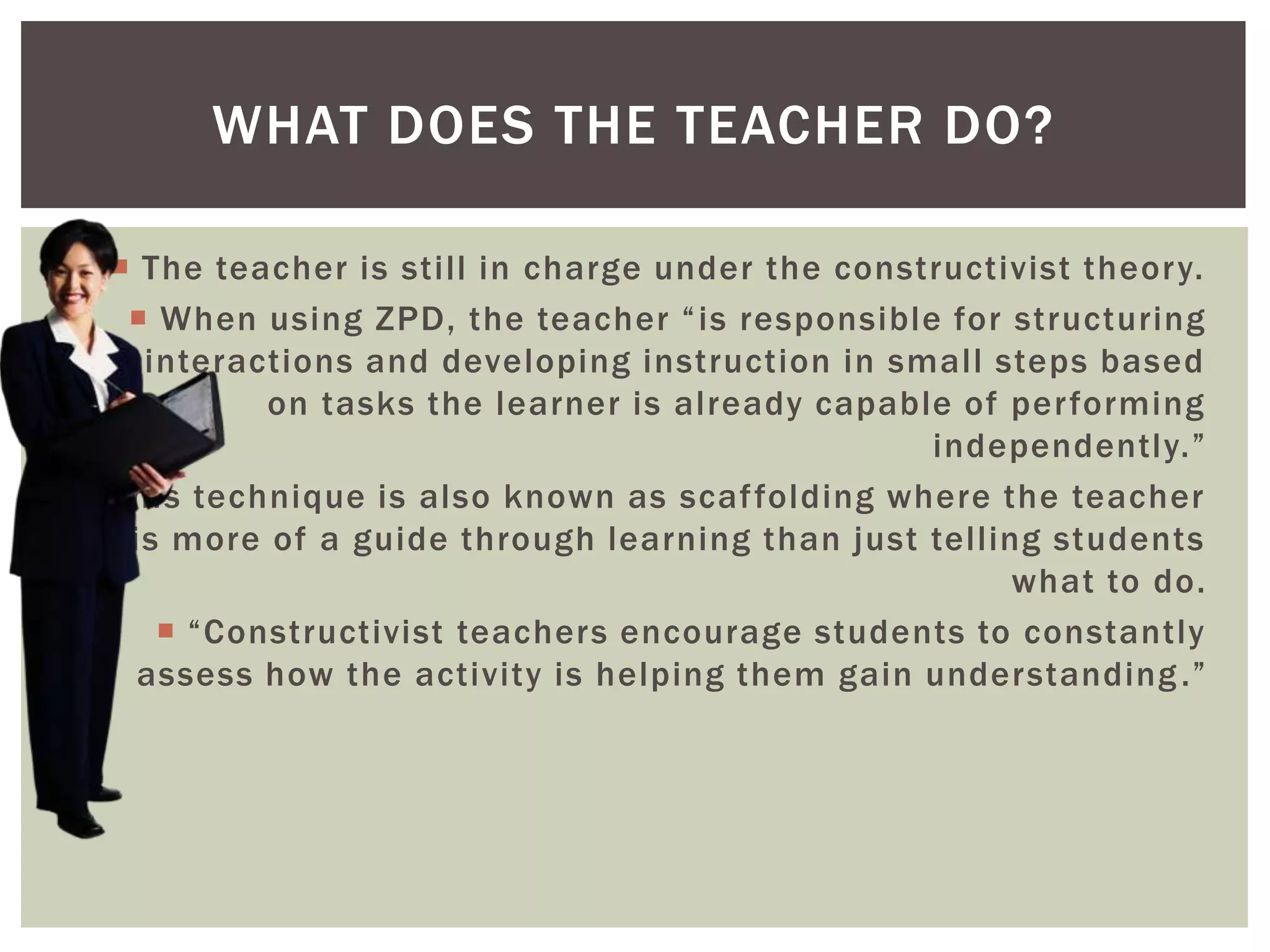
 The teacher is still in charge under the constructivist theory.
 When using ZPD, the teacher “is responsible for structuring
interactions and developing instruction in small steps based
on tasks the learner is already capable of performing
independently.”
 This technique is also known as scaffolding where the teacher
is more of a guide through learning than just telling students
what to do.
 “Constructivist teachers encourage students to constantly
assess how the activity is helping them gain understanding.”
WHAT DOES THE TEACHER DO?
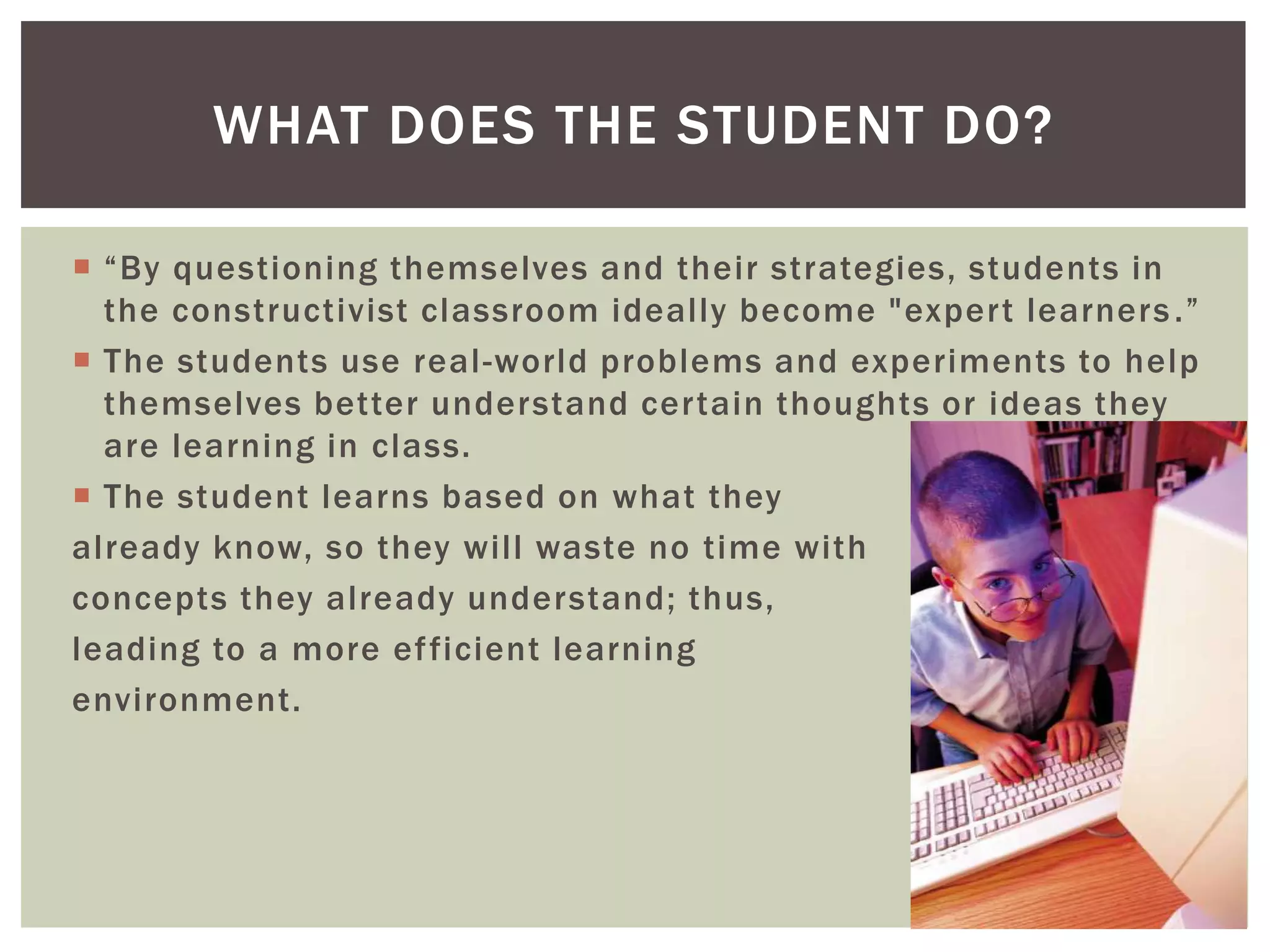
 “By questioning themselves and their strategies, students in
the constructivist classroom ideally become "expert learners.”
 The students use real-world problems and experiments to help
themselves better understand certain thoughts or ideas they
are learning in class.
 The student learns based on what they
already know, so they will waste no time with
concepts they already understand; thus,
leading to a more efficient learning
environment.
WHAT DOES THE STUDENT DO?
 I think the constructivist theory would be effective in a
classroom and I would probably incorporate elements of it
into my curriculum.
 However, I feel as though it would be harder to actually put
into practice because of all the standards and FCAT I would
have to deal with. I would also have to find time to
incorporate my students’ wants and needs education wise
along with having to teach certain things at certain points
during the year.
 I think that it’s important to take into account the needs and
the different levels of knowledge each student has and learn
how to teach to everyone so that no one is lost. That is why I
like the constructivist theory because the teacher and the
students work together to make a better and more effective
lesson plan.
MY THOUGHTS ON CONSTRUCTIVISM
 Slide 2 quote: Teachers Discovering Computer: Integrating
Technology and Digital Media in the Classroom. By Shelly,
Gunter, and Gunter.
 Slide 2 picture: http://www.eyecomassistivetech.com/assistive-
tech-in-education/what-should-be-in-my-childs-iep-part-2/
 Slide 3 quote: https://www.pbs.org/onlyateacher/john.html
 Slide 4 quote:
http://www.exploratorium.edu/ifi/resources/constructivistlearni
ng.html
 Second Slide 4 quote:
http://www.simplypsychology.org/vygotsky.html
 Slide 5 quote: http://www.learnnc.org/lp/pages/5075
 Second Slide 5 quote and Slide 6 quote:
http://www.thirteen.org/edonline/concept2class/constructivism
/
CREDITS

Learning theory Powerpoint

  • 1.
  • 2.
     The Constructivistlearning theory is, “based on a type of learning in which the learner forms, or constructs, much of what he or she learns or comprehends.” according to the textbook Teachers Discovering Computers.  Basically, it’s when the students and the teachers work together to create lessons instead of just the teacher. WHAT IS CONSTRUCTIVISM?
  • 3.
     Jean Piaget:He saw and defined the 4 cognitive stages in children.  Jerome Bruner: A psychologist and an educator who believed that even very young children could learn anything as long as the instruction was clear and organized.  John Dewey: Known for being a part of the progressive education movement and “argued that curriculum should be relevant to students' lives”.  Lev Vygotsky: Developed social cognition and the Zone of Proximal Development. IMPORTANT CONSTRUCTIVISTS
  • 4.
     The 4cognitive stages are sensorimotor (0-2 years old), preoperational (2-7), concrete operational (7-12), and formal operational (12-adulthood).  “Learning is an active process in which the learner uses sensory input and constructs meaning out of it.” -Prof. George E. Hein  The Zone of Proximal Development (ZPD) is important because according to Vygotsky, “cognitive development stems from social interactions from guided learning within the zone of proximal development as children and their partners co-construct knowledge.” KEY POINTS OF CONSTRUCTIVISM
  • 5.
     The teacheris still in charge under the constructivist theory.  When using ZPD, the teacher “is responsible for structuring interactions and developing instruction in small steps based on tasks the learner is already capable of performing independently.”  This technique is also known as scaffolding where the teacher is more of a guide through learning than just telling students what to do.  “Constructivist teachers encourage students to constantly assess how the activity is helping them gain understanding.” WHAT DOES THE TEACHER DO?
  • 6.
     “By questioningthemselves and their strategies, students in the constructivist classroom ideally become "expert learners.”  The students use real-world problems and experiments to help themselves better understand certain thoughts or ideas they are learning in class.  The student learns based on what they already know, so they will waste no time with concepts they already understand; thus, leading to a more efficient learning environment. WHAT DOES THE STUDENT DO?
  • 7.
     I thinkthe constructivist theory would be effective in a classroom and I would probably incorporate elements of it into my curriculum.  However, I feel as though it would be harder to actually put into practice because of all the standards and FCAT I would have to deal with. I would also have to find time to incorporate my students’ wants and needs education wise along with having to teach certain things at certain points during the year.  I think that it’s important to take into account the needs and the different levels of knowledge each student has and learn how to teach to everyone so that no one is lost. That is why I like the constructivist theory because the teacher and the students work together to make a better and more effective lesson plan. MY THOUGHTS ON CONSTRUCTIVISM
  • 8.
     Slide 2quote: Teachers Discovering Computer: Integrating Technology and Digital Media in the Classroom. By Shelly, Gunter, and Gunter.  Slide 2 picture: http://www.eyecomassistivetech.com/assistive- tech-in-education/what-should-be-in-my-childs-iep-part-2/  Slide 3 quote: https://www.pbs.org/onlyateacher/john.html  Slide 4 quote: http://www.exploratorium.edu/ifi/resources/constructivistlearni ng.html  Second Slide 4 quote: http://www.simplypsychology.org/vygotsky.html  Slide 5 quote: http://www.learnnc.org/lp/pages/5075  Second Slide 5 quote and Slide 6 quote: http://www.thirteen.org/edonline/concept2class/constructivism / CREDITS