SITUATIONAL LEADERSHIP
Leadership

• The ability to influence a group toward the
  achievement of goals

• “When you boil it down, contemporary leadership
  seems to a matter of aligning people toward
  common goals and empowering them to take the
  actions needed to reach them.”
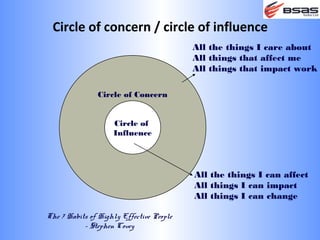
Circle of concern / circle of influence
                                          All the things I care about
                                          All things that affect me
                                          All things that impact work

               Circle of Concern


                    Circle of
                    Influence


                                          All the things I can affect
                                          All things I can impact
                                          All things I can change

The 7 Habits of Highly Effective People
           - Stephen Covey
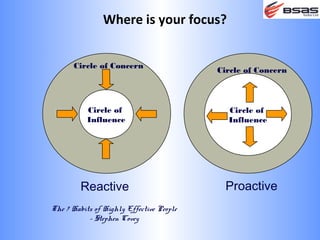
Where is your focus?


      Circle of Concern
                                          Circle of Concern


           Circle of                        Circle of
           Influence                        Influence


         Reactive                           Proactive
The 7 Habits of Highly Effective People
           - Stephen Covey
What are the Leadership Traits of Highly
      Productive Organizations?
Levels of Leadership
               (Jim Collins, HBR, Jan. 2001)

• Highly capable individual
• Contributing team member
• Competent manager
• Effective leader – catalyzes commitment to and vigorous
  pursuit of a clear & compelling vision, stimulate high
  performance
• Executive – builds enduring greatness through humility and
  professional wills
Charismatic Leadership

Key Characteristics of Charismatic leaders

1.    Self Confidence- They have complete confidence in their judgment and ability.

2.    A vision- This is an idealized goal that proposes a future better than the status
      quo. The greater the disparity between idealized goal and the status quo, the
      more likely that followers will attribute extraordinary vision to the leader.

3.    Ability to articulate the vision- They are able to clarify and state the vision in
      terms that are understandable to others. This articulation demonstrates an
      understanding of the followers’ needs and, hence acts as a motivating force.

4.    Strong convictions about vision- Charismatic leaders are perceived as being
      strongly committed, and willing to take on high personal risk, incur high costs,
      and engage in self-sacrifice to achieve their vision.
Charismatic Leadership


Key Characteristics of Charismatic leaders

5.   Behavior that is out of the ordinary- Those with charisma engage in
     behavior that is perceived as being novel, unconventional, and counter
     to norms. When successful , these behaviors evoke surprise and
     admiration in followers.

6.   Perceived as being a change agent- Charismatic leaders are perceived
     as agents of radical change rather than as caretakers of the status quo.

7.   Environmental sensitivity- These leaders are able to make realistic
     assessments of the environmental constraints and resources needed
     to bring about change.
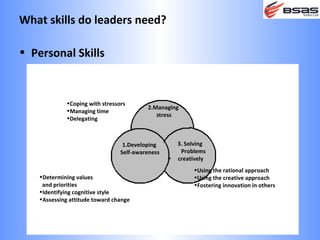
What skills do leaders need?

• Personal Skills


             •Coping with stressors
                                          2.Managing
             •Managing time
                                             stress
             •Delegating


                                  1.Developing     3. Solving
                                 Self-awareness     Problems
                                                   creatively
                                                        •Using the rational approach
    •Determining values                                 •Using the creative approach
     and priorities                                     •Fostering innovation in others
    •Identifying cognitive style
    •Assessing attitude toward change
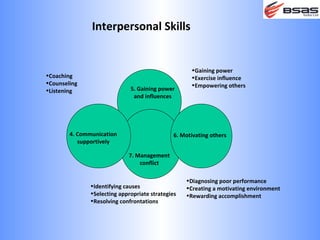
Interpersonal Skills


                                                     •Gaining power
•Coaching                                            •Exercise influence
•Counseling                                          •Empowering others
•Listening                    5. Gaining power
                               and influences


        4. Communication                       6. Motivating others
           supportively

                             7. Management
                                 conflict

                                                   •Diagnosing poor performance
               •Identifying causes                 •Creating a motivating environment
               •Selecting appropriate strategies   •Rewarding accomplishment
               •Resolving confrontations
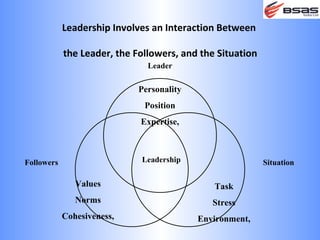
Leadership Involves an Interaction Between

            the Leader, the Followers, and the Situation
                               Leader

                             Personality
                              Position
                             Expertise,


Followers                    Leadership                    Situation

               Values                         Task
               Norms                          Stress
            Cohesiveness,                  Environment,
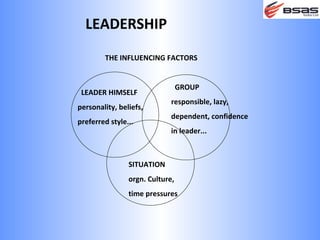
LEADERSHIP
        THE INFLUENCING FACTORS


                                 GROUP
 LEADER HIMSELF
                             responsible, lazy,
personality, beliefs,
                             dependent, confidence
preferred style...
                             in leader...


                SITUATION
                orgn. Culture,
                time pressures
Points to Learn


•   Persuasion skills
•   Motivational skills
•   Conflict resolution skills
•   Leadership tactics
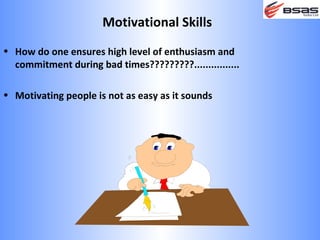
Motivational Skills
• How do one ensures high level of enthusiasm and
  commitment during bad times?????????................

• Motivating people is not as easy as it sounds
The twelve major causes of failure in leadership
Although it is important to know what to do when leading people , it must be
important to know what not to do.

1. Inability to organize detail
2.Unwillingness to do what they would ask another to do
3.Expectation of pay for what they know instead of what they do.
4 fear of competition from others
5.Lack of creative thinking
6. The ‘’I’’ syndrome
7. Over-indulgence
8. Disloyalty
9. Emphasis of the authority of leadership
10 . Emphasis of title
11. lack of understanding of the destructive effects of a negative environment
12 .a lack of common sense
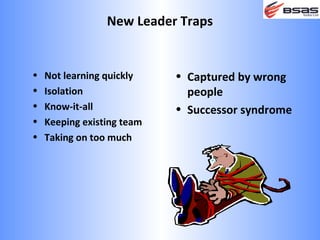
New Leader Traps


•   Not learning quickly    • Captured by wrong
•   Isolation                 people
•   Know-it-all             • Successor syndrome
•   Keeping existing team
•   Taking on too much
How Leaders Interact with Followers,
                     continued


• Motivate followers through more personal and
  intangible factors.
• Redefine the parameters of tasks and
  responsibilities.
• Change situations rather than just optimize
  their group’s adaptation to it.
Situational Leadership
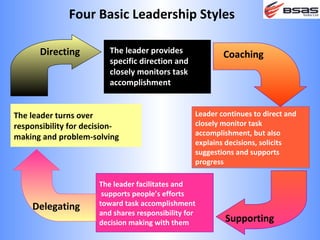
Four Basic Leadership Styles

      Directing          The leader provides              Coaching
                         specific direction and
                         closely monitors task
                         accomplishment


The leader turns over                             Leader continues to direct and
responsibility for decision-                      closely monitor task
                                                  accomplishment, but also
making and problem-solving
                                                  explains decisions, solicits
                                                  suggestions and supports
                                                  progress

                      The leader facilitates and
                       supports people’s efforts
    Delegating        toward task accomplishment
                      and shares responsibility for
                      decision making with them           Supporting
Situational Leadership Skills


Flexibl
          e
There is NO ONE BEST leadership style or strategy.
We need to use different styles/strategies for different
  people/situations.

In some cases, we need to use different approaches with
  the SAME person, depending on the given situation.
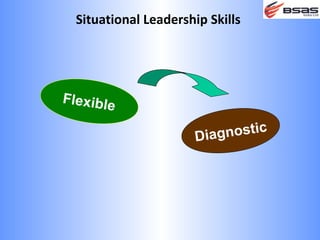
Situational Leadership Skills


Flexible

                       Dia gnostic
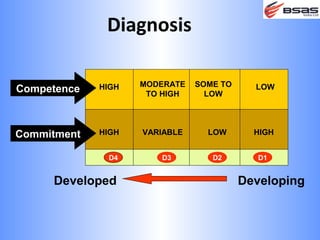
Diagnosis

             HIGH   MODERATE   SOME TO     LOW
Competence           TO HIGH     LOW


Commitment   HIGH   VARIABLE     LOW       HIGH


              D4       D3         D2        D1


     Developed                           Developing
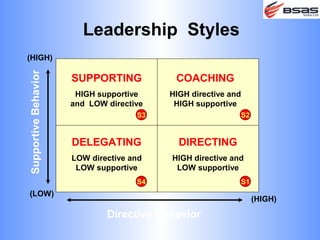
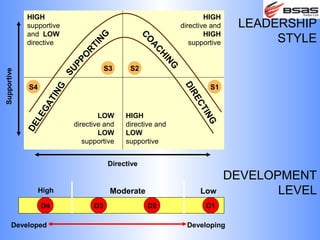
Leadership Styles
(HIGH)
Supportive Behavior


                      SUPPORTING           COACHING
                       HIGH supportive    HIGH directive and
                      and LOW directive    HIGH supportive
                                     S3                        S2


                      DELEGATING            DIRECTING
                      LOW directive and   HIGH directive and
                       LOW supportive      LOW supportive
                                     S4                        S1
(LOW)
                                                                    (HIGH)

                              Directive Behavior
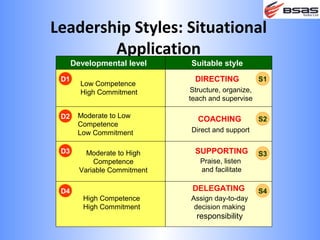
Leadership Styles: Situational
        Application
      Developmental level     Suitable style
 D1                            DIRECTING             S1
        Low Competence
        High Commitment       Structure, organize,
                              teach and supervise

 D2    Moderate to Low
                                COACHING             S2
       Competence
       Low Commitment         Direct and support

 D3       Moderate to High     SUPPORTING            S3
            Competence           Praise, listen
        Variable Commitment      and facilitate


 D4                            DELEGATING            S4
         High Competence      Assign day-to-day
         High Commitment       decision making
                                responsibility
HIGH                                                           HIGH
             supportive                                             directive and    LEADERSHIP
             and LOW                                                        HIGH
                                                                                          STYLE


                                      G


                                                      CO
                                    IN
             directive                                                 supportive


                                                       AC
                                  RT


                                                            HI
                             PO


                                                               NG
                              P
                           SU            S3     S2
Supportive


             S4                                                              S1


                                                                    DI
                         G
                     TIN


                                                                       R
                                                                       EC
                  GA


                                                                           TIN
                                     LOW       HIGH
               LE


                                                                            G
                             directive and     directive and
             DE


                                     LOW       LOW
                                supportive     supportive


                                          Directive
                                                                                    DEVELOPMENT
                  High                    Moderate                         Low             LEVEL
                  D4                D3                 D2                   D1

       Developed                                                      Developing
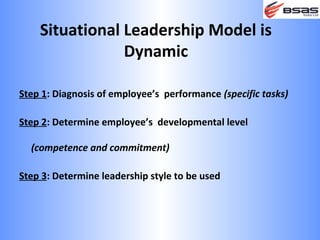
Situational Leadership Model is
                Dynamic

Step 1: Diagnosis of employee’s performance (specific tasks)

Step 2: Determine employee’s developmental level

  (competence and commitment)

Step 3: Determine leadership style to be used
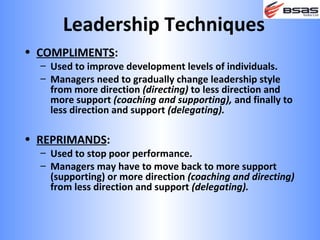
Leadership Techniques
• COMPLIMENTS:
  – Used to improve development levels of individuals.
  – Managers need to gradually change leadership style
    from more direction (directing) to less direction and
    more support (coaching and supporting), and finally to
    less direction and support (delegating).

• REPRIMANDS:
  – Used to stop poor performance.
  – Managers may have to move back to more support
    (supporting) or more direction (coaching and directing)
    from less direction and support (delegating).
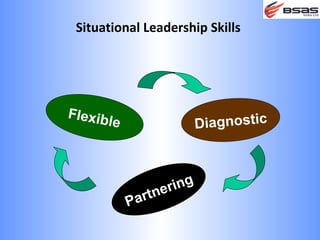
Situational Leadership Skills


Fl exi b
           le                  Diagnostic


                        ring
                Pa rtne
Situational Leadership
is NOT something you
do to people, but
something you do with
People.
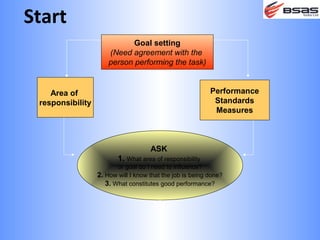
Start
                             Goal setting
                      (Need agreement with the
                      person performing the task)


    Area of                                                Performance
 responsibility                                             Standards
                                                            Measures


                                     ASK
                         1. What area of responsibility
                         or goal do I need to influence?
                  2. How will I know that the job is being done?
                     3. What constitutes good performance?
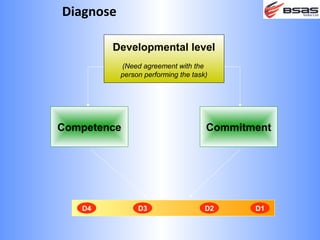
Diagnose

        Developmental level
           (Need agreement with the
           person performing the task)


Competence                           Commitment


   D4           D3                   D2     D1
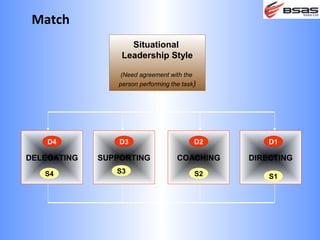
Match
                    Situational
                  Leadership Style

                 (Need agreement with the
                 person performing the task)


    D4           D3                        D2       D1

DELEGATING   SUPPORTING              COACHING   DIRECTING
   S4           S3                         S2       S1
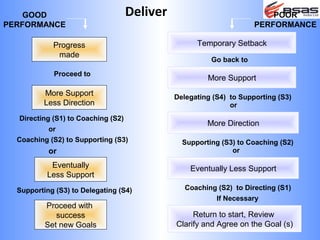
GOOD                            Deliver                              POOR
PERFORMANCE                                                          PERFORMANCE

            Progress                                Temporary Setback
             made
                                                        Go back to
            Proceed to
                                                       More Support
          More Support                        Delegating (S4) to Supporting (S3)
          Less Direction                                      or
  Directing (S1) to Coaching (S2)
                                                       More Direction
          or
  Coaching (S2) to Supporting (S3)              Supporting (S3) to Coaching (S2)
           or                                                 or

           Eventually                             Eventually Less Support
          Less Support
  Supporting (S3) to Delegating (S4)             Coaching (S2) to Directing (S1)
                                                         If Necessary
          Proceed with
             success                               Return to start, Review
          Set new Goals                       Clarify and Agree on the Goal (s)
Adaptive leadership

Adaptive leadership

  • 1.
  • 2.
    Leadership • The abilityto influence a group toward the achievement of goals • “When you boil it down, contemporary leadership seems to a matter of aligning people toward common goals and empowering them to take the actions needed to reach them.”
  • 3.
    Circle of concern/ circle of influence All the things I care about All things that affect me All things that impact work Circle of Concern Circle of Influence All the things I can affect All things I can impact All things I can change The 7 Habits of Highly Effective People - Stephen Covey
  • 4.
    Where is yourfocus? Circle of Concern Circle of Concern Circle of Circle of Influence Influence Reactive Proactive The 7 Habits of Highly Effective People - Stephen Covey
  • 5.
    What are theLeadership Traits of Highly Productive Organizations?
  • 6.
    Levels of Leadership (Jim Collins, HBR, Jan. 2001) • Highly capable individual • Contributing team member • Competent manager • Effective leader – catalyzes commitment to and vigorous pursuit of a clear & compelling vision, stimulate high performance • Executive – builds enduring greatness through humility and professional wills
  • 7.
    Charismatic Leadership Key Characteristicsof Charismatic leaders 1. Self Confidence- They have complete confidence in their judgment and ability. 2. A vision- This is an idealized goal that proposes a future better than the status quo. The greater the disparity between idealized goal and the status quo, the more likely that followers will attribute extraordinary vision to the leader. 3. Ability to articulate the vision- They are able to clarify and state the vision in terms that are understandable to others. This articulation demonstrates an understanding of the followers’ needs and, hence acts as a motivating force. 4. Strong convictions about vision- Charismatic leaders are perceived as being strongly committed, and willing to take on high personal risk, incur high costs, and engage in self-sacrifice to achieve their vision.
  • 8.
    Charismatic Leadership Key Characteristicsof Charismatic leaders 5. Behavior that is out of the ordinary- Those with charisma engage in behavior that is perceived as being novel, unconventional, and counter to norms. When successful , these behaviors evoke surprise and admiration in followers. 6. Perceived as being a change agent- Charismatic leaders are perceived as agents of radical change rather than as caretakers of the status quo. 7. Environmental sensitivity- These leaders are able to make realistic assessments of the environmental constraints and resources needed to bring about change.
  • 9.
    What skills doleaders need? • Personal Skills •Coping with stressors 2.Managing •Managing time stress •Delegating 1.Developing 3. Solving Self-awareness Problems creatively •Using the rational approach •Determining values •Using the creative approach and priorities •Fostering innovation in others •Identifying cognitive style •Assessing attitude toward change
  • 10.
    Interpersonal Skills •Gaining power •Coaching •Exercise influence •Counseling •Empowering others •Listening 5. Gaining power and influences 4. Communication 6. Motivating others supportively 7. Management conflict •Diagnosing poor performance •Identifying causes •Creating a motivating environment •Selecting appropriate strategies •Rewarding accomplishment •Resolving confrontations
  • 11.
    Leadership Involves anInteraction Between the Leader, the Followers, and the Situation Leader Personality Position Expertise, Followers Leadership Situation Values Task Norms Stress Cohesiveness, Environment,
  • 12.
    LEADERSHIP THE INFLUENCING FACTORS GROUP LEADER HIMSELF responsible, lazy, personality, beliefs, dependent, confidence preferred style... in leader... SITUATION orgn. Culture, time pressures
  • 13.
    Points to Learn • Persuasion skills • Motivational skills • Conflict resolution skills • Leadership tactics
  • 14.
    Motivational Skills • Howdo one ensures high level of enthusiasm and commitment during bad times?????????................ • Motivating people is not as easy as it sounds
  • 15.
    The twelve majorcauses of failure in leadership Although it is important to know what to do when leading people , it must be important to know what not to do. 1. Inability to organize detail 2.Unwillingness to do what they would ask another to do 3.Expectation of pay for what they know instead of what they do. 4 fear of competition from others 5.Lack of creative thinking 6. The ‘’I’’ syndrome 7. Over-indulgence 8. Disloyalty 9. Emphasis of the authority of leadership 10 . Emphasis of title 11. lack of understanding of the destructive effects of a negative environment 12 .a lack of common sense
  • 16.
    New Leader Traps • Not learning quickly • Captured by wrong • Isolation people • Know-it-all • Successor syndrome • Keeping existing team • Taking on too much
  • 17.
    How Leaders Interactwith Followers, continued • Motivate followers through more personal and intangible factors. • Redefine the parameters of tasks and responsibilities. • Change situations rather than just optimize their group’s adaptation to it.
  • 18.
  • 19.
    Four Basic LeadershipStyles Directing The leader provides Coaching specific direction and closely monitors task accomplishment The leader turns over Leader continues to direct and responsibility for decision- closely monitor task accomplishment, but also making and problem-solving explains decisions, solicits suggestions and supports progress The leader facilitates and supports people’s efforts Delegating toward task accomplishment and shares responsibility for decision making with them Supporting
  • 20.
  • 21.
    There is NOONE BEST leadership style or strategy. We need to use different styles/strategies for different people/situations. In some cases, we need to use different approaches with the SAME person, depending on the given situation.
  • 22.
  • 23.
    Diagnosis HIGH MODERATE SOME TO LOW Competence TO HIGH LOW Commitment HIGH VARIABLE LOW HIGH D4 D3 D2 D1 Developed Developing
  • 24.
    Leadership Styles (HIGH) Supportive Behavior SUPPORTING COACHING HIGH supportive HIGH directive and and LOW directive HIGH supportive S3 S2 DELEGATING DIRECTING LOW directive and HIGH directive and LOW supportive LOW supportive S4 S1 (LOW) (HIGH) Directive Behavior
  • 25.
    Leadership Styles: Situational Application Developmental level Suitable style D1 DIRECTING S1 Low Competence High Commitment Structure, organize, teach and supervise D2 Moderate to Low COACHING S2 Competence Low Commitment Direct and support D3 Moderate to High SUPPORTING S3 Competence Praise, listen Variable Commitment and facilitate D4 DELEGATING S4 High Competence Assign day-to-day High Commitment decision making responsibility
  • 26.
    HIGH HIGH supportive directive and LEADERSHIP and LOW HIGH STYLE G CO IN directive supportive AC RT HI PO NG P SU S3 S2 Supportive S4 S1 DI G TIN R EC GA TIN LOW HIGH LE G directive and directive and DE LOW LOW supportive supportive Directive DEVELOPMENT High Moderate Low LEVEL D4 D3 D2 D1 Developed Developing
  • 27.
    Situational Leadership Modelis Dynamic Step 1: Diagnosis of employee’s performance (specific tasks) Step 2: Determine employee’s developmental level (competence and commitment) Step 3: Determine leadership style to be used
  • 28.
    Leadership Techniques • COMPLIMENTS: – Used to improve development levels of individuals. – Managers need to gradually change leadership style from more direction (directing) to less direction and more support (coaching and supporting), and finally to less direction and support (delegating). • REPRIMANDS: – Used to stop poor performance. – Managers may have to move back to more support (supporting) or more direction (coaching and directing) from less direction and support (delegating).
  • 29.
    Situational Leadership Skills Flexi b le Diagnostic ring Pa rtne
  • 30.
    Situational Leadership is NOTsomething you do to people, but something you do with People.
  • 31.
    Start Goal setting (Need agreement with the person performing the task) Area of Performance responsibility Standards Measures ASK 1. What area of responsibility or goal do I need to influence? 2. How will I know that the job is being done? 3. What constitutes good performance?
  • 32.
    Diagnose Developmental level (Need agreement with the person performing the task) Competence Commitment D4 D3 D2 D1
  • 33.
    Match Situational Leadership Style (Need agreement with the person performing the task) D4 D3 D2 D1 DELEGATING SUPPORTING COACHING DIRECTING S4 S3 S2 S1
  • 34.
    GOOD Deliver POOR PERFORMANCE PERFORMANCE Progress Temporary Setback made Go back to Proceed to More Support More Support Delegating (S4) to Supporting (S3) Less Direction or Directing (S1) to Coaching (S2) More Direction or Coaching (S2) to Supporting (S3) Supporting (S3) to Coaching (S2) or or Eventually Eventually Less Support Less Support Supporting (S3) to Delegating (S4) Coaching (S2) to Directing (S1) If Necessary Proceed with success Return to start, Review Set new Goals Clarify and Agree on the Goal (s)

Editor's Notes

  • #20 Supporting
  • #21 Flexibility: give everyone according to their particular needs. “there is nothing so unequal as the equal treatment of unequals” Diagnosis : we need to learn how to diagnose the needs of the people you work for us
  • #23 Flexibility: give everyone according to their particular needs. “there is nothing so unequal as the equal treatment of unequals” Diagnosis : we need to learn how to diagnose the needs of the people you work for us
  • #26 Directing (S1) is for people who lack competency but are enthusiastic and committed (D1) They need direction and frequent feedback to get them started. Coaching (S2) is for people who have some competence but lack commitment (D2) They need direction and feedback because they’re still relatively inexperienced. They also need support and praise to build their self-esteem and involvement in decision-making to restore their commitment. Supporting (S3) is for people who have some competence but lack confidence or motivation (D3) They do not need much direction because of their skills, but support is necessary to bolster their confidence and motivation Delegating (S4) for people who have both competence and commitment (D4) Theu are able and silling to work on a project by themselves with little supervision or support
  • #28 Flexibility: give everyone according to their particular needs. “there is nothing so unequal as the equal treatment of unequals” Diagnosis : we need to learn how to diagnose the needs of the people you work for us
  • #30 Flexibility: give everyone according to their particular needs. “there is nothing so unequal as the equal treatment of unequals” Diagnosis : we need to learn how to diagnose the needs of the people you work for us
  • #31 Flexibility: give everyone according to their particular needs. “there is nothing so unequal as the equal treatment of unequals” Diagnosis : we need to learn how to diagnose the needs of the people you work for us