Questions?
•   What is a Team?
•   What do you mean by Adaptive Leadership Team?
•   What are the qualities of a Adaptive Leader?
•   What are the winning traits of an Adaptive Team?
•   How to strengthen a Team’s Adaptive Capability?
•   How to indentify teams issues and challenges?
TEAM
A group of two or more people with
complementary skills who are committed to a
common purpose and approach for which the
team holds its members mutually accountable.
ogether

everyone

 chieves

 ore

uccess
Today’s Leadership Team Needs
• Today’s business environment is very volatile,
  uncertain and globally distributed.
• Leadership at top need to act as a team sport, not a
  heroic Individual effort.
• Matches are won by teams and not individuals.
• A leader cannot single-handedly manage such
  conditions.
• Leadership at the top is now a team effort.
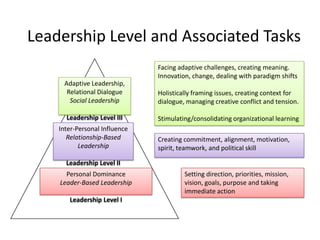
Leadership Level and Associated Tasks
                               Facing adaptive challenges, creating meaning.
                               Innovation, change, dealing with paradigm shifts
     Adaptive Leadership,
      Relational Dialogue      Holistically framing issues, creating context for
       Social Leadership       dialogue, managing creative conflict and tension.

      Leadership Level III     Stimulating/consolidating organizational learning
    Inter-Personal Influence
       Relationship-Based      Creating commitment, alignment, motivation,
           Leadership          spirit, teamwork, and political skill

      Leadership Level II
      Personal Dominance                Setting direction, priorities, mission,
    Leader-Based Leadership             vision, goals, purpose and taking
                                        immediate action
       Leadership Level I
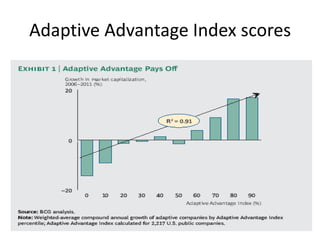
Adaptive Advantage Index scores
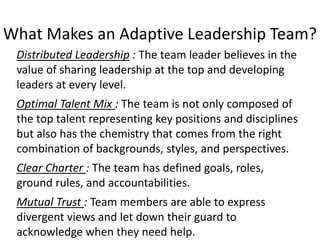
What Makes an Adaptive Leadership Team?
 Distributed Leadership : The team leader believes in the
 value of sharing leadership at the top and developing
 leaders at every level.
 Optimal Talent Mix : The team is not only composed of
 the top talent representing key positions and disciplines
 but also has the chemistry that comes from the right
 combination of backgrounds, styles, and perspectives.
 Clear Charter : The team has defined goals, roles,
 ground rules, and accountabilities.
 Mutual Trust : Team members are able to express
 divergent views and let down their guard to
 acknowledge when they need help.
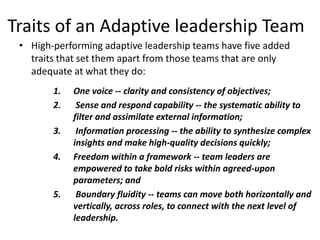
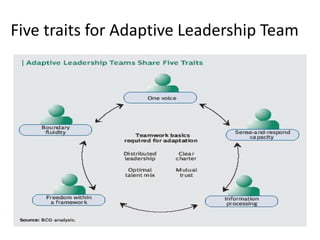
Traits of an Adaptive leadership Team
 • High-performing adaptive leadership teams have five added
   traits that set them apart from those teams that are only
   adequate at what they do:
        1.   One voice -- clarity and consistency of objectives;
        2.    Sense and respond capability -- the systematic ability to
             filter and assimilate external information;
        3.    Information processing -- the ability to synthesize complex
             insights and make high-quality decisions quickly;
        4.   Freedom within a framework -- team leaders are
             empowered to take bold risks within agreed-upon
             parameters; and
        5.    Boundary fluidity -- teams can move both horizontally and
             vertically, across roles, to connect with the next level of
             leadership.
Five traits for Adaptive Leadership Team
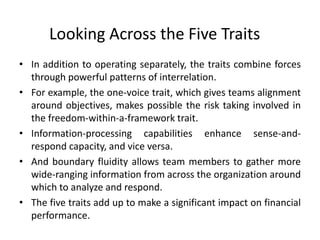
Looking Across the Five Traits
• In addition to operating separately, the traits combine forces
  through powerful patterns of interrelation.
• For example, the one-voice trait, which gives teams alignment
  around objectives, makes possible the risk taking involved in
  the freedom-within-a-framework trait.
• Information-processing capabilities enhance sense-and-
  respond capacity, and vice versa.
• And boundary fluidity allows team members to gather more
  wide-ranging information from across the organization around
  which to analyze and respond.
• The five traits add up to make a significant impact on financial
  performance.
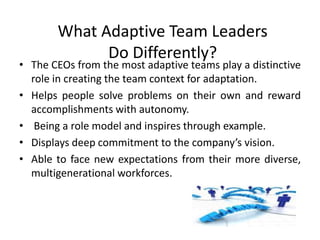
What Adaptive Team Leaders
             Do Differently?
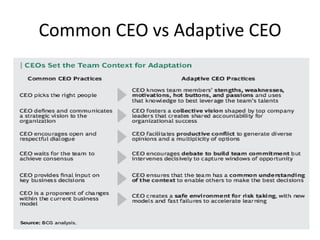
• The CEOs from the most adaptive teams play a distinctive
  role in creating the team context for adaptation.
• Helps people solve problems on their own and reward
  accomplishments with autonomy.
• Being a role model and inspires through example.
• Displays deep commitment to the company’s vision.
• Able to face new expectations from their more diverse,
  multigenerational workforces.
Common CEO vs Adaptive CEO
TEAM ANALYSIS SYSTEM (TAS)
     Allows an Organization….
• To identify ideal team culture
• Assess actual team culture
• Assesses every team member against the team culture
•Team Strengths
• Roles required
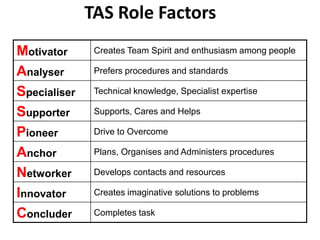
TAS Role Factors
Motivator      Creates Team Spirit and enthusiasm among people

Analyser       Prefers procedures and standards

Specialiser    Technical knowledge, Specialist expertise

Supporter      Supports, Cares and Helps

Pioneer        Drive to Overcome

Anchor         Plans, Organises and Administers procedures

Networker      Develops contacts and resources

Innovator      Creates imaginative solutions to problems

Concluder      Completes task
Adaptive  leadership team

Adaptive leadership team

  • 2.
    Questions? • What is a Team? • What do you mean by Adaptive Leadership Team? • What are the qualities of a Adaptive Leader? • What are the winning traits of an Adaptive Team? • How to strengthen a Team’s Adaptive Capability? • How to indentify teams issues and challenges?
  • 3.
    TEAM A group oftwo or more people with complementary skills who are committed to a common purpose and approach for which the team holds its members mutually accountable.
  • 4.
  • 5.
    Today’s Leadership TeamNeeds • Today’s business environment is very volatile, uncertain and globally distributed. • Leadership at top need to act as a team sport, not a heroic Individual effort. • Matches are won by teams and not individuals. • A leader cannot single-handedly manage such conditions. • Leadership at the top is now a team effort.
  • 6.
    Leadership Level andAssociated Tasks Facing adaptive challenges, creating meaning. Innovation, change, dealing with paradigm shifts Adaptive Leadership, Relational Dialogue Holistically framing issues, creating context for Social Leadership dialogue, managing creative conflict and tension. Leadership Level III Stimulating/consolidating organizational learning Inter-Personal Influence Relationship-Based Creating commitment, alignment, motivation, Leadership spirit, teamwork, and political skill Leadership Level II Personal Dominance Setting direction, priorities, mission, Leader-Based Leadership vision, goals, purpose and taking immediate action Leadership Level I
  • 7.
  • 8.
    What Makes anAdaptive Leadership Team? Distributed Leadership : The team leader believes in the value of sharing leadership at the top and developing leaders at every level. Optimal Talent Mix : The team is not only composed of the top talent representing key positions and disciplines but also has the chemistry that comes from the right combination of backgrounds, styles, and perspectives. Clear Charter : The team has defined goals, roles, ground rules, and accountabilities. Mutual Trust : Team members are able to express divergent views and let down their guard to acknowledge when they need help.
  • 9.
    Traits of anAdaptive leadership Team • High-performing adaptive leadership teams have five added traits that set them apart from those teams that are only adequate at what they do: 1. One voice -- clarity and consistency of objectives; 2. Sense and respond capability -- the systematic ability to filter and assimilate external information; 3. Information processing -- the ability to synthesize complex insights and make high-quality decisions quickly; 4. Freedom within a framework -- team leaders are empowered to take bold risks within agreed-upon parameters; and 5. Boundary fluidity -- teams can move both horizontally and vertically, across roles, to connect with the next level of leadership.
  • 10.
    Five traits forAdaptive Leadership Team
  • 11.
    Looking Across theFive Traits • In addition to operating separately, the traits combine forces through powerful patterns of interrelation. • For example, the one-voice trait, which gives teams alignment around objectives, makes possible the risk taking involved in the freedom-within-a-framework trait. • Information-processing capabilities enhance sense-and- respond capacity, and vice versa. • And boundary fluidity allows team members to gather more wide-ranging information from across the organization around which to analyze and respond. • The five traits add up to make a significant impact on financial performance.
  • 12.
    What Adaptive TeamLeaders Do Differently? • The CEOs from the most adaptive teams play a distinctive role in creating the team context for adaptation. • Helps people solve problems on their own and reward accomplishments with autonomy. • Being a role model and inspires through example. • Displays deep commitment to the company’s vision. • Able to face new expectations from their more diverse, multigenerational workforces.
  • 13.
    Common CEO vsAdaptive CEO
  • 14.
    TEAM ANALYSIS SYSTEM(TAS) Allows an Organization…. • To identify ideal team culture • Assess actual team culture • Assesses every team member against the team culture •Team Strengths • Roles required
  • 15.
    TAS Role Factors Motivator Creates Team Spirit and enthusiasm among people Analyser Prefers procedures and standards Specialiser Technical knowledge, Specialist expertise Supporter Supports, Cares and Helps Pioneer Drive to Overcome Anchor Plans, Organises and Administers procedures Networker Develops contacts and resources Innovator Creates imaginative solutions to problems Concluder Completes task