1
PRESENTED BY: M.ANISHA   I MBA(GA)
Presented by


               2
LEADERSHIP

• DEFINITION
• INGREDIENTS
• APPROACHES
• THEORIES
• STYLE
• QUALITIES
• IMPORTANCE
• SKILLS
• MANAGER v/s
  LEADER
• WOMEN          3
  PERSPECTIVE
LEADERSHIP
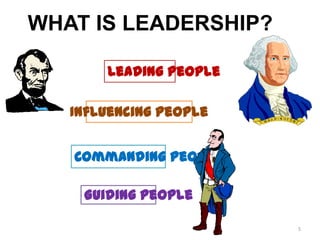
WHAT IS LEADERSHIP?

       Leading people

   Influencing people


   Commanding people

    Guiding people

                        5
“Management is doing things right, leadership is doing the right things”

                         Warren Bennis and Peter Drucker


"leadership is influence - nothing more, nothing less."

                         John C Maxwell


“Getting extra-ordinary performance out of ordinary people”

                         Sir John Harvey Jones

                                                                           6
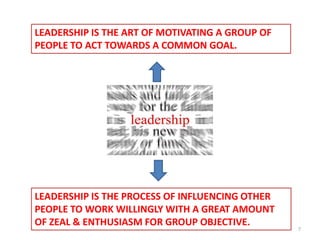
LEADERSHIP IS THE ART OF MOTIVATING A GROUP OF
PEOPLE TO ACT TOWARDS A COMMON GOAL.


LEADERSHIP IS THE PROCESS OF INFLUENCING OTHER
PEOPLE TO WORK WILLINGLY WITH A GREAT AMOUNT
OF ZEAL & ENTHUSIASM FOR GROUP OBJECTIVE.
                                                 7
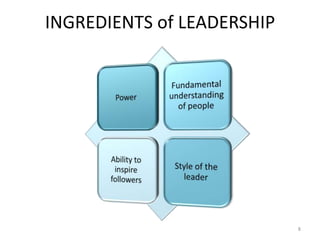
INGREDIENTS of LEADERSHIP


                            8
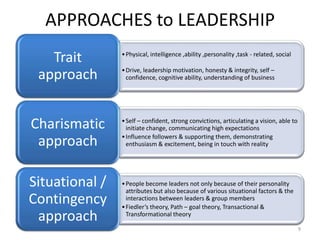
APPROACHES to LEADERSHIP
   Trait        • Physical, intelligence ,ability ,personality ,task - related, social

                • Drive, leadership motivation, honesty & integrity, self –
 approach         confidence, cognitive ability, understanding of business


Charismatic     • Self – confident, strong convictions, articulating a vision, able to
                  initiate change, communicating high expectations
                • Influence followers & supporting them, demonstrating
 approach         enthusiasm & excitement, being in touch with reality


Situational /   • People become leaders not only because of their personality
                  attributes but also because of various situational factors & the
Contingency       interactions between leaders & group members
                • Fiedler’s theory, Path – goal theory, Transactional &
 approach         Transformational theory

                                                                                         9
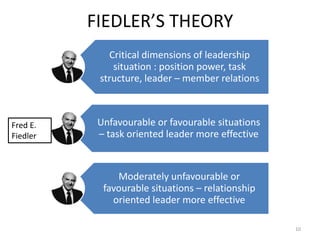
FIEDLER’S THEORY
             Critical dimensions of leadership
              situation : position power, task
           structure, leader – member relations


Fred E.    Unfavourable or favourable situations
Fiedler    – task oriented leader more effective


               Moderately unfavourable or
            favourable situations – relationship
              oriented leader more effective

                                                   10
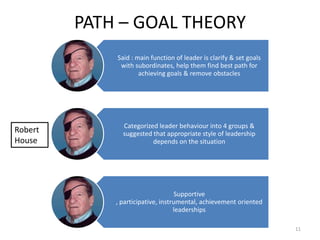
PATH – GOAL THEORY
             Said : main function of leader is clarify & set goals
              with subordinates, help them find best path for
                     achieving goals & remove obstacles


               Categorized leader behaviour into 4 groups &
Robert         suggested that appropriate style of leadership
House                    depends on the situation


                                    Supportive
             , participative, instrumental, achievement oriented
                                   leaderships

                                                                     11
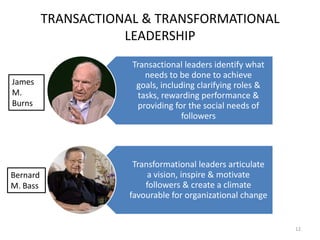
TRANSACTIONAL & TRANSFORMATIONAL
                     LEADERSHIP
                      Transactional leaders identify what
                         needs to be done to achieve
James                  goals, including clarifying roles &
M.                     tasks, rewarding performance &
Burns                  providing for the social needs of
                                    followers


                      Transformational leaders articulate
Bernard                   a vision, inspire & motivate
M. Bass                  followers & create a climate
                     favourable for organizational change


                                                             12
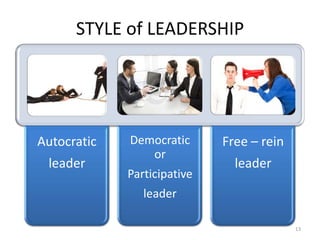
STYLE of LEADERSHIP


Autocratic   Democratic      Free – rein
                or
 leader                        leader
             Participative
                leader

                                           13
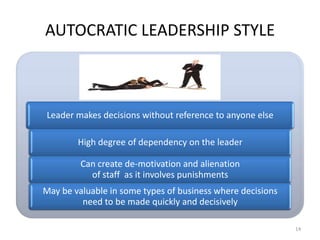
AUTOCRATIC LEADERSHIP STYLE


Leader makes decisions without reference to anyone else

        High degree of dependency on the leader

         Can create de-motivation and alienation
           of staff as it involves punishments
May be valuable in some types of business where decisions
         need to be made quickly and decisively

                                                            14
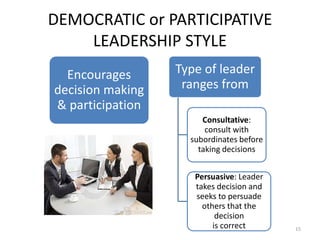
DEMOCRATIC or PARTICIPATIVE
    LEADERSHIP STYLE
  Encourages      Type of leader
decision making    ranges from
& participation
                       Consultative:
                        consult with
                    subordinates before
                      taking decisions


                     Persuasive: Leader
                     takes decision and
                     seeks to persuade
                       others that the
                           decision
                          is correct      15
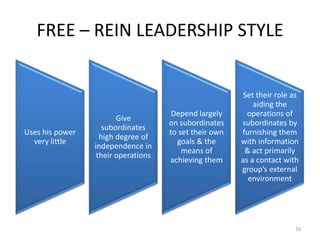
FREE – REIN LEADERSHIP STYLE


                                                         Set their role as
                                                            aiding the
                                      Depend largely      operations of
                        Give
                                     on subordinates    subordinates by
                    subordinates
Uses his power                       to set their own   furnishing them
                   high degree of
  very little                          goals & the      with information
                 independence in
                                         means of        & act primarily
                  their operations
                                     achieving them     as a contact with
                                                        group’s external
                                                          environment


                                                                        16
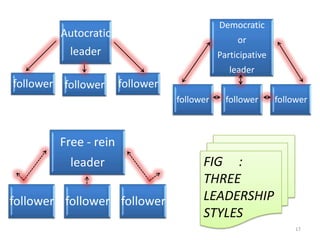
Democratic
        Autocratic
                                                 or
          leader                            Participative
                                               leader
follower follower     follower
                                 follower     follower      follower


        Free - rein
          leader                       FIG :
                                       THREE
follower follower follower             LEADERSHIP
                                       STYLES
                                                                 17
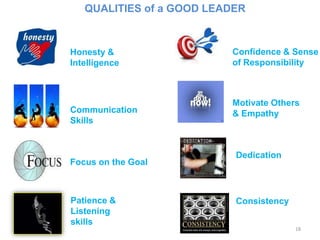
QUALITIES of a GOOD LEADER


Honesty &                 Confidence & Sense
Intelligence              of Responsibility


                          Motivate Others
Communication             & Empathy
Skills


                           Dedication
Focus on the Goal


Patience &                 Consistency
Listening
skills
                                         18
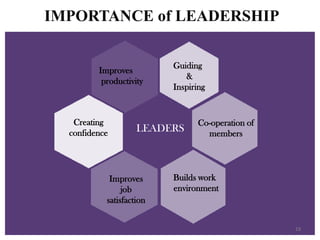
IMPORTANCE of LEADERSHIP

                          Guiding
         Improves
                             &
          productivity
                          Inspiring


   Creating                      Co-operation of
  confidence        LEADERS        members


            Improves      Builds work
                job       environment
           satisfaction


                                                   19
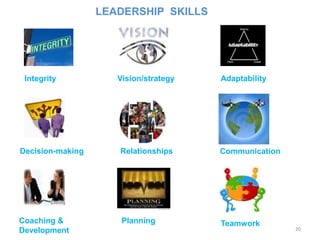
LEADERSHIP SKILLS


 Integrity           Vision/strategy   Adaptability


Decision-making      Relationships     Communication


Coaching &            Planning         Teamwork
Development                                            20
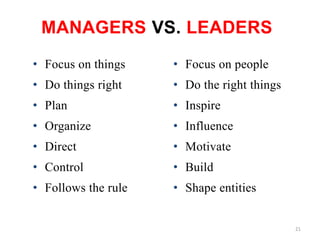
MANAGERS VS. LEADERS
• Focus on things    • Focus on people
• Do things right    • Do the right things
• Plan               • Inspire
• Organize           • Influence
• Direct             • Motivate
• Control            • Build
• Follows the rule   • Shape entities


                                             21
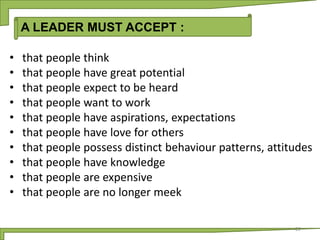
A LEADER MUST ACCEPT :

•   that people think
•   that people have great potential
•   that people expect to be heard
•   that people want to work
•   that people have aspirations, expectations
•   that people have love for others
•   that people possess distinct behaviour patterns, attitudes
•   that people have knowledge
•   that people are expensive
•   that people are no longer meek

                                                          22
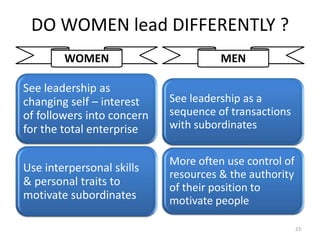
DO WOMEN lead DIFFERENTLY ?
        WOMEN                         MEN

See leadership as
changing self – interest    See leadership as a
of followers into concern   sequence of transactions
for the total enterprise    with subordinates


                            More often use control of
Use interpersonal skills
                            resources & the authority
& personal traits to        of their position to
motivate subordinates       motivate people

                                                        23
How Far Can You Go?
          THANK
       THANK YOU !!!
          YOU !!!

Leadership

  • 1.
  • 2.
  • 3.
    LEADERSHIP • DEFINITION • INGREDIENTS •APPROACHES • THEORIES • STYLE • QUALITIES • IMPORTANCE • SKILLS • MANAGER v/s LEADER • WOMEN 3 PERSPECTIVE
  • 4.
  • 5.
    WHAT IS LEADERSHIP? Leading people Influencing people Commanding people Guiding people 5
  • 6.
    “Management is doingthings right, leadership is doing the right things” Warren Bennis and Peter Drucker "leadership is influence - nothing more, nothing less." John C Maxwell “Getting extra-ordinary performance out of ordinary people” Sir John Harvey Jones 6
  • 7.
    LEADERSHIP IS THEART OF MOTIVATING A GROUP OF PEOPLE TO ACT TOWARDS A COMMON GOAL. LEADERSHIP IS THE PROCESS OF INFLUENCING OTHER PEOPLE TO WORK WILLINGLY WITH A GREAT AMOUNT OF ZEAL & ENTHUSIASM FOR GROUP OBJECTIVE. 7
  • 8.
  • 9.
    APPROACHES to LEADERSHIP Trait • Physical, intelligence ,ability ,personality ,task - related, social • Drive, leadership motivation, honesty & integrity, self – approach confidence, cognitive ability, understanding of business Charismatic • Self – confident, strong convictions, articulating a vision, able to initiate change, communicating high expectations • Influence followers & supporting them, demonstrating approach enthusiasm & excitement, being in touch with reality Situational / • People become leaders not only because of their personality attributes but also because of various situational factors & the Contingency interactions between leaders & group members • Fiedler’s theory, Path – goal theory, Transactional & approach Transformational theory 9
  • 10.
    FIEDLER’S THEORY Critical dimensions of leadership situation : position power, task structure, leader – member relations Fred E. Unfavourable or favourable situations Fiedler – task oriented leader more effective Moderately unfavourable or favourable situations – relationship oriented leader more effective 10
  • 11.
    PATH – GOALTHEORY Said : main function of leader is clarify & set goals with subordinates, help them find best path for achieving goals & remove obstacles Categorized leader behaviour into 4 groups & Robert suggested that appropriate style of leadership House depends on the situation Supportive , participative, instrumental, achievement oriented leaderships 11
  • 12.
    TRANSACTIONAL & TRANSFORMATIONAL LEADERSHIP Transactional leaders identify what needs to be done to achieve James goals, including clarifying roles & M. tasks, rewarding performance & Burns providing for the social needs of followers Transformational leaders articulate Bernard a vision, inspire & motivate M. Bass followers & create a climate favourable for organizational change 12
  • 13.
    STYLE of LEADERSHIP Autocratic Democratic Free – rein or leader leader Participative leader 13
  • 14.
    AUTOCRATIC LEADERSHIP STYLE Leadermakes decisions without reference to anyone else High degree of dependency on the leader Can create de-motivation and alienation of staff as it involves punishments May be valuable in some types of business where decisions need to be made quickly and decisively 14
  • 15.
    DEMOCRATIC or PARTICIPATIVE LEADERSHIP STYLE Encourages Type of leader decision making ranges from & participation Consultative: consult with subordinates before taking decisions Persuasive: Leader takes decision and seeks to persuade others that the decision is correct 15
  • 16.
    FREE – REINLEADERSHIP STYLE Set their role as aiding the Depend largely operations of Give on subordinates subordinates by subordinates Uses his power to set their own furnishing them high degree of very little goals & the with information independence in means of & act primarily their operations achieving them as a contact with group’s external environment 16
  • 17.
    Democratic Autocratic or leader Participative leader follower follower follower follower follower follower Free - rein leader FIG : THREE follower follower follower LEADERSHIP STYLES 17
  • 18.
    QUALITIES of aGOOD LEADER Honesty & Confidence & Sense Intelligence of Responsibility Motivate Others Communication & Empathy Skills Dedication Focus on the Goal Patience & Consistency Listening skills 18
  • 19.
    IMPORTANCE of LEADERSHIP Guiding Improves & productivity Inspiring Creating Co-operation of confidence LEADERS members Improves Builds work job environment satisfaction 19
  • 20.
    LEADERSHIP SKILLS Integrity Vision/strategy Adaptability Decision-making Relationships Communication Coaching & Planning Teamwork Development 20
  • 21.
    MANAGERS VS. LEADERS •Focus on things • Focus on people • Do things right • Do the right things • Plan • Inspire • Organize • Influence • Direct • Motivate • Control • Build • Follows the rule • Shape entities 21
  • 22.
    A LEADER MUSTACCEPT : • that people think • that people have great potential • that people expect to be heard • that people want to work • that people have aspirations, expectations • that people have love for others • that people possess distinct behaviour patterns, attitudes • that people have knowledge • that people are expensive • that people are no longer meek 22
  • 23.
    DO WOMEN leadDIFFERENTLY ? WOMEN MEN See leadership as changing self – interest See leadership as a of followers into concern sequence of transactions for the total enterprise with subordinates More often use control of Use interpersonal skills resources & the authority & personal traits to of their position to motivate subordinates motivate people 23
  • 24.
    How Far CanYou Go? THANK THANK YOU !!! YOU !!!