Leadership vs.
 Management
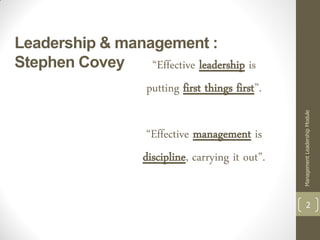
Leadership & management :
Stephen Covey    “Effective leadership is
                      putting first things first”.


                                                     Management Leadership Module
                      “Effective management is
                     discipline, carrying it out”.

                                                               2
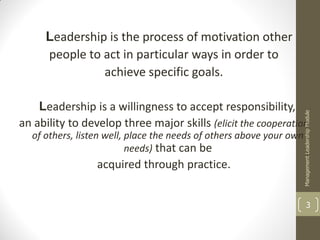
Leadership is the process of motivation other
     people to act in particular ways in order to
               achieve specific goals.

    Leadership is a willingness to accept responsibility,


                                                                     Management Leadership Module
an ability to develop three major skills (elicit the cooperation
  of others, listen well, place the needs of others above your own
                          needs) that can be
                 acquired through practice.


                                                                               3
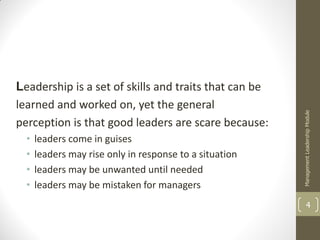
Leadership is a set of skills and traits that can be
learned and worked on, yet the general


                                                         Management Leadership Module
perception is that good leaders are scare because:
  •   leaders come in guises
  •   leaders may rise only in response to a situation
  •   leaders may be unwanted until needed
  •   leaders may be mistaken for managers
                                                                   4
What is the difference between
  a leader and a manager?


                                 Management Leadership Module
                                           5
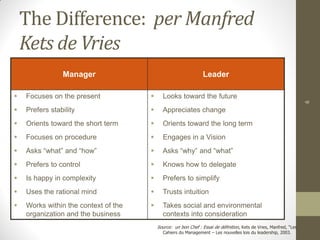
The Difference: per Manfred
    Kets de Vries
                Manager                                          Leader

   Focuses on the present                 Looks toward the future


                                                                                                                    6
   Prefers stability                      Appreciates change
   Orients toward the short term          Orients toward the long term
   Focuses on procedure                   Engages in a Vision
   Asks “what” and “how”                  Asks “why” and “what”
   Prefers to control                     Knows how to delegate
   Is happy in complexity                 Prefers to simplify
   Uses the rational mind                 Trusts intuition
   Works within the context of the        Takes social and environmental
    organization and the business           contexts into consideration
                                          Source: un bon Chef : Essai de définition, Kets de Vries, Manfred, “Les
                                            Cahiers du Management – Les nouvelles lois du leadership, 2003.
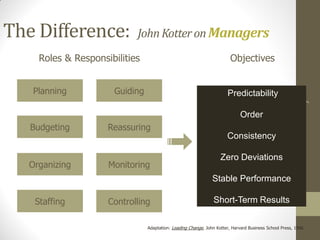
The Difference:             John Kotter on Managers
     Roles & Responsibilities                                           Objectives


   Planning           Guiding                                          Predictability


                                                                                                            7
                                                                             Order
   Budgeting         Reassuring
                                                                       Consistency

                                                                   Zero Deviations
   Organizing        Monitoring
                                                               Stable Performance

    Staffing         Controlling                                Short-Term Results


                                Adaptation: Leading Change, John Kotter, Harvard Business School Press, 1996.
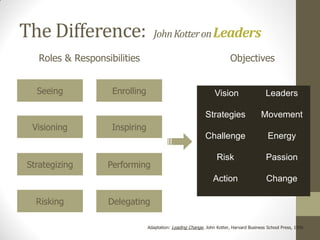
The Difference:                    John Kotter on Leaders

   Roles & Responsibilities                                             Objectives


  Seeing            Enrolling                                   Vision                   Leaders


                                                                                                            8
                                                            Strategies                 Movement
 Visioning          Inspiring
                                                            Challenge                     Energy

                                                                 Risk                     Passion
Strategizing       Performing
                                                                Action                    Change

  Risking          Delegating

                                Adaptation: Leading Change, John Kotter, Harvard Business School Press, 1996.
Leadership vs. Management
Leadership can been seen as performing the influencing
function of management, largely involved in goals setting
and motivating people to achieve them. Leaders decide


                                                                      Management Leadership Module
‘where we are going’ and influence people to take that
particular direction, rather than describe ‘how we are going
to get there’.
Inspired leaders are not necessarily good organizers and excellent
managers.
The most effective managers are also leaders, and the quality of
leadership has become and increasingly important part of management             9
ability.
Leadership Types
All leadership is temporary-the transient nature of
leadership is because the situation may come to an
end or times and circumstances change:

        • Situational Leadership


                                                      Management Leadership Module
        • Transitional Leadership
        • Hierarchical Leadership

                                                      10
Situational Leadership
• The right person in the right place at the right
  moment.
• Recognize the time and circumstances.


                                                                                Management Leadership Module
• Willingness and ability to assume the responsibility,
  listen and to take the responsibility to help the group
  achieve its goal.
• It often involves: no cost decision, solomonic decision, moral
 decision, meditative decision, community decisions, philanthropic
 decisions, institutional decisions, community decisions, princely decisions.
Bring example form your own experience                                          11
Transitional Leadership
 • The right time but wrong circumstances.
 • It may occur when: leadership requires at a certain
   moment, but the person who is the leader may not


                                                                  Management Leadership Module
   be capable of delivering the leadership.
 • Transitional leaders may: be missing all the right stuff, be
  fearing the risk.


 Bring example form your own experience
                                                                  12
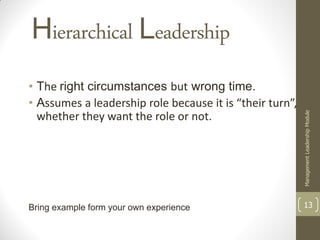
Hierarchical Leadership
• The right circumstances but wrong time.
• Assumes a leadership role because it is “their turn”,


                                                          Management Leadership Module
  whether they want the role or not.


Bring example form your own experience                    13
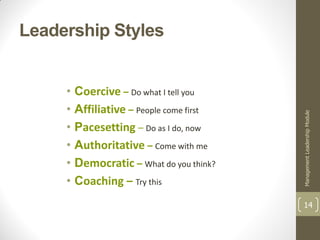
Leadership Styles


     • Coercive – Do what I tell you
     • Affiliative – People come first


                                         Management Leadership Module
     • Pacesetting – Do as I do, now
     • Authoritative – Come with me
     • Democratic – What do you think?
     • Coaching – Try this
                                         14
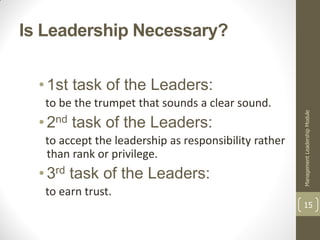
Is Leadership Necessary?


  • 1st task of the Leaders:
   to be the trumpet that sounds a clear sound.


                                                       Management Leadership Module
  • 2nd task of the Leaders:
   to accept the leadership as responsibility rather
   than rank or privilege.
  • 3rd task of the Leaders:
   to earn trust.
                                                       15
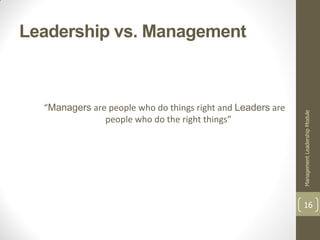
Leadership vs. Management


  “Managers are people who do things right and Leaders are


                                                             Management Leadership Module
               people who do the right things”


                                                             16
Transitioning from Manager to
Leader
• The journey from manager to leader, and from leader to
  executive, has 3 key transition points
  • Manager: from individual performer to managing a team; “what’s
    good for me”  “what’s good for my team”


                                                                     17
  • Leader: from managing a team to orchestrating groups of teams;
    “what’s good for my team  what’s good for the organization”
  • Executive: from groups of teams to complex organizations;
    “what’s good for my organization  what’s the larger, longer
    term context”

• Transitioning is situational as well as hierarchical

Leadership vs. management

  • 1.
  • 2.
    Leadership & management: Stephen Covey “Effective leadership is putting first things first”. Management Leadership Module “Effective management is discipline, carrying it out”. 2
  • 3.
    Leadership is theprocess of motivation other people to act in particular ways in order to achieve specific goals. Leadership is a willingness to accept responsibility, Management Leadership Module an ability to develop three major skills (elicit the cooperation of others, listen well, place the needs of others above your own needs) that can be acquired through practice. 3
  • 4.
    Leadership is aset of skills and traits that can be learned and worked on, yet the general Management Leadership Module perception is that good leaders are scare because: • leaders come in guises • leaders may rise only in response to a situation • leaders may be unwanted until needed • leaders may be mistaken for managers 4
  • 5.
    What is thedifference between a leader and a manager? Management Leadership Module 5
  • 6.
    The Difference: perManfred Kets de Vries Manager Leader  Focuses on the present  Looks toward the future 6  Prefers stability  Appreciates change  Orients toward the short term  Orients toward the long term  Focuses on procedure  Engages in a Vision  Asks “what” and “how”  Asks “why” and “what”  Prefers to control  Knows how to delegate  Is happy in complexity  Prefers to simplify  Uses the rational mind  Trusts intuition  Works within the context of the  Takes social and environmental organization and the business contexts into consideration Source: un bon Chef : Essai de définition, Kets de Vries, Manfred, “Les Cahiers du Management – Les nouvelles lois du leadership, 2003.
  • 7.
    The Difference: John Kotter on Managers Roles & Responsibilities Objectives Planning Guiding Predictability 7 Order Budgeting Reassuring Consistency Zero Deviations Organizing Monitoring Stable Performance Staffing Controlling Short-Term Results Adaptation: Leading Change, John Kotter, Harvard Business School Press, 1996.
  • 8.
    The Difference: John Kotter on Leaders Roles & Responsibilities Objectives Seeing Enrolling Vision Leaders 8 Strategies Movement Visioning Inspiring Challenge Energy Risk Passion Strategizing Performing Action Change Risking Delegating Adaptation: Leading Change, John Kotter, Harvard Business School Press, 1996.
  • 9.
    Leadership vs. Management Leadershipcan been seen as performing the influencing function of management, largely involved in goals setting and motivating people to achieve them. Leaders decide Management Leadership Module ‘where we are going’ and influence people to take that particular direction, rather than describe ‘how we are going to get there’. Inspired leaders are not necessarily good organizers and excellent managers. The most effective managers are also leaders, and the quality of leadership has become and increasingly important part of management 9 ability.
  • 10.
    Leadership Types All leadershipis temporary-the transient nature of leadership is because the situation may come to an end or times and circumstances change: • Situational Leadership Management Leadership Module • Transitional Leadership • Hierarchical Leadership 10
  • 11.
    Situational Leadership • Theright person in the right place at the right moment. • Recognize the time and circumstances. Management Leadership Module • Willingness and ability to assume the responsibility, listen and to take the responsibility to help the group achieve its goal. • It often involves: no cost decision, solomonic decision, moral decision, meditative decision, community decisions, philanthropic decisions, institutional decisions, community decisions, princely decisions. Bring example form your own experience 11
  • 12.
    Transitional Leadership •The right time but wrong circumstances. • It may occur when: leadership requires at a certain moment, but the person who is the leader may not Management Leadership Module be capable of delivering the leadership. • Transitional leaders may: be missing all the right stuff, be fearing the risk. Bring example form your own experience 12
  • 13.
    Hierarchical Leadership • Theright circumstances but wrong time. • Assumes a leadership role because it is “their turn”, Management Leadership Module whether they want the role or not. Bring example form your own experience 13
  • 14.
    Leadership Styles • Coercive – Do what I tell you • Affiliative – People come first Management Leadership Module • Pacesetting – Do as I do, now • Authoritative – Come with me • Democratic – What do you think? • Coaching – Try this 14
  • 15.
    Is Leadership Necessary? • 1st task of the Leaders: to be the trumpet that sounds a clear sound. Management Leadership Module • 2nd task of the Leaders: to accept the leadership as responsibility rather than rank or privilege. • 3rd task of the Leaders: to earn trust. 15
  • 16.
    Leadership vs. Management “Managers are people who do things right and Leaders are Management Leadership Module people who do the right things” 16
  • 17.
    Transitioning from Managerto Leader • The journey from manager to leader, and from leader to executive, has 3 key transition points • Manager: from individual performer to managing a team; “what’s good for me”  “what’s good for my team” 17 • Leader: from managing a team to orchestrating groups of teams; “what’s good for my team  what’s good for the organization” • Executive: from groups of teams to complex organizations; “what’s good for my organization  what’s the larger, longer term context” • Transitioning is situational as well as hierarchical