CHAPTER 15
               LEADERSHIP


15 May 2007       LEADERSHIP   1
Introduction
     Success of a business concern is
     dependent upon the ability of its
     leadership. Whenever and in whatever
     situation if someone tries to influence the
     behavior of another individual, there is a
     leadership. It helps to attain the business
     goals of an organization.


15 May 2007            LEADERSHIP              2
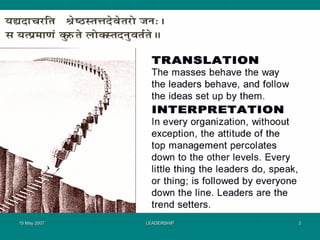
15 May 2007   LEADERSHIP   3
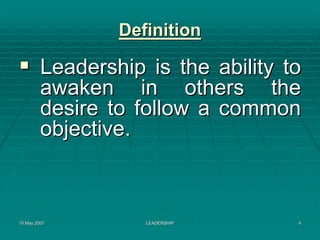
Definition

         Leadership is the ability to
         awaken in others the
         desire to follow a common
         objective.


15 May 2007         LEADERSHIP      4
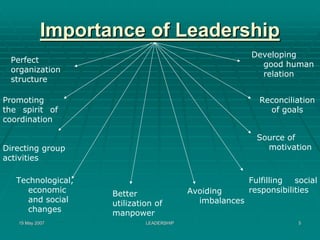
Importance of Leadership
                                                         Developing
 Perfect
                                                           good human
 organization
                                                           relation
 structure

Promoting                                                  Reconciliation
the spirit of                                                of goals
coordination

                                                           Source of
Directing group                                              motivation
activities

   Technological,                                        Fulfilling  social
      economic      Better                Avoiding       responsibilities
      and social    utilization of          imbalances
      changes       manpower
   15 May 2007               LEADERSHIP                               5
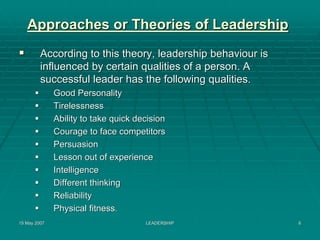
Approaches or Theories of Leadership
         According to this theory, leadership behaviour is
         influenced by certain qualities of a person. A
         successful leader has the following qualities.
              Good Personality
              Tirelessness
              Ability to take quick decision
              Courage to face competitors
              Persuasion
              Lesson out of experience
              Intelligence
              Different thinking
              Reliability
              Physical fitness.
15 May 2007                           LEADERSHIP             6
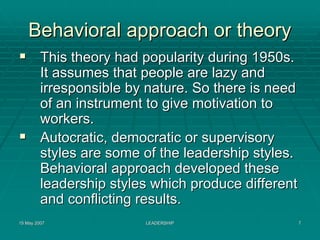
Behavioral approach or theory
         This theory had popularity during 1950s.
         It assumes that people are lazy and
         irresponsible by nature. So there is need
         of an instrument to give motivation to
         workers.
         Autocratic, democratic or supervisory
         styles are some of the leadership styles.
         Behavioral approach developed these
         leadership styles which produce different
         and conflicting results.
15 May 2007              LEADERSHIP                  7
Situationalist approach or theory
         During 1970s this theory was developed
         where some traits and behaviours are
         effective in a particular situation and
         ineffective in another situation. Situation
         helps persons to develop their leadership
         qualities and emerge as leaders


15 May 2007               LEADERSHIP               8
Follower’s theory or acceptance
                     theory
         Here, only followers decide whether a
         person is a leader or not. Followers take
         decision on the quality of the leader who
         fulfills their needs. Traits and behaviour
         are not considered as essential element
         of leadership. This is mainly applied in
         politics.


15 May 2007              LEADERSHIP               9
System theory or a path goal
                          theory
         This is focused on a person’s act
         rather than his traits or behaviour. A
         leader coordinates the efforts of his
         followers. This considers all variables
         like leader, followers, situation,
         leadership traits, environment goals
         and group’s nature, characteristics
         and needs, role behaviour of leader. It
         is also termed as modern theory of
         leadership.
15 May 2007               LEADERSHIP           10
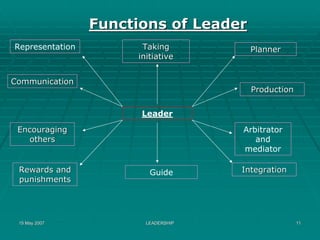
Functions of Leader
Representation         Taking          Planner
                      initiative


Communication
                                       Production


                       Leader

 Encouraging                         Arbitrator
   others                               and
                                     mediator

 Rewards and             Guide       Integration
 punishments


 15 May 2007            LEADERSHIP                  11
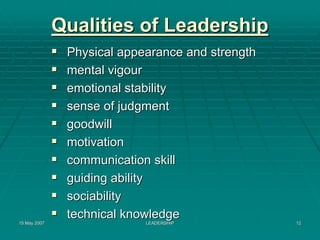
Qualities of Leadership
               Physical appearance and strength
               mental vigour
               emotional stability
               sense of judgment
               goodwill
               motivation
               communication skill
               guiding ability
               sociability
               technical knowledge
15 May 2007                 LEADERSHIP            12
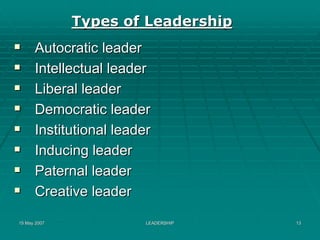
Types of Leadership
      Autocratic leader
      Intellectual leader
      Liberal leader
      Democratic leader
      Institutional leader
      Inducing leader
      Paternal leader
      Creative leader

15 May 2007              LEADERSHIP   13
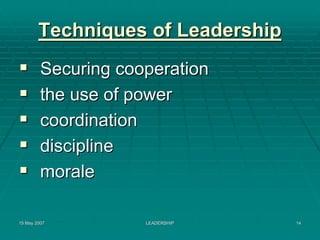
Techniques of Leadership
         Securing cooperation
         the use of power
         coordination
         discipline
         morale

15 May 2007          LEADERSHIP    14
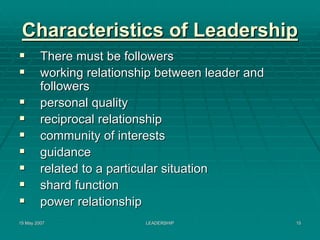
Characteristics of Leadership
         There must be followers
         working relationship between leader and
         followers
         personal quality
         reciprocal relationship
         community of interests
         guidance
         related to a particular situation
         shard function
         power relationship
15 May 2007                LEADERSHIP              15
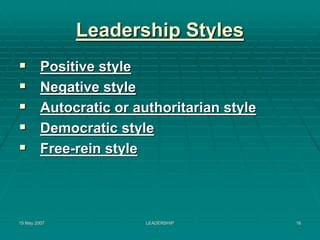
Leadership Styles
         Positive style
         Negative style
         Autocratic or authoritarian style
         Democratic style
         Free-rein style


15 May 2007              LEADERSHIP          16
Positive style

         A      leader    motivates
         followers to work hard by
         offering them rewards like
         bonus and incentives


15 May 2007        LEADERSHIP     17
Negative style
     Leader foresees his followers to
     work hard and penalize them if
     the work is not upto the standard.
     This has high human cost. Here
     everyone       tries     to    shift
     responsibility over to others.


15 May 2007         LEADERSHIP          18
Autocratic or authoritarian style
Advantages:
   Leadership style provides strong
   motivation to followers.
   Quick decision is possible.
   less talented followers can perform job
   effectively
   Followers do not take any decision
   Decision making planning need no
   initiative
15 May 2007         LEADERSHIP               19
Autocratic or authoritarian style
Disadvantages
   Most dislike this style as it takes negative
   motivation approach.
   frustration, low morale and conflict develop
   easily
   New ideas and creative ideas have no
   scope for application
   followers have no opportunity for
   development
Suitability: It is suitable to where followers are
   uneducated and unskilled.
15 May 2007           LEADERSHIP                 20
Democratic style
Advantages
   Consultation give satisfaction to the followers
   due reorganization is given to the followers
   followers are aware of the activities
   leader can improve decision making ability
   followers get opportunity to show their ability


15 May 2007            LEADERSHIP                    21
Democratic style
Disadvantages
   Taking decision and implementation
   require more time.
   Followers can dominate the leader
   leader can easily shift the responsibility
   to his followers for failure
   it requires communicating skill on part of
   leaders otherwise it may ruin the
   organization
15 May 2007         LEADERSHIP                  22
Free-rein style
Advantages
  Morale and job satisfied of the followers
  are increased to some extent.
  The talent of the followers is properly
  utilized.
  The followers get full opportunity to
  develop their talents.

15 May 2007         LEADERSHIP                23
Free-rein style
Disadvantage
   The leader does not care to motivate his
   followers.
   The contribution of a leader is nothing.
   The leader does not support the follower
   and no guidance is available to the
   fanner.

15 May 2007        LEADERSHIP                 24
THANK YOU


15 May 2007     LEADERSHIP   25

Principles of Management – Chpt 15 : Leadership

  • 1.
    CHAPTER 15 LEADERSHIP 15 May 2007 LEADERSHIP 1
  • 2.
    Introduction Success of a business concern is dependent upon the ability of its leadership. Whenever and in whatever situation if someone tries to influence the behavior of another individual, there is a leadership. It helps to attain the business goals of an organization. 15 May 2007 LEADERSHIP 2
  • 3.
    15 May 2007 LEADERSHIP 3
  • 4.
    Definition Leadership is the ability to awaken in others the desire to follow a common objective. 15 May 2007 LEADERSHIP 4
  • 5.
    Importance of Leadership Developing Perfect good human organization relation structure Promoting Reconciliation the spirit of of goals coordination Source of Directing group motivation activities Technological, Fulfilling social economic Better Avoiding responsibilities and social utilization of imbalances changes manpower 15 May 2007 LEADERSHIP 5
  • 6.
    Approaches or Theoriesof Leadership According to this theory, leadership behaviour is influenced by certain qualities of a person. A successful leader has the following qualities. Good Personality Tirelessness Ability to take quick decision Courage to face competitors Persuasion Lesson out of experience Intelligence Different thinking Reliability Physical fitness. 15 May 2007 LEADERSHIP 6
  • 7.
    Behavioral approach ortheory This theory had popularity during 1950s. It assumes that people are lazy and irresponsible by nature. So there is need of an instrument to give motivation to workers. Autocratic, democratic or supervisory styles are some of the leadership styles. Behavioral approach developed these leadership styles which produce different and conflicting results. 15 May 2007 LEADERSHIP 7
  • 8.
    Situationalist approach ortheory During 1970s this theory was developed where some traits and behaviours are effective in a particular situation and ineffective in another situation. Situation helps persons to develop their leadership qualities and emerge as leaders 15 May 2007 LEADERSHIP 8
  • 9.
    Follower’s theory oracceptance theory Here, only followers decide whether a person is a leader or not. Followers take decision on the quality of the leader who fulfills their needs. Traits and behaviour are not considered as essential element of leadership. This is mainly applied in politics. 15 May 2007 LEADERSHIP 9
  • 10.
    System theory ora path goal theory This is focused on a person’s act rather than his traits or behaviour. A leader coordinates the efforts of his followers. This considers all variables like leader, followers, situation, leadership traits, environment goals and group’s nature, characteristics and needs, role behaviour of leader. It is also termed as modern theory of leadership. 15 May 2007 LEADERSHIP 10
  • 11.
    Functions of Leader Representation Taking Planner initiative Communication Production Leader Encouraging Arbitrator others and mediator Rewards and Guide Integration punishments 15 May 2007 LEADERSHIP 11
  • 12.
    Qualities of Leadership Physical appearance and strength mental vigour emotional stability sense of judgment goodwill motivation communication skill guiding ability sociability technical knowledge 15 May 2007 LEADERSHIP 12
  • 13.
    Types of Leadership Autocratic leader Intellectual leader Liberal leader Democratic leader Institutional leader Inducing leader Paternal leader Creative leader 15 May 2007 LEADERSHIP 13
  • 14.
    Techniques of Leadership Securing cooperation the use of power coordination discipline morale 15 May 2007 LEADERSHIP 14
  • 15.
    Characteristics of Leadership There must be followers working relationship between leader and followers personal quality reciprocal relationship community of interests guidance related to a particular situation shard function power relationship 15 May 2007 LEADERSHIP 15
  • 16.
    Leadership Styles Positive style Negative style Autocratic or authoritarian style Democratic style Free-rein style 15 May 2007 LEADERSHIP 16
  • 17.
    Positive style A leader motivates followers to work hard by offering them rewards like bonus and incentives 15 May 2007 LEADERSHIP 17
  • 18.
    Negative style Leader foresees his followers to work hard and penalize them if the work is not upto the standard. This has high human cost. Here everyone tries to shift responsibility over to others. 15 May 2007 LEADERSHIP 18
  • 19.
    Autocratic or authoritarianstyle Advantages: Leadership style provides strong motivation to followers. Quick decision is possible. less talented followers can perform job effectively Followers do not take any decision Decision making planning need no initiative 15 May 2007 LEADERSHIP 19
  • 20.
    Autocratic or authoritarianstyle Disadvantages Most dislike this style as it takes negative motivation approach. frustration, low morale and conflict develop easily New ideas and creative ideas have no scope for application followers have no opportunity for development Suitability: It is suitable to where followers are uneducated and unskilled. 15 May 2007 LEADERSHIP 20
  • 21.
    Democratic style Advantages Consultation give satisfaction to the followers due reorganization is given to the followers followers are aware of the activities leader can improve decision making ability followers get opportunity to show their ability 15 May 2007 LEADERSHIP 21
  • 22.
    Democratic style Disadvantages Taking decision and implementation require more time. Followers can dominate the leader leader can easily shift the responsibility to his followers for failure it requires communicating skill on part of leaders otherwise it may ruin the organization 15 May 2007 LEADERSHIP 22
  • 23.
    Free-rein style Advantages Morale and job satisfied of the followers are increased to some extent. The talent of the followers is properly utilized. The followers get full opportunity to develop their talents. 15 May 2007 LEADERSHIP 23
  • 24.
    Free-rein style Disadvantage The leader does not care to motivate his followers. The contribution of a leader is nothing. The leader does not support the follower and no guidance is available to the fanner. 15 May 2007 LEADERSHIP 24
  • 25.
    THANK YOU 15 May2007 LEADERSHIP 25