The
Immune
System
• The immunesystem is the complex
collection of cells and organs that destroys
or neutralizes pathogens that would
otherwise cause disease or death.
• The immune system is a collection of
barriers, cells, and soluble proteins that
interact and communicate with each other
in extraordinarily complex ways.
• The modern model of immune function is
organized into three phases based on the
timing of their effects.
3.
The Immune
System
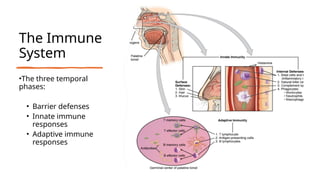
•The threetemporal
phases:
• Barrier defenses
• Innate immune
responses
• Adaptive immune
responses
4.
Barrier
Defenses
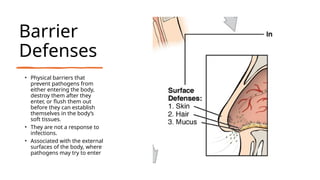
• Physical barriersthat
prevent pathogens from
either entering the body,
destroy them after they
enter, or flush them out
before they can establish
themselves in the body’s
soft tissues.
• They are not a response to
infections.
• Associated with the external
surfaces of the body, where
pathogens may try to enter
5.
Barrier
Defenses
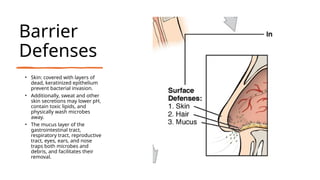
• Skin: coveredwith layers of
dead, keratinized epithelium
prevent bacterial invasion.
• Additionally, sweat and other
skin secretions may lower pH,
contain toxic lipids, and
physically wash microbes
away.
• The mucus layer of the
gastrointestinal tract,
respiratory tract, reproductive
tract, eyes, ears, and nose
traps both microbes and
debris, and facilitates their
removal.
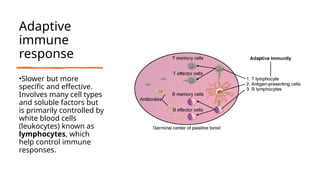
Adaptive
immune
response
•Slower but more
specificand effective.
Involves many cell types
and soluble factors but
is primarily controlled by
white blood cells
(leukocytes) known as
lymphocytes, which
help control immune
responses.
8.
The Immune
System
• Innateand adaptive immune
defenses can recognize and deal
with the same pathogens, but the
difference is the intensity and
effectiveness of the response.
• Both responses are intertwined -
not separate responses.
• Each type has a different pathway
of activation.
• Innate immune responses can
alert cells of adaptive immune
responses.
9.
Immune
System Cells
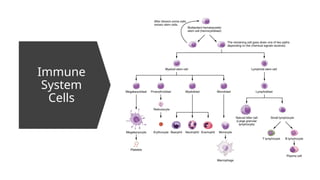
• Immunecells arise in the bone marrow
from the same hematopoietic stem cells
responsible for RBC production.
• These cells can be divided into three
classes based on function:
• Phagocytic cells, which ingest
pathogens to destroy them.
• Lymphocytes, which specifically
coordinate the activities of adaptive
immunity.
• Cells containing cytoplasmic
granules, which help mediate
immune responses against parasites
and intracellular pathogens(viruses).
Phagocytic
cells
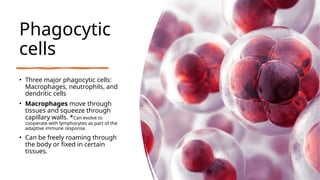
• Three majorphagocytic cells:
Macrophages, neutrophils, and
dendritic cells
• Macrophages move through
tissues and squeeze through
capillary walls. *Can evolve to
cooperate with lymphocytes as part of the
adaptive immune response.
• Can be freely roaming through
the body or fixed in certain
tissues.
12.
Phagocytic
cells
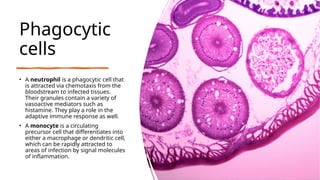
• A neutrophilis a phagocytic cell that
is attracted via chemotaxis from the
bloodstream to infected tissues.
Their granules contain a variety of
vasoactive mediators such as
histamine. They play a role in the
adaptive immune response as well.
• A monocyte is a circulating
precursor cell that differentiates into
either a macrophage or dendritic cell,
which can be rapidly attracted to
areas of infection by signal molecules
of inflammation.
13.
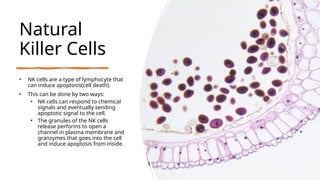
Natural
Killer Cells
• NKcells are a type of lymphocyte that
can induce apoptosis(cell death).
• This can be done by two ways:
• NK cells can respond to chemical
signals and eventually sending
apoptotic signal to the cell.
• The granules of the NK cells
release perforins to open a
channel in plasma membrane and
granzymes that goes into the cell
and induce apoptosis from inside.
14.
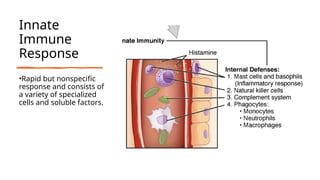
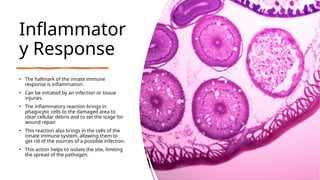
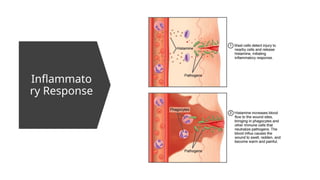
Inflammator
y Response
• Thehallmark of the innate immune
response is inflammation.
• Can be initiated by an infection or tissue
injuries.
• The inflammatory reaction brings in
phagocytic cells to the damaged area to
clear cellular debris and to set the stage for
wound repair.
• This reaction also brings in the cells of the
innate immune system, allowing them to
get rid of the sources of a possible infection.
• This action helps to isolate the site, limiting
the spread of the pathogen.
Inflammato
ry Response
• Acuteinflammation is a short-term
inflammatory response to an insult to the
body.
• Chronic inflammation is ongoing
inflammation. It can be caused by foreign
bodies, persistent pathogens, and
autoimmune diseases such as rheumatoid
arthritis or lupus.
17.
Soluble
Mediators
of the
Innate
Immune
Response
• Acytokine is signaling molecule that allows
cells to communicate with each other over
short distances.
• Interferons are secreted by cells infected
with viruses. Interferons travel to adjacent
cells and induce them to make antiviral
proteins to defend them against the coming
virus.
• The complement system is a series of
proteins found in the blood plasma. They
can kill the pathogen by fusing digestive
enzymes into it. They can also activate the
adaptive immune system.
19.
The
Adaptive
Immune
Response
• The immunesystem’s first exposure to a
pathogen is called a primary adaptive
response.
• Upon re-exposure to the same pathogen, a
secondary adaptive response is
generated, which is stronger and faster
that the primary response. This secondary
response is the basis of immunological
memory.
• Self-recognition: the ability to distinguish
between self-antigens, those that are
normally present in the body, and foreign
antigens, those that might be on a
potential pathogen.
20.
The Adaptive
Immune
Response
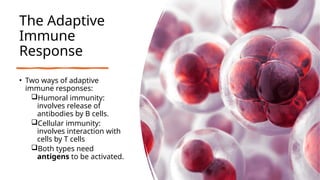
• Twoways of adaptive
immune responses:
Humoral immunity:
involves release of
antibodies by B cells.
Cellular immunity:
involves interaction with
cells by T cells
Both types need
antigens to be activated.
Antigens
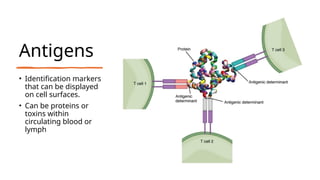
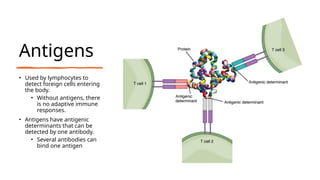
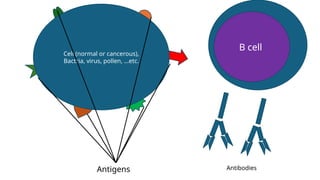
• Used bylymphocytes to
detect foreign cells entering
the body.
• Without antigens, there
is no adaptive immune
responses.
• Antigens have antigenic
determinants that can be
detected by one antibody.
• Several antibodies can
bind one antigen
Antigens
• T cellsonly recognize antigen on the
surface of specialized cells called antigen-
presenting cells (APCs).
• Macrophages, dendritic cells, and B
cells are APCs
• Antigens presented by these cells using a
specific protein known as a major
histocompatibility complex (MHC)
molecule.
• Two distinct types MHC class I and MHC
class II.
• MHC-I presented on all nucleated
cells of the body.
• MHC-II presented only on antigen
presenting cells
25.
Cells of the
AdaptiveImmune
Responses
• Adaptive immune system involves
three types of cells
• Two major types of lymphocytes
• B lymphocytes (B cells) in
humoral immunity.
• T lymphocytes (T cells
CD4+ & CD8+) in cellular
immunity
• Recent evidence
suggest NK cells as
well
• Antigen-presenting cells (APCs)
• Macrophages, dendritic
cells, and B cells
• Display antigens on MHC-II
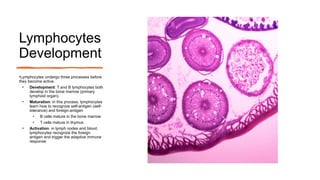
26.
Lymphocytes
Development
•Lymphocytes undergo threeprocesses before
they become active.
• Development: T and B lymphocytes both
develop in the bone marrow (primary
lymphoid organ).
• Maturation: in this process, lymphocytes
learn how to recognize self-antigen (self-
tolerance) and foreign-antigen
• B cells mature in the bone marrow
• T cells mature in thymus
• Activation: in lymph nodes and blood,
lymphocytes recognize the foreign
antigen and trigger the adaptive immune
response
27.
Antigen-
Presenting
Cells (APCs)
• Mainfunction is to present
antigens to lymphocytes.
• Recognize foreign antigen,
engulf them and process
them. They then “display”
the processed antigen
pieces on their surface.
• Major types
• Dendritic cells
• Macrophages
• B cells
28.
T Cell-Mediated
Immune
Responses
• Tcells induce cell mediated immune
response.
• Several subtypes: helper, cytotoxic and
regulatory T cells
• Each subtype performs different functions
and in different locations within the body.
• Helper and cytotoxic cells are based on
CD4 or CD8 markers that a cell can display
upon leaving the thymus.
• Regulatory T cells regulate and suppress
the immune response to not spiral out of
control and cause autoimmune diseases.
29.
T Cell-Mediated
Immune
Responses
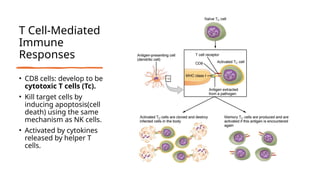
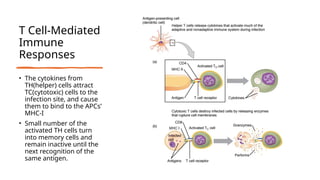
• CD8cells: develop to be
cytotoxic T cells (Tc).
• Kill target cells by
inducing apoptosis(cell
death) using the same
mechanism as NK cells.
• Activated by cytokines
released by helper T
cells.
30.
T Cell-Mediated
Immune
Responses
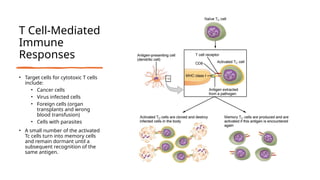
• Targetcells for cytotoxic T cells
include:
• Cancer cells
• Virus infected cells
• Foreign cells (organ
transplants and wrong
blood transfusion)
• Cells with parasites
• A small number of the activated
Tc cells turn into memory cells
and remain dormant until a
subsequent recognition of the
same antigen.
31.
T Cell-Mediated
Immune
Responses
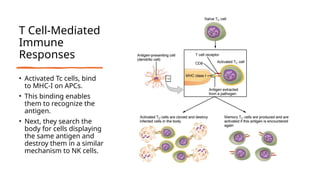
• ActivatedTc cells, bind
to MHC-I on APCs.
• This binding enables
them to recognize the
antigen.
• Next, they search the
body for cells displaying
the same antigen and
destroy them in a similar
mechanism to NK cells.
32.
T Cell-Mediated
Immune
Responses
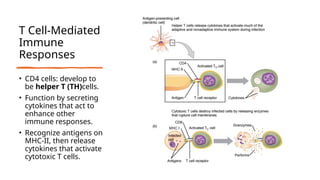
• CD4cells: develop to
be helper T (TH)cells.
• Function by secreting
cytokines that act to
enhance other
immune responses.
• Recognize antigens on
MHC-II, then release
cytokines that activate
cytotoxic T cells.
33.
T Cell-Mediated
Immune
Responses
• Thecytokines from
TH(helper) cells attract
TC(cytotoxic) cells to the
infection site, and cause
them to bind to the APCs’
MHC-I
• Small number of the
activated TH cells turn
into memory cells and
remain inactive until the
next recognition of the
same antigen.
34.
B
Humoral-
Mediated
Immune
Response
s
• B cellsinduce humoral immune response.
The humoral response is a type of adaptive
immunity that relies on B cells and antibodies
to fight off.
• They produce and release antibodies that
attach and neutralize or agglutinate antigens.
• There are five different classes of antibody in
humans: IgM, IgD, IgG, IgA, and IgE. Each one
has specific functions in the immune
response.
• B cells do not recognize antigen in the
complex fashion of T cells.
• B cells can recognize native, unprocessed
antigens and do not require the participation
of MHC molecules and antigen-presenting
cells.
35.
Antibody
Structure
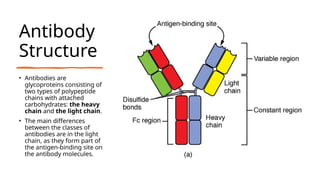
• Antibodies are
glycoproteinsconsisting of
two types of polypeptide
chains with attached
carbohydrates: the heavy
chain and the light chain.
• The main differences
between the classes of
antibodies are in the light
chain, as they form part of
the antigen-binding site on
the antibody molecules.
36.
Five Classes of
Antibodiesand
their Functions
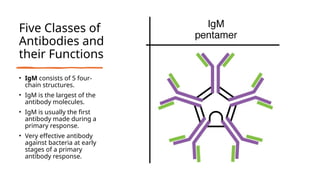
• IgM consists of 5 four-
chain structures.
• IgM is the largest of the
antibody molecules.
• IgM is usually the first
antibody made during a
primary response.
• Very effective antibody
against bacteria at early
stages of a primary
antibody response.
37.
Five Classes of
Antibodiesand
their Functions
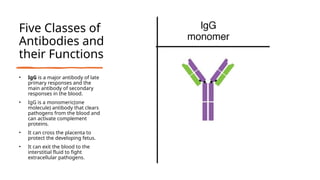
• IgG is a major antibody of late
primary responses and the
main antibody of secondary
responses in the blood.
• IgG is a monomeric(one
molecule) antibody that clears
pathogens from the blood and
can activate complement
proteins.
• It can cross the placenta to
protect the developing fetus.
• It can exit the blood to the
interstitial fluid to fight
extracellular pathogens.
38.
Five Classes of
Antibodiesand
their Functions
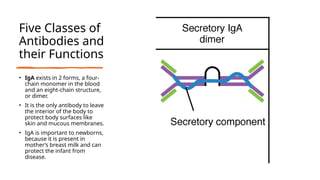
• IgA exists in 2 forms, a four-
chain monomer in the blood
and an eight-chain structure,
or dimer.
• It is the only antibody to leave
the interior of the body to
protect body surfaces like
skin and mucous membranes.
• IgA is important to newborns,
because it is present in
mother’s breast milk and can
protect the infant from
disease.
39.
Five Classes of
Antibodiesand
their Functions
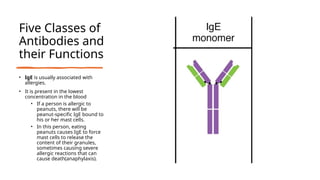
• IgE is usually associated with
allergies.
• It is present in the lowest
concentration in the blood
• If a person is allergic to
peanuts, there will be
peanut-specific IgE bound to
his or her mast cells.
• In this person, eating
peanuts causes IgE to force
mast cells to release the
content of their granules,
sometimes causing severe
allergic reactions that can
cause death(anaphylaxis).
40.
Five Classes of
Antibodiesand
their Functions
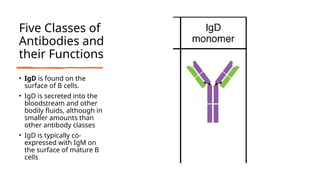
• IgD is found on the
surface of B cells.
• IgD is secreted into the
bloodstream and other
bodily fluids, although in
smaller amounts than
other antibody classes
• IgD is typically co-
expressed with IgM on
the surface of mature B
cells
41.
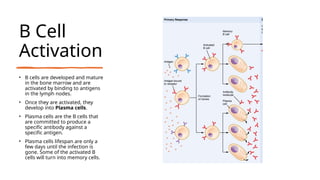
B Cell
Activation
• Bcells are developed and mature
in the bone marrow and are
activated by binding to antigens
in the lymph nodes.
• Once they are activated, they
develop into Plasma cells.
• Plasma cells are the B cells that
are committed to produce a
specific antibody against a
specific antigen.
• Plasma cells lifespan are only a
few days until the infection is
gone. Some of the activated B
cells will turn into memory cells.
42.
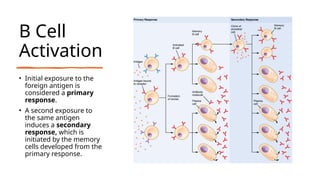
B Cell
Activation
• Initialexposure to the
foreign antigen is
considered a primary
response.
• A second exposure to
the same antigen
induces a secondary
response, which is
initiated by the memory
cells developed from the
primary response.
43.
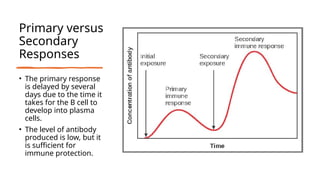
Primary versus
Secondary
Responses
• Theprimary response
is delayed by several
days due to the time it
takes for the B cell to
develop into plasma
cells.
• The level of antibody
produced is low, but it
is sufficient for
immune protection.
44.
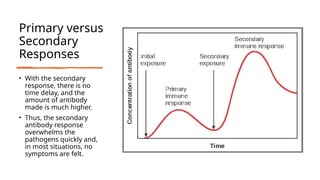
Primary versus
Secondary
Responses
• Withthe secondary
response, there is no
time delay, and the
amount of antibody
made is much higher.
• Thus, the secondary
antibody response
overwhelms the
pathogens quickly and,
in most situations, no
symptoms are felt.
45.
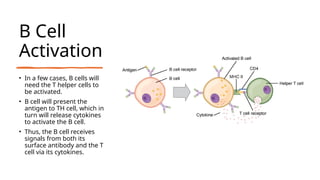
B Cell
Activation
• Ina few cases, B cells will
need the T helper cells to
be activated.
• B cell will present the
antigen to TH cell, which in
turn will release cytokines
to activate the B cell.
• Thus, the B cell receives
signals from both its
surface antibody and the T
cell via its cytokines.
46.
Active and
Passive
Immunity
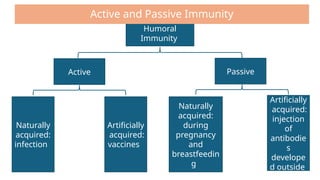
• Activeimmunity is the resistance to
pathogens acquired during an adaptive
immune response within an individual.
• Naturally acquired active immunity, the
response to a pathogen that naturally
invaded the body.
• Artificially acquired active immunity is
when the pathogen is introduced to the
body as the example of vaccines.
• A vaccine is a killed or weakened
pathogen or its components that, when
administered to a healthy individual,
leads to the development of
immunological memory (a weakened
primary immune response) without
causing much in the way of symptoms.
47.
Active and
Passive
Immunity
• Passiveimmunity arises from the transfer
of antibodies to an individual without
requiring them to mount their own active
immune response.
*No antigen involved therefore no
immunological memory, and it is only effective
for short period of time.
• Naturally acquired is seen during fetal
development and breast feeding. Antibodies
cross the placenta or passed with milk
protect the fetus/baby from infection for the
first few months of its life.
• Artificially acquired usually involves
injections of immunoglobulins taken from
animals previously exposed to a specific
pathogen.
Immunodeficienci
es
• Acquired immunedeficiency
syndrome (AIDS)
• A result of human
immunodeficiency virus (HIV)
that targets the helper T cells.
• HIV uses CD4 as the receptor to
get inside cells.
• Treatment for the disease
consists of drugs that target
virally encoded proteins that are
necessary for viral replication,
but are absent from normal
human cells.
50.
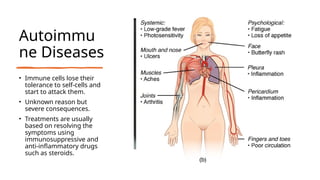
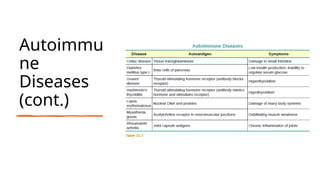
Autoimmu
ne Diseases
• Immunecells lose their
tolerance to self-cells and
start to attack them.
• Unknown reason but
severe consequences.
• Treatments are usually
based on resolving the
symptoms using
immunosuppressive and
anti-inflammatory drugs
such as steroids.
Hypersensitivitie
s
• The word“hypersensitivity” simply means
sensitive beyond normal levels of activation.
• The immune system is stimulated and ready
to initiate a complex immune response even
with minimum exposure to antigens.
• Four types based on the way they occur.
53.
Hypersensitivitie
s
• Type Iinvolves the mast cells releasing
histamine
• Type II involves the complement system
and happens with mismatched blood
transfusion
• Type III is when the antibody and antigen
precipitate in blood vessels and cause
inflammation
• Type IV is a delayed hypersensitivity. T
helper cells take extra time to activate
cytotoxic T cells.
54.
References
• Contanzo, L.(2021). Contanzo Physiology. (7th, Ed.) Philadephia: Elsevier.
• Hall, J., & Hall, M. (2020). Guyton and Hall Textbook of medical physiology.
(14th, Ed.) Philadelphia: Saunders.
• Justiz Vaillant, A. A., Sabir, S., & Jan, A. (2024). Physiology, Immune
Response. Statpearls.
• Rice University. (2025, June 4). Anatomy of the Lymphatic and Immune
Systems. Retrieved from Rice University:
https://openstax.org/books/anatomy-and-physiology-2e/pages/21-1-
anatomy-of-the-lymphatic-and-immune-systems
• University of Hawaii. (2024, May). Immunology. Retrieved from University
of Hawaii:
https://pressbooks-dev.oer.hawaii.edu/anatomyandphysiology2021/chapte
r/22-immunology/