Viral Pathogens
Herpes viruses
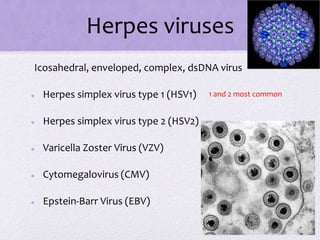
Icosahedral, enveloped, complex, dsDNA virus
 Herpes simplex virus type 1 (HSV1)
 Herpes simplex virus type 2 (HSV2)
 Varicella Zoster Virus (VZV)
 Cytomegalovirus (CMV)
 Epstein-Barr Virus (EBV)
1 and 2 most common
Herpes Simplex Virus
type 1
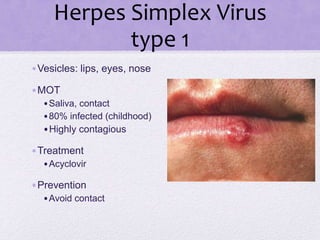
•Vesicles: lips, eyes, nose
•MOT
•Saliva, contact
•80% infected (childhood)
•Highly contagious
•Treatment
•Acyclovir
•Prevention
•Avoid contact
Latent Herpes
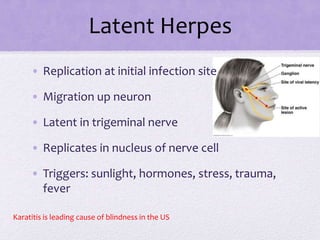
• Replication at initial infection site
• Migration up neuron
• Latent in trigeminal nerve
• Replicates in nucleus of nerve cell
• Triggers: sunlight, hormones, stress, trauma,
fever
Karatitis is leading cause of blindness in the US
Herpes Simplex Virus
type 2
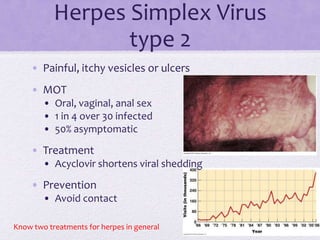
• Painful, itchy vesicles or ulcers
• MOT
• Oral, vaginal, anal sex
• 1 in 4 over 30 infected
• 50% asymptomatic
• Treatment
• Acyclovir shortens viral shedding
• Prevention
• Avoid contact
Know two treatments for herpes in general
Varicella Zoster Virus
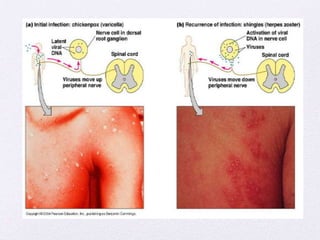
• Chickenpox in children, shingles in adults
• MOT
• Respiratory route
• Prevention
• Chickenpox vaccine for children
• Zostavax against shingles in adults over 60
Maculopapular – raised red bumps
Chickenpox less dangerous before puberty
Can only get shingles after chickenpox
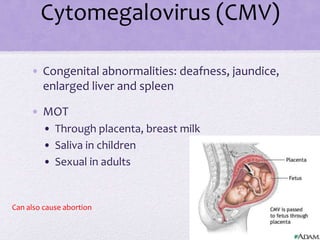
Cytomegalovirus (CMV)
• Congenital abnormalities: deafness, jaundice,
enlarged liver and spleen
• MOT
• Through placenta, breast milk
• Saliva in children
• Sexual in adults
Can also cause abortion
CMV
• Treatment
• Ganciclovir
• Prevention
• Screening blood transfusions and organ donors
• Safe sex
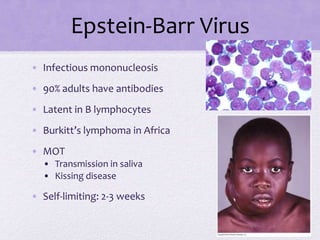
Epstein-Barr Virus
• Infectious mononucleosis
• 90% adults have antibodies
• Latent in B lymphocytes
• Burkitt’s lymphoma in Africa
• MOT
• Transmission in saliva
• Kissing disease
• Self-limiting: 2-3 weeks
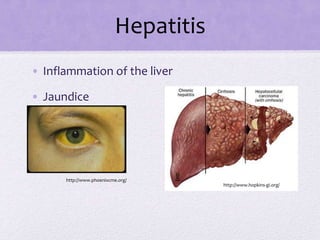
http://www.hopkins-gi.org/
http://www.phoenixcme.org/
Hepatitis
• Inflammation of the liver
• Jaundice
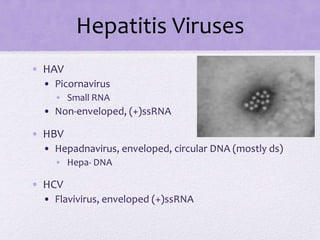
• HAV
• Picornavirus
• Small RNA
• Non-enveloped, (+)ssRNA
• HBV
• Hepadnavirus, enveloped, circular DNA (mostly ds)
• Hepa- DNA
• HCV
• Flavivirus, enveloped (+)ssRNA
Hepatitis Viruses
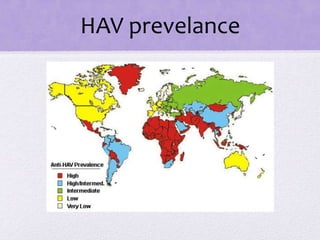
HAV prevelance
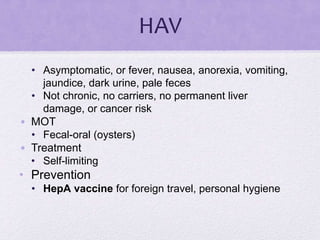
HAV
• Asymptomatic, or fever, nausea, anorexia, vomiting,
jaundice, dark urine, pale feces
• Not chronic, no carriers, no permanent liver
damage, or cancer risk
• MOT
• Fecal-oral (oysters)
• Treatment
• Self-limiting
• Prevention
• HepA vaccine for foreign travel, personal hygiene
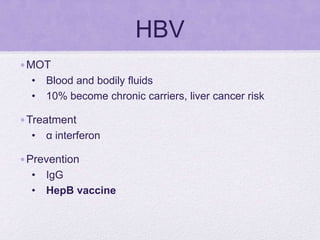
HBV
•MOT
• Blood and bodily fluids
• 10% become chronic carriers, liver cancer risk
•Treatment
• α interferon
•Prevention
• IgG
• HepB vaccine
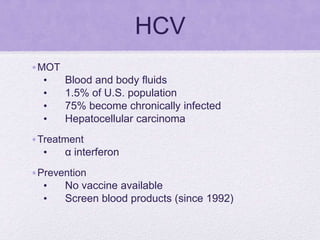
HCV
•MOT
• Blood and body fluids
• 1.5% of U.S. population
• 75% become chronically infected
• Hepatocellular carcinoma
•Treatment
• α interferon
•Prevention
• No vaccine available
• Screen blood products (since 1992)
Human Papillomavirus
(HPV)
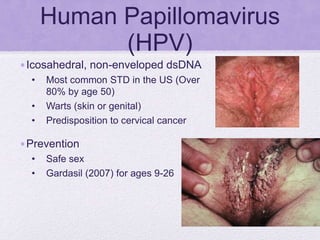
•Icosahedral, non-enveloped dsDNA
• Most common STD in the US (Over
80% by age 50)
• Warts (skin or genital)
• Predisposition to cervical cancer
•Prevention
• Safe sex
• Gardasil (2007) for ages 9-26
Influenza Virus
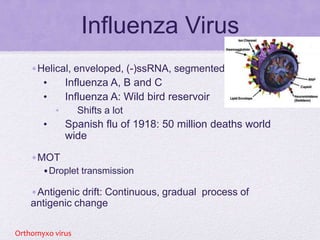
•Helical, enveloped, (-)ssRNA, segmented
• Influenza A, B and C
• Influenza A: Wild bird reservoir
• Shifts a lot
• Spanish flu of 1918: 50 million deaths world
wide
•MOT
•Droplet transmission
•Antigenic drift: Continuous, gradual process of
antigenic change
Orthomyxo virus
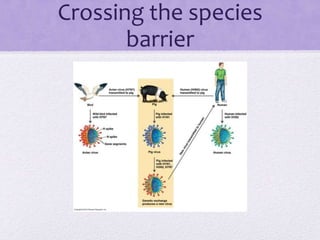
• Re-assortment via co-infection of two strains.
• High pandemic potential.
• Occurs approximately every 30 years.
Antigenic Shift
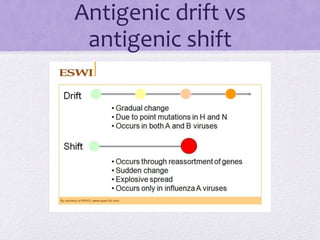
Antigenic drift vs
antigenic shift
Crossing the species
barrier
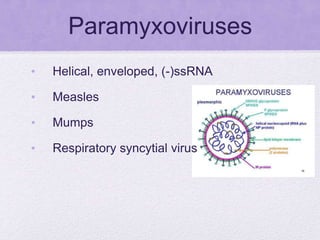
Paramyxoviruses
• Helical, enveloped, (-)ssRNA
• Measles
• Mumps
• Respiratory syncytial virus
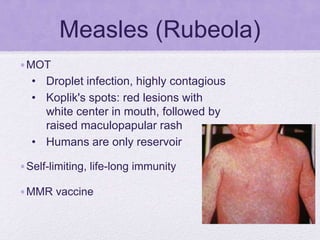
Measles (Rubeola)
•MOT
• Droplet infection, highly contagious
• Koplik's spots: red lesions with
white center in mouth, followed by
raised maculopapular rash
• Humans are only reservoir
•Self-limiting, life-long immunity
•MMR vaccine
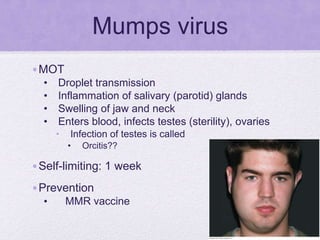
Mumps virus
•MOT
• Droplet transmission
• Inflammation of salivary (parotid) glands
• Swelling of jaw and neck
• Enters blood, infects testes (sterility), ovaries
• Infection of testes is called
• Orcitis??
•Self-limiting: 1 week
•Prevention
• MMR vaccine
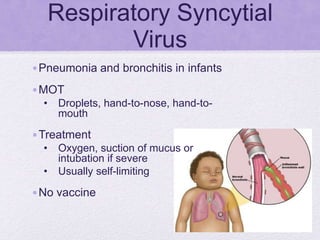
Respiratory Syncytial
Virus
•Pneumonia and bronchitis in infants
•MOT
• Droplets, hand-to-nose, hand-to-
mouth
•Treatment
• Oxygen, suction of mucus or
intubation if severe
• Usually self-limiting
•No vaccine
Togavirus
• Icosahedral, enveloped, (+)ssRNA
• Rubella
• Eastern Equine Encephalitis (arbovirus
[transmitted by insects])
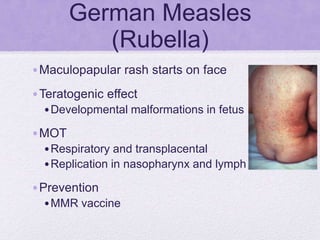
German Measles
(Rubella)
•Maculopapular rash starts on face
•Teratogenic effect
•Developmental malformations in fetus
•MOT
•Respiratory and transplacental
•Replication in nasopharynx and lymph nodes
•Prevention
•MMR vaccine
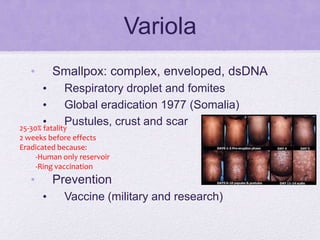
Variola
• Smallpox: complex, enveloped, dsDNA
• Respiratory droplet and fomites
• Global eradication 1977 (Somalia)
• Pustules, crust and scar
• Prevention
• Vaccine (military and research)
25-30% fatality
2 weeks before effects
Eradicated because:
-Human only reservoir
-Ring vaccination
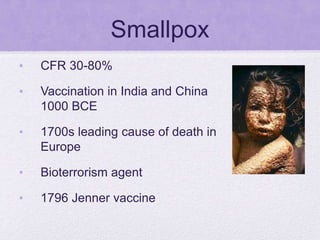
Smallpox
• CFR 30-80%
• Vaccination in India and China
1000 BCE
• 1700s leading cause of death in
Europe
• Bioterrorism agent
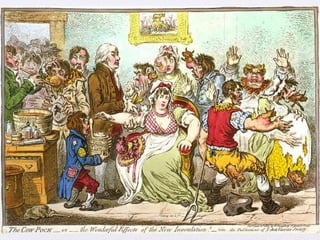
• 1796 Jenner vaccine
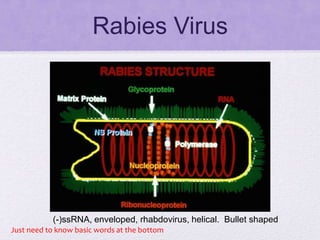
Rabies Virus
(-)ssRNA, enveloped, rhabdovirus, helical. Bullet shaped
Just need to know basic words at the bottom
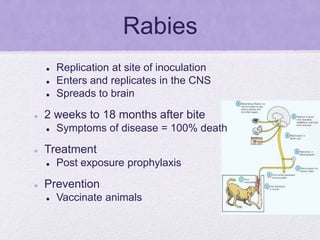
Rabies
 Replication at site of inoculation
 Enters and replicates in the CNS
 Spreads to brain
 2 weeks to 18 months after bite
 Symptoms of disease = 100% death
 Treatment
 Post exposure prophylaxis
 Prevention
 Vaccinate animals
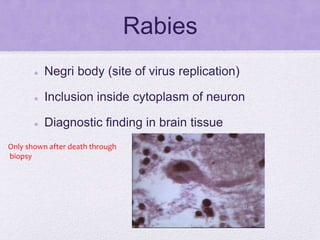
Rabies
 Negri body (site of virus replication)
 Inclusion inside cytoplasm of neuron
 Diagnostic finding in brain tissue
Only shown after death through
biopsy
Rabies symptoms
 Highly variable
 Fever, anorexia, headache, myalgia
 Nausea, vomiting, hydrophobia (20-50%)
 Confusion, hallucinations, seizures, paralysis
 Coma, respiratory failure, death
 Rabid animals: aggressive behavior, excessive
salivation
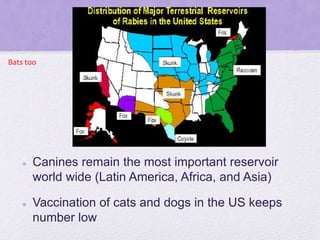
 Canines remain the most important reservoir
world wide (Latin America, Africa, and Asia)
 Vaccination of cats and dogs in the US keeps
number low
Bats too
Enteroviruses
 Poliovirus: Naked, icosahedral, + strand
RNA
 Rotavirus: transient envelope, icosahedral
dsRNA
Poliomyelitis
 Fecal-oral (humans only)
 Replicates in intestine then spreads to CNS
 Destroys motor neurons in brain: muscle
paralysis
 In brain stem: respiratory paralysis and death
 Flaccid paralysis, especially lower limbs,
asymmetrical, muscle wasting.
Two different vaccines that were used, Salk and Sabin
Salk – Dead, intravenous, used in the US
Sabin “OPV” – Oral, intenuated, used in third world countries, more risky
In the picornavirus family
Polio
 1952 outbreak with 60,000 cases (3,000 deaths
in the U.S. alone), mostly Children
 Vaccine in 1955, eliminated from US in 1979
 600,000 survivors in U.S.
 1920s
 FDR - president
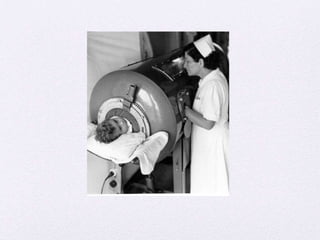
 Iron lung
Getting polio back then wasn’t so bad, bad hygiene meant kids got it, and it was just a
gastrointestinal bug, now with better hygiene they are getting it older and older, and it’s
much worse.
Rotavirus
 Most common cause of gastroenteritis in
children
 600,000 world wide die (children under 5)
 50,000 hospitalized/year in U.S.
 MOT
 Fecal/oral
 Prevention
 2006 Rota Teq
Norwalk Virus
 Icosahedral, ssRNA, naked
 Outbreaks of gastroenteritis in schools, camps and
cruise ships
 Very contagious: ID50 of 10 virions
 50% of all food-borne outbreaks
 Can survive wide temp ranges and up to 10ppm (parts/mil)
chlorine
 Nausea, vomiting, diarrhea
 MOT
 Fecal-oral
 Self-limiting 12-24 hours
Two bucket disease
Viruses that cause colds
(200 types)
 Adenovirus
 Coronavirus (also causative agent of SARS)
 Rhinovirus (most common cause)
 Droplet and hand transmission
 Mild upper respiratory symptoms
 Self-limiting (can last up to two weeks)
Progression of a runny
nose
 Clear mucus: to clear the virus from nose
and sinus
 White or yellow: white blood cells due to
immune response
 Green: bacteria that are NF come back
Arboviruses
 Arthropod-borne viruses (mainly mosquito)
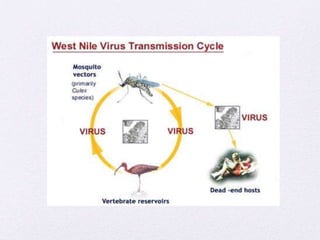
 Life cycle is typically bird-mosquito-bird
 Certain conditions lead to spillover into humans
 Eastern Equine Encephalitis
 West Nile virus
 St. Louis Encephalitis
Encephalitis
 Fever, headache, nausea, vomiting
 Confusion, stupor, coma
 WNV: most asymptomatic or recover
 SLE and EEE high mortality rate and morbidity
 No human vaccine
 Prevention is mosquito control
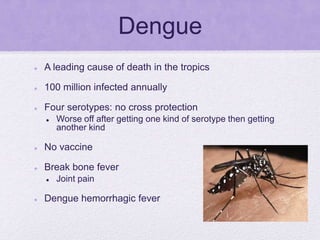
Dengue
 A leading cause of death in the tropics
 100 million infected annually
 Four serotypes: no cross protection
 Worse off after getting one kind of serotype then getting
another kind
 No vaccine
 Break bone fever
 Joint pain
 Dengue hemorrhagic fever
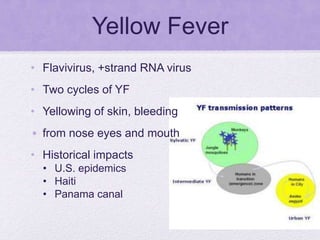
Yellow Fever
• Flavivirus, +strand RNA virus
• Two cycles of YF
• Yellowing of skin, bleeding
• from nose eyes and mouth
• Historical impacts
• U.S. epidemics
• Haiti
• Panama canal
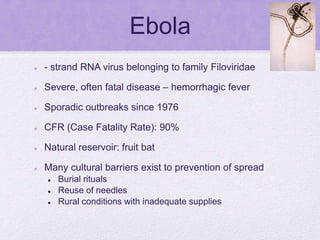
Ebola
 - strand RNA virus belonging to family Filoviridae
 Severe, often fatal disease – hemorrhagic fever
 Sporadic outbreaks since 1976
 CFR (Case Fatality Rate): 90%
 Natural reservoir: fruit bat
 Many cultural barriers exist to prevention of spread
 Burial rituals
 Reuse of needles
 Rural conditions with inadequate supplies
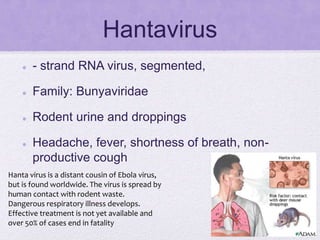
Hantavirus
 - strand RNA virus, segmented,
 Family: Bunyaviridae
 Rodent urine and droppings
 Headache, fever, shortness of breath, non-
productive cough
Hanta virus is a distant cousin of Ebola virus,
but is found worldwide. The virus is spread by
human contact with rodent waste.
Dangerous respiratory illness develops.
Effective treatment is not yet available and
over 50% of cases end in fatality
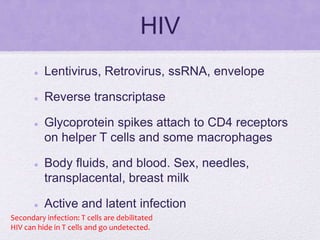
HIV
 Lentivirus, Retrovirus, ssRNA, envelope
 Reverse transcriptase
 Glycoprotein spikes attach to CD4 receptors
on helper T cells and some macrophages
 Body fluids, and blood. Sex, needles,
transplacental, breast milk
 Active and latent infection
Secondary infection: T cells are debilitated
HIV can hide in T cells and go undetected.
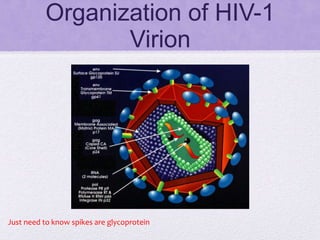
Organization of HIV-1
Virion
Just need to know spikes are glycoprotein
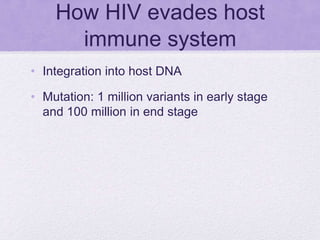
How HIV evades host
immune system
• Integration into host DNA
• Mutation: 1 million variants in early stage
and 100 million in end stage

9 - Viral Pathogens

  • 1.
  • 2.
    Herpes viruses Icosahedral, enveloped,complex, dsDNA virus  Herpes simplex virus type 1 (HSV1)  Herpes simplex virus type 2 (HSV2)  Varicella Zoster Virus (VZV)  Cytomegalovirus (CMV)  Epstein-Barr Virus (EBV) 1 and 2 most common
  • 3.
    Herpes Simplex Virus type1 •Vesicles: lips, eyes, nose •MOT •Saliva, contact •80% infected (childhood) •Highly contagious •Treatment •Acyclovir •Prevention •Avoid contact
  • 4.
    Latent Herpes • Replicationat initial infection site • Migration up neuron • Latent in trigeminal nerve • Replicates in nucleus of nerve cell • Triggers: sunlight, hormones, stress, trauma, fever Karatitis is leading cause of blindness in the US
  • 5.
    Herpes Simplex Virus type2 • Painful, itchy vesicles or ulcers • MOT • Oral, vaginal, anal sex • 1 in 4 over 30 infected • 50% asymptomatic • Treatment • Acyclovir shortens viral shedding • Prevention • Avoid contact Know two treatments for herpes in general
  • 6.
    Varicella Zoster Virus •Chickenpox in children, shingles in adults • MOT • Respiratory route • Prevention • Chickenpox vaccine for children • Zostavax against shingles in adults over 60 Maculopapular – raised red bumps Chickenpox less dangerous before puberty Can only get shingles after chickenpox
  • 8.
    Cytomegalovirus (CMV) • Congenitalabnormalities: deafness, jaundice, enlarged liver and spleen • MOT • Through placenta, breast milk • Saliva in children • Sexual in adults Can also cause abortion
  • 9.
    CMV • Treatment • Ganciclovir •Prevention • Screening blood transfusions and organ donors • Safe sex
  • 10.
    Epstein-Barr Virus • Infectiousmononucleosis • 90% adults have antibodies • Latent in B lymphocytes • Burkitt’s lymphoma in Africa • MOT • Transmission in saliva • Kissing disease • Self-limiting: 2-3 weeks
  • 11.
  • 12.
    • HAV • Picornavirus •Small RNA • Non-enveloped, (+)ssRNA • HBV • Hepadnavirus, enveloped, circular DNA (mostly ds) • Hepa- DNA • HCV • Flavivirus, enveloped (+)ssRNA Hepatitis Viruses
  • 13.
  • 14.
    HAV • Asymptomatic, orfever, nausea, anorexia, vomiting, jaundice, dark urine, pale feces • Not chronic, no carriers, no permanent liver damage, or cancer risk • MOT • Fecal-oral (oysters) • Treatment • Self-limiting • Prevention • HepA vaccine for foreign travel, personal hygiene
  • 15.
    HBV •MOT • Blood andbodily fluids • 10% become chronic carriers, liver cancer risk •Treatment • α interferon •Prevention • IgG • HepB vaccine
  • 16.
    HCV •MOT • Blood andbody fluids • 1.5% of U.S. population • 75% become chronically infected • Hepatocellular carcinoma •Treatment • α interferon •Prevention • No vaccine available • Screen blood products (since 1992)
  • 17.
    Human Papillomavirus (HPV) •Icosahedral, non-envelopeddsDNA • Most common STD in the US (Over 80% by age 50) • Warts (skin or genital) • Predisposition to cervical cancer •Prevention • Safe sex • Gardasil (2007) for ages 9-26
  • 18.
    Influenza Virus •Helical, enveloped,(-)ssRNA, segmented • Influenza A, B and C • Influenza A: Wild bird reservoir • Shifts a lot • Spanish flu of 1918: 50 million deaths world wide •MOT •Droplet transmission •Antigenic drift: Continuous, gradual process of antigenic change Orthomyxo virus
  • 19.
    • Re-assortment viaco-infection of two strains. • High pandemic potential. • Occurs approximately every 30 years. Antigenic Shift
  • 20.
  • 21.
  • 22.
    Paramyxoviruses • Helical, enveloped,(-)ssRNA • Measles • Mumps • Respiratory syncytial virus
  • 23.
    Measles (Rubeola) •MOT • Dropletinfection, highly contagious • Koplik's spots: red lesions with white center in mouth, followed by raised maculopapular rash • Humans are only reservoir •Self-limiting, life-long immunity •MMR vaccine
  • 24.
    Mumps virus •MOT • Droplettransmission • Inflammation of salivary (parotid) glands • Swelling of jaw and neck • Enters blood, infects testes (sterility), ovaries • Infection of testes is called • Orcitis?? •Self-limiting: 1 week •Prevention • MMR vaccine
  • 25.
    Respiratory Syncytial Virus •Pneumonia andbronchitis in infants •MOT • Droplets, hand-to-nose, hand-to- mouth •Treatment • Oxygen, suction of mucus or intubation if severe • Usually self-limiting •No vaccine
  • 26.
    Togavirus • Icosahedral, enveloped,(+)ssRNA • Rubella • Eastern Equine Encephalitis (arbovirus [transmitted by insects])
  • 27.
    German Measles (Rubella) •Maculopapular rashstarts on face •Teratogenic effect •Developmental malformations in fetus •MOT •Respiratory and transplacental •Replication in nasopharynx and lymph nodes •Prevention •MMR vaccine
  • 28.
    Variola • Smallpox: complex,enveloped, dsDNA • Respiratory droplet and fomites • Global eradication 1977 (Somalia) • Pustules, crust and scar • Prevention • Vaccine (military and research) 25-30% fatality 2 weeks before effects Eradicated because: -Human only reservoir -Ring vaccination
  • 29.
    Smallpox • CFR 30-80% •Vaccination in India and China 1000 BCE • 1700s leading cause of death in Europe • Bioterrorism agent • 1796 Jenner vaccine
  • 31.
    Rabies Virus (-)ssRNA, enveloped,rhabdovirus, helical. Bullet shaped Just need to know basic words at the bottom
  • 32.
    Rabies  Replication atsite of inoculation  Enters and replicates in the CNS  Spreads to brain  2 weeks to 18 months after bite  Symptoms of disease = 100% death  Treatment  Post exposure prophylaxis  Prevention  Vaccinate animals
  • 33.
    Rabies  Negri body(site of virus replication)  Inclusion inside cytoplasm of neuron  Diagnostic finding in brain tissue Only shown after death through biopsy
  • 34.
    Rabies symptoms  Highlyvariable  Fever, anorexia, headache, myalgia  Nausea, vomiting, hydrophobia (20-50%)  Confusion, hallucinations, seizures, paralysis  Coma, respiratory failure, death  Rabid animals: aggressive behavior, excessive salivation
  • 35.
     Canines remainthe most important reservoir world wide (Latin America, Africa, and Asia)  Vaccination of cats and dogs in the US keeps number low Bats too
  • 36.
    Enteroviruses  Poliovirus: Naked,icosahedral, + strand RNA  Rotavirus: transient envelope, icosahedral dsRNA
  • 37.
    Poliomyelitis  Fecal-oral (humansonly)  Replicates in intestine then spreads to CNS  Destroys motor neurons in brain: muscle paralysis  In brain stem: respiratory paralysis and death  Flaccid paralysis, especially lower limbs, asymmetrical, muscle wasting. Two different vaccines that were used, Salk and Sabin Salk – Dead, intravenous, used in the US Sabin “OPV” – Oral, intenuated, used in third world countries, more risky In the picornavirus family
  • 38.
    Polio  1952 outbreakwith 60,000 cases (3,000 deaths in the U.S. alone), mostly Children  Vaccine in 1955, eliminated from US in 1979  600,000 survivors in U.S.  1920s  FDR - president  Iron lung Getting polio back then wasn’t so bad, bad hygiene meant kids got it, and it was just a gastrointestinal bug, now with better hygiene they are getting it older and older, and it’s much worse.
  • 40.
    Rotavirus  Most commoncause of gastroenteritis in children  600,000 world wide die (children under 5)  50,000 hospitalized/year in U.S.  MOT  Fecal/oral  Prevention  2006 Rota Teq
  • 41.
    Norwalk Virus  Icosahedral,ssRNA, naked  Outbreaks of gastroenteritis in schools, camps and cruise ships  Very contagious: ID50 of 10 virions  50% of all food-borne outbreaks  Can survive wide temp ranges and up to 10ppm (parts/mil) chlorine  Nausea, vomiting, diarrhea  MOT  Fecal-oral  Self-limiting 12-24 hours Two bucket disease
  • 42.
    Viruses that causecolds (200 types)  Adenovirus  Coronavirus (also causative agent of SARS)  Rhinovirus (most common cause)  Droplet and hand transmission  Mild upper respiratory symptoms  Self-limiting (can last up to two weeks)
  • 43.
    Progression of arunny nose  Clear mucus: to clear the virus from nose and sinus  White or yellow: white blood cells due to immune response  Green: bacteria that are NF come back
  • 44.
    Arboviruses  Arthropod-borne viruses(mainly mosquito)  Life cycle is typically bird-mosquito-bird  Certain conditions lead to spillover into humans  Eastern Equine Encephalitis  West Nile virus  St. Louis Encephalitis
  • 45.
    Encephalitis  Fever, headache,nausea, vomiting  Confusion, stupor, coma  WNV: most asymptomatic or recover  SLE and EEE high mortality rate and morbidity  No human vaccine  Prevention is mosquito control
  • 47.
    Dengue  A leadingcause of death in the tropics  100 million infected annually  Four serotypes: no cross protection  Worse off after getting one kind of serotype then getting another kind  No vaccine  Break bone fever  Joint pain  Dengue hemorrhagic fever
  • 48.
    Yellow Fever • Flavivirus,+strand RNA virus • Two cycles of YF • Yellowing of skin, bleeding • from nose eyes and mouth • Historical impacts • U.S. epidemics • Haiti • Panama canal
  • 49.
    Ebola  - strandRNA virus belonging to family Filoviridae  Severe, often fatal disease – hemorrhagic fever  Sporadic outbreaks since 1976  CFR (Case Fatality Rate): 90%  Natural reservoir: fruit bat  Many cultural barriers exist to prevention of spread  Burial rituals  Reuse of needles  Rural conditions with inadequate supplies
  • 50.
    Hantavirus  - strandRNA virus, segmented,  Family: Bunyaviridae  Rodent urine and droppings  Headache, fever, shortness of breath, non- productive cough Hanta virus is a distant cousin of Ebola virus, but is found worldwide. The virus is spread by human contact with rodent waste. Dangerous respiratory illness develops. Effective treatment is not yet available and over 50% of cases end in fatality
  • 51.
    HIV  Lentivirus, Retrovirus,ssRNA, envelope  Reverse transcriptase  Glycoprotein spikes attach to CD4 receptors on helper T cells and some macrophages  Body fluids, and blood. Sex, needles, transplacental, breast milk  Active and latent infection Secondary infection: T cells are debilitated HIV can hide in T cells and go undetected.
  • 52.
    Organization of HIV-1 Virion Justneed to know spikes are glycoprotein
  • 53.
    How HIV evadeshost immune system • Integration into host DNA • Mutation: 1 million variants in early stage and 100 million in end stage