Antigen Recognition by
T Lymphocytes
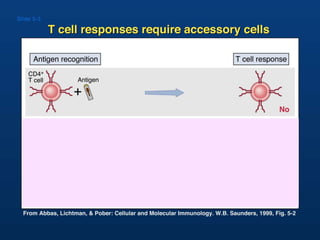
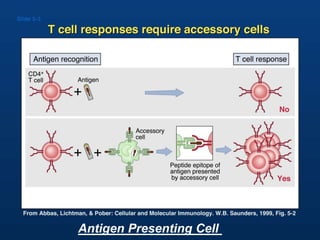
Antigen Presenting Cell
T Cell-Antigen Recognition
• Respond to contiguous short amino acid
sequences in proteins-T Cell Epitopes
– Peptides
– Not Native Protein
• T cells do not bind free peptides
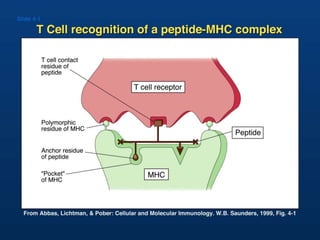
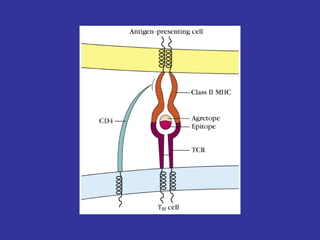
• T Cells Recognize a complex of a peptide
fragment bound to the membrane
proteins of cells- Major
histocompatibility complex (MHC)
molecules
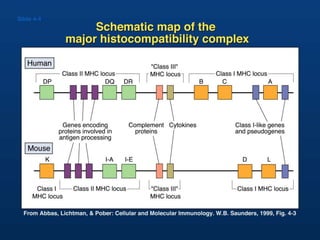
MHC Molecules
• MHC I
• MHC II
• Physiological function is to present
peptides to T cells
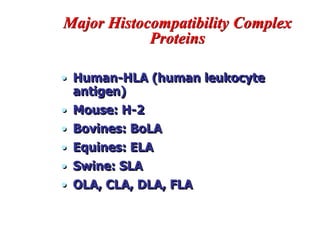
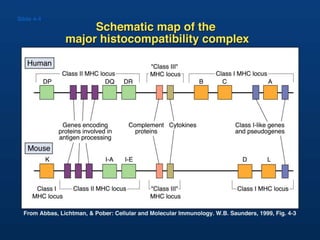
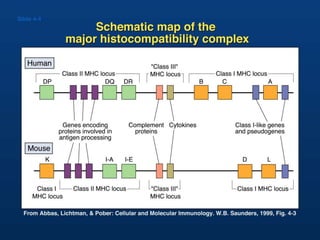
Major Histocompatibility Complex
Proteins
• Human-HLA (human leukocyte
antigen)
• Mouse: H-2
• Bovines: BoLA
• Equines: ELA
• Swine: SLA
• OLA, CLA, DLA, FLA
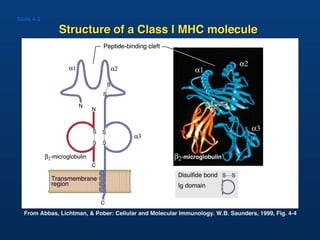
MHC Class I Molecules
• Present Peptides to CD8+ T Cells
• Expressed on ALL Nucleated Cells
of the Body
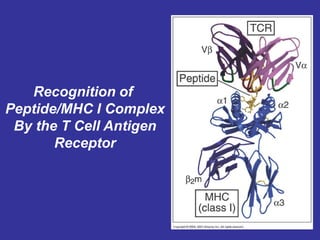
Recognition of
Peptide/MHC I Complex
By the T Cell Antigen
Receptor
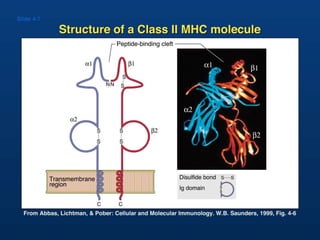
MHC Class II Molecules
• Present Peptides to CD4+ T Cells
• Expressed on Dendritic Cells, B
Cells, Macrophages-Professional
Antigen Presenting Cells
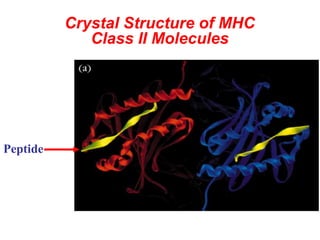
Crystal Structure of MHC
Class II Molecules
Peptide
General Characteristic of Peptide-
MHC Interactions
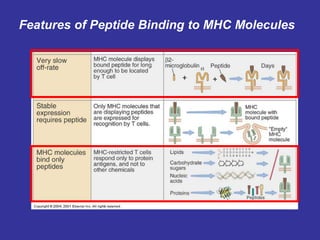
• Each MHC class I & class II
molecule has a single peptide
binding cleft that can bind many
different peptides
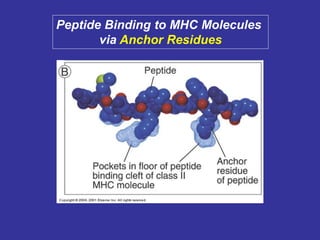
• Anchor Residues
Peptide Binding to MHC Molecules
via Anchor Residues
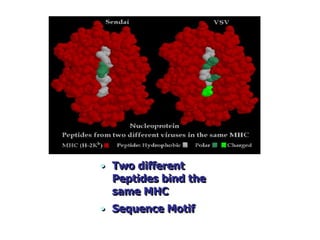
• Two different
Peptides bind the
same MHC
• Sequence Motif
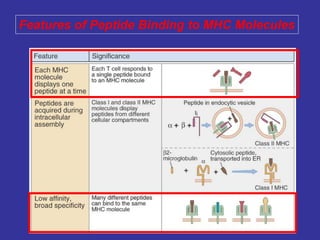
Features of Peptide Binding to MHC Molecules
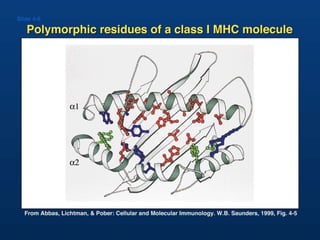
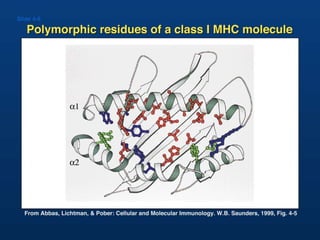
MHC Polymorphism
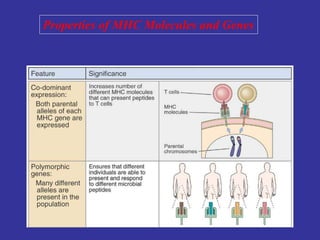
Properties of MHC Molecules and Genes
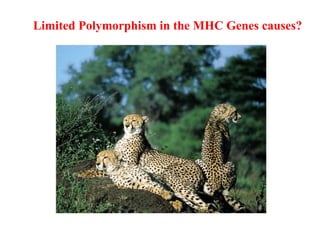
Limited Polymorphism in the MHC Genes causes?
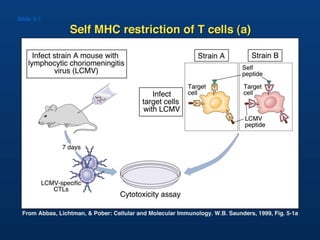
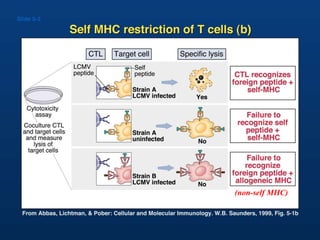
Self MHC Restriction
Both CD4+ and CD8+ T cells
can recognize antigen only when
presented by a self-MHC
molecule on the membrane of an
antigen presenting cells
CD4+ T Cells-Self MHC II-
Restricted
CD8+ T Cells-Self MHC I-
Restricted
Self MHC Restriction
(non-self MHC)
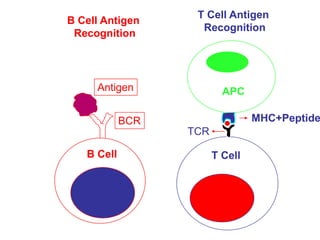
Antigen
BCR
B Cell
B Cell Antigen
Recognition
T Cell
APC
T Cell Antigen
Recognition
TCR
MHC+Peptide
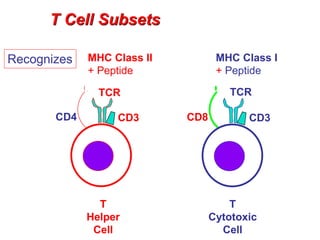
T Cell Subsets
T
Helper
Cell
TCR
CD3CD4
T
Cytotoxic
Cell
TCR
CD3CD8
MHC Class II MHC Class I
+ Peptide + Peptide
Recognizes

Antigen Recognition