Adaptive Immunity:  Specific Defenses of the Host  Chapter 17 Tortora
Immunity Protection against disease (etc) The immune system recognizes foreign substances and develops an immune response against them. Innate or nonspecific immunity seems to have an inherited (genetic) component Adaptive or specific immunity adapts to a particular invader or foreign substance
Types of acquired immunity Acquired immunity  can be acquired passively or actively Active or passive can be acquired naturally or artificially Naturally acquired active  immunity-exposure to antigens (you get sick and recover) Naturally acquired passive  immunity-natural transfer of antibodies from mom to child (breast feeding and in utero)-this is short lived.
Immunity continued Artificially acquired active -get a vaccination which introduces specially prepared antigens into the body  Doesn’t cause disease but stimulates your reaction Artificially acquired passive -introduce antibodies into the body These are derived from serum so are called antisera  Often inject a horse with antigen and then use the horse antibody (spider and snake antivenom)
Dual nature of the immune system First Nobel prize winner was Emil von Behring who discovered immunity can be passed from one organism to another (now called  humoral immunity) Scientists later discovered this was due to antibodies (1930’s) Cell mediated immunity  is governed by  lymphocytes Humoral immunity  (antibody mediated) involves the production of  antibody
Humoral immunity B cells  or B lymphocytes are responsible for antibody production This provides resistance to bacteria and viruses and bacterial toxins B stands for the Bursae of Fabricius  Antibody or immunoglobulins recognize different types of antigen
Cell mediated Immunity Involves  T cells  (T lymphocytes) that act against foreign cells or tissue T cells mature in  the thymus gland Also regulate the activation and proliferation of other immune system cells Cell mediated immune response is directed against bacteria and viruses inside phagocytic cells or infected host cells, fungi, protozoa, and helminths This also causes rejection in implanted tissue
Antigens and antibody Antigen is any foreign substance We recognize ‘ self’  and don’t attack it ( MHC  antigen) Antibody is produced by B cells and combines with antigenic determinant or  epitopes  on the antigen Some antigens are small (a molecular weight of less than 10,000) and won’t trigger a response unless attached to a carrier. These small antigens are  HAPTENS. The antibody reacts with the hapten, not the carrier.
Nature of antibody Antibodies are proteins made in response to antigen that recognize and bind to antigen The  valence  of an antibody is the number of antigen binding sites Most humans are  bivalent   Antibodies are members of a group of soluble proteins called  immunoglobulins  or Igs.
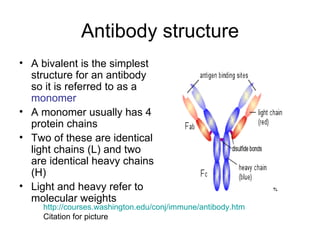
Antibody structure A bivalent is the simplest structure for an antibody so it is referred to as a  monomer A monomer usually has 4 protein chains Two of these are identical light chains (L) and two are identical heavy chains (H) Light and heavy refer to molecular weights http://courses.washington.edu/conj/immune/antibody.htm Citation for picture
Antibody structure continued Variable regions (V) are located at the end of the Y’s arms  Their structure reflects the specific antigen they recognize, and these are specific to the two antigen binding sites (bind to epitopes) The stem and lower portion of the Y are the constant regions (C) These are the same for a particular class of Ig There are 5 major types of C regions, giving us 5 major classes of immunoglobulin The Fc regions (on the stem) are important in immunological reactions
Classes of Ig IgG -80% of all serum antibody, cross blood vessel walls and enter tissue fluids Cross placenta  to protect fetus Protect against circulating bacteria, viruses, neutralize toxin, trigger complement, and enhance phagocytic cells IgM  5-10% of serum antibody and is shaped like a pentamer First to respond  to initial antigen exposure. Subsequent exposure results in increased IgG Valuable in diagnosis because it is early to respond.
Classes continued IgA -5-10% of serum antibody, but most common in fluids like saliva and  breast milk  (helps keep baby safe while it develops its own immune system) Prevent attachment of viruses and/or bacteria to mucosal surfaces IgD -0.2%, found on surface of B cells and act as antigen receptors (no known function in serum) IgE -0.002% of serum antibody, Fc portion binds to mast cells and basophils (allergic reactions),  Increases during parasite or allergy
B cells and Humoral immunity This antibody mediated immunity is carried out by B cells HOW? B cell exposed to antigen and become activated B cells divide and produce clones called  plasma cells Plasma cells produce antibody to that specific antigen (say you have measles for instance, it won’t work against chicken pox) Some turn into  memory cells  so that you can have long term immunity to that disease.
More on B cells B cells come from stem cells in bone marrow (adult) and liver (fetus) Mature B cells are found in spleen and lymph nodes Recognize antigen by antigen receptors on cell surface Apoptosis -programmed cell death We make 100 million lymphocytes a day, so equal number must die.  Any that don’t encounter antigen quickly go through apoptosis
Activation of antibody producing clones Each B cell can only produce an antibody against a particular antigen A mature B cell can  have 100,000 IgM or IgD antibody bound to it’s surface When antigen binds to antigen receptor, the B cell proliferates into clones that will recognize this one antigen (clonal selection) Each B cell has the ability to respond to 100 million antigens thanks to the variable region, but once it has responded it can only make clones for ONE type.
Antigen/antibody complex B cells usually require the help of a  helper T  cell An antigen that requires the helper T cells for antibody production is called a  T-dependent antigen B cell contacts the antigen and is processed inside the B cell Fragments of the antigen combine with MHC and are displayed on the B cell surface. The T cell comes in contact with the antigenic fragment/MHC presented on the B cell and activates the T cell The T cell produces cytokines that in turn activate the B cell to produce clones, some of which become the plasma cell.
Antigen-antibody binding and results Antigen/antibody complex is formed quickly Binding targets the antigen for phagocytosis or complement Agglutination is clumping of antigens to make them easier for phagocytes to digest Neutralization-IgG antibodies inactivate viruses by blocking their attachment to a host Opsonization-antigen is covered by antibody to aid in ingestion/digestion by phagocytic cells IgG and IgM trigger complement
T cells and Cell mediated Immunity The chemical messengers of immune cells are called  cytokines These chemical messengers allow the cells to communicate with each other There are 60 different cytokines identified to date Some cytokines help the communication between leukocytes and are called  interleukins  There are 18 of these (IL-1, IL-2 etc) (see table 17.3) Another group is called  chemokines  that help induce leukocytes to migrate into infected areas.
Cellular components of immunity T cells are the key  component They develop from stem cells in bone marrow and mature in the thymus gland After maturation they migrate to lymphoid organs T cells respond to specific antigen, multiply as clones into effector T cells, and destroy the invader
Types of T cells Helper T- have   central role in immune response, these activate macrophages and help form cytotoxic T cells Cytotoxic T  destroy target cells on contact by producing  perforin  that lysis a bacterial or viral infected cells Delayed hypersensitivity T  involved in allergic reactions and tissue rejection,  Suppressor T  are involved in stopping the reaction once the danger is passed. (Now called regulatory T cells). Another way to classify T cells is by the type of surface receptor called CD (clusters of differentiation) Two are CD4 and CD8.
Nonspecific cellular components Natural killer cells or NK cells  -lymphocytes that can destroy other cells, especially tumor cells and other viral infected cells Activated macrophages are stimulated macrophages that have been activated by the cytokines produced by helper T cells These macrophages can be activated by digesting antigen too. Macrophages often act as  antigen presenting cells (APC’s)  This is identified by the T cells
Interrelationship between cell mediated and humoral immunity Antibody production depends on macrophages and T cells (T dependent antigen) 1.  antigen is  ingested and presented  by the APC 2. The helper T cells reacts with this MHC-antigen complex 3.  This activates the T cell and it begins to proliferate and produce cytokines. 4. The cytokines activate macrophages, CD8 cells, and natural killer cells
continued 5. IL-2 influences a B cell to differentiate into a plasma cell that produces antibody Sometimes antigen can stimulate B cells directly without the help of T cells. This is called  T independent antigen In this case the antigen reacts directly with the B cell receptors. This is usually weaker
Immunological memory Intensity of the antibody mediated humoral response is reflected by  antibody titer This is the amount of antibody in the serum after infection has been cleared There is no detectable titer in the serum for 4-7 days (initial infection) IgG peaks in 10-17 days, and titer increases This is the  primary response If you are exposed again, the  memory response peaks in 2-7 days and is much greater!
When the immune system goes haywire! Hypersensitivity -antigenic response beyond the normal response due to previous exposure (sensitization) by an allergen 4 types: Type I-anaphylatic reactions Type II cytotoxic reactions Type III-Immune complex reactions Type IV-delayed cell mediated (delayed hypersensitivity) http://www.cehs.siu.edu/fix/medmicro/hyper.htm
Type I Occur quickly (2-30 minutes) after exposure May be localized or systemic Localized reactions include hives, hay fever, asthma Systemic includes shock and breathing difficulty (death can result) Over reactive IgE  ( you inherit the sensitivity but may have a completely different allergy)
Type II Involve activation of complement by IgG or IgM antibodies within an antigenic cell This causes lysis of the cell Common type II reactions are  transfusion reactions (ABO blood group) Erthryoblastosis fetalis or  hemolytic disease of the newborn  (Rh negative mom has a second Rh positive baby, the second baby is likely to develop this)
Type III Form when certain ratios of antigen and antibody occur Usually involves IgG IF there is a slight excess of antigen, the soluble complex that forms is small and escape phagocytosis It this happens the complex may become trapped in the basement membrane beneath cells, activating complement and inflammation Neutrophils enter and release enzymes that can damage the cells within 2-8 hours. An example is  glomerulonephritis  which damages kidney glomeruli causing kidney failure Another is  serum sickness  following injection of antitoxin produced by an animal
Type IV Caused by T cells Delay may be a day or more Include allergic  contact dermatitis  (allergic to latex) T B tine test

Adaptive Immunity Chapter 17 Tortora

  • 1.
    Adaptive Immunity: Specific Defenses of the Host Chapter 17 Tortora
  • 2.
    Immunity Protection againstdisease (etc) The immune system recognizes foreign substances and develops an immune response against them. Innate or nonspecific immunity seems to have an inherited (genetic) component Adaptive or specific immunity adapts to a particular invader or foreign substance
  • 3.
    Types of acquiredimmunity Acquired immunity can be acquired passively or actively Active or passive can be acquired naturally or artificially Naturally acquired active immunity-exposure to antigens (you get sick and recover) Naturally acquired passive immunity-natural transfer of antibodies from mom to child (breast feeding and in utero)-this is short lived.
  • 4.
    Immunity continued Artificiallyacquired active -get a vaccination which introduces specially prepared antigens into the body Doesn’t cause disease but stimulates your reaction Artificially acquired passive -introduce antibodies into the body These are derived from serum so are called antisera Often inject a horse with antigen and then use the horse antibody (spider and snake antivenom)
  • 5.
    Dual nature ofthe immune system First Nobel prize winner was Emil von Behring who discovered immunity can be passed from one organism to another (now called humoral immunity) Scientists later discovered this was due to antibodies (1930’s) Cell mediated immunity is governed by lymphocytes Humoral immunity (antibody mediated) involves the production of antibody
  • 6.
    Humoral immunity Bcells or B lymphocytes are responsible for antibody production This provides resistance to bacteria and viruses and bacterial toxins B stands for the Bursae of Fabricius Antibody or immunoglobulins recognize different types of antigen
  • 7.
    Cell mediated ImmunityInvolves T cells (T lymphocytes) that act against foreign cells or tissue T cells mature in the thymus gland Also regulate the activation and proliferation of other immune system cells Cell mediated immune response is directed against bacteria and viruses inside phagocytic cells or infected host cells, fungi, protozoa, and helminths This also causes rejection in implanted tissue
  • 8.
    Antigens and antibodyAntigen is any foreign substance We recognize ‘ self’ and don’t attack it ( MHC antigen) Antibody is produced by B cells and combines with antigenic determinant or epitopes on the antigen Some antigens are small (a molecular weight of less than 10,000) and won’t trigger a response unless attached to a carrier. These small antigens are HAPTENS. The antibody reacts with the hapten, not the carrier.
  • 9.
    Nature of antibodyAntibodies are proteins made in response to antigen that recognize and bind to antigen The valence of an antibody is the number of antigen binding sites Most humans are bivalent Antibodies are members of a group of soluble proteins called immunoglobulins or Igs.
  • 10.
    Antibody structure Abivalent is the simplest structure for an antibody so it is referred to as a monomer A monomer usually has 4 protein chains Two of these are identical light chains (L) and two are identical heavy chains (H) Light and heavy refer to molecular weights http://courses.washington.edu/conj/immune/antibody.htm Citation for picture
  • 11.
    Antibody structure continuedVariable regions (V) are located at the end of the Y’s arms Their structure reflects the specific antigen they recognize, and these are specific to the two antigen binding sites (bind to epitopes) The stem and lower portion of the Y are the constant regions (C) These are the same for a particular class of Ig There are 5 major types of C regions, giving us 5 major classes of immunoglobulin The Fc regions (on the stem) are important in immunological reactions
  • 12.
    Classes of IgIgG -80% of all serum antibody, cross blood vessel walls and enter tissue fluids Cross placenta to protect fetus Protect against circulating bacteria, viruses, neutralize toxin, trigger complement, and enhance phagocytic cells IgM 5-10% of serum antibody and is shaped like a pentamer First to respond to initial antigen exposure. Subsequent exposure results in increased IgG Valuable in diagnosis because it is early to respond.
  • 13.
    Classes continued IgA-5-10% of serum antibody, but most common in fluids like saliva and breast milk (helps keep baby safe while it develops its own immune system) Prevent attachment of viruses and/or bacteria to mucosal surfaces IgD -0.2%, found on surface of B cells and act as antigen receptors (no known function in serum) IgE -0.002% of serum antibody, Fc portion binds to mast cells and basophils (allergic reactions), Increases during parasite or allergy
  • 14.
    B cells andHumoral immunity This antibody mediated immunity is carried out by B cells HOW? B cell exposed to antigen and become activated B cells divide and produce clones called plasma cells Plasma cells produce antibody to that specific antigen (say you have measles for instance, it won’t work against chicken pox) Some turn into memory cells so that you can have long term immunity to that disease.
  • 15.
    More on Bcells B cells come from stem cells in bone marrow (adult) and liver (fetus) Mature B cells are found in spleen and lymph nodes Recognize antigen by antigen receptors on cell surface Apoptosis -programmed cell death We make 100 million lymphocytes a day, so equal number must die. Any that don’t encounter antigen quickly go through apoptosis
  • 16.
    Activation of antibodyproducing clones Each B cell can only produce an antibody against a particular antigen A mature B cell can have 100,000 IgM or IgD antibody bound to it’s surface When antigen binds to antigen receptor, the B cell proliferates into clones that will recognize this one antigen (clonal selection) Each B cell has the ability to respond to 100 million antigens thanks to the variable region, but once it has responded it can only make clones for ONE type.
  • 17.
    Antigen/antibody complex Bcells usually require the help of a helper T cell An antigen that requires the helper T cells for antibody production is called a T-dependent antigen B cell contacts the antigen and is processed inside the B cell Fragments of the antigen combine with MHC and are displayed on the B cell surface. The T cell comes in contact with the antigenic fragment/MHC presented on the B cell and activates the T cell The T cell produces cytokines that in turn activate the B cell to produce clones, some of which become the plasma cell.
  • 18.
    Antigen-antibody binding andresults Antigen/antibody complex is formed quickly Binding targets the antigen for phagocytosis or complement Agglutination is clumping of antigens to make them easier for phagocytes to digest Neutralization-IgG antibodies inactivate viruses by blocking their attachment to a host Opsonization-antigen is covered by antibody to aid in ingestion/digestion by phagocytic cells IgG and IgM trigger complement
  • 19.
    T cells andCell mediated Immunity The chemical messengers of immune cells are called cytokines These chemical messengers allow the cells to communicate with each other There are 60 different cytokines identified to date Some cytokines help the communication between leukocytes and are called interleukins There are 18 of these (IL-1, IL-2 etc) (see table 17.3) Another group is called chemokines that help induce leukocytes to migrate into infected areas.
  • 20.
    Cellular components ofimmunity T cells are the key component They develop from stem cells in bone marrow and mature in the thymus gland After maturation they migrate to lymphoid organs T cells respond to specific antigen, multiply as clones into effector T cells, and destroy the invader
  • 21.
    Types of Tcells Helper T- have central role in immune response, these activate macrophages and help form cytotoxic T cells Cytotoxic T destroy target cells on contact by producing perforin that lysis a bacterial or viral infected cells Delayed hypersensitivity T involved in allergic reactions and tissue rejection, Suppressor T are involved in stopping the reaction once the danger is passed. (Now called regulatory T cells). Another way to classify T cells is by the type of surface receptor called CD (clusters of differentiation) Two are CD4 and CD8.
  • 22.
    Nonspecific cellular componentsNatural killer cells or NK cells -lymphocytes that can destroy other cells, especially tumor cells and other viral infected cells Activated macrophages are stimulated macrophages that have been activated by the cytokines produced by helper T cells These macrophages can be activated by digesting antigen too. Macrophages often act as antigen presenting cells (APC’s) This is identified by the T cells
  • 23.
    Interrelationship between cellmediated and humoral immunity Antibody production depends on macrophages and T cells (T dependent antigen) 1. antigen is ingested and presented by the APC 2. The helper T cells reacts with this MHC-antigen complex 3. This activates the T cell and it begins to proliferate and produce cytokines. 4. The cytokines activate macrophages, CD8 cells, and natural killer cells
  • 24.
    continued 5. IL-2influences a B cell to differentiate into a plasma cell that produces antibody Sometimes antigen can stimulate B cells directly without the help of T cells. This is called T independent antigen In this case the antigen reacts directly with the B cell receptors. This is usually weaker
  • 25.
    Immunological memory Intensityof the antibody mediated humoral response is reflected by antibody titer This is the amount of antibody in the serum after infection has been cleared There is no detectable titer in the serum for 4-7 days (initial infection) IgG peaks in 10-17 days, and titer increases This is the primary response If you are exposed again, the memory response peaks in 2-7 days and is much greater!
  • 26.
    When the immunesystem goes haywire! Hypersensitivity -antigenic response beyond the normal response due to previous exposure (sensitization) by an allergen 4 types: Type I-anaphylatic reactions Type II cytotoxic reactions Type III-Immune complex reactions Type IV-delayed cell mediated (delayed hypersensitivity) http://www.cehs.siu.edu/fix/medmicro/hyper.htm
  • 27.
    Type I Occurquickly (2-30 minutes) after exposure May be localized or systemic Localized reactions include hives, hay fever, asthma Systemic includes shock and breathing difficulty (death can result) Over reactive IgE ( you inherit the sensitivity but may have a completely different allergy)
  • 28.
    Type II Involveactivation of complement by IgG or IgM antibodies within an antigenic cell This causes lysis of the cell Common type II reactions are transfusion reactions (ABO blood group) Erthryoblastosis fetalis or hemolytic disease of the newborn (Rh negative mom has a second Rh positive baby, the second baby is likely to develop this)
  • 29.
    Type III Formwhen certain ratios of antigen and antibody occur Usually involves IgG IF there is a slight excess of antigen, the soluble complex that forms is small and escape phagocytosis It this happens the complex may become trapped in the basement membrane beneath cells, activating complement and inflammation Neutrophils enter and release enzymes that can damage the cells within 2-8 hours. An example is glomerulonephritis which damages kidney glomeruli causing kidney failure Another is serum sickness following injection of antitoxin produced by an animal
  • 30.
    Type IV Causedby T cells Delay may be a day or more Include allergic contact dermatitis (allergic to latex) T B tine test