Mycology and Fungal Pathogens
Mycology
• Study of fungi
– Greater than 100,000 fungal species
• Only ~200 human/animal pathogen
• FUNGI
– Eukaryotes: Yeasts and molds
– Cell wall – Chitin
– Cell membrane - ergosterol
– Chemoheterotrophs
• Require organic compounds for carbon and energy
– Food industry: bread, alcohol, edible fungi (mushrooms), cheeses
– Some are deadly
– Adapted to environments hostile to bacteria
• pH 5
• High osmotic pressure
• Low moisture
• Complex carbohydrates (ex. Lignin from wood)
• Less nitrogen
Yeast
• Unicellular fungi
– Spherical
– Facultative anaerobe
– Reproduce
• budding or fission
• Budding Yeast
– Ex. Saccharomyces
– Uneven division
• Bud forms on outer surface
• Parent nucleus divides
• One nucleus migrates into bud
• Cell wall forms, bud breaks away
• Fission Yeast
– Ex. Shizosaccharomyces
– Binary fission  identical daughter cells
Molds and Fleshy Fungi
• Multicellular
• Aerobic
• Composed of hyphae
– Long filaments of cells joined together
• Grow by elongating at ends
• Fragments break off to form new hyphae
Hyphae:
• Vegetative
– Part that absorbs nutrients
• Aerial
– Projects above medium
– Bears reproductive spores
Fungal Reproduction
Molds (multicellular fungi)
• Asexual reproduction
– Fragmentation
• Hyphae break off to form new molds
– Spores
• Asexual spores
– Form by mitosis, detach from parent, germinate to form new hyphae identical
to parent
• Sexual reproduction
– Sexual spores
• Formed by fusion of nuclei from two opposing mating strains
• Detach from parent structure
• Germinate into new mold
• Contain genes from both parent fungi
Asexual Spores
• Examination of spores aid clinical identification
of fungal infection
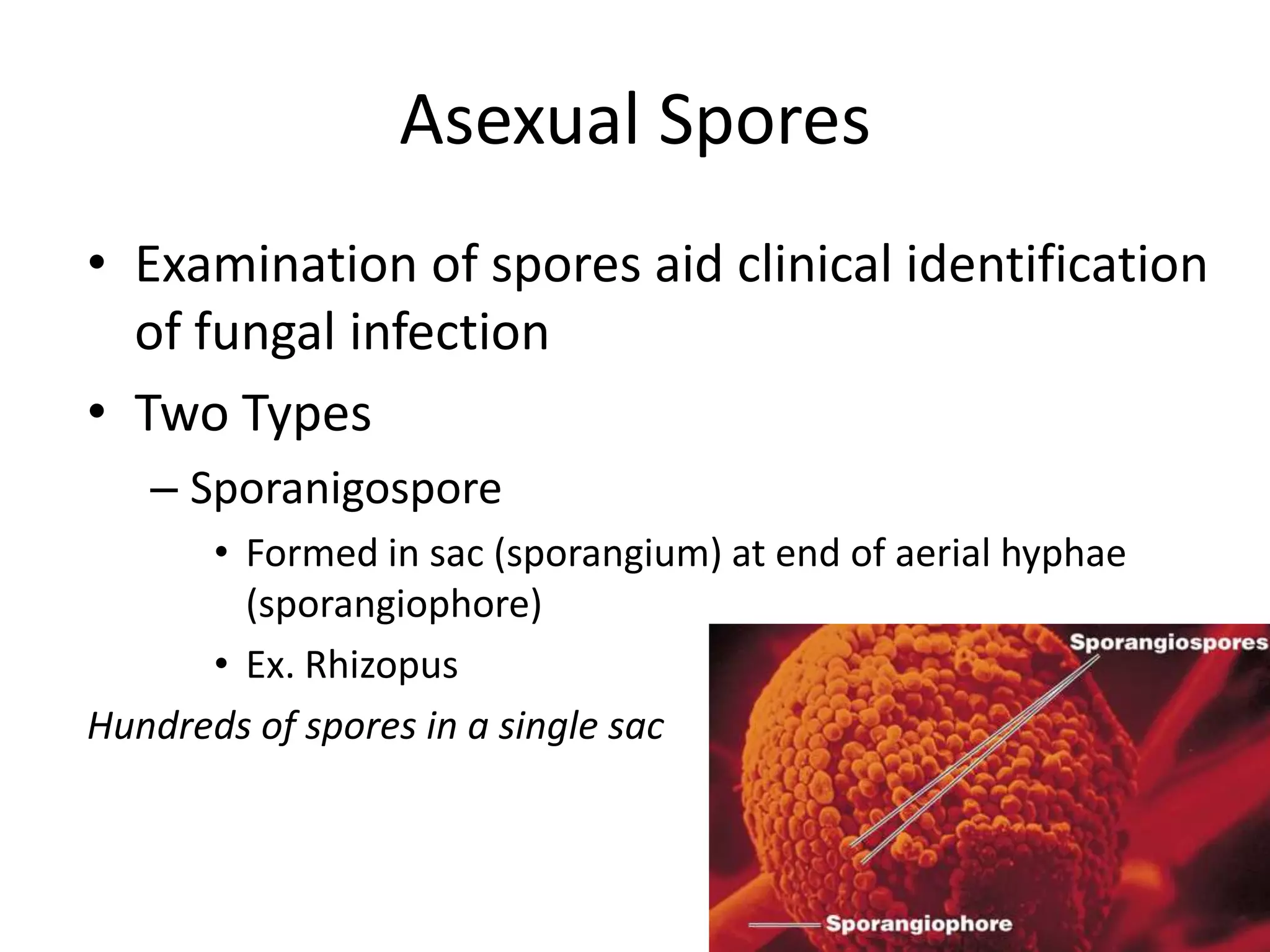
• Two Types
– Sporanigospore
• Formed in sac (sporangium) at end of aerial hyphae
(sporangiophore)
• Ex. Rhizopus
Hundreds of spores in a single sac
Asexual Spores: Condiospore
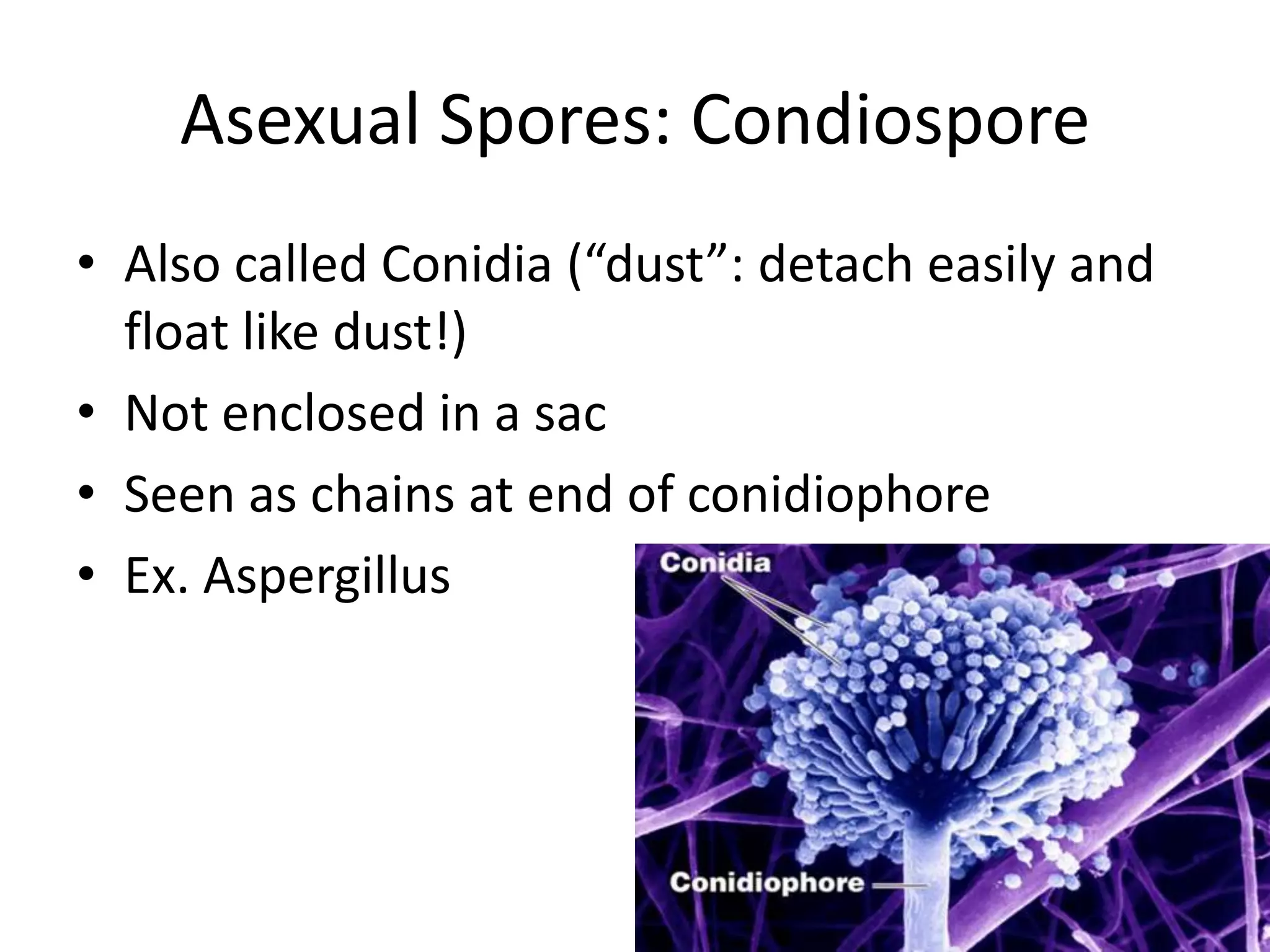
• Also called Conidia (“dust”: detach easily and
float like dust!)
• Not enclosed in a sac
• Seen as chains at end of conidiophore
• Ex. Aspergillus
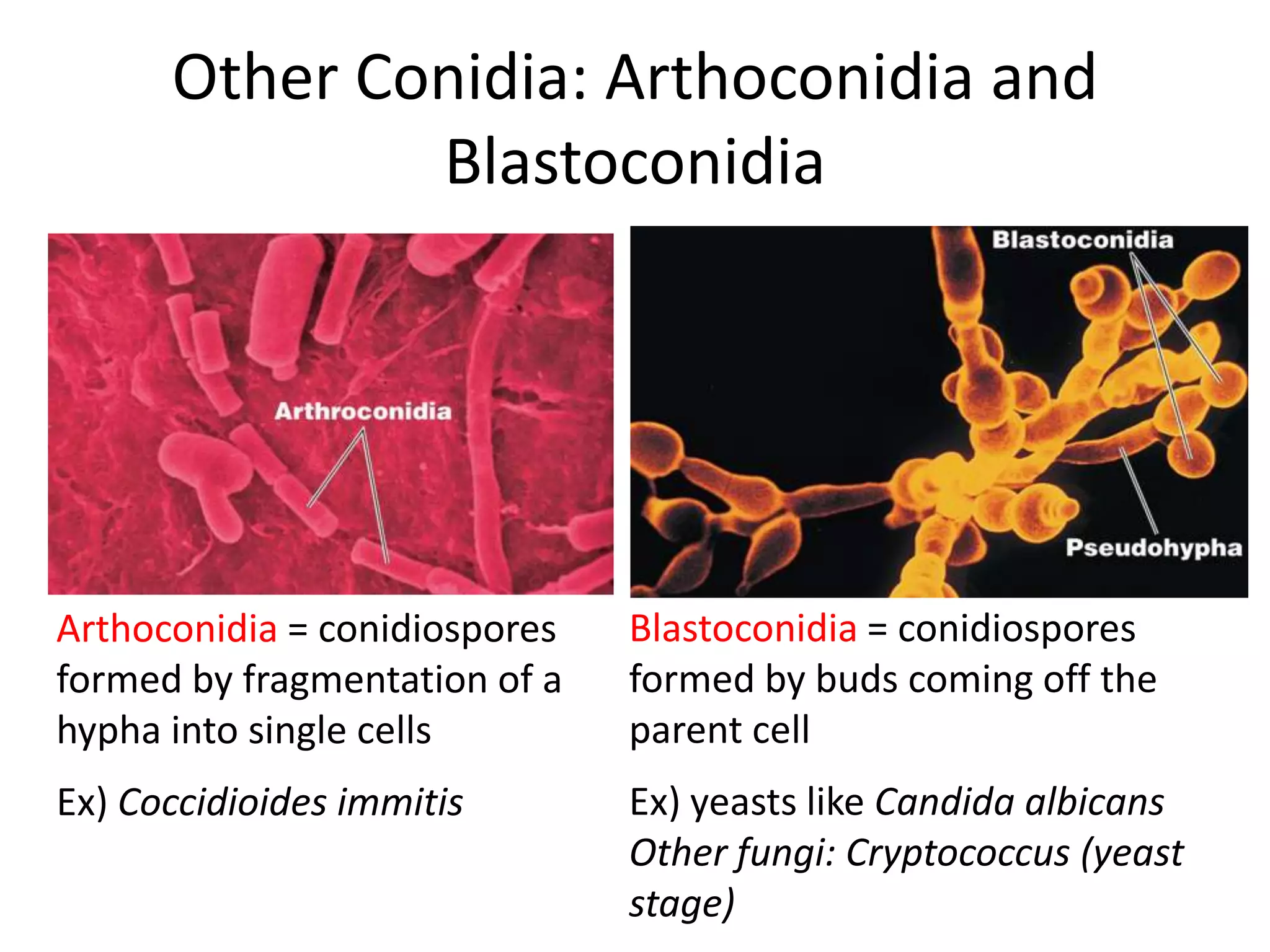
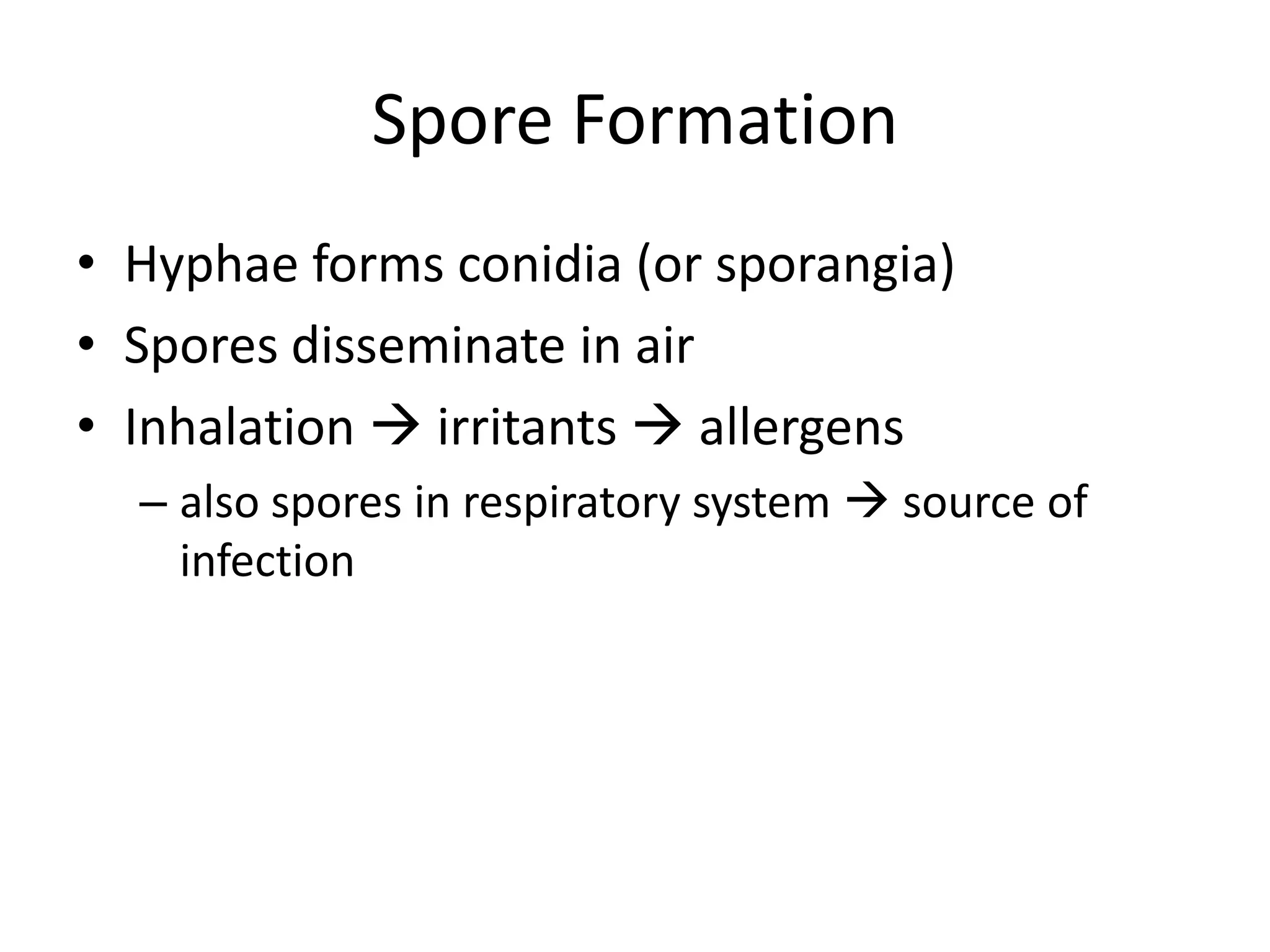
Other Conidia: Arthoconidia and
Blastoconidia
Arthoconidia = conidiospores
formed by fragmentation of a
hypha into single cells
Ex) Coccidioides immitis
Blastoconidia = conidiospores
formed by buds coming off the
parent cell
Ex) yeasts like Candida albicans
Other fungi: Cryptococcus (yeast
stage)
Spore Formation
• Hyphae forms conidia (or sporangia)
• Spores disseminate in air
• Inhalation  irritants  allergens
– also spores in respiratory system  source of
infection
Fungal Toxins
• Some fungi secrete toxins
– Muscarin: Hallucinogenic
– Phalloidin: irreversible damage to liver cells
– Amanitin: inhibits RNA polymerase II activity
– Aflatoxin (Aspergillus flavus)
• Liver damage
– Ergot (Claviceps purpurea)
• Gangrene, convulsions,
hallucinations (LSD)
Deathcap (Amanita phalloides)
Mycoses
• Fungal Infections
– Usually chronic, fungi grow slowly
– Treatment difficult
• Fungi are eukaryotes
• Antifungals can affect human cells
– Serious kidney, liver failure
• Types of Mycoses
– Cutaneous
– Subcutaneous
– Systemic
– Opportunistic
Cutaneous Mycoses
• Fungal infection of skin, hair, nails
• Dermatophytes
– Cause only cutaneous infections
– Secrete keratinase to degrade keratin
Trichophyton, Epidermophyton, Microsporum
Need to remember those names and what they cause
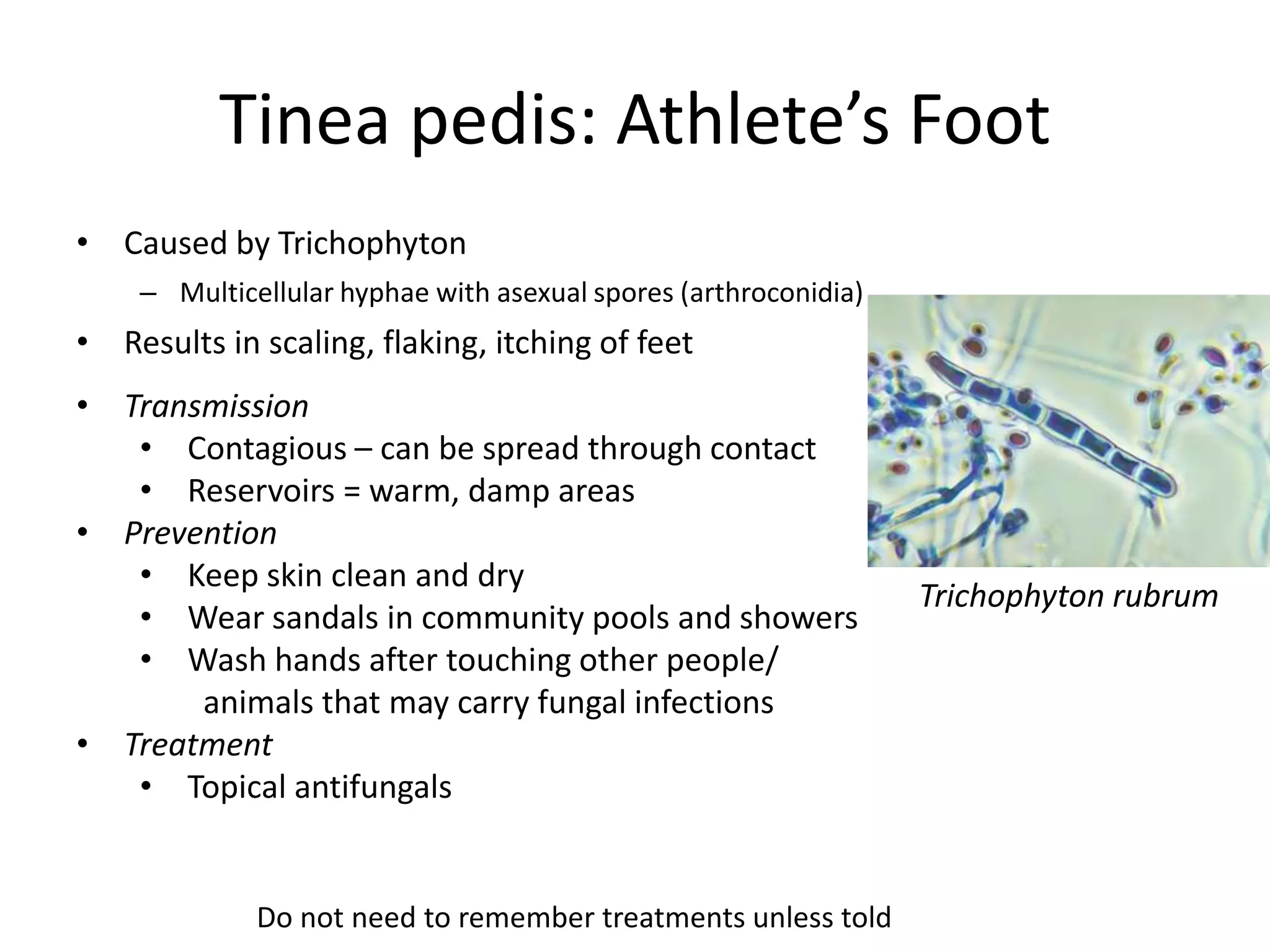
Tinea pedis: Athlete’s Foot
• Caused by Trichophyton
– Multicellular hyphae with asexual spores (arthroconidia)
• Results in scaling, flaking, itching of feet
• Transmission
• Contagious – can be spread through contact
• Reservoirs = warm, damp areas
• Prevention
• Keep skin clean and dry
• Wear sandals in community pools and showers
• Wash hands after touching other people/
animals that may carry fungal infections
• Treatment
• Topical antifungals
Trichophyton rubrum
Do not need to remember treatments unless told
Tinea capitis (ringworm of scalp)
• Caused by Microsporum genus
• Grows as multicellular hyphae
• asexual spores (conidiospores)
• Found in soil and on animals
• Results in inflammation, scarring,
permanent hair loss
• Transmission = touching infected
human or animal, touching infected objects
• Treatment = terbinafine hydrochloride (lamisil) ingestion
Subcutaneous Mycoses
• Infection beneath the skin
• More dangerous than cutaneous
• Usually from soil dwellers invading
puncture wounds
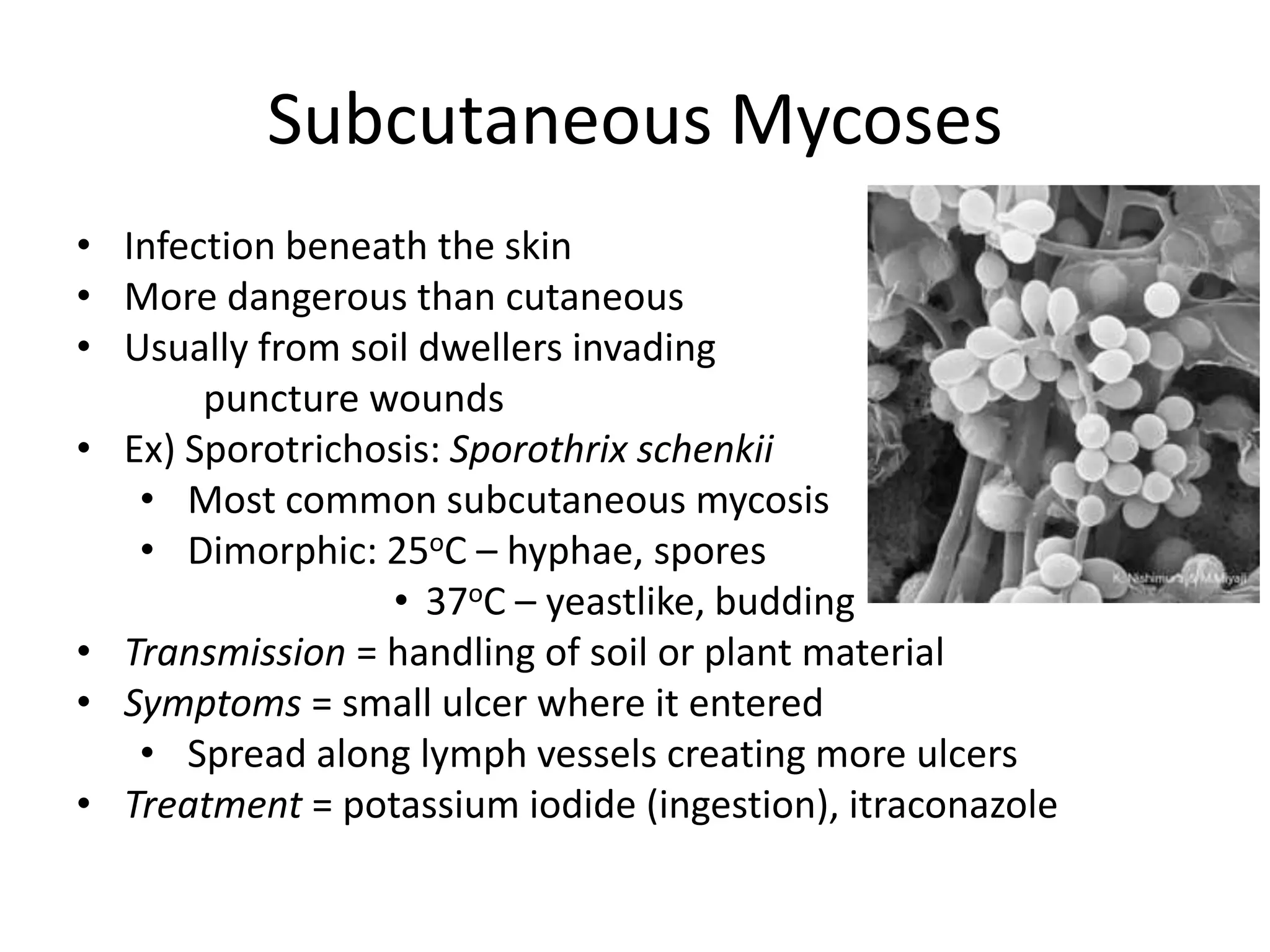
• Ex) Sporotrichosis: Sporothrix schenkii
• Most common subcutaneous mycosis
• Dimorphic: 25oC – hyphae, spores
• 37oC – yeastlike, budding
• Transmission = handling of soil or plant material
• Symptoms = small ulcer where it entered
• Spread along lymph vessels creating more ulcers
• Treatment = potassium iodide (ingestion), itraconazole
Systemic Mycoses
• Fungal infection affecting internal organs
• Soil dwelling fungi
• Initiated by inhaling spores
– Infection in lungs
– Spreads to other parts of body
Histoplasmosis:
• Histoplasma capsulatum
• Dimorphic = filamentous in soil,
yeast-like morphology in tissue
• lives, multiplies in macrophages
• Symptoms: mainly mild respiratory infection
• Treatment: if severe, intravenous Itraconazole
Histoplasmosis: geographic distribution
Areas of moist soils are good for H. capsulatum growth
 more airborne spores
Systemic mycoses: Coccidioidomycosis
• Valley Fever
• Coccidiodes immitis
• Dry, alkaline soils of American SW,
S. America and Mexico
• Dimorphic = filamentous in soil;
thick-walled spherule filled with spores in tissue
• Symptoms = Chest pain, fever, coughing, weight loss
• Diagnosis = Identification of spherules in tissue/fluids
• Treatment = Most recover without treatment
Systemic Opportunistic Mycoses
• Opportunistic mycoses
– Fungal infection occuring in immunocompromised
human/animal
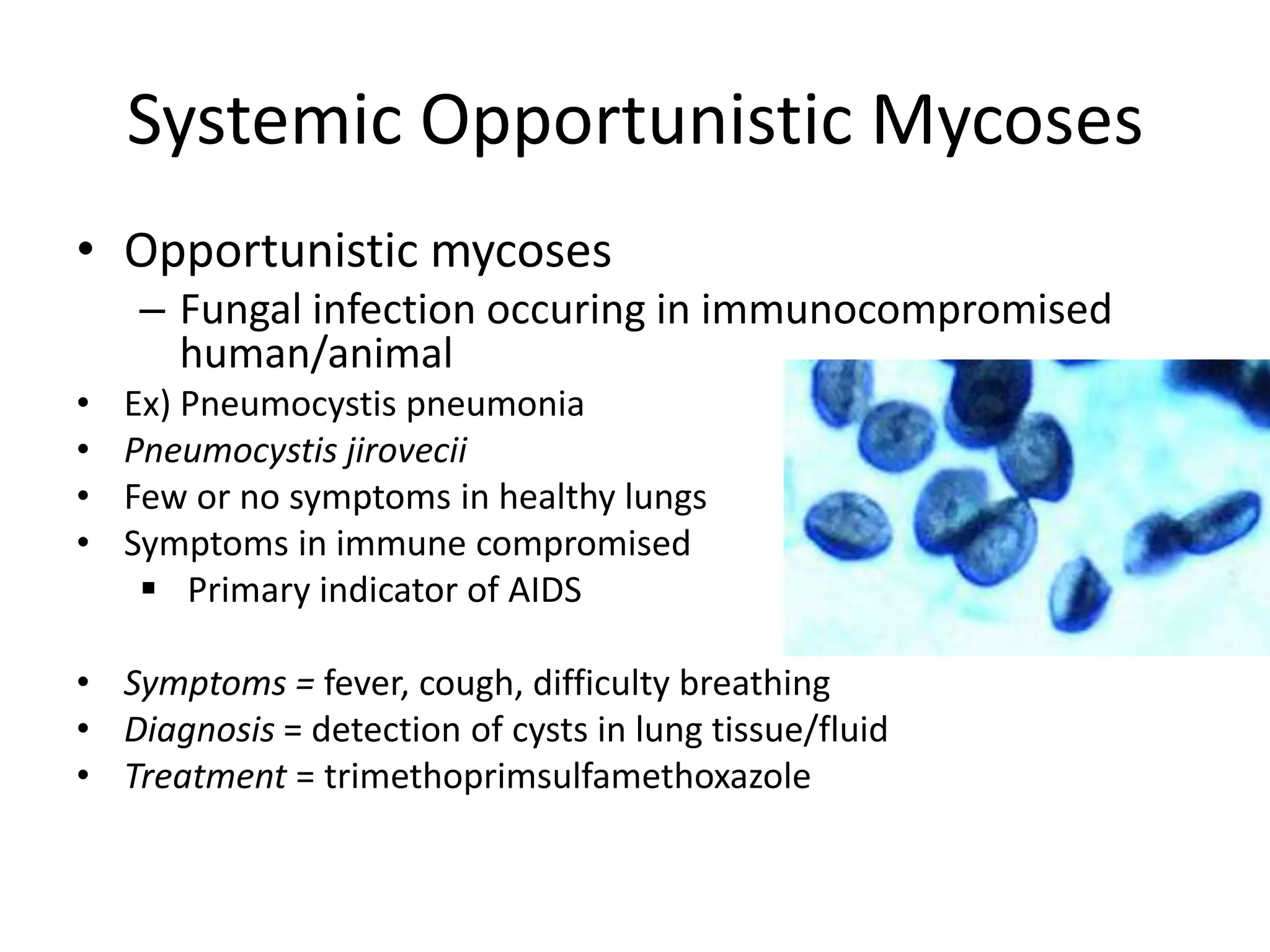
• Ex) Pneumocystis pneumonia
• Pneumocystis jirovecii
• Few or no symptoms in healthy lungs
• Symptoms in immune compromised
 Primary indicator of AIDS
• Symptoms = fever, cough, difficulty breathing
• Diagnosis = detection of cysts in lung tissue/fluid
• Treatment = trimethoprimsulfamethoxazole
Systemic opportunistic mycoses
Ex) Aspergillosis
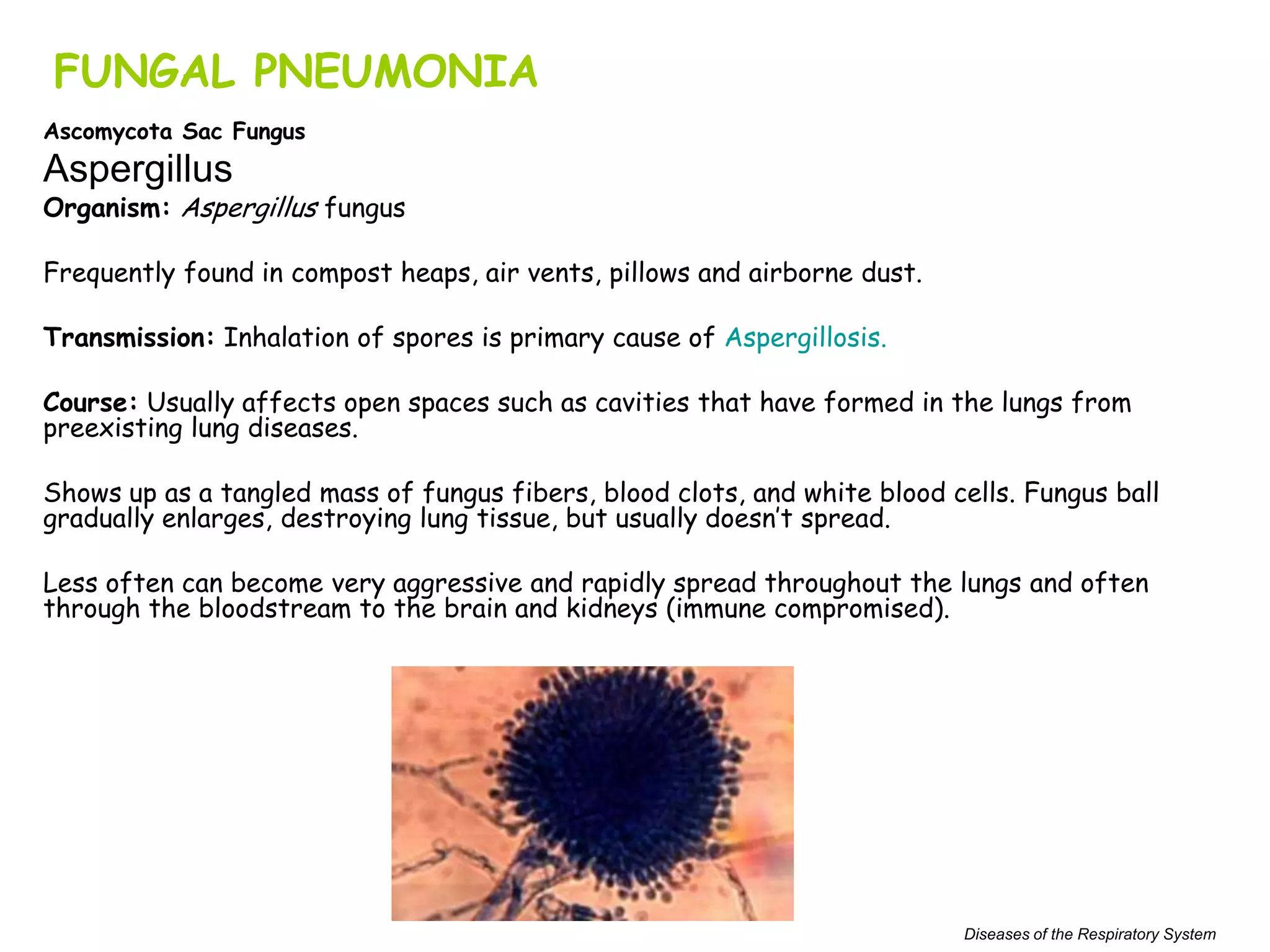
• Aspergillus fumigatus
Transmission = airborne spores from soil and compost
• Most people inhale Aspergillus spores every day
• Destroyed by healthy immune systems
Pathogenesis = germinate into hyphae in alveoli  lesions
Symptoms = fever, bloody cough, chest pain
Diagnosis = lung tissue biopsy
Treatment = amphotericin B, voriconizole
FUNGAL PNEUMONIA
Ascomycota Sac Fungus
Aspergillus
Organism: Aspergillus fungus
Frequently found in compost heaps, air vents, pillows and airborne dust.
Transmission: Inhalation of spores is primary cause of Aspergillosis.
Course: Usually affects open spaces such as cavities that have formed in the lungs from
preexisting lung diseases.
Shows up as a tangled mass of fungus fibers, blood clots, and white blood cells. Fungus ball
gradually enlarges, destroying lung tissue, but usually doesn’t spread.
Less often can become very aggressive and rapidly spread throughout the lungs and often
through the bloodstream to the brain and kidneys (immune compromised).
Diseases of the Respiratory System
Opportunistic Normal Flora
Candida albicans
• Part of normal flora of mouth, skin,
intestine and vagina
• Opportunistic  candidiasis
- Oral thrush: whitish velvety sores of
the mouth and tongue
- Vaginitis (yeast infection)
Candida blastoconidia
(asexual spores) SEM
Oral thrush in an infant
Include Blastomycoses

6 - Mycology and Fungal Pathogens

  • 1.
  • 2.
    Mycology • Study offungi – Greater than 100,000 fungal species • Only ~200 human/animal pathogen • FUNGI – Eukaryotes: Yeasts and molds – Cell wall – Chitin – Cell membrane - ergosterol – Chemoheterotrophs • Require organic compounds for carbon and energy – Food industry: bread, alcohol, edible fungi (mushrooms), cheeses – Some are deadly – Adapted to environments hostile to bacteria • pH 5 • High osmotic pressure • Low moisture • Complex carbohydrates (ex. Lignin from wood) • Less nitrogen
  • 3.
    Yeast • Unicellular fungi –Spherical – Facultative anaerobe – Reproduce • budding or fission • Budding Yeast – Ex. Saccharomyces – Uneven division • Bud forms on outer surface • Parent nucleus divides • One nucleus migrates into bud • Cell wall forms, bud breaks away • Fission Yeast – Ex. Shizosaccharomyces – Binary fission  identical daughter cells
  • 4.
    Molds and FleshyFungi • Multicellular • Aerobic • Composed of hyphae – Long filaments of cells joined together • Grow by elongating at ends • Fragments break off to form new hyphae Hyphae: • Vegetative – Part that absorbs nutrients • Aerial – Projects above medium – Bears reproductive spores
  • 5.
    Fungal Reproduction Molds (multicellularfungi) • Asexual reproduction – Fragmentation • Hyphae break off to form new molds – Spores • Asexual spores – Form by mitosis, detach from parent, germinate to form new hyphae identical to parent • Sexual reproduction – Sexual spores • Formed by fusion of nuclei from two opposing mating strains • Detach from parent structure • Germinate into new mold • Contain genes from both parent fungi
  • 6.
    Asexual Spores • Examinationof spores aid clinical identification of fungal infection • Two Types – Sporanigospore • Formed in sac (sporangium) at end of aerial hyphae (sporangiophore) • Ex. Rhizopus Hundreds of spores in a single sac
  • 7.
    Asexual Spores: Condiospore •Also called Conidia (“dust”: detach easily and float like dust!) • Not enclosed in a sac • Seen as chains at end of conidiophore • Ex. Aspergillus
  • 8.
    Other Conidia: Arthoconidiaand Blastoconidia Arthoconidia = conidiospores formed by fragmentation of a hypha into single cells Ex) Coccidioides immitis Blastoconidia = conidiospores formed by buds coming off the parent cell Ex) yeasts like Candida albicans Other fungi: Cryptococcus (yeast stage)
  • 9.
    Spore Formation • Hyphaeforms conidia (or sporangia) • Spores disseminate in air • Inhalation  irritants  allergens – also spores in respiratory system  source of infection
  • 10.
    Fungal Toxins • Somefungi secrete toxins – Muscarin: Hallucinogenic – Phalloidin: irreversible damage to liver cells – Amanitin: inhibits RNA polymerase II activity – Aflatoxin (Aspergillus flavus) • Liver damage – Ergot (Claviceps purpurea) • Gangrene, convulsions, hallucinations (LSD) Deathcap (Amanita phalloides)
  • 11.
    Mycoses • Fungal Infections –Usually chronic, fungi grow slowly – Treatment difficult • Fungi are eukaryotes • Antifungals can affect human cells – Serious kidney, liver failure • Types of Mycoses – Cutaneous – Subcutaneous – Systemic – Opportunistic
  • 12.
    Cutaneous Mycoses • Fungalinfection of skin, hair, nails • Dermatophytes – Cause only cutaneous infections – Secrete keratinase to degrade keratin Trichophyton, Epidermophyton, Microsporum Need to remember those names and what they cause
  • 13.
    Tinea pedis: Athlete’sFoot • Caused by Trichophyton – Multicellular hyphae with asexual spores (arthroconidia) • Results in scaling, flaking, itching of feet • Transmission • Contagious – can be spread through contact • Reservoirs = warm, damp areas • Prevention • Keep skin clean and dry • Wear sandals in community pools and showers • Wash hands after touching other people/ animals that may carry fungal infections • Treatment • Topical antifungals Trichophyton rubrum Do not need to remember treatments unless told
  • 14.
    Tinea capitis (ringwormof scalp) • Caused by Microsporum genus • Grows as multicellular hyphae • asexual spores (conidiospores) • Found in soil and on animals • Results in inflammation, scarring, permanent hair loss • Transmission = touching infected human or animal, touching infected objects • Treatment = terbinafine hydrochloride (lamisil) ingestion
  • 15.
    Subcutaneous Mycoses • Infectionbeneath the skin • More dangerous than cutaneous • Usually from soil dwellers invading puncture wounds • Ex) Sporotrichosis: Sporothrix schenkii • Most common subcutaneous mycosis • Dimorphic: 25oC – hyphae, spores • 37oC – yeastlike, budding • Transmission = handling of soil or plant material • Symptoms = small ulcer where it entered • Spread along lymph vessels creating more ulcers • Treatment = potassium iodide (ingestion), itraconazole
  • 16.
    Systemic Mycoses • Fungalinfection affecting internal organs • Soil dwelling fungi • Initiated by inhaling spores – Infection in lungs – Spreads to other parts of body Histoplasmosis: • Histoplasma capsulatum • Dimorphic = filamentous in soil, yeast-like morphology in tissue • lives, multiplies in macrophages • Symptoms: mainly mild respiratory infection • Treatment: if severe, intravenous Itraconazole
  • 17.
    Histoplasmosis: geographic distribution Areasof moist soils are good for H. capsulatum growth  more airborne spores
  • 18.
    Systemic mycoses: Coccidioidomycosis •Valley Fever • Coccidiodes immitis • Dry, alkaline soils of American SW, S. America and Mexico • Dimorphic = filamentous in soil; thick-walled spherule filled with spores in tissue • Symptoms = Chest pain, fever, coughing, weight loss • Diagnosis = Identification of spherules in tissue/fluids • Treatment = Most recover without treatment
  • 19.
    Systemic Opportunistic Mycoses •Opportunistic mycoses – Fungal infection occuring in immunocompromised human/animal • Ex) Pneumocystis pneumonia • Pneumocystis jirovecii • Few or no symptoms in healthy lungs • Symptoms in immune compromised  Primary indicator of AIDS • Symptoms = fever, cough, difficulty breathing • Diagnosis = detection of cysts in lung tissue/fluid • Treatment = trimethoprimsulfamethoxazole
  • 20.
    Systemic opportunistic mycoses Ex)Aspergillosis • Aspergillus fumigatus Transmission = airborne spores from soil and compost • Most people inhale Aspergillus spores every day • Destroyed by healthy immune systems Pathogenesis = germinate into hyphae in alveoli  lesions Symptoms = fever, bloody cough, chest pain Diagnosis = lung tissue biopsy Treatment = amphotericin B, voriconizole
  • 21.
    FUNGAL PNEUMONIA Ascomycota SacFungus Aspergillus Organism: Aspergillus fungus Frequently found in compost heaps, air vents, pillows and airborne dust. Transmission: Inhalation of spores is primary cause of Aspergillosis. Course: Usually affects open spaces such as cavities that have formed in the lungs from preexisting lung diseases. Shows up as a tangled mass of fungus fibers, blood clots, and white blood cells. Fungus ball gradually enlarges, destroying lung tissue, but usually doesn’t spread. Less often can become very aggressive and rapidly spread throughout the lungs and often through the bloodstream to the brain and kidneys (immune compromised). Diseases of the Respiratory System
  • 22.
    Opportunistic Normal Flora Candidaalbicans • Part of normal flora of mouth, skin, intestine and vagina • Opportunistic  candidiasis - Oral thrush: whitish velvety sores of the mouth and tongue - Vaginitis (yeast infection) Candida blastoconidia (asexual spores) SEM Oral thrush in an infant
  • 23.