Acute Respiratory Failure Mechanical Ventilation
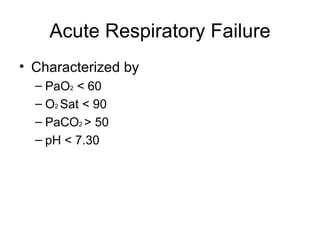
Acute Respiratory Failure Characterized by PaO 2  < 60 O 2  Sat < 90 PaCO 2  > 50 pH < 7.30
Types of Failure Ventilatory Failure Oxygenation Failure Combined Ventilatory/Oxygenation Failure
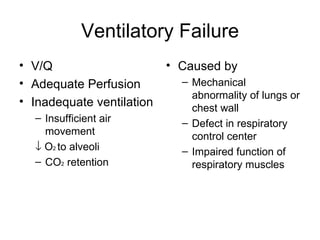
Ventilatory Failure V/Q  Adequate Perfusion Inadequate ventilation Insufficient air movement    O 2  to alveoli CO 2  retention Caused by Mechanical abnormality of lungs or chest wall Defect in respiratory control center Impaired function of respiratory muscles
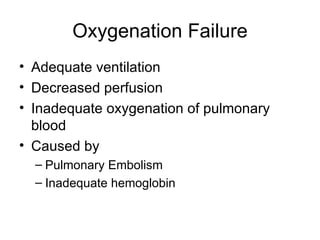
Oxygenation Failure Adequate ventilation Decreased perfusion Inadequate oxygenation of pulmonary blood Caused by Pulmonary Embolism Inadequate hemoglobin
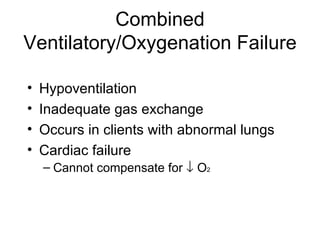
Combined Ventilatory/Oxygenation Failure Hypoventilation Inadequate gas exchange Occurs in clients with abnormal lungs Cardiac failure Cannot compensate for    O 2
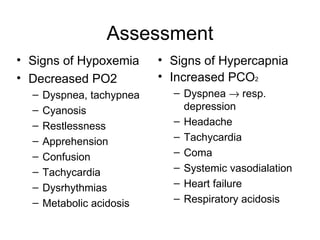
Assessment Signs of Hypoxemia Decreased PO 2 Dyspnea, tachypnea Cyanosis Restlessness Apprehension Confusion Tachycardia Dysrhythmias Metabolic acidosis Signs of Hypercapnia Increased P CO 2 Dyspnea    resp. depression Headache Tachycardia Coma Systemic vasodialation Heart failure Respiratory acidosis
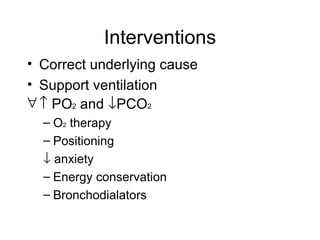
Interventions Correct underlying cause Support ventilation   PO 2  and   PCO 2 O 2  therapy Positioning     anxiety Energy conservation Bronchodialators
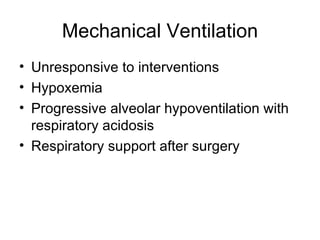
Mechanical Ventilation Unresponsive to interventions Hypoxemia Progressive alveolar hypoventilation with respiratory acidosis Respiratory support after surgery
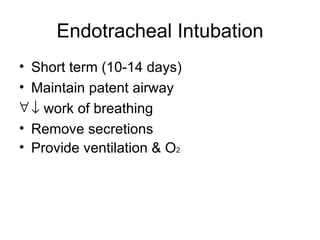
Endotracheal Intubation Short term (10-14 days) Maintain patent airway   work of breathing Remove secretions Provide ventilation & O 2
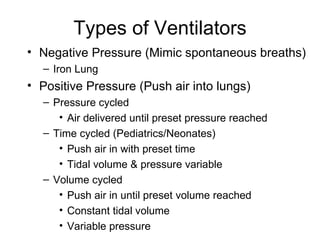
Types of Ventilators Negative Pressure (Mimic spontaneous breaths) Iron Lung Positive Pressure (Push air into lungs) Pressure cycled Air delivered until preset pressure reached Time cycled (Pediatrics/Neonates) Push air in with preset time Tidal volume & pressure variable Volume cycled Push air in until preset volume reached Constant tidal volume Variable pressure
Modes of ventilation Controlled ventilation Assist-control (A/C) Synchronized Intermittent Mandatory Ventilation (SIMV)
Controlled ventilation Least used All breaths delivered at preset tidal volume, pressure & rate Client with no spontaneous effort Severe ICP Brain death Voluntary paralysis of muscles
Assist-Control Ventilation Most commonly used Tidal volume & rate preset Client does not trigger breath, ventilator will deliver breath Advantage- client controls rate of breathing Disadvantage -    respiratory rate    hyperventilation    respiratory alkalosis
SIMV Similar to A/C ventilation Spontaneous breathing between ventilator breaths at clients own rate & tidal volume Used as primary ventilator mode or weaning mode
Ventilator Settings Tidal Volume (V T ) Volume of air delivered each breath 7-10 cc/kg body wt. 75 kg = 750 cc Rate # of breath/minute 10-14 BPM Fraction of inspired O 2  (F I O 2 ) Oxygen concentration 21% (room air) to 100%
Ventilator Settings Peak Airway (Inspiratory) Pressure (PIP) Pressure needed to deliver set tidal volume Highest pressure indicated during inspiration    airway resistance Bronchospasms   secretions Pulmonary edema   pulmonary compliance Prevents barotrauma  Lung damage from excessive pressure
Ventilatory Settings Continuous Positive Airway Pressure (CPAP) Spontaneous respirations Intubation or tight fitting mask Positive pressure during the entire respiratory cycle (5-15 cm H 2 O) Keeps alveoli open during inspiration Prevents alveoli collapse during expiration Improves gas exchange & oxygenation Used during weaning Nasal CPAP, B I PAP
Ventilatory Settings Positive End-Expiratory Pressure (PEEP) Must be intubated Positive pressure exerted during expiration  (+5 to +15 cm H 2 O) Keeps alveoli open between breaths Improves oxygenation Enhances gas exchange Treatment for persistent hypoxemia
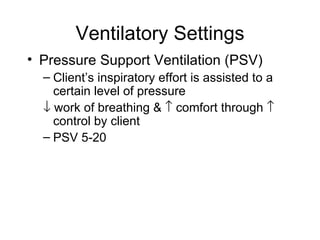
Ventilatory Settings Pressure Support Ventilation (PSV) Client’s inspiratory effort is assisted to a certain level of pressure   work of breathing &    comfort through    control by client PSV 5-20
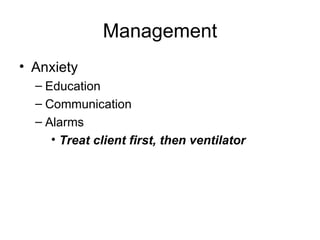
Management Anxiety Education Communication Alarms Treat client first, then ventilator
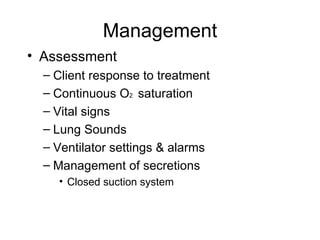
Management Assessment Client response to treatment Continuous O 2  saturation Vital signs Lung Sounds Ventilator settings & alarms Management of secretions Closed suction system
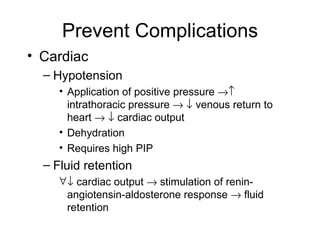
Prevent Complications Cardiac Hypotension Application of positive pressure    intrathoracic pressure       venous return to heart       cardiac output Dehydration Requires high PIP Fluid retention   cardiac output    stimulation of renin-angiotensin-aldosterone response    fluid retention
Prevent Complications Lungs Barotrauma COPD  Pneumothorax, subq emphysema Volutrauma Acid-base abnormalities Infection Within 48 hrs of intubation, bacteria colonization
Prevent Complications Electrolyte Imbalances Monitor K+, Ca++, Mg++, phosphate levels Efficiency of respiratory muscle function Muscular Immobility   muscle tone & strength Facilitates gas exchange
Prevent Complications Ventilator Dependence Respiratory muscle fatigue Client unable to resume independent breathing Extubation Monitor respiratory effort Supplemental O 2 Monitor O 2  saturation
Weaning from Ventilator Parameters set for PaO 2,  O 2  Sat, PaCO 2  &   pH    F I O 2    spontaneous effort by client Remain on T-piece after ventilator before extubation    aerosol mask Minimal sedation while weaning Monitor respiratory effort & rate, vital signs

Acute Respiratory Failure Mechanical Ventilation

  • 1.
    Acute Respiratory FailureMechanical Ventilation
  • 2.
    Acute Respiratory FailureCharacterized by PaO 2 < 60 O 2 Sat < 90 PaCO 2 > 50 pH < 7.30
  • 3.
    Types of FailureVentilatory Failure Oxygenation Failure Combined Ventilatory/Oxygenation Failure
  • 4.
    Ventilatory Failure V/Q Adequate Perfusion Inadequate ventilation Insufficient air movement  O 2 to alveoli CO 2 retention Caused by Mechanical abnormality of lungs or chest wall Defect in respiratory control center Impaired function of respiratory muscles
  • 5.
    Oxygenation Failure Adequateventilation Decreased perfusion Inadequate oxygenation of pulmonary blood Caused by Pulmonary Embolism Inadequate hemoglobin
  • 6.
    Combined Ventilatory/Oxygenation FailureHypoventilation Inadequate gas exchange Occurs in clients with abnormal lungs Cardiac failure Cannot compensate for  O 2
  • 7.
    Assessment Signs ofHypoxemia Decreased PO 2 Dyspnea, tachypnea Cyanosis Restlessness Apprehension Confusion Tachycardia Dysrhythmias Metabolic acidosis Signs of Hypercapnia Increased P CO 2 Dyspnea  resp. depression Headache Tachycardia Coma Systemic vasodialation Heart failure Respiratory acidosis
  • 8.
    Interventions Correct underlyingcause Support ventilation  PO 2 and  PCO 2 O 2 therapy Positioning  anxiety Energy conservation Bronchodialators
  • 9.
    Mechanical Ventilation Unresponsiveto interventions Hypoxemia Progressive alveolar hypoventilation with respiratory acidosis Respiratory support after surgery
  • 10.
    Endotracheal Intubation Shortterm (10-14 days) Maintain patent airway  work of breathing Remove secretions Provide ventilation & O 2
  • 11.
    Types of VentilatorsNegative Pressure (Mimic spontaneous breaths) Iron Lung Positive Pressure (Push air into lungs) Pressure cycled Air delivered until preset pressure reached Time cycled (Pediatrics/Neonates) Push air in with preset time Tidal volume & pressure variable Volume cycled Push air in until preset volume reached Constant tidal volume Variable pressure
  • 12.
    Modes of ventilationControlled ventilation Assist-control (A/C) Synchronized Intermittent Mandatory Ventilation (SIMV)
  • 13.
    Controlled ventilation Leastused All breaths delivered at preset tidal volume, pressure & rate Client with no spontaneous effort Severe ICP Brain death Voluntary paralysis of muscles
  • 14.
    Assist-Control Ventilation Mostcommonly used Tidal volume & rate preset Client does not trigger breath, ventilator will deliver breath Advantage- client controls rate of breathing Disadvantage -  respiratory rate  hyperventilation  respiratory alkalosis
  • 15.
    SIMV Similar toA/C ventilation Spontaneous breathing between ventilator breaths at clients own rate & tidal volume Used as primary ventilator mode or weaning mode
  • 16.
    Ventilator Settings TidalVolume (V T ) Volume of air delivered each breath 7-10 cc/kg body wt. 75 kg = 750 cc Rate # of breath/minute 10-14 BPM Fraction of inspired O 2 (F I O 2 ) Oxygen concentration 21% (room air) to 100%
  • 17.
    Ventilator Settings PeakAirway (Inspiratory) Pressure (PIP) Pressure needed to deliver set tidal volume Highest pressure indicated during inspiration  airway resistance Bronchospasms  secretions Pulmonary edema  pulmonary compliance Prevents barotrauma Lung damage from excessive pressure
  • 18.
    Ventilatory Settings ContinuousPositive Airway Pressure (CPAP) Spontaneous respirations Intubation or tight fitting mask Positive pressure during the entire respiratory cycle (5-15 cm H 2 O) Keeps alveoli open during inspiration Prevents alveoli collapse during expiration Improves gas exchange & oxygenation Used during weaning Nasal CPAP, B I PAP
  • 19.
    Ventilatory Settings PositiveEnd-Expiratory Pressure (PEEP) Must be intubated Positive pressure exerted during expiration (+5 to +15 cm H 2 O) Keeps alveoli open between breaths Improves oxygenation Enhances gas exchange Treatment for persistent hypoxemia
  • 20.
    Ventilatory Settings PressureSupport Ventilation (PSV) Client’s inspiratory effort is assisted to a certain level of pressure  work of breathing &  comfort through  control by client PSV 5-20
  • 21.
    Management Anxiety EducationCommunication Alarms Treat client first, then ventilator
  • 22.
    Management Assessment Clientresponse to treatment Continuous O 2 saturation Vital signs Lung Sounds Ventilator settings & alarms Management of secretions Closed suction system
  • 23.
    Prevent Complications CardiacHypotension Application of positive pressure  intrathoracic pressure   venous return to heart   cardiac output Dehydration Requires high PIP Fluid retention  cardiac output  stimulation of renin-angiotensin-aldosterone response  fluid retention
  • 24.
    Prevent Complications LungsBarotrauma COPD Pneumothorax, subq emphysema Volutrauma Acid-base abnormalities Infection Within 48 hrs of intubation, bacteria colonization
  • 25.
    Prevent Complications ElectrolyteImbalances Monitor K+, Ca++, Mg++, phosphate levels Efficiency of respiratory muscle function Muscular Immobility  muscle tone & strength Facilitates gas exchange
  • 26.
    Prevent Complications VentilatorDependence Respiratory muscle fatigue Client unable to resume independent breathing Extubation Monitor respiratory effort Supplemental O 2 Monitor O 2 saturation
  • 27.
    Weaning from VentilatorParameters set for PaO 2, O 2 Sat, PaCO 2 & pH  F I O 2  spontaneous effort by client Remain on T-piece after ventilator before extubation  aerosol mask Minimal sedation while weaning Monitor respiratory effort & rate, vital signs