Respiratory failure MBBS.weebly.com
Male, 32 Fever, cough with sputum for 3 days No finding on physical examination Diagnosis : pneumonia  X - ray : shadow in left lower lobe  August 16, 2003 August 20, 2003 Acute shortness of breath Anxiety   RR 40/min, Cyanosis ABG : PaO2 61mm Hg(FiO2 1.0) PaCO2 35 mmHg,  pH 7.20 X-ray : clouded glass Diagnosis : ARDS Acidosis
Intubation via mouth tracheotomy Monitoring and ventilation
Contents 0f outline Definition Etiology & Pathogenesis Classification Clinical manifestations Diagnosis Treatment
Introduction   Be a frequently encountered medical problem A major cause of death in China Mortality from COPD, which ends in death from respiratory failure, continues to increase More than 70% of patients with pneumonia are attributed to respiratory failure About 1/3 patients in ICU in the United States, about 500 000 persons, receive mechanical ventilation each year
Introduction (cont.) Short-term survival is more than 80% for acute respiratory failure not preceded by additional lung disease or systemic illness Multi-system organ failure or pre-existing renal, liver, or chronic gastrointestinal disease with malnutrition substantially worsens outlook About 17% of patients placed on mechanical ventilation require assistance for more than 14 days Among those requiring this amount of mechanical ventilation, elderly patients have a 9% survival and younger patients a 36% survival
Definition   Be a clinical syndrome of respiratory and metabolism dysfunction caused by any condition that severely affects the lung’s ability to maintain arterial oxygenation or carbon dioxide elimination. Both acute or chronic respiratory failure may be divided into two main categories. A failure of gas exchange – hypoxemia A failure of ventilation – hypercapnia
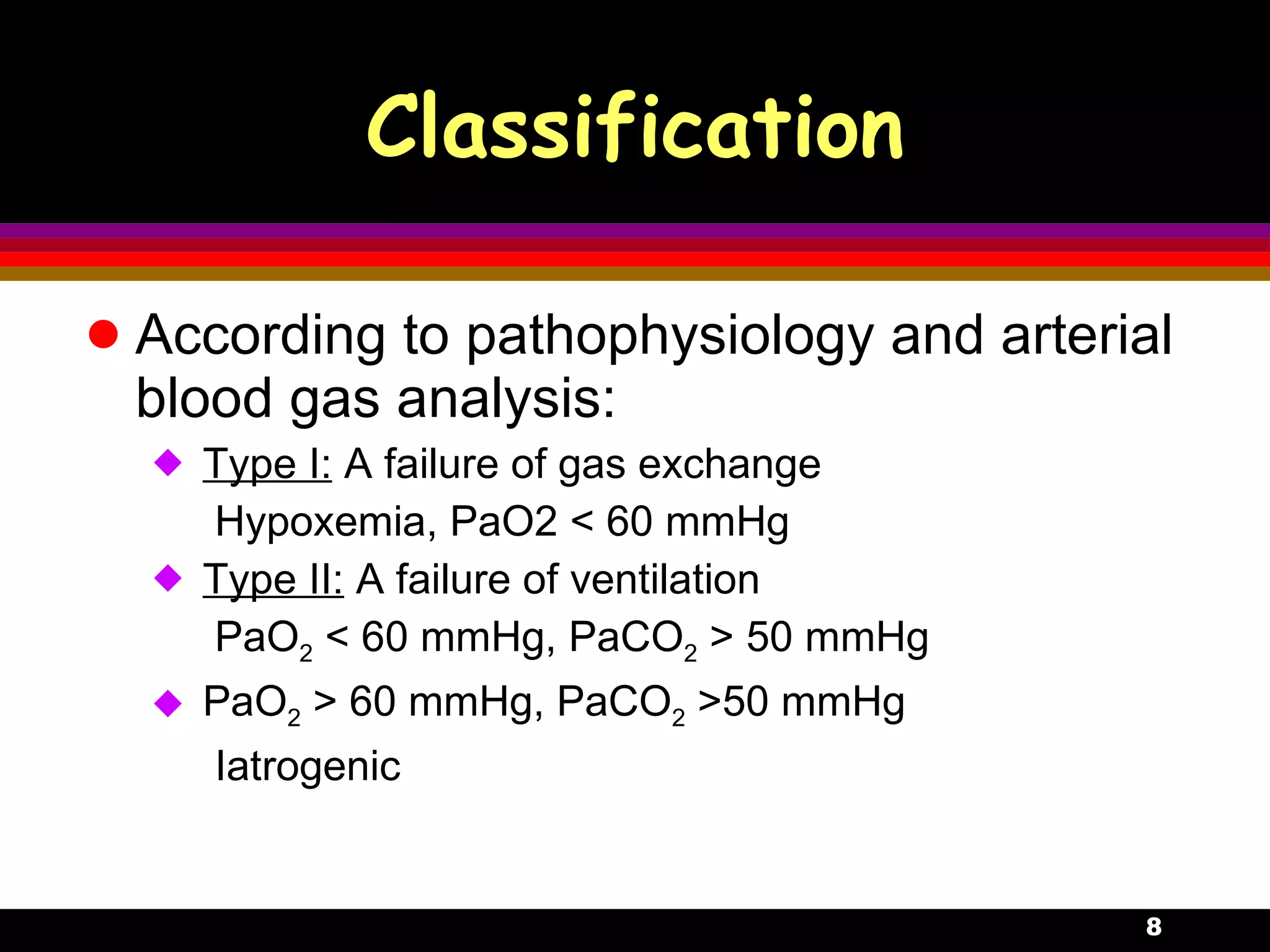
Classification According to pathophysiology and arterial blood gas analysis: Type I:  A failure of gas exchange Hypoxemia, PaO2 < 60 mmHg Type II:  A failure of ventilation PaO 2  < 60 mmHg, PaCO 2  > 50 mmHg PaO 2  > 60 mmHg, PaCO 2  >50 mmHg Iatrogenic
Classification According to the involved site Central respiratory failure Change of respiratory rhythm and frequency  Peripheral respiratory failure Dyspnea According to onset of respiratory failure Acute, develops in seconds or hours Chronic, develops in days or longer, elevated HCO3- Acute onset of Chronic respiratory failure Have no definitive borderline According to mechanisms Pump failure Lung failure
Etiology Airway obstruction Airway inflammation, tumor, foreign bodies, fibrosis scar COPD and asthma Alveolar or interstitial lung diseases pneumonia, emphysema, pulmonary tuberculosis, diffuse interstitial pulmonary fibrosis, pulmonary edema Pulmonary vascular diseases Pulmonary embolism, pulmonary vasculitis Chest wall or pleural diseases Flail chest caused by trauma, pneumothorax, severe spinal deformity, massive pleural effusion Neuromuscular diseases Cerebrovascular diseases, craniocerebral trauma, cerebritis and sedative-hypnotic, poliomyelitis, polyneuritis, myasthenia gravis
Respiratory Pump Failure (泵衰竭) Pump failure is caused by dysfunction of respiratory pump Low respiratory drive due to   central or peripheral nervous system diseases, neuromuscular junction problem or f atigue of  respiratory muscles -> hypoventilation   manifested as type  Ⅱ  respiratory failure
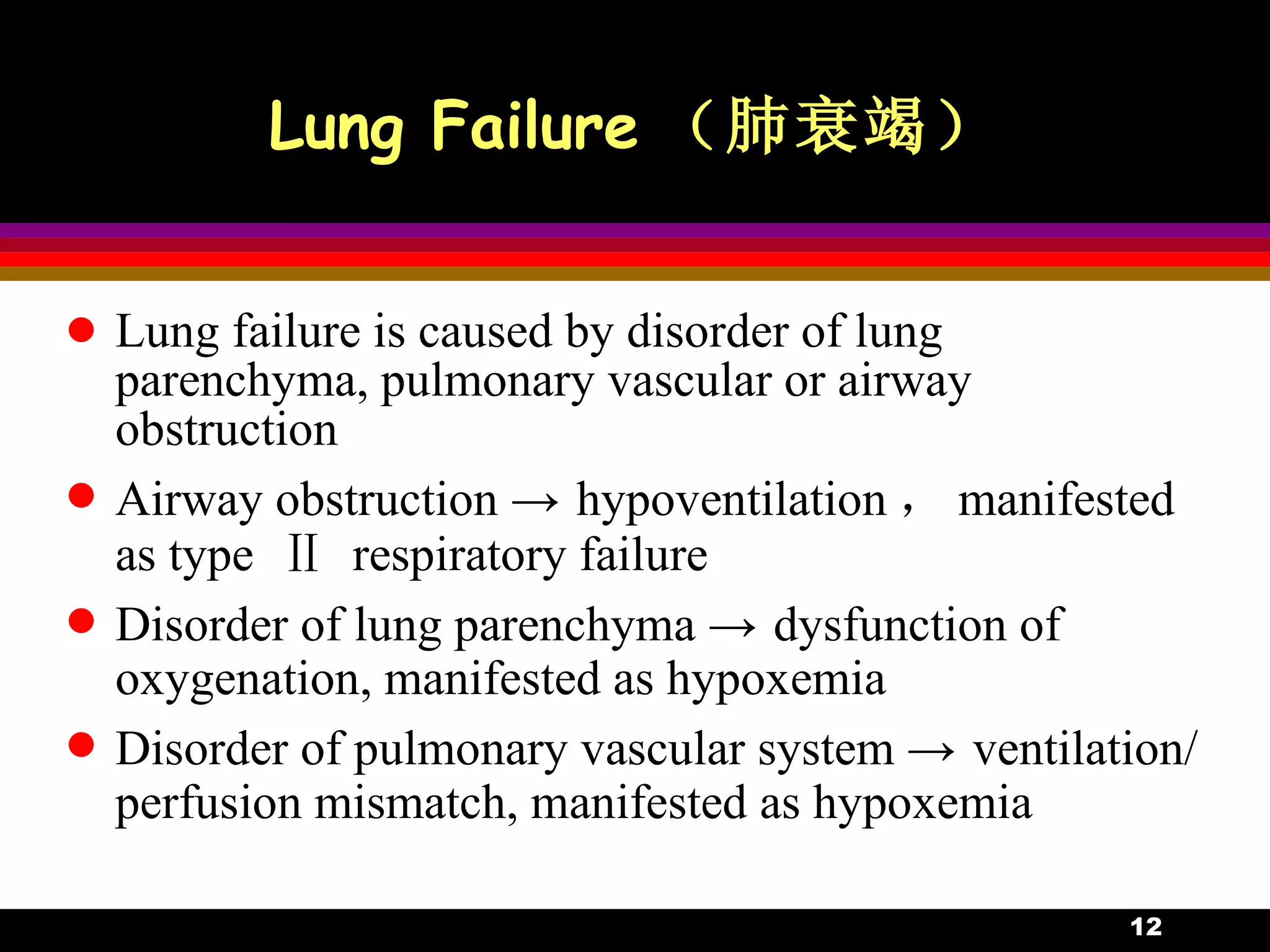
Lung Failure (肺衰竭) Lung failure is caused by disorder of lung parenchyma, pulmonary vascular or airway obstruction Airway obstruction  ->  hypoventilation , manifested as type  Ⅱ  respiratory failure Disorder of lung parenchyma  ->  dysfunction of   oxygenation, manifested as hypoxemia Disorder of pulmonary vascular system  ->  ventilation/perfusion mismatch, manifested as hypoxemia
Mechanisms & Pathophysiology Hypoxemia Alveolar ventilation ↓ FiO 2 ↓ Diffusion abnormality V/Q mismatch A-V shunt Hypercapnia( CO2 retention) CO 2  production ↑ Alveolar ventilation ↓
Mechanisms of hypoxemia FiO2 ↓ Altiplano or under a deep well PAO2  & PaO2 ↓ Hypoventilation VA = VE – VD The diffusion capacity of CO2 is 20 times of that of O2 25  20  15  10  5  肺泡分压 (kPa) 0  2  4  6  8  10 肺泡通气量 (l/min) P A CO2 P A O2 P A C O 2  =0.863*VC O2 /VA
Mechanisms of hypoxemia ––   Diffusion abnormality ( 弥散障碍 ) The factors that influence rate of gas diffusion across the respiratory membrane include:  the partial pressure difference of the gas between the two sides of the membrane,  the surface area of membrane the time of contact between blood and alveoli  the permeability of the membrane Diffusion abnormality manifested as hypoxemia 100 80 60 40 动脉氧分压 0.25  0.5  0.75 血液通过肺泡毛细血管时间
Mechanisms of hypoxemia Ventilation/perfusion mismatch ( 通气 / 灌流失衡 ) Shunt (肺动 - 静脉分流) V/Q=0.8 V/Q>0.8 V/Q<0.8 Q > V (A-V shunt) Normal V > Q (dead space effect)
( 二 ) 通气 / 血流比例  V/Q 肺泡死腔通气 V/Q > 0.8 静 - 动脉分流 V/Q < 0.8 正常通气 / 血流 V/Q 0.8 VD  PaCO 2 - PeCO 2 VT  PaCO 2 Qs  CcO 2   - CaO 2 Q T   CcO 2   - CvO 2 V A   4.2L(R2.1, L2.1) Q  5.0L(R2.5, L2.5) 见于肺不张, ARDS 见于 COPD 正常 Mechanisms of hypoxemia
Mechanisms of hypoxemia Oxygen consumption, (VO2 )   ↑: fever, chill, dyspnea, twitch (eg, 500ml/min) Oxygen delivery (DO2 )↓ , Palev  O2  ↓ 800 100 20 10 肺泡氧分压 2  4  6  8  10 肺泡通气量 (l/min) 400 动脉氧分压 (kPa)
Mechanisms of hypercapnia CO2 production↑:  •  fever, infection, sepsis, epilepsy Alveolar ventilation ↓ • neuromuscular diseases or fatigue of respiratory muscles • obstructive ventilation disorder
Influence of hypoxemia  Central nervous system   Oxygen consumption of brain- -3  ml/100g·min If jugular vein PaO2 <20mmHg : unconsciousness, coma PaO2 <20mmHg : irreversible damage to nerve cells in several minutes (4~5min) Mild hypoxemia : impaired concentration, disorientation, hypomnesia Severe hypoxemia : dysphoria, unconsciousness, coma
Influence of hypoxemia Cardiovascular system Myocardium  oxygen consumption :  10 ml/100g/min Early stage of acute hypoxia–stimulation of sympathetic nerve->HR  、 BP  、 CO   Chronic hypoxia -> small pulmonary arteries contraction -> pulmonary hypertension  — Cor pulmonale
PaO 2 ↓  (<60mmHg)  -> stimulate the chemoreceptors  ->   stimulate respiratory center  ->   strengthen respiratory movement, MV   , respiratory distress   PaO 2 ↓(<30mmHg) -> inhibition of respiratory center>stimulation of respiratory center  ->   respiratory depression Hyperventilation ->CO 2 ↓ -> inhibition of respiratory center Severe hypoxemia  ->   slow shallow irregular  respiration  or Cheyne-Stokes  respiration Influence of hypoxemia Respiratory system
Influence of hypoxemia haematological system   Chronic hypoxemia ->stimulate hematopoiesis of bone marrow -> EPO production     RBC      haemoglobin saturation &  O 2  Delivery capacity        blood viscosity   , blood stream resistance    ->   cardiac load & CO     hypoxemia and blood viscosity    -> the risk of DIC 
Influence of hypoxemia Renal & Digestive system Renal blood vessels contraction, blood supply ↓when accompany  with hypotension, DIC  ->  Renal failure Gastric mucosal erosion, necrosis, ulcer and bleeding Hepatic cell impairment by hypoxia  ->  ALT↑ , jaundice
Influence of hypercapnia  Central nervous system Cerebral blood flow : PaCO2  0.133kPa ,  blood flow   4%  ->  headache, intracranial pressure  Cerebrospinal fluid : H+ 、 HCO 3 、 CO 2 enter blood-brain barrier  -> [H+]     ->stimulate subcortex &  excitability     Consciousness :  dizziness, asterixis, somnolence, coma, convulsion   Peripheral nerves : sympathetic nerve, adrenal gland, distal nerves , catecholamine(CA) 
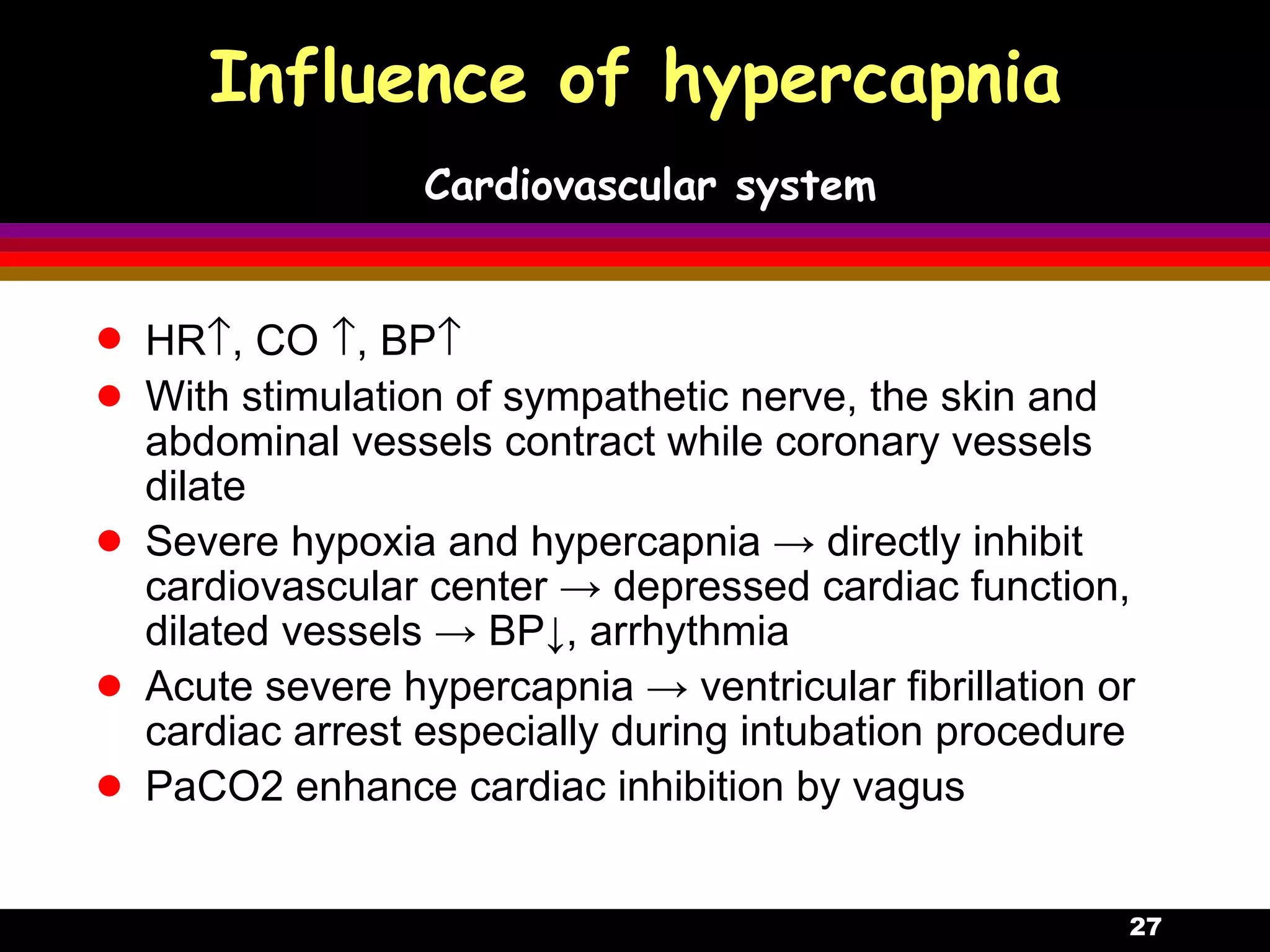
Influence of hypercapnia   Cardiovascular system HR  , CO   , BP    With stimulation of sympathetic nerve, the skin and abdominal vessels contract while coronary vessels dilate Severe hypoxia and hypercapnia -> directly inhibit cardiovascular center -> depressed cardiac function, dilated vessels -> BP↓, arrhythmia  Acute severe hypercapnia -> ventricular fibrillation or cardiac arrest especially during intubation procedure  PaCO2 enhance cardiac inhibition by vagus
Influence of hypercapnia   Respiratory system Stimulate respiratory center -> strengthen respiratory movement, Ventilation   (PaCO2    0.133 kPa ,  Ventilation volume   2 L/min) Slight contraction of small pulmonary arteries Directly relax the bronchial smooth muscle PAO2  PaCO2   -> rightward shift of the oxyhaemoglobin dissociation curve (ODC)
pH  pH     26.6mmHg
Influence of hypercapnia urinary  system Mild CO2 retention ->dilation of renal blood vessels -> renal blood flow   -> urine     PaCO2 > 8 kPa,  pH       ->renal blood vessels spasm -> renal blood flow     HCO3 and Na+ reabsorption   -> urine  
Influence of hypoxemia & hypercapnia Acid-base balance and electrolytes Severe hypoxia  ->  inhibition of cellular energy metabolism  ->  insufficient energy production, production of lactic acid ↑  ->  sodium-potassium pump failure  ->  metabolic acidosis, hyperkalemia  ->  PCO 2 ↑  Respiratory acidosis and metabolic acidosis pH is determined by HCO 3 /PaCO 2  ratio Slow CO 2  retention ->   compensated by kidney, decreased elimination of HCO 3 - ( It takes 1 ~ 3 days for  kidney to compensate ) pH = HCO 3 - PaCO 2
Clinical manifestation Acute respiratory failure (1) Dyspnea   Dyspnea is a early symptom of respiratory failure.  Increased breath rates Change in breath rhythm: Cheyne-Stokes respiration, Biot’s respiration Accessory respiratory muscles involved in  breathing  ->  “three depressions sign”
Cyanosis: Cyanosis is a typical sign of hypoxia, indicating arterial oxygen saturation lower than 90%. The extent of cyanosis is associated with content of reduced hemoglobin. So it is less readily detectable if anemia is present and more readily seen in polycythemia. Peripheral cyanosis is associated with stasis, in which oxyhemoglobin is reduced more than it normally is because of the prolonged peripheral blood transit time, while the PaO2 could be normal.  Central cyanosis results from arterial hypoxemia. Clinical manifestation Acute respiratory failure (2)
Neuropsychic symptoms: Mental disorder, mania, coma, convulsion Circulatory system: Tachycardia, myocardial impairment, peripheral circulatory failure, hypotension, arrhythmia, cardiac arrest. Digestive system : Hepatic function impairment: ALT↑ Gastrointestinal tract: mucosal erosion, stress ulcer, gastrointestinal bleeding Urinary system: Renal function impairment: BUN↑ Proteinuria, hematuria, casts in urine Clinical manifestation Acute respiratory failure (3)
Clinical manifestation Chronic respiratory failure Dyspnea: Excessive respiratory effort, prolonged expiration——rapid shallow breathing——slow shallow breathing, Cheyne-Stokes breathing (CO2 narcosis, severe respiratory depression) Neuropsychic symptoms: Irritation caused by increased PaCO2 in early stage: insomnia at night, drowsiness during the day Depression caused by pulmonary encephalopathy in late stage: apathy, convulsion, coma, tendon reflex weakened or disappear Circulatory system: Peripheral vesodilation, skin congestion, warm and sweaty extremities, BP ↑ , CO ↑ , pulsus magnus, HR ↑ , pulsatile headache
Diagnostic criteria   History of respiratory dysfunction that severely affects the lung’s ability to maintain arterial oxygenation or carbon dioxide elimination Clinical manifestation of d yspnea and cyanosis Blood gas analysis PaO2 < 60 mmHg, or plus PaCO2 > 50 mmHg Breathing air on sea level and standard atmosphere pressure at rest   Exclude intracardiac shunt and  decreased cardiac output , such as ventricular septal defect In fact it is a pathophysiology & laboratory Diagnosis
Diagnostic criteria   The acute respiratory distress syndrome (ARDS)   ARDS is a process of nonhydrostatic pulmonary edema and hypoxemia associated with a variety of etiologies:  Progressive dyspnea and hypoxia which can not be relieved by oxygen therapy Bilateral infiltrates on chest radiograph  PaO2/FiO2 <200  Excluding patients with signs of heart failure or a pulmonary capillary wedge pressure (PCWP) >18 mmHg
Treatment   (outline of principle) Etiology Management Keep airway open Oxygen therapy Ensure adequate alveolar ventilation, correct CO2 retention Respiratory stimulant Mechanical Ventilation General supportive care Transfer to ICU for critical care and treatment  Infection control  Management of electrolyte and acid-base disturbance Management of cor pulmonale, pulmonary encephalopathy, multi-organ dysfunction syndrome(MODS). Nutrition support
Treatment Etiology Management Management of any underlying diseases : upper airway obstruction, severe pneumothorax, massive pleural effusions Eliminate any factors that cause respiratory failure secondary to infection or shock Any inducement leading to acute deterioration of chronic respiratory failure : infection,   malnutrition, inappropriate medication usage
Causes of Upper Airway Obstruction CNS depression-anesthesia, drug overdose Cardiac arrest Loss of consciousness Foreign body or tumor
Treatment   Keep airway open  保持气道通畅 Importance of airway open :  Airway obstruction: resistance ↑  ->  WOB↑ respiratory muscle fatigue difficult to clear airway secretion  ->  infection deteriorate atelectasis  ->  the surface area of gas exchange     Complete airway obstruction  ->  apnea, death Clear airway secretion : mucolytics  manual  suction
A: Airway   ( 气道通畅吗? ) Open airway, blind sweep inside mouth Look, listen, and feel Assist if patient is not breathing adequately (watch for neck injury) Head tilt Jaw thrust Intubation – best protection Airway confirmation: CO 2  + BBS CO 2  may be absent if patient has no circulation
Maneuvers to Open the Airway Head tilt Jaw thrust (preferred in trauma) Triple airway maneuver:  chin lift, head tilt, separation of teeth
Treatment   Keep airway open 保持气道通畅 Bronchodilators for patients with bronchospasm:   β 2-adrenoreceptor agonist, anticholinergic,  glucocorticoid, theophylline Mode of administration : parenteral first and then inhale Mechanical ventilation+ medications delivery Airway humidify & nebulize Establishing artificial airway Endotracheal intubation  Tracheostomy
Intubation Procedure Obtain a brief history Oxygenate Position Align the oral with the pharyngeal-laryngeal axis Have suction ready Sedation and neuromuscular blockade
Intubation Procedure Perform laryngoscopy Introduce on the right side, sweeping the tongue left Straight blade under the epiglottis Curved blade in the vallecula
CO 2  Detection  测定证实
B: Breathing  呼吸 Identify: He is not breathing!  Mouth-to-mouth: slow, low pressure Evidence: expired O2 is sufficient Evidence: Breathless CPR is still beneficial Intubation + Ambu Bag = Best Connect O2 when possible
Barrier Breathing Devices 呼吸保护屏障装置
B: Breathing  呼吸 New airway equipment guidelines: Endotracheal intubation = Gold standard Laryngeal Mask Airway (LMA) and Combitube are easier to use by less skilled personnel Don’t forget cricoid pressure Use 6-7 mL tidal volume over 2 sec. if O2 is available 15 chest compressions / 2 ventilations increase coronary perfusion pressure and reduce risk of aspiration
B: Breathing  呼吸 Airway Alternatives “ Fast-Trach” LMA (Laryngeal Mask Airway)
C: Circulation  循环 Start IV (antecubital (肘前静脉)  is the 1st choice) Femoral and internal jugular lines may be necessary Chest compressions: 80-100 bpm, rate is more important than actual compressions Confirm effectiveness: feel pulse, arterial waveform
D: Diagnosis  诊断 Work with internal medicine and cardiology Start with 5H and 5T
Chain of Survival   生还之链 The sequence of events (Call first    A   B  C   D) “ The chain is only as strong as its weakest link”
Treatment Oxygen therapy Indications of oxygen therapy : Pump failure:  improve ventilation Pneumonia, Pulmonary embolism, acute attack of asthma Severe pulmonary edema, ARDS Acute deterioration or worsening of COPD (pay attention to CO2 retention when giving oxygen therapy! )
Treatment Oxygen therapy Inspired oxygen concentration: Inspired oxygen concentration should be the lowest value that results in an oxygen saturation of over 90% (PaCO2 about 60mmHg). High concentrations of inspired oxygen (>35%) are safe in patients with type Ⅰ respiratory failure, as there is no risk of CO2 retention. While in patients with type Ⅱ respiratory failure, who are dependent on hypoxic drive for ventilation, oxygen therapy must be carefully controlled so that sufficient oxygen is supplied but without precipitating severe respiratory acidosis.
Oxygen delivery device: ①  Nasal cannula/prongs: Advantage: allow patients to eat, drink, expectorate and speak Disadvantage: FiO2 delivered is not stable and affected by breathing; high flow rates irritate nasopharyngeal mucosa Guide: Delivers 4% Oxygen per liter flow;  FiO2 (%)=21+4×oxygen flow rate (L/min) Flow rates should be limited to less than 7L/min. ②  Mask:   Simple oxygen mask, nonrebreathing mask with reservoir bag, Venturi mask. Advantage: FiO2 delivered is comparatively stable and is adjustable; less irritative to nasopharyngeal mucosa Disadvantage: inconvenient for patients to expectorate, eat and drink Treatment Oxygen therapy
Nasal cannula/prongs 鼻导管吸氧 鼻导管给氧的上限量为 6L/min ,大于这一流量时,由于管道和鼻咽内产生涡流,吸氧浓度不再增加。
Simple oxygen mask 常规面罩 常规面罩可提供较稳定的氧浓度,其输送的氧浓度大约为 70% -80% 但是这两种方法都不能精确地监测 FiO2 。因为随呼吸频率、每分钟通气量、室内空气的流动、输氧装置的放置等因素的不同而改变。故影响纠正低氧血症并防止高碳酸血症的发生的治疗观察。
Venturi mask  Venturi 面罩 Venturi 面罩可较精确地调整 FiO2 ,但面罩必须佩戴正确才能使预期的氧量得到输送
Treatment Oxygen therapy Side effects Inhibition of respiratory center  in patients with type  Ⅱ  respiratory failure, who are dependent on hypoxic drive for ventilation     CO2 retention  ↑   Absorption atelectasis/denitrogenisation  吸收性肺不张 ):   nitrogen is replaced by more absorptive oxygen Oxygen poisoning   : High concentrations of inspired oxygen   injury of pulmonary capillary epithelium
Treatment Ensure adequate ventilation, correct CO2 retention Respiratory stimulant: mainly used in CNS depression Principles for respiratory stimulant ( 呼吸兴奋剂 ) : Maintain potency of airway to avoid respiratory muscles fatigue and deteriorate CO2 retention Be cautious when used in patients with frequent convulsion caused by cerebral anoxia, cerebral edema Suitable for patients with normal respiratory muscle strength Not suitable for patients only with oxygenation failure Avoid sudden withdrawal Drug: coramine, lobeline, doxapram
Treatment Non-invasive positive pressure ventilation, NIPPV Indications Conscious and cooperative Stable circulation Be able to protect airway No facial trauma, injury and deformity Be endurable to mask
Different kind of masks  各款口鼻面罩
Treatment Mechanical ventilation Goals of Mechanical Ventilation: improve alveolar ventilation, decrease PaCO2; improve pulmonary gas exchange; Decrease work of breathing, reverse respiratory muscle fatigue. Indications for mechanical ventilation :  apnea; upper airway obstruction; impaired airway protection; inadequate handling of secretions; acute hypercapnia that is not quickly reversed by appropriate specific therapy; severe hypoxemia; progressive patient fatigue despite appropriate treatment. Adjust modes and settings for mechanical ventilation  according to blood gas analysis and clinical judgment
Treatment Management of electrolyte and acid-base disturbance Respiratory acidosis improve alveolar ventilation Respiratory acidosis + metabolic acidosis  Etiology management of acidosis improve alveolar ventilation appropriate alkali supplement Respiratory acidosis + metabolic alkalosis Avoid  Iatrogenic  factors
Thank you!

12.Respiratory Failure

  • 1.
  • 2.
    Male, 32 Fever,cough with sputum for 3 days No finding on physical examination Diagnosis : pneumonia X - ray : shadow in left lower lobe August 16, 2003 August 20, 2003 Acute shortness of breath Anxiety RR 40/min, Cyanosis ABG : PaO2 61mm Hg(FiO2 1.0) PaCO2 35 mmHg, pH 7.20 X-ray : clouded glass Diagnosis : ARDS Acidosis
  • 3.
    Intubation via mouthtracheotomy Monitoring and ventilation
  • 4.
    Contents 0f outlineDefinition Etiology & Pathogenesis Classification Clinical manifestations Diagnosis Treatment
  • 5.
    Introduction Be a frequently encountered medical problem A major cause of death in China Mortality from COPD, which ends in death from respiratory failure, continues to increase More than 70% of patients with pneumonia are attributed to respiratory failure About 1/3 patients in ICU in the United States, about 500 000 persons, receive mechanical ventilation each year
  • 6.
    Introduction (cont.) Short-termsurvival is more than 80% for acute respiratory failure not preceded by additional lung disease or systemic illness Multi-system organ failure or pre-existing renal, liver, or chronic gastrointestinal disease with malnutrition substantially worsens outlook About 17% of patients placed on mechanical ventilation require assistance for more than 14 days Among those requiring this amount of mechanical ventilation, elderly patients have a 9% survival and younger patients a 36% survival
  • 7.
    Definition Be a clinical syndrome of respiratory and metabolism dysfunction caused by any condition that severely affects the lung’s ability to maintain arterial oxygenation or carbon dioxide elimination. Both acute or chronic respiratory failure may be divided into two main categories. A failure of gas exchange – hypoxemia A failure of ventilation – hypercapnia
  • 8.
    Classification According topathophysiology and arterial blood gas analysis: Type I: A failure of gas exchange Hypoxemia, PaO2 < 60 mmHg Type II: A failure of ventilation PaO 2 < 60 mmHg, PaCO 2 > 50 mmHg PaO 2 > 60 mmHg, PaCO 2 >50 mmHg Iatrogenic
  • 9.
    Classification According tothe involved site Central respiratory failure Change of respiratory rhythm and frequency Peripheral respiratory failure Dyspnea According to onset of respiratory failure Acute, develops in seconds or hours Chronic, develops in days or longer, elevated HCO3- Acute onset of Chronic respiratory failure Have no definitive borderline According to mechanisms Pump failure Lung failure
  • 10.
    Etiology Airway obstructionAirway inflammation, tumor, foreign bodies, fibrosis scar COPD and asthma Alveolar or interstitial lung diseases pneumonia, emphysema, pulmonary tuberculosis, diffuse interstitial pulmonary fibrosis, pulmonary edema Pulmonary vascular diseases Pulmonary embolism, pulmonary vasculitis Chest wall or pleural diseases Flail chest caused by trauma, pneumothorax, severe spinal deformity, massive pleural effusion Neuromuscular diseases Cerebrovascular diseases, craniocerebral trauma, cerebritis and sedative-hypnotic, poliomyelitis, polyneuritis, myasthenia gravis
  • 11.
    Respiratory Pump Failure(泵衰竭) Pump failure is caused by dysfunction of respiratory pump Low respiratory drive due to central or peripheral nervous system diseases, neuromuscular junction problem or f atigue of respiratory muscles -> hypoventilation manifested as type Ⅱ respiratory failure
  • 12.
    Lung Failure (肺衰竭)Lung failure is caused by disorder of lung parenchyma, pulmonary vascular or airway obstruction Airway obstruction -> hypoventilation , manifested as type Ⅱ respiratory failure Disorder of lung parenchyma -> dysfunction of oxygenation, manifested as hypoxemia Disorder of pulmonary vascular system -> ventilation/perfusion mismatch, manifested as hypoxemia
  • 13.
    Mechanisms & PathophysiologyHypoxemia Alveolar ventilation ↓ FiO 2 ↓ Diffusion abnormality V/Q mismatch A-V shunt Hypercapnia( CO2 retention) CO 2 production ↑ Alveolar ventilation ↓
  • 15.
    Mechanisms of hypoxemiaFiO2 ↓ Altiplano or under a deep well PAO2 & PaO2 ↓ Hypoventilation VA = VE – VD The diffusion capacity of CO2 is 20 times of that of O2 25 20 15 10 5 肺泡分压 (kPa) 0 2 4 6 8 10 肺泡通气量 (l/min) P A CO2 P A O2 P A C O 2 =0.863*VC O2 /VA
  • 16.
    Mechanisms of hypoxemia–– Diffusion abnormality ( 弥散障碍 ) The factors that influence rate of gas diffusion across the respiratory membrane include: the partial pressure difference of the gas between the two sides of the membrane, the surface area of membrane the time of contact between blood and alveoli the permeability of the membrane Diffusion abnormality manifested as hypoxemia 100 80 60 40 动脉氧分压 0.25 0.5 0.75 血液通过肺泡毛细血管时间
  • 17.
    Mechanisms of hypoxemiaVentilation/perfusion mismatch ( 通气 / 灌流失衡 ) Shunt (肺动 - 静脉分流) V/Q=0.8 V/Q>0.8 V/Q<0.8 Q > V (A-V shunt) Normal V > Q (dead space effect)
  • 18.
    ( 二 )通气 / 血流比例 V/Q 肺泡死腔通气 V/Q > 0.8 静 - 动脉分流 V/Q < 0.8 正常通气 / 血流 V/Q 0.8 VD PaCO 2 - PeCO 2 VT PaCO 2 Qs CcO 2 - CaO 2 Q T CcO 2 - CvO 2 V A 4.2L(R2.1, L2.1) Q 5.0L(R2.5, L2.5) 见于肺不张, ARDS 见于 COPD 正常 Mechanisms of hypoxemia
  • 19.
    Mechanisms of hypoxemiaOxygen consumption, (VO2 ) ↑: fever, chill, dyspnea, twitch (eg, 500ml/min) Oxygen delivery (DO2 )↓ , Palev O2 ↓ 800 100 20 10 肺泡氧分压 2 4 6 8 10 肺泡通气量 (l/min) 400 动脉氧分压 (kPa)
  • 20.
    Mechanisms of hypercapniaCO2 production↑: • fever, infection, sepsis, epilepsy Alveolar ventilation ↓ • neuromuscular diseases or fatigue of respiratory muscles • obstructive ventilation disorder
  • 21.
    Influence of hypoxemia Central nervous system Oxygen consumption of brain- -3 ml/100g·min If jugular vein PaO2 <20mmHg : unconsciousness, coma PaO2 <20mmHg : irreversible damage to nerve cells in several minutes (4~5min) Mild hypoxemia : impaired concentration, disorientation, hypomnesia Severe hypoxemia : dysphoria, unconsciousness, coma
  • 22.
    Influence of hypoxemiaCardiovascular system Myocardium oxygen consumption : 10 ml/100g/min Early stage of acute hypoxia–stimulation of sympathetic nerve->HR  、 BP  、 CO  Chronic hypoxia -> small pulmonary arteries contraction -> pulmonary hypertension  — Cor pulmonale
  • 23.
    PaO 2 ↓ (<60mmHg) -> stimulate the chemoreceptors -> stimulate respiratory center -> strengthen respiratory movement, MV  , respiratory distress PaO 2 ↓(<30mmHg) -> inhibition of respiratory center>stimulation of respiratory center -> respiratory depression Hyperventilation ->CO 2 ↓ -> inhibition of respiratory center Severe hypoxemia -> slow shallow irregular respiration or Cheyne-Stokes respiration Influence of hypoxemia Respiratory system
  • 24.
    Influence of hypoxemiahaematological system Chronic hypoxemia ->stimulate hematopoiesis of bone marrow -> EPO production  RBC   haemoglobin saturation & O 2 Delivery capacity   blood viscosity  , blood stream resistance  -> cardiac load & CO   hypoxemia and blood viscosity  -> the risk of DIC 
  • 25.
    Influence of hypoxemiaRenal & Digestive system Renal blood vessels contraction, blood supply ↓when accompany with hypotension, DIC -> Renal failure Gastric mucosal erosion, necrosis, ulcer and bleeding Hepatic cell impairment by hypoxia -> ALT↑ , jaundice
  • 26.
    Influence of hypercapnia Central nervous system Cerebral blood flow : PaCO2  0.133kPa , blood flow  4% -> headache, intracranial pressure  Cerebrospinal fluid : H+ 、 HCO 3 、 CO 2 enter blood-brain barrier -> [H+]  ->stimulate subcortex & excitability  Consciousness : dizziness, asterixis, somnolence, coma, convulsion Peripheral nerves : sympathetic nerve, adrenal gland, distal nerves , catecholamine(CA) 
  • 27.
    Influence of hypercapnia Cardiovascular system HR  , CO  , BP  With stimulation of sympathetic nerve, the skin and abdominal vessels contract while coronary vessels dilate Severe hypoxia and hypercapnia -> directly inhibit cardiovascular center -> depressed cardiac function, dilated vessels -> BP↓, arrhythmia Acute severe hypercapnia -> ventricular fibrillation or cardiac arrest especially during intubation procedure PaCO2 enhance cardiac inhibition by vagus
  • 28.
    Influence of hypercapnia Respiratory system Stimulate respiratory center -> strengthen respiratory movement, Ventilation  (PaCO2  0.133 kPa , Ventilation volume  2 L/min) Slight contraction of small pulmonary arteries Directly relax the bronchial smooth muscle PAO2  PaCO2  -> rightward shift of the oxyhaemoglobin dissociation curve (ODC)
  • 29.
    pH  pH  26.6mmHg
  • 30.
    Influence of hypercapniaurinary system Mild CO2 retention ->dilation of renal blood vessels -> renal blood flow  -> urine  PaCO2 > 8 kPa, pH   ->renal blood vessels spasm -> renal blood flow  HCO3 and Na+ reabsorption  -> urine 
  • 31.
    Influence of hypoxemia& hypercapnia Acid-base balance and electrolytes Severe hypoxia -> inhibition of cellular energy metabolism -> insufficient energy production, production of lactic acid ↑ -> sodium-potassium pump failure -> metabolic acidosis, hyperkalemia -> PCO 2 ↑ Respiratory acidosis and metabolic acidosis pH is determined by HCO 3 /PaCO 2 ratio Slow CO 2 retention -> compensated by kidney, decreased elimination of HCO 3 - ( It takes 1 ~ 3 days for kidney to compensate ) pH = HCO 3 - PaCO 2
  • 32.
    Clinical manifestation Acuterespiratory failure (1) Dyspnea Dyspnea is a early symptom of respiratory failure. Increased breath rates Change in breath rhythm: Cheyne-Stokes respiration, Biot’s respiration Accessory respiratory muscles involved in breathing -> “three depressions sign”
  • 33.
    Cyanosis: Cyanosis isa typical sign of hypoxia, indicating arterial oxygen saturation lower than 90%. The extent of cyanosis is associated with content of reduced hemoglobin. So it is less readily detectable if anemia is present and more readily seen in polycythemia. Peripheral cyanosis is associated with stasis, in which oxyhemoglobin is reduced more than it normally is because of the prolonged peripheral blood transit time, while the PaO2 could be normal. Central cyanosis results from arterial hypoxemia. Clinical manifestation Acute respiratory failure (2)
  • 34.
    Neuropsychic symptoms: Mentaldisorder, mania, coma, convulsion Circulatory system: Tachycardia, myocardial impairment, peripheral circulatory failure, hypotension, arrhythmia, cardiac arrest. Digestive system : Hepatic function impairment: ALT↑ Gastrointestinal tract: mucosal erosion, stress ulcer, gastrointestinal bleeding Urinary system: Renal function impairment: BUN↑ Proteinuria, hematuria, casts in urine Clinical manifestation Acute respiratory failure (3)
  • 35.
    Clinical manifestation Chronicrespiratory failure Dyspnea: Excessive respiratory effort, prolonged expiration——rapid shallow breathing——slow shallow breathing, Cheyne-Stokes breathing (CO2 narcosis, severe respiratory depression) Neuropsychic symptoms: Irritation caused by increased PaCO2 in early stage: insomnia at night, drowsiness during the day Depression caused by pulmonary encephalopathy in late stage: apathy, convulsion, coma, tendon reflex weakened or disappear Circulatory system: Peripheral vesodilation, skin congestion, warm and sweaty extremities, BP ↑ , CO ↑ , pulsus magnus, HR ↑ , pulsatile headache
  • 36.
    Diagnostic criteria History of respiratory dysfunction that severely affects the lung’s ability to maintain arterial oxygenation or carbon dioxide elimination Clinical manifestation of d yspnea and cyanosis Blood gas analysis PaO2 < 60 mmHg, or plus PaCO2 > 50 mmHg Breathing air on sea level and standard atmosphere pressure at rest Exclude intracardiac shunt and decreased cardiac output , such as ventricular septal defect In fact it is a pathophysiology & laboratory Diagnosis
  • 37.
    Diagnostic criteria The acute respiratory distress syndrome (ARDS) ARDS is a process of nonhydrostatic pulmonary edema and hypoxemia associated with a variety of etiologies: Progressive dyspnea and hypoxia which can not be relieved by oxygen therapy Bilateral infiltrates on chest radiograph PaO2/FiO2 <200 Excluding patients with signs of heart failure or a pulmonary capillary wedge pressure (PCWP) >18 mmHg
  • 38.
    Treatment (outline of principle) Etiology Management Keep airway open Oxygen therapy Ensure adequate alveolar ventilation, correct CO2 retention Respiratory stimulant Mechanical Ventilation General supportive care Transfer to ICU for critical care and treatment Infection control Management of electrolyte and acid-base disturbance Management of cor pulmonale, pulmonary encephalopathy, multi-organ dysfunction syndrome(MODS). Nutrition support
  • 39.
    Treatment Etiology ManagementManagement of any underlying diseases : upper airway obstruction, severe pneumothorax, massive pleural effusions Eliminate any factors that cause respiratory failure secondary to infection or shock Any inducement leading to acute deterioration of chronic respiratory failure : infection, malnutrition, inappropriate medication usage
  • 40.
    Causes of UpperAirway Obstruction CNS depression-anesthesia, drug overdose Cardiac arrest Loss of consciousness Foreign body or tumor
  • 41.
    Treatment Keep airway open 保持气道通畅 Importance of airway open : Airway obstruction: resistance ↑ -> WOB↑ respiratory muscle fatigue difficult to clear airway secretion -> infection deteriorate atelectasis -> the surface area of gas exchange  Complete airway obstruction -> apnea, death Clear airway secretion : mucolytics manual suction
  • 42.
    A: Airway ( 气道通畅吗? ) Open airway, blind sweep inside mouth Look, listen, and feel Assist if patient is not breathing adequately (watch for neck injury) Head tilt Jaw thrust Intubation – best protection Airway confirmation: CO 2 + BBS CO 2 may be absent if patient has no circulation
  • 43.
    Maneuvers to Openthe Airway Head tilt Jaw thrust (preferred in trauma) Triple airway maneuver: chin lift, head tilt, separation of teeth
  • 44.
    Treatment Keep airway open 保持气道通畅 Bronchodilators for patients with bronchospasm: β 2-adrenoreceptor agonist, anticholinergic, glucocorticoid, theophylline Mode of administration : parenteral first and then inhale Mechanical ventilation+ medications delivery Airway humidify & nebulize Establishing artificial airway Endotracheal intubation Tracheostomy
  • 45.
    Intubation Procedure Obtaina brief history Oxygenate Position Align the oral with the pharyngeal-laryngeal axis Have suction ready Sedation and neuromuscular blockade
  • 46.
    Intubation Procedure Performlaryngoscopy Introduce on the right side, sweeping the tongue left Straight blade under the epiglottis Curved blade in the vallecula
  • 47.
    CO 2 Detection 测定证实
  • 48.
    B: Breathing 呼吸 Identify: He is not breathing! Mouth-to-mouth: slow, low pressure Evidence: expired O2 is sufficient Evidence: Breathless CPR is still beneficial Intubation + Ambu Bag = Best Connect O2 when possible
  • 49.
    Barrier Breathing Devices呼吸保护屏障装置
  • 50.
    B: Breathing 呼吸 New airway equipment guidelines: Endotracheal intubation = Gold standard Laryngeal Mask Airway (LMA) and Combitube are easier to use by less skilled personnel Don’t forget cricoid pressure Use 6-7 mL tidal volume over 2 sec. if O2 is available 15 chest compressions / 2 ventilations increase coronary perfusion pressure and reduce risk of aspiration
  • 51.
    B: Breathing 呼吸 Airway Alternatives “ Fast-Trach” LMA (Laryngeal Mask Airway)
  • 52.
    C: Circulation 循环 Start IV (antecubital (肘前静脉) is the 1st choice) Femoral and internal jugular lines may be necessary Chest compressions: 80-100 bpm, rate is more important than actual compressions Confirm effectiveness: feel pulse, arterial waveform
  • 53.
    D: Diagnosis 诊断 Work with internal medicine and cardiology Start with 5H and 5T
  • 54.
    Chain of Survival 生还之链 The sequence of events (Call first  A  B  C  D) “ The chain is only as strong as its weakest link”
  • 55.
    Treatment Oxygen therapyIndications of oxygen therapy : Pump failure: improve ventilation Pneumonia, Pulmonary embolism, acute attack of asthma Severe pulmonary edema, ARDS Acute deterioration or worsening of COPD (pay attention to CO2 retention when giving oxygen therapy! )
  • 56.
    Treatment Oxygen therapyInspired oxygen concentration: Inspired oxygen concentration should be the lowest value that results in an oxygen saturation of over 90% (PaCO2 about 60mmHg). High concentrations of inspired oxygen (>35%) are safe in patients with type Ⅰ respiratory failure, as there is no risk of CO2 retention. While in patients with type Ⅱ respiratory failure, who are dependent on hypoxic drive for ventilation, oxygen therapy must be carefully controlled so that sufficient oxygen is supplied but without precipitating severe respiratory acidosis.
  • 57.
    Oxygen delivery device:① Nasal cannula/prongs: Advantage: allow patients to eat, drink, expectorate and speak Disadvantage: FiO2 delivered is not stable and affected by breathing; high flow rates irritate nasopharyngeal mucosa Guide: Delivers 4% Oxygen per liter flow; FiO2 (%)=21+4×oxygen flow rate (L/min) Flow rates should be limited to less than 7L/min. ② Mask: Simple oxygen mask, nonrebreathing mask with reservoir bag, Venturi mask. Advantage: FiO2 delivered is comparatively stable and is adjustable; less irritative to nasopharyngeal mucosa Disadvantage: inconvenient for patients to expectorate, eat and drink Treatment Oxygen therapy
  • 58.
    Nasal cannula/prongs 鼻导管吸氧鼻导管给氧的上限量为 6L/min ,大于这一流量时,由于管道和鼻咽内产生涡流,吸氧浓度不再增加。
  • 59.
    Simple oxygen mask常规面罩 常规面罩可提供较稳定的氧浓度,其输送的氧浓度大约为 70% -80% 但是这两种方法都不能精确地监测 FiO2 。因为随呼吸频率、每分钟通气量、室内空气的流动、输氧装置的放置等因素的不同而改变。故影响纠正低氧血症并防止高碳酸血症的发生的治疗观察。
  • 60.
    Venturi mask Venturi 面罩 Venturi 面罩可较精确地调整 FiO2 ,但面罩必须佩戴正确才能使预期的氧量得到输送
  • 61.
    Treatment Oxygen therapySide effects Inhibition of respiratory center in patients with type Ⅱ respiratory failure, who are dependent on hypoxic drive for ventilation  CO2 retention ↑ Absorption atelectasis/denitrogenisation 吸收性肺不张 ): nitrogen is replaced by more absorptive oxygen Oxygen poisoning : High concentrations of inspired oxygen  injury of pulmonary capillary epithelium
  • 62.
    Treatment Ensure adequateventilation, correct CO2 retention Respiratory stimulant: mainly used in CNS depression Principles for respiratory stimulant ( 呼吸兴奋剂 ) : Maintain potency of airway to avoid respiratory muscles fatigue and deteriorate CO2 retention Be cautious when used in patients with frequent convulsion caused by cerebral anoxia, cerebral edema Suitable for patients with normal respiratory muscle strength Not suitable for patients only with oxygenation failure Avoid sudden withdrawal Drug: coramine, lobeline, doxapram
  • 63.
    Treatment Non-invasive positivepressure ventilation, NIPPV Indications Conscious and cooperative Stable circulation Be able to protect airway No facial trauma, injury and deformity Be endurable to mask
  • 64.
    Different kind ofmasks 各款口鼻面罩
  • 65.
    Treatment Mechanical ventilationGoals of Mechanical Ventilation: improve alveolar ventilation, decrease PaCO2; improve pulmonary gas exchange; Decrease work of breathing, reverse respiratory muscle fatigue. Indications for mechanical ventilation : apnea; upper airway obstruction; impaired airway protection; inadequate handling of secretions; acute hypercapnia that is not quickly reversed by appropriate specific therapy; severe hypoxemia; progressive patient fatigue despite appropriate treatment. Adjust modes and settings for mechanical ventilation according to blood gas analysis and clinical judgment
  • 66.
    Treatment Management ofelectrolyte and acid-base disturbance Respiratory acidosis improve alveolar ventilation Respiratory acidosis + metabolic acidosis Etiology management of acidosis improve alveolar ventilation appropriate alkali supplement Respiratory acidosis + metabolic alkalosis Avoid Iatrogenic factors
  • 67.