Assisted Ventilation
Indications
Respiratory Failure
Type I Hypoxemic airway – lung
Type II Hypercarbia CNS - Muscles
PaO2 <60mmHg at FiO2 60% or PaCO2>60mmHg
Cardiovascular Failure
Shock states ( central / peripheral )
Neuromuscular Failure
Airway protection
CPAP Failure
Pao2<50 while breathing 60-80% o2
Resp Acidosis with PH <7.20 -7.25 or Paco2 >60-
65
Persistent hypoxemia and Met Acidosis with BE >-
8
Marked retractions on cpap
Intractable apnea and bradycardia
LUNG MECHANICS
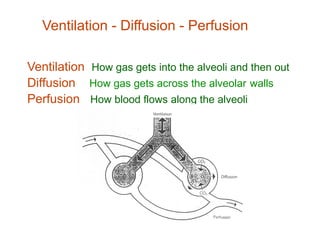
Ventilation - Diffusion - Perfusion
Ventilation How gas gets into the alveoli and then out
Diffusion How gas gets across the alveolar walls
Perfusion How blood flows along the alveoli
Compliance
Compliance is a measurement related to the elasticity of the
lung.
∆Volume
C = -----------------
∆Pressure
A low compliance inicates a stiff lung so It needs high
pressure and long IT to inflate
 Normal compliance = 3-6 mL/cmH2O.
 Compliance is decreased with surfactant
deficiency (0.5-1 mL/cmH2O),
Resistance
.
.
The range of values for total airway plus tissue respiratory
resistance for healthy newborns is 20-40 cm H2 O/L/s; in
intubated newborns, this range is 50-150 cm H2 O/L/s.
resistance > 100 mean obstructive disease
Ex : RDS
Stiff lung Compliance Decreased Resistance
Normal
Therefore
Improving oxygenation by prolonging inspiratory time
usually causes no harm
Ex : MAS
Compliance Normal Resistance Increased
These patients are very liable to air trapping and PAL syndrome it is
important to provide a long expiratory time during ventilation
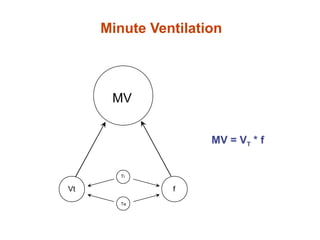
Minute Ventilation
Ti
Te
Vt f
MV
MV = VT * f
Goal of Assisted Ventilation
Provide optimal pulmonary gas exchange .
Oxygenation Get oxygen into blood
Ventilation Remove CO2 from blood
while Reducing patient‘s Work of Breathing
Optimizing patient‘s Comfort
Minimizing risk of lung injury /circulatory impact
Oxygen therapy
Methods of delivery
Free flow oxygen
Headbox
Nasal canula
CPAP
Mechanical ventilation
Hazards of O2 therapy
Little O2 CNS morbidity
Excess O2 ROP - BPD
Modes Of Ventilation
AC PCV IMV(VC , PC)
 An inspiratory cycle is initiated either by the
patient's inspiratory effort or, if no patient effort is
detected within a specified time window, by a
timer signal within the ventilator
 Every breath delivered consists of the operator-
specified tidal volume (Full support). Ventilatory
rate is determined either by the patient or by the
operator-specified backup rate, whichever is of
higher frequency
AC
Assist-Control Ventilation
SIMV (VC ,PC)+PS
 The major difference between SIMV and AC is
that in the former the patient is allowed to
breathe spontaneously, i.e., without ventilator
assist, between delivered ventilator breaths (PC
+PS)
 SIMV allows patients with an intact respiratory
drive to exercise inspiratory muscles between
assisted breaths. This characteristic makes
SIMV a useful mode of ventilation for both
supporting and weaning intubated patients
SIMV
Synchronized Intermittent Mandatory Ventilation
pressure-support is usually set at 30 to 50 % of the
difference between the PIP and PEEP
Pressure support ventilation (SPONT) CPAP
PSV
Fixed amount of pressure augments each
patient’s breath and is delivered by ventilator
while patient determines all other settings
Rate - Ti - Flow
Ventilator
MECHANICS
Peak Inspiratory Pressure
(PIP) “PC”
Pip 18-25 cmh2o to obtain VT 4-6?ml/kg
Changes determine the pressure gradient
between onset and end of inspiration
Increase PIP leads to:
1 - Increase tidal volume
2 - Increase CO2 elimination lead to
decrease PaCo2
3- Increase Paw improve oxygenation.
Peak Inspiratory Pressure
(PIP)
Risks (4+)
1- Increase barotrauma, air leak and
BPD
2- Impairs cardiac function
Positive End Expiratory
Pressure (PEEP)
A minimum of 2 -5 cm H2O
Significance:
1. Prevents alveolar collapse at end of
expiration
2. Improves V/Q
Positive End Expiratory
Pressure (PEEP)
Risk of excessive increase (2+)
1. Decrease tidal volume and CO2
elimination …… increase PaCO2
2. Impaired venous return and cardiac
output
Frequency (Rate)
Synchrony is provoked when ventilator
rate is similar to infant’s own breathing
rate
Starting RR : newborn 40-60/min.
infant &child 20-40/min
adults 8-15/min
High rate : may lead to small increase in
Pa O2
Frequency (Rate)
Precaution : Higher frequency leads to
a.shorter TE , reduction of pressure
gradient
and decrease PaCO2
I / E Ratio
 Normal ratio is
 1:1.2 or 1:1.5 (newborn)
 1:2 (children)
Ti (inspiratory time) =
0.3-0.5 sec(newborn),0.5-1sec (child)
 Higher ratio leads to increase Paw and
improves oxygenation
 Risk of prolonged inspiration (3+)
1 . Impedes venous return
FiO2
Changes alter alveolar O2 tension and
thus oxygenation
Start with 60% then decrease downward
Suggested initial settings for someSuggested initial settings for some
diseases:diseases:
Preterm 1.2 kg
RDS
(Restrictive)
3 kg Infant
pneumonia
(Restrictive)
3 kg Infant
MAS
(Obstructive)
Full term
HIE apnea
(normal
lung)
PiP High 18-25 High 18-30 High 25-30 Low 12-20
Peep
High
4-6
High
5
Low
3
Low
below 3
Ti
Long
0.3-0.5
1:1.2
Long
0.3-0.5
1:1.2
Short
0.3
1:3
Short
0.3
1:2-3
Rate
Medium
40-60
Medium
40-60
Rapid
40-60
Slow
30-40
FiO2
Guided by
oximeter
High
start 40-60%
High
start 40-60 %
High
start 40-60 %
Low
below
40%
Pressure - Time - Flow Waves
PIP
PEEP
Ti Te
MAP
Rate
TV
MV
MAP
 MAP(PAW) = K ( Pip – Peep ) ( Ti/Ti+Te )
+ Peep
N 10-12 cmh2o
MAP > 14 >>air leaks
 PEEP
 PiP (risk of barotrauma )
 Ti (consider I:E ratio for auto PEEP)
 Flow (Increase airway resistance & risk of barotrauma )
Subsequent Settings
1 . To increase PaO2
1- Increase FiO 2(risk 0 +)
2 - Increase PEEP ( risk 2 +)
3 - Increase Ti ( risk 3 + )
4 - Increase PIP ( risk 4 + )
Subsequent Settings
2 . To decrease PaCO2
1 - Increase rate ( risk 0 )
2 - Increase PIP ( RISK 4 + )
Ventilatory management of RD
Aims :
 PaO2 50 - 80 mmHg
 PaCO2 45 - 65 mmHg
 pH 7.25 - 7.45
Precaution
 Start xanthine before extubation
Dexamethsone???
 The goal of therapy for patients with
RDS(HMD)
a pH of 7.25-7.4, PaO2 of 50-70 mm Hg,
and PCO2 of 40-65 mm Hg,
oxygen saturations in the 88% to 95%
range,
In the smallest infants (<1,250 g birth
weight), lower oxygen saturation targets
(85%-92%) may be preferable
 The goal of therapy for patients with BPD
pH at 7.20-7.40, partial pressure of carbon
dioxide at 45-65 mm Hg, and partial
pressure of oxygen at 50-70 mm Hg , The
optimal range of oxygen saturation in BPD
is controversial, but maintain saturation of
arterial oxygen (SaO2) at 90-95%
 The goal of therapy for patients with Persistent
pulmonary hypertension of the newborn
PaO2 at 80-100 mm Hg to minimize hypoxia-
mediated pulmonary vasoconstriction; adjust
ventilatory rates and pressures to maintain an
arterial pH of 7.45-7.55 (sometimes combined
with bicarbonate infusion). Take care to prevent
extremely low PaCO2 (<30 mm Hg), which can
cause cerebral vasoconstriction and subsequent
neurologic injury
Drugs ? M V
Anesthesia ( Local ) Lidocaine 0.5% 5mg/kg SC=1ml/kg
EMLA 5% cream for 1 hr
Analgesia Morphine 0.02 mg /kg/hr
Fentanyl 0.2 mic/kg/hr
Sedation Midazolam 0.1mg /kg/dose
phenobarbitone
fentanyl
Muscle relaxation Pancuromium O.1mg /kg/dose
babies who fight the ventilator despite sedation
who require very high setting PIP>30
Antinflamatory Dexamthsone 0.25mg /kg
12 h before extubation 3 doses
Criteria for weaning
 If the infant is clinically and metabolically stable as evidenced by
reduction of the work of breathing, increased chest expansion and
aeration by chest auscultation and radiographic evidence of
improved lung volume.
 If the infant has an efficient spontaneous respiratory drive.
 If the infant is able to maintain satisfactory blood gas exchange:
► PaO2 >50 mmHg
► Optimal PaCO2 .a PaCO2 of 50-60 mmHg may be tolerated
(permissible hypercarbia), provided that pH is >7.25
 When an infant has been weaned to a mean airway pressure of 6
cm H2O and a low (40%) FIO2, extubation should be considered.
A RSBI value of </= 8 breaths/ml/kg had a sensitivity of 74% and
specificity of 74%, whereas a CROP value of >/= 0.15
ml/kg/breaths/min had a sensitivity of 83% and specificity of 53% for
extubation success.
Weaning(newborn)Weaning(newborn)
1-Decrease FiO2 by 5% increments down to
30%
2-Decrease Pip by 2cm down to 12-18cm H2O.
3-Decrease Peep by 1-2cm down to 2-4cm H2O.
N.B:N.B: Coordinate between PiP & Peep
4-Decrease Rate by increments of 5/min down
to 20
5-Discontinue to nasal canula or Ncpap with
higher FiO2.
Sudden deterioration of baby on
MV
 Think DOPE (VTE=VTI 20%)
Dislocation
Obstruction
Pneumothorax
Equipment failure
BiLevels
What is BiLevel Ventilation?
 Is a spontaneous breathing mode
in which two levels of pressure
and hi/low are set
 Enabled utilizing an active
exhalation valve
 Substantial improvements for
spontaneous breathing
better synchronization, more options
for supporting spontaneous
breathing, and potential for improved
monitoring
BiLevel Ventilation
Synchronized TransitionsSpontaneous Breaths
Spontaneous Breaths
PPawaw
cmHcmH2200
6060
-20-20
1 2 3 4 5 6 7
PRVC
THANK YOU

Assisted ventilation in neonates

  • 1.
  • 2.
    Indications Respiratory Failure Type IHypoxemic airway – lung Type II Hypercarbia CNS - Muscles PaO2 <60mmHg at FiO2 60% or PaCO2>60mmHg Cardiovascular Failure Shock states ( central / peripheral ) Neuromuscular Failure Airway protection
  • 3.
    CPAP Failure Pao2<50 whilebreathing 60-80% o2 Resp Acidosis with PH <7.20 -7.25 or Paco2 >60- 65 Persistent hypoxemia and Met Acidosis with BE >- 8 Marked retractions on cpap Intractable apnea and bradycardia
  • 4.
  • 5.
    Ventilation - Diffusion- Perfusion Ventilation How gas gets into the alveoli and then out Diffusion How gas gets across the alveolar walls Perfusion How blood flows along the alveoli
  • 6.
    Compliance Compliance is ameasurement related to the elasticity of the lung. ∆Volume C = ----------------- ∆Pressure A low compliance inicates a stiff lung so It needs high pressure and long IT to inflate  Normal compliance = 3-6 mL/cmH2O.  Compliance is decreased with surfactant deficiency (0.5-1 mL/cmH2O),
  • 7.
  • 8.
    . . The range ofvalues for total airway plus tissue respiratory resistance for healthy newborns is 20-40 cm H2 O/L/s; in intubated newborns, this range is 50-150 cm H2 O/L/s. resistance > 100 mean obstructive disease
  • 9.
    Ex : RDS Stifflung Compliance Decreased Resistance Normal Therefore Improving oxygenation by prolonging inspiratory time usually causes no harm
  • 10.
    Ex : MAS ComplianceNormal Resistance Increased These patients are very liable to air trapping and PAL syndrome it is important to provide a long expiratory time during ventilation
  • 11.
  • 12.
    Goal of AssistedVentilation Provide optimal pulmonary gas exchange . Oxygenation Get oxygen into blood Ventilation Remove CO2 from blood while Reducing patient‘s Work of Breathing Optimizing patient‘s Comfort Minimizing risk of lung injury /circulatory impact
  • 13.
    Oxygen therapy Methods ofdelivery Free flow oxygen Headbox Nasal canula CPAP Mechanical ventilation Hazards of O2 therapy Little O2 CNS morbidity Excess O2 ROP - BPD
  • 14.
  • 15.
    AC PCV IMV(VC, PC)  An inspiratory cycle is initiated either by the patient's inspiratory effort or, if no patient effort is detected within a specified time window, by a timer signal within the ventilator  Every breath delivered consists of the operator- specified tidal volume (Full support). Ventilatory rate is determined either by the patient or by the operator-specified backup rate, whichever is of higher frequency
  • 16.
  • 18.
    SIMV (VC ,PC)+PS The major difference between SIMV and AC is that in the former the patient is allowed to breathe spontaneously, i.e., without ventilator assist, between delivered ventilator breaths (PC +PS)  SIMV allows patients with an intact respiratory drive to exercise inspiratory muscles between assisted breaths. This characteristic makes SIMV a useful mode of ventilation for both supporting and weaning intubated patients
  • 19.
  • 20.
    pressure-support is usuallyset at 30 to 50 % of the difference between the PIP and PEEP
  • 21.
    Pressure support ventilation(SPONT) CPAP PSV Fixed amount of pressure augments each patient’s breath and is delivered by ventilator while patient determines all other settings Rate - Ti - Flow
  • 23.
  • 24.
    Peak Inspiratory Pressure (PIP)“PC” Pip 18-25 cmh2o to obtain VT 4-6?ml/kg Changes determine the pressure gradient between onset and end of inspiration Increase PIP leads to: 1 - Increase tidal volume 2 - Increase CO2 elimination lead to decrease PaCo2 3- Increase Paw improve oxygenation.
  • 25.
    Peak Inspiratory Pressure (PIP) Risks(4+) 1- Increase barotrauma, air leak and BPD 2- Impairs cardiac function
  • 26.
    Positive End Expiratory Pressure(PEEP) A minimum of 2 -5 cm H2O Significance: 1. Prevents alveolar collapse at end of expiration 2. Improves V/Q
  • 27.
    Positive End Expiratory Pressure(PEEP) Risk of excessive increase (2+) 1. Decrease tidal volume and CO2 elimination …… increase PaCO2 2. Impaired venous return and cardiac output
  • 28.
    Frequency (Rate) Synchrony isprovoked when ventilator rate is similar to infant’s own breathing rate Starting RR : newborn 40-60/min. infant &child 20-40/min adults 8-15/min High rate : may lead to small increase in Pa O2
  • 29.
    Frequency (Rate) Precaution :Higher frequency leads to a.shorter TE , reduction of pressure gradient and decrease PaCO2
  • 30.
    I / ERatio  Normal ratio is  1:1.2 or 1:1.5 (newborn)  1:2 (children) Ti (inspiratory time) = 0.3-0.5 sec(newborn),0.5-1sec (child)  Higher ratio leads to increase Paw and improves oxygenation  Risk of prolonged inspiration (3+) 1 . Impedes venous return
  • 31.
    FiO2 Changes alter alveolarO2 tension and thus oxygenation Start with 60% then decrease downward
  • 32.
    Suggested initial settingsfor someSuggested initial settings for some diseases:diseases: Preterm 1.2 kg RDS (Restrictive) 3 kg Infant pneumonia (Restrictive) 3 kg Infant MAS (Obstructive) Full term HIE apnea (normal lung) PiP High 18-25 High 18-30 High 25-30 Low 12-20 Peep High 4-6 High 5 Low 3 Low below 3 Ti Long 0.3-0.5 1:1.2 Long 0.3-0.5 1:1.2 Short 0.3 1:3 Short 0.3 1:2-3 Rate Medium 40-60 Medium 40-60 Rapid 40-60 Slow 30-40 FiO2 Guided by oximeter High start 40-60% High start 40-60 % High start 40-60 % Low below 40%
  • 33.
    Pressure - Time- Flow Waves PIP PEEP Ti Te MAP Rate TV MV
  • 34.
    MAP  MAP(PAW) =K ( Pip – Peep ) ( Ti/Ti+Te ) + Peep N 10-12 cmh2o MAP > 14 >>air leaks  PEEP  PiP (risk of barotrauma )  Ti (consider I:E ratio for auto PEEP)  Flow (Increase airway resistance & risk of barotrauma )
  • 35.
    Subsequent Settings 1 .To increase PaO2 1- Increase FiO 2(risk 0 +) 2 - Increase PEEP ( risk 2 +) 3 - Increase Ti ( risk 3 + ) 4 - Increase PIP ( risk 4 + )
  • 36.
    Subsequent Settings 2 .To decrease PaCO2 1 - Increase rate ( risk 0 ) 2 - Increase PIP ( RISK 4 + )
  • 37.
    Ventilatory management ofRD Aims :  PaO2 50 - 80 mmHg  PaCO2 45 - 65 mmHg  pH 7.25 - 7.45 Precaution  Start xanthine before extubation Dexamethsone???
  • 38.
     The goalof therapy for patients with RDS(HMD) a pH of 7.25-7.4, PaO2 of 50-70 mm Hg, and PCO2 of 40-65 mm Hg, oxygen saturations in the 88% to 95% range, In the smallest infants (<1,250 g birth weight), lower oxygen saturation targets (85%-92%) may be preferable
  • 39.
     The goalof therapy for patients with BPD pH at 7.20-7.40, partial pressure of carbon dioxide at 45-65 mm Hg, and partial pressure of oxygen at 50-70 mm Hg , The optimal range of oxygen saturation in BPD is controversial, but maintain saturation of arterial oxygen (SaO2) at 90-95%
  • 40.
     The goalof therapy for patients with Persistent pulmonary hypertension of the newborn PaO2 at 80-100 mm Hg to minimize hypoxia- mediated pulmonary vasoconstriction; adjust ventilatory rates and pressures to maintain an arterial pH of 7.45-7.55 (sometimes combined with bicarbonate infusion). Take care to prevent extremely low PaCO2 (<30 mm Hg), which can cause cerebral vasoconstriction and subsequent neurologic injury
  • 41.
    Drugs ? MV Anesthesia ( Local ) Lidocaine 0.5% 5mg/kg SC=1ml/kg EMLA 5% cream for 1 hr Analgesia Morphine 0.02 mg /kg/hr Fentanyl 0.2 mic/kg/hr Sedation Midazolam 0.1mg /kg/dose phenobarbitone fentanyl Muscle relaxation Pancuromium O.1mg /kg/dose babies who fight the ventilator despite sedation who require very high setting PIP>30 Antinflamatory Dexamthsone 0.25mg /kg 12 h before extubation 3 doses
  • 42.
    Criteria for weaning If the infant is clinically and metabolically stable as evidenced by reduction of the work of breathing, increased chest expansion and aeration by chest auscultation and radiographic evidence of improved lung volume.  If the infant has an efficient spontaneous respiratory drive.  If the infant is able to maintain satisfactory blood gas exchange: ► PaO2 >50 mmHg ► Optimal PaCO2 .a PaCO2 of 50-60 mmHg may be tolerated (permissible hypercarbia), provided that pH is >7.25  When an infant has been weaned to a mean airway pressure of 6 cm H2O and a low (40%) FIO2, extubation should be considered. A RSBI value of </= 8 breaths/ml/kg had a sensitivity of 74% and specificity of 74%, whereas a CROP value of >/= 0.15 ml/kg/breaths/min had a sensitivity of 83% and specificity of 53% for extubation success.
  • 43.
    Weaning(newborn)Weaning(newborn) 1-Decrease FiO2 by5% increments down to 30% 2-Decrease Pip by 2cm down to 12-18cm H2O. 3-Decrease Peep by 1-2cm down to 2-4cm H2O. N.B:N.B: Coordinate between PiP & Peep 4-Decrease Rate by increments of 5/min down to 20 5-Discontinue to nasal canula or Ncpap with higher FiO2.
  • 44.
    Sudden deterioration ofbaby on MV  Think DOPE (VTE=VTI 20%) Dislocation Obstruction Pneumothorax Equipment failure
  • 45.
  • 46.
    What is BiLevelVentilation?  Is a spontaneous breathing mode in which two levels of pressure and hi/low are set  Enabled utilizing an active exhalation valve  Substantial improvements for spontaneous breathing better synchronization, more options for supporting spontaneous breathing, and potential for improved monitoring
  • 47.
    BiLevel Ventilation Synchronized TransitionsSpontaneousBreaths Spontaneous Breaths PPawaw cmHcmH2200 6060 -20-20 1 2 3 4 5 6 7
  • 48.
  • 50.

Editor's Notes

  • #6 Notizen: ------------------------------------------------------------------------------------------------------------------- ------------------------------------------------------------------------------------------------------------------- ------------------------------------------------------------------------------------------------------------------- ------------------------------------------------------------------------------------------------------------------- ------------------------------------------------------------------------------------------------------------------- ------------------------------------------------------------------------------------------------------------------- ------------------------------------------------------------------------------------------------------------------- ------------------------------------------------------------------------------------------------------------------- ------------------------------------------------------------------------------------------------------------------- -------------------------------------------------------------------------------------------------------------------
  • #7 Notizen: ------------------------------------------------------------------------------------------------------------------- ------------------------------------------------------------------------------------------------------------------- ------------------------------------------------------------------------------------------------------------------- ------------------------------------------------------------------------------------------------------------------- ------------------------------------------------------------------------------------------------------------------- ------------------------------------------------------------------------------------------------------------------- ------------------------------------------------------------------------------------------------------------------- ------------------------------------------------------------------------------------------------------------------- ------------------------------------------------------------------------------------------------------------------- -------------------------------------------------------------------------------------------------------------------
  • #8 Notizen: ------------------------------------------------------------------------------------------------------------------- ------------------------------------------------------------------------------------------------------------------- ------------------------------------------------------------------------------------------------------------------- ------------------------------------------------------------------------------------------------------------------- ------------------------------------------------------------------------------------------------------------------- ------------------------------------------------------------------------------------------------------------------- ------------------------------------------------------------------------------------------------------------------- ------------------------------------------------------------------------------------------------------------------- ------------------------------------------------------------------------------------------------------------------- -------------------------------------------------------------------------------------------------------------------
  • #9 Notizen: ------------------------------------------------------------------------------------------------------------------- ------------------------------------------------------------------------------------------------------------------- ------------------------------------------------------------------------------------------------------------------- ------------------------------------------------------------------------------------------------------------------- ------------------------------------------------------------------------------------------------------------------- ------------------------------------------------------------------------------------------------------------------- ------------------------------------------------------------------------------------------------------------------- ------------------------------------------------------------------------------------------------------------------- ------------------------------------------------------------------------------------------------------------------- -------------------------------------------------------------------------------------------------------------------
  • #12 Notizen: ------------------------------------------------------------------------------------------------------------------- ------------------------------------------------------------------------------------------------------------------- ------------------------------------------------------------------------------------------------------------------- ------------------------------------------------------------------------------------------------------------------- ------------------------------------------------------------------------------------------------------------------- ------------------------------------------------------------------------------------------------------------------- ------------------------------------------------------------------------------------------------------------------- ------------------------------------------------------------------------------------------------------------------- ------------------------------------------------------------------------------------------------------------------- -------------------------------------------------------------------------------------------------------------------
  • #13 Notizen: ------------------------------------------------------------------------------------------------------------------- ------------------------------------------------------------------------------------------------------------------- ------------------------------------------------------------------------------------------------------------------- ------------------------------------------------------------------------------------------------------------------- ------------------------------------------------------------------------------------------------------------------- ------------------------------------------------------------------------------------------------------------------- ------------------------------------------------------------------------------------------------------------------- ------------------------------------------------------------------------------------------------------------------- ------------------------------------------------------------------------------------------------------------------- -------------------------------------------------------------------------------------------------------------------
  • #34 Notizen: ------------------------------------------------------------------------------------------------------------------- ------------------------------------------------------------------------------------------------------------------- ------------------------------------------------------------------------------------------------------------------- ------------------------------------------------------------------------------------------------------------------- ------------------------------------------------------------------------------------------------------------------- ------------------------------------------------------------------------------------------------------------------- ------------------------------------------------------------------------------------------------------------------- ------------------------------------------------------------------------------------------------------------------- ------------------------------------------------------------------------------------------------------------------- -------------------------------------------------------------------------------------------------------------------