HUMIDIFICATION
PRESENTED BY DR. SHREYA DAS ADHIKARI
MODERATOR : DR. APARNA SHARMA
 HUMIDITY
 general term used to describe the amount of water vapor in a
gas
 may be expressed several ways:-
 Absolute Humidity
- the mass of water vapor present in a volume of gas
- commonly expressed in milligrams of water per liter of gas.
 Humidity at Saturation
-maximum amount of water vapor that a volume of gas can
hold
- varies with the temperature.The warmer the temperature,
the more water vapor can be held in a gas
 RELATIVE HUMIDITY
 the amount of water vapor at a particular temperature
expressed as a percentage of the amount that would be held
if the gas were saturated.
 DEW POINT
 The temperature at which a gas is 100% saturated
 WATER VAPOR PRESSURE
 Humidity may also be expressed as the pressure exerted by
water vapor in a gas mixture.
 normal breathing : upper respiratory tract warms,
humidifies, and filters inspired gases, primarily in the
nasopharynx
 Even at extremes of inspired temperature and humidity,
gas that reaches the alveolar level is 100% saturated at
body temperature.
 ISOTHERMIC SATURATION BOUNDARY (ISB) : The point
at which gases reach alveolar conditions (37°C and 100%
relative humidity)
 Over the course of a normal day, the respiratory tract loses
approximately 1470 J of heat and 250 mL of water.
IMPORTANCE OF HUMIDIFICATION
 Water is intentionally removed from medical gases so that gases
delivered from anaesthesia machine are dry and at room
temperature
 Gases must therefore be warmed to body temperature and
saturated with water by upper respiratory tract
 normal nasal breathing : temperature in upper trachea is
between 30-33o C with RH-98% & AH-33 mg/L
: at alveolar level 37 degree C , RH- 100% , AH – 44 mg/L
 Tracheal intubation and high fresh gas flows bypass this normal
humidification by upper airways and expose lower airways to dry
(< 10 mg H2O/L), room temperature gases
EFFECTS OF INHALING DRY GASES
 DAMAGETOTHE RESPIRATORYTRACT
 Mucosa dries
 Temperature drops
 Secretions thicken  if not cleared atelectasis / airway
obstruction
 Thick plugs  loci for infection
 Ciliary function reduced
 Surfactant activity impaired
 Mucosa more susceptible to injury
 Dry gases  bronchoconstriction
 Recommendations: 12 -44 mgH2O/L ofAH
 BODY HEAT LOSS
 ABSORBENT DESICCATION
 TRACHEALTUBE OBSTRUCTION
EFFECTS OF INHALING DRY GASES
SOURCES OF HUMIDITY
 CO2 absorbent – reaction of CO2 with absorbent releases water
-- absorbent granules also contain water
 Exhaled gases – some rebreathing is present in tracheal tube,
supraglottic airway device, and connections to breathing system
-almost half of humidity in expired gases is preserved in this manner
 Moistening/Rinsing breathing tubes and reservoir bag before use
 Low fresh gas flows – conserve moisture
 Coaxial breathing circuits – increase humidity more quickly than a
system with 2 separate limbs, when combined with low flows
-not very efficient : Bain system (coaxialVersion of Mapleson D) does
not meet optimal humidification requirements because of high fresh
gas flow required
 HEAT AND MOISTURE
EXCHANGERS –
 hydrophobic
 hygroscopic
 HUMIDIFIERS – pass-over/blow-
by/bubble-through/vapor-phase
humidifier
 HEATED
 UNHEATED
 Nebulisers
SOURCES OF HUMIDITY
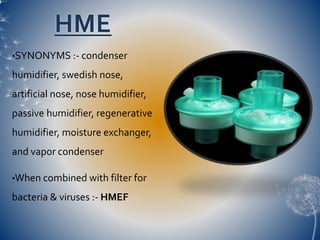
HME
•SYNONYMS :- condenser
humidifier, swedish nose,
artificial nose, nose humidifier,
passive humidifier, regenerative
humidifier, moisture exchanger,
and vapor condenser
•When combined with filter for
bacteria & viruses :- HMEF
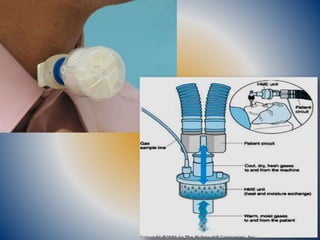
 disposable devices
 exchanging medium enclosed in a plastic housing
 vary in size and shape
 Each has a 15-mm female connection port at the patient
end and a 15-mm male port at the other end; patient port
may also have a concentric 22-mm male fitting
 May have a port to attach the gas sampling line for a
respiratory gas monitor or an oxygen line
 One type utilizes a ceramic heating element with a water
input port, a membrane, and an aluminum grid that
vaporizes the water
 Preferred for short term use.
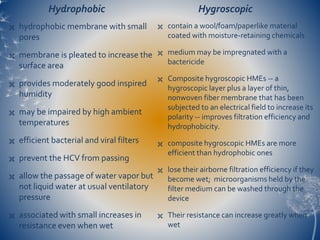
Hydrophobic
 hydrophobic membrane with small
pores
 membrane is pleated to increase the
surface area
 provides moderately good inspired
humidity
 may be impaired by high ambient
temperatures
 efficient bacterial and viral filters
 prevent the HCV from passing
 allow the passage of water vapor but
not liquid water at usual ventilatory
pressure
 associated with small increases in
resistance even when wet
Hygroscopic
 contain a wool/foam/paperlike material
coated with moisture-retaining chemicals
 medium may be impregnated with a
bactericide
 Composite hygroscopic HMEs -- a
hygroscopic layer plus a layer of thin,
nonwoven fiber membrane that has been
subjected to an electrical field to increase its
polarity -- improves filtration efficiency and
hydrophobicity.
 composite hygroscopic HMEs are more
efficient than hydrophobic ones
 lose their airborne filtration efficiency if they
become wet; microorganisms held by the
filter medium can be washed through the
device
 Their resistance can increase greatly when
wet
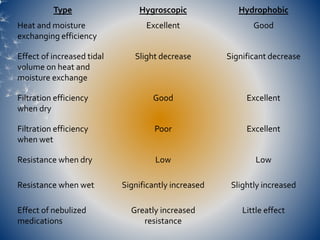
Type Hygroscopic Hydrophobic
Heat and moisture
exchanging efficiency
Excellent Good
Effect of increased tidal
volume on heat and
moisture exchange
Slight decrease Significant decrease
Filtration efficiency
when dry
Good Excellent
Filtration efficiency
when wet
Poor Excellent
Resistance when dry Low Low
Resistance when wet Significantly increased Slightly increased
Effect of nebulized
medications
Greatly increased
resistance
Little effect
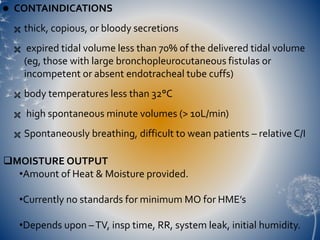
 CONTAINDICATIONS
 thick, copious, or bloody secretions
 expired tidal volume less than 70% of the delivered tidal volume
(eg, those with large bronchopleurocutaneous fistulas or
incompetent or absent endotracheal tube cuffs)
 body temperatures less than 32°C
 high spontaneous minute volumes (> 10L/min)
 Spontaneously breathing, difficult to wean patients – relative C/I
MOISTURE OUTPUT
•Amount of Heat & Moisture provided.
•Currently no standards for minimum MO for HME’s
•Depends upon –TV, insp time, RR, system leak, initial humidity.
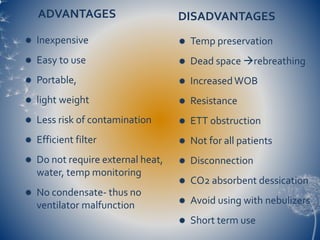
ADVANTAGES DISADVANTAGES
 Temp preservation
 Dead space rebreathing
 IncreasedWOB
 Resistance
 ETT obstruction
 Not for all patients
 Disconnection
 CO2 absorbent dessication
 Avoid using with nebulizers
 Short term use
 Inexpensive
 Easy to use
 Portable,
 light weight
 Less risk of contamination
 Efficient filter
 Do not require external heat,
water, temp monitoring
 No condensate- thus no
ventilator malfunction
HAZARDS
 ineffective low-pressure alarm during disconnection due to
resistance through HME.
 Suspected high resistance  Peak airway pressure should be
measured with AND without HME in place
 possible increased resistive work of breathing due to mucus plugging
of HME
 In Mapleson system – resistance causes diversion of FGF down the
expiratory limb.
 hypothermia
 airway obstruction– ETT blockage/ ETT kinking/ detachment
 Should not be used with Heated Humidifiers
 nebulized medications increase resistance of hygroscopic HME.
•Ineffective filtration:- liquid can break through a hygroscopic HME
•Foreign body aspiration – detached parts inhaled
•Rebreathing due to dead space (more in paed)
•Hypothermia
•Leaks & disconnections
•dry CO2 absorbent- absorb volatile agents, hence delay in induction.
POSITION IN CIRCUIT : -
Patient – HME – filter – sampling line – machine/ ventilator
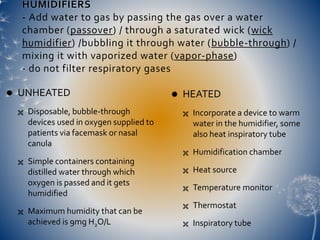
HUMIDIFIERS
- Add water to gas by passing the gas over a water
chamber (passover) / through a saturated wick (wick
humidifier) /bubbling it through water (bubble-through) /
mixing it with vaporized water (vapor-phase)
- do not filter respiratory gases
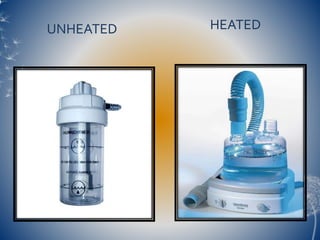
 UNHEATED
 Disposable, bubble-through
devices used in oxygen supplied to
patients via facemask or nasal
canula
 Simple containers containing
distilled water through which
oxygen is passed and it gets
humidified
 Maximum humidity that can be
achieved is 9mg H2O/L
 HEATED
 Incorporate a device to warm
water in the humidifier, some
also heat inspiratory tube
 Humidification chamber
 Heat source
 Temperature monitor
 Thermostat
 Inspiratory tube
UNHEATED HEATED
HEATED HUMIDIFIERS
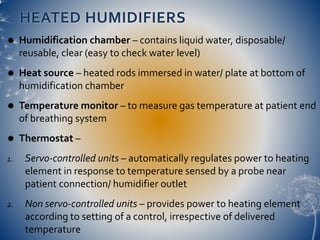
 Humidification chamber – contains liquid water, disposable/
reusable, clear (easy to check water level)
 Heat source – heated rods immersed in water/ plate at bottom of
humidification chamber
 Temperature monitor – to measure gas temperature at patient end
of breathing system
 Thermostat –
1. Servo-controlled units – automatically regulates power to heating
element in response to temperature sensed by a probe near
patient connection/ humidifier outlet
2. Non servo-controlled units – provides power to heating element
according to setting of a control, irrespective of delivered
temperature
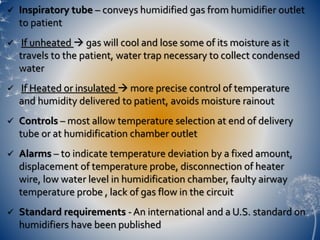
 Inspiratory tube – conveys humidified gas from humidifier outlet
to patient
 If unheated  gas will cool and lose some of its moisture as it
travels to the patient, water trap necessary to collect condensed
water
 If Heated or insulated  more precise control of temperature
and humidity delivered to patient, avoids moisture rainout
 Controls – most allow temperature selection at end of delivery
tube or at humidification chamber outlet
 Alarms – to indicate temperature deviation by a fixed amount,
displacement of temperature probe, disconnection of heater
wire, low water level in humidification chamber, faulty airway
temperature probe , lack of gas flow in the circuit
 Standard requirements - An international and a U.S. standard on
humidifiers have been published
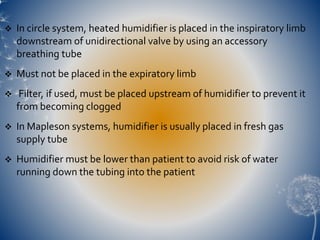
 In circle system, heated humidifier is placed in the inspiratory limb
downstream of unidirectional valve by using an accessory
breathing tube
 Must not be placed in the expiratory limb
 Filter, if used, must be placed upstream of humidifier to prevent it
from becoming clogged
 In Mapleson systems, humidifier is usually placed in fresh gas
supply tube
 Humidifier must be lower than patient to avoid risk of water
running down the tubing into the patient
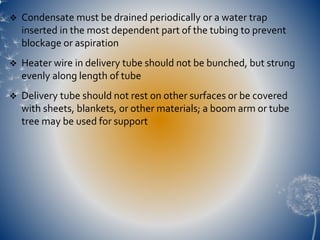
 Condensate must be drained periodically or a water trap
inserted in the most dependent part of the tubing to prevent
blockage or aspiration
 Heater wire in delivery tube should not be bunched, but strung
evenly along length of tube
 Delivery tube should not rest on other surfaces or be covered
with sheets, blankets, or other materials; a boom arm or tube
tree may be used for support
 Advantages –
1. Capable of delivering saturated gas at body temperature or
above, even with high flow rates
2. More effective humidification than an HME
 Disadvantages –
1. Bulky and somewhat complex
2. Involve high maintenance costs, electrical hazards, and
increased work (temperature control, refilling the reservoir,
draining condensate, cleaning, and sterilization)
3. Offers relatively little protection against heat loss during
anaesthesia as compared to circulating water and forced-air
warming
NEBULISERS
 Aerosol generators/ atomizers/ nebulizing humidifiers
 Emit water in the form of an aerosol mist (water vapor plus
particulate water)
 Used for producing humdification and delivery of drug directly into
respiratory tract
 Drugs delivered by nebulizers – Bronchodilators, decongestants,
mucolytic agents, steroids
 Optimal particle size of droplet (aerosol) = 0.5 to 5 µm
 Particles > 5 µm – unable to reach peripheral airways, deposited in
main airways
 Particles < 0.5 µm - very light, come back with expired gases
without being deposited in airways
 Most commonly used 2 types –
1. Pneumatically driven (gas-driven, jet, high pressure, compressed
gas)
2. Ultrasonic
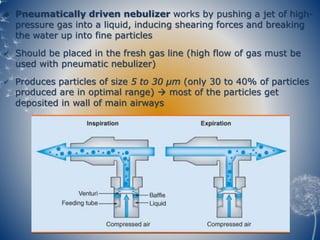
 Pneumatically driven nebulizer works by pushing a jet of high-
pressure gas into a liquid, inducing shearing forces and breaking
the water up into fine particles
 Should be placed in the fresh gas line (high flow of gas must be
used with pneumatic nebulizer)
 Produces particles of size 5 to 30 µm (only 30 to 40% of particles
produced are in optimal range)  most of the particles get
deposited in wall of main airways
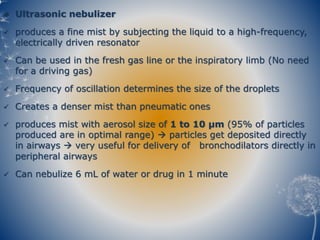
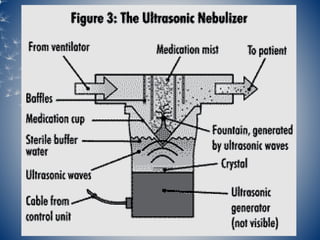
 Ultrasonic nebulizer
 produces a fine mist by subjecting the liquid to a high-frequency,
electrically driven resonator
 Can be used in the fresh gas line or the inspiratory limb (No need
for a driving gas)
 Frequency of oscillation determines the size of the droplets
 Creates a denser mist than pneumatic ones
 produces mist with aerosol size of 1 to 10 µm (95% of particles
produced are in optimal range)  particles get deposited directly
in airways  very useful for delivery of bronchodilators directly in
peripheral airways
 Can nebulize 6 mL of water or drug in 1 minute
HAZARDS
1. Nebulized drugs may obstruct an HME or filter in the
breathing system
2. Overhydration
3. Hypothermia
4. Transmission of infection
5. Case reports where a nebulizer was connected
directly to a tracheal tube without provision for
exhalation  resulted in pneumothorax in one case
 Advantage - can deliver gases saturated with water
without heat and, if desired, can produce gases carrying
more water
 Disadvantages –
1. Somewhat costly
2. Pneumatic nebulizers require high gas flows
3. Ultrasonic nebulizers require a source of electricity and
may present electrical hazards
4. May be considerable water deposition in the tubings,
requiring frequent draining, water traps in both the
inspiratory and exhalation tubes, and posing the dangers
of water draining into the patient or blocking the tubing

Humidification in Anaesthesia

  • 1.
    HUMIDIFICATION PRESENTED BY DR.SHREYA DAS ADHIKARI MODERATOR : DR. APARNA SHARMA
  • 2.
     HUMIDITY  generalterm used to describe the amount of water vapor in a gas  may be expressed several ways:-  Absolute Humidity - the mass of water vapor present in a volume of gas - commonly expressed in milligrams of water per liter of gas.  Humidity at Saturation -maximum amount of water vapor that a volume of gas can hold - varies with the temperature.The warmer the temperature, the more water vapor can be held in a gas
  • 3.
     RELATIVE HUMIDITY the amount of water vapor at a particular temperature expressed as a percentage of the amount that would be held if the gas were saturated.  DEW POINT  The temperature at which a gas is 100% saturated  WATER VAPOR PRESSURE  Humidity may also be expressed as the pressure exerted by water vapor in a gas mixture.
  • 4.
     normal breathing: upper respiratory tract warms, humidifies, and filters inspired gases, primarily in the nasopharynx  Even at extremes of inspired temperature and humidity, gas that reaches the alveolar level is 100% saturated at body temperature.  ISOTHERMIC SATURATION BOUNDARY (ISB) : The point at which gases reach alveolar conditions (37°C and 100% relative humidity)  Over the course of a normal day, the respiratory tract loses approximately 1470 J of heat and 250 mL of water. IMPORTANCE OF HUMIDIFICATION
  • 5.
     Water isintentionally removed from medical gases so that gases delivered from anaesthesia machine are dry and at room temperature  Gases must therefore be warmed to body temperature and saturated with water by upper respiratory tract  normal nasal breathing : temperature in upper trachea is between 30-33o C with RH-98% & AH-33 mg/L : at alveolar level 37 degree C , RH- 100% , AH – 44 mg/L  Tracheal intubation and high fresh gas flows bypass this normal humidification by upper airways and expose lower airways to dry (< 10 mg H2O/L), room temperature gases
  • 6.
    EFFECTS OF INHALINGDRY GASES  DAMAGETOTHE RESPIRATORYTRACT  Mucosa dries  Temperature drops  Secretions thicken  if not cleared atelectasis / airway obstruction  Thick plugs  loci for infection  Ciliary function reduced  Surfactant activity impaired  Mucosa more susceptible to injury  Dry gases  bronchoconstriction  Recommendations: 12 -44 mgH2O/L ofAH
  • 7.
     BODY HEATLOSS  ABSORBENT DESICCATION  TRACHEALTUBE OBSTRUCTION EFFECTS OF INHALING DRY GASES
  • 8.
    SOURCES OF HUMIDITY CO2 absorbent – reaction of CO2 with absorbent releases water -- absorbent granules also contain water  Exhaled gases – some rebreathing is present in tracheal tube, supraglottic airway device, and connections to breathing system -almost half of humidity in expired gases is preserved in this manner  Moistening/Rinsing breathing tubes and reservoir bag before use  Low fresh gas flows – conserve moisture  Coaxial breathing circuits – increase humidity more quickly than a system with 2 separate limbs, when combined with low flows -not very efficient : Bain system (coaxialVersion of Mapleson D) does not meet optimal humidification requirements because of high fresh gas flow required
  • 9.
     HEAT ANDMOISTURE EXCHANGERS –  hydrophobic  hygroscopic  HUMIDIFIERS – pass-over/blow- by/bubble-through/vapor-phase humidifier  HEATED  UNHEATED  Nebulisers SOURCES OF HUMIDITY
  • 10.
    HME •SYNONYMS :- condenser humidifier,swedish nose, artificial nose, nose humidifier, passive humidifier, regenerative humidifier, moisture exchanger, and vapor condenser •When combined with filter for bacteria & viruses :- HMEF
  • 12.
     disposable devices exchanging medium enclosed in a plastic housing  vary in size and shape  Each has a 15-mm female connection port at the patient end and a 15-mm male port at the other end; patient port may also have a concentric 22-mm male fitting  May have a port to attach the gas sampling line for a respiratory gas monitor or an oxygen line  One type utilizes a ceramic heating element with a water input port, a membrane, and an aluminum grid that vaporizes the water  Preferred for short term use.
  • 13.
    Hydrophobic  hydrophobic membranewith small pores  membrane is pleated to increase the surface area  provides moderately good inspired humidity  may be impaired by high ambient temperatures  efficient bacterial and viral filters  prevent the HCV from passing  allow the passage of water vapor but not liquid water at usual ventilatory pressure  associated with small increases in resistance even when wet Hygroscopic  contain a wool/foam/paperlike material coated with moisture-retaining chemicals  medium may be impregnated with a bactericide  Composite hygroscopic HMEs -- a hygroscopic layer plus a layer of thin, nonwoven fiber membrane that has been subjected to an electrical field to increase its polarity -- improves filtration efficiency and hydrophobicity.  composite hygroscopic HMEs are more efficient than hydrophobic ones  lose their airborne filtration efficiency if they become wet; microorganisms held by the filter medium can be washed through the device  Their resistance can increase greatly when wet
  • 14.
    Type Hygroscopic Hydrophobic Heatand moisture exchanging efficiency Excellent Good Effect of increased tidal volume on heat and moisture exchange Slight decrease Significant decrease Filtration efficiency when dry Good Excellent Filtration efficiency when wet Poor Excellent Resistance when dry Low Low Resistance when wet Significantly increased Slightly increased Effect of nebulized medications Greatly increased resistance Little effect
  • 15.
     CONTAINDICATIONS  thick,copious, or bloody secretions  expired tidal volume less than 70% of the delivered tidal volume (eg, those with large bronchopleurocutaneous fistulas or incompetent or absent endotracheal tube cuffs)  body temperatures less than 32°C  high spontaneous minute volumes (> 10L/min)  Spontaneously breathing, difficult to wean patients – relative C/I MOISTURE OUTPUT •Amount of Heat & Moisture provided. •Currently no standards for minimum MO for HME’s •Depends upon –TV, insp time, RR, system leak, initial humidity.
  • 16.
    ADVANTAGES DISADVANTAGES  Temppreservation  Dead space rebreathing  IncreasedWOB  Resistance  ETT obstruction  Not for all patients  Disconnection  CO2 absorbent dessication  Avoid using with nebulizers  Short term use  Inexpensive  Easy to use  Portable,  light weight  Less risk of contamination  Efficient filter  Do not require external heat, water, temp monitoring  No condensate- thus no ventilator malfunction
  • 17.
    HAZARDS  ineffective low-pressurealarm during disconnection due to resistance through HME.  Suspected high resistance  Peak airway pressure should be measured with AND without HME in place  possible increased resistive work of breathing due to mucus plugging of HME  In Mapleson system – resistance causes diversion of FGF down the expiratory limb.  hypothermia  airway obstruction– ETT blockage/ ETT kinking/ detachment  Should not be used with Heated Humidifiers  nebulized medications increase resistance of hygroscopic HME.
  • 18.
    •Ineffective filtration:- liquidcan break through a hygroscopic HME •Foreign body aspiration – detached parts inhaled •Rebreathing due to dead space (more in paed) •Hypothermia •Leaks & disconnections •dry CO2 absorbent- absorb volatile agents, hence delay in induction. POSITION IN CIRCUIT : - Patient – HME – filter – sampling line – machine/ ventilator
  • 19.
    HUMIDIFIERS - Add waterto gas by passing the gas over a water chamber (passover) / through a saturated wick (wick humidifier) /bubbling it through water (bubble-through) / mixing it with vaporized water (vapor-phase) - do not filter respiratory gases  UNHEATED  Disposable, bubble-through devices used in oxygen supplied to patients via facemask or nasal canula  Simple containers containing distilled water through which oxygen is passed and it gets humidified  Maximum humidity that can be achieved is 9mg H2O/L  HEATED  Incorporate a device to warm water in the humidifier, some also heat inspiratory tube  Humidification chamber  Heat source  Temperature monitor  Thermostat  Inspiratory tube
  • 20.
  • 21.
    HEATED HUMIDIFIERS  Humidificationchamber – contains liquid water, disposable/ reusable, clear (easy to check water level)  Heat source – heated rods immersed in water/ plate at bottom of humidification chamber  Temperature monitor – to measure gas temperature at patient end of breathing system  Thermostat – 1. Servo-controlled units – automatically regulates power to heating element in response to temperature sensed by a probe near patient connection/ humidifier outlet 2. Non servo-controlled units – provides power to heating element according to setting of a control, irrespective of delivered temperature
  • 22.
     Inspiratory tube– conveys humidified gas from humidifier outlet to patient  If unheated  gas will cool and lose some of its moisture as it travels to the patient, water trap necessary to collect condensed water  If Heated or insulated  more precise control of temperature and humidity delivered to patient, avoids moisture rainout  Controls – most allow temperature selection at end of delivery tube or at humidification chamber outlet  Alarms – to indicate temperature deviation by a fixed amount, displacement of temperature probe, disconnection of heater wire, low water level in humidification chamber, faulty airway temperature probe , lack of gas flow in the circuit  Standard requirements - An international and a U.S. standard on humidifiers have been published
  • 23.
     In circlesystem, heated humidifier is placed in the inspiratory limb downstream of unidirectional valve by using an accessory breathing tube  Must not be placed in the expiratory limb  Filter, if used, must be placed upstream of humidifier to prevent it from becoming clogged  In Mapleson systems, humidifier is usually placed in fresh gas supply tube  Humidifier must be lower than patient to avoid risk of water running down the tubing into the patient
  • 24.
     Condensate mustbe drained periodically or a water trap inserted in the most dependent part of the tubing to prevent blockage or aspiration  Heater wire in delivery tube should not be bunched, but strung evenly along length of tube  Delivery tube should not rest on other surfaces or be covered with sheets, blankets, or other materials; a boom arm or tube tree may be used for support
  • 25.
     Advantages – 1.Capable of delivering saturated gas at body temperature or above, even with high flow rates 2. More effective humidification than an HME  Disadvantages – 1. Bulky and somewhat complex 2. Involve high maintenance costs, electrical hazards, and increased work (temperature control, refilling the reservoir, draining condensate, cleaning, and sterilization) 3. Offers relatively little protection against heat loss during anaesthesia as compared to circulating water and forced-air warming
  • 26.
    NEBULISERS  Aerosol generators/atomizers/ nebulizing humidifiers  Emit water in the form of an aerosol mist (water vapor plus particulate water)  Used for producing humdification and delivery of drug directly into respiratory tract  Drugs delivered by nebulizers – Bronchodilators, decongestants, mucolytic agents, steroids  Optimal particle size of droplet (aerosol) = 0.5 to 5 µm  Particles > 5 µm – unable to reach peripheral airways, deposited in main airways  Particles < 0.5 µm - very light, come back with expired gases without being deposited in airways
  • 27.
     Most commonlyused 2 types – 1. Pneumatically driven (gas-driven, jet, high pressure, compressed gas) 2. Ultrasonic
  • 28.
     Pneumatically drivennebulizer works by pushing a jet of high- pressure gas into a liquid, inducing shearing forces and breaking the water up into fine particles  Should be placed in the fresh gas line (high flow of gas must be used with pneumatic nebulizer)  Produces particles of size 5 to 30 µm (only 30 to 40% of particles produced are in optimal range)  most of the particles get deposited in wall of main airways
  • 29.
     Ultrasonic nebulizer produces a fine mist by subjecting the liquid to a high-frequency, electrically driven resonator  Can be used in the fresh gas line or the inspiratory limb (No need for a driving gas)  Frequency of oscillation determines the size of the droplets  Creates a denser mist than pneumatic ones  produces mist with aerosol size of 1 to 10 µm (95% of particles produced are in optimal range)  particles get deposited directly in airways  very useful for delivery of bronchodilators directly in peripheral airways  Can nebulize 6 mL of water or drug in 1 minute
  • 31.
    HAZARDS 1. Nebulized drugsmay obstruct an HME or filter in the breathing system 2. Overhydration 3. Hypothermia 4. Transmission of infection 5. Case reports where a nebulizer was connected directly to a tracheal tube without provision for exhalation  resulted in pneumothorax in one case
  • 32.
     Advantage -can deliver gases saturated with water without heat and, if desired, can produce gases carrying more water  Disadvantages – 1. Somewhat costly 2. Pneumatic nebulizers require high gas flows 3. Ultrasonic nebulizers require a source of electricity and may present electrical hazards 4. May be considerable water deposition in the tubings, requiring frequent draining, water traps in both the inspiratory and exhalation tubes, and posing the dangers of water draining into the patient or blocking the tubing