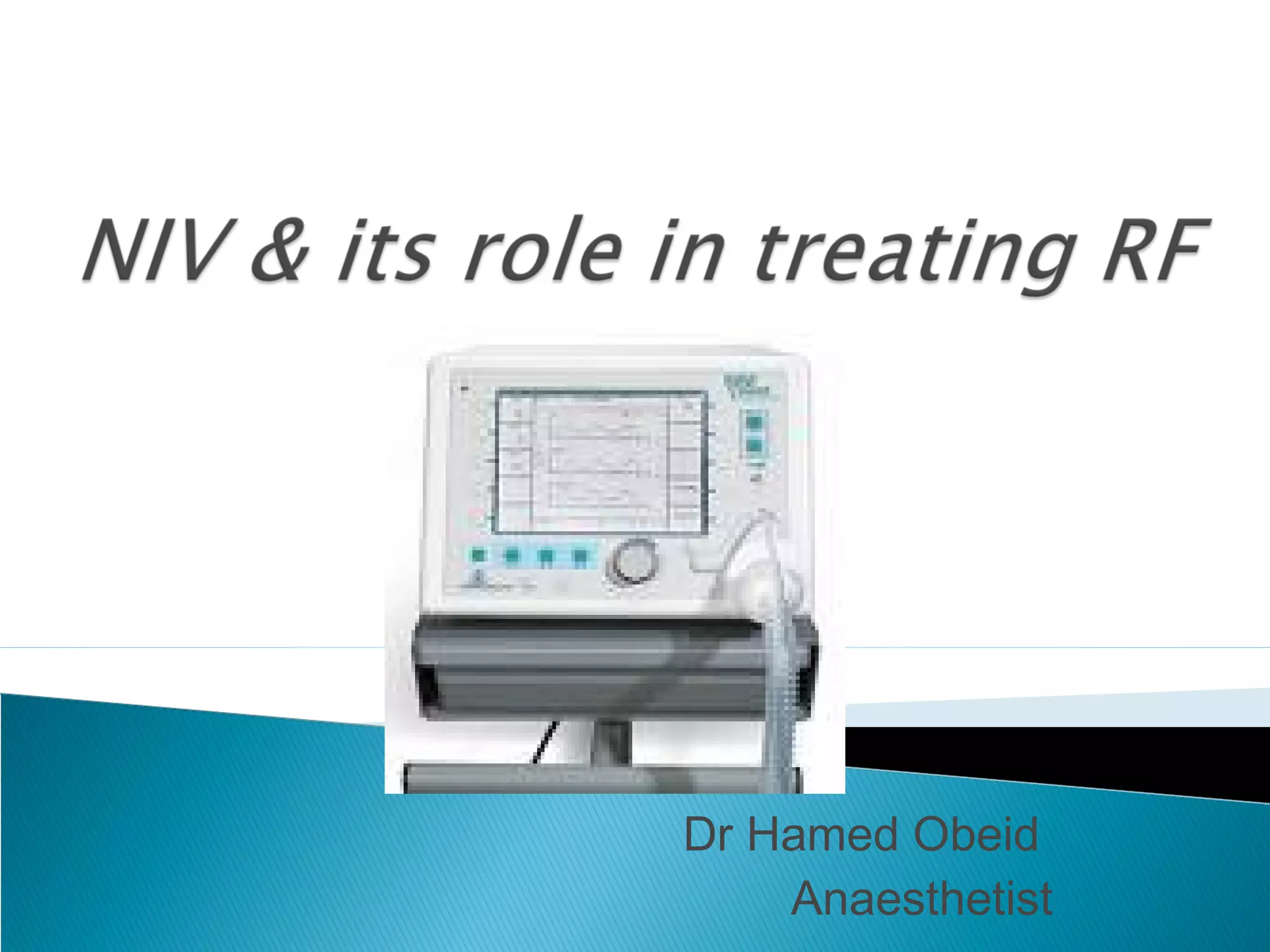
Dr Hamed Obeid
Anaesthetist
 Definitions
 Advantages and Disadvantages
 Indications
 Contraindications
 Modes
“The delivery of mechanical ventilation to the lungs
using techniques that do not require endotracheal
intubation”
 Initially used in the treatment of hypoventilation
with Neuromuscular Disease
 Now accepted modality in treatment of acute
respiratory failure
 Respiratory effort required for inspiration needs to
overcome
◦ Elastic work (stretch)
◦ Flow resistance work ( airway obstruction)
 Respiratory failure – forces opposing inspiration
exceed respiratory muscle effort
Failure to maintain adequate gas exchange
 Hypoxic ( Type 1)
or
Hypercapnic /Hypoxic (Type 2)
 Acute /Chronic / Acute on Chronic
 Improves alveolar ventilation to reverse
respiratory acidosis and hypercarbia
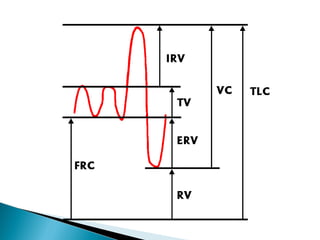
 Recruits alveoli and increases FRC to reverse
hypoxia
 Reduces work of breathing
Noninvasiveness
 Application - easy to implement or remove
 Improves patient comfort
 Reduces the need for sedation
 Oral patency
(preserves speech, swallowing, and cough)
 Avoid the resistive work of ETT
 Avoids the complications of ETT
◦ Early (local trauma, aspiration)
◦ Late (injury to the the hypopharynx, larynx, and trachea,
nosocomial infections)
 Reduced Cost and Length of Stay
1.System
Slower correction of gas exchange abnormalities
Gastric distension (occurs in <2% patients)
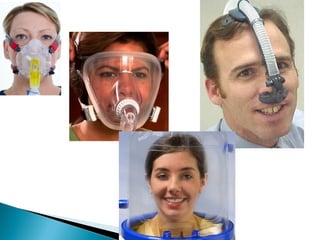
2.Mask
Air leakage
Eye irritation
Facial skin necrosis (most common complication)
3.Lack of airway access and protection
Suctioning of secretions
Aspiration
4. Compliance / claustrophobia
5. Work load and supervision
 Hypoxaemia = CPAP
 Hypercapnia and hypoxaemia= Bi Level
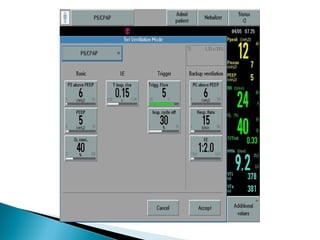
CONTINUOUS POSITIVE AIRWAY PRESSURE (AKA
PEEP)
 Constant positive airway pressure throughout cycle
 Improves oxygenation
 Decreases work of breathing by alveolar recruitment
(Dec elastic work) and unloads insp muscles
 Decreases hypoxia by alveolar recruitment and
reduces intrapulmonary shunt
 Acute pulmonary oedema
 Pneumonia
 Combination of IPAP and EPAP
Inspiratory PAP = Pressure Support
Expiratory PAP = CPAP
• EPAP
– Provides PEEP
– Increases Functional Residual Capacity
– Reduces FiO2 required to optimise SaO2
• IPAP
– Decreases work of breathing + oxygen demand
– Increases spontaneous tidal volume
– Decreases spontaneous respiratory rate
 Acute Respiratory Failure
 Chronic Airway Limitation/COPD
 Asthma?
 Indication: APO, COAD
 Contraindications excluded
 Assessment
◦ Sick not moribund
◦ Able to protect airway
◦ Conscious/cooperative
◦ Haemodynamic stability
 Premorbid state / Ceiling of therapy?
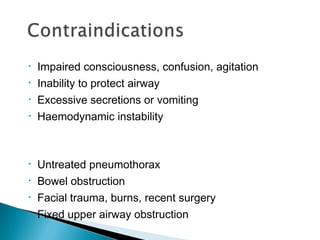
• Impaired consciousness, confusion, agitation
• Inability to protect airway
• Excessive secretions or vomiting
• Haemodynamic instability
• Untreated pneumothorax
• Bowel obstruction
• Facial trauma, burns, recent surgery
• Fixed upper airway obstruction
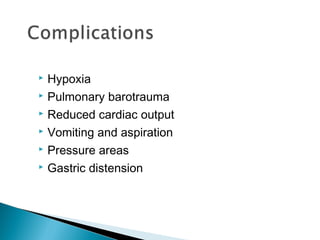
 Hypoxia
 Pulmonary barotrauma
 Reduced cardiac output
 Vomiting and aspiration
 Pressure areas
 Gastric distension
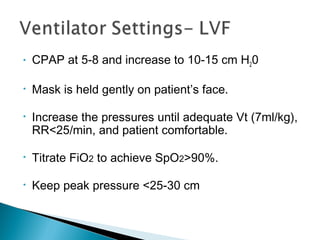
• CPAP at 5-8 and increase to 10-15 cm H20
• Mask is held gently on patient’s face.
• Increase the pressures until adequate Vt (7ml/kg),
RR<25/min, and patient comfortable.
• Titrate FiO2 to achieve SpO2>90%.
• Keep peak pressure <25-30 cm
 increases pH, reduces PaCO2, reduces the
severity of breathlessness in first 4 h of treatment
 decreases the length of hospital stay
 mortality and intubation rates are reduced
• Mode- Spontaneous/Timed
• EPAP- 4-5 cm H20 IPAP- 12- 15 cm H20
• Trigger- maximum sensitivity
• Back up rate- 15 breaths/min
• Back up I:E 1:3
 No contraindications
 O2  medical therapy underway
 Explanation and reassurance
 Correct mask size
 Ventilator set up
 Commence NIV hold mask in place
 Reassure and fix mask
 Monitor and observe, regular assessment
Physiological
a) Continuous oximetry
b) Exhaled tidal volume
c) ABG- Initial, 1, 2-6 hrs
Objective
a) Respiratory rate
b) Chest wall movement
c) Coordination of respiratory effort with NIV
d) Accessory muscle use
e) HR and BP
f) Mental state
Subjective
a) Dyspnoea
b) Comfort
 Mode of ventilation
 Flow rate of oxygen, percentage of oxygen
 TPR and BP
 Respiratory assessment
 Conscious level (GCS)
Obs - 15 minutely for first hour, then hourly if condition stable
 Deterioration in condition
 Worsening or non improving ABG
 Intolerance or failure to coordinate with machine
 Back to the patient- ABC
 Medical therapy optimised
 Treatment of complications
• Inability to tolerate the mask
• Inability to improve gas exchange or dyspnoea
• Need for endotracheal intubation
• Hemodynamic instability
• ECG – ischaemia/arrhythmia
 Clinical improvement
 Aim for
◦ RR<24
◦ HR <110
◦ pH>7.35
◦ Sats >90% on <40%
 Selection of patient really vital to success - need
to have reversible pathology
 Aim for gradual improvement over hours with
good supportive nursing
 In ED, main use is to avoid intubation / ventilation
in LVF and COAD

Niv $ rf copy

  • 1.
  • 2.
     Definitions  Advantagesand Disadvantages  Indications  Contraindications  Modes
  • 8.
    “The delivery ofmechanical ventilation to the lungs using techniques that do not require endotracheal intubation”
  • 9.
     Initially usedin the treatment of hypoventilation with Neuromuscular Disease  Now accepted modality in treatment of acute respiratory failure
  • 10.
     Respiratory effortrequired for inspiration needs to overcome ◦ Elastic work (stretch) ◦ Flow resistance work ( airway obstruction)  Respiratory failure – forces opposing inspiration exceed respiratory muscle effort
  • 11.
    Failure to maintainadequate gas exchange  Hypoxic ( Type 1) or Hypercapnic /Hypoxic (Type 2)  Acute /Chronic / Acute on Chronic
  • 12.
     Improves alveolarventilation to reverse respiratory acidosis and hypercarbia  Recruits alveoli and increases FRC to reverse hypoxia  Reduces work of breathing
  • 14.
    Noninvasiveness  Application -easy to implement or remove  Improves patient comfort  Reduces the need for sedation  Oral patency (preserves speech, swallowing, and cough)
  • 15.
     Avoid theresistive work of ETT  Avoids the complications of ETT ◦ Early (local trauma, aspiration) ◦ Late (injury to the the hypopharynx, larynx, and trachea, nosocomial infections)  Reduced Cost and Length of Stay
  • 16.
    1.System Slower correction ofgas exchange abnormalities Gastric distension (occurs in <2% patients) 2.Mask Air leakage Eye irritation Facial skin necrosis (most common complication)
  • 17.
    3.Lack of airwayaccess and protection Suctioning of secretions Aspiration 4. Compliance / claustrophobia 5. Work load and supervision
  • 19.
     Hypoxaemia =CPAP  Hypercapnia and hypoxaemia= Bi Level
  • 20.
    CONTINUOUS POSITIVE AIRWAYPRESSURE (AKA PEEP)  Constant positive airway pressure throughout cycle  Improves oxygenation  Decreases work of breathing by alveolar recruitment (Dec elastic work) and unloads insp muscles  Decreases hypoxia by alveolar recruitment and reduces intrapulmonary shunt
  • 22.
     Acute pulmonaryoedema  Pneumonia
  • 23.
     Combination ofIPAP and EPAP Inspiratory PAP = Pressure Support Expiratory PAP = CPAP
  • 25.
    • EPAP – ProvidesPEEP – Increases Functional Residual Capacity – Reduces FiO2 required to optimise SaO2 • IPAP – Decreases work of breathing + oxygen demand – Increases spontaneous tidal volume – Decreases spontaneous respiratory rate
  • 26.
     Acute RespiratoryFailure  Chronic Airway Limitation/COPD  Asthma?
  • 27.
     Indication: APO,COAD  Contraindications excluded  Assessment ◦ Sick not moribund ◦ Able to protect airway ◦ Conscious/cooperative ◦ Haemodynamic stability  Premorbid state / Ceiling of therapy?
  • 28.
    • Impaired consciousness,confusion, agitation • Inability to protect airway • Excessive secretions or vomiting • Haemodynamic instability • Untreated pneumothorax • Bowel obstruction • Facial trauma, burns, recent surgery • Fixed upper airway obstruction
  • 29.
     Hypoxia  Pulmonarybarotrauma  Reduced cardiac output  Vomiting and aspiration  Pressure areas  Gastric distension
  • 31.
    • CPAP at5-8 and increase to 10-15 cm H20 • Mask is held gently on patient’s face. • Increase the pressures until adequate Vt (7ml/kg), RR<25/min, and patient comfortable. • Titrate FiO2 to achieve SpO2>90%. • Keep peak pressure <25-30 cm
  • 32.
     increases pH,reduces PaCO2, reduces the severity of breathlessness in first 4 h of treatment  decreases the length of hospital stay  mortality and intubation rates are reduced
  • 33.
    • Mode- Spontaneous/Timed •EPAP- 4-5 cm H20 IPAP- 12- 15 cm H20 • Trigger- maximum sensitivity • Back up rate- 15 breaths/min • Back up I:E 1:3
  • 34.
     No contraindications O2 medical therapy underway  Explanation and reassurance  Correct mask size  Ventilator set up  Commence NIV hold mask in place  Reassure and fix mask  Monitor and observe, regular assessment
  • 35.
    Physiological a) Continuous oximetry b)Exhaled tidal volume c) ABG- Initial, 1, 2-6 hrs Objective a) Respiratory rate b) Chest wall movement c) Coordination of respiratory effort with NIV d) Accessory muscle use e) HR and BP f) Mental state Subjective a) Dyspnoea b) Comfort
  • 36.
     Mode ofventilation  Flow rate of oxygen, percentage of oxygen  TPR and BP  Respiratory assessment  Conscious level (GCS) Obs - 15 minutely for first hour, then hourly if condition stable
  • 37.
     Deterioration incondition  Worsening or non improving ABG  Intolerance or failure to coordinate with machine
  • 38.
     Back tothe patient- ABC  Medical therapy optimised  Treatment of complications
  • 39.
    • Inability totolerate the mask • Inability to improve gas exchange or dyspnoea • Need for endotracheal intubation • Hemodynamic instability • ECG – ischaemia/arrhythmia
  • 40.
     Clinical improvement Aim for ◦ RR<24 ◦ HR <110 ◦ pH>7.35 ◦ Sats >90% on <40%
  • 41.
     Selection ofpatient really vital to success - need to have reversible pathology  Aim for gradual improvement over hours with good supportive nursing  In ED, main use is to avoid intubation / ventilation in LVF and COAD