Arterial Blood Gas Analysis
Dr. Boudhayan Bhattacharjee
Junior resident 3
STM, Kolkata
FACT
• In a survey conducted at a university teaching hospital,
70% of the participating physicians claimed that they were
well versed in the diagnosis of acid-base disorders and that
they needed no assistance in the interpretation of arterial
blood gases (ABGs).
• These same physicians were then given a series of ABG
measurements to interpret, and they correctly interpreted
only 40% of the test samples.
• 9 of every 10 patients may have an acid-base disorder in an ICU.
Indication
• Assess ventilatory status, oxygenation and acid base status
• Assess the response to an intervention
• Regulate electrolyte therapy
• Establish preoperative baseline parameters
Contraindications
 Bleeding diathesis, Severe coagulopathy
 AV fistula
 Severe peripheral vascular disease, absence of an arterial pulse
 Infection
 Abnormal Allen's test
 Use of thrombolytic agents
Not what
you want to
see
Procedure
• Site - Radial Artery, Brachial Artery, Femoral Artery
• Heparinized ABG syringes - Syringe should be flushed with
0.5ml of 1:1000 Heparin solution and emptied.
• Do not leave excessive heparin in the syringe
• Syringes should be half filled with blood
• Use only 2ml or less syringe
• Patients body temperature affects the values of PCO2 and
HCO3
Cap the syringe, push out any air within it, and
send immediately for analysis ensuring that the
sample is packed in ice
Air bubbles in syringe
• It is presumed that air bubbles contain po2 =150 and pco2=0
• Air bubbles + blood = po2 goes up + pco2 goes down
• If air bubbles are present, then remove the air bubbles
otherwise discard the syringe
Leukocytosis causes decreased PO2
SAMPLING
Normal ABG values
• Only the person who has drawn the sample can tell if he has drawn a
pulsating blood or blood under high pressure
• PaO2 < 40
• Partly mixed sample- difficult to recognize
Venous Sample
pCO2 <45 in VBG excludes hypercrabia
O2 content
• CaO2 (ml/dl) = [ Hb (g/dl) × 1.34 × % saturation] +
[0.003 × PaO2]
CO2 Content
• PaCO2 = (VCO2/VA) X 0.863
PaCO2= partial pressure of CO2 in the arterial blood
VCO2: metabolic production of CO2
VA: alveolar ventilation = VE - VD
VE: minute ventilation = tidal volume X respiratory rate
VD: dead space ventilation
paO2
PaO2 = 109 - 0.4 (Age)
Importance
of FiO2
•Alveolar Gas Equation:
•PAO2= (PB- PH20) x FiO2- pCO2/R
Hypoxemia
• Mild Hypoxemia : PaO2 60 – 80 mm of Hg
• Moderate Hypoxemia : PaO2 40 – 60 of mm Hg –
tachycardia, hypertension, cool extremities
• Severe Hypoxemia : PaO2 < 40 mm of Hg – severe
arrhythmias, brain injury, death
Alveolar-arterial O2 gradient
• P(A-a)O2 is the alveolar-arterial difference in partial
pressure of oxygen
= [(Patm - PH2O) x FiO2] - (PCO2/RQ) - PaO2
• Normal range : 5 - 25 mm Hg (increases with age)
• Increase P(A-a)O2 : lung parenchymal disease
SpO2 vs SaO2
• When O2 saturation is measured by pulse oximeter..... SpO2
• When O2 saturation is measured by CO- oximeter..... SaO2
• SpO2 is also called functional arterial O2 saturation and SaO2 as fractional arterial
O2 saturation.
• Only true CO-oximeter can determine an accurate value for SaO2
HbO2
• SpO2 == ----------------------------------------
HbO2 + Hb
HbO2
• SaO2 == --------------------------------------------------------------------------------------------
HbO2+ Hb+ COHb+ MetHb+ SfHb+ COSfHb
pH
• Negative logarithm of hydrogen ion concentration
pH= -log [H+]
Life is a struggle, not against sin, not against money,
power... but against hydrogen ions.
- H.L. Mencken
pH balance
pH Balance
1.Chemical buffers (extracellular and intracellular) react
instantly to compensate. E.g. Protein and phosphate buffer
2. CO2 elimination is controlled by the lungs (respiratory
system). Reacts within minutes.
3. HCO3- elimination is controlled by the kidneys. It takes
hours to days for the renal system to compensate for
changes in pH. (glutamate and bicarbonate)
• ISOHYDRIC PRINCIPLE
Validity of ABG
[H+] = 24 x (PCO2 / [HCO3 -] )
• Maintaining a constant PCO2/HCO3- ratio will
maintain a constant extracellular pH
• End-Point of compensation:
A Constant PCO2/[HCO3- ] Ratio
• In general, compensatory responses
return the pH toward, but not to, the normal value
except Chronic respiratory alkalosis.
During compensation HCO3¯ & PaCO2 move in the
same direction
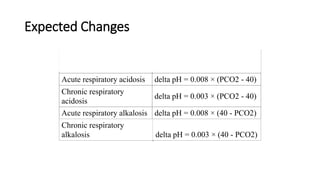
Expected Changes
Metabolic acidosis PCO2 = 1.5 × HCO3 + (8 ± 2)
Metabolic alkalosis PCO2 = 0.7 × HCO3 + (21 ± 2)
Acute respiratory acidosis delta pH = 0.008 × (PCO2 - 40)
Chronic respiratory
acidosis
delta pH = 0.003 × (PCO2 - 40)
Acute respiratory alkalosis delta pH = 0.008 × (40 - PCO2)
Chronic respiratory
alkalosis delta pH = 0.003 × (40 - PCO2)
Acid Base
Nomogram
Anion Gap (AG)
• Represents the concentration of all the unmeasured anions in
the plasma
AG = [Na+] – {[Cl–] + [HCO3–]}
Normal AG is 12 ± 4 mEq/l.
• Conditions resulting in metabolic acidosis other than
hydrochloric acidosis usually lead to a decrease in the serum
bicarbonate concentration without a concomitant rise in serum
chloride thereby increasing the AG.
• Adjusted Anion Gap = Observed AG +2.5 (4.5- Serum albumin)
Anion Gap (AG)
• Unmeasured anions(UA) = albumin, phosphate, sulphate, lactate
• Unmeasured cations(UC) = Ca, K, Mg
• AG= UA-UC
Low Anion Gap
1. Decrease in UA- albuminuria secondary to nephrotic syndrome
2. Increase in UC- Multiple myeloma (positively charged Ab’s),
Waldenstrom’s macroglobulinemia, Lithium toxicity
Delta Ratio
• Delta ratio = [increase in AG/decrease in bicarbonate]
• A high delta ratio can occur when the bicarbonate levels are
already elevated at the onset of the metabolic acidosis either
due to a pre-existing metabolic alkalosis, or as a
compensation for pre-existing respiratory acidosis
• A low delta ratio occurs with hyperchloremic normal anion
gap acidosis
Delta Ratio
∆AG/ HCO3
- = 1  Pure High AG Met Acidosis
AG/ HCO3
- > 1  Associated Metabolic Alkalosis
AG/ HCO3
- < 1  Associated Normal AG Met Acidosis
(hyperchloremic)
Delta gap
• Delta gap = (actual AG – 12) + HCO3
• Adjusted HCO3 should be 24 (+_ 6) {18-30}
• If delta gap > 30 -> additional metabolic alkalosis
• If delta gap < 18 -> additional non-gap metabolic acidosis
• If delta gap 18 – 30 -> no additional metabolic disorders
Clues to a mixed disorder
• Normal pH with abnormal HCO3
- or pCO2
• pCO2 and HCO3
- move in opposite directions
• pH changes in an opposite direction for a known
primary disorder
Triple acid-base disturbances
• Metabolic acidosis due to alcoholic ketoacidosis may
develop metabolic alkalosis due to vomiting and
superimposed respiratory alkalosis due to the
hyperventilation of hepatic dysfunction or alcohol
withdrawal
Normal
Anion Gap
Metabolic
acidosis
Urimary AG
• Check urinary AG in non-AG metabolic
acidosis
(U Na + U K) – U Cl
• Normal : negative
• Non-renal loss of bicarbonate [diarrhea] :
negative
• Renal loss of bicarbonate[ RTA / decreased H+
excretion] : positive
PaCO2 Variance
1. pH 7.06, PaCO2 = 74
74 - 40 = 34
PaCO2 variance = 0.34
2. pH 7.48, PaCO2 = 20
40 - 20 = 20
PaCO2 variance = 0.20
Predicted pH
1. pH 7.06, PaCO2 = 74
74 - 40 = 34
PaCO2 variance = 0.34
0.34 × ½ = 0.17
Predicted respiratory pH = 7.40 - 0.17 = 7.23
2. pH 7.48, PaCO2 = 20
40 - 20 = 20
PaCO2 variance = 0.20
Predicted respiratory pH = 7.40 + 0.20 = 7.60Base Excess/Deficit
1. pH 7.06, PaCO2 = 74, predicted pH = 7.23
Difference between predicted and measured pH = 7.23 - 7.06 = 0.17
Applying ⅔ rule 0.17 × ⅔ = 0.11, Base deficit = -11 mEq/l
2. pH 7.48, PaCO2 = 20, predicted pH = 7.60
Difference between predicted and measured pH = 7.6 - 7.48 = 0.12
Applying ⅔ rule 0.12 × ⅔ = 0.08, Base deficit = 8 mEq/l
Base excess/deficit
• Amount of strong acid or base required to return pH to 7.4,
assuming a PCO2 of 40 mm Hg and temperature of 38°C
• Derived from the Van Slyke equation
• SBE = 0.9287 [HCO3
- - 24.4 + (PH – 7.4)]
Metabolic acidosis- Treatment
• Amount of HCO3 required =
(desired HCO3-actual HCO3)×0.5× body weight in kg
• Aim to bring up pH to 7.2 & HCO3-  10 meq/L
Osmolar gap
• Calculated osmolality =
Glucose (mg/dl) Blood urea nitrogen (mg/dl)
2[Na+ (mEq/l)] + __________________+ __________________________
18 2.8
• Osmolar gap = Measured osmolality - Calculated osmolality
• Osmolar gap >10 mOsm/l is considered abnormal
Metabolic Alkalosis
Respiratory acidosis
• Decreases in minute ventilation may occur
• Central ventilatory depression by drugs
• Central nervous system injury
• Increased work of breathing
• Airway obstruction
• Neuromuscular dysfunction.
• Increases in dead space volume occur with
• COPD
• Pulmonary embolism
• Consolidations
• Mucus plugs or foreign body
Respiratory alkalosis
1. Hypoxemia from any causes
2. Respiratory center stimulation
3. Mechanical hyperventilation
4. Sepsis
5. pain
pH < 7.35
Acidosis
pH > 7.45
Alkalosis
pCO2 > 45
Respiratory
HCO3 < 22
Metabolic
pCO2 < 35
Respiratory
HCO3 > 26
Metabolic
PaCO2 ↑10
→HCO3 ↑3.5
PaCO2 ↑10
→HCO3 ↑1
PaCO2 ↓10
→HCO3 ↓4
PaCO2 ↓10
→HCO3 ↓2
PaCO2 ↑7
→HCO3 ↑10
Urine Cl < 10
Cl ResponsiveAnion Gap < 12
Non-Anion Gap
Anion Gap > 12
Anion Gap
Urine Cl > 10
Cl Unresponsive
Interpreting ABGs
Osm Gap > 10
Methanol
Ethylene Glycol
Osmolar Gap < 10
Ketoacidosis
Lactic acidosis
Uremia
Aspirin/salicylate tox
Diarrhea
Renal tubular acidosis
Acetazolamide
Total parenteral nutrition
Ureteral diversion
Pancreas transplant
CNS depressants
Neuromuscular disorder
Thoracic cage abnormalities
Obstructive lung disease
Obesity/hypoventilation syndrome
Myxedema coma
Anxiety/pain
Sepsis
CNS (stroke)
Aspirin OD
Chronic liver disease
Pulmonary embolism
Pregnancy
Hyperthyroidism
Loss of body fluids:
Vomiting
Nasogastric suctioning
Diuretic use
Excess body fluids:
Exogenous steroids
Cushing’s syndrome
Hyperaldosteronism
Bartter’s syndrome
=Na - (Cl+HCO3)
Acute
Chronic
PaCO2 ↓15
→HCO3 ↓10
Compensation:
If:
ΔPCO2/ΔHCO3
=
CO2/HCO3ratio
Then it IS comp.
Acute
Chronic
(2xNa) + (Glu/18) +
(BUN/2.8) = calculated
serum osmoles
HCO3 loss Extra H+
THEORY ENDS HERE
Is this ABG Authentic?STEP 0
ACIDOSIS or ALKALOSIS?STEP 1
RESPIRATORY or METABOLIC?STEP 2
If Respiratory – ACUTE or
CHRONIC?STEP 3
Is COMPENSATION adequate?STEP 4
If METABOLIC – ANION GAP?STEP 5
If High gap Metabolic Acidosis– GAP
GAP?STEP 6
Scenario 1
known COPD
Breathlessness, progressively
increased, aggravated on exertion for
last 2 days
Smoker
Bilateral expiratory rhonchi
STEP 1 – ACIDOSIS
STEP 2 – Respiratory
STEP 3 – pH expected
pH acute = 7.40 – 0.008(92-40)= 6.984
pH chronic = 7.40 – 0.003(92-40) = 7.244
pH b/w 6.98 to 7.244
 So, chronic
STEP 4- Increment of HCO3 expected
= [92-40]X 0.4 = 20.8
expected HCO3 = 45
Diagnosis:
Chronic Respiratory Acidosis with metabolic
acidosis
Scenario 2
Known chronic kidney disease
Breathlessness
Decreased Urine Output for 2days
Vomiting +
 No pedal edema, dehydration +
 STEP 1 – ACIDOSIS
 STEP 2 – METABOLIC
 STEP 4 –
PCO2exp = (1.5 x HCO3)+8+2= (1.5X7.80)+8+2
= 17.7 – 21.7
 STEP5 –
ANION GAP = 140.6-(7.80+102) = 30.8
AG corrected for albumin = 30.8+5.25
AG = 36.05
 HIGH AG Met. Acidosis
STEP 6 –
Delta gap = (AG-12)/(24-HCO3) = 36.05-12/24-7.80
= 24.05/16.2 = 1.48
Delta gap > 1 = associated Metabolic alkalosis
Diagnosis:
High Anion Gap Metabolic Acidosis with
partial respiratory compensation with associated
Metabolic Alkalosis
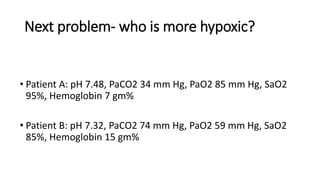
Next problem- who is more hypoxic?
• Patient A: pH 7.48, PaCO2 34 mm Hg, PaO2 85 mm Hg, SaO2
95%, Hemoglobin 7 gm%
• Patient B: pH 7.32, PaCO2 74 mm Hg, PaO2 59 mm Hg, SaO2
85%, Hemoglobin 15 gm%
Who is more hypoxic?
• Patient A:
Arterial oxygen content = .95 x 7 x 1.34 = 8.9 ml O2/dl
• Patient B:
Arterial oxygen content = .85 x 15 x 1.34 = 17.1 ml O2/dl
• Patient A, with the higher PaO2 but the lower hemoglobin content, is
more hypoxemic.
• In this problem the amount of oxygen molecules contributed by the
dissolved fraction is negligible and will not affect the answer
Scenario 3
• pH 7.08
• PCO2 80
• HCO3-26mEq/l
• 80KG Man post gastrectomy on
CMV
• Acidosis
• Expected HCO3= 24+4=28mEq/L
• pH 7.08
• PCO2 80
• HCO3-26mEq/l
• Diabetic + Chronic COPD
• Baseline PCO2 -80
• Stopped insulin few days back
• DKA
• Expected HCO3-=24+4×4=40
Scenario 4
pH 7.28
pCO2 40
HCO3 20
pO2 88
SO2 96
• 24 year-old college student
• Acute Gastroenteritis
• 3 day history of watery diarrhea
STEP 1 – ACIDOSIS
STEP 2 – Metabolic
STEP 4- expected pCO2
= 1.5 X 20 + 8 = 38
Diagnosis:
Metabolic Acidosis with partial
respiratory compensation
pH 7.28
pCO2 40
HCO3 20
pO2 88
SO2 96
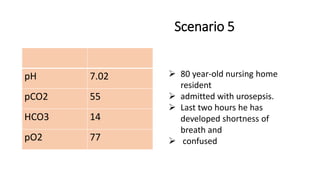
Scenario 5
pH 7.02
pCO2 55
HCO3 14
pO2 77
 80 year-old nursing home
resident
 admitted with urosepsis.
 Last two hours he has
developed shortness of
breath and
 confused
STEP 1 – ACIDOSIS
STEP 2 – Metabolic
STEP 4- expected pCO2
= 1.5 X 14 + 8 = 29
Diagnosis:
Metabolic Acidosis with Respiratory
acidosis
pH 7.02
pCO2 55
HCO3 14
pO2 77
???
Scenario 6
pH 7.5
pCO2 36
HCO3 27
pO2 92
17 year-old with
recurrent vomiting
STEP 1 – ALKALOSIS
STEP 2 – Metabolic
STEP 4- expected pCO2
= 40- (3X 0.75) = 37
Diagnosis:
Metabolic Alkalosis
(uncompensated)
pH 7.5
pCO2 36
HCO3 27
pO2 92
Scenario 7
• 65 years old male with CKD presenting
with nausea, diarrhea and acute
respiratory distress
• ABG: 7.23/17/235/7 with 50% FiO2 on
MV
• Electrolytes: Na: 123 mEq/L, Cl: 97
mEq/L, K 3.5
• Renal function: S. Creat: 5.1 mg%, BUN:
119
• STEP 1 – ACIDOSIS
• STEP 2 – Metabolic
• STEP 4- expected pCO2
= (1.5 X 7)+ 8 = 18.5
• AG= 123 – [97 + 7] = 19
• Delta gap = [19 - 12 ] / [24 – 7 ]
= < 1
• Diagnosis: HAGMA with NAGMA
ABG: 7.23/17/235/7
Na: 123 mEq/L, Cl: 97 mEq/L
Scenario 8
56 year old man
being evaluated for
a possible double
lung transplant
Dyspnoea on
minimal exertion
On home oxygen
therapy
(nasal prongs, 2
lpm)
Numerous
pulmonary
medications
ABG:
7.30/65/88/33.1
ABG: 7.30/65/88/33.1
STEP 1 – ACIDOSIS
STEP 2 – Respiratory
STEP 3- For Acute disorder;Change in pH = 0.008 X [65 – 40 ]=0.2 ,Expected pH
= 7.40 – 0.2 = 7.20
For chronic disorder;Change n pH= 0.003 X [65 – 40 ]=0.07,Expected pH
= 7.40 – 0.07 = 7.33
So its chronic respiratory acidosis
STEP 4- expected HCO3
= 24+ (25X 0.4) = 34
Dignosis: Chronic respiratory acidosis with partial renal compensation
Scenario 9
A 44 year old
moderately dehydrated
man was admitted with
a two day history of
acute severe diarrhea
ABG: 7.31 / 33 / 88 /16
/ 95%
Na: 136 mEq/L, Cl: 106
mEq/L, K: 2.9 mEq/L
ABG: 7.31 / 33 / 88 /16 / 95%
Na: 136 mEq/L, Cl: 106 mEq/L,
K: 2.9 mEq/L
STEP 1 – ACIDOSIS
STEP 2 – Metabolic
STEP 4- expected pCO2
= (1.5X 16) +8 = 32
AG = 136 – [106 + 16 ] = 14
Dignosis: Non anion gap Metabolic
acidosis with partial respiratory
compensation
Scenario 10
• A known case of case of chronic kidney disease, discontinued MHD &
presented to the emergency in an altered state of sensorium.
Attendants gave history of repeated episodes of vomiting at home.
ABG results
pH 7.42
PCO₂ 40
HCO₃ 25
Na 140
K 3.0
Cl 92
pH, PCO₂, HCO₃ all normal
AG = 23 (↑)
Delta gap = 11 /1 = >1
Diagnosis: high AG
metabolic acidosis and
metabolic alkalosis
ABG results
pH 7.42
PCO₂ 40
HCO₃ 25
Na 140
K 3.0
Cl 92
Scenario 11
• 65 yrs old male past h/o
AMI, presented with high
grade fever with, cough &
yellowish expectoration
for 5 days. Acute increase
in shortness of breath.
• Acidosis
• Metabolic
• Expected PCO₂ = (1.5 × 16) + 8 =
32
• Calculated PCO₂ < estimated PCO₂
• AG = 22
• Delta gap = (10/8) = >1
• Diagnosis: Mixed disorder with
high anion gap metabolic acidosis &
respiratory acidosis And associated
metabolic alkalosis
Scenario 12
47 year old male
experienced crush
injury at
construction site
ABG - 7.3 / 32 / 96
/ 15
Na- 135 / K-5 / Cl-
98 / HCO3- 15 /
BUN- 38 / Cr- 1.7
CK- 42, 346
ABG - 7.3 / 32 / 96 / 15
Na- 135 / K-5 / Cl- 98 / HCO3- 15 / BUN- 38 / Cr- 1.7
• Acidosis
• Metabolic
• Compensated- 1.5X15+8 =30
• AG= 22
• Delta gap= 10/9 ==1 (pure acidosis)
Diagnosis: High anion gap metabolic acidosis with respiratory
compensation
Scenario 13
A 14 yrs old boy presents
with continuous vomiting
of 3 days duration, mental
confusion, giddiness, and
tiredness for 1 day
Examination revealed
tachycardia, hypotension
and dehydration
pH 7.50
PaCO2 48
HCO3 32
PaO2 90
Na 139
K 3.9
Cl 85
• Alkalosis
• Metabolic
• Compensated
Δ PaCO2 = 0.7 × Δ HCO3
= 0.7 × 8
= 5.6
PaCO2 = 40 + 6 = 46
• AG= 22
Diagnosis: Metabolic alkalosis with respiratory compensation and
associated high anion gap metabolic acidosis
pH 7.50
PaCO2 48
HCO3 32
PaO2 90
Na 139
K 3.9
Cl 85
Scenario 14
• 18-year-old boy with
history of chronic
renal failure treated
with high dose
diuretics admitted to
hospital with
pneumonia
• Alkalosis
• Respiratory
• Compensated
Δ HCO3= 0.2 × Δ PaCO2 = 0.2 × 10 = 2
HCO3= 24 – 2 = 22
• AG= 26
• Delta gap= 14/3=>1
Diagnosis: Respiratory alkalosis with high anion gap
metabolic acidosis with associated metabolic alkalosis
Lactic acidosis (> 2 mmol/litre)
Scenario 15
• A 55 yr, female c/o sudden onset of breathlessness & left sided chest pain,
underwent knee replacement operation 4 days back, no relevant past medical
history
• CVS/RS-NAD, no clinical evidence of DVT, CXR-NAD, ECG- sinus tachycardia
• PR-98/min, RR- 20/min, BP-150/90 mmHg, temp-36.6 degrees,O2%-99%
• FIO2 0.21 Na+ 136 mEq/L
pH 7.43 K+ 3.8 mEq/L
PaCO2 37 mm Hg Cl- 99 mEq/L
PaO2 91 mm Hg lactate 1 mmol/L
SaO2 99%
HCO3 25.8 mEq/L
%COHb 2.1%
Hb 10 gm%
Normal gas exchange, normal acid base status!!
• PA02=(.21 x 713) + (37 x 1.2), PaO2 91 mm Hg
• P(A-a)02= 106-91=15 mmHg
• Patient is high risk for PE
• Normal ABG never excludes it and she requires V/Q scan or
CTPA
THANK YOU

Abg

  • 1.
    Arterial Blood GasAnalysis Dr. Boudhayan Bhattacharjee Junior resident 3 STM, Kolkata
  • 2.
    FACT • In asurvey conducted at a university teaching hospital, 70% of the participating physicians claimed that they were well versed in the diagnosis of acid-base disorders and that they needed no assistance in the interpretation of arterial blood gases (ABGs). • These same physicians were then given a series of ABG measurements to interpret, and they correctly interpreted only 40% of the test samples. • 9 of every 10 patients may have an acid-base disorder in an ICU.
  • 3.
    Indication • Assess ventilatorystatus, oxygenation and acid base status • Assess the response to an intervention • Regulate electrolyte therapy • Establish preoperative baseline parameters Contraindications  Bleeding diathesis, Severe coagulopathy  AV fistula  Severe peripheral vascular disease, absence of an arterial pulse  Infection  Abnormal Allen's test  Use of thrombolytic agents
  • 4.
  • 5.
    Procedure • Site -Radial Artery, Brachial Artery, Femoral Artery • Heparinized ABG syringes - Syringe should be flushed with 0.5ml of 1:1000 Heparin solution and emptied. • Do not leave excessive heparin in the syringe • Syringes should be half filled with blood • Use only 2ml or less syringe • Patients body temperature affects the values of PCO2 and HCO3
  • 6.
    Cap the syringe,push out any air within it, and send immediately for analysis ensuring that the sample is packed in ice
  • 7.
    Air bubbles insyringe • It is presumed that air bubbles contain po2 =150 and pco2=0 • Air bubbles + blood = po2 goes up + pco2 goes down • If air bubbles are present, then remove the air bubbles otherwise discard the syringe
  • 8.
  • 9.
  • 10.
    • Only theperson who has drawn the sample can tell if he has drawn a pulsating blood or blood under high pressure • PaO2 < 40 • Partly mixed sample- difficult to recognize Venous Sample pCO2 <45 in VBG excludes hypercrabia
  • 12.
    O2 content • CaO2(ml/dl) = [ Hb (g/dl) × 1.34 × % saturation] + [0.003 × PaO2] CO2 Content • PaCO2 = (VCO2/VA) X 0.863 PaCO2= partial pressure of CO2 in the arterial blood VCO2: metabolic production of CO2 VA: alveolar ventilation = VE - VD VE: minute ventilation = tidal volume X respiratory rate VD: dead space ventilation
  • 13.
    paO2 PaO2 = 109- 0.4 (Age)
  • 14.
    Importance of FiO2 •Alveolar GasEquation: •PAO2= (PB- PH20) x FiO2- pCO2/R
  • 15.
    Hypoxemia • Mild Hypoxemia: PaO2 60 – 80 mm of Hg • Moderate Hypoxemia : PaO2 40 – 60 of mm Hg – tachycardia, hypertension, cool extremities • Severe Hypoxemia : PaO2 < 40 mm of Hg – severe arrhythmias, brain injury, death
  • 16.
    Alveolar-arterial O2 gradient •P(A-a)O2 is the alveolar-arterial difference in partial pressure of oxygen = [(Patm - PH2O) x FiO2] - (PCO2/RQ) - PaO2 • Normal range : 5 - 25 mm Hg (increases with age) • Increase P(A-a)O2 : lung parenchymal disease
  • 17.
    SpO2 vs SaO2 •When O2 saturation is measured by pulse oximeter..... SpO2 • When O2 saturation is measured by CO- oximeter..... SaO2 • SpO2 is also called functional arterial O2 saturation and SaO2 as fractional arterial O2 saturation. • Only true CO-oximeter can determine an accurate value for SaO2 HbO2 • SpO2 == ---------------------------------------- HbO2 + Hb HbO2 • SaO2 == -------------------------------------------------------------------------------------------- HbO2+ Hb+ COHb+ MetHb+ SfHb+ COSfHb
  • 18.
    pH • Negative logarithmof hydrogen ion concentration pH= -log [H+] Life is a struggle, not against sin, not against money, power... but against hydrogen ions. - H.L. Mencken
  • 20.
  • 21.
    pH Balance 1.Chemical buffers(extracellular and intracellular) react instantly to compensate. E.g. Protein and phosphate buffer 2. CO2 elimination is controlled by the lungs (respiratory system). Reacts within minutes. 3. HCO3- elimination is controlled by the kidneys. It takes hours to days for the renal system to compensate for changes in pH. (glutamate and bicarbonate) • ISOHYDRIC PRINCIPLE
  • 22.
    Validity of ABG [H+]= 24 x (PCO2 / [HCO3 -] ) • Maintaining a constant PCO2/HCO3- ratio will maintain a constant extracellular pH • End-Point of compensation: A Constant PCO2/[HCO3- ] Ratio • In general, compensatory responses return the pH toward, but not to, the normal value except Chronic respiratory alkalosis.
  • 23.
    During compensation HCO3¯& PaCO2 move in the same direction
  • 24.
    Expected Changes Metabolic acidosisPCO2 = 1.5 × HCO3 + (8 ± 2) Metabolic alkalosis PCO2 = 0.7 × HCO3 + (21 ± 2) Acute respiratory acidosis delta pH = 0.008 × (PCO2 - 40) Chronic respiratory acidosis delta pH = 0.003 × (PCO2 - 40) Acute respiratory alkalosis delta pH = 0.008 × (40 - PCO2) Chronic respiratory alkalosis delta pH = 0.003 × (40 - PCO2)
  • 27.
  • 28.
    Anion Gap (AG) •Represents the concentration of all the unmeasured anions in the plasma AG = [Na+] – {[Cl–] + [HCO3–]} Normal AG is 12 ± 4 mEq/l. • Conditions resulting in metabolic acidosis other than hydrochloric acidosis usually lead to a decrease in the serum bicarbonate concentration without a concomitant rise in serum chloride thereby increasing the AG. • Adjusted Anion Gap = Observed AG +2.5 (4.5- Serum albumin)
  • 29.
    Anion Gap (AG) •Unmeasured anions(UA) = albumin, phosphate, sulphate, lactate • Unmeasured cations(UC) = Ca, K, Mg • AG= UA-UC Low Anion Gap 1. Decrease in UA- albuminuria secondary to nephrotic syndrome 2. Increase in UC- Multiple myeloma (positively charged Ab’s), Waldenstrom’s macroglobulinemia, Lithium toxicity
  • 30.
    Delta Ratio • Deltaratio = [increase in AG/decrease in bicarbonate] • A high delta ratio can occur when the bicarbonate levels are already elevated at the onset of the metabolic acidosis either due to a pre-existing metabolic alkalosis, or as a compensation for pre-existing respiratory acidosis • A low delta ratio occurs with hyperchloremic normal anion gap acidosis
  • 31.
    Delta Ratio ∆AG/ HCO3 -= 1  Pure High AG Met Acidosis AG/ HCO3 - > 1  Associated Metabolic Alkalosis AG/ HCO3 - < 1  Associated Normal AG Met Acidosis (hyperchloremic)
  • 33.
    Delta gap • Deltagap = (actual AG – 12) + HCO3 • Adjusted HCO3 should be 24 (+_ 6) {18-30} • If delta gap > 30 -> additional metabolic alkalosis • If delta gap < 18 -> additional non-gap metabolic acidosis • If delta gap 18 – 30 -> no additional metabolic disorders
  • 34.
    Clues to amixed disorder • Normal pH with abnormal HCO3 - or pCO2 • pCO2 and HCO3 - move in opposite directions • pH changes in an opposite direction for a known primary disorder
  • 37.
    Triple acid-base disturbances •Metabolic acidosis due to alcoholic ketoacidosis may develop metabolic alkalosis due to vomiting and superimposed respiratory alkalosis due to the hyperventilation of hepatic dysfunction or alcohol withdrawal
  • 39.
  • 40.
    Urimary AG • Checkurinary AG in non-AG metabolic acidosis (U Na + U K) – U Cl • Normal : negative • Non-renal loss of bicarbonate [diarrhea] : negative • Renal loss of bicarbonate[ RTA / decreased H+ excretion] : positive
  • 41.
    PaCO2 Variance 1. pH7.06, PaCO2 = 74 74 - 40 = 34 PaCO2 variance = 0.34 2. pH 7.48, PaCO2 = 20 40 - 20 = 20 PaCO2 variance = 0.20 Predicted pH 1. pH 7.06, PaCO2 = 74 74 - 40 = 34 PaCO2 variance = 0.34 0.34 × ½ = 0.17 Predicted respiratory pH = 7.40 - 0.17 = 7.23 2. pH 7.48, PaCO2 = 20 40 - 20 = 20 PaCO2 variance = 0.20 Predicted respiratory pH = 7.40 + 0.20 = 7.60Base Excess/Deficit 1. pH 7.06, PaCO2 = 74, predicted pH = 7.23 Difference between predicted and measured pH = 7.23 - 7.06 = 0.17 Applying ⅔ rule 0.17 × ⅔ = 0.11, Base deficit = -11 mEq/l 2. pH 7.48, PaCO2 = 20, predicted pH = 7.60 Difference between predicted and measured pH = 7.6 - 7.48 = 0.12 Applying ⅔ rule 0.12 × ⅔ = 0.08, Base deficit = 8 mEq/l
  • 42.
    Base excess/deficit • Amountof strong acid or base required to return pH to 7.4, assuming a PCO2 of 40 mm Hg and temperature of 38°C • Derived from the Van Slyke equation • SBE = 0.9287 [HCO3 - - 24.4 + (PH – 7.4)]
  • 43.
    Metabolic acidosis- Treatment •Amount of HCO3 required = (desired HCO3-actual HCO3)×0.5× body weight in kg • Aim to bring up pH to 7.2 & HCO3-  10 meq/L
  • 44.
    Osmolar gap • Calculatedosmolality = Glucose (mg/dl) Blood urea nitrogen (mg/dl) 2[Na+ (mEq/l)] + __________________+ __________________________ 18 2.8 • Osmolar gap = Measured osmolality - Calculated osmolality • Osmolar gap >10 mOsm/l is considered abnormal
  • 46.
  • 47.
    Respiratory acidosis • Decreasesin minute ventilation may occur • Central ventilatory depression by drugs • Central nervous system injury • Increased work of breathing • Airway obstruction • Neuromuscular dysfunction. • Increases in dead space volume occur with • COPD • Pulmonary embolism • Consolidations • Mucus plugs or foreign body
  • 48.
    Respiratory alkalosis 1. Hypoxemiafrom any causes 2. Respiratory center stimulation 3. Mechanical hyperventilation 4. Sepsis 5. pain
  • 49.
    pH < 7.35 Acidosis pH> 7.45 Alkalosis pCO2 > 45 Respiratory HCO3 < 22 Metabolic pCO2 < 35 Respiratory HCO3 > 26 Metabolic PaCO2 ↑10 →HCO3 ↑3.5 PaCO2 ↑10 →HCO3 ↑1 PaCO2 ↓10 →HCO3 ↓4 PaCO2 ↓10 →HCO3 ↓2 PaCO2 ↑7 →HCO3 ↑10 Urine Cl < 10 Cl ResponsiveAnion Gap < 12 Non-Anion Gap Anion Gap > 12 Anion Gap Urine Cl > 10 Cl Unresponsive Interpreting ABGs Osm Gap > 10 Methanol Ethylene Glycol Osmolar Gap < 10 Ketoacidosis Lactic acidosis Uremia Aspirin/salicylate tox Diarrhea Renal tubular acidosis Acetazolamide Total parenteral nutrition Ureteral diversion Pancreas transplant CNS depressants Neuromuscular disorder Thoracic cage abnormalities Obstructive lung disease Obesity/hypoventilation syndrome Myxedema coma Anxiety/pain Sepsis CNS (stroke) Aspirin OD Chronic liver disease Pulmonary embolism Pregnancy Hyperthyroidism Loss of body fluids: Vomiting Nasogastric suctioning Diuretic use Excess body fluids: Exogenous steroids Cushing’s syndrome Hyperaldosteronism Bartter’s syndrome =Na - (Cl+HCO3) Acute Chronic PaCO2 ↓15 →HCO3 ↓10 Compensation: If: ΔPCO2/ΔHCO3 = CO2/HCO3ratio Then it IS comp. Acute Chronic (2xNa) + (Glu/18) + (BUN/2.8) = calculated serum osmoles HCO3 loss Extra H+
  • 50.
  • 51.
    Is this ABGAuthentic?STEP 0 ACIDOSIS or ALKALOSIS?STEP 1 RESPIRATORY or METABOLIC?STEP 2 If Respiratory – ACUTE or CHRONIC?STEP 3 Is COMPENSATION adequate?STEP 4 If METABOLIC – ANION GAP?STEP 5 If High gap Metabolic Acidosis– GAP GAP?STEP 6
  • 52.
    Scenario 1 known COPD Breathlessness,progressively increased, aggravated on exertion for last 2 days Smoker Bilateral expiratory rhonchi
  • 53.
    STEP 1 –ACIDOSIS STEP 2 – Respiratory STEP 3 – pH expected pH acute = 7.40 – 0.008(92-40)= 6.984 pH chronic = 7.40 – 0.003(92-40) = 7.244 pH b/w 6.98 to 7.244  So, chronic STEP 4- Increment of HCO3 expected = [92-40]X 0.4 = 20.8 expected HCO3 = 45 Diagnosis: Chronic Respiratory Acidosis with metabolic acidosis
  • 54.
    Scenario 2 Known chronickidney disease Breathlessness Decreased Urine Output for 2days Vomiting +  No pedal edema, dehydration +
  • 55.
     STEP 1– ACIDOSIS  STEP 2 – METABOLIC  STEP 4 – PCO2exp = (1.5 x HCO3)+8+2= (1.5X7.80)+8+2 = 17.7 – 21.7  STEP5 – ANION GAP = 140.6-(7.80+102) = 30.8 AG corrected for albumin = 30.8+5.25 AG = 36.05  HIGH AG Met. Acidosis STEP 6 – Delta gap = (AG-12)/(24-HCO3) = 36.05-12/24-7.80 = 24.05/16.2 = 1.48 Delta gap > 1 = associated Metabolic alkalosis Diagnosis: High Anion Gap Metabolic Acidosis with partial respiratory compensation with associated Metabolic Alkalosis
  • 56.
    Next problem- whois more hypoxic? • Patient A: pH 7.48, PaCO2 34 mm Hg, PaO2 85 mm Hg, SaO2 95%, Hemoglobin 7 gm% • Patient B: pH 7.32, PaCO2 74 mm Hg, PaO2 59 mm Hg, SaO2 85%, Hemoglobin 15 gm%
  • 57.
    Who is morehypoxic? • Patient A: Arterial oxygen content = .95 x 7 x 1.34 = 8.9 ml O2/dl • Patient B: Arterial oxygen content = .85 x 15 x 1.34 = 17.1 ml O2/dl • Patient A, with the higher PaO2 but the lower hemoglobin content, is more hypoxemic. • In this problem the amount of oxygen molecules contributed by the dissolved fraction is negligible and will not affect the answer
  • 58.
    Scenario 3 • pH7.08 • PCO2 80 • HCO3-26mEq/l • 80KG Man post gastrectomy on CMV • Acidosis • Expected HCO3= 24+4=28mEq/L • pH 7.08 • PCO2 80 • HCO3-26mEq/l • Diabetic + Chronic COPD • Baseline PCO2 -80 • Stopped insulin few days back • DKA • Expected HCO3-=24+4×4=40
  • 59.
    Scenario 4 pH 7.28 pCO240 HCO3 20 pO2 88 SO2 96 • 24 year-old college student • Acute Gastroenteritis • 3 day history of watery diarrhea
  • 60.
    STEP 1 –ACIDOSIS STEP 2 – Metabolic STEP 4- expected pCO2 = 1.5 X 20 + 8 = 38 Diagnosis: Metabolic Acidosis with partial respiratory compensation pH 7.28 pCO2 40 HCO3 20 pO2 88 SO2 96
  • 61.
    Scenario 5 pH 7.02 pCO255 HCO3 14 pO2 77  80 year-old nursing home resident  admitted with urosepsis.  Last two hours he has developed shortness of breath and  confused
  • 62.
    STEP 1 –ACIDOSIS STEP 2 – Metabolic STEP 4- expected pCO2 = 1.5 X 14 + 8 = 29 Diagnosis: Metabolic Acidosis with Respiratory acidosis pH 7.02 pCO2 55 HCO3 14 pO2 77 ???
  • 63.
    Scenario 6 pH 7.5 pCO236 HCO3 27 pO2 92 17 year-old with recurrent vomiting
  • 64.
    STEP 1 –ALKALOSIS STEP 2 – Metabolic STEP 4- expected pCO2 = 40- (3X 0.75) = 37 Diagnosis: Metabolic Alkalosis (uncompensated) pH 7.5 pCO2 36 HCO3 27 pO2 92
  • 65.
    Scenario 7 • 65years old male with CKD presenting with nausea, diarrhea and acute respiratory distress • ABG: 7.23/17/235/7 with 50% FiO2 on MV • Electrolytes: Na: 123 mEq/L, Cl: 97 mEq/L, K 3.5 • Renal function: S. Creat: 5.1 mg%, BUN: 119
  • 66.
    • STEP 1– ACIDOSIS • STEP 2 – Metabolic • STEP 4- expected pCO2 = (1.5 X 7)+ 8 = 18.5 • AG= 123 – [97 + 7] = 19 • Delta gap = [19 - 12 ] / [24 – 7 ] = < 1 • Diagnosis: HAGMA with NAGMA ABG: 7.23/17/235/7 Na: 123 mEq/L, Cl: 97 mEq/L
  • 67.
    Scenario 8 56 yearold man being evaluated for a possible double lung transplant Dyspnoea on minimal exertion On home oxygen therapy (nasal prongs, 2 lpm) Numerous pulmonary medications ABG: 7.30/65/88/33.1
  • 68.
    ABG: 7.30/65/88/33.1 STEP 1– ACIDOSIS STEP 2 – Respiratory STEP 3- For Acute disorder;Change in pH = 0.008 X [65 – 40 ]=0.2 ,Expected pH = 7.40 – 0.2 = 7.20 For chronic disorder;Change n pH= 0.003 X [65 – 40 ]=0.07,Expected pH = 7.40 – 0.07 = 7.33 So its chronic respiratory acidosis STEP 4- expected HCO3 = 24+ (25X 0.4) = 34 Dignosis: Chronic respiratory acidosis with partial renal compensation
  • 69.
    Scenario 9 A 44year old moderately dehydrated man was admitted with a two day history of acute severe diarrhea ABG: 7.31 / 33 / 88 /16 / 95% Na: 136 mEq/L, Cl: 106 mEq/L, K: 2.9 mEq/L
  • 70.
    ABG: 7.31 /33 / 88 /16 / 95% Na: 136 mEq/L, Cl: 106 mEq/L, K: 2.9 mEq/L STEP 1 – ACIDOSIS STEP 2 – Metabolic STEP 4- expected pCO2 = (1.5X 16) +8 = 32 AG = 136 – [106 + 16 ] = 14 Dignosis: Non anion gap Metabolic acidosis with partial respiratory compensation
  • 71.
    Scenario 10 • Aknown case of case of chronic kidney disease, discontinued MHD & presented to the emergency in an altered state of sensorium. Attendants gave history of repeated episodes of vomiting at home. ABG results pH 7.42 PCO₂ 40 HCO₃ 25 Na 140 K 3.0 Cl 92
  • 72.
    pH, PCO₂, HCO₃all normal AG = 23 (↑) Delta gap = 11 /1 = >1 Diagnosis: high AG metabolic acidosis and metabolic alkalosis ABG results pH 7.42 PCO₂ 40 HCO₃ 25 Na 140 K 3.0 Cl 92
  • 73.
    Scenario 11 • 65yrs old male past h/o AMI, presented with high grade fever with, cough & yellowish expectoration for 5 days. Acute increase in shortness of breath.
  • 74.
    • Acidosis • Metabolic •Expected PCO₂ = (1.5 × 16) + 8 = 32 • Calculated PCO₂ < estimated PCO₂ • AG = 22 • Delta gap = (10/8) = >1 • Diagnosis: Mixed disorder with high anion gap metabolic acidosis & respiratory acidosis And associated metabolic alkalosis
  • 75.
    Scenario 12 47 yearold male experienced crush injury at construction site ABG - 7.3 / 32 / 96 / 15 Na- 135 / K-5 / Cl- 98 / HCO3- 15 / BUN- 38 / Cr- 1.7 CK- 42, 346
  • 76.
    ABG - 7.3/ 32 / 96 / 15 Na- 135 / K-5 / Cl- 98 / HCO3- 15 / BUN- 38 / Cr- 1.7 • Acidosis • Metabolic • Compensated- 1.5X15+8 =30 • AG= 22 • Delta gap= 10/9 ==1 (pure acidosis) Diagnosis: High anion gap metabolic acidosis with respiratory compensation
  • 77.
    Scenario 13 A 14yrs old boy presents with continuous vomiting of 3 days duration, mental confusion, giddiness, and tiredness for 1 day Examination revealed tachycardia, hypotension and dehydration pH 7.50 PaCO2 48 HCO3 32 PaO2 90 Na 139 K 3.9 Cl 85
  • 78.
    • Alkalosis • Metabolic •Compensated Δ PaCO2 = 0.7 × Δ HCO3 = 0.7 × 8 = 5.6 PaCO2 = 40 + 6 = 46 • AG= 22 Diagnosis: Metabolic alkalosis with respiratory compensation and associated high anion gap metabolic acidosis pH 7.50 PaCO2 48 HCO3 32 PaO2 90 Na 139 K 3.9 Cl 85
  • 79.
    Scenario 14 • 18-year-oldboy with history of chronic renal failure treated with high dose diuretics admitted to hospital with pneumonia
  • 80.
    • Alkalosis • Respiratory •Compensated Δ HCO3= 0.2 × Δ PaCO2 = 0.2 × 10 = 2 HCO3= 24 – 2 = 22 • AG= 26 • Delta gap= 14/3=>1 Diagnosis: Respiratory alkalosis with high anion gap metabolic acidosis with associated metabolic alkalosis
  • 81.
    Lactic acidosis (>2 mmol/litre)
  • 82.
    Scenario 15 • A55 yr, female c/o sudden onset of breathlessness & left sided chest pain, underwent knee replacement operation 4 days back, no relevant past medical history • CVS/RS-NAD, no clinical evidence of DVT, CXR-NAD, ECG- sinus tachycardia • PR-98/min, RR- 20/min, BP-150/90 mmHg, temp-36.6 degrees,O2%-99% • FIO2 0.21 Na+ 136 mEq/L pH 7.43 K+ 3.8 mEq/L PaCO2 37 mm Hg Cl- 99 mEq/L PaO2 91 mm Hg lactate 1 mmol/L SaO2 99% HCO3 25.8 mEq/L %COHb 2.1% Hb 10 gm%
  • 83.
    Normal gas exchange,normal acid base status!! • PA02=(.21 x 713) + (37 x 1.2), PaO2 91 mm Hg • P(A-a)02= 106-91=15 mmHg • Patient is high risk for PE • Normal ABG never excludes it and she requires V/Q scan or CTPA
  • 84.