Blood Gas Analysis and it’s Clinical
Interpretation
Dr R.S.Gangwar
MD, PDCC, FIPM
Assistant Professor
Geriatric ICU,DGMH
Outline
1. Common Errors During ABG Sampling
2. Components of ABG
3. Discuss simple steps in analyzing ABGs
4. Calculate the anion gap
5. Calculate the delta gap
6. Differentials for specific acid-base disorders
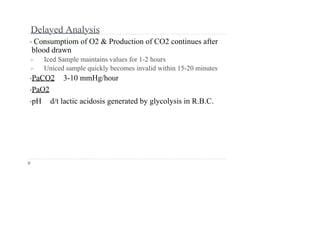
Delayed Analysis
• Consumptiom of O2 & Production of CO2 continues after
blood drawn
➢ Iced Sample maintains values for 1-2 hours
➢ Uniced sample quickly becomes invalid within 15-20 minutes
•PaCO2 3-10 mmHg/hour
•PaO2
•pH d/t lactic acidosis generated by glycolysis in R.B.C.
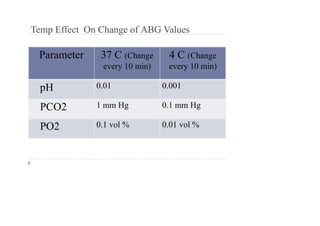
Parameter 37 C (Change
every 10 min)
4 C (Change
every 10 min)
pH 0.01 0.001
PCO2 1 mm Hg 0.1 mm Hg
PO2 0.1 vol % 0.01 vol %
Temp Effect On Change of ABG Values
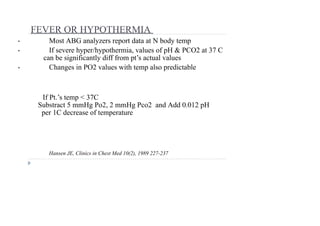
FEVER OR HYPOTHERMIA
• Most ABG analyzers report data at N body temp
• If severe hyper/hypothermia, values of pH & PCO2 at 37 C
can be significantly diff from pt’s actual values
• Changes in PO2 values with temp also predictable
Hansen JE, Clinics in Chest Med 10(2), 1989 227-237
If Pt.’s temp < 37C
Substract 5 mmHg Po2, 2 mmHg Pco2 and Add 0.012 pH
per 1C decrease of temperature
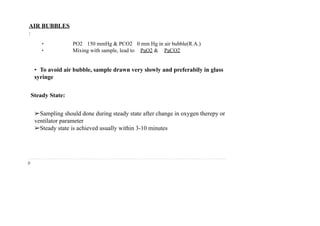
AIR BUBBLES
:
• PO2 150 mmHg & PCO2 0 mm Hg in air bubble(R.A.)
• Mixing with sample, lead to PaO2 & PaCO2
• To avoid air bubble, sample drawn very slowly and preferabily in glass
syringe
Steady State:
➢Sampling should done during steady state after change in oxygen therepy or
ventilator parameter
➢Steady state is achieved usually within 3-10 minutes
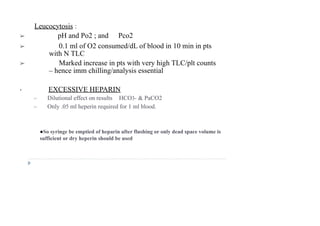
Leucocytosis :
➢ pH and Po2 ; and Pco2
➢ 0.1 ml of O2 consumed/dL of blood in 10 min in pts
with N TLC
➢ Marked increase in pts with very high TLC/plt counts
– hence imm chilling/analysis essential
• EXCESSIVE HEPARIN
➢ Dilutional effect on results HCO3- & PaCO2
➢ Only .05 ml heperin required for 1 ml blood.
●So syringe be emptied of heparin after flushing or only dead space volume is
sufficient or dry heperin should be used
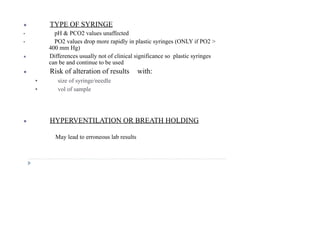
● TYPE OF SYRINGE
• pH & PCO2 values unaffected
• PO2 values drop more rapidly in plastic syringes (ONLY if PO2 >
400 mm Hg)
● Differences usually not of clinical significance so plastic syringes
can be and continue to be used
● Risk of alteration of results with:
• size of syringe/needle
• vol of sample
● HYPERVENTILATION OR BREATH HOLDING
May lead to erroneous lab results
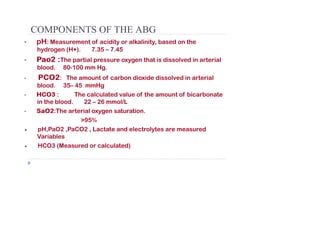
COMPONENTS OF THE ABG
• pH: Measurement of acidity or alkalinity, based on the
hydrogen (H+). 7.35 – 7.45
• Pao
Pao2
2 :
:The partial pressure oxygen that is dissolved in arterial
blood. 80-100 mm Hg.
• PCO
PCO2
2: The amount of carbon dioxide dissolved in arterial
blood. 35– 45 mmHg
• HCO
HCO3
3 : The calculated value of the amount of bicarbonate
in the blood. 22 – 26 mmol/L
• SaO
SaO2
2:The arterial oxygen saturation.
>95%
● pH,PaO2 ,PaCO2 , Lactate and electrolytes are measured
Variables
● HCO3 (Measured or calculated)
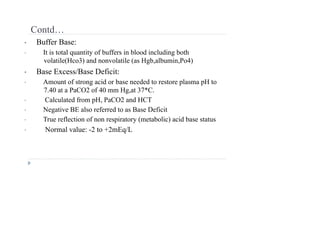
Contd…
• Buffer Base:
• It is total quantity of buffers in blood including both
volatile(Hco3) and nonvolatile (as Hgb,albumin,Po4)
• Base Excess/Base Deficit:
• Amount of strong acid or base needed to restore plasma pH to
7.40 at a PaCO2 of 40 mm Hg,at 37*C.
• Calculated from pH, PaCO2 and HCT
• Negative BE also referred to as Base Deficit
• True reflection of non respiratory (metabolic) acid base status
• Normal value: -2 to +2mEq/L
CENTRAL EQUATION OF ACID-BASE
PHYSIOLOGY
➢ Henderson Hasselbach Equation:
➢ where [ H+] is related to pH by
• To maintain a constant pH, PCO2/HCO3- ratio should be constant
• When one component of the PCO2/[HCO3- ]ratio is altered, the
compensatory response alters the other component in the same direction to
keep the PCO2/[HCO3- ] ratio constant
● [H+] in nEq/L = 24 x (PCO2 / [HCO3 -] )
● [ H+] in nEq/L = 10 (9-pH)
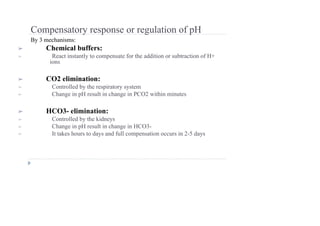
Compensatory response or regulation of pH
By 3 mechanisms:
➢ Chemical buffers:
➢ React instantly to compensate for the addition or subtraction of H+
ions
➢ CO2 elimination:
➢ Controlled by the respiratory system
➢ Change in pH result in change in PCO2 within minutes
➢ HCO3- elimination:
➢ Controlled by the kidneys
➢ Change in pH result in change in HCO3-
➢ It takes hours to days and full compensation occurs in 2-5 days
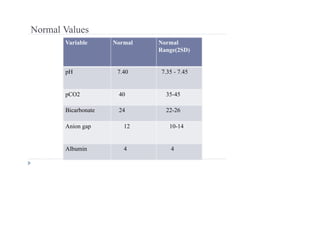
Normal Values
Variable Normal Normal
Range(2SD)
pH 7.40 7.35 - 7.45
pCO2 40 35-45
Bicarbonate 24 22-26
Anion gap 12 10-14
Albumin 4 4
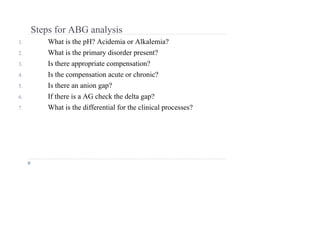
Steps for ABG analysis
1. What is the pH? Acidemia or Alkalemia?
2. What is the primary disorder present?
3. Is there appropriate compensation?
4. Is the compensation acute or chronic?
5. Is there an anion gap?
6. If there is a AG check the delta gap?
7. What is the differential for the clinical processes?
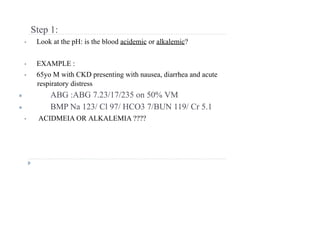
Step 1:
• Look at the pH: is the blood acidemic or alkalemic?
• EXAMPLE :
• 65yo M with CKD presenting with nausea, diarrhea and acute
respiratory distress
● ABG :ABG 7.23/17/235 on 50% VM
● BMP Na 123/ Cl 97/ HCO3 7/BUN 119/ Cr 5.1
• ACIDMEIA OR ALKALEMIA ????
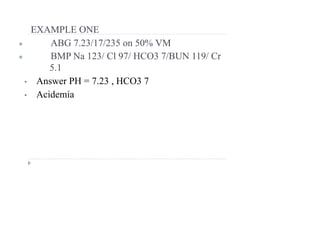
EXAMPLE ONE
● ABG 7.23/17/235 on 50% VM
● BMP Na 123/ Cl 97/ HCO3 7/BUN 119/ Cr
5.1
• Answer PH = 7.23 , HCO3 7
• Acidemia
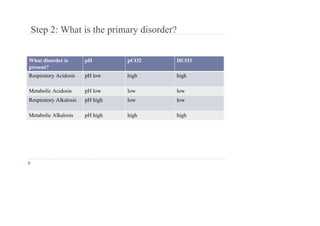
Step 2: What is the primary disorder?
What disorder is
present?
pH pCO2 HCO3
Respiratory Acidosis pH low high high
Metabolic Acidosis pH low low low
Respiratory Alkalosis pH high low low
Metabolic Alkalosis pH high high high
Contd….
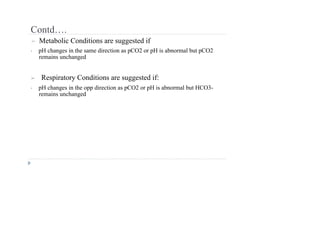
➢ Metabolic Conditions are suggested if
• pH changes in the same direction as pCO2 or pH is abnormal but pCO2
remains unchanged
➢ Respiratory Conditions are suggested if:
• pH changes in the opp direction as pCO2 or pH is abnormal but HCO3-
remains unchanged
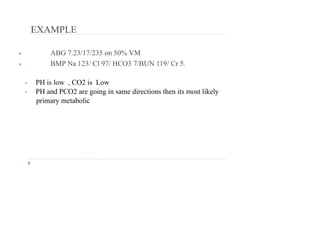
EXAMPLE
● ABG 7.23/17/235 on 50% VM
● BMP Na 123/ Cl 97/ HCO3 7/BUN 119/ Cr 5.
• PH is low , CO2 is Low
• PH and PCO2 are going in same directions then its most likely
primary metabolic
EXPECTED CHANGES IN ACID-BASE DISORDERS
Primary Disorder Expected Changes
Metabolic acidosis PCO2 = 1.5 × HCO3 + (8 ± 2)
Metabolic alkalosis PCO2 = 0.7 × HCO3 + (21 ± 2)
Acute respiratory acidosis delta pH = 0.008 × (PCO2 - 40)
Chronic respiratory acidosis delta pH = 0.003 × (PCO2 - 40)
Acute respiratory alkalosis delta pH = 0.008 × (40 - PCO2)
Chronic respiratory alkalosis delta pH = 0.003 × (40 - PCO2)
From: THE ICU BOOK - 2nd Ed. (1998) [Corrected]
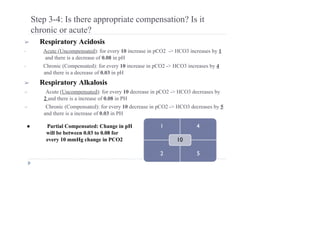
Step 3-4: Is there appropriate compensation? Is it
chronic or acute?
➢ Respiratory Acidosis
• Acute (Uncompensated): for every 10 increase in pCO2 -> HCO3 increases by 1
and there is a decrease of 0.08 in pH
• Chronic (Compensated): for every 10 increase in pCO2 -> HCO3 increases by 4
and there is a decrease of 0.03 in pH
➢ Respiratory Alkalosis
➢ Acute (Uncompensated): for every 10 decrease in pCO2 -> HCO3 decreases by
2 and there is a increase of 0.08 in PH
➢ Chronic (Compensated): for every 10 decrease in pCO2 -> HCO3 decreases by 5
and there is a increase of 0.03 in PH
● Partial Compensated: Change in pH
will be between 0.03 to 0.08 for
every 10 mmHg change in PCO2
Step 3-4: Is there appropriate compensation?
➢ Metabolic Acidosis
➢ Winter’s formula: Expected pCO2 = 1.5[HCO3] + 8 ± 2
OR
pCO2 = 1.2 ( HCO3)
➢ If serum pCO2 > expected pCO2 -> additional respiratory acidosis and
vice versa
➢ Metabolic Alkalosis
• Expected PCO2 = 0.7 × HCO3 + (21 ± 2)
OR
pCO2 = 0.7 ( HCO3)
• If serum pCO2 < expected pCO2 - additional respiratory alkalosis and
vice versa
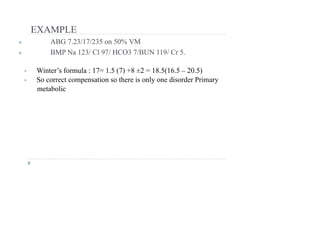
EXAMPLE
● ABG 7.23/17/235 on 50% VM
● BMP Na 123/ Cl 97/ HCO3 7/BUN 119/ Cr 5.
• Winter’s formula : 17= 1.5 (7) +8 ±2 = 18.5(16.5 – 20.5)
• So correct compensation so there is only one disorder Primary
metabolic
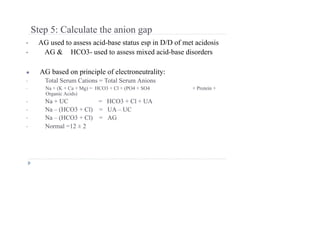
Step 5: Calculate the anion gap
• AG used to assess acid-base status esp in D/D of met acidosis
• AG & HCO3- used to assess mixed acid-base disorders
● AG based on principle of electroneutrality:
• Total Serum Cations = Total Serum Anions
• Na + (K + Ca + Mg) = HCO3 + Cl + (PO4 + SO4 + Protein +
Organic Acids)
• Na + UC = HCO3 + Cl + UA
• Na – (HCO3 + Cl) = UA – UC
• Na – (HCO3 + Cl) = AG
• Normal =12 ± 2
Contd…
• AG corrected = AG + 2.5[4 – albumin]
• If there is an anion Gap then calculate the Delta/delta
gap (step 6) to determine additional hidden nongap
metabolic acidosis or metabolic alkalosis
• If there is no anion gap then start analyzing for non-
anion gap acidosis
EXAMPLE
• Calculate Anion gap
● ABG 7.23/17/235 on 50% VM
● BMP Na 123/ Cl 97/ HCO3 7/BUN 119/ Cr 5/ Albumin 2.
• AG = Na – Cl – HCO3 (normal 12 ± 2)
123 – 97 – 7 = 19
• AG corrected = AG + 2.5[4 – albumin]
= 19 + 2.5 [4 – 2]
= 19 + 5 = 24
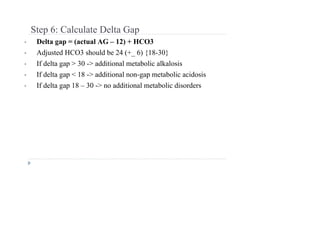
Step 6: Calculate Delta Gap
• Delta gap = (actual AG – 12) + HCO3
• Adjusted HCO3 should be 24 (+_ 6) {18-30}
• If delta gap > 30 -> additional metabolic alkalosis
• If delta gap < 18 -> additional non-gap metabolic acidosis
• If delta gap 18 – 30 -> no additional metabolic disorders
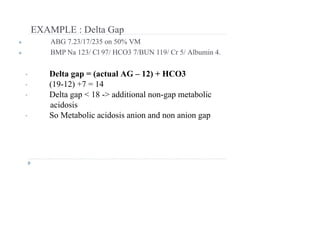
EXAMPLE : Delta Gap
● ABG 7.23/17/235 on 50% VM
● BMP Na 123/ Cl 97/ HCO3 7/BUN 119/ Cr 5/ Albumin 4.
• Delta gap = (actual AG – 12) + HCO3
• (19-12) +7 = 14
• Delta gap < 18 -> additional non-gap metabolic
acidosis
• So Metabolic acidosis anion and non anion gap
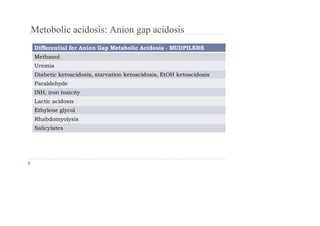
Metobolic acidosis: Anion gap acidosis
EXAMPLE: WHY ANION GAP?
• 65yo M with CKD presenting with nausea, diarrhea and acute
respiratory distress
● ABG :ABG 7.23/17/235 on 50% VM
● BMP Na 123/ Cl 97/ HCO3 7/BUN 119/ Cr 5.1
• So for our patient for anion gap portion its due to BUN of
119 UREMIA
• But would still check lactic acid
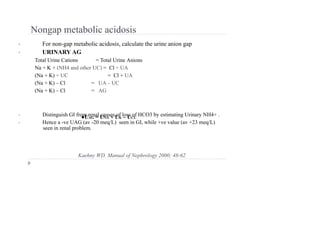
Nongap metabolic acidosis
• For non-gap metabolic acidosis, calculate the urine anion gap
• URINARY AG
Total Urine Cations = Total Urine Anions
Na + K + (NH4 and other UC) = Cl + UA
(Na + K) + UC = Cl + UA
(Na + K) – Cl = UA – UC
(Na + K) – Cl = AG
• Distinguish GI from renal causes of loss of HCO3 by estimating Urinary NH4+ .
• Hence a -ve UAG (av -20 meq/L) seen in GI, while +ve value (av +23 meq/L)
seen in renal problem.
●UAG = UNA + UK – UCL
Kaehny WD. Manual of Nephrology 2000; 48-62
EXAMPLE : NON ANION GAP ACIDOSIS
• 65yo M with CKD presenting with nausea, diarrhea and acute
respiratory distress
● ABG :ABG 7.23/17/235 on 50% VM
● BMP Na 123/ Cl 97/ HCO3 14
● AG = 123 – 97-14 = 12
• Most likely due to the diarrhea
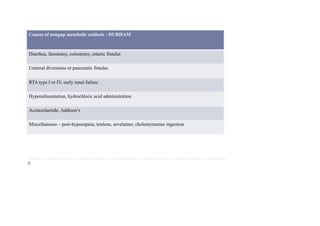
Causes of nongap metabolic acidosis - DURHAM
Diarrhea, ileostomy, colostomy, enteric fistulas
Ureteral diversions or pancreatic fistulas
RTA type I or IV, early renal failure
Hyperailmentation, hydrochloric acid administration
Acetazolamide, Addison’s
Miscellaneous – post-hypocapnia, toulene, sevelamer, cholestyramine ingestion
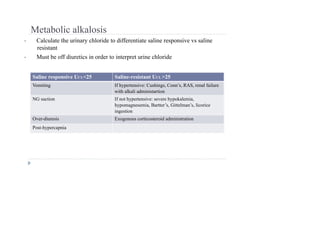
Metabolic alkalosis
• Calculate the urinary chloride to differentiate saline responsive vs saline
resistant
• Must be off diuretics in order to interpret urine chloride
Saline responsive UCL<25 Saline-resistant UCL >25
Vomiting If hypertensive: Cushings, Conn’s, RAS, renal failure
with alkali administartion
NG suction If not hypertensive: severe hypokalemia,
hypomagnesemia, Bartter’s, Gittelman’s, licorice
ingestion
Over-diuresis Exogenous corticosteroid administration
Post-hypercapnia
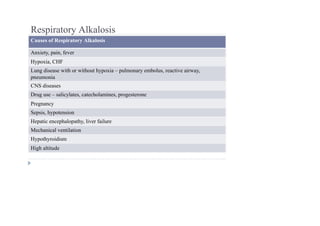
Respiratory Alkalosis
Causes of Respiratory Alkalosis
Anxiety, pain, fever
Hypoxia, CHF
Lung disease with or without hypoxia – pulmonary embolus, reactive airway,
pneumonia
CNS diseases
Drug use – salicylates, catecholamines, progesterone
Pregnancy
Sepsis, hypotension
Hepatic encephalopathy, liver failure
Mechanical ventilation
Hypothyroidism
High altitude
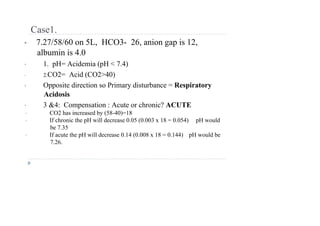
Case1.
• 7.27/58/60 on 5L, HCO3- 26, anion gap is 12,
albumin is 4.0
• 1. pH= Acidemia (pH < 7.4)
• 2.CO2= Acid (CO2>40)
• Opposite direction so Primary disturbance = Respiratory
Acidosis
• 3 &4: Compensation : Acute or chronic? ACUTE
• CO2 has increased by (58-40)=18
• If chronic the pH will decrease 0.05 (0.003 x 18 = 0.054) pH would
be 7.35
• If acute the pH will decrease 0.14 (0.008 x 18 = 0.144) pH would be
7.26.
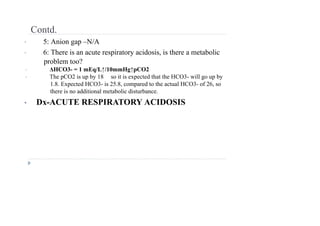
Contd.
• 5: Anion gap –N/A
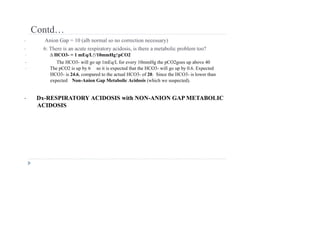
• 6: There is an acute respiratory acidosis, is there a metabolic
problem too?
• ΔHCO3- = 1 mEq/L↑/10mmHg↑pCO2
• The pCO2 is up by 18 so it is expected that the HCO3- will go up by
1.8. Expected HCO3- is 25.8, compared to the actual HCO3- of 26, so
there is no additional metabolic disturbance.
• Dx-ACUTE RESPIRATORY ACIDOSIS
Case.2
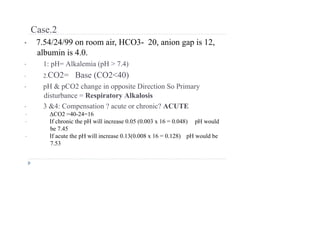
• 7.54/24/99 on room air, HCO3- 20, anion gap is 12,
albumin is 4.0.
• 1: pH= Alkalemia (pH > 7.4)
• 2.CO2= Base (CO2<40)
• pH & pCO2 change in opposite Direction So Primary
disturbance = Respiratory Alkalosis
• 3 &4: Compensation ? acute or chronic? ACUTE
• ΔCO2 =40-24=16
• If chronic the pH will increase 0.05 (0.003 x 16 = 0.048) pH would
be 7.45
• If acute the pH will increase 0.13(0.008 x 16 = 0.128) pH would be
7.53
Contd…
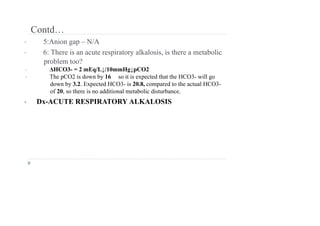
• 5:Anion gap – N/A
• 6: There is an acute respiratory alkalosis, is there a metabolic
problem too?
• ΔHCO3- = 2 mEq/L↓/10mmHg↓pCO2
• The pCO2 is down by 16 so it is expected that the HCO3- will go
down by 3.2. Expected HCO3- is 20.8, compared to the actual HCO3-
of 20, so there is no additional metabolic disturbance.
• Dx-ACUTE RESPIRATORY ALKALOSIS
Case-3
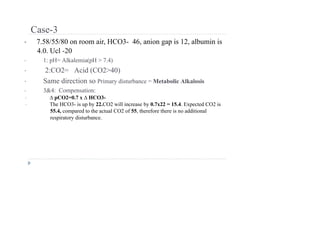
• 7.58/55/80 on room air, HCO3- 46, anion gap is 12, albumin is
4.0. Ucl -20
• 1: pH= Alkalemia(pH > 7.4)
• 2:CO2= Acid (CO2>40)
• Same direction so Primary disturbance = Metabolic Alkalosis
• 3&4: Compensation:
• ∆ pCO2=0.7 x ∆ HCO3-
• The HCO3- is up by 22.CO2 will increase by 0.7x22 = 15.4. Expected CO2 is
55.4, compared to the actual CO2 of 55, therefore there is no additional
respiratory disturbance.
contd
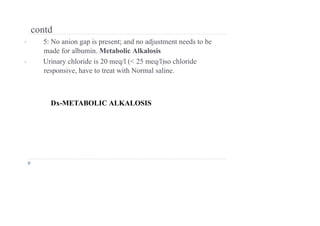
• 5: No anion gap is present; and no adjustment needs to be
made for albumin. Metabolic Alkalosis
• Urinary chloride is 20 meq/l (< 25 meq/l)so chloride
responsive, have to treat with Normal saline.
Dx-METABOLIC ALKALOSIS
Case-4
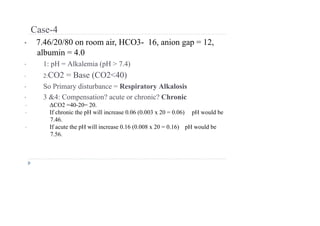
• 7.46/20/80 on room air, HCO3- 16, anion gap = 12,
albumin = 4.0
• 1: pH = Alkalemia (pH > 7.4)
• 2:CO2 = Base (CO2<40)
• So Primary disturbance = Respiratory Alkalosis
• 3 &4: Compensation? acute or chronic? Chronic
• ΔCO2 =40-20= 20.
• If chronic the pH will increase 0.06 (0.003 x 20 = 0.06) pH would be
7.46.
• If acute the pH will increase 0.16 (0.008 x 20 = 0.16) pH would be
7.56.
Contd….
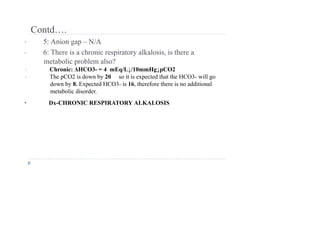
• 5: Anion gap – N/A
• 6: There is a chronic respiratory alkalosis, is there a
metabolic problem also?
• Chronic: ΔHCO3- = 4 mEq/L↓/10mmHg↓pCO2
• The pCO2 is down by 20 so it is expected that the HCO3- will go
down by 8. Expected HCO3- is 16, therefore there is no additional
metabolic disorder.
• Dx-CHRONIC RESPIRATORY ALKALOSIS
Case-5
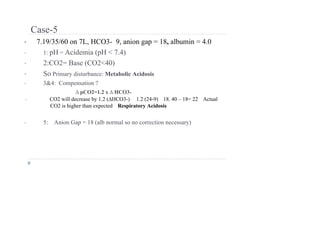
• 7.19/35/60 on 7L, HCO3- 9, anion gap = 18, albumin = 4.0
• 1: pH = Acidemia (pH < 7.4)
• 2:CO2= Base (CO2<40)
• So Primary disturbance: Metabolic Acidosis
• 3&4: Compensation ?
∆ pCO2=1.2 x ∆ HCO3-
• CO2 will decrease by 1.2 (∆HCO3-) 1.2 (24-9) 18. 40 – 18= 22 Actual
CO2 is higher than expected Respiratory Acidosis
• 5: Anion Gap = 18 (alb normal so no correction necessary)
Contd…..
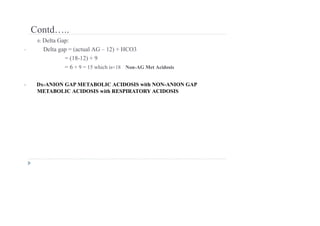
6: Delta Gap:
• Delta gap = (actual AG – 12) + HCO3
= (18-12) + 9
= 6 + 9 = 15 which is<18 Non-AG Met Acidosis
• Dx-ANION GAP METABOLIC ACIDOSIS with NON-ANION GAP
METABOLIC ACIDOSIS with RESPIRATORY ACIDOSIS
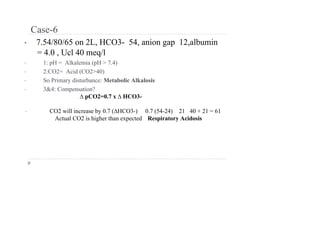
Case-6
• 7.54/80/65 on 2L, HCO3- 54, anion gap 12,albumin
= 4.0 , Ucl 40 meq/l
• 1: pH = Alkalemia (pH > 7.4)
• 2:CO2= Acid (CO2>40)
• So Primary disturbance: Metabolic Alkalosis
• 3&4: Compensation?
∆ pCO2=0.7 x ∆ HCO3-
• CO2 will increase by 0.7 (∆HCO3-) 0.7 (54-24) 21 40 + 21 = 61
Actual CO2 is higher than expected Respiratory Acidosis
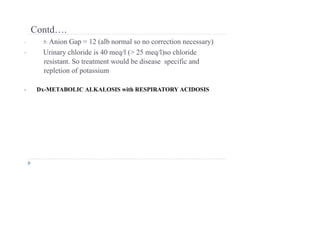
Contd….
• 5: Anion Gap = 12 (alb normal so no correction necessary)
• Urinary chloride is 40 meq/l (> 25 meq/l)so chloride
resistant. So treatment would be disease specific and
repletion of potassium
• Dx-METABOLIC ALKALOSIS with RESPIRATORY ACIDOSIS
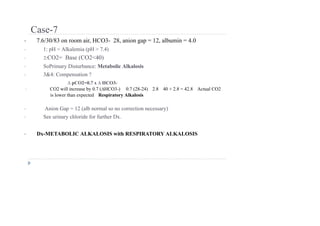
Case-7
• 7.6/30/83 on room air, HCO3- 28, anion gap = 12, albumin = 4.0
• 1: pH = Alkalemia (pH > 7.4)
• 2:CO2= Base (CO2<40)
• SoPrimary Disturbance: Metabolic Alkalosis
• 3&4: Compensation ?
∆ pCO2=0.7 x ∆ HCO3-
• CO2 will increase by 0.7 (∆HCO3-) 0.7 (28-24) 2.8 40 + 2.8 = 42.8 Actual CO2
is lower than expected Respiratory Alkalosis
• Anion Gap = 12 (alb normal so no correction necessary)
• See urinary chloride for further Dx.
• Dx-METABOLIC ALKALOSIS with RESPIRATORY ALKALOSIS
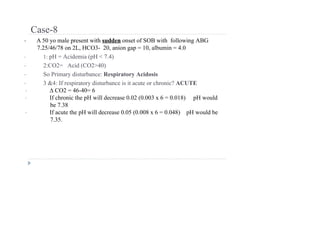
Case-8
• A 50 yo male present with sudden onset of SOB with following ABG
7.25/46/78 on 2L, HCO3- 20, anion gap = 10, albumin = 4.0
• 1: pH = Acidemia (pH < 7.4)
• 2:CO2= Acid (CO2>40)
• So Primary disturbance: Respiratory Acidosis
• 3 &4: If respiratory disturbance is it acute or chronic? ACUTE
• ∆ CO2 = 46-40= 6
• If chronic the pH will decrease 0.02 (0.003 x 6 = 0.018) pH would
be 7.38
• If acute the pH will decrease 0.05 (0.008 x 6 = 0.048) pH would be
7.35.
Contd…
• Anion Gap = 10 (alb normal so no correction necessary)
• 6: There is an acute respiratory acidosis, is there a metabolic problem too?
• ∆ HCO3- = 1 mEq/L↑/10mmHg↑pCO2
• The HCO3- will go up 1mEq/L for every 10mmHg the pCO2goes up above 40
• The pCO2 is up by 6 so it is expected that the HCO3- will go up by 0.6. Expected
HCO3- is 24.6, compared to the actual HCO3- of 20. Since the HCO3- is lower than
expected Non-Anion Gap Metabolic Acidosis (which we suspected).
• Dx-RESPIRATORY ACIDOSIS with NON-ANION GAP METABOLIC
ACIDOSIS
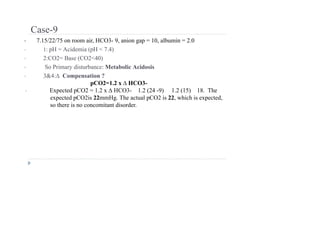
Case-9
• 7.15/22/75 on room air, HCO3- 9, anion gap = 10, albumin = 2.0
• 1: pH = Acidemia (pH < 7.4)
• 2:CO2= Base (CO2<40)
• So Primary disturbance: Metabolic Acidosis
• 3&4:∆ Compensation ?
pCO2=1.2 x ∆ HCO3-
• Expected pCO2 = 1.2 x ∆ HCO3- 1.2 (24 -9) 1.2 (15) 18. The
expected pCO2is 22mmHg. The actual pCO2 is 22, which is expected,
so there is no concomitant disorder.
Contd….
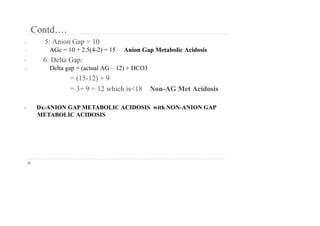
• 5: Anion Gap = 10
• AGc = 10 + 2.5(4-2) = 15 Anion Gap Metabolic Acidosis
• 6: Delta Gap:
• Delta gap = (actual AG – 12) + HCO3
= (15-12) + 9
= 3+ 9 = 12 which is<18 Non-AG Met Acidosis
• Dx-ANION GAP METABOLIC ACIDOSIS with NON-ANION GAP
METABOLIC ACIDOSIS
Arterial Blood Gas.ppt1.pdf

Arterial Blood Gas.ppt1.pdf

  • 1.
    Blood Gas Analysisand it’s Clinical Interpretation Dr R.S.Gangwar MD, PDCC, FIPM Assistant Professor Geriatric ICU,DGMH
  • 2.
    Outline 1. Common ErrorsDuring ABG Sampling 2. Components of ABG 3. Discuss simple steps in analyzing ABGs 4. Calculate the anion gap 5. Calculate the delta gap 6. Differentials for specific acid-base disorders
  • 3.
    Delayed Analysis • Consumptiomof O2 & Production of CO2 continues after blood drawn ➢ Iced Sample maintains values for 1-2 hours ➢ Uniced sample quickly becomes invalid within 15-20 minutes •PaCO2 3-10 mmHg/hour •PaO2 •pH d/t lactic acidosis generated by glycolysis in R.B.C.
  • 4.
    Parameter 37 C(Change every 10 min) 4 C (Change every 10 min) pH 0.01 0.001 PCO2 1 mm Hg 0.1 mm Hg PO2 0.1 vol % 0.01 vol % Temp Effect On Change of ABG Values
  • 5.
    FEVER OR HYPOTHERMIA •Most ABG analyzers report data at N body temp • If severe hyper/hypothermia, values of pH & PCO2 at 37 C can be significantly diff from pt’s actual values • Changes in PO2 values with temp also predictable Hansen JE, Clinics in Chest Med 10(2), 1989 227-237 If Pt.’s temp < 37C Substract 5 mmHg Po2, 2 mmHg Pco2 and Add 0.012 pH per 1C decrease of temperature
  • 6.
    AIR BUBBLES : • PO2150 mmHg & PCO2 0 mm Hg in air bubble(R.A.) • Mixing with sample, lead to PaO2 & PaCO2 • To avoid air bubble, sample drawn very slowly and preferabily in glass syringe Steady State: ➢Sampling should done during steady state after change in oxygen therepy or ventilator parameter ➢Steady state is achieved usually within 3-10 minutes
  • 7.
    Leucocytosis : ➢ pHand Po2 ; and Pco2 ➢ 0.1 ml of O2 consumed/dL of blood in 10 min in pts with N TLC ➢ Marked increase in pts with very high TLC/plt counts – hence imm chilling/analysis essential • EXCESSIVE HEPARIN ➢ Dilutional effect on results HCO3- & PaCO2 ➢ Only .05 ml heperin required for 1 ml blood. ●So syringe be emptied of heparin after flushing or only dead space volume is sufficient or dry heperin should be used
  • 8.
    ● TYPE OFSYRINGE • pH & PCO2 values unaffected • PO2 values drop more rapidly in plastic syringes (ONLY if PO2 > 400 mm Hg) ● Differences usually not of clinical significance so plastic syringes can be and continue to be used ● Risk of alteration of results with: • size of syringe/needle • vol of sample ● HYPERVENTILATION OR BREATH HOLDING May lead to erroneous lab results
  • 9.
    COMPONENTS OF THEABG • pH: Measurement of acidity or alkalinity, based on the hydrogen (H+). 7.35 – 7.45 • Pao Pao2 2 : :The partial pressure oxygen that is dissolved in arterial blood. 80-100 mm Hg. • PCO PCO2 2: The amount of carbon dioxide dissolved in arterial blood. 35– 45 mmHg • HCO HCO3 3 : The calculated value of the amount of bicarbonate in the blood. 22 – 26 mmol/L • SaO SaO2 2:The arterial oxygen saturation. >95% ● pH,PaO2 ,PaCO2 , Lactate and electrolytes are measured Variables ● HCO3 (Measured or calculated)
  • 10.
    Contd… • Buffer Base: •It is total quantity of buffers in blood including both volatile(Hco3) and nonvolatile (as Hgb,albumin,Po4) • Base Excess/Base Deficit: • Amount of strong acid or base needed to restore plasma pH to 7.40 at a PaCO2 of 40 mm Hg,at 37*C. • Calculated from pH, PaCO2 and HCT • Negative BE also referred to as Base Deficit • True reflection of non respiratory (metabolic) acid base status • Normal value: -2 to +2mEq/L
  • 11.
    CENTRAL EQUATION OFACID-BASE PHYSIOLOGY ➢ Henderson Hasselbach Equation: ➢ where [ H+] is related to pH by • To maintain a constant pH, PCO2/HCO3- ratio should be constant • When one component of the PCO2/[HCO3- ]ratio is altered, the compensatory response alters the other component in the same direction to keep the PCO2/[HCO3- ] ratio constant ● [H+] in nEq/L = 24 x (PCO2 / [HCO3 -] ) ● [ H+] in nEq/L = 10 (9-pH)
  • 12.
    Compensatory response orregulation of pH By 3 mechanisms: ➢ Chemical buffers: ➢ React instantly to compensate for the addition or subtraction of H+ ions ➢ CO2 elimination: ➢ Controlled by the respiratory system ➢ Change in pH result in change in PCO2 within minutes ➢ HCO3- elimination: ➢ Controlled by the kidneys ➢ Change in pH result in change in HCO3- ➢ It takes hours to days and full compensation occurs in 2-5 days
  • 13.
    Normal Values Variable NormalNormal Range(2SD) pH 7.40 7.35 - 7.45 pCO2 40 35-45 Bicarbonate 24 22-26 Anion gap 12 10-14 Albumin 4 4
  • 14.
    Steps for ABGanalysis 1. What is the pH? Acidemia or Alkalemia? 2. What is the primary disorder present? 3. Is there appropriate compensation? 4. Is the compensation acute or chronic? 5. Is there an anion gap? 6. If there is a AG check the delta gap? 7. What is the differential for the clinical processes?
  • 15.
    Step 1: • Lookat the pH: is the blood acidemic or alkalemic? • EXAMPLE : • 65yo M with CKD presenting with nausea, diarrhea and acute respiratory distress ● ABG :ABG 7.23/17/235 on 50% VM ● BMP Na 123/ Cl 97/ HCO3 7/BUN 119/ Cr 5.1 • ACIDMEIA OR ALKALEMIA ????
  • 16.
    EXAMPLE ONE ● ABG7.23/17/235 on 50% VM ● BMP Na 123/ Cl 97/ HCO3 7/BUN 119/ Cr 5.1 • Answer PH = 7.23 , HCO3 7 • Acidemia
  • 17.
    Step 2: Whatis the primary disorder? What disorder is present? pH pCO2 HCO3 Respiratory Acidosis pH low high high Metabolic Acidosis pH low low low Respiratory Alkalosis pH high low low Metabolic Alkalosis pH high high high
  • 18.
    Contd…. ➢ Metabolic Conditionsare suggested if • pH changes in the same direction as pCO2 or pH is abnormal but pCO2 remains unchanged ➢ Respiratory Conditions are suggested if: • pH changes in the opp direction as pCO2 or pH is abnormal but HCO3- remains unchanged
  • 19.
    EXAMPLE ● ABG 7.23/17/235on 50% VM ● BMP Na 123/ Cl 97/ HCO3 7/BUN 119/ Cr 5. • PH is low , CO2 is Low • PH and PCO2 are going in same directions then its most likely primary metabolic
  • 20.
    EXPECTED CHANGES INACID-BASE DISORDERS Primary Disorder Expected Changes Metabolic acidosis PCO2 = 1.5 × HCO3 + (8 ± 2) Metabolic alkalosis PCO2 = 0.7 × HCO3 + (21 ± 2) Acute respiratory acidosis delta pH = 0.008 × (PCO2 - 40) Chronic respiratory acidosis delta pH = 0.003 × (PCO2 - 40) Acute respiratory alkalosis delta pH = 0.008 × (40 - PCO2) Chronic respiratory alkalosis delta pH = 0.003 × (40 - PCO2) From: THE ICU BOOK - 2nd Ed. (1998) [Corrected]
  • 21.
    Step 3-4: Isthere appropriate compensation? Is it chronic or acute? ➢ Respiratory Acidosis • Acute (Uncompensated): for every 10 increase in pCO2 -> HCO3 increases by 1 and there is a decrease of 0.08 in pH • Chronic (Compensated): for every 10 increase in pCO2 -> HCO3 increases by 4 and there is a decrease of 0.03 in pH ➢ Respiratory Alkalosis ➢ Acute (Uncompensated): for every 10 decrease in pCO2 -> HCO3 decreases by 2 and there is a increase of 0.08 in PH ➢ Chronic (Compensated): for every 10 decrease in pCO2 -> HCO3 decreases by 5 and there is a increase of 0.03 in PH ● Partial Compensated: Change in pH will be between 0.03 to 0.08 for every 10 mmHg change in PCO2
  • 22.
    Step 3-4: Isthere appropriate compensation? ➢ Metabolic Acidosis ➢ Winter’s formula: Expected pCO2 = 1.5[HCO3] + 8 ± 2 OR pCO2 = 1.2 ( HCO3) ➢ If serum pCO2 > expected pCO2 -> additional respiratory acidosis and vice versa ➢ Metabolic Alkalosis • Expected PCO2 = 0.7 × HCO3 + (21 ± 2) OR pCO2 = 0.7 ( HCO3) • If serum pCO2 < expected pCO2 - additional respiratory alkalosis and vice versa
  • 23.
    EXAMPLE ● ABG 7.23/17/235on 50% VM ● BMP Na 123/ Cl 97/ HCO3 7/BUN 119/ Cr 5. • Winter’s formula : 17= 1.5 (7) +8 ±2 = 18.5(16.5 – 20.5) • So correct compensation so there is only one disorder Primary metabolic
  • 24.
    Step 5: Calculatethe anion gap • AG used to assess acid-base status esp in D/D of met acidosis • AG & HCO3- used to assess mixed acid-base disorders ● AG based on principle of electroneutrality: • Total Serum Cations = Total Serum Anions • Na + (K + Ca + Mg) = HCO3 + Cl + (PO4 + SO4 + Protein + Organic Acids) • Na + UC = HCO3 + Cl + UA • Na – (HCO3 + Cl) = UA – UC • Na – (HCO3 + Cl) = AG • Normal =12 ± 2
  • 25.
    Contd… • AG corrected= AG + 2.5[4 – albumin] • If there is an anion Gap then calculate the Delta/delta gap (step 6) to determine additional hidden nongap metabolic acidosis or metabolic alkalosis • If there is no anion gap then start analyzing for non- anion gap acidosis
  • 26.
    EXAMPLE • Calculate Aniongap ● ABG 7.23/17/235 on 50% VM ● BMP Na 123/ Cl 97/ HCO3 7/BUN 119/ Cr 5/ Albumin 2. • AG = Na – Cl – HCO3 (normal 12 ± 2) 123 – 97 – 7 = 19 • AG corrected = AG + 2.5[4 – albumin] = 19 + 2.5 [4 – 2] = 19 + 5 = 24
  • 27.
    Step 6: CalculateDelta Gap • Delta gap = (actual AG – 12) + HCO3 • Adjusted HCO3 should be 24 (+_ 6) {18-30} • If delta gap > 30 -> additional metabolic alkalosis • If delta gap < 18 -> additional non-gap metabolic acidosis • If delta gap 18 – 30 -> no additional metabolic disorders
  • 28.
    EXAMPLE : DeltaGap ● ABG 7.23/17/235 on 50% VM ● BMP Na 123/ Cl 97/ HCO3 7/BUN 119/ Cr 5/ Albumin 4. • Delta gap = (actual AG – 12) + HCO3 • (19-12) +7 = 14 • Delta gap < 18 -> additional non-gap metabolic acidosis • So Metabolic acidosis anion and non anion gap
  • 29.
  • 30.
    EXAMPLE: WHY ANIONGAP? • 65yo M with CKD presenting with nausea, diarrhea and acute respiratory distress ● ABG :ABG 7.23/17/235 on 50% VM ● BMP Na 123/ Cl 97/ HCO3 7/BUN 119/ Cr 5.1 • So for our patient for anion gap portion its due to BUN of 119 UREMIA • But would still check lactic acid
  • 31.
    Nongap metabolic acidosis •For non-gap metabolic acidosis, calculate the urine anion gap • URINARY AG Total Urine Cations = Total Urine Anions Na + K + (NH4 and other UC) = Cl + UA (Na + K) + UC = Cl + UA (Na + K) – Cl = UA – UC (Na + K) – Cl = AG • Distinguish GI from renal causes of loss of HCO3 by estimating Urinary NH4+ . • Hence a -ve UAG (av -20 meq/L) seen in GI, while +ve value (av +23 meq/L) seen in renal problem. ●UAG = UNA + UK – UCL Kaehny WD. Manual of Nephrology 2000; 48-62
  • 32.
    EXAMPLE : NONANION GAP ACIDOSIS • 65yo M with CKD presenting with nausea, diarrhea and acute respiratory distress ● ABG :ABG 7.23/17/235 on 50% VM ● BMP Na 123/ Cl 97/ HCO3 14 ● AG = 123 – 97-14 = 12 • Most likely due to the diarrhea
  • 33.
    Causes of nongapmetabolic acidosis - DURHAM Diarrhea, ileostomy, colostomy, enteric fistulas Ureteral diversions or pancreatic fistulas RTA type I or IV, early renal failure Hyperailmentation, hydrochloric acid administration Acetazolamide, Addison’s Miscellaneous – post-hypocapnia, toulene, sevelamer, cholestyramine ingestion
  • 34.
    Metabolic alkalosis • Calculatethe urinary chloride to differentiate saline responsive vs saline resistant • Must be off diuretics in order to interpret urine chloride Saline responsive UCL<25 Saline-resistant UCL >25 Vomiting If hypertensive: Cushings, Conn’s, RAS, renal failure with alkali administartion NG suction If not hypertensive: severe hypokalemia, hypomagnesemia, Bartter’s, Gittelman’s, licorice ingestion Over-diuresis Exogenous corticosteroid administration Post-hypercapnia
  • 35.
    Respiratory Alkalosis Causes ofRespiratory Alkalosis Anxiety, pain, fever Hypoxia, CHF Lung disease with or without hypoxia – pulmonary embolus, reactive airway, pneumonia CNS diseases Drug use – salicylates, catecholamines, progesterone Pregnancy Sepsis, hypotension Hepatic encephalopathy, liver failure Mechanical ventilation Hypothyroidism High altitude
  • 36.
    Case1. • 7.27/58/60 on5L, HCO3- 26, anion gap is 12, albumin is 4.0 • 1. pH= Acidemia (pH < 7.4) • 2.CO2= Acid (CO2>40) • Opposite direction so Primary disturbance = Respiratory Acidosis • 3 &4: Compensation : Acute or chronic? ACUTE • CO2 has increased by (58-40)=18 • If chronic the pH will decrease 0.05 (0.003 x 18 = 0.054) pH would be 7.35 • If acute the pH will decrease 0.14 (0.008 x 18 = 0.144) pH would be 7.26.
  • 37.
    Contd. • 5: Aniongap –N/A • 6: There is an acute respiratory acidosis, is there a metabolic problem too? • ΔHCO3- = 1 mEq/L↑/10mmHg↑pCO2 • The pCO2 is up by 18 so it is expected that the HCO3- will go up by 1.8. Expected HCO3- is 25.8, compared to the actual HCO3- of 26, so there is no additional metabolic disturbance. • Dx-ACUTE RESPIRATORY ACIDOSIS
  • 38.
    Case.2 • 7.54/24/99 onroom air, HCO3- 20, anion gap is 12, albumin is 4.0. • 1: pH= Alkalemia (pH > 7.4) • 2.CO2= Base (CO2<40) • pH & pCO2 change in opposite Direction So Primary disturbance = Respiratory Alkalosis • 3 &4: Compensation ? acute or chronic? ACUTE • ΔCO2 =40-24=16 • If chronic the pH will increase 0.05 (0.003 x 16 = 0.048) pH would be 7.45 • If acute the pH will increase 0.13(0.008 x 16 = 0.128) pH would be 7.53
  • 39.
    Contd… • 5:Anion gap– N/A • 6: There is an acute respiratory alkalosis, is there a metabolic problem too? • ΔHCO3- = 2 mEq/L↓/10mmHg↓pCO2 • The pCO2 is down by 16 so it is expected that the HCO3- will go down by 3.2. Expected HCO3- is 20.8, compared to the actual HCO3- of 20, so there is no additional metabolic disturbance. • Dx-ACUTE RESPIRATORY ALKALOSIS
  • 40.
    Case-3 • 7.58/55/80 onroom air, HCO3- 46, anion gap is 12, albumin is 4.0. Ucl -20 • 1: pH= Alkalemia(pH > 7.4) • 2:CO2= Acid (CO2>40) • Same direction so Primary disturbance = Metabolic Alkalosis • 3&4: Compensation: • ∆ pCO2=0.7 x ∆ HCO3- • The HCO3- is up by 22.CO2 will increase by 0.7x22 = 15.4. Expected CO2 is 55.4, compared to the actual CO2 of 55, therefore there is no additional respiratory disturbance.
  • 41.
    contd • 5: Noanion gap is present; and no adjustment needs to be made for albumin. Metabolic Alkalosis • Urinary chloride is 20 meq/l (< 25 meq/l)so chloride responsive, have to treat with Normal saline. Dx-METABOLIC ALKALOSIS
  • 42.
    Case-4 • 7.46/20/80 onroom air, HCO3- 16, anion gap = 12, albumin = 4.0 • 1: pH = Alkalemia (pH > 7.4) • 2:CO2 = Base (CO2<40) • So Primary disturbance = Respiratory Alkalosis • 3 &4: Compensation? acute or chronic? Chronic • ΔCO2 =40-20= 20. • If chronic the pH will increase 0.06 (0.003 x 20 = 0.06) pH would be 7.46. • If acute the pH will increase 0.16 (0.008 x 20 = 0.16) pH would be 7.56.
  • 43.
    Contd…. • 5: Aniongap – N/A • 6: There is a chronic respiratory alkalosis, is there a metabolic problem also? • Chronic: ΔHCO3- = 4 mEq/L↓/10mmHg↓pCO2 • The pCO2 is down by 20 so it is expected that the HCO3- will go down by 8. Expected HCO3- is 16, therefore there is no additional metabolic disorder. • Dx-CHRONIC RESPIRATORY ALKALOSIS
  • 44.
    Case-5 • 7.19/35/60 on7L, HCO3- 9, anion gap = 18, albumin = 4.0 • 1: pH = Acidemia (pH < 7.4) • 2:CO2= Base (CO2<40) • So Primary disturbance: Metabolic Acidosis • 3&4: Compensation ? ∆ pCO2=1.2 x ∆ HCO3- • CO2 will decrease by 1.2 (∆HCO3-) 1.2 (24-9) 18. 40 – 18= 22 Actual CO2 is higher than expected Respiratory Acidosis • 5: Anion Gap = 18 (alb normal so no correction necessary)
  • 45.
    Contd….. 6: Delta Gap: •Delta gap = (actual AG – 12) + HCO3 = (18-12) + 9 = 6 + 9 = 15 which is<18 Non-AG Met Acidosis • Dx-ANION GAP METABOLIC ACIDOSIS with NON-ANION GAP METABOLIC ACIDOSIS with RESPIRATORY ACIDOSIS
  • 46.
    Case-6 • 7.54/80/65 on2L, HCO3- 54, anion gap 12,albumin = 4.0 , Ucl 40 meq/l • 1: pH = Alkalemia (pH > 7.4) • 2:CO2= Acid (CO2>40) • So Primary disturbance: Metabolic Alkalosis • 3&4: Compensation? ∆ pCO2=0.7 x ∆ HCO3- • CO2 will increase by 0.7 (∆HCO3-) 0.7 (54-24) 21 40 + 21 = 61 Actual CO2 is higher than expected Respiratory Acidosis
  • 47.
    Contd…. • 5: AnionGap = 12 (alb normal so no correction necessary) • Urinary chloride is 40 meq/l (> 25 meq/l)so chloride resistant. So treatment would be disease specific and repletion of potassium • Dx-METABOLIC ALKALOSIS with RESPIRATORY ACIDOSIS
  • 48.
    Case-7 • 7.6/30/83 onroom air, HCO3- 28, anion gap = 12, albumin = 4.0 • 1: pH = Alkalemia (pH > 7.4) • 2:CO2= Base (CO2<40) • SoPrimary Disturbance: Metabolic Alkalosis • 3&4: Compensation ? ∆ pCO2=0.7 x ∆ HCO3- • CO2 will increase by 0.7 (∆HCO3-) 0.7 (28-24) 2.8 40 + 2.8 = 42.8 Actual CO2 is lower than expected Respiratory Alkalosis • Anion Gap = 12 (alb normal so no correction necessary) • See urinary chloride for further Dx. • Dx-METABOLIC ALKALOSIS with RESPIRATORY ALKALOSIS
  • 49.
    Case-8 • A 50yo male present with sudden onset of SOB with following ABG 7.25/46/78 on 2L, HCO3- 20, anion gap = 10, albumin = 4.0 • 1: pH = Acidemia (pH < 7.4) • 2:CO2= Acid (CO2>40) • So Primary disturbance: Respiratory Acidosis • 3 &4: If respiratory disturbance is it acute or chronic? ACUTE • ∆ CO2 = 46-40= 6 • If chronic the pH will decrease 0.02 (0.003 x 6 = 0.018) pH would be 7.38 • If acute the pH will decrease 0.05 (0.008 x 6 = 0.048) pH would be 7.35.
  • 50.
    Contd… • Anion Gap= 10 (alb normal so no correction necessary) • 6: There is an acute respiratory acidosis, is there a metabolic problem too? • ∆ HCO3- = 1 mEq/L↑/10mmHg↑pCO2 • The HCO3- will go up 1mEq/L for every 10mmHg the pCO2goes up above 40 • The pCO2 is up by 6 so it is expected that the HCO3- will go up by 0.6. Expected HCO3- is 24.6, compared to the actual HCO3- of 20. Since the HCO3- is lower than expected Non-Anion Gap Metabolic Acidosis (which we suspected). • Dx-RESPIRATORY ACIDOSIS with NON-ANION GAP METABOLIC ACIDOSIS
  • 51.
    Case-9 • 7.15/22/75 onroom air, HCO3- 9, anion gap = 10, albumin = 2.0 • 1: pH = Acidemia (pH < 7.4) • 2:CO2= Base (CO2<40) • So Primary disturbance: Metabolic Acidosis • 3&4:∆ Compensation ? pCO2=1.2 x ∆ HCO3- • Expected pCO2 = 1.2 x ∆ HCO3- 1.2 (24 -9) 1.2 (15) 18. The expected pCO2is 22mmHg. The actual pCO2 is 22, which is expected, so there is no concomitant disorder.
  • 52.
    Contd…. • 5: AnionGap = 10 • AGc = 10 + 2.5(4-2) = 15 Anion Gap Metabolic Acidosis • 6: Delta Gap: • Delta gap = (actual AG – 12) + HCO3 = (15-12) + 9 = 3+ 9 = 12 which is<18 Non-AG Met Acidosis • Dx-ANION GAP METABOLIC ACIDOSIS with NON-ANION GAP METABOLIC ACIDOSIS