Childhood Tuberculosis 檀卫平 中山二院 Tan-weiping
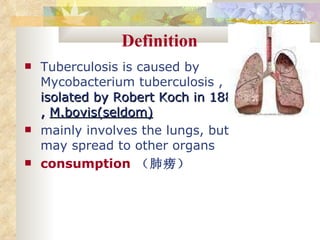
Definition Tuberculosis is caused by Mycobacterium tuberculosis ,  isolated by Robert Koch in 1882 ,  M.bovis(seldom) mainly involves the lungs, but may spread to other organs  consumption   (肺痨)
Epidemiology 19th century, 25% deaths by TB   1940s, effective medicines Annually, 8 million become ill with tuberculosis, 2 million people die China has the world's second largest   tuberculosis epidemic   (after   India ), 1.3  million new cases every year Work migrants  "floating" peasants migrant population:100 million  incidences   rates  113 per 100,000  in China
Epidemiology The morbidity / mortality of tuberculosis are high in developing countries (southeast asia,China,India,Africa,latin america) Age:60% Infant - <5yr  Favored age:5-14yr Male:female-1:1(adults male predominate)
Epidemiology TB adults exposure Immunocompromise malnutrition HIV/AIDS  infection Poverty,immigration irregular treatment breeds : drug-resistant tuberculosis
Risk factors Socioeconomic status Over-crowding Poor nutrition Inadequate health care HIV infection Drug abuse
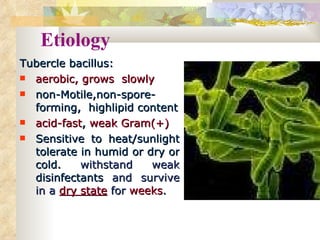
Etiology Tubercle bacillus: aerobic,   grows  slowly non-Motile,non-spore-forming,  highlipid content acid-fast ,  weak Gram(+) Sensitive to heat/sunlight tolerate in humid or dry or cold.  withstand weak  disinfectants   and survive in a  dry state   for  weeks .
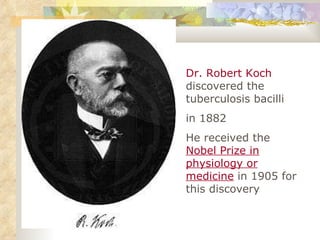
Dr. Robert Koch  discovered the tuberculosis bacilli in 1882  He received the  Nobel Prize in physiology or medicine  in 1905 for this discovery
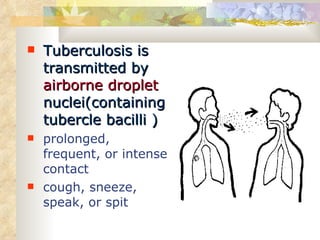
Tuberculosis is transmitted by  airborne droplet  nuclei(containing tubercle bacilli ) prolonged, frequent, or intense contact  cough, sneeze, speak, or spit
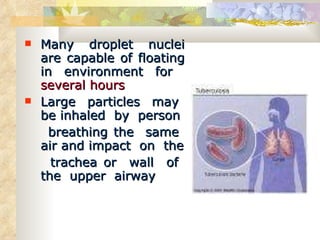
Many droplet nuclei are capable of floating in environment for  several hours Large  particles  may  be inhaled  by  person breathing the  same  air and impact  on  the trachea or  wall  of  the  upper  airway
The transmission is determined The probability of contact with  active — not latent — TB intimacy  and  duration  of contact effectiveness of  ventilation  number s   and  virulence  of the  M. tuberculosis   strain  in  infectious droplets
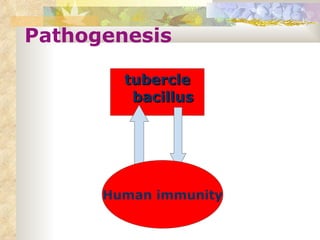
Pathogenesis tubercle bacillus  Human immunity
Pathogenesis 90% infected with  Mycobacterium tuberculosis   asymptomatic,  latent TB infection   10% progress to TB disease  if untreated, the  death rate  for these active TB cases is more than   50%
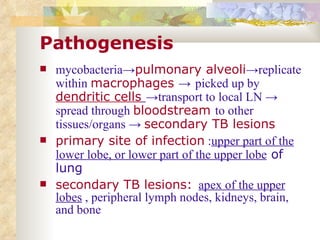
Pathogenesis mycobacteria -> pulmonary alveoli -> replicate within   macrophages  ->   picked up by  dendritic cells   -> transport to local LN  ->  spread through  bloodstream  to other tissues/organs  ->   secondary TB lesions primary site of infection  : upper part of the lower lobe, or lower part of the upper lobe  of lung secondary TB lesions:   apex of the upper lobes  , peripheral lymph nodes, kidneys, brain, and bone
Human Immunity /hypersensitivity  after TB infection Specific immunity after infected or  given  BCG  vaccine Cell-mediate immunity develops within  4-8 weeks  after infected with  bacillus  Many immunologic cells:   Macrophages, T/B lymphocytes, fibroblasts   involved
Two types of cells are essential in the formation of TB Macrophages: directly phagocytize TB and processing and presenting antigens to T lymphocyte T lymphocytes(CD4+): induce protection through the production of lymphokines
T lymphocytes(CD4+) Many lymphokines are involved in tuberculosis, the interplay of these cytokines determine the hosts response for example IL-1 is related to fever IL-6 is related to hyperglobulinemia TNF is related to the killing of mycobacteria formation of granulomas other cytokines including IL-4,IL-5,IL-10 can promote humoral immunity
Genetic factors ( HLA-BW35) play a key role in innate non-immune resistance  to  infection with M. Tuberculosis  These genes may have a role in determining  susceptibility  to  tuberculosis
Basic pathologic changes infiltration -> hyperplasia( granuloma) ,   ulceration  or  calcification  in different stage  host defense <  bacterias,  caseating ulceration( caseous necrosis ) -> fibrosis host defense  > bacteria,  granuloma   calcification
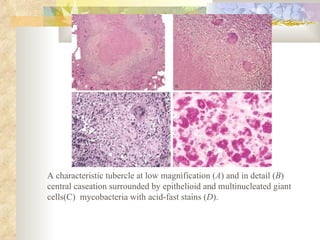
A characteristic tubercle at low magnification ( A ) and in detail ( B ) central caseation surrounded by epithelioid and multinucleated giant cells(C)  mycobacteria with acid-fast stains ( D ).
Progression of tuberculosis Absorption Fibrosis Calcification Deterioration: enlargement of infected aeras and appear newer  infiltrated regions or spreading.
Five common clinical patterns 1.  Primary pulmonary tuberculosis  (Primary Complex and Bronchial Lymphnode-Tuberculosis) 2.  Milliary Tuberculosis  (acute, subacute and chronic hematogenous pulmonary tuberculosis) 3.  secondary pulmonary  tuberculosis   Infiltrative pulmonary tuberculosis Chronic fibrocavenous pulmonary  tuberculosis  4.Tuberculous pleuritis 5.Extrapulmonary tuberculosis
Diagnosis History and Clinical Manifestations   Tuberculin testing Lab examination X-r ay bronchoscopy Puncture of adenopathy
History /Clinical Manifestations systemic signs : fever,  weight loss, fatigue,  night sweats, wasting,coughing up blood, Chest pain. TB Contaction   : adults in family History of BCG Vaccination  Acute infectious disease recently  :  measles,whooping cough Allergy to TB : erythema nodosum  、 herpetic conjunctivitis
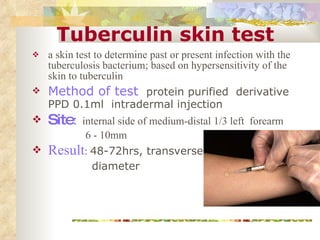
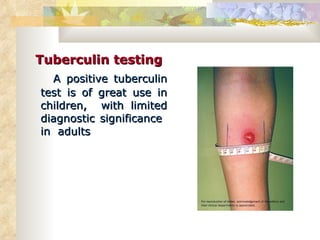
Tuberculin skin test a skin test to determine past or present infection with the tuberculosis bacterium; based on hypersensitivity of the skin to tuberculin Method of test  protein purified  derivative PPD 0.1ml  intradermal injection Site :   internal side of medium-distal 1/3 left  forearm 6 - 10mm Result :  48-72hrs, transverse diameter
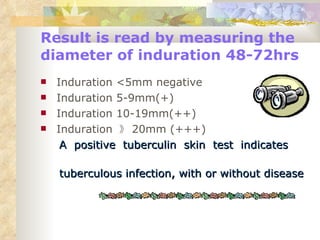
Result is read by measuring the diameter of induration 48-72hrs Induration <5mm negative Induration 5-9mm(+) Induration 10-19mm(++) Induration  》 20mm (+++) A  positive  tuberculin  skin  test  indicates  tuberculous infection, with or without disease
Tuberculin testing A positive tuberculin test is of great use in children,  with limited diagnostic significance  in  adults
Clinical Significance Positive  Negative
Positive Reaction :  indicates TB exposure BCG Vaccination Children and adolescents(++) exposed to TB Infant﹤3yrs (++)  recent infection (+++) Active  TB infectin (-) -> (+)  , or  Induration<10mm ->>10mm, ↑>6mm recent infection
Negative Reaction Never exposed to TB Within 4-8wks of primary infectin False negative:compromised immunity Technique failure or PPD invalidated
PPD reaction of natural TB infection  and BCG vaccination Natural  infection stronge Induration  >10-15mm deep red 、 regular margin 、  hard pigmentation Long duration >  7-10d Less change  BCG vaccination weak Induration  5-9mm light red 、  unregular margin 、 soft Short  duration:2-3d Become weak gradually,disappear3-5y
Laboratory examinations Sputum examination  acid-fast staining ----LED microscopes DNA-based diagnosis  :PCR test TB  antibody testing ESR Blood Routine
Isolation of  M. tuberculosis   automatic radiometric methods: such as BACTEC—1-3wks
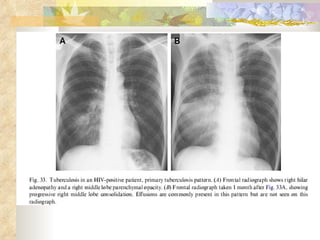
Chest radiography Chest X-ray: most important method to detect TB  Characteristics ,area, degree of activity or progress Differentiation with other disease Follow the effectivity of therapy
bronchoscopy Endobrochial tuberculosis  tuberculous tracheobronchial lymphadenitis
Puncture of peripherial LN Tubercle caseous necrosis
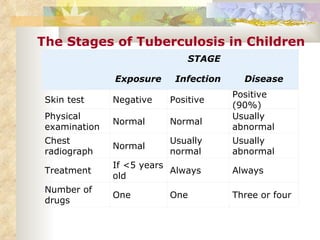
Table 39-1     -- The Stages of Tuberculosis in Children  The Stages of Tuberculosis in Children   Three or four One One Number of drugs Always Always If <5 years old Treatment Usually abnormal Usually normal Normal Chest radiograph Usually abnormal Normal Normal Physical examination Positive (90%) Positive Negative Skin test Disease Infection Exposure STAGE  
Treatment Common therapy :  Nutrition 、 Rest Ventilation Isolation
Chemotherapy goal :  Kill TB  Limit TB from  spreading principles :   earlier, appropriate Combination,  Full course regularly and  Staged .
Classification of antitubercular drug bactericidal ( 1 ) complete  bactericidal : INH 、 RFP ( 2 ) semi-  bactericidal : SM : alkaline, fast propagation,  intracellular  TB  ( Pyrazinamide)  PZA : Acidic 、 slow growth  intracellular  TB
medicines  are  classified as  first-line  and  second-line  agents First-line essential  antituberculous agents are the most  effective  and are  necessary components of any short-course therapeutic regimen
First-line medicines include   Isoniazid,  rifampin, pyrazinamide,streptomycine Second-line medicines include ethambutal, para-amino-salicylic  acid, kanamycin, amikacin and ects. Newer  antituberculous  drugs rifapentine, rifabutin  quinolones
Isoniazid (INH)  first-line drug Isoniazid is a principal agent used to treat TB It is universally accepted for initial treatment Now considered the best anti-TB drug It should be included in all TB treatment regimens unless the organism is resistant
Advantages Inexpensive Readily synthesized Availabe worldwide Highly selective for mycobacteria Well tolerated(about only 5% of  patients exhibiting adverse effects )
Dosage Tuberculosis organization have recommended  5 mg/kg daily  for both groups Generally,  300mg daily  oral dose is adopted
Adverse effects The two most important adverse effects of  isoniazid  therapy  are  hepatotoxicity peripheral neuropathy   We must measure liver enzymes before  administrating and during treatment  periods(usually monthly measure) If the liver enzymes level is higher than  normal,the drug must be discontinued
Rifampin (RFP)   first-line drug It is also considered the most important and potent  antituberculous agent Like  isoniazid  it  is  bactericidal  and highly effective  Unlike isoniazid, it is also effective against most other  mycobacteria  as well as other organisms
Chemotherapy Regimens Standard regimen : asymptomatic primary infection INH 、 RFP and/ ( or ) EMB 9-12 months
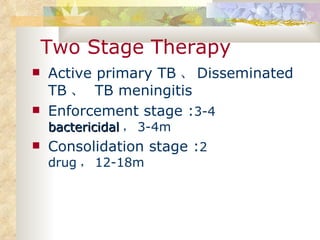
Two Stage Therapy Active primary TB 、 Disseminated TB 、  TB meningitis Enforcement stage : 3-4  bactericidal , 3-4m Consolidation stage : 2 drug , 12-18m
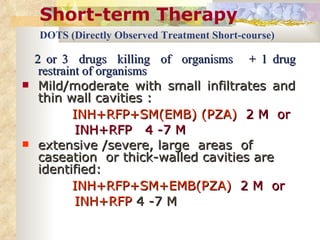
Short-term Therapy DOTS (Directly Observed Treatment Short-course)   2 or 3  drugs  killing  of  organisms  + 1 drug restraint of organisms Mild/moderate with small infiltrates and thin wall cavities : INH+RFP+SM(EMB) (PZA)   2 M  or  INH+RFP  4 -7 M extensive /severe, large  areas  of  caseation  or thick-walled cavities are identified: INH+RFP+SM+EMB(PZA)   2 M  or INH+RFP  4 -7 M
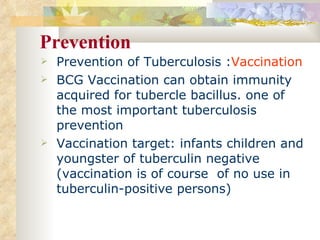
Prevention Prevention of Tuberculosis : Vaccination BCG Vaccination can obtain immunity acquired for tubercle bacillus. one of the most important tuberculosis prevention Vaccination target: infants children and youngster of tuberculin negative (vaccination is of course  of no use in tuberculin-positive persons)
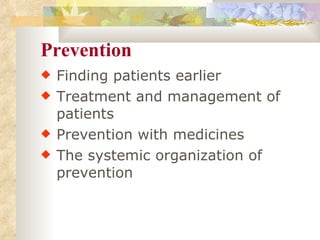
Prevention Finding patients earlier Treatment and management of patients  Prevention with medicines The systemic organization of prevention
Prophylatic chemotherapy Intimate contact with family members suffering active TB <3y infant PPD test(++) without BCG viccination PPD test (-)  -> (+)  recently PPD test(++) accompanied by Tb toxic symptoms PPD test(++)  , suffered measles,whooping cough PPD test(++) and need long term steroid therapy
Regimen: INH : 10mg/kg.d , 6-9m
Tuberculous meningitis
Pathogenesis Spreading through bloodstream Rupture of TB lesion->bacteria enter choroids plexuses -> CSF Extension  from nearby organ infected with TB
Clinical Manifestation The 1st Stage:  1-2wks change of character:irritability, Tb toxic symptom Headaches ( vomiting 、 drowsiness )
The 2nd Stage 1-2wks Meningeal irritation stage Increased ICP:   Headaches,vomiting, drowsiness, seizure, nuchal rigidity, back pain, Kerning sign, Brudzinski sign. Cranial Nerve palsy  Encephalitis:disorentation,movement disorders,  speech impaiment, papilledema
The 3rd Stage Coma stage  1-3wks coma,  hemiplegia, paraplegia, convulsion  consumption, abnormal metabolise of electrolyte hypertenion, decerebrate posture brain hernia->death
Diagnosis Medical history  Clinical manifestation CSF examination X -ray check CT or  MRI scanning Tuberculin test
Differentiation diagnosis Meningococcal Meningitis Viral Meningitis cryptococcal meningitis  Cerebral tumor
Treatment General  therapy Anti-tuberculous therapy Decreasing intracranial pressure corticosteroids Anti-symptomatic therapy Follow -up
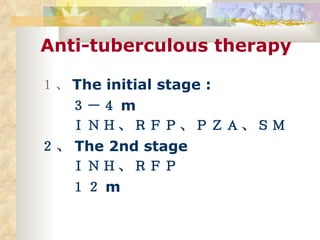
Anti-tuberculous therapy 1、 The initial stage :   3-4 m   INH、RFP、PZA、SM 2、 The 2nd stage   INH、RFP   12 m
Latent infection of tuberculosis A patient is infected with  Mycobacterium tuberculosis , but does not have active disease  Patients with latent tuberculosis are not infectious The main risk is that approximately 10% of these patients will go on to develop active tuberculosis at a later stage of their life The identification and treatment of people with latent TB is an important part of controlling this disease.
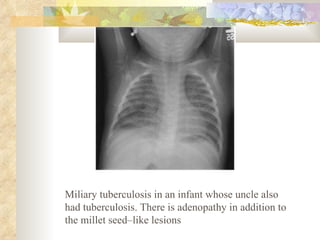
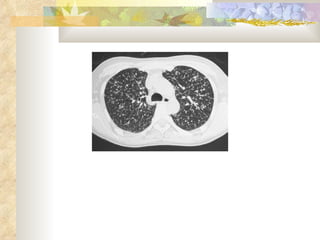
Miliary tuberculosis in an infant whose uncle also had tuberculosis. There is adenopathy in addition to the millet seed–like lesions
 
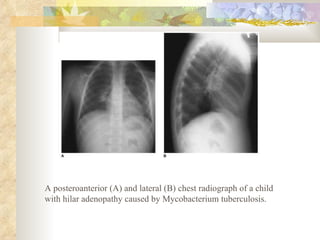
A posteroanterior (A) and lateral (B) chest radiograph of a child with hilar adenopathy caused by Mycobacterium tuberculosis.
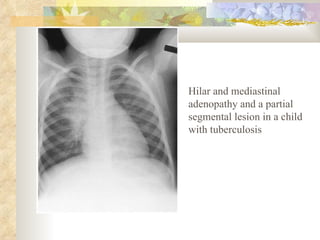
Hilar and mediastinal adenopathy and a partial segmental lesion in a child with tuberculosis
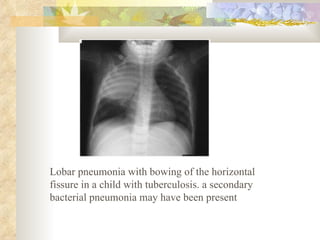
Lobar pneumonia with bowing of the horizontal fissure in a child with tuberculosis. a secondary bacterial pneumonia may have been present
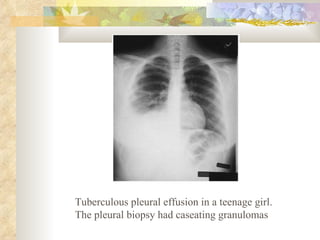
Tuberculous pleural effusion in a teenage girl. The pleural biopsy had caseating granulomas
 
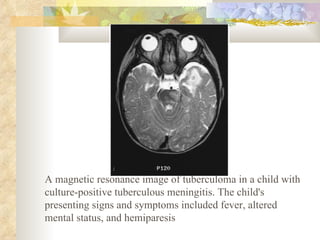
A magnetic resonance image of tuberculoma in a child with culture-positive tuberculous meningitis. The child's presenting signs and symptoms included fever, altered mental status, and hemiparesis
Thank you

9 tuberculosis tanweiping

  • 1.
    ChildhoodTuberculosis 檀卫平 中山二院 Tan-weiping
  • 2.
    Definition Tuberculosis iscaused by Mycobacterium tuberculosis , isolated by Robert Koch in 1882 , M.bovis(seldom) mainly involves the lungs, but may spread to other organs consumption (肺痨)
  • 3.
    Epidemiology 19th century,25% deaths by TB 1940s, effective medicines Annually, 8 million become ill with tuberculosis, 2 million people die China has the world's second largest tuberculosis epidemic (after India ), 1.3 million new cases every year Work migrants &quot;floating&quot; peasants migrant population:100 million incidences rates 113 per 100,000 in China
  • 4.
    Epidemiology The morbidity/ mortality of tuberculosis are high in developing countries (southeast asia,China,India,Africa,latin america) Age:60% Infant - <5yr Favored age:5-14yr Male:female-1:1(adults male predominate)
  • 5.
    Epidemiology TB adultsexposure Immunocompromise malnutrition HIV/AIDS infection Poverty,immigration irregular treatment breeds : drug-resistant tuberculosis
  • 6.
    Risk factors Socioeconomicstatus Over-crowding Poor nutrition Inadequate health care HIV infection Drug abuse
  • 7.
    Etiology Tubercle bacillus:aerobic, grows slowly non-Motile,non-spore-forming, highlipid content acid-fast , weak Gram(+) Sensitive to heat/sunlight tolerate in humid or dry or cold. withstand weak disinfectants and survive in a dry state for weeks .
  • 8.
    Dr. Robert Koch discovered the tuberculosis bacilli in 1882 He received the Nobel Prize in physiology or medicine in 1905 for this discovery
  • 9.
    Tuberculosis is transmittedby airborne droplet nuclei(containing tubercle bacilli ) prolonged, frequent, or intense contact cough, sneeze, speak, or spit
  • 10.
    Many droplet nucleiare capable of floating in environment for several hours Large particles may be inhaled by person breathing the same air and impact on the trachea or wall of the upper airway
  • 11.
    The transmission isdetermined The probability of contact with active — not latent — TB intimacy and duration of contact effectiveness of ventilation number s and virulence of the M. tuberculosis strain in infectious droplets
  • 12.
  • 13.
    Pathogenesis 90% infectedwith Mycobacterium tuberculosis asymptomatic, latent TB infection 10% progress to TB disease if untreated, the death rate for these active TB cases is more than 50%
  • 14.
    Pathogenesis mycobacteria ->pulmonary alveoli -> replicate within macrophages -> picked up by dendritic cells -> transport to local LN -> spread through bloodstream to other tissues/organs -> secondary TB lesions primary site of infection : upper part of the lower lobe, or lower part of the upper lobe of lung secondary TB lesions: apex of the upper lobes , peripheral lymph nodes, kidneys, brain, and bone
  • 15.
    Human Immunity /hypersensitivity after TB infection Specific immunity after infected or given BCG vaccine Cell-mediate immunity develops within 4-8 weeks after infected with bacillus Many immunologic cells: Macrophages, T/B lymphocytes, fibroblasts involved
  • 16.
    Two types ofcells are essential in the formation of TB Macrophages: directly phagocytize TB and processing and presenting antigens to T lymphocyte T lymphocytes(CD4+): induce protection through the production of lymphokines
  • 17.
    T lymphocytes(CD4+) Manylymphokines are involved in tuberculosis, the interplay of these cytokines determine the hosts response for example IL-1 is related to fever IL-6 is related to hyperglobulinemia TNF is related to the killing of mycobacteria formation of granulomas other cytokines including IL-4,IL-5,IL-10 can promote humoral immunity
  • 18.
    Genetic factors (HLA-BW35) play a key role in innate non-immune resistance to infection with M. Tuberculosis These genes may have a role in determining susceptibility to tuberculosis
  • 19.
    Basic pathologic changesinfiltration -> hyperplasia( granuloma) , ulceration or calcification in different stage host defense < bacterias, caseating ulceration( caseous necrosis ) -> fibrosis host defense > bacteria, granuloma calcification
  • 20.
    A characteristic tubercleat low magnification ( A ) and in detail ( B ) central caseation surrounded by epithelioid and multinucleated giant cells(C) mycobacteria with acid-fast stains ( D ).
  • 21.
    Progression of tuberculosisAbsorption Fibrosis Calcification Deterioration: enlargement of infected aeras and appear newer infiltrated regions or spreading.
  • 22.
    Five common clinicalpatterns 1. Primary pulmonary tuberculosis (Primary Complex and Bronchial Lymphnode-Tuberculosis) 2. Milliary Tuberculosis (acute, subacute and chronic hematogenous pulmonary tuberculosis) 3. secondary pulmonary tuberculosis Infiltrative pulmonary tuberculosis Chronic fibrocavenous pulmonary tuberculosis 4.Tuberculous pleuritis 5.Extrapulmonary tuberculosis
  • 23.
    Diagnosis History andClinical Manifestations Tuberculin testing Lab examination X-r ay bronchoscopy Puncture of adenopathy
  • 24.
    History /Clinical Manifestationssystemic signs : fever, weight loss, fatigue, night sweats, wasting,coughing up blood, Chest pain. TB Contaction : adults in family History of BCG Vaccination Acute infectious disease recently : measles,whooping cough Allergy to TB : erythema nodosum 、 herpetic conjunctivitis
  • 25.
    Tuberculin skin testa skin test to determine past or present infection with the tuberculosis bacterium; based on hypersensitivity of the skin to tuberculin Method of test protein purified derivative PPD 0.1ml intradermal injection Site : internal side of medium-distal 1/3 left forearm 6 - 10mm Result : 48-72hrs, transverse diameter
  • 26.
    Result is readby measuring the diameter of induration 48-72hrs Induration <5mm negative Induration 5-9mm(+) Induration 10-19mm(++) Induration 》 20mm (+++) A positive tuberculin skin test indicates tuberculous infection, with or without disease
  • 27.
    Tuberculin testing Apositive tuberculin test is of great use in children, with limited diagnostic significance in adults
  • 28.
  • 29.
    Positive Reaction : indicates TB exposure BCG Vaccination Children and adolescents(++) exposed to TB Infant﹤3yrs (++) recent infection (+++) Active TB infectin (-) -> (+) , or Induration<10mm ->>10mm, ↑>6mm recent infection
  • 30.
    Negative Reaction Neverexposed to TB Within 4-8wks of primary infectin False negative:compromised immunity Technique failure or PPD invalidated
  • 31.
    PPD reaction ofnatural TB infection and BCG vaccination Natural infection stronge Induration >10-15mm deep red 、 regular margin 、 hard pigmentation Long duration > 7-10d Less change BCG vaccination weak Induration 5-9mm light red 、 unregular margin 、 soft Short duration:2-3d Become weak gradually,disappear3-5y
  • 32.
    Laboratory examinations Sputumexamination acid-fast staining ----LED microscopes DNA-based diagnosis :PCR test TB antibody testing ESR Blood Routine
  • 33.
    Isolation of M. tuberculosis automatic radiometric methods: such as BACTEC—1-3wks
  • 34.
    Chest radiography ChestX-ray: most important method to detect TB Characteristics ,area, degree of activity or progress Differentiation with other disease Follow the effectivity of therapy
  • 35.
    bronchoscopy Endobrochial tuberculosis tuberculous tracheobronchial lymphadenitis
  • 36.
    Puncture of peripherialLN Tubercle caseous necrosis
  • 37.
    Table 39-1    -- The Stages of Tuberculosis in Children The Stages of Tuberculosis in Children Three or four One One Number of drugs Always Always If <5 years old Treatment Usually abnormal Usually normal Normal Chest radiograph Usually abnormal Normal Normal Physical examination Positive (90%) Positive Negative Skin test Disease Infection Exposure STAGE  
  • 38.
    Treatment Common therapy: Nutrition 、 Rest Ventilation Isolation
  • 39.
    Chemotherapy goal : Kill TB Limit TB from spreading principles : earlier, appropriate Combination, Full course regularly and Staged .
  • 40.
    Classification of antituberculardrug bactericidal ( 1 ) complete bactericidal : INH 、 RFP ( 2 ) semi- bactericidal : SM : alkaline, fast propagation, intracellular TB ( Pyrazinamide) PZA : Acidic 、 slow growth intracellular TB
  • 41.
    medicines are classified as first-line and second-line agents First-line essential antituberculous agents are the most effective and are necessary components of any short-course therapeutic regimen
  • 42.
    First-line medicines include Isoniazid, rifampin, pyrazinamide,streptomycine Second-line medicines include ethambutal, para-amino-salicylic acid, kanamycin, amikacin and ects. Newer antituberculous drugs rifapentine, rifabutin quinolones
  • 43.
    Isoniazid (INH) first-line drug Isoniazid is a principal agent used to treat TB It is universally accepted for initial treatment Now considered the best anti-TB drug It should be included in all TB treatment regimens unless the organism is resistant
  • 44.
    Advantages Inexpensive Readilysynthesized Availabe worldwide Highly selective for mycobacteria Well tolerated(about only 5% of patients exhibiting adverse effects )
  • 45.
    Dosage Tuberculosis organizationhave recommended 5 mg/kg daily for both groups Generally, 300mg daily oral dose is adopted
  • 46.
    Adverse effects Thetwo most important adverse effects of isoniazid therapy are hepatotoxicity peripheral neuropathy We must measure liver enzymes before administrating and during treatment periods(usually monthly measure) If the liver enzymes level is higher than normal,the drug must be discontinued
  • 47.
    Rifampin (RFP) first-line drug It is also considered the most important and potent antituberculous agent Like isoniazid it is bactericidal and highly effective Unlike isoniazid, it is also effective against most other mycobacteria as well as other organisms
  • 48.
    Chemotherapy Regimens Standardregimen : asymptomatic primary infection INH 、 RFP and/ ( or ) EMB 9-12 months
  • 49.
    Two Stage TherapyActive primary TB 、 Disseminated TB 、 TB meningitis Enforcement stage : 3-4 bactericidal , 3-4m Consolidation stage : 2 drug , 12-18m
  • 50.
    Short-term Therapy DOTS(Directly Observed Treatment Short-course) 2 or 3 drugs killing of organisms + 1 drug restraint of organisms Mild/moderate with small infiltrates and thin wall cavities : INH+RFP+SM(EMB) (PZA) 2 M or INH+RFP 4 -7 M extensive /severe, large areas of caseation or thick-walled cavities are identified: INH+RFP+SM+EMB(PZA) 2 M or INH+RFP 4 -7 M
  • 51.
    Prevention Prevention ofTuberculosis : Vaccination BCG Vaccination can obtain immunity acquired for tubercle bacillus. one of the most important tuberculosis prevention Vaccination target: infants children and youngster of tuberculin negative (vaccination is of course of no use in tuberculin-positive persons)
  • 52.
    Prevention Finding patientsearlier Treatment and management of patients Prevention with medicines The systemic organization of prevention
  • 53.
    Prophylatic chemotherapy Intimatecontact with family members suffering active TB <3y infant PPD test(++) without BCG viccination PPD test (-) -> (+) recently PPD test(++) accompanied by Tb toxic symptoms PPD test(++) , suffered measles,whooping cough PPD test(++) and need long term steroid therapy
  • 54.
    Regimen: INH :10mg/kg.d , 6-9m
  • 55.
  • 56.
    Pathogenesis Spreading throughbloodstream Rupture of TB lesion->bacteria enter choroids plexuses -> CSF Extension from nearby organ infected with TB
  • 57.
    Clinical Manifestation The1st Stage: 1-2wks change of character:irritability, Tb toxic symptom Headaches ( vomiting 、 drowsiness )
  • 58.
    The 2nd Stage1-2wks Meningeal irritation stage Increased ICP: Headaches,vomiting, drowsiness, seizure, nuchal rigidity, back pain, Kerning sign, Brudzinski sign. Cranial Nerve palsy Encephalitis:disorentation,movement disorders, speech impaiment, papilledema
  • 59.
    The 3rd StageComa stage 1-3wks coma, hemiplegia, paraplegia, convulsion consumption, abnormal metabolise of electrolyte hypertenion, decerebrate posture brain hernia->death
  • 60.
    Diagnosis Medical history Clinical manifestation CSF examination X -ray check CT or MRI scanning Tuberculin test
  • 61.
    Differentiation diagnosis MeningococcalMeningitis Viral Meningitis cryptococcal meningitis Cerebral tumor
  • 62.
    Treatment General therapy Anti-tuberculous therapy Decreasing intracranial pressure corticosteroids Anti-symptomatic therapy Follow -up
  • 63.
    Anti-tuberculous therapy 1、The initial stage :   3-4 m   INH、RFP、PZA、SM 2、 The 2nd stage   INH、RFP   12 m
  • 64.
    Latent infection oftuberculosis A patient is infected with Mycobacterium tuberculosis , but does not have active disease Patients with latent tuberculosis are not infectious The main risk is that approximately 10% of these patients will go on to develop active tuberculosis at a later stage of their life The identification and treatment of people with latent TB is an important part of controlling this disease.
  • 65.
    Miliary tuberculosis inan infant whose uncle also had tuberculosis. There is adenopathy in addition to the millet seed–like lesions
  • 66.
  • 67.
    A posteroanterior (A)and lateral (B) chest radiograph of a child with hilar adenopathy caused by Mycobacterium tuberculosis.
  • 68.
    Hilar and mediastinaladenopathy and a partial segmental lesion in a child with tuberculosis
  • 69.
    Lobar pneumonia withbowing of the horizontal fissure in a child with tuberculosis. a secondary bacterial pneumonia may have been present
  • 70.
    Tuberculous pleural effusionin a teenage girl. The pleural biopsy had caseating granulomas
  • 71.
  • 72.
    A magnetic resonanceimage of tuberculoma in a child with culture-positive tuberculous meningitis. The child's presenting signs and symptoms included fever, altered mental status, and hemiparesis
  • 73.