Toxoplasma Gondii and
Human Response
Presented By: Hadiah Bassam Al Mahdi
PhD. Student in Genetics
Faculty of Science , King Adulaziz University
Developmental Genetics Course Bio707
Outline
• Toxoplasma Gondii.
• Toxoplasmosis - Congenital Toxoplasmosis
• The transition between tachyzoites and bradyzoites.
• T.gondii as an Epigenator.
• Immune Response Pathway.
• Behavior Changer by T.gondii infection.
• Conclusion.
Toxoplasma Gondii
• Toxoplasma gondii is a coccidian parasite which is
unicellular eukaryote is a member of the phylum
Apicomplexa.
• The Apicomplexa, typically live as obligate
intracellular parasites within host cells.
• This The prevalence of T. gondii infection varies by
country, 30–50% of the world’s human population.
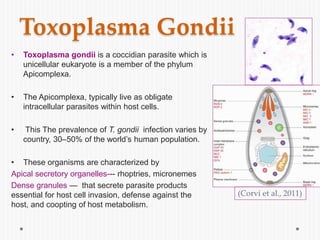
• These organisms are characterized by
Apical secretory organelles--- rhoptries, micronemes
Dense granules — that secrete parasite products
essential for host cell invasion, defense against the
host, and coopting of host metabolism.
(Corvi et al., 2011)
Life Cycle
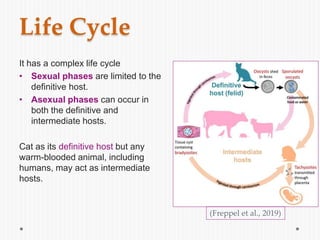
It has a complex life cycle
• Sexual phases are limited to the
definitive host.
• Asexual phases can occur in
both the definitive and
intermediate hosts.
Cat as its definitive host but any
warm-blooded animal, including
humans, may act as intermediate
hosts.
(Freppel et al., 2019)
Toxoplasmosis
• Infection with Toxoplasma gondii.
• It was initially described in 1908 in Tunis by Nicolle and Manceaux
(1908) and in Brazil by Splendore (1908).
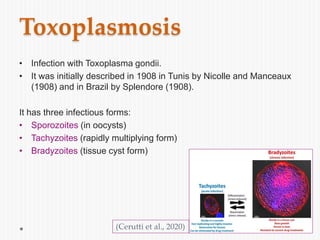
It has three infectious forms:
• Sporozoites (in oocysts)
• Tachyzoites (rapidly multiplying form)
• Bradyzoites (tissue cyst form)
(Cerutti et al., 2020)
Risk Factors of Transmission
infection
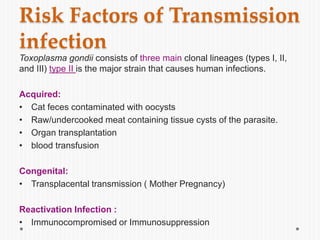
Toxoplasma gondii consists of three main clonal lineages (types I, II,
and III) type II is the major strain that causes human infections.
Acquired:
• Cat feces contaminated with oocysts
• Raw/undercooked meat containing tissue cysts of the parasite.
• Organ transplantation
• blood transfusion
Congenital:
• Transplacental transmission ( Mother Pregnancy)
Reactivation Infection :
• Immunocompromised or Immunosuppression
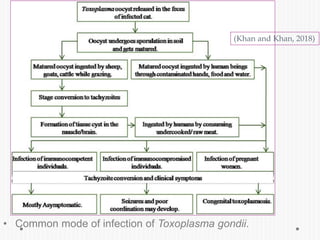
• Common mode of infection of Toxoplasma gondii.
(Khan and Khan, 2018)
Congenital Toxoplasmosis
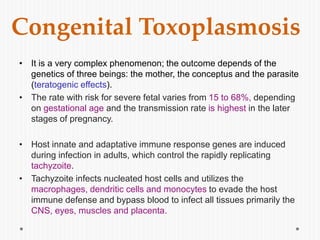
• It is a very complex phenomenon; the outcome depends of the
genetics of three beings: the mother, the conceptus and the parasite
(teratogenic effects).
• The rate with risk for severe fetal varies from 15 to 68%, depending
on gestational age and the transmission rate is highest in the later
stages of pregnancy.
• Host innate and adaptative immune response genes are induced
during infection in adults, which control the rapidly replicating
tachyzoite.
• Tachyzoite infects nucleated host cells and utilizes the
macrophages, dendritic cells and monocytes to evade the host
immune defense and bypass blood to infect all tissues primarily the
CNS, eyes, muscles and placenta.
Congenital Toxoplasmosis
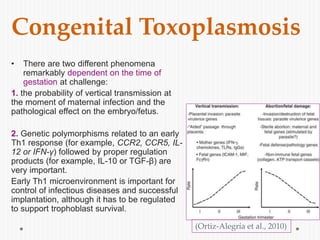
• There are two different phenomena
remarkably dependent on the time of
gestation at challenge:
1. the probability of vertical transmission at
the moment of maternal infection and the
pathological effect on the embryo/fetus.
2. Genetic polymorphisms related to an early
Th1 response (for example, CCR2, CCR5, IL-
12 or IFN-γ) followed by proper regulation
products (for example, IL-10 or TGF-β) are
very important.
Early Th1 microenvironment is important for
control of infectious diseases and successful
implantation, although it has to be regulated
to support trophoblast survival.
(Ortiz-Alegría et al., 2010)
• Many non-immune genes of the host may influence tissue pathology
during embryogenesis.
• Two molecules were specifically studied,
the IIB isoform of collagen 2A1, involved in optic nerve conduction
during early development
the ABCA4 form of the retina-specific ATP-binding cassette transporter
protein, present in the choroid plexus and at the rim of the
photoreceptor outer membrane
Congenital Toxoplasmosis
Manifestation of Infection
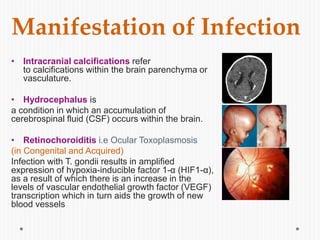
• Intracranial calcifications refer
to calcifications within the brain parenchyma or
vasculature.
• Hydrocephalus is
a condition in which an accumulation of
cerebrospinal fluid (CSF) occurs within the brain.
• Retinochoroiditis i.e Ocular Toxoplasmosis
(in Congenital and Acquired)
Infection with T. gondii results in amplified
expression of hypoxia-inducible factor 1-α (HIF1-α),
as a result of which there is an increase in the
levels of vascular endothelial growth factor (VEGF)
transcription which in turn aids the growth of new
blood vessels
Diagnosis Test
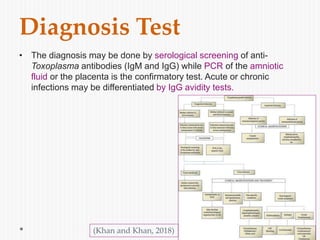
• The diagnosis may be done by serological screening of anti-
Toxoplasma antibodies (IgM and IgG) while PCR of the amniotic
fluid or the placenta is the confirmatory test. Acute or chronic
infections may be differentiated by IgG avidity tests.
(Khan and Khan, 2018)
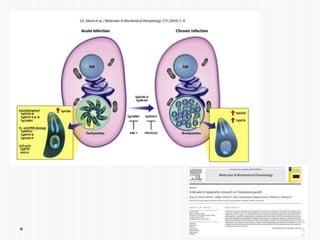
The transition between tachyzoites and bradyzoites (Acute to Chronic) is
epigenetically regulated and coupled to the cell cycle
Epigenetic: refers to heritable changes in an organism that alter gene
expression levels without altering the DNA sequence.
Types of epigenetic modifications.
(A) Histones can undergo phosphorylation
(Ph), methylation (Me), and acetylation (Ac).
(B) DNA molecules are methylated by the
addition of a methyl group on cytosine
bases.
(C) mRNA is translated into a protein
product, but this process can be repressed by
binding of microRNAs (miRNA), a class of
noncoding RNA (ncRNA).
Tachyzoites to Bradyzoites
(Gómez-Díaz et al., 2012)
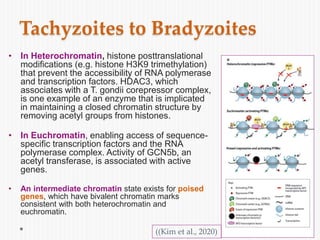
• In Heterochromatin, histone posttranslational
modifications (e.g. histone H3K9 trimethylation)
that prevent the accessibility of RNA polymerase
and transcription factors. HDAC3, which
associates with a T. gondii corepressor complex,
is one example of an enzyme that is implicated
in maintaining a closed chromatin structure by
removing acetyl groups from histones.
• In Euchromatin, enabling access of sequence-
specific transcription factors and the RNA
polymerase complex. Activity of GCN5b, an
acetyl transferase, is associated with active
genes.
• An intermediate chromatin state exists for poised
genes, which have bivalent chromatin marks
consistent with both heterochromatin and
euchromatin.
Tachyzoites to Bradyzoites
((Kim et al., 2020)
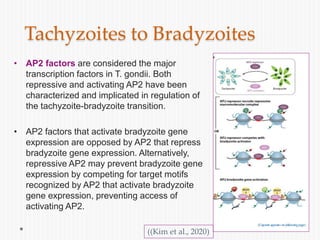
• AP2 factors are considered the major
transcription factors in T. gondii. Both
repressive and activating AP2 have been
characterized and implicated in regulation of
the tachyzoite-bradyzoite transition.
• AP2 factors that activate bradyzoite gene
expression are opposed by AP2 that repress
bradyzoite gene expression. Alternatively,
repressive AP2 may prevent bradyzoite gene
expression by competing for target motifs
recognized by AP2 that activate bradyzoite
gene expression, preventing access of
activating AP2.
Tachyzoites to Bradyzoites
((Kim et al., 2020)
Induced Alterations of the Host
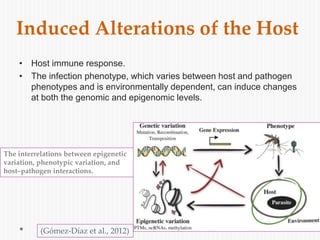
• Host immune response.
• The infection phenotype, which varies between host and pathogen
phenotypes and is environmentally dependent, can induce changes
at both the genomic and epigenomic levels.
The interrelations between epigenetic
variation, phenotypic variation, and
host–pathogen interactions.
(Gómez-Díaz et al., 2012)
T.gondii as an Epigenator
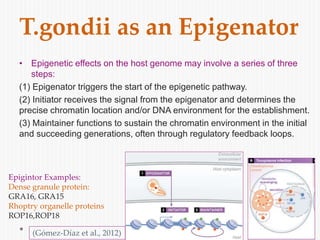
• Epigenetic effects on the host genome may involve a series of three
steps:
(1) Epigenator triggers the start of the epigenetic pathway.
(2) Initiator receives the signal from the epigenator and determines the
precise chromatin location and/or DNA environment for the establishment.
(3) Maintainer functions to sustain the chromatin environment in the initial
and succeeding generations, often through regulatory feedback loops.
Epigintor Examples:
Dense granule protein:
GRA16, GRA15
Rhoptry organelle proteins
ROP16,ROP18
(Gómez-Díaz et al., 2012)
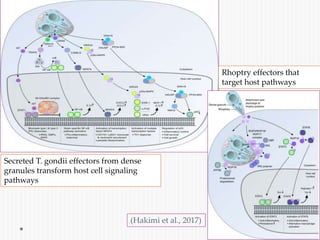
Secreted T. gondii effectors from dense
granules transform host cell signaling
pathways
Rhoptry effectors that
target host pathways
(Hakimi et al., 2017)
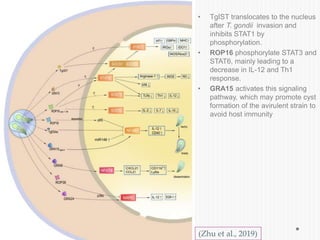
• TgIST translocates to the nucleus
after T. gondii invasion and
inhibits STAT1 by
phosphorylation.
• ROP16 phosphorylate STAT3 and
STAT6, mainly leading to a
decrease in IL-12 and Th1
response.
• GRA15 activates this signaling
pathway, which may promote cyst
formation of the avirulent strain to
avoid host immunity
(Zhu et al., 2019)
Behavior change
The brain is principally considered an immune-privileged tissue as it
lacks a lymphatic system and tight capillary junctions within the blood-
brain barrier prevent diffusion of large molecules, limiting lymphocyte
access to the organ.
• T. gondii infection of neurons can alter dopamine metabolism.
• T. gondii enters the brain, activation the cell is associated with the
production of a general inflammatory response in the brain.
• The neuroinflammation may have a variety of effects on
neurobiology, including influences on neurotransmitter metabolism,
changes in neurotransmitter receptor levels, and effects on synaptic
morphology or connectivity.
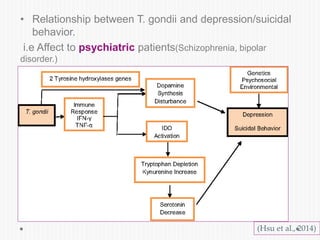
• Relationship between T. gondii and depression/suicidal
behavior.
i.e Affect to psychiatric patients(Schizophrenia, bipolar
disorder.)
(Hsu et al., 2014)
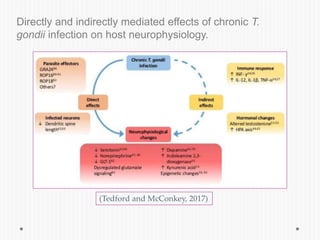
Directly and indirectly mediated effects of chronic T.
gondii infection on host neurophysiology.
(Tedford and McConkey, 2017)
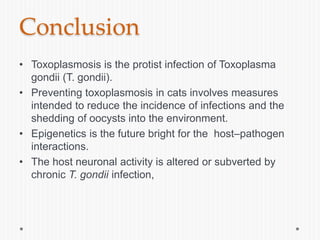
Conclusion
• Toxoplasmosis is the protist infection of Toxoplasma
gondii (T. gondii).
• Preventing toxoplasmosis in cats involves measures
intended to reduce the incidence of infections and the
shedding of oocysts into the environment.
• Epigenetics is the future bright for the host–pathogen
interactions.
• The host neuronal activity is altered or subverted by
chronic T. gondii infection,
References
• CERUTTI, A., BLANCHARD, N. & BESTEIRO, S. 2020. The Bradyzoite: A Key Developmental Stage for the
Persistence and Pathogenesis of Toxoplasmosis. Pathogens, 9, 234.
• CORVI, M. M., BERTHIAUME, L. G. & DE NAPOLI, M. G. 2011. Protein palmitoylation in protozoan
parasites. Frontiers in bioscience, 3, 1067-1079.
• FREPPEL, W., FERGUSON, D. J., SHAPIRO, K., DUBEY, J. P., PUECH, P.-H. & DUMÈTRE, A. 2019.
Structure, composition, and roles of the Toxoplasma gondii oocyst and sporocyst walls. The Cell Surface, 5,
100016.
• GÓMEZ-DÍAZ, E., JORDÀ, M., PEINADO, M. A. & RIVERO, A. 2012. Epigenetics of host–pathogen
interactions: the road ahead and the road behind. PLoS Pathog, 8, e1003007.
• HAKIMI, M.-A., OLIAS, P. & SIBLEY, L. D. 2017. Toxoplasma effectors targeting host signaling and
transcription. Clinical microbiology reviews, 30, 615-645.
• HSU, P. C., GROER, M. & BECKIE, T. 2014. New findings: Depression, suicide, and Toxoplasma gondii
infection. Journal of the American Association of Nurse Practitioners, 26, 629-637.
• KHAN, K. & KHAN, W. 2018. Congenital toxoplasmosis: an overview of the neurological and ocular
manifestations. Parasitology international, 67, 715-721.
• KIM, K., JEFFERS, V. & SULLIVAN JR, W. J. 2020. Regulation of gene expression in Toxoplasma gondii.
Toxoplasma gondii. Elsevier.
• ORTIZ-ALEGRÍA, L., CABALLERO-ORTEGA, H., CAÑEDO-SOLARES, I., RICO-TORRES, C.,
SAHAGÚN-RUIZ, A., MEDINA-ESCUTIA, M. & CORREA, D. 2010. Congenital toxoplasmosis: candidate
host immune genes relevant for vertical transmission and pathogenesis. Genes & Immunity, 11, 363-373.
• TEDFORD, E. & MCCONKEY, G. 2017. Neurophysiological changes induced by chronic Toxoplasma gondii
infection. Pathogens, 6, 19.
• ZHU, W., LI, J., PAPPOE, F., SHEN, J. & YU, L. 2019. Strategies Developed by Toxoplasma gondii to
Survive in the Host. Frontiers in microbiology, 10, 899.
Thank You
Avoid Cats To Avoid Toxoplasma
Gondii

Toxoplasma gondii

  • 1.
    Toxoplasma Gondii and HumanResponse Presented By: Hadiah Bassam Al Mahdi PhD. Student in Genetics Faculty of Science , King Adulaziz University Developmental Genetics Course Bio707
  • 2.
    Outline • Toxoplasma Gondii. •Toxoplasmosis - Congenital Toxoplasmosis • The transition between tachyzoites and bradyzoites. • T.gondii as an Epigenator. • Immune Response Pathway. • Behavior Changer by T.gondii infection. • Conclusion.
  • 3.
    Toxoplasma Gondii • Toxoplasmagondii is a coccidian parasite which is unicellular eukaryote is a member of the phylum Apicomplexa. • The Apicomplexa, typically live as obligate intracellular parasites within host cells. • This The prevalence of T. gondii infection varies by country, 30–50% of the world’s human population. • These organisms are characterized by Apical secretory organelles--- rhoptries, micronemes Dense granules — that secrete parasite products essential for host cell invasion, defense against the host, and coopting of host metabolism. (Corvi et al., 2011)
  • 4.
    Life Cycle It hasa complex life cycle • Sexual phases are limited to the definitive host. • Asexual phases can occur in both the definitive and intermediate hosts. Cat as its definitive host but any warm-blooded animal, including humans, may act as intermediate hosts. (Freppel et al., 2019)
  • 5.
    Toxoplasmosis • Infection withToxoplasma gondii. • It was initially described in 1908 in Tunis by Nicolle and Manceaux (1908) and in Brazil by Splendore (1908). It has three infectious forms: • Sporozoites (in oocysts) • Tachyzoites (rapidly multiplying form) • Bradyzoites (tissue cyst form) (Cerutti et al., 2020)
  • 6.
    Risk Factors ofTransmission infection Toxoplasma gondii consists of three main clonal lineages (types I, II, and III) type II is the major strain that causes human infections. Acquired: • Cat feces contaminated with oocysts • Raw/undercooked meat containing tissue cysts of the parasite. • Organ transplantation • blood transfusion Congenital: • Transplacental transmission ( Mother Pregnancy) Reactivation Infection : • Immunocompromised or Immunosuppression
  • 7.
    • Common modeof infection of Toxoplasma gondii. (Khan and Khan, 2018)
  • 8.
    Congenital Toxoplasmosis • Itis a very complex phenomenon; the outcome depends of the genetics of three beings: the mother, the conceptus and the parasite (teratogenic effects). • The rate with risk for severe fetal varies from 15 to 68%, depending on gestational age and the transmission rate is highest in the later stages of pregnancy. • Host innate and adaptative immune response genes are induced during infection in adults, which control the rapidly replicating tachyzoite. • Tachyzoite infects nucleated host cells and utilizes the macrophages, dendritic cells and monocytes to evade the host immune defense and bypass blood to infect all tissues primarily the CNS, eyes, muscles and placenta.
  • 9.
    Congenital Toxoplasmosis • Thereare two different phenomena remarkably dependent on the time of gestation at challenge: 1. the probability of vertical transmission at the moment of maternal infection and the pathological effect on the embryo/fetus. 2. Genetic polymorphisms related to an early Th1 response (for example, CCR2, CCR5, IL- 12 or IFN-γ) followed by proper regulation products (for example, IL-10 or TGF-β) are very important. Early Th1 microenvironment is important for control of infectious diseases and successful implantation, although it has to be regulated to support trophoblast survival. (Ortiz-Alegría et al., 2010)
  • 10.
    • Many non-immunegenes of the host may influence tissue pathology during embryogenesis. • Two molecules were specifically studied, the IIB isoform of collagen 2A1, involved in optic nerve conduction during early development the ABCA4 form of the retina-specific ATP-binding cassette transporter protein, present in the choroid plexus and at the rim of the photoreceptor outer membrane Congenital Toxoplasmosis
  • 11.
    Manifestation of Infection •Intracranial calcifications refer to calcifications within the brain parenchyma or vasculature. • Hydrocephalus is a condition in which an accumulation of cerebrospinal fluid (CSF) occurs within the brain. • Retinochoroiditis i.e Ocular Toxoplasmosis (in Congenital and Acquired) Infection with T. gondii results in amplified expression of hypoxia-inducible factor 1-α (HIF1-α), as a result of which there is an increase in the levels of vascular endothelial growth factor (VEGF) transcription which in turn aids the growth of new blood vessels
  • 12.
    Diagnosis Test • Thediagnosis may be done by serological screening of anti- Toxoplasma antibodies (IgM and IgG) while PCR of the amniotic fluid or the placenta is the confirmatory test. Acute or chronic infections may be differentiated by IgG avidity tests. (Khan and Khan, 2018)
  • 13.
    The transition betweentachyzoites and bradyzoites (Acute to Chronic) is epigenetically regulated and coupled to the cell cycle Epigenetic: refers to heritable changes in an organism that alter gene expression levels without altering the DNA sequence. Types of epigenetic modifications. (A) Histones can undergo phosphorylation (Ph), methylation (Me), and acetylation (Ac). (B) DNA molecules are methylated by the addition of a methyl group on cytosine bases. (C) mRNA is translated into a protein product, but this process can be repressed by binding of microRNAs (miRNA), a class of noncoding RNA (ncRNA). Tachyzoites to Bradyzoites (Gómez-Díaz et al., 2012)
  • 14.
    • In Heterochromatin,histone posttranslational modifications (e.g. histone H3K9 trimethylation) that prevent the accessibility of RNA polymerase and transcription factors. HDAC3, which associates with a T. gondii corepressor complex, is one example of an enzyme that is implicated in maintaining a closed chromatin structure by removing acetyl groups from histones. • In Euchromatin, enabling access of sequence- specific transcription factors and the RNA polymerase complex. Activity of GCN5b, an acetyl transferase, is associated with active genes. • An intermediate chromatin state exists for poised genes, which have bivalent chromatin marks consistent with both heterochromatin and euchromatin. Tachyzoites to Bradyzoites ((Kim et al., 2020)
  • 15.
    • AP2 factorsare considered the major transcription factors in T. gondii. Both repressive and activating AP2 have been characterized and implicated in regulation of the tachyzoite-bradyzoite transition. • AP2 factors that activate bradyzoite gene expression are opposed by AP2 that repress bradyzoite gene expression. Alternatively, repressive AP2 may prevent bradyzoite gene expression by competing for target motifs recognized by AP2 that activate bradyzoite gene expression, preventing access of activating AP2. Tachyzoites to Bradyzoites ((Kim et al., 2020)
  • 17.
    Induced Alterations ofthe Host • Host immune response. • The infection phenotype, which varies between host and pathogen phenotypes and is environmentally dependent, can induce changes at both the genomic and epigenomic levels. The interrelations between epigenetic variation, phenotypic variation, and host–pathogen interactions. (Gómez-Díaz et al., 2012)
  • 18.
    T.gondii as anEpigenator • Epigenetic effects on the host genome may involve a series of three steps: (1) Epigenator triggers the start of the epigenetic pathway. (2) Initiator receives the signal from the epigenator and determines the precise chromatin location and/or DNA environment for the establishment. (3) Maintainer functions to sustain the chromatin environment in the initial and succeeding generations, often through regulatory feedback loops. Epigintor Examples: Dense granule protein: GRA16, GRA15 Rhoptry organelle proteins ROP16,ROP18 (Gómez-Díaz et al., 2012)
  • 19.
    Secreted T. gondiieffectors from dense granules transform host cell signaling pathways Rhoptry effectors that target host pathways (Hakimi et al., 2017)
  • 20.
    • TgIST translocatesto the nucleus after T. gondii invasion and inhibits STAT1 by phosphorylation. • ROP16 phosphorylate STAT3 and STAT6, mainly leading to a decrease in IL-12 and Th1 response. • GRA15 activates this signaling pathway, which may promote cyst formation of the avirulent strain to avoid host immunity (Zhu et al., 2019)
  • 21.
    Behavior change The brainis principally considered an immune-privileged tissue as it lacks a lymphatic system and tight capillary junctions within the blood- brain barrier prevent diffusion of large molecules, limiting lymphocyte access to the organ. • T. gondii infection of neurons can alter dopamine metabolism. • T. gondii enters the brain, activation the cell is associated with the production of a general inflammatory response in the brain. • The neuroinflammation may have a variety of effects on neurobiology, including influences on neurotransmitter metabolism, changes in neurotransmitter receptor levels, and effects on synaptic morphology or connectivity.
  • 22.
    • Relationship betweenT. gondii and depression/suicidal behavior. i.e Affect to psychiatric patients(Schizophrenia, bipolar disorder.) (Hsu et al., 2014)
  • 23.
    Directly and indirectlymediated effects of chronic T. gondii infection on host neurophysiology. (Tedford and McConkey, 2017)
  • 24.
    Conclusion • Toxoplasmosis isthe protist infection of Toxoplasma gondii (T. gondii). • Preventing toxoplasmosis in cats involves measures intended to reduce the incidence of infections and the shedding of oocysts into the environment. • Epigenetics is the future bright for the host–pathogen interactions. • The host neuronal activity is altered or subverted by chronic T. gondii infection,
  • 25.
    References • CERUTTI, A.,BLANCHARD, N. & BESTEIRO, S. 2020. The Bradyzoite: A Key Developmental Stage for the Persistence and Pathogenesis of Toxoplasmosis. Pathogens, 9, 234. • CORVI, M. M., BERTHIAUME, L. G. & DE NAPOLI, M. G. 2011. Protein palmitoylation in protozoan parasites. Frontiers in bioscience, 3, 1067-1079. • FREPPEL, W., FERGUSON, D. J., SHAPIRO, K., DUBEY, J. P., PUECH, P.-H. & DUMÈTRE, A. 2019. Structure, composition, and roles of the Toxoplasma gondii oocyst and sporocyst walls. The Cell Surface, 5, 100016. • GÓMEZ-DÍAZ, E., JORDÀ, M., PEINADO, M. A. & RIVERO, A. 2012. Epigenetics of host–pathogen interactions: the road ahead and the road behind. PLoS Pathog, 8, e1003007. • HAKIMI, M.-A., OLIAS, P. & SIBLEY, L. D. 2017. Toxoplasma effectors targeting host signaling and transcription. Clinical microbiology reviews, 30, 615-645. • HSU, P. C., GROER, M. & BECKIE, T. 2014. New findings: Depression, suicide, and Toxoplasma gondii infection. Journal of the American Association of Nurse Practitioners, 26, 629-637. • KHAN, K. & KHAN, W. 2018. Congenital toxoplasmosis: an overview of the neurological and ocular manifestations. Parasitology international, 67, 715-721. • KIM, K., JEFFERS, V. & SULLIVAN JR, W. J. 2020. Regulation of gene expression in Toxoplasma gondii. Toxoplasma gondii. Elsevier. • ORTIZ-ALEGRÍA, L., CABALLERO-ORTEGA, H., CAÑEDO-SOLARES, I., RICO-TORRES, C., SAHAGÚN-RUIZ, A., MEDINA-ESCUTIA, M. & CORREA, D. 2010. Congenital toxoplasmosis: candidate host immune genes relevant for vertical transmission and pathogenesis. Genes & Immunity, 11, 363-373. • TEDFORD, E. & MCCONKEY, G. 2017. Neurophysiological changes induced by chronic Toxoplasma gondii infection. Pathogens, 6, 19. • ZHU, W., LI, J., PAPPOE, F., SHEN, J. & YU, L. 2019. Strategies Developed by Toxoplasma gondii to Survive in the Host. Frontiers in microbiology, 10, 899.
  • 26.
    Thank You Avoid CatsTo Avoid Toxoplasma Gondii