Diagnostic Testing Prof. Wei-Qing Chen MD PhD Department of Biostatistics and Epidemiology School of Public Health 87332199 [email_address]
OBJECTIVES OF LECTURE understand that making a diagnosis is not black & white understand subclinical, preclinical disease understand accuracy (validity) of a diagnostic test understand the need for a ‘Gold Standard’ understand the indices by which accuracy is assessed understand reliability of a diagnostic test
Section A Diagnosis and  Diagnostic Testing
Diagnosis Diagnosis is “the process determining health status and the factors responsible for producing it. Separating a target disease from health/other diseases Indicating that his outcome will be different (die earlier, suffer more, develop complications) Being indicative of treatment Changing the patterns following treatment
Way of diagnosis Collecting clinical data Symptoms: malaise, memory loss, fatigue, anxiety, etc. Signs: pale skin, hyperactive, red in face, etc. Special tests: cell count, x-ray, PB, cholesterolemia
Way of diagnosis Assembling a diagnostic entity (category) Diagnosis based on one variable: made by an “abnormal” value of a physiological function. Hypertension: SBP  160mmHg,or/and DBP   95mmHg, Anaemia: haemoglobin is less than 12mg% in adult women.
Way of diagnosis Assembling a diagnostic entity (category) Diagnosis based on several variable: made by an “abnormal” value of several physiological function. Metabolism syndrome: Hypertension, overweight, obesity in abdomen, high blood lipid, high blood glucose.
Diagnostic testing A “diagnostic test” originally is meant a test performed in a laboratory. In this chapter, including histories of disease, signs, symptoms, physical exams, special tests (x-ray, ECG, CT, cell counts, etc)
Section B Assessment on Diagnostic Testing
Diagnostic Tests Suppose a researcher had developed a new test for diagnosing the presence of disease A  The new test is half the price of the current test for the same disease and can be administered during a routine checkup, as opposed to a half day hospital stay
Diagnostic Tests From a cost benefits perspective, this new test sounds like a winner However, before it becomes part of standard medical practice, it is important to evaluate the accuracy of this test compared to the existing technology
Is the diagnostic test valid??? Goal: Evaluate the “accuracy” of the new test
diagnose individuals for “disease” using both Gold standard (perfect) New diagnostic test The way to evaluate a new diagnostic test Continued
Selection of Gold standard A gold standard test is currently recognized as the most reliable test. Tissue diagnosis Radiological exam Autopsies Prolonged follow-up
Selection of subjects Target patients Patients diagnosed by “gold standard test” Typical and untypical patients Patients in early, middle and later period Light, middle and serious patients With and without complications
Selection of subjects Patients without target disease as control group Healthy persons are not suitable for as control group
Blindly comparing the results between the gold standard test and the new test
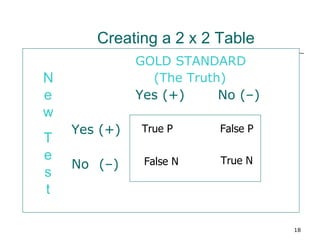
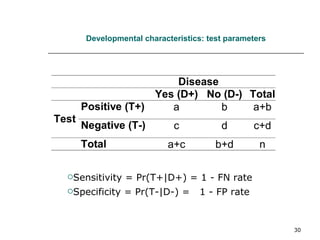
    GOLD STANDARD (The Truth)     Yes (+) No (–)   Yes (+)       No   (–)          Creating a 2 x 2 Table New Test True P False P False N True N
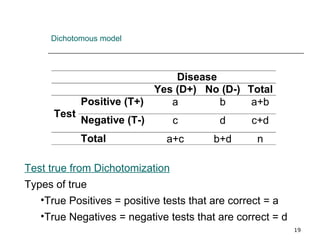
Dichotomous model Test true from Dichotomization Types of true True Positives = positive tests that are correct = a True Negatives = negative tests that are correct = d
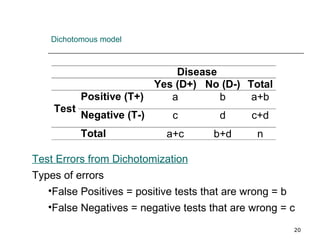
Dichotomous model Test Errors from Dichotomization Types of errors False Positives = positive tests that are wrong = b False Negatives = negative tests that are wrong = c
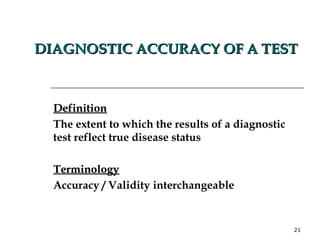
DIAGNOSTIC ACCURACY OF A TEST Definition The extent to which the results of a diagnostic test reflect true disease status Terminology Accuracy / Validity interchangeable
Indicators for assessing diagnostic test
Measures of diagnostic accuracy Sensitivity Specificity Predictive values Measures of reliability / reproductivity Percent agreement
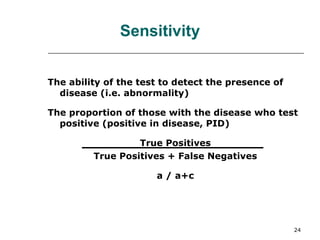
The ability of the test to detect the presence of disease (i.e. abnormality) The proportion of those with the disease who test positive (positive in disease, PID) True Positives True Positives + False Negatives a / a+c Sensitivity
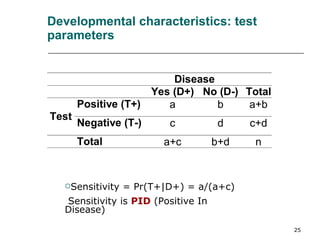
Developmental characteristics: test parameters Sensitivity = Pr(T+|D+) = a/(a+c) Sensitivity is  PID  (Positive In Disease)
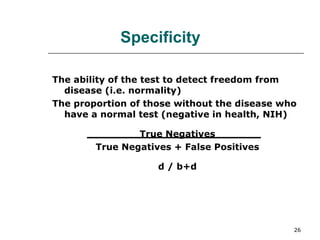
The ability of the test to detect freedom from disease (i.e. normality) The proportion of those without the disease who have a normal test (negative in health, NIH) True Negatives True Negatives + False Positives d / b+d Specificity
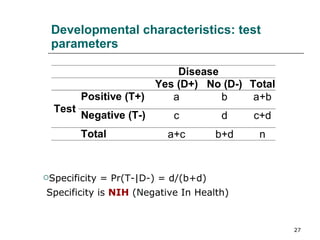
Developmental characteristics: test parameters Specificity = Pr(T-|D-) = d/(b+d) Specificity is  NIH  (Negative In Health)
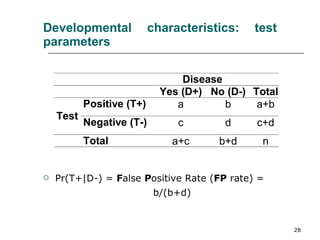
Developmental characteristics: test parameters Pr(T+|D-) =  F alse  P ositive Rate ( FP  rate) =  b/(b+d)
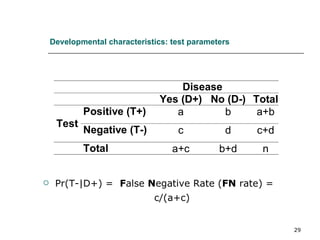
Developmental characteristics: test parameters Pr(T-|D+) =  F alse  N egative Rate ( FN  rate) = c/(a+c)
Developmental characteristics: test parameters Sensitivity = Pr(T+|D+) = 1 - FN rate  Specificity = Pr(T-|D-) =  1 - FP rate
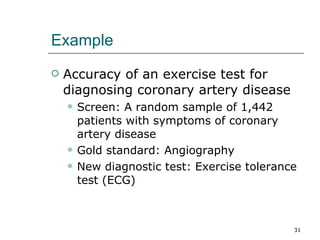
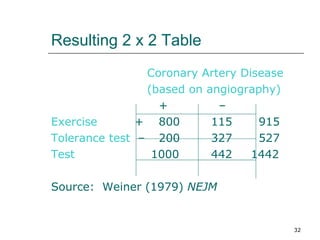
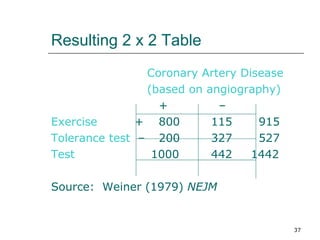
Example Accuracy of an exercise test for diagnosing coronary artery disease Screen: A random sample of 1,442 patients with symptoms of coronary artery disease Gold standard: Angiography New diagnostic test: Exercise tolerance test (ECG)
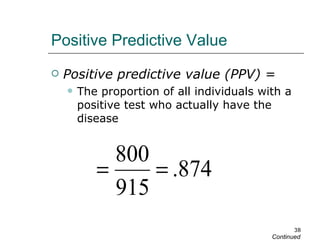
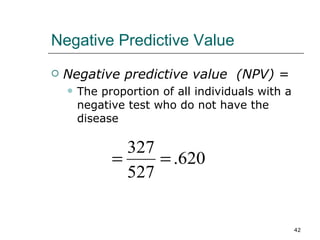
Resulting 2 x 2 Table Coronary Artery Disease (based on angiography)   +   – Exercise     +   800 115   915 Tolerance test   –   200 327   527 Test   1000 442   1442 Source:  Weiner (1979)  NEJM
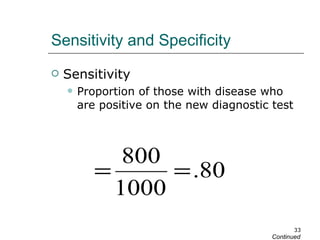
Sensitivity and Specificity Sensitivity Proportion of those with disease who are positive on the new diagnostic test Continued
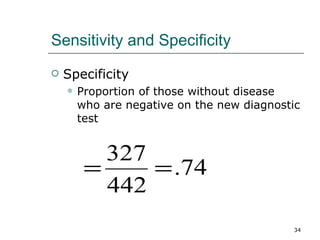
Sensitivity and Specificity Specificity Proportion of those without disease who are negative on the new diagnostic test
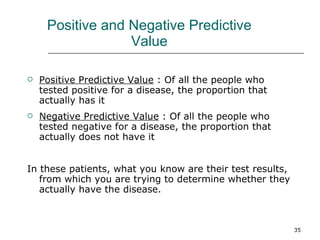
Positive and Negative Predictive Value Positive Predictive Value  : Of all the people who tested positive for a disease, the proportion that actually has it Negative Predictive Value  : Of all the people who tested negative for a disease, the proportion that actually does not have it In these patients, what you know are their test results, from which you are trying to determine whether they actually have the disease.
Positive Predictive Value Referring back to the exercise tolerance test: We want to know the chances of having coronary artery disease for someone who tests positive with the exercise tolerance test
Resulting 2 x 2 Table Coronary Artery Disease (based on angiography)   +   – Exercise     +   800 115   915 Tolerance test   –   200 327   527 Test   1000 442   1442 Source:  Weiner (1979)  NEJM
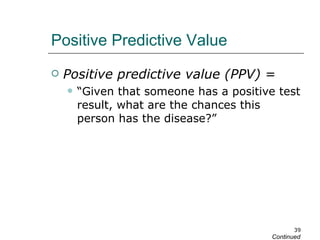
Positive Predictive Value Positive predictive value (PPV)  = The proportion of all individuals with a positive test who actually have the disease Continued
Positive Predictive Value Positive predictive value (PPV)  = “ Given that someone has a positive test result, what are the chances this person has the disease?” Continued
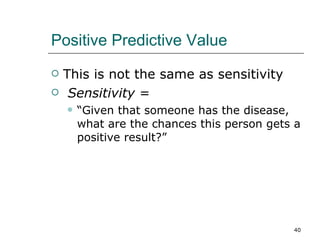
Positive Predictive Value This is not the same as sensitivity Sensitivity  = “ Given that someone has the disease, what are the chances this person gets a positive result?”
Negative Predictive Value Referring back to the exercise tolerance test: We want to know the chances of not having coronary artery disease for someone who tests negative with the exercise tolerance test Continued
Negative Predictive Value Negative predictive value  (NPV)  = The proportion of all individuals with a negative test who do not have the disease
Negative Predictive Value Negative predictive value (NPV)  = “ Given that someone has a negative test result, what are the chances this person does not have the disease?” Continued
Negative Predictive Value This is not the same as specificity Specificity  = “ Given that someone does not have the disease, what are the chances this person gets a negative result?”
Notes on Interpretation The positive predictive value is 88% and the negative predictive value is 62% The sample was from a population of patients with symptoms of coronary artery disease Continued
Notes on Interpretation Interpretation If you have symptoms of coronary disease and you have a positive exercise test, there is an 88% chance you have coronary artery disease If you have a negative test result, there is a 62% you do not have coronary artery disease Continued
Notes on Interpretation However, in an asymptomatic population the positive predictive value might be much lower These estimates only apply to the population tested—the population of individuals with symptoms of coronary artery disease
Summary Sensitivity and specificity do not depend on prevalence of a disease and can always be estimated in a diagnostic test PPV and NPV do depend on the population prevalence of disease Continued
Summary If we start with a completely random sample, we can also estimate PPV and NPV  for the population from which we have sampled If we want to estimate PPV and NPV for a  different population  we will need more machinery Continued
Summary If we over sample cases we will need more machinery to estimate PPV and NPV in a population with a given prevalence of disease
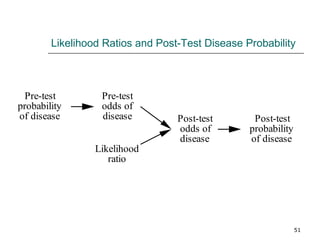
Likelihood Ratios and Post-Test Disease Probability
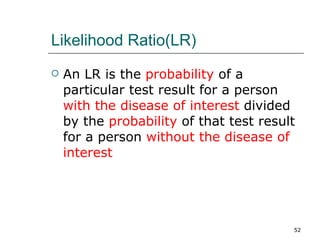
Likelihood Ratio(LR) An LR is the  probability  of a particular test result for a person  with the disease of interest  divided by the  probability  of that test result for a person  without the disease of interest
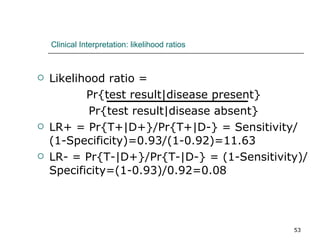
Clinical Interpretation: likelihood ratios Likelihood ratio =  Pr{test result|disease present} Pr{test result|disease absent} LR+ = Pr{T+|D+}/Pr{T+|D-} = Sensitivity/(1-Specificity)=0.93/(1-0.92)=11.63 LR- = Pr{T-|D+}/Pr{T-|D-} = (1-Sensitivity)/Specificity=(1-0.93)/0.92=0.08
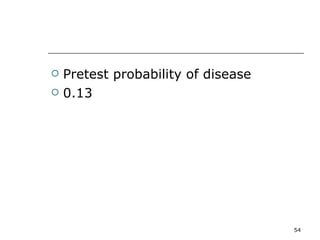
Pretest probability of disease 0.13
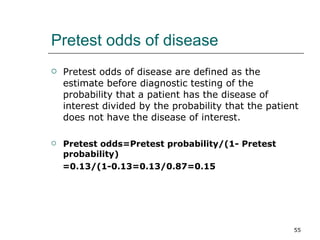
Pretest odds of disease Pretest odds of disease are defined as the estimate before diagnostic testing of the probability that a patient has the disease of interest divided by the probability that the patient does not have the disease of interest. Pretest odds=Pretest probability/(1- Pretest probability) =0.13/(1-0.13=0.13/0.87=0.15
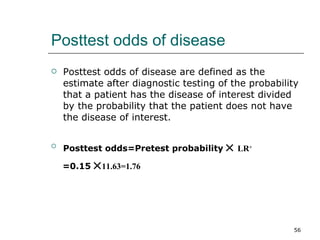
Posttest odds of disease Posttest odds of disease are defined as the estimate after diagnostic testing of the probability that a patient has the disease of interest divided by the probability that the patient does not have the disease of interest. Posttest odds=Pretest probability     LR + =0.15   11.63=1.76
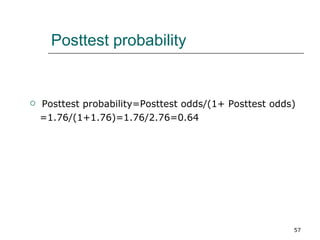
Posttest probability Posttest probability=Posttest odds/(1+ Posttest odds) =1.76/(1+1.76)=1.76/2.76=0.64
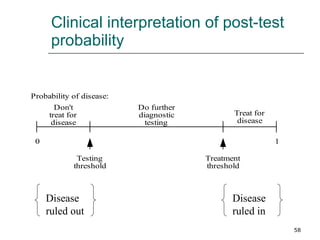
Clinical interpretation of post-test probability Disease ruled out Disease ruled in
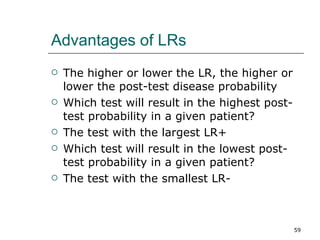
Advantages of LRs The higher or lower the LR, the higher or lower the post-test disease probability Which test will result in the highest post-test probability in a given patient? The test with the largest LR+ Which test will result in the lowest post-test probability in a given patient? The test with the smallest LR-
Advantages of LRs Clear separation of test characteristics from disease probability.
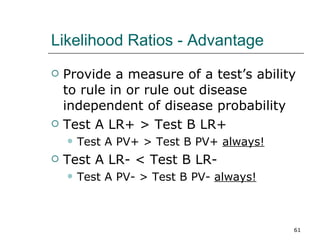
Likelihood Ratios - Advantage Provide a measure of a test’s ability to rule in or rule out disease independent of disease probability Test A LR+ > Test B LR+ Test A PV+ > Test B PV+  always! Test A LR- < Test B LR- Test A PV- > Test B PV-  always!
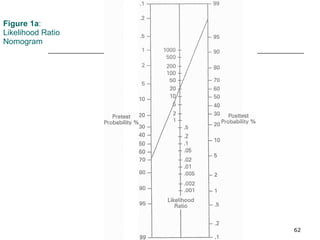
Figure 1a :  Likelihood Ratio  Nomogram
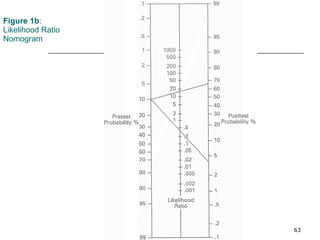
Figure 1b :  Likelihood Ratio  Nomogram
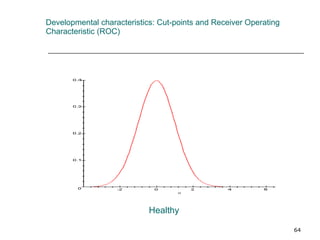
Developmental characteristics: Cut-points and Receiver Operating Characteristic (ROC) Healthy
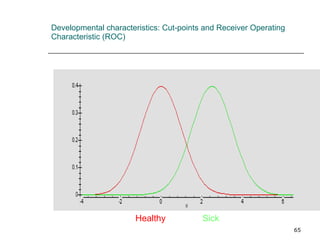
Developmental characteristics: Cut-points and Receiver Operating Characteristic (ROC) Healthy   Sick
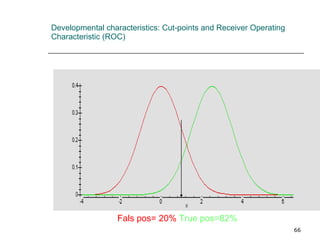
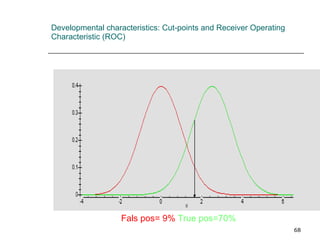
Developmental characteristics: Cut-points and Receiver Operating Characteristic (ROC) Fals pos= 20%   True pos=82%
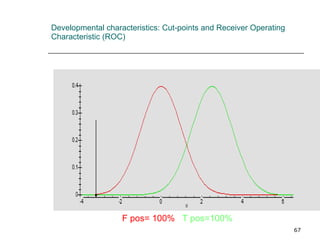
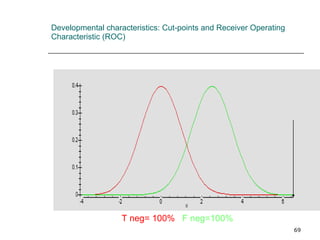
Developmental characteristics: Cut-points and Receiver Operating Characteristic (ROC) F pos= 100%  T pos=100%
Developmental characteristics: Cut-points and Receiver Operating Characteristic (ROC) Fals pos= 9%   True pos=70%
Developmental characteristics: Cut-points and Receiver Operating Characteristic (ROC) T neg= 100%  F neg=100%
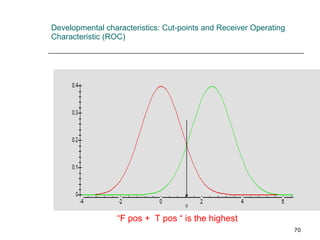
Developmental characteristics: Cut-points and Receiver Operating Characteristic (ROC) “ F pos +  T pos “ is the highest
 
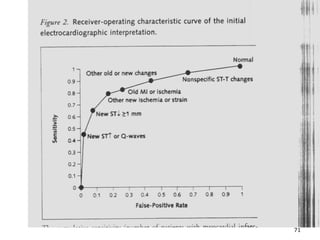
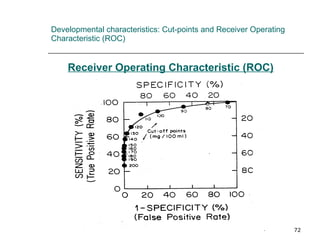
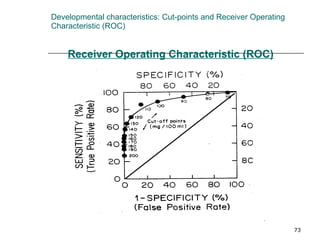
Developmental characteristics: Cut-points and Receiver Operating Characteristic (ROC) Receiver Operating Characteristic (ROC)
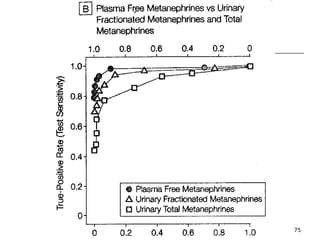
Receiver Operating Characteristic (ROC) ROC Curve allows comparison of different tests for the same condition without (before) specifying a cut-off point. The test with the largest AUC (Area under the curve) is the best.
 
Section C Diagnostic strategies
Combination tests: serial and parallel testing Combinations of specificity and sensitivity superior to the use of any single test may sometimes be achieved by strategic uses of multiple tests.  There are two usual ways of doing this. Serial testing: Use >1 test in sequence, stopping at the first negative test.  Diagnosis requires all tests to be positive. Parallel testing: Use >1 test simultaneously, diagnosing if any test is positive.
Combination tests: serial testing Doing the tests sequentially, instead of together with the same decision rule, is a cost saving measure. This strategy  increases specificity above that of any of the individual tests, but  degrades sensitivity below that of any of them singly.  However, the sensitivity of the serial combination may still be higher than would be achievable if the cut-point of any single test were raised to achieve the same specificity as the serial combination.
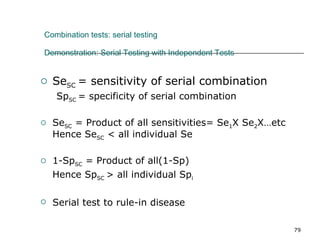
Combination tests: serial testing   Demonstration: Serial Testing with Independent Tests Se SC  = sensitivity of serial combination Sp SC  = specificity of serial combination Se SC  = Product of all sensitivities= Se 1 X Se 2 X…etc Hence Se SC  < all individual Se 1-Sp SC  = Product of all(1-Sp) Hence Sp SC  > all individual Sp i Serial test to rule-in disease
Combination tests: parallel testing Parallel Testing Usual decision strategy diagnoses if any test positive. This strategy  increases sensitivity above that of any of the individual tests, but  degrades specificity below that of any individual test. However, the specificity of the combination may be higher than would be achievable if the cut-point of any single test were lowered to achieve the same sensitivity as the parallel combination.
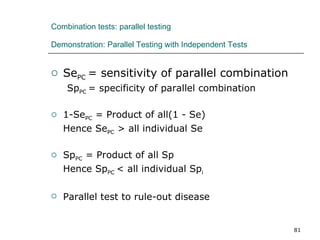
Combination tests: parallel testing   Demonstration: Parallel Testing with Independent Tests Se PC  = sensitivity of parallel combination Sp PC  = specificity of parallel combination 1-Se PC  = Product of all(1 - Se) Hence Se PC  > all individual Se Sp PC  = Product of all Sp Hence Sp PC  < all individual Sp i Parallel test to rule-out disease
Clinical settings for parallel testing Parallel testing is used to rule-out serious but treatable conditions (example rule-out MI by CPK, CPK-MB, Troponin, and EKG. Any positive is considered positive) When a patient has non-specific symptoms, large list of possibilities (differential diagnosis). None of the possibilities has a high pretest probability. Negative test for each possibility is enough to rule it out. Any positive test is considered positive.
Because specificity is low, further testing is now required (serial testing) to make a diagnosis (Sp P In).
Clinical settings for serial testing When treatment is hazardous (surgery, chemotherapy) we use serial testing to raise specificity.(Blood test followed by more tests, followed by imaging, followed by biopsy).
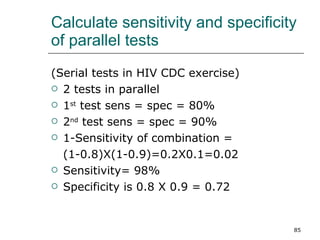
Calculate sensitivity and specificity of parallel tests (Serial tests in HIV CDC exercise) 2 tests in parallel  1 st  test sens = spec = 80% 2 nd  test sens = spec = 90% 1-Sensitivity of combination = (1-0.8)X(1-0.9)=0.2X0.1=0.02  Sensitivity= 98% Specificity is 0.8 X 0.9 = 0.72
Increasing the prevalence of disease Referral process Selected demographic groups Specific of the clinical situation
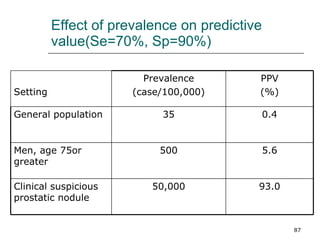
Effect of prevalence on predictive value(Se=70%, Sp=90%) 93.0 50,000 Clinical suspicious prostatic nodule 5.6 500 Men, age 75or greater 0.4 35 General population PPV (%) Prevalence (case/100,000) Setting
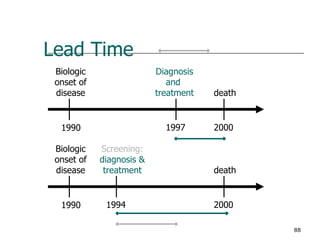
Lead Time 1990 1997 2000 death Diagnosis and  treatment Biologic onset of disease 1990 1994 2000 death Biologic onset of disease Screening: diagnosis & treatment
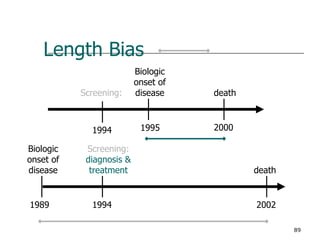
Length Bias 1995 2000 death Biologic onset of disease 1989 1994 death Biologic onset of disease Screening: diagnosis & treatment 2002 1994 Screening:
Thanks!!!

05 diagnostic tests cwq

  • 1.
    Diagnostic Testing Prof.Wei-Qing Chen MD PhD Department of Biostatistics and Epidemiology School of Public Health 87332199 [email_address]
  • 2.
    OBJECTIVES OF LECTUREunderstand that making a diagnosis is not black & white understand subclinical, preclinical disease understand accuracy (validity) of a diagnostic test understand the need for a ‘Gold Standard’ understand the indices by which accuracy is assessed understand reliability of a diagnostic test
  • 3.
    Section A Diagnosisand Diagnostic Testing
  • 4.
    Diagnosis Diagnosis is“the process determining health status and the factors responsible for producing it. Separating a target disease from health/other diseases Indicating that his outcome will be different (die earlier, suffer more, develop complications) Being indicative of treatment Changing the patterns following treatment
  • 5.
    Way of diagnosisCollecting clinical data Symptoms: malaise, memory loss, fatigue, anxiety, etc. Signs: pale skin, hyperactive, red in face, etc. Special tests: cell count, x-ray, PB, cholesterolemia
  • 6.
    Way of diagnosisAssembling a diagnostic entity (category) Diagnosis based on one variable: made by an “abnormal” value of a physiological function. Hypertension: SBP  160mmHg,or/and DBP  95mmHg, Anaemia: haemoglobin is less than 12mg% in adult women.
  • 7.
    Way of diagnosisAssembling a diagnostic entity (category) Diagnosis based on several variable: made by an “abnormal” value of several physiological function. Metabolism syndrome: Hypertension, overweight, obesity in abdomen, high blood lipid, high blood glucose.
  • 8.
    Diagnostic testing A“diagnostic test” originally is meant a test performed in a laboratory. In this chapter, including histories of disease, signs, symptoms, physical exams, special tests (x-ray, ECG, CT, cell counts, etc)
  • 9.
    Section B Assessmenton Diagnostic Testing
  • 10.
    Diagnostic Tests Supposea researcher had developed a new test for diagnosing the presence of disease A The new test is half the price of the current test for the same disease and can be administered during a routine checkup, as opposed to a half day hospital stay
  • 11.
    Diagnostic Tests Froma cost benefits perspective, this new test sounds like a winner However, before it becomes part of standard medical practice, it is important to evaluate the accuracy of this test compared to the existing technology
  • 12.
    Is the diagnostictest valid??? Goal: Evaluate the “accuracy” of the new test
  • 13.
    diagnose individuals for“disease” using both Gold standard (perfect) New diagnostic test The way to evaluate a new diagnostic test Continued
  • 14.
    Selection of Goldstandard A gold standard test is currently recognized as the most reliable test. Tissue diagnosis Radiological exam Autopsies Prolonged follow-up
  • 15.
    Selection of subjectsTarget patients Patients diagnosed by “gold standard test” Typical and untypical patients Patients in early, middle and later period Light, middle and serious patients With and without complications
  • 16.
    Selection of subjectsPatients without target disease as control group Healthy persons are not suitable for as control group
  • 17.
    Blindly comparing theresults between the gold standard test and the new test
  • 18.
    GOLD STANDARD (The Truth) Yes (+) No (–) Yes (+) No (–)   Creating a 2 x 2 Table New Test True P False P False N True N
  • 19.
    Dichotomous model Testtrue from Dichotomization Types of true True Positives = positive tests that are correct = a True Negatives = negative tests that are correct = d
  • 20.
    Dichotomous model TestErrors from Dichotomization Types of errors False Positives = positive tests that are wrong = b False Negatives = negative tests that are wrong = c
  • 21.
    DIAGNOSTIC ACCURACY OFA TEST Definition The extent to which the results of a diagnostic test reflect true disease status Terminology Accuracy / Validity interchangeable
  • 22.
    Indicators for assessingdiagnostic test
  • 23.
    Measures of diagnosticaccuracy Sensitivity Specificity Predictive values Measures of reliability / reproductivity Percent agreement
  • 24.
    The ability ofthe test to detect the presence of disease (i.e. abnormality) The proportion of those with the disease who test positive (positive in disease, PID) True Positives True Positives + False Negatives a / a+c Sensitivity
  • 25.
    Developmental characteristics: testparameters Sensitivity = Pr(T+|D+) = a/(a+c) Sensitivity is PID (Positive In Disease)
  • 26.
    The ability ofthe test to detect freedom from disease (i.e. normality) The proportion of those without the disease who have a normal test (negative in health, NIH) True Negatives True Negatives + False Positives d / b+d Specificity
  • 27.
    Developmental characteristics: testparameters Specificity = Pr(T-|D-) = d/(b+d) Specificity is NIH (Negative In Health)
  • 28.
    Developmental characteristics: testparameters Pr(T+|D-) = F alse P ositive Rate ( FP rate) = b/(b+d)
  • 29.
    Developmental characteristics: testparameters Pr(T-|D+) = F alse N egative Rate ( FN rate) = c/(a+c)
  • 30.
    Developmental characteristics: testparameters Sensitivity = Pr(T+|D+) = 1 - FN rate Specificity = Pr(T-|D-) = 1 - FP rate
  • 31.
    Example Accuracy ofan exercise test for diagnosing coronary artery disease Screen: A random sample of 1,442 patients with symptoms of coronary artery disease Gold standard: Angiography New diagnostic test: Exercise tolerance test (ECG)
  • 32.
    Resulting 2 x2 Table Coronary Artery Disease (based on angiography) + – Exercise + 800 115 915 Tolerance test – 200 327 527 Test 1000 442 1442 Source: Weiner (1979) NEJM
  • 33.
    Sensitivity and SpecificitySensitivity Proportion of those with disease who are positive on the new diagnostic test Continued
  • 34.
    Sensitivity and SpecificitySpecificity Proportion of those without disease who are negative on the new diagnostic test
  • 35.
    Positive and NegativePredictive Value Positive Predictive Value : Of all the people who tested positive for a disease, the proportion that actually has it Negative Predictive Value : Of all the people who tested negative for a disease, the proportion that actually does not have it In these patients, what you know are their test results, from which you are trying to determine whether they actually have the disease.
  • 36.
    Positive Predictive ValueReferring back to the exercise tolerance test: We want to know the chances of having coronary artery disease for someone who tests positive with the exercise tolerance test
  • 37.
    Resulting 2 x2 Table Coronary Artery Disease (based on angiography) + – Exercise + 800 115 915 Tolerance test – 200 327 527 Test 1000 442 1442 Source: Weiner (1979) NEJM
  • 38.
    Positive Predictive ValuePositive predictive value (PPV) = The proportion of all individuals with a positive test who actually have the disease Continued
  • 39.
    Positive Predictive ValuePositive predictive value (PPV) = “ Given that someone has a positive test result, what are the chances this person has the disease?” Continued
  • 40.
    Positive Predictive ValueThis is not the same as sensitivity Sensitivity = “ Given that someone has the disease, what are the chances this person gets a positive result?”
  • 41.
    Negative Predictive ValueReferring back to the exercise tolerance test: We want to know the chances of not having coronary artery disease for someone who tests negative with the exercise tolerance test Continued
  • 42.
    Negative Predictive ValueNegative predictive value (NPV) = The proportion of all individuals with a negative test who do not have the disease
  • 43.
    Negative Predictive ValueNegative predictive value (NPV) = “ Given that someone has a negative test result, what are the chances this person does not have the disease?” Continued
  • 44.
    Negative Predictive ValueThis is not the same as specificity Specificity = “ Given that someone does not have the disease, what are the chances this person gets a negative result?”
  • 45.
    Notes on InterpretationThe positive predictive value is 88% and the negative predictive value is 62% The sample was from a population of patients with symptoms of coronary artery disease Continued
  • 46.
    Notes on InterpretationInterpretation If you have symptoms of coronary disease and you have a positive exercise test, there is an 88% chance you have coronary artery disease If you have a negative test result, there is a 62% you do not have coronary artery disease Continued
  • 47.
    Notes on InterpretationHowever, in an asymptomatic population the positive predictive value might be much lower These estimates only apply to the population tested—the population of individuals with symptoms of coronary artery disease
  • 48.
    Summary Sensitivity andspecificity do not depend on prevalence of a disease and can always be estimated in a diagnostic test PPV and NPV do depend on the population prevalence of disease Continued
  • 49.
    Summary If westart with a completely random sample, we can also estimate PPV and NPV for the population from which we have sampled If we want to estimate PPV and NPV for a different population we will need more machinery Continued
  • 50.
    Summary If weover sample cases we will need more machinery to estimate PPV and NPV in a population with a given prevalence of disease
  • 51.
    Likelihood Ratios andPost-Test Disease Probability
  • 52.
    Likelihood Ratio(LR) AnLR is the probability of a particular test result for a person with the disease of interest divided by the probability of that test result for a person without the disease of interest
  • 53.
    Clinical Interpretation: likelihoodratios Likelihood ratio = Pr{test result|disease present} Pr{test result|disease absent} LR+ = Pr{T+|D+}/Pr{T+|D-} = Sensitivity/(1-Specificity)=0.93/(1-0.92)=11.63 LR- = Pr{T-|D+}/Pr{T-|D-} = (1-Sensitivity)/Specificity=(1-0.93)/0.92=0.08
  • 54.
  • 55.
    Pretest odds ofdisease Pretest odds of disease are defined as the estimate before diagnostic testing of the probability that a patient has the disease of interest divided by the probability that the patient does not have the disease of interest. Pretest odds=Pretest probability/(1- Pretest probability) =0.13/(1-0.13=0.13/0.87=0.15
  • 56.
    Posttest odds ofdisease Posttest odds of disease are defined as the estimate after diagnostic testing of the probability that a patient has the disease of interest divided by the probability that the patient does not have the disease of interest. Posttest odds=Pretest probability  LR + =0.15  11.63=1.76
  • 57.
    Posttest probability Posttestprobability=Posttest odds/(1+ Posttest odds) =1.76/(1+1.76)=1.76/2.76=0.64
  • 58.
    Clinical interpretation ofpost-test probability Disease ruled out Disease ruled in
  • 59.
    Advantages of LRsThe higher or lower the LR, the higher or lower the post-test disease probability Which test will result in the highest post-test probability in a given patient? The test with the largest LR+ Which test will result in the lowest post-test probability in a given patient? The test with the smallest LR-
  • 60.
    Advantages of LRsClear separation of test characteristics from disease probability.
  • 61.
    Likelihood Ratios -Advantage Provide a measure of a test’s ability to rule in or rule out disease independent of disease probability Test A LR+ > Test B LR+ Test A PV+ > Test B PV+ always! Test A LR- < Test B LR- Test A PV- > Test B PV- always!
  • 62.
    Figure 1a : Likelihood Ratio Nomogram
  • 63.
    Figure 1b : Likelihood Ratio Nomogram
  • 64.
    Developmental characteristics: Cut-pointsand Receiver Operating Characteristic (ROC) Healthy
  • 65.
    Developmental characteristics: Cut-pointsand Receiver Operating Characteristic (ROC) Healthy Sick
  • 66.
    Developmental characteristics: Cut-pointsand Receiver Operating Characteristic (ROC) Fals pos= 20% True pos=82%
  • 67.
    Developmental characteristics: Cut-pointsand Receiver Operating Characteristic (ROC) F pos= 100% T pos=100%
  • 68.
    Developmental characteristics: Cut-pointsand Receiver Operating Characteristic (ROC) Fals pos= 9% True pos=70%
  • 69.
    Developmental characteristics: Cut-pointsand Receiver Operating Characteristic (ROC) T neg= 100% F neg=100%
  • 70.
    Developmental characteristics: Cut-pointsand Receiver Operating Characteristic (ROC) “ F pos + T pos “ is the highest
  • 71.
  • 72.
    Developmental characteristics: Cut-pointsand Receiver Operating Characteristic (ROC) Receiver Operating Characteristic (ROC)
  • 73.
    Developmental characteristics: Cut-pointsand Receiver Operating Characteristic (ROC) Receiver Operating Characteristic (ROC)
  • 74.
    Receiver Operating Characteristic(ROC) ROC Curve allows comparison of different tests for the same condition without (before) specifying a cut-off point. The test with the largest AUC (Area under the curve) is the best.
  • 75.
  • 76.
  • 77.
    Combination tests: serialand parallel testing Combinations of specificity and sensitivity superior to the use of any single test may sometimes be achieved by strategic uses of multiple tests. There are two usual ways of doing this. Serial testing: Use >1 test in sequence, stopping at the first negative test. Diagnosis requires all tests to be positive. Parallel testing: Use >1 test simultaneously, diagnosing if any test is positive.
  • 78.
    Combination tests: serialtesting Doing the tests sequentially, instead of together with the same decision rule, is a cost saving measure. This strategy increases specificity above that of any of the individual tests, but degrades sensitivity below that of any of them singly. However, the sensitivity of the serial combination may still be higher than would be achievable if the cut-point of any single test were raised to achieve the same specificity as the serial combination.
  • 79.
    Combination tests: serialtesting Demonstration: Serial Testing with Independent Tests Se SC = sensitivity of serial combination Sp SC = specificity of serial combination Se SC = Product of all sensitivities= Se 1 X Se 2 X…etc Hence Se SC < all individual Se 1-Sp SC = Product of all(1-Sp) Hence Sp SC > all individual Sp i Serial test to rule-in disease
  • 80.
    Combination tests: paralleltesting Parallel Testing Usual decision strategy diagnoses if any test positive. This strategy increases sensitivity above that of any of the individual tests, but degrades specificity below that of any individual test. However, the specificity of the combination may be higher than would be achievable if the cut-point of any single test were lowered to achieve the same sensitivity as the parallel combination.
  • 81.
    Combination tests: paralleltesting Demonstration: Parallel Testing with Independent Tests Se PC = sensitivity of parallel combination Sp PC = specificity of parallel combination 1-Se PC = Product of all(1 - Se) Hence Se PC > all individual Se Sp PC = Product of all Sp Hence Sp PC < all individual Sp i Parallel test to rule-out disease
  • 82.
    Clinical settings forparallel testing Parallel testing is used to rule-out serious but treatable conditions (example rule-out MI by CPK, CPK-MB, Troponin, and EKG. Any positive is considered positive) When a patient has non-specific symptoms, large list of possibilities (differential diagnosis). None of the possibilities has a high pretest probability. Negative test for each possibility is enough to rule it out. Any positive test is considered positive.
  • 83.
    Because specificity islow, further testing is now required (serial testing) to make a diagnosis (Sp P In).
  • 84.
    Clinical settings forserial testing When treatment is hazardous (surgery, chemotherapy) we use serial testing to raise specificity.(Blood test followed by more tests, followed by imaging, followed by biopsy).
  • 85.
    Calculate sensitivity andspecificity of parallel tests (Serial tests in HIV CDC exercise) 2 tests in parallel 1 st test sens = spec = 80% 2 nd test sens = spec = 90% 1-Sensitivity of combination = (1-0.8)X(1-0.9)=0.2X0.1=0.02 Sensitivity= 98% Specificity is 0.8 X 0.9 = 0.72
  • 86.
    Increasing the prevalenceof disease Referral process Selected demographic groups Specific of the clinical situation
  • 87.
    Effect of prevalenceon predictive value(Se=70%, Sp=90%) 93.0 50,000 Clinical suspicious prostatic nodule 5.6 500 Men, age 75or greater 0.4 35 General population PPV (%) Prevalence (case/100,000) Setting
  • 88.
    Lead Time 19901997 2000 death Diagnosis and treatment Biologic onset of disease 1990 1994 2000 death Biologic onset of disease Screening: diagnosis & treatment
  • 89.
    Length Bias 19952000 death Biologic onset of disease 1989 1994 death Biologic onset of disease Screening: diagnosis & treatment 2002 1994 Screening:
  • 90.