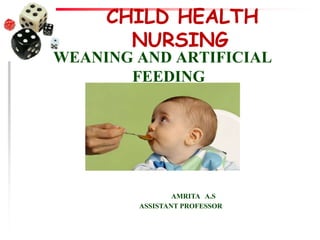
CHILD HEALTH
NURSING
WEANING AND ARTIFICIAL
FEEDING
AMRITA A.S
ASSISTANT PROFESSOR
Meaning of weaning
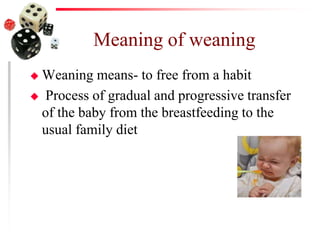
 Weaning means- to free from a habit
 Process of gradual and progressive transfer
of the baby from the breastfeeding to the
usual family diet
Definition
 Weaning is defined as ‘the systematic
process of introduction of suitable food at
the right time in addition to mother’s milk
in order to provide needed nutrients to the
baby’ (UNICEF, 1984).
Cont…
 Weaning does not mean discontinuity of
breast feeding. Weaning foods are given in
addition of breast feed when the amount of
breastfeeding is inadequate.
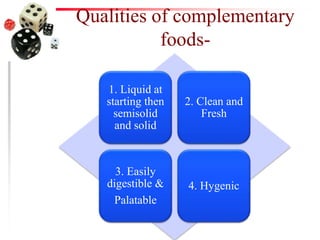
Qualities of complementary
foods-
1. Liquid at
starting then
semisolid
and solid
2. Clean and
Fresh
3. Easily
digestible &
Palatable
4. Hygenic
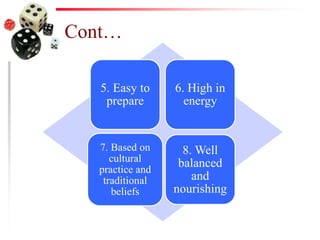
Cont…
5. Easy to
prepare
6. High in
energy
7. Based on
cultural
practice and
traditional
beliefs
8. Well
balanced
and
nourishing
Principles of introduction of weaning
food-
During introduction of weaning foods
following principles to be remembered:-
1. Weaning foods should provide extra
requirement as per need of the baby
2. Initially small amount should be given then
increase gradually in course of a week
Cont….
3.New food to be placed over the tongue of
the baby to get the taste of food and to feel
the consistency.
4. A single weaning food is added at a time.
5. Weaning should be started between 5 to 6
months of age but breastfeeding to be
continued up to 2 yrs of age.
Cont….
6. Additional food can be given in the day time.
Initially it can be given once, then twice or
thrice.
7. New foods should be given when the infant is
hungry, but never force the child to take the
feeds.
8. Delayed weaning result in malnutrition and
growth failure.
Cont…
9. Observe the problems related to weaning
process. The infant may have:-
- indigestion
- pain in abdomen
- weaning diarrhea
- skin rashes
- psychological upset
Preparing and storing the weaning
foods-
 Carefull preparation and storage of the
weaning food is essential to prevent
contamination.
 The following aspects need consideration in
this context:-
1.Hands-carefully washed with soap
and water before preparing food
2.Utensils – washed and scrubed
thoroughly
3. Clean cooking place and chopping
board
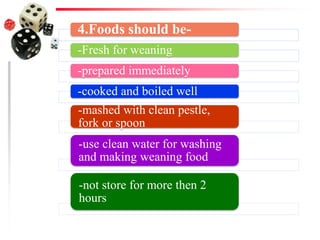
4.Foods should be-
-Fresh for weaning
-prepared immediately
-cooked and boiled well
-mashed with clean pestle,
fork or spoon
-use clean water for washing
and making weaning food
-not store for more then 2
hours
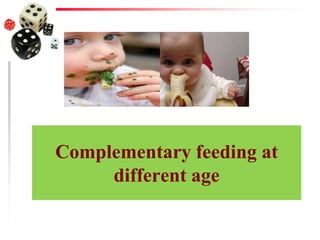
Complementary feeding at
different age
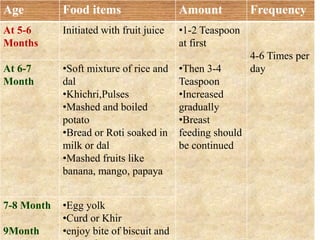
Age Food items Amount Frequency
At 5-6
Months
Initiated with fruit juice •1-2 Teaspoon
at first
•Then 3-4
Teaspoon
•Increased
gradually
•Breast
feeding should
be continued
4-6 Times per
dayAt 6-7
Month
•Soft mixture of rice and
dal
•Khichri,Pulses
•Mashed and boiled
potato
•Bread or Roti soaked in
milk or dal
•Mashed fruits like
banana, mango, papaya
7-8 Month
9Month
•Egg yolk
•Curd or Khir
•enjoy bite of biscuit and
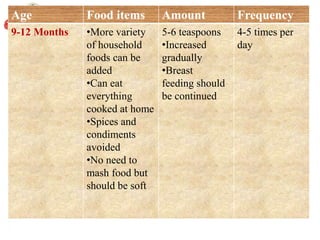
Age Food items Amount Frequency
9-12 Months •More variety
of household
foods can be
added
•Can eat
everything
cooked at home
•Spices and
condiments
avoided
•No need to
mash food but
should be soft
5-6 teaspoons
•Increased
gradually
•Breast
feeding should
be continued
4-5 times per
day
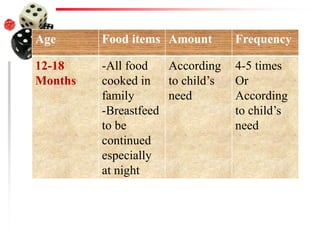
Age Food items Amount Frequency
12-18
Months
-All food
cooked in
family
-Breastfeed
to be
continued
especially
at night
According
to child’s
need
4-5 times
Or
According
to child’s
need
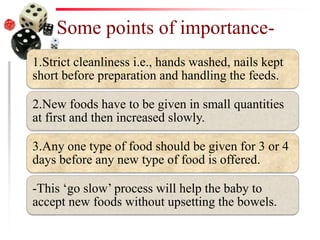
Some points of importance-
1.Strict cleanliness i.e., hands washed, nails kept
short before preparation and handling the feeds.
2.New foods have to be given in small quantities
at first and then increased slowly.
3.Any one type of food should be given for 3 or 4
days before any new type of food is offered.
-This ‘go slow’ process will help the baby to
accept new foods without upsetting the bowels.
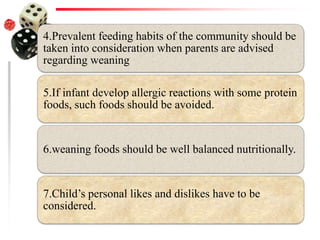
4.Prevalent feeding habits of the community should be
taken into consideration when parents are advised
regarding weaning
5.If infant develop allergic reactions with some protein
foods, such foods should be avoided.
6.weaning foods should be well balanced nutritionally.
7.Child’s personal likes and dislikes have to be
considered.
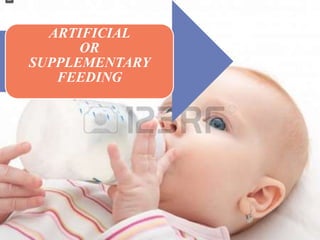
ARTIFICIAL
OR
SUPPLEMENTARY
FEEDING
ARTIFICIAL FEEDING
Introduction:-
 Artificial feeding should be started only if
mother is unable to breastfeed the baby
 Mothers who are not motivated for
breastfeeding may use this as an excuse for
top feeding their babies.
Meaning
 Artificial feeding means -to feed the child
other than breast milk.
 It involves the use of breast milk
substitutes in the form of liquid milk,
i.e.fresh cows or buffalo’s milk or
commercially available dried whole milk.
Aims of artificial feeding:-
-to provide adequate nutrition to
the infant
-to substitute breast milk and
provide nutrients approx. as same
as breastmilk
-to fullfil the needs of the child
for proper growth and
development
Indications for artificial
feeding-
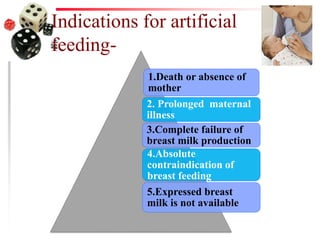
1.Death or absence of
mother
2. Prolonged maternal
illness
3.Complete failure of
breast milk production
4.Absolute
contraindication of
breast feeding
5.Expressed breast
milk is not available
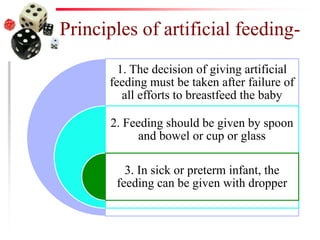
Factors contributing to rising
incidence of artificial feeding:-
Lack of interest in breast feeding
Wrong beliefs and ignorance related to
breastfeeding
Increasing numbers of working
mothers
Aping the western countries
Changing lifestyle
Availability of alternatives of mother’s milk
Publicity and appealing advertisements
Principles of artificial feeding-
1. The decision of giving artificial
feeding must be taken after failure of
all efforts to breastfeed the baby
2. Feeding should be given by spoon
and bowel or cup or glass
3. In sick or preterm infant, the
feeding can be given with dropper
Cont….
4. Bottle feeding must be avoided and mothers
need explanation or information about the hazards
of bottle feeding
5. Strict cleanliness in the preparation and feeding
procedure should be practiced.
6. Milk left over from previous feed should not be
used again.
7. Feeding must be given with the calculated
amount of fluids and calories according to the
baby’s expected weight.
8. Correct technique of
feeding to be followed.
9. The milk should be warm,
not too hot or cold.
10. An average 15 to 20
minutes may be needed to feed
the total quantity, as required.
11. No. of feed can be 6 to 8
times in infant and 3 to 5 times
in older babies.
Cont….
12. Hygienic measures are very
important.
13. If dried milk is used, it should be
reconstituted as per direction given
by the manufacturer.
14. Burping may be needed to allow
to push out the swallowed air and to
prevent vomiting, abdominal
discomfort
15. Supplementation of vitamins and
minerals may be needed for babies to
prevent deficiency condition.
Choice of milk-
Cow milk
Buffalo
milk
Formula
milk
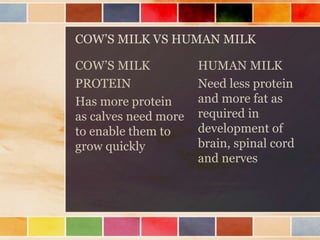
COW’S MILK VS HUMAN MILK
COW’S MILK
PROTEIN
Has more protein
as calves need more
to enable them to
grow quickly
HUMAN MILK
Need less protein
and more fat as
required in
development of
brain, spinal cord
and nerves
Protein divided into CASEIN: WHEY PROTEINS
Normal ratio in cow milk is 80:20
Normal ratio in human milk is 40:60
CASEIN is difficult to digest and linked to various
disease, allergies and diabetes in children
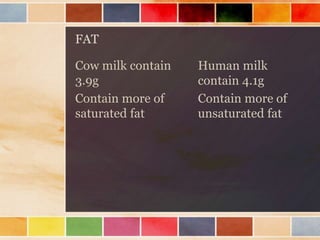
FAT
Cow milk contain
3.9g
Contain more of
saturated fat
Human milk
contain 4.1g
Contain more of
unsaturated fat
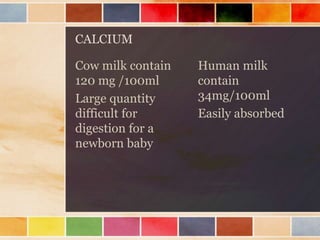
CALCIUM
Cow milk contain
120 mg /100ml
Large quantity
difficult for
digestion for a
newborn baby
Human milk
contain
34mg/100ml
Easily absorbed
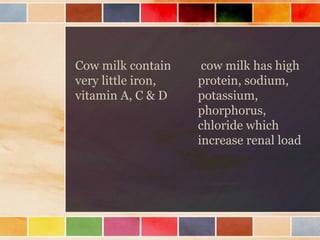
Cow milk contain
very little iron,
vitamin A, C & D
cow milk has high
protein, sodium,
potassium,
phorphorus,
chloride which
increase renal load
Important points-
 Use katori spoon or cup for feeding
 Avoid using bottle for feeding which is a
source of infection.
 If used, prefer glass bottles instead of
plastic or metal bottles.
 Clean feeding vessels and rubber Nipples
using bottle brush & fresh clean water after
each feed.
Cont…
 Bottle and nipple need to be sterilized by
boiling before each feed.
 Boil rubber nipple for 1 or 2 minutes only
&bottle for at least 10 minutes.
 keep bottles and nipples in covered
container, till these are used
Preparation of milk
 If cow or buffalo milk,boil properly,
boiling makes caesin curds finer and
easily digestible
 Commercially available dried powered
milks are reconstitued by mixing –
one level measure of milk powder
+
30 ml of water
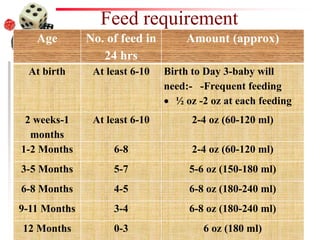
Feed requirement
Age No. of feed in
24 hrs
Amount (approx)
At birth At least 6-10 Birth to Day 3-baby will
need:- -Frequent feeding
 ½ oz -2 oz at each feeding
2 weeks-1
months
At least 6-10 2-4 oz (60-120 ml)
1-2 Months 6-8 2-4 oz (60-120 ml)
3-5 Months 5-7 5-6 oz (150-180 ml)
6-8 Months 4-5 6-8 oz (180-240 ml)
9-11 Months 3-4 6-8 oz (180-240 ml)
12 Months 0-3 6 oz (180 ml)
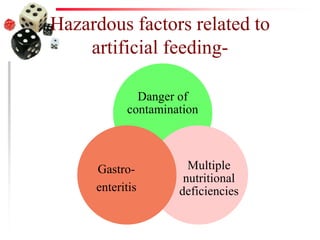
Hazardous factors related to
artificial feeding-
Danger of
contamination
Multiple
nutritional
deficiencies
Gastro-
enteritis
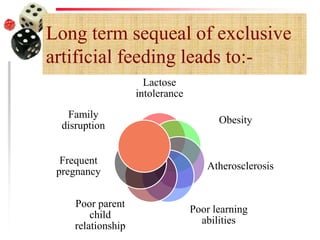
Long term sequeal of exclusive
artificial feeding leads to:-
Lactose
intolerance
Obesity
Atherosclerosis
Poor learning
abilities
Poor parent
child
relationship
Frequent
pregnancy
Family
disruption
Weaning & artifical feeding

Weaning & artifical feeding

  • 1.
    CHILD HEALTH NURSING WEANING ANDARTIFICIAL FEEDING AMRITA A.S ASSISTANT PROFESSOR
  • 2.
    Meaning of weaning Weaning means- to free from a habit  Process of gradual and progressive transfer of the baby from the breastfeeding to the usual family diet
  • 3.
    Definition  Weaning isdefined as ‘the systematic process of introduction of suitable food at the right time in addition to mother’s milk in order to provide needed nutrients to the baby’ (UNICEF, 1984).
  • 4.
    Cont…  Weaning doesnot mean discontinuity of breast feeding. Weaning foods are given in addition of breast feed when the amount of breastfeeding is inadequate.

  • 5.
    Qualities of complementary foods- 1.Liquid at starting then semisolid and solid 2. Clean and Fresh 3. Easily digestible & Palatable 4. Hygenic
  • 6.
    Cont… 5. Easy to prepare 6.High in energy 7. Based on cultural practice and traditional beliefs 8. Well balanced and nourishing
  • 7.
    Principles of introductionof weaning food- During introduction of weaning foods following principles to be remembered:- 1. Weaning foods should provide extra requirement as per need of the baby 2. Initially small amount should be given then increase gradually in course of a week
  • 8.
    Cont…. 3.New food tobe placed over the tongue of the baby to get the taste of food and to feel the consistency. 4. A single weaning food is added at a time. 5. Weaning should be started between 5 to 6 months of age but breastfeeding to be continued up to 2 yrs of age.
  • 9.
    Cont…. 6. Additional foodcan be given in the day time. Initially it can be given once, then twice or thrice. 7. New foods should be given when the infant is hungry, but never force the child to take the feeds. 8. Delayed weaning result in malnutrition and growth failure.
  • 10.
    Cont… 9. Observe theproblems related to weaning process. The infant may have:- - indigestion - pain in abdomen - weaning diarrhea - skin rashes - psychological upset
  • 11.
    Preparing and storingthe weaning foods-  Carefull preparation and storage of the weaning food is essential to prevent contamination.  The following aspects need consideration in this context:-
  • 12.
    1.Hands-carefully washed withsoap and water before preparing food 2.Utensils – washed and scrubed thoroughly 3. Clean cooking place and chopping board
  • 13.
    4.Foods should be- -Freshfor weaning -prepared immediately -cooked and boiled well -mashed with clean pestle, fork or spoon -use clean water for washing and making weaning food -not store for more then 2 hours
  • 14.
  • 15.
    Age Food itemsAmount Frequency At 5-6 Months Initiated with fruit juice •1-2 Teaspoon at first •Then 3-4 Teaspoon •Increased gradually •Breast feeding should be continued 4-6 Times per dayAt 6-7 Month •Soft mixture of rice and dal •Khichri,Pulses •Mashed and boiled potato •Bread or Roti soaked in milk or dal •Mashed fruits like banana, mango, papaya 7-8 Month 9Month •Egg yolk •Curd or Khir •enjoy bite of biscuit and
  • 16.
    Age Food itemsAmount Frequency 9-12 Months •More variety of household foods can be added •Can eat everything cooked at home •Spices and condiments avoided •No need to mash food but should be soft 5-6 teaspoons •Increased gradually •Breast feeding should be continued 4-5 times per day
  • 17.
    Age Food itemsAmount Frequency 12-18 Months -All food cooked in family -Breastfeed to be continued especially at night According to child’s need 4-5 times Or According to child’s need
  • 18.
    Some points ofimportance- 1.Strict cleanliness i.e., hands washed, nails kept short before preparation and handling the feeds. 2.New foods have to be given in small quantities at first and then increased slowly. 3.Any one type of food should be given for 3 or 4 days before any new type of food is offered. -This ‘go slow’ process will help the baby to accept new foods without upsetting the bowels.
  • 19.
    4.Prevalent feeding habitsof the community should be taken into consideration when parents are advised regarding weaning 5.If infant develop allergic reactions with some protein foods, such foods should be avoided. 6.weaning foods should be well balanced nutritionally. 7.Child’s personal likes and dislikes have to be considered.
  • 20.
  • 21.
    ARTIFICIAL FEEDING Introduction:-  Artificialfeeding should be started only if mother is unable to breastfeed the baby  Mothers who are not motivated for breastfeeding may use this as an excuse for top feeding their babies.
  • 22.
    Meaning  Artificial feedingmeans -to feed the child other than breast milk.  It involves the use of breast milk substitutes in the form of liquid milk, i.e.fresh cows or buffalo’s milk or commercially available dried whole milk.
  • 23.
    Aims of artificialfeeding:- -to provide adequate nutrition to the infant -to substitute breast milk and provide nutrients approx. as same as breastmilk -to fullfil the needs of the child for proper growth and development
  • 24.
    Indications for artificial feeding- 1.Deathor absence of mother 2. Prolonged maternal illness 3.Complete failure of breast milk production 4.Absolute contraindication of breast feeding 5.Expressed breast milk is not available
  • 25.
    Factors contributing torising incidence of artificial feeding:- Lack of interest in breast feeding Wrong beliefs and ignorance related to breastfeeding Increasing numbers of working mothers Aping the western countries Changing lifestyle Availability of alternatives of mother’s milk Publicity and appealing advertisements
  • 26.
    Principles of artificialfeeding- 1. The decision of giving artificial feeding must be taken after failure of all efforts to breastfeed the baby 2. Feeding should be given by spoon and bowel or cup or glass 3. In sick or preterm infant, the feeding can be given with dropper
  • 27.
    Cont…. 4. Bottle feedingmust be avoided and mothers need explanation or information about the hazards of bottle feeding 5. Strict cleanliness in the preparation and feeding procedure should be practiced. 6. Milk left over from previous feed should not be used again. 7. Feeding must be given with the calculated amount of fluids and calories according to the baby’s expected weight.
  • 28.
    8. Correct techniqueof feeding to be followed. 9. The milk should be warm, not too hot or cold. 10. An average 15 to 20 minutes may be needed to feed the total quantity, as required. 11. No. of feed can be 6 to 8 times in infant and 3 to 5 times in older babies.
  • 29.
    Cont…. 12. Hygienic measuresare very important. 13. If dried milk is used, it should be reconstituted as per direction given by the manufacturer. 14. Burping may be needed to allow to push out the swallowed air and to prevent vomiting, abdominal discomfort 15. Supplementation of vitamins and minerals may be needed for babies to prevent deficiency condition.
  • 30.
    Choice of milk- Cowmilk Buffalo milk Formula milk
  • 31.
    COW’S MILK VSHUMAN MILK COW’S MILK PROTEIN Has more protein as calves need more to enable them to grow quickly HUMAN MILK Need less protein and more fat as required in development of brain, spinal cord and nerves
  • 32.
    Protein divided intoCASEIN: WHEY PROTEINS Normal ratio in cow milk is 80:20 Normal ratio in human milk is 40:60 CASEIN is difficult to digest and linked to various disease, allergies and diabetes in children
  • 33.
    FAT Cow milk contain 3.9g Containmore of saturated fat Human milk contain 4.1g Contain more of unsaturated fat
  • 34.
    CALCIUM Cow milk contain 120mg /100ml Large quantity difficult for digestion for a newborn baby Human milk contain 34mg/100ml Easily absorbed
  • 35.
    Cow milk contain verylittle iron, vitamin A, C & D cow milk has high protein, sodium, potassium, phorphorus, chloride which increase renal load
  • 36.
    Important points-  Usekatori spoon or cup for feeding  Avoid using bottle for feeding which is a source of infection.  If used, prefer glass bottles instead of plastic or metal bottles.  Clean feeding vessels and rubber Nipples using bottle brush & fresh clean water after each feed.
  • 37.
    Cont…  Bottle andnipple need to be sterilized by boiling before each feed.  Boil rubber nipple for 1 or 2 minutes only &bottle for at least 10 minutes.  keep bottles and nipples in covered container, till these are used
  • 38.
    Preparation of milk If cow or buffalo milk,boil properly, boiling makes caesin curds finer and easily digestible  Commercially available dried powered milks are reconstitued by mixing – one level measure of milk powder + 30 ml of water
  • 39.
    Feed requirement Age No.of feed in 24 hrs Amount (approx) At birth At least 6-10 Birth to Day 3-baby will need:- -Frequent feeding  ½ oz -2 oz at each feeding 2 weeks-1 months At least 6-10 2-4 oz (60-120 ml) 1-2 Months 6-8 2-4 oz (60-120 ml) 3-5 Months 5-7 5-6 oz (150-180 ml) 6-8 Months 4-5 6-8 oz (180-240 ml) 9-11 Months 3-4 6-8 oz (180-240 ml) 12 Months 0-3 6 oz (180 ml)
  • 40.
    Hazardous factors relatedto artificial feeding- Danger of contamination Multiple nutritional deficiencies Gastro- enteritis
  • 41.
    Long term sequealof exclusive artificial feeding leads to:- Lactose intolerance Obesity Atherosclerosis Poor learning abilities Poor parent child relationship Frequent pregnancy Family disruption