




Fluid Therapy The first affiliated hospital  SUN YAT-SEN university Prof.  Wang Huishen 王慧深
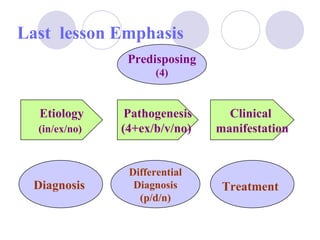
Last  lesson Emphasis  Etiology (in/ex/no)   Pathogenesis (4+ex/b/v/no)  Clinical  manifestation Diagnosis   Differential Diagnosis (p/d/n) Treatment   Predisposing (4)
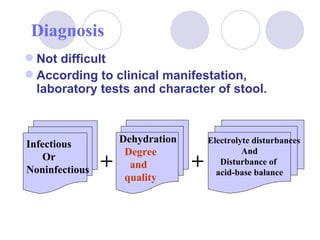
Not difficult According to clinical manifestation, laboratory tests and character of stool.  Diagnosis  + + Infectious Or Noninfectious  Dehydration Degree and quality Electrolyte disturbances And Disturbance of  acid-base balance
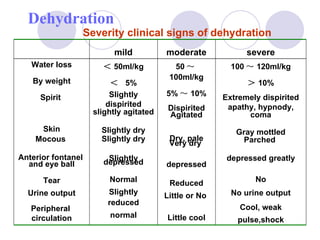
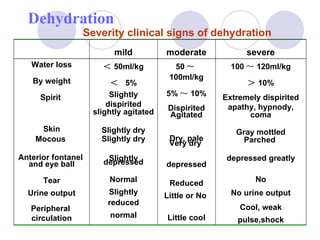
Severity clinical signs of dehydration Dehydration  mild moderate severe Water loss By weight Spirit  Skin Mocous  Anterior fontanel  and eye ball Tear Urine output Peripheral  circulation < 50ml/kg <  5% Slightly dispirited slightly agitated Slightly dry Slightly dry Slightly depressed Normal Slightly reduced normal 50 ~ 100ml/kg 5% ~ 10% Dispirited Agitated Dry, pale Very dry  depressed Reduced Little or No  Little cool 100 ~ 120ml/kg > 10% Extremely dispirited apathy, hypnody, coma Gray mottled Parched  depressed greatly No No urine output Cool, weak pulse,shock
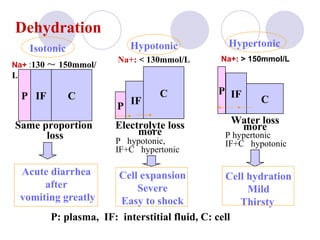
Dehydration   Same proportion  loss P IF C P IF C Electrolyte loss more P  hypotonic, IF+C  hypertonic Cell expansion Severe Easy to shock P: plasma,  IF:  interstitial fluid, C: cell Isotonic P IF C Water loss more P hypertonic IF+C  hypotonic Cell hydration Mild Thirsty   Acute diarrhea after vomiting greatly Hypotonic   Hypertonic  Na+  : 130 ~ 150mmol/L Na+:   <  130mmol/L Na+:   >  150mmol/L
Electrolyte disturbance Diarrhea complicated hyponatremia & hypernatremia hypokalemia hypocalcemia  hypomagnesemia
K +  (potassium)<3.5mmol/L (normal: 3.5 ~ 5.5 mmol/L) causes :   Excessive losses: vomit, diarrhea. Inadequate intake. Renal function of keeping kalium  ,it continues excluding kalium when with hypokalemia. Clinical manifestation: electrolyte disorder Hypokalemia
depressed Tension of skeletal muscle  , tendon reflex , even respiratory muscle weakness  Tension of smooth muscl  , abdominal extension, intestinal sound  or disappear Myocardium excitability  , arrhythmia, ECG: T-wave  is low or inversion, U-wave occurs, prolonged P-R  interval and Q-T interval, ST section descending. Baseosis hypokalemia  K+  (potassium)<3.5mmol/L  (normal: 3.5 ~ 5.5 mmol/L) Clinical manifestation: nerve and muscular excitability
Ca 2+ ﹤1.75mmol/L (7mg/dl) ;  Mg 2+ ﹤0.6mmol/L (1.5mg/dl). Symptoms usually occur after dehydration and  acidosis resolved, or fluid replacement. Clinical manifestation: thrill, tetany, convulsion. If convulsion hasn ’ t relieved after supplement  calcium,  pay attention to hypomagnesemia. hypocalcemia & hypomagnesemia
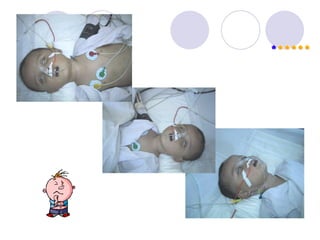
Case example  An 8 – month boy had diarrhea and vomited for 3 days, urine stream reduced, irritability. PE: Pulse rate 150/min, weight loss was 10%, blood pressure 65/40mmHg, skin color showed grey and skin turgor looked like tents. Mucous membranes were very dry; eye ball was sunken greatly, anterior fontanel depressed greatly. Abdomen distended, bowel sound diminished. Questions: 1.What is the diagnosis? 2.How to administer the fluid therapy?
Answer 1  (diagnosis) Acute diarrhea  severe dehydration hypokalemia
Fluid Therapy
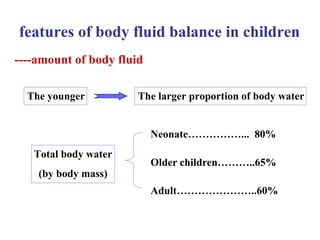
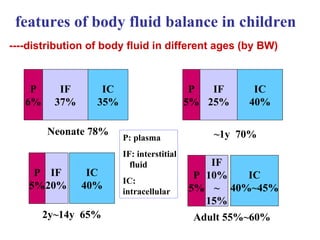
Neonate …………… ...  80%  Older children ……… ..65%  Adult ………………… ..60% features of body fluid balance in children   The younger The larger proportion of body water Total body water (by body mass) ----amount of body fluid
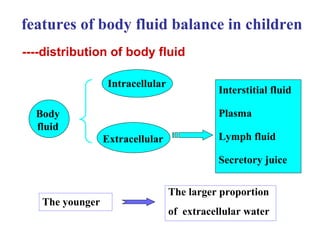
features of body fluid balance in children The younger The larger proportion  of  extracellular water Intracellular  Body fluid Extracellular  Interstitial fluid Plasma Lymph fluid Secretory juice ----distribution of body fluid
P 6% IF 37% IC 35% IF 20% IF 10% ~ 15% IF 25% IC 40% P 5% P 5% P 5% IC 40% IC 40%~45% Neonate 78%   ~1y  70% 2y~14y  65% Adult 55%~60% features of body fluid balance in children   P: plasma IF: interstitial  fluid IC: intracellular ----distribution of body fluid in different ages (by BW)
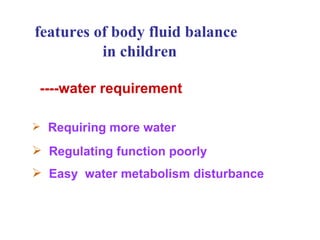
features of body fluid balance in children ----water requirement Requiring more water Regulating function poorly Easy  water metabolism disturbance
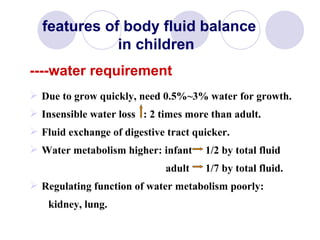
Due to grow quickly, need 0.5%~3% water for growth. Insensible water loss  : 2 times more than adult. Fluid exchange of digestive tract quicker. Water metabolism higher: infant  1/2 by total fluid  adult  1/7 by total fluid. Regulating function of water metabolism poorly:  kidney, lung. features of body fluid balance    in children ----water requirement
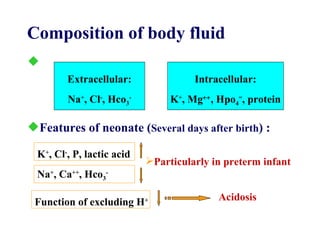
Similar with adult Extracellular: Na + , Cl - , Hco 3 - Intracellular: K + , Mg  , Hpo 4 = , protein Features of neonate ( Several days after birth ) : Composition of body fluid Particularly in preterm infant K + , Cl - , P, lactic acid Na + , Ca ++ , Hco 3 - Function of excluding H + Acidosis
Acid-base balance and adjust ----two concept Acid-base balance Acidity and alkalinity Anion-cation balance Anion and cation
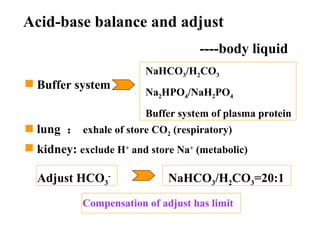
Compensation of adjust has limit Acid-base balance and adjust ----body liquid Buffer system lung  : exhale of store CO 2  (respiratory) kidney:  exclude H +  and store Na +  (metabolic) NaHCO 3 /H 2 CO 3 Na 2 HPO 4 /NaH 2 PO 4 Buffer system of plasma protein Adjust   HCO 3 -   NaHCO 3 /H 2 CO 3 =20:1
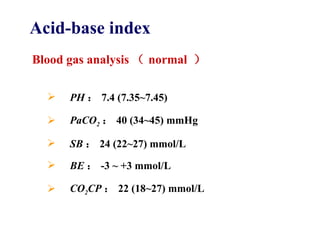
PH : 7.4 (7.35 ~7.45) PaCO 2 : 40 (34 ~45) mmHg SB : 24 (22 ~27) mmol/L BE : -3  ~ +3 mmol/L CO 2 CP : 22 (18 ~27) mmol/L Acid-base index Blood gas analysis ( normal  )
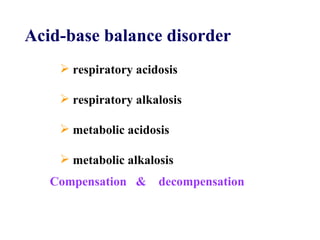
Compensation  &  decompensation Acid-base balance disorder respiratory acidosis respiratory alkalosis metabolic acidosis metabolic alkalosis
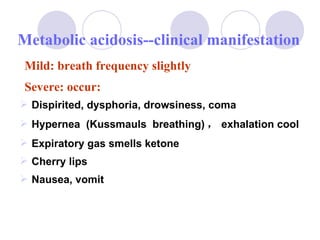
Dispirited, dysphoria, drowsiness, coma Hypernea  (Kussmauls  breathing) , exhalation cool Expiratory gas smells ketone Cherry lips Nausea, vomit Metabolic acidosis--clinical manifestation Mild: breath frequency slightly Severe: occur:
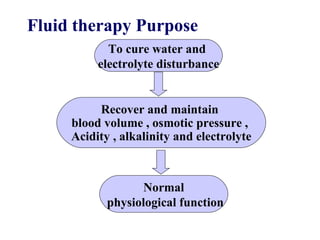
To cure water and  electrolyte disturbance Recover and maintain  blood volume , osmotic pressure ,  Acidity , alkalinity and electrolyte Normal physiological function Fluid therapy Purpose
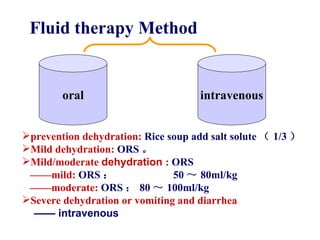
oral intravenous Fluid therapy Method  prevention dehydration:  Rice soup add salt solute ( 1/3 ) Mild dehydration:  ORS 。 Mild/moderate  dehydration   :  ORS —— mild:  ORS :  50 ~ 80ml/kg  —— moderate:  ORS : 80 ~ 100ml/kg Severe dehydration or vomiting and diarrhea ——  intravenous
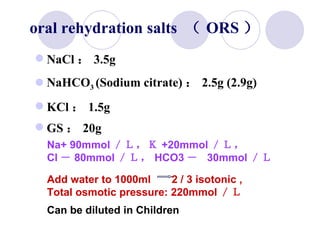
NaCl : 3.5g NaHCO 3  (Sodium citrate) : 2.5g (2.9g) KCl : 1.5g  GS : 20g oral rehydration salts  ( ORS ) Na+ 90mmol /L,K +20mmol /L, Cl - 80mmol /L, HCO3 -  30mmol /L Add water to 1000ml  2 / 3 isotonic ,  Total osmotic pressure: 220mmol /L Can be diluted in Children
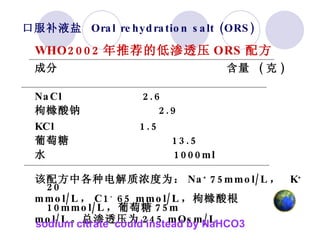
口服补液盐  Oral rehydration salt (ORS)  WHO2002 年推荐的低渗透压 ORS 配方   成分  含量  ( 克 ) NaCl  2.6 枸橼酸钠  2.9 KCl  1.5 葡萄糖  13.5 水  1000ml 该配方中各种电解质浓度为: Na +  75mmol/L ,  K +  20 mmol/L , C1 -  65 mmol/L ,枸橼酸根  10mmol/L ,葡萄糖 75m   mol/L 。总渗透压为 245 mOsm/L sodium citrate  could instead by NaHCO3
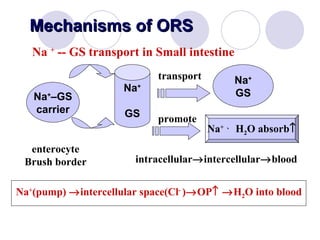
Na  +  -- GS transport in Small intestine Na + – GS carrier enterocyte Brush border intracellular  intercellular  blood Na + GS Na + GS transport promote Na + 、 H 2 O absorb  Na + (pump)   intercellular space(Cl -  )  OP     H 2 O into blood Mechanisms of ORS
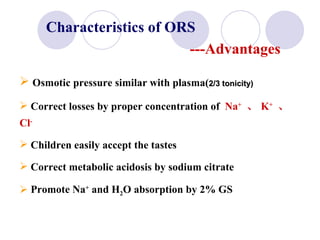
Characteristics of ORS   ---Advantages Osmotic pressure similar with plasma( 2/3 tonicity) Correct losses by proper concentration of  Na +   、 K +   、 Cl - Children easily accept the tastes Correct metabolic acidosis by sodium citrate Promote Na +  and H 2 O absorption by 2% GS
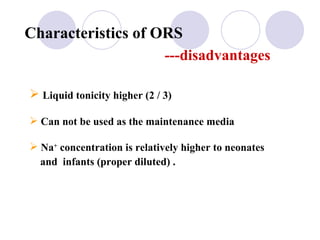
Characteristics of ORS   ---disadvantages Liquid tonicity higher (2 / 3)  Can not be used as the maintenance media  Na +  concentration is relatively higher to neonates  and  infants (proper diluted) .
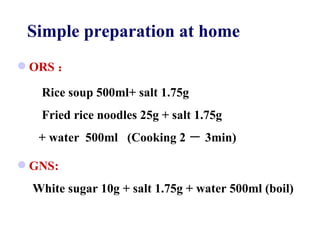
ORS : Rice soup 500ml+ salt 1.75g Fried rice noodles 25g + salt 1.75g  + water  500ml  (Cooking 2 - 3min) GNS: White sugar 10g + salt 1.75g + water 500ml (boil) Simple preparation at home
Severe dehydration intravenous
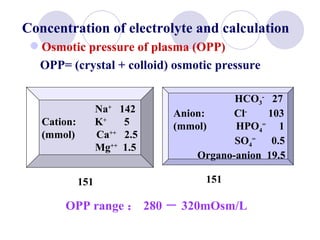
Osmotic pressure of plasma (OPP) OPP= (crystal + colloid) osmotic pressure Na +   142  Cation:   K +  5 (mmol)  Ca ++   2.5 Mg ++   1.5 HCO 3 -   27 Anion:   Cl -   103 (mmol)  HPO 4 =   1 SO 4 =   0.5 Organo-anion  19.5 151  mmol/L 151  mmol/L OPP range : 280 - 320mOsm/L Concentration of electrolyte and calculation
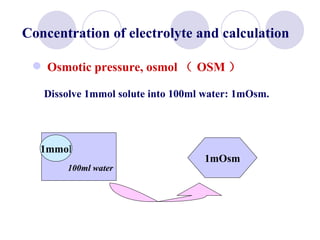
Osmotic pressure, osmol ( OSM ) Dissolve 1mmol solute into 100ml water: 1mOsm. 100ml water 1mmo l 1mOsm Concentration of electrolyte and calculation
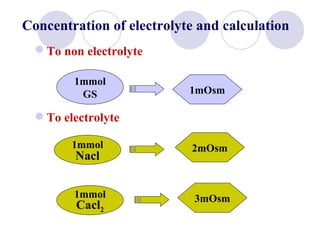
To non electrolyte   1mmol GS 1mOsm 2mOsm 1mmol Nacl To electrolyte  1mmol Cacl 2 3mOsm Concentration of electrolyte and calculation
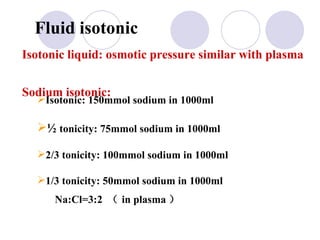
Na : Cl=3 :2  ( in plasma ) Fluid isotonic Isotonic liquid: osmotic pressure similar with plasma  Sodium isotonic: Isotonic: 150mmol sodium in 1000ml ½  tonicity: 75mmol sodium in 1000ml 2/3 tonicity: 100mmol sodium in 1000ml 1/3 tonicity: 50mmol sodium in 1000ml
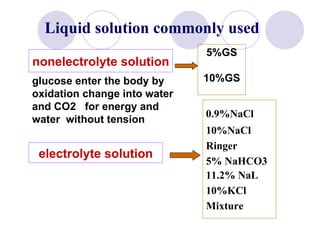
Liquid solution commonly used 5%GS 10%GS 0.9%NaCl 10%NaCl Ringer 5% NaHCO3  11.2% NaL 10%KCl Mixture nonelectrolyte solution electrolyte solution glucose enter the body by oxidation change into water and CO2  for energy and water  without tension
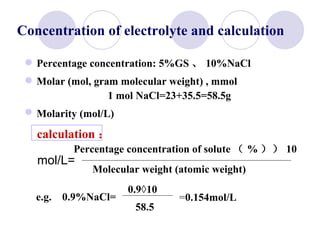
Percentage concentration: 5%GS 、 10%NaCl Molar (mol, gram molecular weight) , mmol 1 mol NaCl=23+35.5=58.5g Molarity (mol/L)   calculation : mol/L= e.g.  0.9%NaCl= = 0.154mol/L   Concentration of electrolyte and calculation Percentage concentration of solute ( % )  10 Molecular weight (atomic weight) 0.9×10 58.5 =154mmol/L
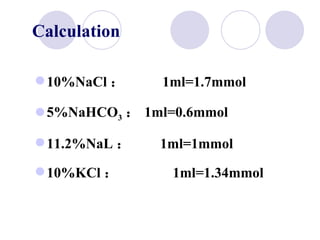
10%NaCl :  1ml=1.7mmol 5%NaHCO 3 : 1ml=0.6mmol 11.2%NaL :  1ml=1mmol 10%KCl :  1ml=1.34mmol Calculation
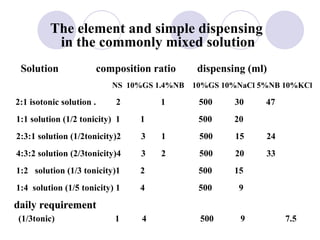
The element and simple dispensing    in the commonly mixed solution Solution  composition ratio   dispensing   (ml)  NS  10%GS 1.4%NB  10%GS 10%NaCl 5%NB 10%KCl 2:1 isotonic solution .  2  1  500  30  47 1:1 solution (1/2 tonicity)  1  1  500  20 2:3:1 solution (1/2tonicity)2  3  1  500  15  24   4:3:2 solution   (2/3tonicity)4  3  2  500  20  33   1:2  solution (1/3 tonicity)1  2  500  15   1:4  solution (1/5 tonicity) 1  4  500  9   daily  requirement (1/3tonic)  1  4  500  9  7.5
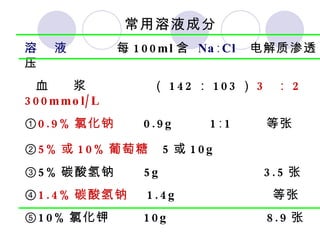
常用溶液成分 溶  液   每 100ml 含  Na∶Cl   电解质渗透压 血  浆   ( 142 : 103 ) 3  : 2  300mmol/L   ① 0.9% 氯化钠   0.9g  1∶1  等张 ② 5% 或 10% 葡萄糖   5 或 10g   ③ 5% 碳酸氢钠  5g  3.5 张 ④ 1.4% 碳酸氢钠   1.4g  等张 ⑤ 10% 氯化钾  10g  8.9 张
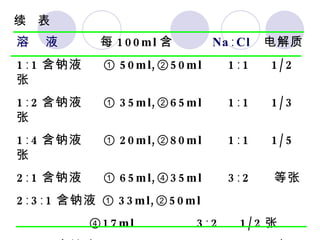
溶  液   每 100ml 含  Na∶Cl   电解质 1∶1 含钠液  ① 50ml,②50ml  1∶1  1/2 张 1∶2 含钠液  ① 35ml,②65ml  1∶1  1/3 张 1∶4 含钠液  ① 20ml,②80ml  1∶1  1/5 张 2∶1 含钠液  ① 65ml,④35ml  3∶2  等张 2∶3∶1 含钠液 ① 33ml,②50ml ④ 17ml  3∶2  1/2 张 4∶3∶2 含钠液 ① 45ml,②33ml  3∶2  2/3 张 ④ 22ml 续  表
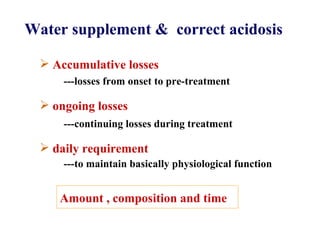
Water supplement &  correct acidosis Accumulative losses ---losses from onset to pre-treatment ongoing losses ---continuing losses during treatment daily requirement ---to maintain basically physiological function Amount , composition and time
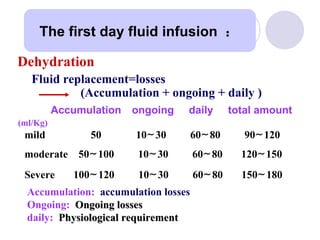
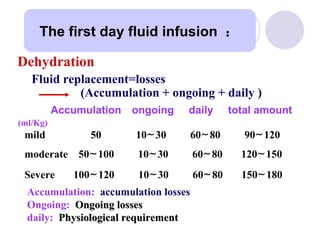
Dehydration  Fluid replacement=losses  (Accumulation + ongoing + daily ) Accumulation   ongoing  daily  total amount (ml/Kg) mild  50  10 ~ 30  60 ~ 80  90 ~ 120  moderate  50 ~ 100  10 ~ 30  60 ~ 80  120 ~ 150 Severe  100 ~ 120  10 ~ 30  60 ~ 80  150 ~ 180 The first day fluid infusion  : Accumulation:   accumulation losses Ongoing:  Ongoing losses daily:  Physiological requirement
Severity clinical signs of dehydration Dehydration  mild moderate severe Water loss By weight Spirit  Skin Mocous  Anterior fontanel  and eye ball Tear Urine output Peripheral  circulation < 50ml/kg <  5% Slightly dispirited slightly agitated Slightly dry Slightly dry Slightly depressed Normal Slightly reduced normal 50 ~ 100ml/kg 5% ~ 10% Dispirited Agitated Dry, pale Very dry  depressed Reduced Little or No  Little cool 100 ~ 120ml/kg > 10% Extremely dispirited apathy, hypnody, coma Gray mottled Parched  depressed greatly No No urine output Cool, weak pulse,shock
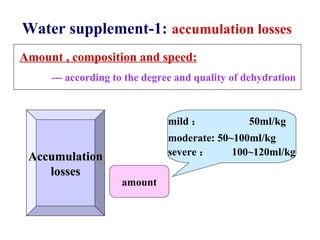
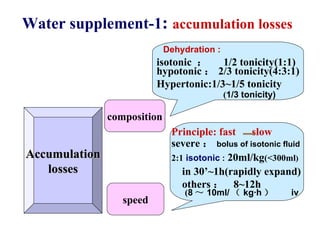
Accumulation losses amount mild :  50ml/kg moderate: 50 ~100ml/kg severe :  100 ~120ml/kg Water supplement-1:   accumulation losses Amount , composition and speed: --- according to the degree and quality of dehydration
composition isotonic  :  1/2 tonicity(1:1) hypotonic : 2/3 tonicity(4:3:1) Hypertonic:1/3~1/5 tonicity  ( 1/3 tonicity) speed Principle: fast  slow severe : bolus of isotonic fluid   2:1  isotonic   :  20ml/kg (<300ml ) in 30’~1h(rapidly expand) others :  8~12h ( 8 ~ 10ml/ ( kg·h )  iv Water supplement-1 :   accumulation losses Accumulation losses Dehydration :
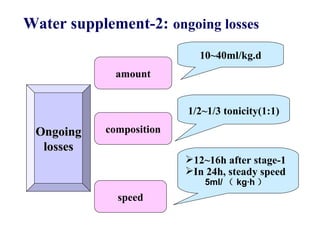
Ongoing losses amount 1/2~1/3 tonicity(1:1) speed 12~16h after stage-1  In 24h, steady speed 5ml/ ( kg·h ) 10~40ml/kg.d composition Water supplement-2:   ongoing losses
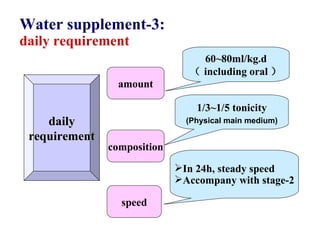
daily requirement amount 1/3~1/5 tonicity (Physical main medium) speed In 24h, steady speed Accompany with stage-2 60~80ml/kg.d ( including oral ) composition Water supplement-3:  daily requirement
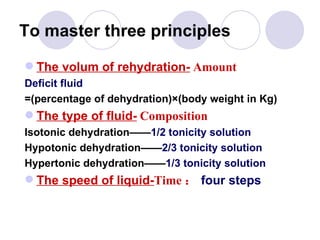
To master three principles The volum of rehydration-  Amount Deficit fluid =(percentage of dehydration)×(body weight in Kg) The type of fluid-  Composition Isotonic dehydration—— 1/2 tonicity solution Hypotonic dehydration—— 2/3 tonicity solution Hypertonic dehydration—— 1/3 tonicity solution The speed of liquid- Time : four steps
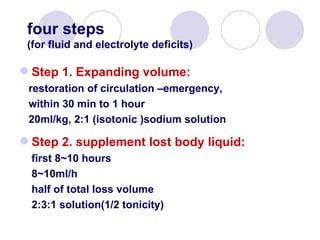
four steps (for fluid and electrolyte deficits) Step 1. Expanding volume: restoration of circulation –emergency, within 30 min to 1 hour  20ml/kg, 2:1 (isotonic )sodium solution  Step 2. supplement lost body liquid:   first 8~10 hours 8~10ml/h half of total loss volume 2:3:1 solution(1/2 tonicity)
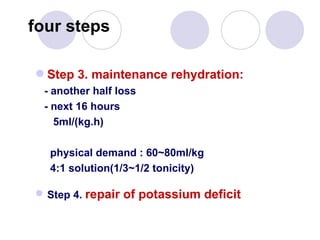
Step 3. maintenance rehydration: - another half loss  - next 16 hours 5ml/(kg.h) physical demand : 60~80ml/kg 4:1 solution(1/3~1/2 tonicity) Step 4.  repair of potassium deficit  four steps
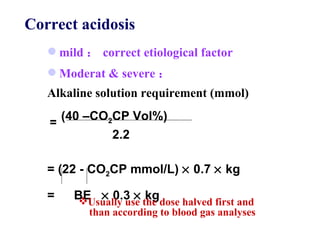
mild : correct etiological factor Moderat & severe : Alkaline solution requirement (mmol) (40 –CO 2 CP Vol%)      2.2 = (22 - CO 2 CP mmol/L)    0.7    kg =   BE    0.3    kg  0.7    kg Usually use the dose halved first and than according to blood gas analyses  Correct acidosis =
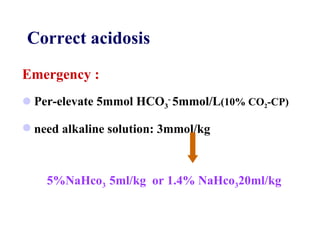
Emergency : Per-elevate 5mmol HCO 3 -  5mmol/L (10% CO 2 -CP) need alkaline solution: 3mmol/kg 5%NaHco 3  5ml/kg  or 1.4% NaHco 3 20ml/kg   Correct acidosis
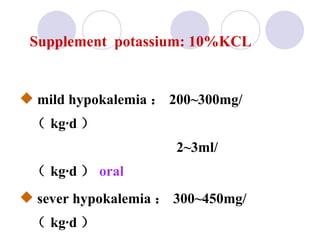
Supplement  potassium: 10%KCL mild hypokalemia : 200~300mg/ ( kg·d )    2~3ml/ ( kg·d ) oral  sever hypokalemia : 300~450mg/ ( kg·d )    3~4.5ml/kg.d  10% KCl  ivdrip
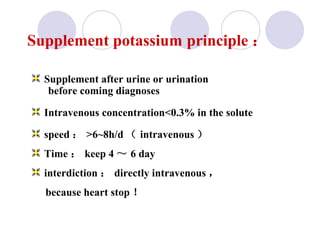
Supplement after urine or urination before coming diagnoses  Intravenous concentration <0.3% in the  solute speed : >6~8 h/d ( intravenous ) Time : keep 4 ~ 6 day  interdiction : directly intravenous , because heart stop ! Supplement potassium   principle :
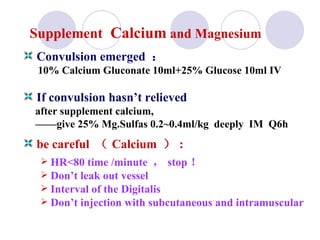
Supplement   Calcium  and Magnesium Convulsion emerged  : 10% Calcium Gluconate 10ml+25% Glucose 10ml IV If convulsion hasn’t relieved after supplement calcium,  —— give 25% Mg.Sulfas 0.2~0.4ml/kg  deeply  IM  Q6h be careful  ( Calcium  ) : HR<80 time /minute  , stop ! Don’t leak out vessel  Interval of the Digitalis  Don’t injection with subcutaneous and intramuscular
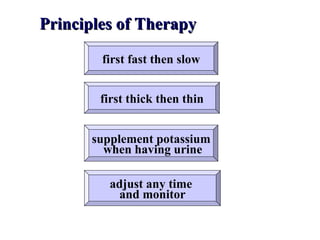
Principles of Therapy first fast then slow first thick then thin supplement potassium when having urine adjust any time  and monitor
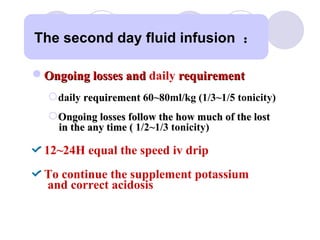
Ongoing losses and  daily  requirement   daily  requirement   60~80ml/kg ( 1/3~1/5 tonicity) Ongoing losses follow the how much of the lost in the any time (  1/2~ 1/3 tonicity) 12~24H equal the speed iv drip  To continue the supplement potassium  and correct acidosis  The second day fluid infusion  :
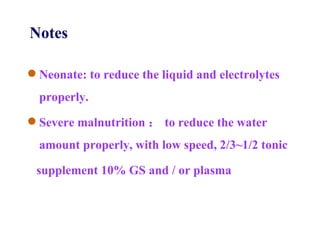
Neonate: to reduce the liquid and electrolytes properly. Severe malnutrition : to reduce the water amount properly, with low speed, 2/3 ~1/2  tonic supplement 10% GS and / or plasma Notes
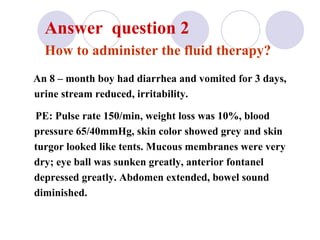
An 8 – month boy had diarrhea and vomited for 3 days, urine stream reduced, irritability.  PE: Pulse rate 150/min, weight loss was 10%, blood pressure 65/40mmHg, skin color showed grey and skin turgor looked like tents. Mucous membranes were very dry; eye ball was sunken greatly, anterior fontanel depressed greatly. Abdomen extended, bowel sound diminished. Answer  question 2 How to administer the fluid therapy?
Dehydration  Fluid replacement=losses  (Accumulation + ongoing + daily ) Accumulation   ongoing  daily  total amount (ml/Kg) mild  50  10 ~ 30  60 ~ 80  90 ~ 120  moderate  50 ~ 100  10 ~ 30  60 ~ 80  120 ~ 150 Severe  100 ~ 120  10 ~ 30  60 ~ 80  150 ~ 180 The first day fluid infusion  : Accumulation:   accumulation losses Ongoing:  Ongoing losses daily:  Physiological requirement
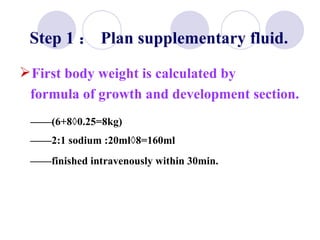
Step 1 : Plan supplementary fluid. First body weight is calculated by  formula of growth and development section.  —— (6+8×0.25=8kg) —— 2:1 sodium :20ml×8=160ml —— finished intravenously within 30min.
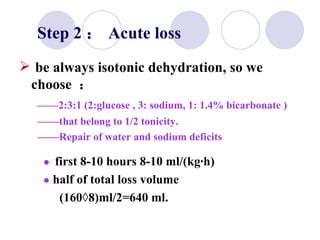
Step 2 : Acute loss be always isotonic dehydration, so we choose  : —— 2:3:1 (2:glucose , 3: sodium, 1: 1.4% bicarbonate )  —— that belong to 1/2 tonicity.  —— Repair of water and sodium deficits  ●  first 8-10 hours 8-10 ml/(kg·h)  ●   half of total loss volume  (160×8)ml/2=640 ml.
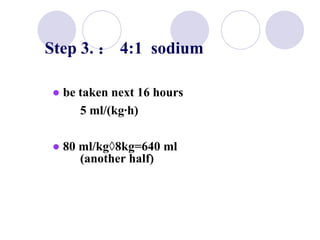
Step 3. : 4:1  sodium ●   be taken next 16 hours 5 ml/(kg·h) ●  80 ml/kg×8kg=640 ml  (another half)
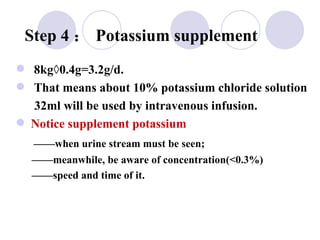
Step 4 : Potassium supplement 8kg×0.4g=3.2g/d.  That means about 10% potassium chloride solution  32ml will be used by intravenous infusion. Notice supplement potassium  —— when urine stream must be seen;  —— meanwhile, be aware of concentration(<0.3%) —— speed and time of it.
 
 
Thanks!!!

C:\documents and settings\administrator\桌面\11 fluid therapy

  • 1.
    Fluid Therapy Thefirst affiliated hospital SUN YAT-SEN university Prof. Wang Huishen 王慧深
  • 2.
    Last lessonEmphasis Etiology (in/ex/no) Pathogenesis (4+ex/b/v/no) Clinical manifestation Diagnosis Differential Diagnosis (p/d/n) Treatment Predisposing (4)
  • 3.
    Not difficult Accordingto clinical manifestation, laboratory tests and character of stool. Diagnosis + + Infectious Or Noninfectious Dehydration Degree and quality Electrolyte disturbances And Disturbance of acid-base balance
  • 4.
    Severity clinical signsof dehydration Dehydration mild moderate severe Water loss By weight Spirit Skin Mocous Anterior fontanel and eye ball Tear Urine output Peripheral circulation < 50ml/kg < 5% Slightly dispirited slightly agitated Slightly dry Slightly dry Slightly depressed Normal Slightly reduced normal 50 ~ 100ml/kg 5% ~ 10% Dispirited Agitated Dry, pale Very dry depressed Reduced Little or No Little cool 100 ~ 120ml/kg > 10% Extremely dispirited apathy, hypnody, coma Gray mottled Parched depressed greatly No No urine output Cool, weak pulse,shock
  • 5.
    Dehydration Same proportion loss P IF C P IF C Electrolyte loss more P hypotonic, IF+C hypertonic Cell expansion Severe Easy to shock P: plasma, IF: interstitial fluid, C: cell Isotonic P IF C Water loss more P hypertonic IF+C hypotonic Cell hydration Mild Thirsty Acute diarrhea after vomiting greatly Hypotonic Hypertonic Na+ : 130 ~ 150mmol/L Na+: < 130mmol/L Na+: > 150mmol/L
  • 6.
    Electrolyte disturbance Diarrheacomplicated hyponatremia & hypernatremia hypokalemia hypocalcemia hypomagnesemia
  • 7.
    K + (potassium)<3.5mmol/L (normal: 3.5 ~ 5.5 mmol/L) causes : Excessive losses: vomit, diarrhea. Inadequate intake. Renal function of keeping kalium ,it continues excluding kalium when with hypokalemia. Clinical manifestation: electrolyte disorder Hypokalemia
  • 8.
    depressed Tension ofskeletal muscle , tendon reflex , even respiratory muscle weakness Tension of smooth muscl , abdominal extension, intestinal sound or disappear Myocardium excitability , arrhythmia, ECG: T-wave is low or inversion, U-wave occurs, prolonged P-R interval and Q-T interval, ST section descending. Baseosis hypokalemia K+ (potassium)<3.5mmol/L (normal: 3.5 ~ 5.5 mmol/L) Clinical manifestation: nerve and muscular excitability
  • 9.
    Ca 2+ ﹤1.75mmol/L(7mg/dl) ; Mg 2+ ﹤0.6mmol/L (1.5mg/dl). Symptoms usually occur after dehydration and acidosis resolved, or fluid replacement. Clinical manifestation: thrill, tetany, convulsion. If convulsion hasn ’ t relieved after supplement calcium, pay attention to hypomagnesemia. hypocalcemia & hypomagnesemia
  • 10.
    Case example An 8 – month boy had diarrhea and vomited for 3 days, urine stream reduced, irritability. PE: Pulse rate 150/min, weight loss was 10%, blood pressure 65/40mmHg, skin color showed grey and skin turgor looked like tents. Mucous membranes were very dry; eye ball was sunken greatly, anterior fontanel depressed greatly. Abdomen distended, bowel sound diminished. Questions: 1.What is the diagnosis? 2.How to administer the fluid therapy?
  • 11.
    Answer 1 (diagnosis) Acute diarrhea severe dehydration hypokalemia
  • 12.
  • 13.
    Neonate …………… ... 80% Older children ……… ..65% Adult ………………… ..60% features of body fluid balance in children The younger The larger proportion of body water Total body water (by body mass) ----amount of body fluid
  • 14.
    features of bodyfluid balance in children The younger The larger proportion of extracellular water Intracellular Body fluid Extracellular Interstitial fluid Plasma Lymph fluid Secretory juice ----distribution of body fluid
  • 15.
    P 6% IF37% IC 35% IF 20% IF 10% ~ 15% IF 25% IC 40% P 5% P 5% P 5% IC 40% IC 40%~45% Neonate 78% ~1y 70% 2y~14y 65% Adult 55%~60% features of body fluid balance in children P: plasma IF: interstitial fluid IC: intracellular ----distribution of body fluid in different ages (by BW)
  • 16.
    features of bodyfluid balance in children ----water requirement Requiring more water Regulating function poorly Easy water metabolism disturbance
  • 17.
    Due to growquickly, need 0.5%~3% water for growth. Insensible water loss : 2 times more than adult. Fluid exchange of digestive tract quicker. Water metabolism higher: infant 1/2 by total fluid adult 1/7 by total fluid. Regulating function of water metabolism poorly: kidney, lung. features of body fluid balance in children ----water requirement
  • 18.
    Similar with adultExtracellular: Na + , Cl - , Hco 3 - Intracellular: K + , Mg  , Hpo 4 = , protein Features of neonate ( Several days after birth ) : Composition of body fluid Particularly in preterm infant K + , Cl - , P, lactic acid Na + , Ca ++ , Hco 3 - Function of excluding H + Acidosis
  • 19.
    Acid-base balance andadjust ----two concept Acid-base balance Acidity and alkalinity Anion-cation balance Anion and cation
  • 20.
    Compensation of adjusthas limit Acid-base balance and adjust ----body liquid Buffer system lung : exhale of store CO 2 (respiratory) kidney: exclude H + and store Na + (metabolic) NaHCO 3 /H 2 CO 3 Na 2 HPO 4 /NaH 2 PO 4 Buffer system of plasma protein Adjust HCO 3 - NaHCO 3 /H 2 CO 3 =20:1
  • 21.
    PH : 7.4(7.35 ~7.45) PaCO 2 : 40 (34 ~45) mmHg SB : 24 (22 ~27) mmol/L BE : -3 ~ +3 mmol/L CO 2 CP : 22 (18 ~27) mmol/L Acid-base index Blood gas analysis ( normal )
  • 22.
    Compensation & decompensation Acid-base balance disorder respiratory acidosis respiratory alkalosis metabolic acidosis metabolic alkalosis
  • 23.
    Dispirited, dysphoria, drowsiness,coma Hypernea (Kussmauls breathing) , exhalation cool Expiratory gas smells ketone Cherry lips Nausea, vomit Metabolic acidosis--clinical manifestation Mild: breath frequency slightly Severe: occur:
  • 24.
    To cure waterand electrolyte disturbance Recover and maintain blood volume , osmotic pressure , Acidity , alkalinity and electrolyte Normal physiological function Fluid therapy Purpose
  • 25.
    oral intravenous Fluidtherapy Method prevention dehydration: Rice soup add salt solute ( 1/3 ) Mild dehydration: ORS 。 Mild/moderate dehydration : ORS —— mild: ORS : 50 ~ 80ml/kg —— moderate: ORS : 80 ~ 100ml/kg Severe dehydration or vomiting and diarrhea —— intravenous
  • 26.
    NaCl : 3.5gNaHCO 3 (Sodium citrate) : 2.5g (2.9g) KCl : 1.5g GS : 20g oral rehydration salts ( ORS ) Na+ 90mmol /L,K +20mmol /L, Cl - 80mmol /L, HCO3 - 30mmol /L Add water to 1000ml 2 / 3 isotonic , Total osmotic pressure: 220mmol /L Can be diluted in Children
  • 27.
    口服补液盐 Oralrehydration salt (ORS) WHO2002 年推荐的低渗透压 ORS 配方 成分 含量 ( 克 ) NaCl 2.6 枸橼酸钠 2.9 KCl 1.5 葡萄糖 13.5 水 1000ml 该配方中各种电解质浓度为: Na + 75mmol/L , K + 20 mmol/L , C1 - 65 mmol/L ,枸橼酸根 10mmol/L ,葡萄糖 75m mol/L 。总渗透压为 245 mOsm/L sodium citrate could instead by NaHCO3
  • 28.
    Na + -- GS transport in Small intestine Na + – GS carrier enterocyte Brush border intracellular  intercellular  blood Na + GS Na + GS transport promote Na + 、 H 2 O absorb  Na + (pump)  intercellular space(Cl - )  OP   H 2 O into blood Mechanisms of ORS
  • 29.
    Characteristics of ORS ---Advantages Osmotic pressure similar with plasma( 2/3 tonicity) Correct losses by proper concentration of Na + 、 K + 、 Cl - Children easily accept the tastes Correct metabolic acidosis by sodium citrate Promote Na + and H 2 O absorption by 2% GS
  • 30.
    Characteristics of ORS ---disadvantages Liquid tonicity higher (2 / 3) Can not be used as the maintenance media Na + concentration is relatively higher to neonates and infants (proper diluted) .
  • 31.
    ORS : Ricesoup 500ml+ salt 1.75g Fried rice noodles 25g + salt 1.75g + water 500ml (Cooking 2 - 3min) GNS: White sugar 10g + salt 1.75g + water 500ml (boil) Simple preparation at home
  • 32.
  • 33.
    Osmotic pressure ofplasma (OPP) OPP= (crystal + colloid) osmotic pressure Na + 142 Cation: K + 5 (mmol) Ca ++ 2.5 Mg ++ 1.5 HCO 3 - 27 Anion: Cl - 103 (mmol) HPO 4 = 1 SO 4 = 0.5 Organo-anion 19.5 151 mmol/L 151 mmol/L OPP range : 280 - 320mOsm/L Concentration of electrolyte and calculation
  • 34.
    Osmotic pressure, osmol( OSM ) Dissolve 1mmol solute into 100ml water: 1mOsm. 100ml water 1mmo l 1mOsm Concentration of electrolyte and calculation
  • 35.
    To non electrolyte 1mmol GS 1mOsm 2mOsm 1mmol Nacl To electrolyte 1mmol Cacl 2 3mOsm Concentration of electrolyte and calculation
  • 36.
    Na : Cl=3:2 ( in plasma ) Fluid isotonic Isotonic liquid: osmotic pressure similar with plasma Sodium isotonic: Isotonic: 150mmol sodium in 1000ml ½ tonicity: 75mmol sodium in 1000ml 2/3 tonicity: 100mmol sodium in 1000ml 1/3 tonicity: 50mmol sodium in 1000ml
  • 37.
    Liquid solution commonlyused 5%GS 10%GS 0.9%NaCl 10%NaCl Ringer 5% NaHCO3 11.2% NaL 10%KCl Mixture nonelectrolyte solution electrolyte solution glucose enter the body by oxidation change into water and CO2 for energy and water without tension
  • 38.
    Percentage concentration: 5%GS、 10%NaCl Molar (mol, gram molecular weight) , mmol 1 mol NaCl=23+35.5=58.5g Molarity (mol/L) calculation : mol/L= e.g. 0.9%NaCl= = 0.154mol/L Concentration of electrolyte and calculation Percentage concentration of solute ( % )  10 Molecular weight (atomic weight) 0.9×10 58.5 =154mmol/L
  • 39.
    10%NaCl : 1ml=1.7mmol 5%NaHCO 3 : 1ml=0.6mmol 11.2%NaL : 1ml=1mmol 10%KCl : 1ml=1.34mmol Calculation
  • 40.
    The element andsimple dispensing in the commonly mixed solution Solution composition ratio dispensing (ml) NS 10%GS 1.4%NB 10%GS 10%NaCl 5%NB 10%KCl 2:1 isotonic solution . 2 1 500 30 47 1:1 solution (1/2 tonicity) 1 1 500 20 2:3:1 solution (1/2tonicity)2 3 1 500 15 24   4:3:2 solution (2/3tonicity)4 3 2 500 20 33   1:2 solution (1/3 tonicity)1 2 500 15   1:4 solution (1/5 tonicity) 1 4 500 9   daily requirement (1/3tonic) 1 4 500 9 7.5
  • 41.
    常用溶液成分 溶 液 每 100ml 含 Na∶Cl 电解质渗透压 血 浆 ( 142 : 103 ) 3 : 2 300mmol/L ① 0.9% 氯化钠 0.9g 1∶1 等张 ② 5% 或 10% 葡萄糖 5 或 10g ③ 5% 碳酸氢钠 5g 3.5 张 ④ 1.4% 碳酸氢钠 1.4g 等张 ⑤ 10% 氯化钾 10g 8.9 张
  • 42.
    溶 液 每 100ml 含 Na∶Cl 电解质 1∶1 含钠液 ① 50ml,②50ml 1∶1 1/2 张 1∶2 含钠液 ① 35ml,②65ml 1∶1 1/3 张 1∶4 含钠液 ① 20ml,②80ml 1∶1 1/5 张 2∶1 含钠液 ① 65ml,④35ml 3∶2 等张 2∶3∶1 含钠液 ① 33ml,②50ml ④ 17ml 3∶2 1/2 张 4∶3∶2 含钠液 ① 45ml,②33ml 3∶2 2/3 张 ④ 22ml 续 表
  • 43.
    Water supplement & correct acidosis Accumulative losses ---losses from onset to pre-treatment ongoing losses ---continuing losses during treatment daily requirement ---to maintain basically physiological function Amount , composition and time
  • 44.
    Dehydration Fluidreplacement=losses (Accumulation + ongoing + daily ) Accumulation ongoing daily total amount (ml/Kg) mild 50 10 ~ 30 60 ~ 80 90 ~ 120 moderate 50 ~ 100 10 ~ 30 60 ~ 80 120 ~ 150 Severe 100 ~ 120 10 ~ 30 60 ~ 80 150 ~ 180 The first day fluid infusion : Accumulation: accumulation losses Ongoing: Ongoing losses daily: Physiological requirement
  • 45.
    Severity clinical signsof dehydration Dehydration mild moderate severe Water loss By weight Spirit Skin Mocous Anterior fontanel and eye ball Tear Urine output Peripheral circulation < 50ml/kg < 5% Slightly dispirited slightly agitated Slightly dry Slightly dry Slightly depressed Normal Slightly reduced normal 50 ~ 100ml/kg 5% ~ 10% Dispirited Agitated Dry, pale Very dry depressed Reduced Little or No Little cool 100 ~ 120ml/kg > 10% Extremely dispirited apathy, hypnody, coma Gray mottled Parched depressed greatly No No urine output Cool, weak pulse,shock
  • 46.
    Accumulation losses amountmild : 50ml/kg moderate: 50 ~100ml/kg severe : 100 ~120ml/kg Water supplement-1: accumulation losses Amount , composition and speed: --- according to the degree and quality of dehydration
  • 47.
    composition isotonic : 1/2 tonicity(1:1) hypotonic : 2/3 tonicity(4:3:1) Hypertonic:1/3~1/5 tonicity ( 1/3 tonicity) speed Principle: fast slow severe : bolus of isotonic fluid 2:1 isotonic : 20ml/kg (<300ml ) in 30’~1h(rapidly expand) others : 8~12h ( 8 ~ 10ml/ ( kg·h ) iv Water supplement-1 : accumulation losses Accumulation losses Dehydration :
  • 48.
    Ongoing losses amount1/2~1/3 tonicity(1:1) speed 12~16h after stage-1 In 24h, steady speed 5ml/ ( kg·h ) 10~40ml/kg.d composition Water supplement-2: ongoing losses
  • 49.
    daily requirement amount1/3~1/5 tonicity (Physical main medium) speed In 24h, steady speed Accompany with stage-2 60~80ml/kg.d ( including oral ) composition Water supplement-3: daily requirement
  • 50.
    To master threeprinciples The volum of rehydration- Amount Deficit fluid =(percentage of dehydration)×(body weight in Kg) The type of fluid- Composition Isotonic dehydration—— 1/2 tonicity solution Hypotonic dehydration—— 2/3 tonicity solution Hypertonic dehydration—— 1/3 tonicity solution The speed of liquid- Time : four steps
  • 51.
    four steps (forfluid and electrolyte deficits) Step 1. Expanding volume: restoration of circulation –emergency, within 30 min to 1 hour 20ml/kg, 2:1 (isotonic )sodium solution Step 2. supplement lost body liquid: first 8~10 hours 8~10ml/h half of total loss volume 2:3:1 solution(1/2 tonicity)
  • 52.
    Step 3. maintenancerehydration: - another half loss - next 16 hours 5ml/(kg.h) physical demand : 60~80ml/kg 4:1 solution(1/3~1/2 tonicity) Step 4. repair of potassium deficit four steps
  • 53.
    mild : correctetiological factor Moderat & severe : Alkaline solution requirement (mmol) (40 –CO 2 CP Vol%)     2.2 = (22 - CO 2 CP mmol/L)  0.7  kg =   BE  0.3  kg  0.7  kg Usually use the dose halved first and than according to blood gas analyses Correct acidosis =
  • 54.
    Emergency : Per-elevate5mmol HCO 3 - 5mmol/L (10% CO 2 -CP) need alkaline solution: 3mmol/kg 5%NaHco 3 5ml/kg or 1.4% NaHco 3 20ml/kg Correct acidosis
  • 55.
    Supplement potassium:10%KCL mild hypokalemia : 200~300mg/ ( kg·d ) 2~3ml/ ( kg·d ) oral sever hypokalemia : 300~450mg/ ( kg·d ) 3~4.5ml/kg.d 10% KCl ivdrip
  • 56.
    Supplement after urineor urination before coming diagnoses Intravenous concentration <0.3% in the solute speed : >6~8 h/d ( intravenous ) Time : keep 4 ~ 6 day interdiction : directly intravenous , because heart stop ! Supplement potassium principle :
  • 57.
    Supplement Calcium and Magnesium Convulsion emerged : 10% Calcium Gluconate 10ml+25% Glucose 10ml IV If convulsion hasn’t relieved after supplement calcium, —— give 25% Mg.Sulfas 0.2~0.4ml/kg deeply IM Q6h be careful ( Calcium ) : HR<80 time /minute , stop ! Don’t leak out vessel Interval of the Digitalis Don’t injection with subcutaneous and intramuscular
  • 58.
    Principles of Therapyfirst fast then slow first thick then thin supplement potassium when having urine adjust any time and monitor
  • 59.
    Ongoing losses and daily requirement daily requirement 60~80ml/kg ( 1/3~1/5 tonicity) Ongoing losses follow the how much of the lost in the any time ( 1/2~ 1/3 tonicity) 12~24H equal the speed iv drip To continue the supplement potassium and correct acidosis The second day fluid infusion :
  • 60.
    Neonate: to reducethe liquid and electrolytes properly. Severe malnutrition : to reduce the water amount properly, with low speed, 2/3 ~1/2 tonic supplement 10% GS and / or plasma Notes
  • 61.
    An 8 –month boy had diarrhea and vomited for 3 days, urine stream reduced, irritability. PE: Pulse rate 150/min, weight loss was 10%, blood pressure 65/40mmHg, skin color showed grey and skin turgor looked like tents. Mucous membranes were very dry; eye ball was sunken greatly, anterior fontanel depressed greatly. Abdomen extended, bowel sound diminished. Answer question 2 How to administer the fluid therapy?
  • 62.
    Dehydration Fluidreplacement=losses (Accumulation + ongoing + daily ) Accumulation ongoing daily total amount (ml/Kg) mild 50 10 ~ 30 60 ~ 80 90 ~ 120 moderate 50 ~ 100 10 ~ 30 60 ~ 80 120 ~ 150 Severe 100 ~ 120 10 ~ 30 60 ~ 80 150 ~ 180 The first day fluid infusion : Accumulation: accumulation losses Ongoing: Ongoing losses daily: Physiological requirement
  • 63.
    Step 1 :Plan supplementary fluid. First body weight is calculated by formula of growth and development section. —— (6+8×0.25=8kg) —— 2:1 sodium :20ml×8=160ml —— finished intravenously within 30min.
  • 64.
    Step 2 :Acute loss be always isotonic dehydration, so we choose : —— 2:3:1 (2:glucose , 3: sodium, 1: 1.4% bicarbonate ) —— that belong to 1/2 tonicity. —— Repair of water and sodium deficits ● first 8-10 hours 8-10 ml/(kg·h) ● half of total loss volume (160×8)ml/2=640 ml.
  • 65.
    Step 3. :4:1 sodium ● be taken next 16 hours 5 ml/(kg·h) ● 80 ml/kg×8kg=640 ml (another half)
  • 66.
    Step 4 :Potassium supplement 8kg×0.4g=3.2g/d. That means about 10% potassium chloride solution 32ml will be used by intravenous infusion. Notice supplement potassium —— when urine stream must be seen; —— meanwhile, be aware of concentration(<0.3%) —— speed and time of it.
  • 67.
  • 68.
  • 69.