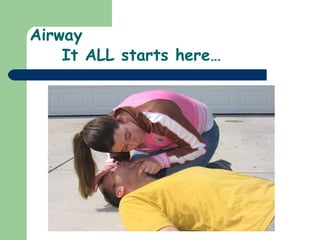
Airway It ALL starts here…
Respiratory System  Function Gas exchange with outside environment Filtration/Humidification/Warming/Conduction of air Structures Nose Mouth Naso/Oro/Laryngopharynx Larynx Bronchi Bronchioles Lungs Diaphragm Associated muscles  Alveoli
Upper Airway  Nose/Mouth Function Filters Warms Moistens
Upper Airway  Pharynx Location Posterior to mouth Superior to esophagus, larynx, trachea Function Conducts air to bronchi 3 Divisions Nasopharynx Oropharynx Laryngopharynx
Upper Airway  Epiglottis  Location Sits posterior to larynx Attached to tongue  Structure Leaf shaped cartilage Function Prevents food/liquid from entering larynx during swallowing  Guards opening to vocal cords (glottis)
Upper Airway  Larynx AKA: “Voice box” Location Inferior to epiglottis Superior to trachea   Structure   Cartilaginous rings Thyroid Cartilage = “Adam’s Apple” Bulk of anterior wall Cricoid Cartilage Firm rings forming lower aspect/base Function Stops foreign objects that pass epiglottis Laryngospasm Voice production
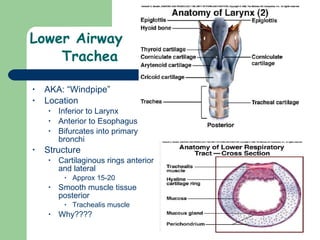
Lower Airway  Trachea AKA: “Windpipe”  Location Inferior to Larynx Anterior to Esophagus Bifurcates into primary bronchi Structure  Cartilaginous rings anterior and lateral Approx 15-20  Smooth muscle tissue posterior  Trachealis muscle  Why????
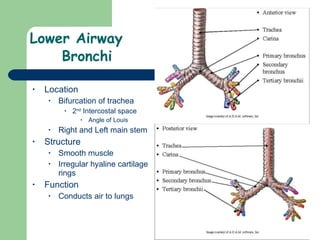
Lower Airway  Bronchi Location Bifurcation of trachea  2 nd  Intercostal space Angle of Louis Right and Left main stem Structure Smooth muscle Irregular hyaline cartilage rings  Function Conducts air to lungs
Lower Airway  Bronchioles  Location Distal bifurcations of the bronchi Terminate at alveoli Function Conduct air to alveoli  Structure 1 st  airways with NO cartilage ALL muscle  Bronchoconstriction  Bronchospasm < 1 mm wide =Tiny
Lower Airway  Alveoli Location Terminal sacs of bronchial tree Distal to bronchioles Particular to mammalian lungs 150 million/lung Structure 1 cell thick Surface are= 75m 2  (Tennis court) Increased SA= Increased 0 2  absorption 0.2-0.3 mm diameter  Covered in capillaries (70%) Bathed in surfactant  Function Diffusion of gas with capillaries
 
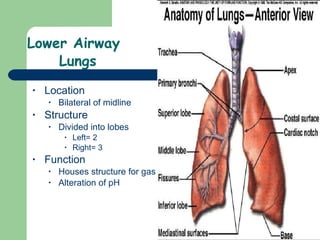
Lower Airway  Lungs Location Bilateral of midline Structure Divided into lobes Left= 2 Right= 3 Function Houses structure for gas exchange Alteration of pH
Lower Airway Mucociliary Escalator  Location Along epithelium of primary bronchi Beat in rhythm  Structure Cilia projections “ Hair like” Function Move debris up out of lungs Cough or swallow Smokers… Prevent mucous accumulation
 
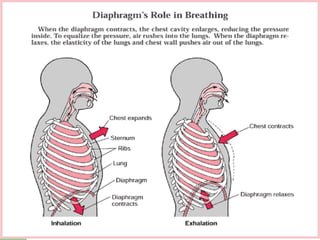
Respiratory Physiology How we breathe…  Ventilation Mechanical movement of air into/out of the body Inhalation ( Active ) Muscles Used Diaphragm & External Intercostals Physiology  Diaphragm contracts downward External intercostals pull ribs up and out Increases dimension of chest cavity Increased diameter of chest drops intra thoracic pressure Air rushes in until pressure is equalized
Respiratory Physiology How we breathe… Ventilation Mechanical movement of air into/out of the body Exhalation ( Passive ) Physiology Diaphragm relaxes as well as intercostals Chest cavity dimension decreases Decrease in dimension increases intrathoracic pressure Air rushes out  Lungs recoil
 
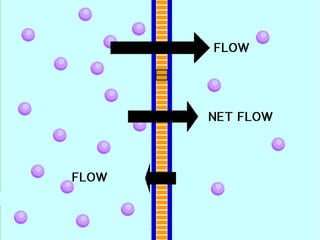
Respiratory Physiology Gas Exchange Respiration Process by which the body utilizes oxygen Diffusion Net movement of molecules from an area of high concentration to an area of low concentration
 
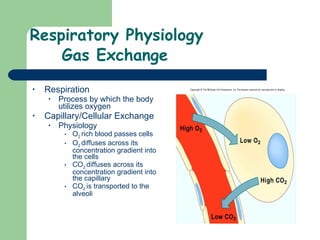
Respiratory Physiology Gas Exchange Respiration Process by which the body utilizes oxygen Alveolar/Capillary Exchange Physiology O 2  rich air enters alveoli O 2  poor blood in capillaries pass alveoli O 2  diffuses down its concentration gradient into the capillaries CO 2  diffuses down its concentration gradient into the alveoli CO 2  is exhaled and O 2  transported to tissues
Respiratory Physiology Gas Exchange Respiration Process by which the body utilizes oxygen Capillary/Cellular Exchange Physiology O 2  rich blood passes cells O 2  diffuses across its concentration gradient into the cells CO 2  diffuses across its concentration gradient into the capillary CO 2  is transported to the alveoli
Respiratory Evaluation Areas of assessment Rate. Rhythm. Depth. Quality. Rate Adult = 12-20 per minute Child = 15-30 per minute Infant = 30-60 per minute Rhythm Regular or irregular Depth Tidal volume adequate or inadequate Amount of air breathed in/out in one ventilation Approx 500 mL
Respiratory Evaluation cont’d. Quality Breath sounds Present or diminished or absent Chest expansion Unequal or symmetrical Increased effort Accessory muscles  “ Seesaw” breathing  Infants Nasal flaring  Retractions  Above clavicles, between ribs Cyanosis Shortness of breath Altered mental status
Accessory Muscle Use Nasal Flaring Retractions
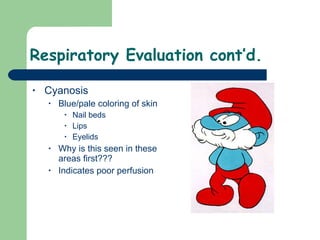
Respiratory Evaluation cont’d. Cyanosis Blue/pale coloring of skin Nail beds Lips Eyelids  Why is this seen in these areas first???  Indicates poor perfusion
Pulse Oximetry “ 5 th  Vital Sign” Normal SpO2 95-100% Sp02 Ranges 91-94% = Mild Hypoxia – Supplemental O2 86-91% = Moderate Hypoxia – Supplemental O2 85%-< = Severe Hypoxia – IMMEDIATE intervention False Readings CO poisoning, high intensity lighting, hemoglobin abnormalities, no pulse in extremity, hypovolemia, severe anemia
Pediatric Considerations Mouth/Nose Smaller and easily obstructed Pharynx Tongue is BIG  Trachea Narrower Softer and more flexible  Cricoid Cartilage Less developed/Less rigid = easily kinked Diaphragm  Chest is soft Depend on diaphragm to do most of the work of breathing Seesaw Breathing….
Accessory Muscle Use Nasal Flaring Retractions
Respiratory Distress “ The pt is able to compensate for the underlying problem and get enough O 2  to maintain mental responsiveness and muscle tone to move air .” Resp. distress can progress to resp. failure  Exhaustion
Respiratory Distress Assessment  Respiratory Distress Work of breathing is increased Maintains LOC Signs/Symptoms  Increased resp rate Accessory muscle use Nasal flaring Tripod position Diff speaking in complete sentences Agitated/Restless  Treatments Maintain clear airway Supplemental O 2 Bronchodilatory drugs
Respiratory Failure “ The pt is not able to maintain mental status, display muscle tone, or move adequate amounts of air to the lungs” Resp. failure can progress to resp. arrest
Respiratory Failure  Assessment Respiratory Failure Inadequate ventilate to support life LOC diminishes  Mechanisms Impaired brain function  Muscle fatigue after respiratory distress Chest wall injury Airway obstruction Sings/Symptoms Low O 2  sat. Sleepiness/weakness Cyanosis Low respiratory rate Little/no chest movement AMS
Respiratory Failure Treatment  Treatment Positive pressure ventilation Err on side of ventilation if in doubt If pt accepts then it’s a sign they need it If a pt fights it it’s a sign they are trying to ventilate
Respiratory Arrest  Respiratory Arrest  Complete cessation of breathing Can progress to cardiac arrest  Treatment Secure patent airway  Positive pressure ventilation
Airway Management It ALL starts with “A”… Goals of airway management Est./maintain patent airway Ensure adequate ventilation Ensure adequate oxygenation Methods of Securing Airways Manual Suctioning Mechanical
Opening the airway Manual techniques  Tongue Attached to lower jaw Obstructs airway in unconscious pt Simple manual techniques can fix this 2 Techniques Head tilt chin lift Jaw Thrust
Opening the airway Head Tilt Chin Lift When to do it… Patients not traumatically injured How to do it… Place index and middle finger of 1 hand under the bony part of pts lower jaw Place other hand on pts forehead Lift the jaw with one hand while tilting the head back with the other
 
Opening the airway Jaw Thrust When to do it… Traumatically injured pts Opens airway without neck extension How to do it… Place hands on either side of pt head Place index and middle fingers beneath the angle of the jaw just below ears Place thumbs on either side of mouth at pt chin Lift jaw up while opening mouth by pushing with your thumbs
 
Securing the airway Suctioning  Purpose Remove blood, food, and other liquids from the airway Inadequate for solid material   Clear airway when ventilating if gurgling is heard
Suctioning Units Types of units Mounted Portable  Electrical  Hand operated
Suction Catheters  Hard/Rigid Yankauer/“Tonsil sucker/Tonsil tip Suction of unresponsive pt Do NOT touch back of pediatric airway Insert only as far as you can see Base of tongue  Soft Suction of nasopharynx Situations when a rigid catheter cannot be used Insert only to base of tongue  Measure from corner of mouth to earlobe
Suctioning How to… Turn unit on Check for 300 mmHg vacuum  Attach catheter Insert into oro/nasopharynx  without  suction on Apply suction  Move catheter from side to side Suction for NO more than 15 seconds   Lesser time for infants If there is a lot of secretions log roll pt and clear 15 sec. suction-ventilate 2 min- 15 sec. suction
Airway Adjuncts  Functions Keeps tongue off posterior oropharynx Types Oropharyngeal Airway (OPA/Oral) Nasopharyngeal Airway (NPA/Nasal)
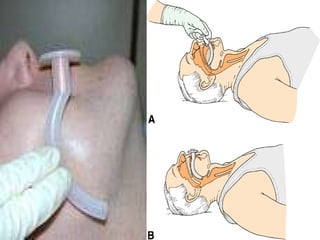
Orophayngeal Airway  Form: Curved plastic device extending from lips to base of tongue When to use it: Unconscious pt without a gag reflex How to use it:  Measure from corner of pt mouth to angle of jaw Open pt mouth Insert OPA upside down (curve pointing to roof of mouth) Insert until slight resistance then invert 180 O  Rest flanges on teeth ALTERNATELY: Use tongue blade and insert curved side down  Pediatric pts
 
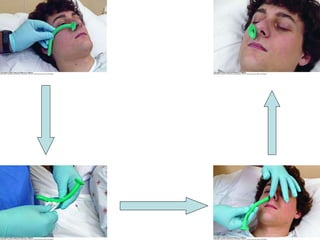
Nasophayngeal Airway Form: Flexible plastic tube beveled on one side that extends from nostril to base of tongue  When to use it: Pt with gag reflex Unable to advance OPA When not to use it: Pt with facial trauma  How to use it: Measure from tip of pt nose to angle of jaw LUBE it… Insert it posteriorly with bevel pointing toward septum  If it doesn’t work in one nostril try the next
 
Ventilating the Airway   Methods of ventilation Mouth-to-Mask Two-person Bag-Valve-Mask Flow restricted, oxygen powered ventilation device One-person Bag-Valve-Mask
Mouth-to-Mouth How to… Open Airway Seal your mouth over the pt Pinch pt nostrils closed Give 2 breaths each over 2 seconds Assess for chest rise Reposition head and reattempt if none How often: 1 breath every 5 seconds= Adult 1 breath every 3 seconds= Child
Mouth-to-Mask Position yourself directly above pt Apply mask to pt  Use bridge of nose as guide Secure mask to pt face using “E-C” technique Provide rescue breaths over 2 seconds Breath-release-release”  Continue at rates previously listed
Ventilating the Airway “E-C” Technique Place thumbs on superior aspect of mask (Half C) Bridge of Nose Place index fingers on inferior aspect of mask (Half C) Chin  Place remaining fingers on the bony ridge of the lower jaw and form and “E” Bring jaw upwards to mask with “E” and push down to seal with “C” Ventilate the pt.
 
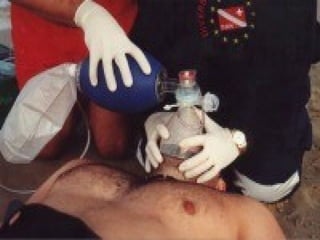
Ventilating the Airway   Bag-Vale-Mask Self Inflating Bag One Way Valve Face Mask O 2  Reservoir  O 2  Tubing
Bag-Vale-Mask Issues: 1600 milliliter volume Less volume than mouth-to-mask Airtight seal is difficult with 1 EMT Position above pt head for ease Use airway adjunct with BVM Anatomy of the BVM Self-refilling bag washable/disposable Non jam valve with O 2  inlet for 15 lpm Absent or disabled pop-off valve Standardized 15/22mm fittings  O 2  inlet and reservoir for high concentration O 2 True non rebreather valve Function in extreme conditions Infant, child, adult sizes
Bag-Vale-Mask How to use it… (Non traumatic) Open airway and select mask size Place thumbs at apex of mask Lower mask over pt face using bridge of nose as a guide Connect BVM if not already Complete E-C Technique Have assistant squeeze bag with 2 hands until chest rise is observed  Ventilate pt 1 ventilation every 5 seconds = Adult 1 ventilation every 3 seconds = Child  “ Squeeze – Release – Release”
 
Bag-Vale-Mask How to use it… (Non traumatic) If alone Proceed as before only moving thumbs from apex of mask to around the ventilator port Continue with E-C technique as usual
 
Bag-Vale-Mask How to use it… (Traumatic) Proceed as before only immobilizing the head with Knees  Manual stabilization by partner  Don’t tilt head back to seal to mask Pull jaw forward with E-C technique
Ventilating the Airway Special Cases  Bag-to-Stoma or Tracheostomy tube Use child/infant bag Place directly over stoma Extension of head is not needed Squeeze bag until chest rise is observed Continue as normal If you cant ventilate: Suction stoma Move to upper airway  Seal off stoma  If pt has tracheostomy: Connect BVM directly to trach tube and ventilate through it Suction may be needed to clear obstructions
 
Flow Restricted, Oxygen Powered Ventilation Device  Flow rate of up to 100% @ 40 lpm Inspiratory pressure relief valve  Opens at 60 cm of water Vents remaining air off Audible alarm that sounds when the valves pressure is exceeded  Trigger that allows both EMT’s hands to be on the mask
Flow Restricted, Oxygen Powered Ventilation Device How to use it (non traumatic) Open airway and insert adjunct Place mask on pt face by E-C technique Connect device to mask if not already Trigger the device until the chest rises How to use is (trauma) Immobilize head Knees Partner Open airway and insert adjunct Place mask on pt face by E-C Technique Proceed as normal without tilting pt head to mask
Adequate Ventilation  Adequate Ventilation Chest rise/fall Lung sounds “ Pinking up” of patient  Sufficient rate Adult -  12 bpm Child – 20 bpm If no chest rise is observed: Reposition head Assess for a leak and correct Assess for obstruction and treat Use another method to ventilate pt Complication Gastric distention
Oxygen… Tanks Atmospheric O 2  concentration  21% O 2  cylinders Color coded Green Various sizes D = 350 Liters  E = 625 Liters M =3,000 Liters G = 5,300 Liters H = 6,900 Liters  D cylinder M cylinder E Cylinder
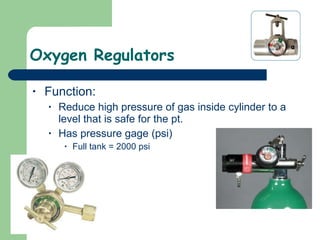
Oxygen Regulators Function: Reduce high pressure of gas inside cylinder to a level that is safe for the pt.  Has pressure gage (psi) Full tank = 2000 psi
Setting up Oxygen How to set your O 2  up Remove protective seal Find plastic “O” ring and place on the cylinder opening/regulator opening Quickly open then shut main valve Blows dust out  Attach regulator to tank Line up pins from the regulator to the holes in the tank Open main valve and check pressure (2000psi) Attach O 2  device and turn regulator to desired setting When complete  Remove device from pt Turn off main valve Bleed pressure out of the regulator
Oxygen Delivery Devices Nasal Cannula 22-24% Oxygen 1-6 Lpm  Simple Face Mask 40-60% Oxygen 8-12 Lpm  Admin no less than 6 Lpm Non Rebreather 80-100% Oxygen, 15 Lpm No less than 8 Lpm Venturi Mask Used for COPD Controlled precise amount of oxygen 24, 28, 35, 40% Oxygen
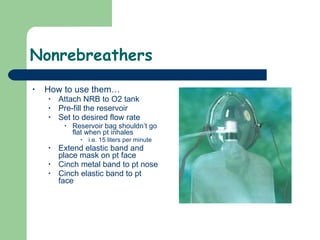
Nonrebreathers How to use them… Attach NRB to O2 tank Pre-fill the reservoir  Set to desired flow rate Reservoir bag shouldn’t go flat when pt inhales  i.e. 15 liters per minute Extend elastic band and place mask on pt face Cinch metal band to pt nose Cinch elastic band to pt face
Oxygen… Nasal Cannula  How to use it… Attach to tank Set on desired flow rate i.e. 6 liters per minute Place prongs in pt nose Curve down Loop tubing around pt ear and under chin Cinch tubing below chin
Cylinder Calculations  Can you make it??? Time(min)=  (Tank Pressure[psi]-200psi)xConstant Flow Rate (L/min)  Constants D cylinder= 0.16   E cylinder= 0.28 M cylinder= 1.56 H cylinder= 3.4 Example You are transporting a patient who is receiving 15L/min of oxygen by NRB. The transport time is 20 min. On your E cylinder, the psi is 1200. Do you have enough oxygen for your patient, of should you prepare to change you settings? Time =(1200psi-200psi)X0.28 15L/min =18 2/3 min = NOT ENOUGH
Special Considerations  Laryngectomies (stomas)  If obstructed =suction If ventilating and air escapes = Close mouth/nose  Facial Injuries Rich blood supply to face Severe bleeding/swelling Challenge to manage Suctioning Obstructions Foreign Body Airway Obstruction Protocols Dental Appliances Leave in place unless they get in the way
Special Considerations Pediatrics Do not hyperextend Neutral/”sniffing” position = Infant  Slightly past neutral position = Child Use only enough pressure to achieve chest rise Gastric distention is common Consider adjuncts if other attempts fail NEVER manipulate the back of a pediatric airway
Special Considerations Breathing Control Voluntary/Involuntary Sensors in brain/brainstem O 2  , CO 2  , acid levels Normal control to breath is high CO 2 When CO 2  increases the brainstem signals to: Increase resp rate Increase depth What if CO 2  chronically builds up???  COPD…
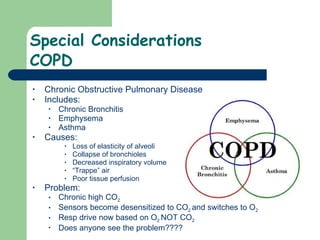
Special Considerations COPD Chronic Obstructive Pulmonary Disease Includes: Chronic Bronchitis Emphysema Asthma  Causes: Loss of elasticity of alveoli Collapse of bronchioles Decreased inspiratory volume “ Trappe” air Poor tissue perfusion Problem: Chronic high CO 2 Sensors become desensitized to CO 2  and switches to O 2 Resp drive now based on O 2  NOT CO 2  Does anyone see the problem????
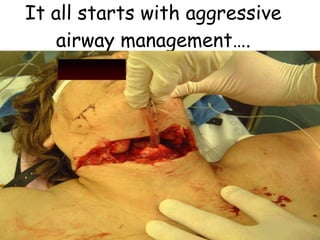
It all starts with aggressive airway management….

8)Airway

  • 1.
    Airway It ALLstarts here…
  • 2.
    Respiratory System Function Gas exchange with outside environment Filtration/Humidification/Warming/Conduction of air Structures Nose Mouth Naso/Oro/Laryngopharynx Larynx Bronchi Bronchioles Lungs Diaphragm Associated muscles Alveoli
  • 3.
    Upper Airway Nose/Mouth Function Filters Warms Moistens
  • 4.
    Upper Airway Pharynx Location Posterior to mouth Superior to esophagus, larynx, trachea Function Conducts air to bronchi 3 Divisions Nasopharynx Oropharynx Laryngopharynx
  • 5.
    Upper Airway Epiglottis Location Sits posterior to larynx Attached to tongue Structure Leaf shaped cartilage Function Prevents food/liquid from entering larynx during swallowing Guards opening to vocal cords (glottis)
  • 6.
    Upper Airway Larynx AKA: “Voice box” Location Inferior to epiglottis Superior to trachea Structure Cartilaginous rings Thyroid Cartilage = “Adam’s Apple” Bulk of anterior wall Cricoid Cartilage Firm rings forming lower aspect/base Function Stops foreign objects that pass epiglottis Laryngospasm Voice production
  • 7.
    Lower Airway Trachea AKA: “Windpipe” Location Inferior to Larynx Anterior to Esophagus Bifurcates into primary bronchi Structure Cartilaginous rings anterior and lateral Approx 15-20 Smooth muscle tissue posterior Trachealis muscle Why????
  • 8.
    Lower Airway Bronchi Location Bifurcation of trachea 2 nd Intercostal space Angle of Louis Right and Left main stem Structure Smooth muscle Irregular hyaline cartilage rings Function Conducts air to lungs
  • 9.
    Lower Airway Bronchioles Location Distal bifurcations of the bronchi Terminate at alveoli Function Conduct air to alveoli Structure 1 st airways with NO cartilage ALL muscle Bronchoconstriction Bronchospasm < 1 mm wide =Tiny
  • 10.
    Lower Airway Alveoli Location Terminal sacs of bronchial tree Distal to bronchioles Particular to mammalian lungs 150 million/lung Structure 1 cell thick Surface are= 75m 2 (Tennis court) Increased SA= Increased 0 2 absorption 0.2-0.3 mm diameter Covered in capillaries (70%) Bathed in surfactant Function Diffusion of gas with capillaries
  • 11.
  • 12.
    Lower Airway Lungs Location Bilateral of midline Structure Divided into lobes Left= 2 Right= 3 Function Houses structure for gas exchange Alteration of pH
  • 13.
    Lower Airway MucociliaryEscalator Location Along epithelium of primary bronchi Beat in rhythm Structure Cilia projections “ Hair like” Function Move debris up out of lungs Cough or swallow Smokers… Prevent mucous accumulation
  • 14.
  • 15.
    Respiratory Physiology Howwe breathe… Ventilation Mechanical movement of air into/out of the body Inhalation ( Active ) Muscles Used Diaphragm & External Intercostals Physiology Diaphragm contracts downward External intercostals pull ribs up and out Increases dimension of chest cavity Increased diameter of chest drops intra thoracic pressure Air rushes in until pressure is equalized
  • 16.
    Respiratory Physiology Howwe breathe… Ventilation Mechanical movement of air into/out of the body Exhalation ( Passive ) Physiology Diaphragm relaxes as well as intercostals Chest cavity dimension decreases Decrease in dimension increases intrathoracic pressure Air rushes out Lungs recoil
  • 17.
  • 18.
    Respiratory Physiology GasExchange Respiration Process by which the body utilizes oxygen Diffusion Net movement of molecules from an area of high concentration to an area of low concentration
  • 19.
  • 20.
    Respiratory Physiology GasExchange Respiration Process by which the body utilizes oxygen Alveolar/Capillary Exchange Physiology O 2 rich air enters alveoli O 2 poor blood in capillaries pass alveoli O 2 diffuses down its concentration gradient into the capillaries CO 2 diffuses down its concentration gradient into the alveoli CO 2 is exhaled and O 2 transported to tissues
  • 21.
    Respiratory Physiology GasExchange Respiration Process by which the body utilizes oxygen Capillary/Cellular Exchange Physiology O 2 rich blood passes cells O 2 diffuses across its concentration gradient into the cells CO 2 diffuses across its concentration gradient into the capillary CO 2 is transported to the alveoli
  • 22.
    Respiratory Evaluation Areasof assessment Rate. Rhythm. Depth. Quality. Rate Adult = 12-20 per minute Child = 15-30 per minute Infant = 30-60 per minute Rhythm Regular or irregular Depth Tidal volume adequate or inadequate Amount of air breathed in/out in one ventilation Approx 500 mL
  • 23.
    Respiratory Evaluation cont’d.Quality Breath sounds Present or diminished or absent Chest expansion Unequal or symmetrical Increased effort Accessory muscles “ Seesaw” breathing Infants Nasal flaring Retractions Above clavicles, between ribs Cyanosis Shortness of breath Altered mental status
  • 24.
    Accessory Muscle UseNasal Flaring Retractions
  • 25.
    Respiratory Evaluation cont’d.Cyanosis Blue/pale coloring of skin Nail beds Lips Eyelids Why is this seen in these areas first??? Indicates poor perfusion
  • 26.
    Pulse Oximetry “5 th Vital Sign” Normal SpO2 95-100% Sp02 Ranges 91-94% = Mild Hypoxia – Supplemental O2 86-91% = Moderate Hypoxia – Supplemental O2 85%-< = Severe Hypoxia – IMMEDIATE intervention False Readings CO poisoning, high intensity lighting, hemoglobin abnormalities, no pulse in extremity, hypovolemia, severe anemia
  • 27.
    Pediatric Considerations Mouth/NoseSmaller and easily obstructed Pharynx Tongue is BIG Trachea Narrower Softer and more flexible Cricoid Cartilage Less developed/Less rigid = easily kinked Diaphragm Chest is soft Depend on diaphragm to do most of the work of breathing Seesaw Breathing….
  • 28.
    Accessory Muscle UseNasal Flaring Retractions
  • 29.
    Respiratory Distress “The pt is able to compensate for the underlying problem and get enough O 2 to maintain mental responsiveness and muscle tone to move air .” Resp. distress can progress to resp. failure Exhaustion
  • 30.
    Respiratory Distress Assessment Respiratory Distress Work of breathing is increased Maintains LOC Signs/Symptoms Increased resp rate Accessory muscle use Nasal flaring Tripod position Diff speaking in complete sentences Agitated/Restless Treatments Maintain clear airway Supplemental O 2 Bronchodilatory drugs
  • 31.
    Respiratory Failure “The pt is not able to maintain mental status, display muscle tone, or move adequate amounts of air to the lungs” Resp. failure can progress to resp. arrest
  • 32.
    Respiratory Failure Assessment Respiratory Failure Inadequate ventilate to support life LOC diminishes Mechanisms Impaired brain function Muscle fatigue after respiratory distress Chest wall injury Airway obstruction Sings/Symptoms Low O 2 sat. Sleepiness/weakness Cyanosis Low respiratory rate Little/no chest movement AMS
  • 33.
    Respiratory Failure Treatment Treatment Positive pressure ventilation Err on side of ventilation if in doubt If pt accepts then it’s a sign they need it If a pt fights it it’s a sign they are trying to ventilate
  • 34.
    Respiratory Arrest Respiratory Arrest Complete cessation of breathing Can progress to cardiac arrest Treatment Secure patent airway Positive pressure ventilation
  • 35.
    Airway Management ItALL starts with “A”… Goals of airway management Est./maintain patent airway Ensure adequate ventilation Ensure adequate oxygenation Methods of Securing Airways Manual Suctioning Mechanical
  • 36.
    Opening the airwayManual techniques Tongue Attached to lower jaw Obstructs airway in unconscious pt Simple manual techniques can fix this 2 Techniques Head tilt chin lift Jaw Thrust
  • 37.
    Opening the airwayHead Tilt Chin Lift When to do it… Patients not traumatically injured How to do it… Place index and middle finger of 1 hand under the bony part of pts lower jaw Place other hand on pts forehead Lift the jaw with one hand while tilting the head back with the other
  • 38.
  • 39.
    Opening the airwayJaw Thrust When to do it… Traumatically injured pts Opens airway without neck extension How to do it… Place hands on either side of pt head Place index and middle fingers beneath the angle of the jaw just below ears Place thumbs on either side of mouth at pt chin Lift jaw up while opening mouth by pushing with your thumbs
  • 40.
  • 41.
    Securing the airwaySuctioning Purpose Remove blood, food, and other liquids from the airway Inadequate for solid material Clear airway when ventilating if gurgling is heard
  • 42.
    Suctioning Units Typesof units Mounted Portable Electrical Hand operated
  • 43.
    Suction Catheters Hard/Rigid Yankauer/“Tonsil sucker/Tonsil tip Suction of unresponsive pt Do NOT touch back of pediatric airway Insert only as far as you can see Base of tongue Soft Suction of nasopharynx Situations when a rigid catheter cannot be used Insert only to base of tongue Measure from corner of mouth to earlobe
  • 44.
    Suctioning How to…Turn unit on Check for 300 mmHg vacuum Attach catheter Insert into oro/nasopharynx without suction on Apply suction Move catheter from side to side Suction for NO more than 15 seconds Lesser time for infants If there is a lot of secretions log roll pt and clear 15 sec. suction-ventilate 2 min- 15 sec. suction
  • 45.
    Airway Adjuncts Functions Keeps tongue off posterior oropharynx Types Oropharyngeal Airway (OPA/Oral) Nasopharyngeal Airway (NPA/Nasal)
  • 46.
    Orophayngeal Airway Form: Curved plastic device extending from lips to base of tongue When to use it: Unconscious pt without a gag reflex How to use it: Measure from corner of pt mouth to angle of jaw Open pt mouth Insert OPA upside down (curve pointing to roof of mouth) Insert until slight resistance then invert 180 O Rest flanges on teeth ALTERNATELY: Use tongue blade and insert curved side down Pediatric pts
  • 47.
  • 48.
    Nasophayngeal Airway Form:Flexible plastic tube beveled on one side that extends from nostril to base of tongue When to use it: Pt with gag reflex Unable to advance OPA When not to use it: Pt with facial trauma How to use it: Measure from tip of pt nose to angle of jaw LUBE it… Insert it posteriorly with bevel pointing toward septum If it doesn’t work in one nostril try the next
  • 49.
  • 50.
    Ventilating the Airway Methods of ventilation Mouth-to-Mask Two-person Bag-Valve-Mask Flow restricted, oxygen powered ventilation device One-person Bag-Valve-Mask
  • 51.
    Mouth-to-Mouth How to…Open Airway Seal your mouth over the pt Pinch pt nostrils closed Give 2 breaths each over 2 seconds Assess for chest rise Reposition head and reattempt if none How often: 1 breath every 5 seconds= Adult 1 breath every 3 seconds= Child
  • 52.
    Mouth-to-Mask Position yourselfdirectly above pt Apply mask to pt Use bridge of nose as guide Secure mask to pt face using “E-C” technique Provide rescue breaths over 2 seconds Breath-release-release” Continue at rates previously listed
  • 53.
    Ventilating the Airway“E-C” Technique Place thumbs on superior aspect of mask (Half C) Bridge of Nose Place index fingers on inferior aspect of mask (Half C) Chin Place remaining fingers on the bony ridge of the lower jaw and form and “E” Bring jaw upwards to mask with “E” and push down to seal with “C” Ventilate the pt.
  • 54.
  • 55.
    Ventilating the Airway Bag-Vale-Mask Self Inflating Bag One Way Valve Face Mask O 2 Reservoir O 2 Tubing
  • 56.
    Bag-Vale-Mask Issues: 1600milliliter volume Less volume than mouth-to-mask Airtight seal is difficult with 1 EMT Position above pt head for ease Use airway adjunct with BVM Anatomy of the BVM Self-refilling bag washable/disposable Non jam valve with O 2 inlet for 15 lpm Absent or disabled pop-off valve Standardized 15/22mm fittings O 2 inlet and reservoir for high concentration O 2 True non rebreather valve Function in extreme conditions Infant, child, adult sizes
  • 57.
    Bag-Vale-Mask How touse it… (Non traumatic) Open airway and select mask size Place thumbs at apex of mask Lower mask over pt face using bridge of nose as a guide Connect BVM if not already Complete E-C Technique Have assistant squeeze bag with 2 hands until chest rise is observed Ventilate pt 1 ventilation every 5 seconds = Adult 1 ventilation every 3 seconds = Child “ Squeeze – Release – Release”
  • 58.
  • 59.
    Bag-Vale-Mask How touse it… (Non traumatic) If alone Proceed as before only moving thumbs from apex of mask to around the ventilator port Continue with E-C technique as usual
  • 60.
  • 61.
    Bag-Vale-Mask How touse it… (Traumatic) Proceed as before only immobilizing the head with Knees Manual stabilization by partner Don’t tilt head back to seal to mask Pull jaw forward with E-C technique
  • 62.
    Ventilating the AirwaySpecial Cases Bag-to-Stoma or Tracheostomy tube Use child/infant bag Place directly over stoma Extension of head is not needed Squeeze bag until chest rise is observed Continue as normal If you cant ventilate: Suction stoma Move to upper airway Seal off stoma If pt has tracheostomy: Connect BVM directly to trach tube and ventilate through it Suction may be needed to clear obstructions
  • 63.
  • 64.
    Flow Restricted, OxygenPowered Ventilation Device Flow rate of up to 100% @ 40 lpm Inspiratory pressure relief valve Opens at 60 cm of water Vents remaining air off Audible alarm that sounds when the valves pressure is exceeded Trigger that allows both EMT’s hands to be on the mask
  • 65.
    Flow Restricted, OxygenPowered Ventilation Device How to use it (non traumatic) Open airway and insert adjunct Place mask on pt face by E-C technique Connect device to mask if not already Trigger the device until the chest rises How to use is (trauma) Immobilize head Knees Partner Open airway and insert adjunct Place mask on pt face by E-C Technique Proceed as normal without tilting pt head to mask
  • 66.
    Adequate Ventilation Adequate Ventilation Chest rise/fall Lung sounds “ Pinking up” of patient Sufficient rate Adult - 12 bpm Child – 20 bpm If no chest rise is observed: Reposition head Assess for a leak and correct Assess for obstruction and treat Use another method to ventilate pt Complication Gastric distention
  • 67.
    Oxygen… Tanks AtmosphericO 2 concentration 21% O 2 cylinders Color coded Green Various sizes D = 350 Liters E = 625 Liters M =3,000 Liters G = 5,300 Liters H = 6,900 Liters D cylinder M cylinder E Cylinder
  • 68.
    Oxygen Regulators Function:Reduce high pressure of gas inside cylinder to a level that is safe for the pt. Has pressure gage (psi) Full tank = 2000 psi
  • 69.
    Setting up OxygenHow to set your O 2 up Remove protective seal Find plastic “O” ring and place on the cylinder opening/regulator opening Quickly open then shut main valve Blows dust out Attach regulator to tank Line up pins from the regulator to the holes in the tank Open main valve and check pressure (2000psi) Attach O 2 device and turn regulator to desired setting When complete Remove device from pt Turn off main valve Bleed pressure out of the regulator
  • 70.
    Oxygen Delivery DevicesNasal Cannula 22-24% Oxygen 1-6 Lpm Simple Face Mask 40-60% Oxygen 8-12 Lpm Admin no less than 6 Lpm Non Rebreather 80-100% Oxygen, 15 Lpm No less than 8 Lpm Venturi Mask Used for COPD Controlled precise amount of oxygen 24, 28, 35, 40% Oxygen
  • 71.
    Nonrebreathers How touse them… Attach NRB to O2 tank Pre-fill the reservoir Set to desired flow rate Reservoir bag shouldn’t go flat when pt inhales i.e. 15 liters per minute Extend elastic band and place mask on pt face Cinch metal band to pt nose Cinch elastic band to pt face
  • 72.
    Oxygen… Nasal Cannula How to use it… Attach to tank Set on desired flow rate i.e. 6 liters per minute Place prongs in pt nose Curve down Loop tubing around pt ear and under chin Cinch tubing below chin
  • 73.
    Cylinder Calculations Can you make it??? Time(min)= (Tank Pressure[psi]-200psi)xConstant Flow Rate (L/min) Constants D cylinder= 0.16 E cylinder= 0.28 M cylinder= 1.56 H cylinder= 3.4 Example You are transporting a patient who is receiving 15L/min of oxygen by NRB. The transport time is 20 min. On your E cylinder, the psi is 1200. Do you have enough oxygen for your patient, of should you prepare to change you settings? Time =(1200psi-200psi)X0.28 15L/min =18 2/3 min = NOT ENOUGH
  • 74.
    Special Considerations Laryngectomies (stomas) If obstructed =suction If ventilating and air escapes = Close mouth/nose Facial Injuries Rich blood supply to face Severe bleeding/swelling Challenge to manage Suctioning Obstructions Foreign Body Airway Obstruction Protocols Dental Appliances Leave in place unless they get in the way
  • 75.
    Special Considerations PediatricsDo not hyperextend Neutral/”sniffing” position = Infant Slightly past neutral position = Child Use only enough pressure to achieve chest rise Gastric distention is common Consider adjuncts if other attempts fail NEVER manipulate the back of a pediatric airway
  • 76.
    Special Considerations BreathingControl Voluntary/Involuntary Sensors in brain/brainstem O 2 , CO 2 , acid levels Normal control to breath is high CO 2 When CO 2 increases the brainstem signals to: Increase resp rate Increase depth What if CO 2 chronically builds up??? COPD…
  • 77.
    Special Considerations COPDChronic Obstructive Pulmonary Disease Includes: Chronic Bronchitis Emphysema Asthma Causes: Loss of elasticity of alveoli Collapse of bronchioles Decreased inspiratory volume “ Trappe” air Poor tissue perfusion Problem: Chronic high CO 2 Sensors become desensitized to CO 2 and switches to O 2 Resp drive now based on O 2 NOT CO 2 Does anyone see the problem????
  • 78.
    It all startswith aggressive airway management….